Category: News & Fair Start Headlines

  • Orgs Are Speaking Out on Smaller Families, and It’s Having an Impact

    Orgs Are Speaking Out on Smaller Families, and It’s Having an Impact

    Kudos to Fair Start Movement coalition member, Population Matters for bringing attention to the topic of sustainable families. The group awarded $695 to Prince Harry and Meghan Markle to be gifted to the charity of their choice, for making the decision to limit their family to two kids. The award, which is garnering headlines and serving to break the taboo, was timed to coincide with the U.N.’s World Population Day.

    Prince Harry revealed the couple’s plans to limit their family size due to environmental concerns back in 2019. Earlier that year we wrote to Megan as well, urging the couple to serve as role models and incorporate sustainability into family planning. It took courage for them to make that statement and it likely would not have happened without the great teamwork and encouragement from Population Matters and Jane Goodall. 

    Despite the endless supply of alarmist stories about declining birthrates, cultural perspectives are beginning to shift and recognize the numerous social and emotional benefits of choosing to have only one or two kids. Choosing a smaller family is also the most effective way to reduce climate impact. 

    The environmental impact of smaller families:

    It’s time for more environmental organizations to inspire eco-conscious parents to choose to have smaller families to reduce human impact on animals and the planet.

    Take Action: Share this headline with your favorite animal and environmental organizations, and urge them to follow suit in promoting more sustainable families. 

    Tweet:

    • Carter Roberts, @Carter_Roberts, president and CEO of the World Wildlife Fund
    • Annie Leonard, @AnnieMLeonard, executive director of Greenpeace USA
    • Michael Brune, @bruneski, executive director of the Sierra Club
    and ask them to take a stand on the most effective way to protect our future: policies that promote sustainable and equitable family planning.

  • Our Real Impact on Animals: Incalculable. Until now.

    Our Real Impact on Animals: Incalculable. Until now.

    Human population growth is the greatest threat to animals across the globe. For World Population Day, we’re launching a campaign around our interactive Animal Mortality Calculator designed to show individuals and policymakers how human population matters to animals.

    Created alongside experts, our model will use existing interdisciplinary data to measure direct human impact (in animals raised for meat, milk, and other products) and indirect impacts (including habitat  loss, traffic-related mortality, and native carnivores killed to protect livestock) on animal life.

    Though several publicly accessible animal “impact” resources and calculators exist, none helps  individuals easily assess the impact of their family planning decisions on nonhuman life. Our science-based calculator will influence individuals and lawmakers by helping individuals conceptualize the impact of their family planning choices while educating the animal protection movement about the need to include growth policy in our campaigning to reduce animal  suffering and death. The upshot is helping to build a sustainable world for animals and future humans.
    Can you help us reveal the truth about the greatest threat to wild and domestic animals worldwide and fund our Animal Mortality Calculator today?
    Donate
  • World Population Day: Young Women, Sustainable Families, and Our Right to Take the Wealth Our Kids Deserve

    World Population Day: Young Women, Sustainable Families, and Our Right to Take the Wealth Our Kids Deserve

    The climate and nature crises that our planet faces are rooted in both population and consumption.  We cannot waste precious time by pointing fingers between consumption and population – we need to talk about both in tandem, as our survival and quality of life, and those of our children, depend on it. 

    On the heels of Independence Day demands from people like Cassie King for the resources all kids deserve to ensure their eco-social Fair Start in life, and others who see their future child’s entitlement to birth equity as a sustainable family planning incentive, dozens of young women have come forward to speak out for more sustainable families. It’s a message for every young person’s future on planet earth.

    On World Population Day, July 11, 2021, GirlPlanet.Earth will launch as an informal forum for global dialogue by women and teenage girls from around the world on population, consumption, planetary boundaries, and personal choices.  Featuring the voices of women from Africa, Europe, North America, Central America, and Asia, GirlPlanet.Earth will enable honest, authentic, lively conversations between women and girls about our future.

    A group of students sit at desks in a classroom, attentively listening and taking notes. The focus is on a girl in a plaid shirt, resting her chin on her hand and looking forward thoughtfully.
    Courtesy of the Urban Institute.

    Join the conversation.

    In addition to young voices pushing back on unsustainable population growth, this Sunday – World Population Day – key experts will make clear the pathway to an optimal world population, at this special event.

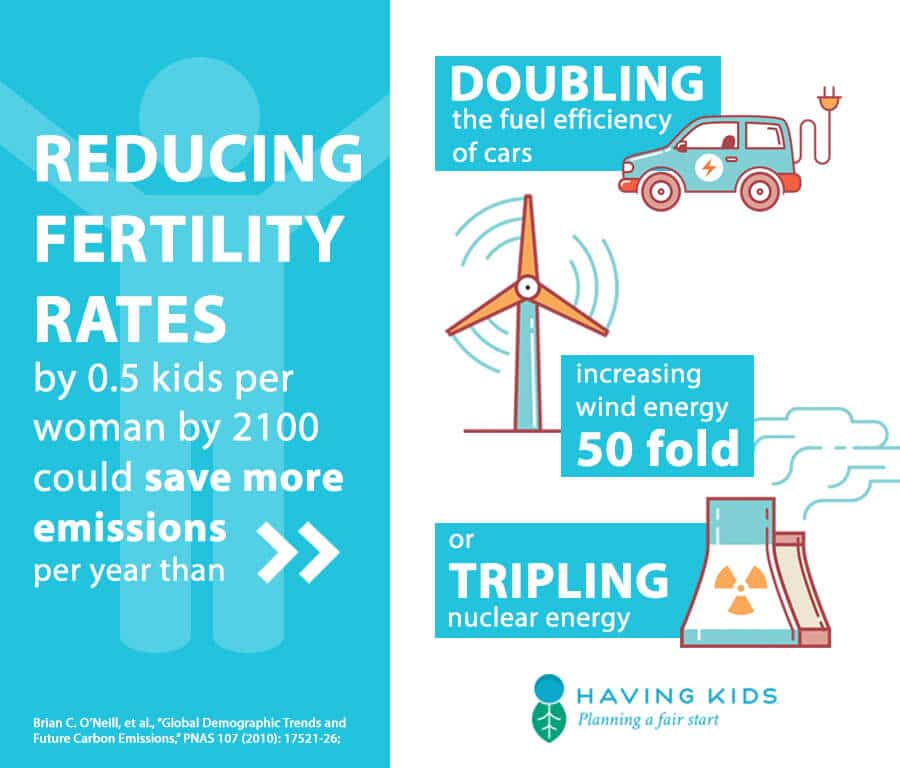
    Having one fewer child actually reduces your carbon footprint more than any other single move you can make. We owe it to future generations to ignore advertiser-bound media pushing women to have kids to grow their economies. Instead, those intending to have small and sustainable families should approach concentrations of power for the wealth – and birth equity – their child has a fundamental right to under the Children’s Rights Convention and other human rights instruments.

    Infographic showing ways to reduce carbon emissions: reducing fertility rates, doubling car fuel efficiency, increasing wind energy 50-fold, and tripling nuclear energy. Includes icons of a car, windmill, and nuclear symbol.

    This is the time to restart the conversation about family sizes, resources, population, personal choice, climate change and the future of our planet. The science is clear – we get the best outcomes, for everyone, when families plan for and invest more love, time, and attention in each child. 

    Stabilizing our human population, even through the most fundamental educational and economic advancement of women, has been taboo for too long.  Humanity has made terrible mistakes through coercive practices and policies, and stabilizing our population needs to be instead profoundly rooted in improved justice, education, and economic opportunity, especially for women and girls.  


  • Relative Freedom From the Power of Others As a Baseline to Assess Cost

    Relative Freedom From the Power of Others As a Baseline to Assess Cost

    How do we know what counts as a cost or benefit in a particular transaction? Enter the idea of normative baselines, or the theoretical states of affairs by which we can answer the question.

    But is there an antecedent question nesting in the above-linked list of possible states of affairs we might use, from human rights to process-based positive law? From what justifiable social organization, of free and equal people, are we orienting when we assess the states of affairs? Perhaps we first have to be, existentially, a group of self-determining people capable of democratically deciding what’s a cost and what’s a benefit?

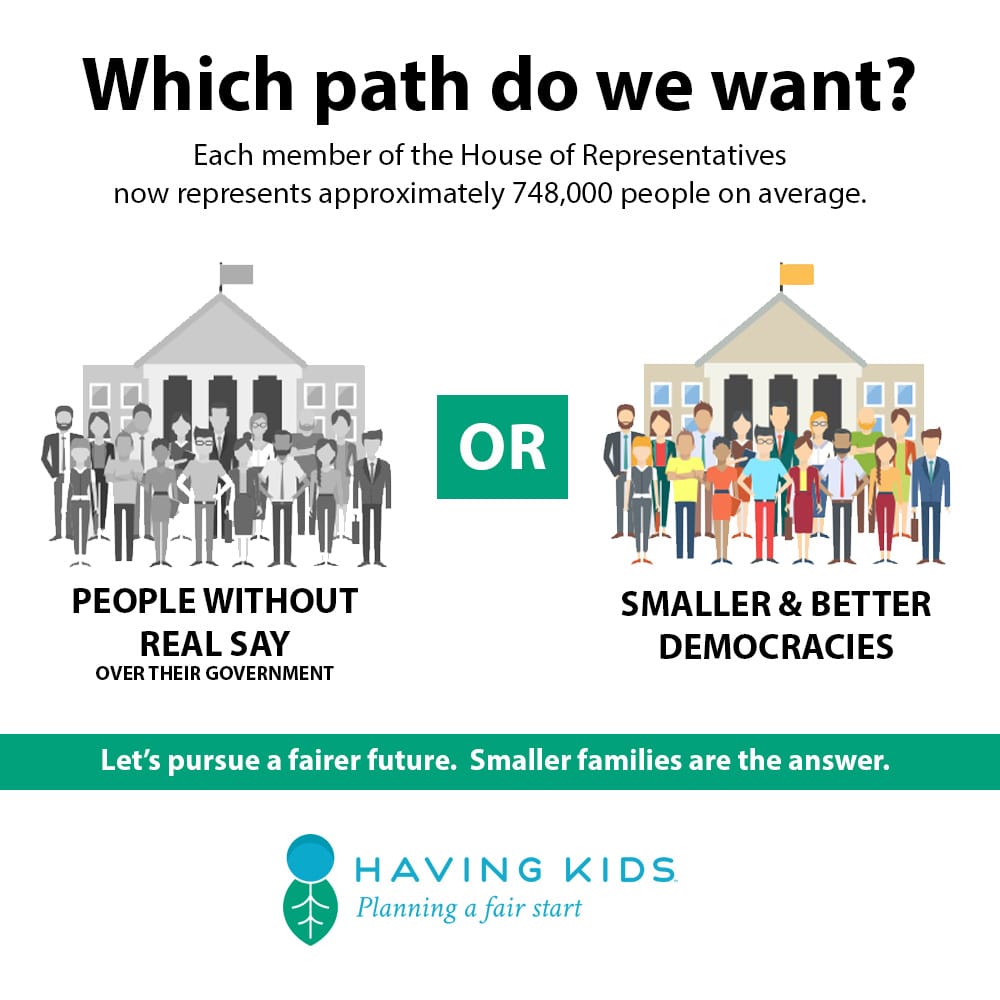
    An infographic compares two options: on the left, gray figures under “People without real say over their government,” and on the right, colorful families with “Smaller & better democracies.” Text promotes smaller families for fairer representation.

    We can think of this in another way. John Rawls is famous for articulating the basic framework of a just and free society. But what rule precedes the existence of the actual people who will eventually comprise Rawlsian systems? Is the rule that determines their creation the first issue that must be decided? How will the quantity of persons, the civic qualities of its members, and their initial relative positioning to their ecology and each other – the conditions of their early development – be determined? What creates the first relations of these people, whom Rawls wished to assure would be free and equal? How, in accounting for those relations, do we account for the dynamic or intergenerational nature of such a group, i.e. that they would die, and others would replace them?

    As a new peer-reviewed article on fair start family planning argues, the most basic criteria for assessing costs and benefits has to be the ideal creation (or procreation) norm, or the norm that first creates the people – and their relations, power differentials, relation to their ecology, etc. – who are making the assessment. Moreover, as the article argues, using such initial criteria to assess what counts as a cost or benefit is actually practicable, given what we know about intergenerational justice, optimal world population ranges, and the need for very specific policies, like education, to ensure relative self-determination or what we commonly call freedom. This differs from the intergenerational justice work of Rawls and others who have asked what we owe, or what we might save for, future generations. Here the question is whether the dynamic “we” – any grouping of people from which we might consider these questions – is a justifiable group of people, in terms of the assuring each member the correct relative degree of self-determination. That difference matters, because the latter approach – or Fair Start reforms – trigger the override of competing norms, very specific criteria for behavior change, and other implications. They would fulfill what might have been the Rawlsian answer to the background question – we must create people in a way that makes them free and equal.

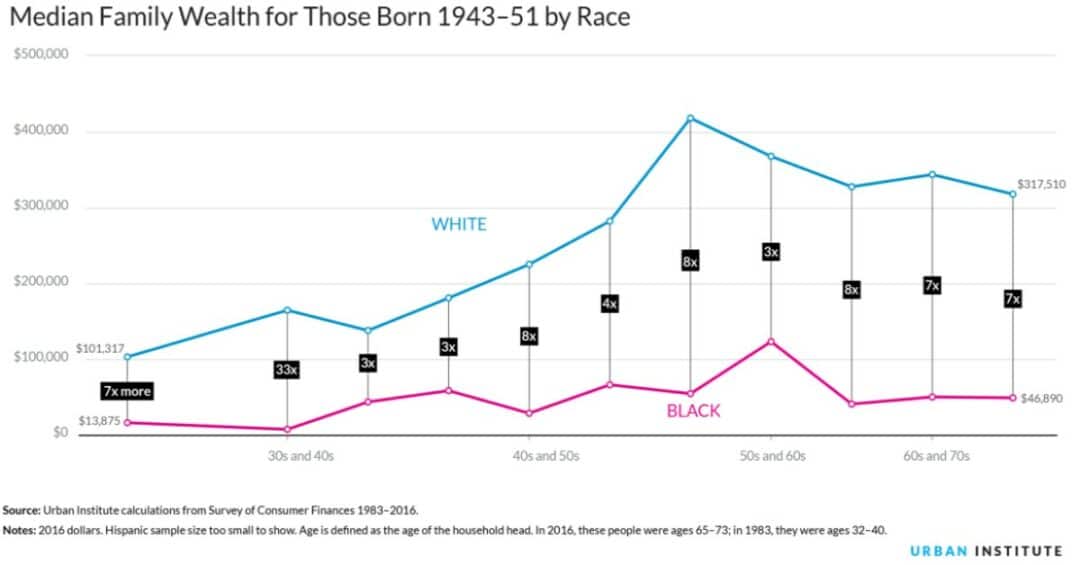
    A line graph compares median family wealth by age for White and Black Americans born 1943–51. White wealth is consistently much higher, peaking at $317,500 in their 60s, while Black wealth peaks at $54,800.

    As part of revisiting the baseline issue for policy reforms, Fair Start is working with IAMECON on the development of further research, specifically around the role of the nonhuman world as an ideal in ecological restoration. Per a lead on the project:

    “In this [forthcoming] paper, we study the relationship between human actions and the wilderness using a static game theoretical framework, and determine the parameter space that manages the gap between the payoff functions required for sustainable action vs payoff functions that leads to unsustainable actions observed in the last two centuries. When agents are not impacted at all from the harm wilderness suffers (as a result of human actions), i.e. zero empathy for the wilderness case, lack of environmental awareness, we find that unsustainable actions are always a dominant strategy for all individuals. When agents are somewhat impacted by the harm the wilderness suffers, i.e. flexible awareness case, we find that the benefit an individual gets from her unsustainable actions should be outweighed by the pressure to conform (to society) plus the negative consequences of the harm wilderness suffers on the individual herself, in order to arrive uniformly sustainable action as nash equilibrium.”

    Fair Start and other more comprehensive baseline approaches can be practiced by targeting concentrations of power, and redistributing their resources to future generations through a “constituting” discourse that limits and decentralizes human power via the simple recognition that every child’s right to a fair start in life, ecologically and socially, overrides the post hoc property rights and entitlements issued by governments whose legitimacy stems from fair and intergenerational social contracting.

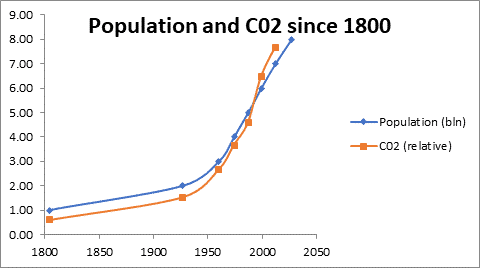
    Line graph showing global population (in billions) and CO2 (relative) from 1800 to 2050. Both lines rise slowly at first, then sharply increase around 1950, with population slightly above CO2 in recent decades.

    Under such an assessment for redistribution of resources and the power that comes with them, we can start by measuring the impact of the climate crisis on maternal, fetal, and neonatal health as a cost relative to a normative state of affairs in which such children would be free from the impacts, or relatively self-determining, rather than having their lives determined by those industries most responsible for the crisis. We can extend the analysis beyond the impact on ecological birth conditions to also assess how those industries benefited from a pronatal and economic growth-based family planning/creation norm that required no minimum levels of wellbeing, economic equality, or an empowering role on one’s democracy, for the children born and thereby impacted, as well as the harms to the parents of the children.

    This is one way to fundamentally assess costs and benefits, by orienting from the most basic notion of a justifiable, or relatively self-determining, social organization constantly recreated through Fair Start family planning.

    What is the upshot of all of this? If Fair Start is the first and overriding human right we have the right to implement it, over all other obligations – like property rights – by all means effective.

    Here is one way to start that process, a discourse, and following that many ways to actualize Fair Start, legally, institutionally, and culturally.

  • The Fundamental Justice Mistake We Must Correct

    The Fundamental Justice Mistake We Must Correct

    In the middle of the twentieth century world leaders misinterpreted the right to have children under Article 16 of the Universal Declaration of Human Rights to ensure a particular level of continued population growth to grow their base, to reinforce power structures, and to evade collective obligations to invest more in kids. Their family planning systems ignored the physical borders of human power and were designed as preconstitutional or illegitimate, to create lots of economic inputs for shopping malls, not politically empowered citizens with influential voices for town halls. The systems isolated parents, and required no minimum level of welfare at birth or the development of prosocial behavior in children, in violation of the Children’s Rights Convention, no level playing field between rich and poor kids, and no environmental sustainability. Public interest mostly groups went along with this plan.  

    That move fundamentally created the ecosocial crises we face today, including the climate crisis, massive inequality, horrific child abuse and neglect, and failing democracies where the average voice does not matter. It also reinforced a fallacy, the constitutive fallacy, that we can abstractly derive just systems without going upstream, to the norms that account for the first creation of social relations. In doing so it gutted the possibility of consensual governance, or freedom from the power of others (or most accurately, relative self-determination).

    Several childrens hands placed together in a supportive gesture over a wooden surface, with text reading, The most powerful social justice is a fair start in life. Join the coalition. Logo and Having Kids appear at the bottom.

    The Fair Start movement was designed to correct that mistake, and promote child-focused and ecosocial Fair Start family planning centered around parental readiness, collective planning to ensure birth equity and a level playing field for all kids, and a universal ethic of more sustainable families. That is the correct interpretation of Article 16.

    Fair Start is the first and overriding human right – the one on which all other rights depend – and it is the genesis of freedom. We can achieve a just transition towards by incentivizing better family planning though taking the resources from the concentrations of power that created and benefited from the crises we face today. Why? Because we first physically constitute just communities by limiting and decentralizing power, and future children have a right to those resources. That – a just claim to family planning incentives as future child entitlements – is the key to qualitative optimal world populations / democratic communities.

    A comparison chart contrasts “Current Family Planning” with “Fair Start Family Planning,” highlighting differences in welfare, opportunity, and environmental protection for children, using bolded text and underlining for emphasis.

    Fulfilling that claim means liberating the most numerous and vulnerable entities in the moral universe – those that will live in the future. Nothing has a greater impact in comprehensively maximizing social justice, and ensuring the transition involves a struggle between free people who promote Fair Start and fundamental justice, and preconstitutional people, or precons, who do not. We can tell the difference between the two by simply asking a few questions.

  • A True Independence Day? Watch Fair Start in Action

    A True Independence Day? Watch Fair Start in Action

    While a lot of people celebrate the Fourth of July with fireworks and beer, some are asking what it truly means to be free, and how to create a world that ensures that freedom for all with equal opportunity, a meaningful role in more effective and participatory democracies, and the freedom from others – and the climate crisis – that we find in nature or the nonhuman world. That sort of freedom is what human rights and consensual governance looks like, and we get there by ensuring an equitable start in life for everyone. Fair Start family planning creates an actual social contract that works, and nothing has a greater impact on the crises we face today.

    Enter Cassie King and Matt Webber. Cassie and Matt are exemplifying what it would mean to constitute communities that are actually free, in part by compensating future generations for the harm we have caused them through the climate, inequity and other ecosocial crises.

    Cassie, an activist and nonprofit professional said this about family planning:

    Current corrupt concentrations of power push a growth model that promotes unsustainable family planning policies. They see us ordinary people as economic inputs in their machine, to use for our reproductive and other labor. It’s our job to fight that narrative and elevate the worth of every individual to have their basic needs met, on day one. My partner and I hope to adopt children one day and I feel the urgency to ensure that my future child, and all children, have the resources and opportunities that are their right.

    Matt, a donor to the Fair Start Movement, said this:

    I support the Fair Start Movement because I know that any claims I have to property and wealth are subject to ensuring every child a fair and equitable start in life, the first and overriding human right. I’m willing to step forward, as a donor, and say that. I challenge others to do the same.

    Together, they are exemplifying a real new deal, one that fixes the fundamental source of the biggest problems in the world today, and leads to a comprehensively liberated state of affairs. It’s not about population. It’s about people, the vast majority of people, who will exist in the future. It’s about putting their interests first. And if it takes a village to raise a child, it takes a village to plan for a child.

    Government derives from the people which derive from their creation. A just creation norm thus precedes and overrides everything else, including the government assigned property rights that have created massive power differentials between rich and poor. Free people will further this truth; precons, or those opposed to just and free communities, will oppose it. Cassie and Matt are engaging in the discourse of decolonization, of physically constituting justifiable and consensual communities of free and equal people. Cassie and Matt are exemplifying what it means to change power structures, and demand justice, at the most fundamental level. They are echoing the spirit of people fighting for freedom in the Ninth Circuit Court of Appeals, in a suit that treats the government’s failure to respond to the climate crisis as a grave violation of our right to be free in nature from the power of others.

    Forget the idea that the borders of human power are lines on a globe. Cassie and Matt are living the truth: The borders of human power that really matter are the conditions in which we are born, and the nexus of our communities with the nonhuman world. Those are the borders where our most basic values align. We were not constituted by god-like founders and ancient constitutions from the past. To constitute just societies means to limit and decentralize human power, first and foremost through the actual constituents – the “We the people.” In other words, we constitute just communities through Fair Start family planning – changing our polities/economies into legalities, and Cassie and Matt are leading the way.

    We maximize autonomy by doing equity upfront – birth equity, in the fullest sense of the concept, including one’s share of democratic rulemaking authority. We don’t maximize it by continuing to pretend the inherently interpersonal act of creating children is an act of autonomy, and then chasing equity through invasive and ineffective measures downstream and later in life.

    We can spread this modeling, and this simple discourse: “Part of your wealth is my and my future child’s family planning entitlement and incentive.”

    The rich and powerful hold their privileged positions because of a racist, colonizing and ecocidal family planning model that exploited future generations and the nonhuman world to create wealth for a small group of people. These people hold their power over others because men with guns are there to defend it – not because it is just. Fair Start is our justified demand to limit and decentralize that power using a zero baseline baseline for distribution, in favor of democratically empowering future generations.

    TAKE ACTION:

    Speak truth to power. Help us approach and engage these five people who together well represent concentrations of public and private power, and the intergenerational injustice that created it.

    Ivanka Trump – daughter of Donald Trump. Contact her and her followers here.

    Hunter Biden – son of Joe Biden. Contact him here. Contact him via his spouse, here.

    Mr. Pedro G. de Oliveira Guterres – son of United Nations Secretary General Antonio Guterres. Contact him here.

    John T. Raymond – son of oil magnate Lee Raymond. Contact him here.

    Elon Musk, who is a perfect example of our unjust family planning system and someone who also continues to promote it as a means of enriching himself. Contact him via his partner Grimes.

    These people hold privileged positions, in derogation of true democracy. They are uniquely situated to promote Fair Start as the best means to compensate future generations for the harms we have caused them. They can lead by example, like Cassie and Matt, and in being willing to support birth equity can show how to put people over property. We have a right to the resources at the top (including the platforms of influence privileged people have to communicate) to further Fair Start – the first and overriding human right.

    If Matt and Cassie can work to change the paradigm away from the isolationist family planning model that helped create the ecosocial crises we face today, so can these five high influencers.

    Join us in urging them to do so.

  • Fair Start Coalitions Are Growing. Join the Movement

    Fair Start Coalitions Are Growing. Join the Movement

    Do you support the simple ideas that 1) parents should be ready before they have kids, 2) that we have a right to distribute resources to give all kids an eco-social Fair Start in life, and that 3) a universal ethic of sustainable families for all is the best way to restore nature? Peer-reviewed research shows that prioritizing these elements in policy has ten to twenty times the positive impact on climate and other crises, relative to most other changes we can make.

    Dozens of groups from the child protection, animal welfare, environmental protection, human rights and democracy sectors are joining various coalitions that further some version of the Fair Start core suite of ideals. Groups like WildEarth Guardians, World Population Balance, ProVeg International, Brighter Green, Population Matters, and Seeding Sovereignty are working on campaigns – from leaning on Joe Biden to issue a declaration of climate emergency based on a -300ppm standard, to supporting litigation in the United States that requires ecocentric (300 ppm or less) solutions to the climate crisis as a constitutional right. These campaigns each help further every child’s fundamental human right to an eco-social Fair Start in life.

    Take Action:

    Will the organizations you support join as well? Urge them to reach out to us at info@fairstartmovement.org to learn more!

  • Fair Start Movement Files Amicus Brief Urging Court to Hear Climate Change Lawsuit

    Fair Start Movement Files Amicus Brief Urging Court to Hear Climate Change Lawsuit

    Fair Start joins Zero Hour, actor Mark Ruffalo, and dozens of other groups filing amicus brief in support of lawsuit arguing for a constitutional right to nature, which would prompt federal climate action 

    The Fair Start Movement has joined dozens of organizations together to file an amicus curiae (“friend of the court”) brief in support of a groundbreaking lawsuit brought by the Animal Legal Defense Fund and Seeding Sovereignty, a project of Earth Island Institute, that aims to compel federal government action on climate change based on a constitutional right to nature and wilderness. There is no freedom without nature. It sets the spectrum for autonomy from other persons, the buffer between us and their impacts upon us. The climate crisis is the erosion of the that buffer.

    The case is currently pending before the Ninth Circuit Court of Appeals. The case is based simply on the plain meaning of the liberty right “to be let alone,” a constitutional right promised by the Supreme Court and enforced in a variety of contexts, but none as important as this case. While the government routinely protects our right to be let alone in terms of being free from surveillance or intrusion into our homes, it is this version of the right – protecting the ecological baseline of nature in which we can be free from others and thrive – that matters most. 

    Cat Hughey, Director at Fair Start, had this to say: 

    “The sacredness of all human life and the more than human life culminates at a moment that we hold space and protections for all equally. The Fair Start Movement holds that the full-fledged experience of humanity exists when we embark on fighting the climate and ecological crisis by ensuring that every child can restore nature and value its health. By environing wilderness and its right, we in turn protect our future generations’ ability to exercise freedom, democracy and, most importantly, keep at bay ecological and social catastrophe.”

    The right to be let alone, applied in this case to require the federal government to take the greatest measures possible to stop the climate crisis and restore nature, would ensure our children enjoy the natural world generations past have enjoyed. The Constitution guarantees that. 

    Nature, like equity and democracy, is part of every child’s right to an ecosocial Fair Start in life, and we have a right to ensure that right by all means effective. No government that fails to ensure that right is legitimate. The Fair Start Movement knows future parents will do what it takes to protect their children’s right to an ecosocial #fairstart in life. 

    What’s next? The Fair Start Movement intends to file federal litigation challenging a state abortion ban not as a violation of personal privacy, but because such bans interfere with the first and most fundamental human right: Every child’s right to a Fair Start in life.

    For more information, visit fairstartmovement.org 

    ### 

  • Open Letter to the UN Environmental Program: The Cost of Not Adopting Fair Start Reproductive Justice Is Mounting

    Open Letter to the UN Environmental Program: The Cost of Not Adopting Fair Start Reproductive Justice Is Mounting

    Dear Director Andersen,

    World Environment Day 2021 provided a crucial opportunity for the United Nations to make good on its promise to reset humanity’s relationship with nature. But by continuing to adhere to a family planning model that allows unfettered growth, despite every opportunity to simply issue statements that would initiate reform, it has failed to honor its pledge at the most fundamental and impactful level.

    Our relationship with nature is fundamentally defined by the laws that shape family planning and drive population size, and whether – in those laws – nature or the nonhuman world is seen as a resource for population growth, or instead a check on it.

    That is the fundamental question.

    Infographic showing ways to reduce carbon emissions: reducing fertility rates, doubling car fuel efficiency, increasing wind energy 50-fold, and tripling nuclear energy. Includes icons of a car, windmill, and nuclear symbol.
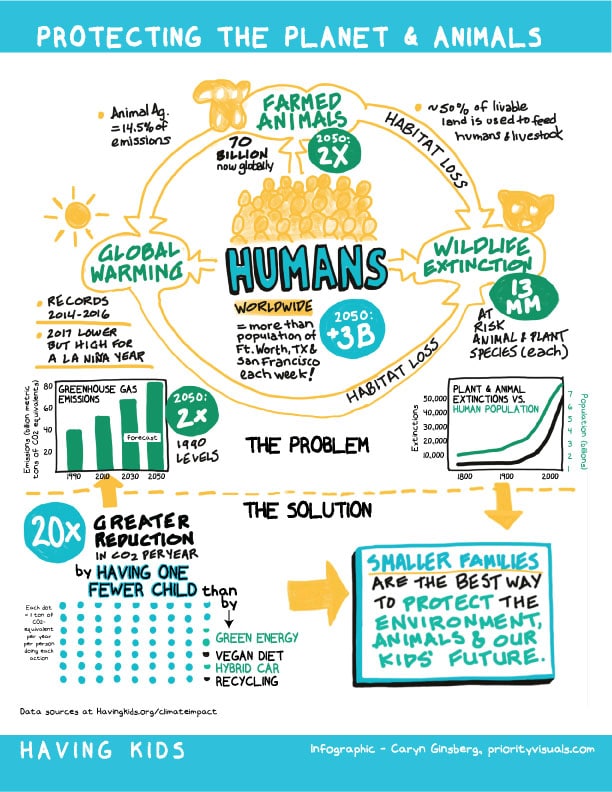
    Infographic showing humans impact on the planet: habitat loss, global warming, wildlife extinction, and farmed animals. Solutions proposed include smaller families, plant-based eating, renewable energy, and recycling.
    • Inaction threatens the UN’s credibility. Pronatal policies being rolled out in response to a perceived economic “baby bust” show that our current systems of governance are fundamentally illegitimate. If we are willing to create lots of people in whom we invest relatively little in order to satisfy markets and economies, instead of fewer people in whom we invest more in order to build the democracies that must precede, justify and regulate those markets and economies, we are admitting fundamental illegitimacy, or as the peer-reviewed work shows, the preconstitutionality, of our political systems. This is especially true when doing so exacerbates the climate crisis. In that case, all effective measures to correct this inversion are just.
    • The costs of ignoring reproductive justice legal reforms are mounting. These include the costs of the relevant climate emissions that could have been avoided since at least 2007, and the role the failure to require equitable family planning has played in driving the massive and growing gap between rich and poor across the globe. The Fair Start Movement is calculating those costs as harms, and believes world leadership must – and one day will – be held fully accountable for them.
    • Because Fair Start and comparable “creation norm” models are peremptory norms that precede other national and international processes and rights (including property rights), the Fair Start Movement is urging young activists to target concentrations of wealth and power to pay for these eco-social harms, derived fundamentally from poor family planning models, by funding Fair Start efforts and incentives.

    Will you join that call? Nothing would have a greater long-run impact on restoring our environment than simultaneously compensating future generations, while helping them become parts of legitimate democracies, via Fair Start investments in their empowerment and resilience.

    Sincerely,

    Ashley Berke, Co-Director at Fair Start

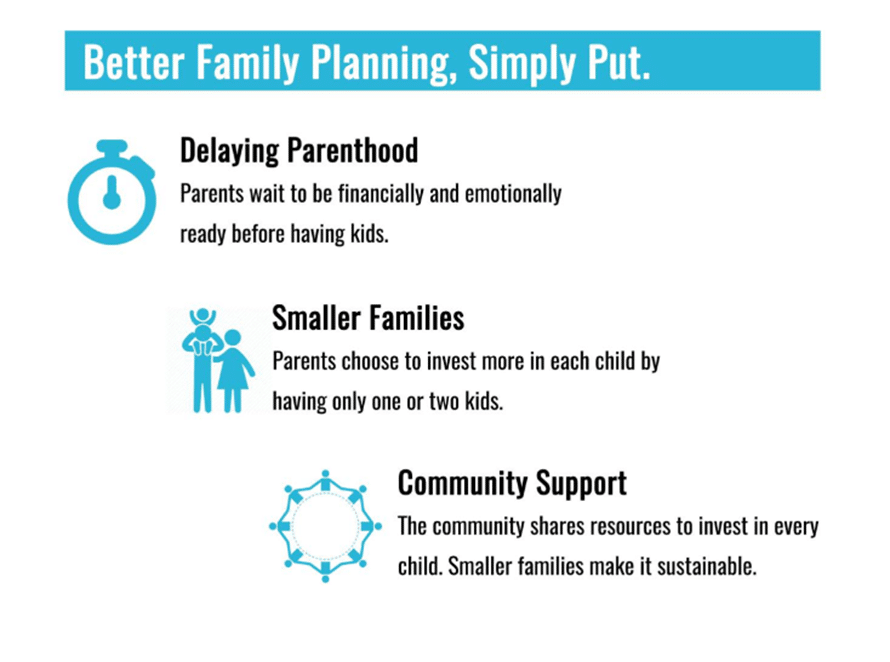
    Infographic titled Better Family Planning, Simply Put with icons and three points: Delaying parenthood, smaller families, and community support, each explained with brief text and blue graphics.