Category: News & Fair Start Headlines

  • The Fair Start Movement is Here

    The Fair Start Movement is Here

    After five years of research and evolution, we are excited to announce that HavingKids is becoming the Fair Start Movement. This comes from the input of many voices from diverse and intersectional areas in advocacy, as the organization pivots to more of a collective structure increasingly led by identities with more at stake. 

    The Fair Start Movement is a collective of parents and young people, child advocates, activists, health practitioners, social scientists, ethicists, and institutions from a range of causes who come together to advance Fair Start efforts at the state, federal, and global level. 
    Several hands of different skin tones are stacked together. Overlaid text reads, The most powerful social justice is a fair start in life. Join the coalition. The Fair Start Movement logo appears at the bottom.

    We advocate for informed, inclusive policies rather than ones focused on short-term and unsustainable economic growth with damaging ecological consequences. We call on those with a platform to speak out, from celebrities to those in governance. We also build our movement through a growing coalition of organizations. But most importantly, we empower young people and parents to share their stories and force accountability from those who oppose giving kids a fair start and threaten our and our children’s future.

    Child-first collective family planning, beyond the isolation of “nobody else’s business” is happening. Most people maintain a taboo against talking about collective family planning because they fear the top-down power of the state. The reality is that we perceive the state as a threat, which in a democracy makes no sense, because of our failure to implement Fair Start or comparably inclusive family planning models.

    Our focus remains on work with the greatest long-run impact on the crises we face today: Rights-based Fair Start reproductive justice reforms that override all competing interests. If it takes a village to raise a child, it takes a village to plan for one. Our interventions are built around three pillars: 1) fertility delay and parental readiness, 2) distribution of resources geared around birth equity, and 3) a universal ethic of sustainable families.
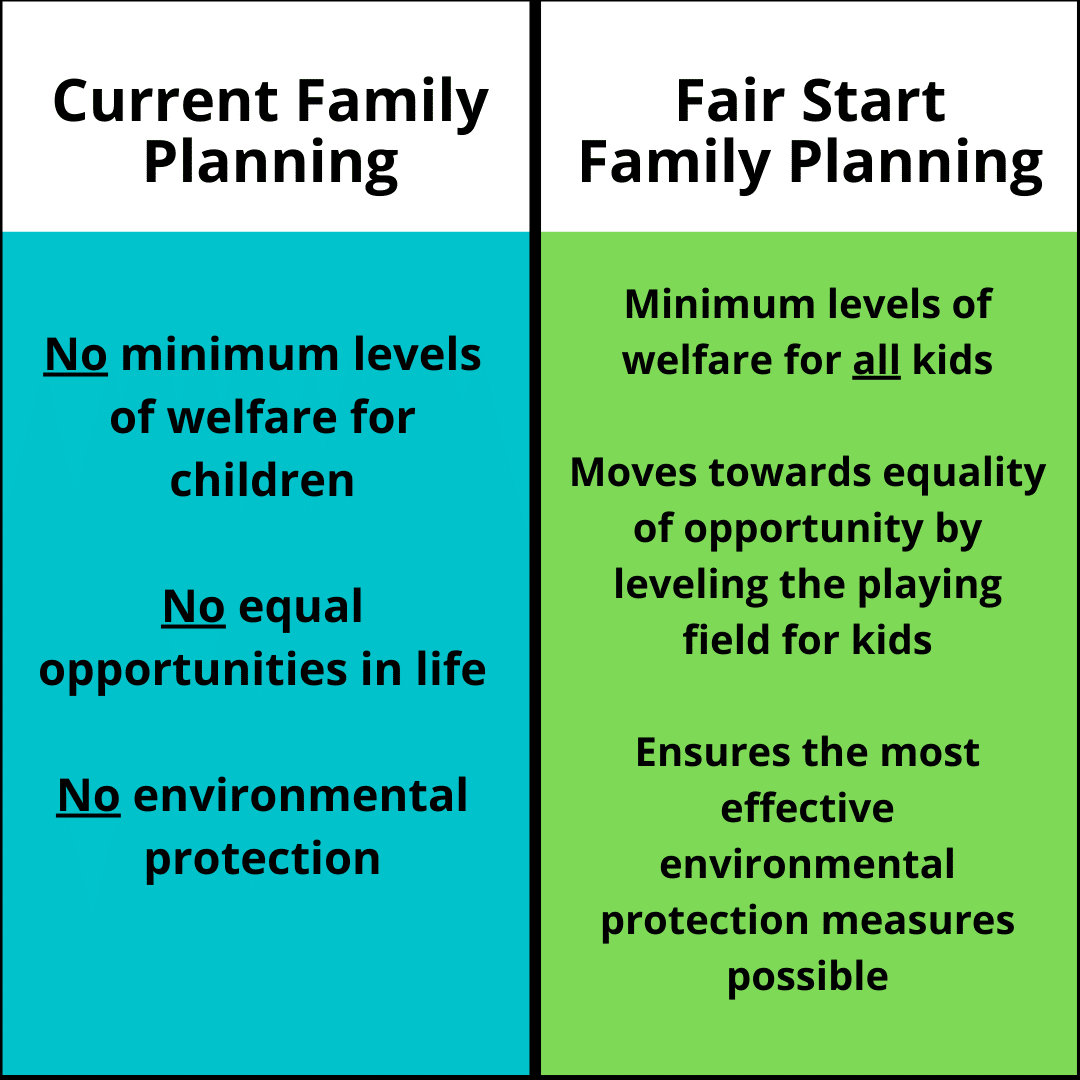
    A comparison chart of Current Family Planning vs. Fair Start Family Planning. The left side lists negatives of current planning; the right side highlights positive outcomes of fair start planning for welfare, equality, and environmental protection.
    Better family planning has the greatest impact on the crises we face today.

    We remain committed to our 2021 plans of action, including: 

    Plans for our first peaceful demonstration as the Fair Start Movement demanding that Exxon officials, past and present, publicly acknowledge their obligations to compensate future generations against a zero baseline, given the climatological harm they have caused. They are obligated to right that wrong by funding climate restorative projects to ensure all kids an ecosocial fair start in life, a moral fact we are also urging the UN to institutionalize through correct interpretation of Article 16 of the Universal Declaration of Human Rights. It’s time for both governments and big business to stop working together to exploit future generations. Fair Start is the first and overriding human right, superseding the property rights of those who have harmed future generations, and who must compensate them through Fair Start and other effective mechanisms.

    Join the coalition as an organization or sign up to follow the latest opportunities to take action. 
  • Alexandra Paul is Speaking Truth to the Power of Unsustainable Growth

    Alexandra Paul is Speaking Truth to the Power of Unsustainable Growth

    Kudos to Alexandra Paul for pushing back against the constant media messaging – often promoted by their advertisers – that falling fertility rates are a bad thing. Her recent letter, published in the LA Times, points out what should be obvious: Growth is not sustainable. She is speaking that truth to the powerful – media and corporate conglomerates – who would exploit future generations as cheap labor, and the Earth with them, to continue growth-fueled profits.

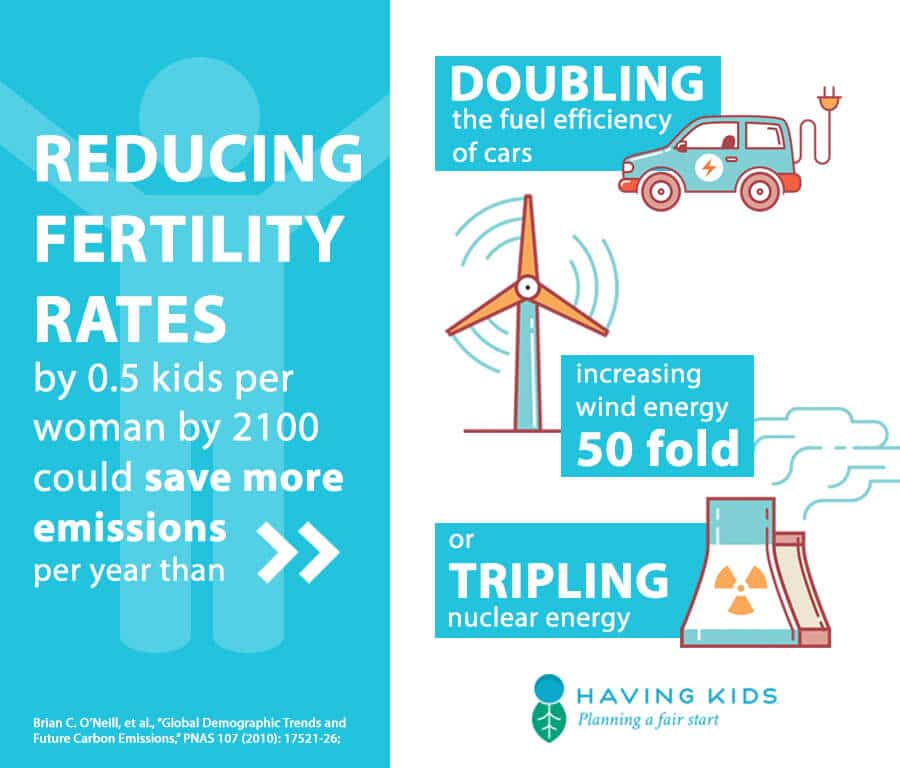
    The move towards better planned families is 1) the product of decades of intentional interventions to stave off disaster, 2) emblematic of the liberation of women, and 3) the most effective tool – on a scale of 20x the impact – we have to fight the climate crisis.


    Infographic showing ways to reduce carbon emissions: reducing fertility rates, doubling car fuel efficiency, increasing wind energy 50-fold, and tripling nuclear energy. Includes icons of a car, windmill, and nuclear symbol.

    But the fight is hardly over. Fair Start is one such approach to implement this.


  • Joyce Tischler: Protecting Animals Starts With A Better Population Policy

    Joyce Tischler: Protecting Animals Starts With A Better Population Policy

    Joyce Tischler is widely considered to be one of the founders of modern animal law and a leader in the field of animal protection. She is affectionately known to the many who admire and follow her as the “mother of animal law.” She has inspired generations of animal law attorneys.

    What few know about Joyce is that she is also mother to her wonderful daughter Margeve, and understands the crucial connection between family planning and protecting nonhumans. Nothing has a greater impact.

    Let’s learn more from Joyce, on a topic few are willing to even discuss, and please share the video and graphic beneath the video if you want people to know how to have the biggest impact on animals.

    We can do better. Take other actions here.

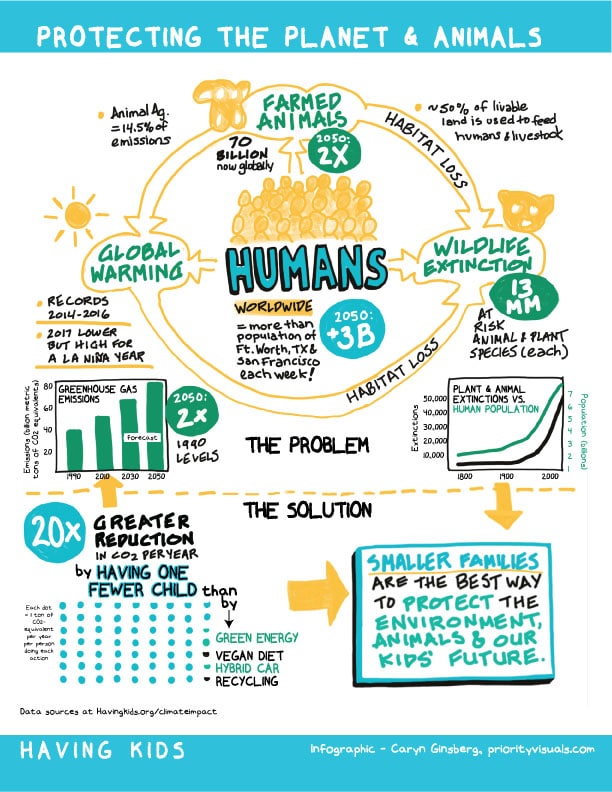
    Infographic showing humans impact on global warming, wildlife extinction, and habitat loss. Highlights overpopulation, animal farming, emissions, and advocates for smaller families and green energy as solutions. Hand-drawn charts and illustrations.
  • Six Best Places To Visit in Southern California With Kids During the Pandemic

    Six Best Places To Visit in Southern California With Kids During the Pandemic

    By Bea Krasner

    Sure, a once-in-a-century virus crash-landed onto Earth — but never fear! We’ve got a list of pandemic-friendly activities for kids in Southern California.

    San Diego Beaches

    San Diego is one of the most scenic places in southern California, and the area beaches are picturesque. So why not plan a sun-and-sand weekend in “America’s Finest City”? If you’re searching for things to do with kids in San Diego, Mission Bay Beach and the neighboring Playa Pacifica Park are great spots for families. Plus, it’s a bucket list item for anyone interested in Americana, as Mission Bay is the largest man-made park in the country. Moonlight Beach, with its gigantic playground, is also a good time.

    Want to wash the sand off your car before returning home? Hit up a drive-through car wash and pop on the Star Wars theme while going through. The kiddos will love it!

    Leo Carrillo State Park

    Going to the Leo Carrillo State Park in Santa Monica, which includes a beach, is a fun day out with the kids. Windsurfing, beachcombing, and fishing are all on tap. Plus, it has tide pools, sea caves, and reefs teeming with natural wonders.

    Malibu Canyon

    With its lurking paparazzo, Runyon Canyon is where celebrities, influencers, and aspiring fame-seekers head for a hike. But if you’re looking to explore with the wee ones, Malibu Canyon is the better choice. Part of Malibu Creek State Park, it’s got hikes for all levels and incredible views. Located about 25 miles from downtown Los Angeles, Malibu Canyon is part of the Agoura Hills in Calabasas.

    Fans of vintage television shows may recognize the area since it was used in many a M.A.S.H. episode.

    Neighborhood Scavenger Hunt

    Staying outside is preferable during the pandemic — so why not do a neighborhood scavenger hunt?

    Parents, we’re not going to sugarcoat it: this option will take a bit of prep on your end. But we think it’s worth it.

    Step One: Stake out a neighborhood. Make a note of both exciting and commonplace things around the town, like benches, statues, murals, and store names.

    Step Two: Make a scavenger hunt card. It can be a list or something resembling a bingo card. You can find examples here, here, and here.

    Step Three: Slap on some sunscreen, make sure the camera phone is charged, and head out the door with materials in hand! Don’t forget to bring pens, pencils, or markers to tick off found items.

    Step Four: Complete the hunt. As a bonus, take pictures of each found object and turn them into a craft or digital art project at home

    This DIY activity is a great way to expose children to people from different walks of life. It can also serve as a teaching tool that introduces children to the realities of systemic inequities and environmental challenges. It’s never too early to bring awareness to the alarming rates of inequality, particularly child inequality, to your young ones. We’ve compiled a fantastic list of child inequality facts that you can share with your kids. 

    Parents interested in solving institutional inequalities should check out the fair start family planning model and movement. 

    Drive-In Movies

    Maybe it’s the gigantic screens or the novelty of watching a film from the car, but for kids, there’s something magical about drive-in movie theaters — and Southern California has lots.

    Options include:

    • Mission Tiki Drive-In Theater — Montclair
    • Paramount Drive-In Theater — Paramount
    • Vineland Drive-In Theater — City of Industry
    • The Roadium — Torrance
    • We Drive-Ins — Santa Monica
    • West Wind Drive-In Theater — Santa Barbara
    • Rubidoux Drive-In — Inland Empire

    Long Beach Aquarium

    Some people call it Long Beach Aquarium, but its official name is Aquarium of the Pacific — and it’s a super Southern California spot to spend a pandemic day with the kids. They have a whopping 11,000 aquatic animals under their care!

    The aquarium is now fully open, but if you want to play it safe, stick to the outside, socially distanced exhibits.

    If you live closer to Monterey, that city’s aquarium is also a treat.

    Things may be a bit different for now, but they’re getting back to normal. In the meantime, play it safe and pick pandemic-friendly activities for a day out with the family.

    Disclaimer: Neither myself nor fairstartmovement.org received compensation for this guest article.

  • Is There A ‘Best’ Way To Parent?

    Is There A ‘Best’ Way To Parent?

    By Jennifer Dawson

    When it comes to the many choices parents must make when they decide to have a child, ‘parenting style’ is one of them. Because parents tend to adopt a blend of styles or strategies, it perhaps befits the topic to do as scientists at Kobe University did in a study, and talk about ‘methods’ instead of ‘styles’. In the study, scientists found that parents tend to use one or more of the following methods when raising children: supportive, strict, indulgent, easy going, harsh, and average (the latter involves having average levels for all other key factors). Although it is impossible to define one specific combination of these factors as ideal, factors certainly emerge that are either positive or detrimental to positive growth and happiness in children.

    Giving Children a Fair Start

    Before discussing parental styles, it is important to clarify that one’s chosen style very much depends on the model of family one chooses to adopt. Having Kids’ Fair Start model aims to help parents make wise choices so that their children can have all their needs met (both material and affective). By planning families better and waiting until they are ready to have children, parents can work on issues that are important to them and their future family – including education and career stability. These, in turn, set up better outcomes for children and increase their chances of a good future. Inequality is something that society as a whole should work to eliminate to give all children a fair start. Currently, around 14.8 million children in the U.S. do not have enough food to eat and around 41% of them live in or near poverty.

    Classic Parental Style Definitions

    In other research (for instance, one study published by the Society for Consumer Psychology), researchers divide parenting into four defined ‘styles’ – authoritative (parents tell children what to do but give reasons for this), warm (parents relate well with children while expecting them to act maturely and follow set rules at the same time as enjoying independence), neglecting (parents offer little guidance and monitoring of a child’s life and activities), and indulgent (parents give children adults’ privileges but do not set responsibilities). In this study, some clear results did emerge. Children who were taught to have responsibilities and follow rules made safer choices, interacted positively with the world around them, and chose healthier diets. The researchers stated, “We found a lot of evidence that demonstrated that it is okay to be restrictive with kids…It’s also important to explain to kids why the restrictions are important.”

    Close-up of an adult holding a child’s hand while crossing a rope bridge. The child, wearing a blue dress, reaches forward for support, and the background is blurred.

    An Example Of Rule Setting: Making Healthy Choices In Life

    Diet is one area which authoritative and warm parents tend to prioritize, as are areas like restrictive use of technology, and an emphasis on the importance of doing homework. This type of parent may take things further, teaching children how to avoid harmful products like BPA – a substance found in a plethora of modern products, including plastic food holders. BPA is known to disrupt the endocrine system and potentially cause or trigger asthma, infertility, early puberty, obesity, and even resistance to chemotherapy. Authoritative and supportive parents may avoid BPA-containing plastics, then, while being honest about the reasons why children have to take glass or BPA-free containers to school. The aim is to interest children in health and to explain why some choices need to be made, even if it means spending time researching healthier alternatives to commonly sourced products.

    Understanding Dos And Don’t In Terms Of Methods

    The Kobe study came to similar findings as the Society for Consumer Psychology research did. Children who had been reared with plenty of support and positive attention earned more money, enjoyed greater academic success, and were happy. Those who were reared very strictly had high levels of achievement but greater stress and lower happiness levels. Attention, interest, and a commitment to helping children understand why specific rules are set up are key. Perhaps, then, the idea isn’t to choose one parenting style, but rather, to give children time, attention and responsibilities, while also explaining reasons for rules and giving children the independence they need to grow into their own person.

    It is difficult (and most probably unfruitful) to strictly define one parenting style that results in success, happiness, health and wellbeing for children. However, studies do show that investing quality time, care and attention in children does make for happier, well adjusted adults in the future. Neglect and strictness with no rhyme or reason do a child little good, and indeed this can be easy to understand for any adult who has ever worked for authoritarian management that left little room for ideas, innovation and independence. In the end, children are not that different from adults after all.

    *Neither the author nor Having Kids received compensation for this piece.

  • Biden’s American Families Plan: Shall We Make It More Just?

    Biden’s American Families Plan: Shall We Make It More Just?

    President Biden is unveiling his American Families Plan this week. It aims to support families with the cost of childcare, expanding child tax credits, providing paid family leave, among other things. But is this enough to meaningfully reduce U.S. inequality (the highest in the developed world) and set up the next generation for a healthy, equitable and sustainable future?

    Leaders on both sides of the aisle already agree that early childhood is critical in positioning kids for success throughout life. Just look at programs like Head Start, SNAP, Medicaid, etc.) The American Families Plan even includes spending for pre-k education. 

    But we need to invest in kids even earlier. We really should be starting from conditions at birth. That is how to truly give kids a fair start in life.

    Given that, shouldn’t we also pursue family planning investments that have more than 50 years of proven results in reducing poverty and improving lives? These are efforts like encouraging delayed parenthood, birth spacing and investing more in each child.

    Yes, family planning decisions are ultimately between parents. But our policies have significant implications for the conditions in which children are born.  

    Therefore, lawmakers must ask key questions as they devise policies if they really want to give kids a fair start in life:

    • How can we help parents be financially ready? 
    • How can we help parents provide stable and healthy home environments?
    • How can we act to reduce inequities and the climate crisis, rather than exacerbate these harms? 
    A comparison chart of Current Family Planning vs. Fair Start Family Planning. The left side lists negatives of current planning; the right side highlights positive outcomes of fair start planning for welfare, equality, and environmental protection.

    Here are a few ways the Biden administration could advance parental readiness and improve equity to give all kids a fair start:

    • Encourage delayed parenthood by releasing funds being held up in the development of the male pill.
    • Making higher education more accessible, allowing parents to better provide for their families throughout their lifetimes. The good news? Tuition-free community college is already included in the American Families Plan!
    • Improve family planning education to arm young people with information about the benefits of delayed parenthood, birth spacing, and focusing resources on kids. Future parents can set themselves up for greater lifetime success and give their future kids a fair start. Why aren’t we giving them this information?
    • Cut all benefits to wealthy families who don’t need the funding.
    • Use those savings as cash incentives to power up family planning and early childhood investment systems in the United States to

    TAKE ACTION: Add your name to urge President Biden to improve his American Families plan. 

  • Vox Founder Pushing Population Growth Made the Climate Crisis Worse. Hold Him Accountable.

    Vox Founder Pushing Population Growth Made the Climate Crisis Worse. Hold Him Accountable.

    The Financial Times just published an article detailing the massive impact policies that promote smaller families – for all – have on the climate crisis. Nothing comes close.

    And yet people like Matthew Yglesias and the media outlet Vox continue to push women to have kids. Many have said that we should punish climate change deniers for blocking policy reforms that could have mitigated the crisis. But all climate emission flow downstream from the increase in demand population growth creates. It is the fundamental driver. Aren’t the people actually making the crisis worse, usually to grow their investments, just as bad as the deniers? Did Ygelsias pushing women to have kids actually have an impact? The proposals to change federal child tax and care subsidy policy to encourage population growth that followed his advice suggest it did.

    Let’s hold him and others, like Lee Raymond, accountable. We have a right to take the resources of wealthy people like Lee and Matthew who profited from poor and unsustainable family planning but never paid that costs that growth imposed on the environment, animals, women, and children. Why? Because every child’s right to an ecosocial Fair Start is the first human right, and it precedes and overrides any other obligation, including property rights.

    It’s time to pay up. Those that really profited owe future generations – more than most.

    What is Fair Start? It’s about people, not population. It’s about shared values and thinking qualitatively about the future, not using poor and unsustainable family planning to grow economies. Read the Allegory of the River, and why Having Kids talks about constituting democratic communities instead of framing our work around the concept of population, to understand more. Let’s make family planning truly inclusive, and geared around creating democratic communities where everyone has a voice. 

    It’s simple: Fair Start family planning means smaller families sharing resources to invest more in every child. For some, the closest analog for this new model would be responsible family planning incentives. But Fair Start resources are actually entitlements held by future children, and funded through non-traditional means. Those opposed to remodeling favor our current system of unsustainable families, unearned privileges, and undemocratic influence, over giving kids a fair start in life.

    In a previous blog post, Having Kids argued that his approach — like many others who see babies as economic inputs to be exploited — was actually compelling evidence of the fundamentally unjust nature of our system.

    All kids have a fundamental human right, ecologically and socially, to a #fairstart in life. It’s the first human right. Help us secure it against those who threaten our future.

    A comparison chart of Current Family Planning vs. Fair Start Family Planning. The former lacks welfare, equality, and environmental protection, while the latter ensures welfare, equal opportunity, and environmental protection for all kids.

    Groups and individuals from around the world are signing on to an effort to change the old model that focuses on what parents want toward a new model that focuses on what all kids need. The new model, called Fair Start family planning, is the beginning of real social justice. The reform can begin with the United Nations secretary general simply acknowledging the need for change.

    Sign on, and urge any organization you support or can influence — nonprofit or for-profit — to also sign on. Sign here, or contact us at info@fairstartmovement.org for more information.

  • Earth Day 2021 Video: Be Effective. Support Fair Start.

    Earth Day 2021 Video: Be Effective. Support Fair Start.

    What’s the most effective way to protect the planet and fight the climate crisis? Fair Start reproductive justice policies, which have ten to twenty times the impact of less fundamental changes. We are only in this ecological mess because world leaders failed to make sure family planning policies worked.

    Smaller families working together to give every child a Fair Start in life = being effective.

    Learn more:

    TAKE ACTION: And take action to ensure Fair Start becomes the universal standard for family planning.

    Infographic showing ways to reduce carbon emissions: reducing fertility rates, doubling car fuel efficiency, increasing wind energy 50-fold, and tripling nuclear energy. Includes icons of a car, windmill, and nuclear symbol.
  • One Reason Animal Rights Fail: We Willingly Create Animal Abusers

    One Reason Animal Rights Fail: We Willingly Create Animal Abusers

    Focus in on almost all work done by those who hold themselves out as animal protectionists and you will see them focused on the particular behaviors of those who abuse animals. From research labs, to factory farms, to puppy mills, our brains – given to think in the here and now – see what the abusers do, rather than who the abusers are and how they differ from the people we can aspire to be.

    But the genesis of the abuse comes years before it’s committed, in the creation of the abusers, and if we wanted to maximize our impact on nonhumans we would hone in on that. We would see how humans plan their families, and how that impacts the development of things like empathy and the practice of compassion. From the demand for abusive animal products and services, to the qualities and dispositions of the researchers, ranchers, zookeepers, hunters, etc., we miss the fundamental driver of abuse – demand and supply – by ignoring the laws and policies that determine our creation.

    Infographic illustrating the impact of human activity on the planet and animals, showing links between family size, resource use, global warming, extinction, and proposed solutions like smaller families and sustainable practices.

    But what do we do, specifically?

    Our current and largely aspirational humane education laws and systems are a good start. Though rarely enforced, they are ubiquitous and apply the correct standards. But without linking them to family planning and population policies, they fall far too downstream, and do not do what animals need them to do: Capture the key phase of human development (early childhood), and actually determine the behavior of humans and the impact of future generations.

    The beauty of focusing on responsible parenting is that unlike many forms of animal protection, it is highly intersectional, and its baseline is set by a widely celebrated value: Democracy. The minimum level of empathy and helping tendency we should require of every human, and develop in all future ones, is that necessary to ensure a functional social contract. It’s not about altruism – it’s about legitimate and just systems. Given that our current laws and policies ensure no levels of empathy or comparable qualities whatsoever, nonhumans will benefit greatly (especially when we factor in the quantities of humans at stake) from our pursuing even relatively minimal standards – like Fair Start.

    Take action:

    If you support an organization engaged in animal protection urge them to include in their focus the negative qualities of the abusers, and in their programming humane education, law and policy reforms that use those qualities – like sociopathology – as factors in reproductive justice reform. It’s that reform that does the most good for animals by creating a smaller future world population of people in whom we’ve invested more, the sort of people democracy requires.