In almost every category, from increased demand for animal products, to the extinction of wildlife, animals are losing. And that’s not even accounting for what the climate crisis will do to animals as it escalates.
What went wrong and how do we reverse course? In short, as a Yale Climate Connections piece recently showed we allowed the Anthropocene to unfold, unchecked, rather than adhering to ecocentric systems. Here is one effective move to change the law to make it work for animals: Reform family policies to promote delayed parenting, birth equity, and sustainable families for all as a matter of fundamental human rights and obligations.
The right to an ecosocial Fair Start represents a unified version of animal personhood – one that aligns human and nonhuman personhood into one functional concept rather than making them oppositional. For example, populations of humans with much higher investments in each child mean more meaningful roles for each person in their democracy, and more room for animals – the height of nonhuman liberation.
Fact: An ecocentric and biodiverse standard for environmentalism would have also prevented the horrific impacts of the climate crisis on motherhood, which fall disproportionately because of inherited inequities.
Without this change refences to animal law are probably misnomers, and misleading . Animal law, minus changing the people we are becoming, would be missing the key ingredient: Us.
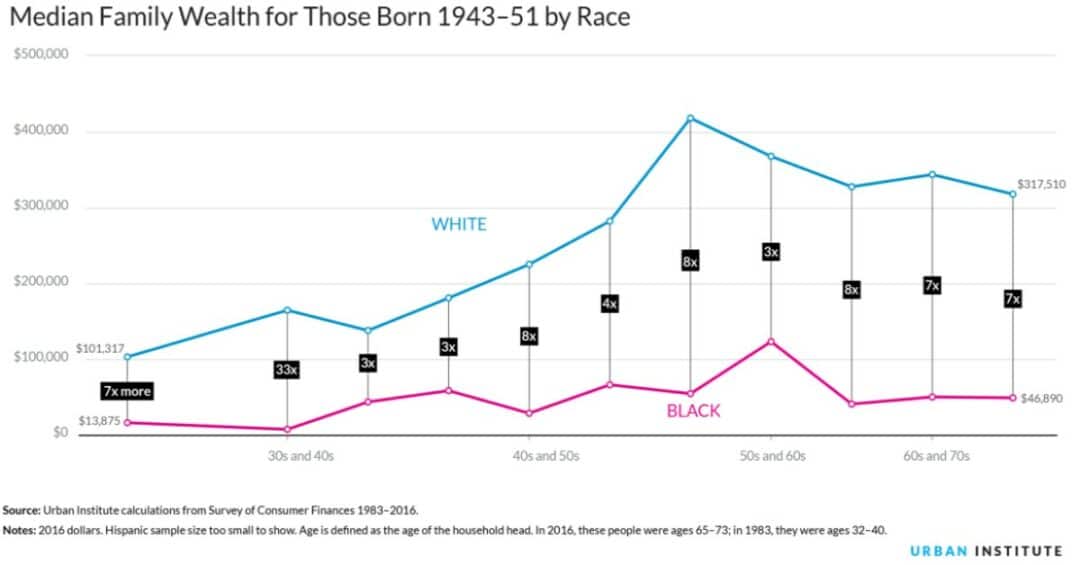
We can’t call something animal law if it does not orient from restoring the nonhuman world – their autonomy, and systems that don’t do that may not even produce law at all – truly obligatory norms – because they do not use a baseline that accounts for how people meaningfully participate in those systems such that the rules the systems produce actually reflect the peoples’ will. How does reconstituting legal systems ensure legitimacy, and help humans and nonhumans? One example: Eliminating the wealth gap at birth between white children and children of color, via Fair Start federal tax reforms, restores the nonhuman world and is antiracist. Traditional “animal law” with its racist outcomes (including evading birth equity, in favor of historical disparities, despite the exponential benefit equity would also bring nonhumans) does none of this. Another: Traditional family law legal scholarship uses case and statutory law – or “positive law” to advance human welfare. But without a system of overriding rights that would mitigate the climate crisis, it’s failed to achieve its purpose and simply condemned future generations to suffer.
This advanced concept of unified animal personhood is now the subject of litigation, in the Texas abortion fight and in litigation surrounding the right to nature in Oregon (which seeks to restore the nonhuman world (including -300ppm climate policies)) as a matter of constitutional right. It’s a form of full personhood that is also consistent with what renowned author Carl Safina – in a pointed Q&A – recently suggested as the best move for animals.
TAKE ACTION: Animal personhood, and animal law, mostly depends on the humans animals share the world with. Let’s start our reforms there.
Kudos to Inside Climate News for covering a topic many are hiding from: The fact that many benefitted from a clearly unsustainable family planning system that hurt future generations, and how to take wealth from the top to now compensate them.
13%: New research by Nobel laureate economist James Heckman and his coauthors suggests that, after accounting more accurately for long-term health and other benefits, the return on investment for early childhood programs is even higher than previously believed, at 13 percent rather than 7-10 percent.
1 MILLION SPECIES face extinction thanks to unsustainable growth-driven human activity, the U.N. reports.
What’s the solution? The UN should use the right to a healthy environment as a springboard to a more aggressive or restorative approach that restores nature and habitat, for all species.
National organizations urge COP26 leaders to protect most vulnerable
San Francisco, CA – Dozens of leading NGOs are calling on the President and Delegates of the COP26 in this open letter to take an urgent and clear public position recommending just and sustainable family planning as the most effective solution to address the climate crisis, and rising global inequality, including gender inequity.
The global community has failed to inform and support a universal effort towards just and sustainable family planning, which:
Is human-rights centered
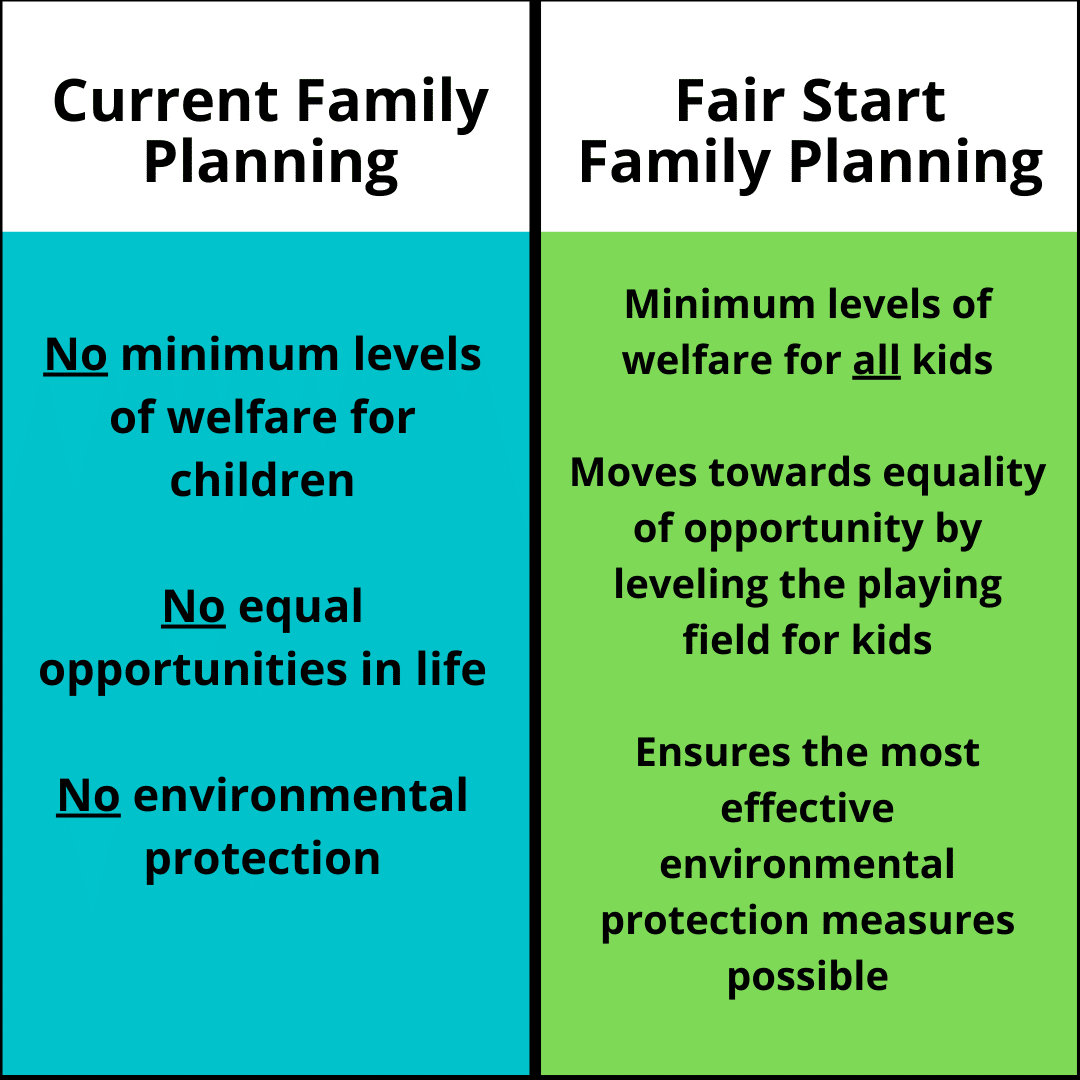
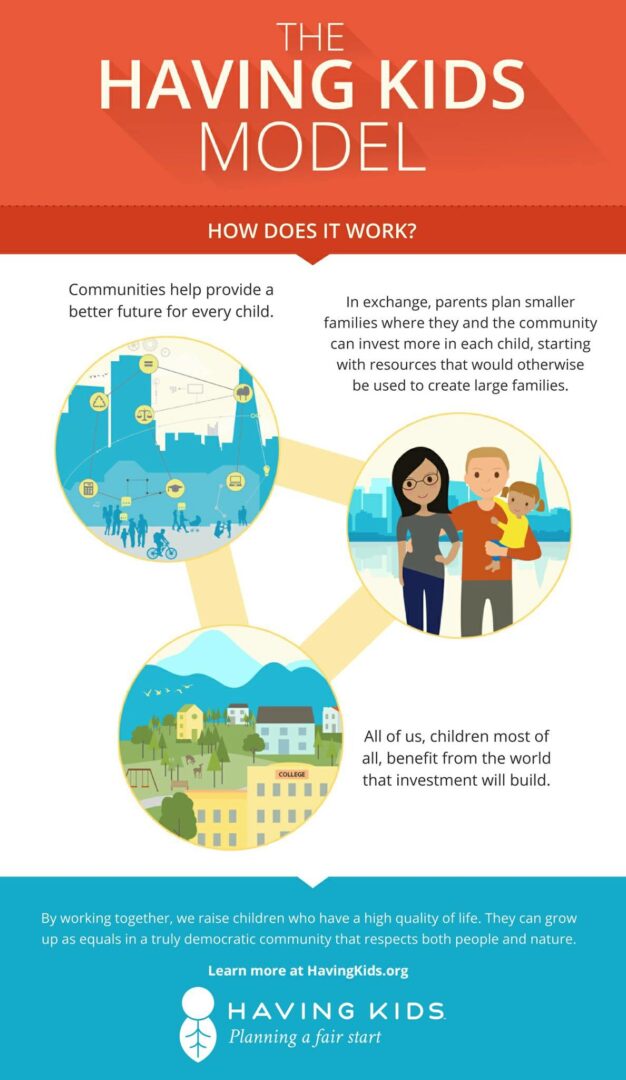
Ensures sustainable and equitable resources for greater investment in each child
Enables communities and governments to protect children and future generations while upholding reproductive rights
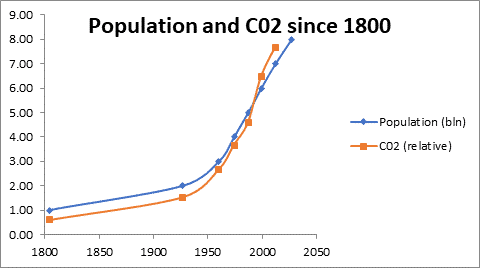
On the contrary, pressures to increase births, or to obstruct family planning programs, are driving our biggest crises and putting the health, safety, and welfare of current and future generations in peril. Unsustainable population growth, a documented threat multiplier, is contributing to catastrophic climate change, unprecedented flooding, pandemics, ecosystem destruction, groundwater depletion, mass extinctions, and environmental degradation. Worsening inequality, in large part driven by our growing population, is also a grave threat to democracy and political stability across the globe.
Nandita Bajaj, Executive Director of Population Balance says, “Our growth-driven policies are not only a cause of immense suffering for marginalized human and ecological communities, present and future, but they are premised upon oppressive power structures. Not only are reproductive, intergenerational, and ecological justice under attack, our current unsustainable growth-centred family planning policies are threatening all life on earth. We collectively need to acknowledge and address the urgency of this predicament.”
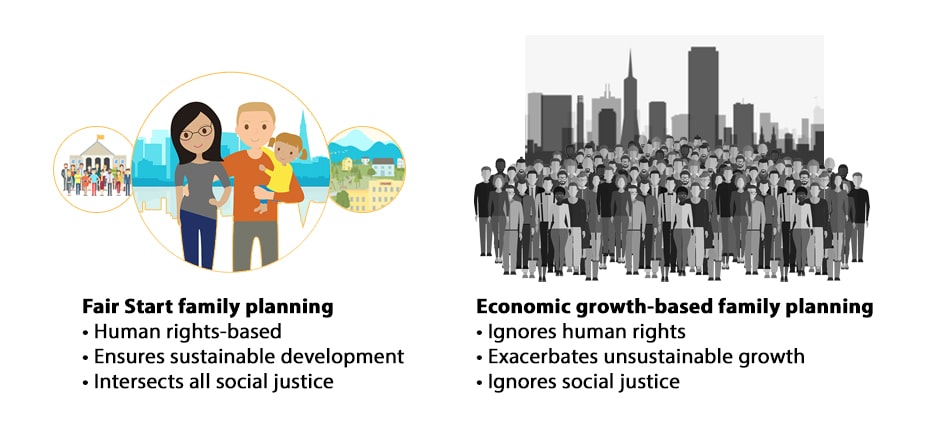
Fair Start Movement is a 501(c)3 nonprofit organization dedicated to reforming family planning by replacing growth-centered family planning models with the human rights-based and child-first Fair Start model.
Population Balance is a 501(c) 3 nonprofit organization that provides education and solutions to address the impacts of human overpopulation and overconsumption on the planet, people, and animals.
Which corporations and nonprofits are benefitting from unsustainable and inequitable family planning – the biggest driver of the climate and inequality crises – while pretending to further environmental and social justice? Federal Environmental, Social and Governance (ESG) disclosure requirements provide an opportunity to find out and act. Support Fair Start’s campaign for an executive order to require disclosure of policies and advocacy around the biggest factor of all – families – so that we can hold bad actors accountable.
Why not be effective?
We are urging the Biden Administration to do what should be painfully obvious by now – actually account for the greatest driver of the climate and other crises that gave need for a new ESG disclosure framework: Our family and population growth policies.
Why report at all if we do not account for the underlying driver/multiplier, and the volatility inherent in it?
We need to know who, among us, promotes putting an unlimited number of children, without any guaranteed levels of preparation, equity, or influential role in their democracy, into an increasingly degraded ecological future.And in terms of the past, we need to know which groups said they were making progress, knowing the growth they supported was undoing that progress the whole timeand moving wealth away from effective investments in children and into the hands of people at the top of the wealth pyramid.
Governments are failing children’s right to an eco social fair start in life. We know that early childhood experience is pivotal to lifetime outcomes. Why are we waiting for adverse childhood experiences to occur before acting?
Children deserve equitable conditions, right from the beginning. A fair start in life is the first human right – it overrides all others. It is what children are entitled to under the Children’s Rights Convention, and what allows them to eventually be free from the power of others, and truly self-determining. Because legitimate governance derives from people, who derive from the norms that create them, there are no such things as just societies, political legitimacy and freedom without the sort of Fair Start reforms discussed in this site. Without them we are always proceeding from, or reconstituting our political societies, from an unjust position.
Ensuring an eco-social #fairstart in life for all kids can have ten to twenty times the long run impact on the key social and ecological crises we are facing today relative to other interventions.
The UN has been obligated to interpret the promise of Article 16 of the Universal Declaration of Human Rights, that of a right “to found a family,” in a way that would protect the right for all generations equally. This includes those in the middle of the Twentieth Century, and those in 2050 for example, equally. It should have also interpreted Article 16 consistent with other human rights obligations, like the Children’s Rights Convention, and well as the Sustainable Development Goals.
Mountains of evidence show young persons are not able to exercise their right equally because of many population-driven threats to the children they would have, including significant birth impacts. In other words, the UN failed to interpret and administer Article 16 correctly.
In fact it caved to member state pressures to maintain large and unsustainable families and population growth rates in the Twentieth century, and violated future generations’ rights to safely and sustainably found their families under Article 16. Because men – under enabling from the UN – pushed women to have large families in the past, younger generations today have to worry about having even one child, given the ecological future that child faces. Moreover, women who were pushed to have children under the growth paradigm enabled by the UN’s modeling – and have children despite the risks of Covid-19 – are dying in massively disproportionate numbers. We need to hold those who enabled this accountable.
Activists should start by engaging the relatively wealthy children of UN officials, in this special form of lawful and peaceful constitutional dialogue and social change, geared around our just desert to family planning incentives/entitlements. There is nothing more just than targeting an extant minority for the benefit of the countless future majority. This process will build, targeting the concentrations of wealth and power – both public and private – most responsible for the climate and other crises we face today, including those that most benefited from past, inequitable and unsustainable interpretations of Article 16.
Take action: Urge United Nations Secretary General Antonio Guterres @antonioguterres to speak out and act to protect all generations’ right to found a family.
This cognitive dissonance creates a special problem when it comes to systems of justice and freedom, normally things that we first deal with through laws, nations’ constitutions, and international human rights conventions. This is the problem: We tend to think of constitutions, or other fundamental and dominant systems of norms, statically. We think of them as fixed things. That is incorrect. The legitimacy of systems of governance derives from people, and people are not static. They are constantly being born and dying. They are dynamic. And most people, all of whom matter, will live in the future. What lies at the base of things like justice and freedom – the dynamic “we” in “We the People” – is more fluid than our brains usually perceive.
It is thus more accurate and true to our values of deriving legitimate governance from the people themselves (per a recent peer-reviewed article), to say that we are constantly constituting as we create new persons, not constituted by god-like founders in the past.We have to account for justice and freedom in the fundamental and ongoing formation of power relations, in the act of having children and ensuring their capacity to consent to the power of others. We thus “constitute” by accounting for the key stages in our development, early childhood and the creation of things like empathy, and the collective impact of that on our ability to socially self-determine. This is how we truly come together, or constitute, as free and equal people. We surpass our constant confusion about what it means to be free by seeing that such a state of being first lies in who we are – the fundamental power relations formed between us as we are created – before freedom can emerge, or not, in what we do.
Making that change, using a verb, frees us from what might be called the constitutive fallacy, an erroneous deference to power structures that oppresses us – like property entitlements that prevent equal opportunities in life for all. Or treating the planning of our families – the creation of children – as “nobody else’s business.”That sense of privacy was not meant to protect would-be parents or children, but was instead designed for concentrations of wealth and power to evade collective obligations to give kids a fair start in life via things like family planning incentives/entitlements pegged to literal birth equity.
How does the verb form free us? If we are dynamically constituting, then that process – limiting and decentralizing power to ensure future generations are free – becomes the dominant norm or ubernorm. We have to first and constantly make a free “We the People.” It precedes and overrides other norms. If we value justice and freedom (or self-determination over top-down systems of influences outside of ourselves like coercion or even incentives, which we can think of as simple sticks and carrots), we have to start from the premise that governance derives its legitimacy – its compelling oughtness – from the norm which through our creation ensures consensual governance.
We have to create future generations in ways that assure they are relatively self-determining, part of a system of laws that reflects their will, and as such free from all forms of power to which they cannot consent.
Using the verb constituting may feel nebulous, leaving us lost in time and space without the familiar static concept of a written constitution, sitting under glass in some far-away place, or militarily defended lines on a globe that define some amorphous “we.” There is a simple way to fix this. If we are constituting or in motion, we will necessarily be focused on where we are going, prioritizing a universal and child-centric (as opposed to parent-centric) system for planning our families that ensures justice and freedom for the majority (those that will live in the future) of persons. We will be sufficiently other-regarding – and free enough – to physically constitute just communities.
In the Fair Start Movement a collective of diverse people are discussing what it means to physically constitute those communities, using the simple and most basic value parameters of 1) minimum levels of welfare approaching birth equity for all, 2) an effective voice for everyone in more participatory democracies, and 3) restoration of nature, or the nonhuman world, which we can also think of as nonpolity, or the original positions/states of nature that undergird all theories of freedom. These values, just relations between people, and freedom, are simply inseparable from who we are and should be. And who we are and should be first depends on our creation. It’s about people, not population, and a physicalizing of justice through an existential norm that would include all other forms of traditional justice, e.g. distributive, environmental, intergenerational, procedural, retributive. We cannot be free if we carry pre-ordained hierarchies into our creation.
In other words, if we don’t start from a just people policy that gives all kids an ecosocial Fair Start in life, we can never proceed from a just position.We can never really be free. Our language and vision for the future will not orient from any of the values that comprise freedom.
As we move to correct the fallacy in our thinking, we will find ourselves divided between free people, and those who are entrenched in preconstituting modes (whom we might call “precons”), often because they benefit at cost to others from those modes. The divide, at this first and uniquely critical border of human power, is binary: We either support sufficiently just beginnings and are sufficiently other-regarding to constitute, or not. We either constitute/maintain polities and their citizenry in the position of being able to effectively participate in a constitutional convention, and have the capacity to consent to others’ power, or we give up the pretense of being free and equal people.
How can we identify precons?While forthcoming federal policies requiring disclosures regarding the role large companies play in the climate and other crises will help out these people, we can force the conversation with a few questions: How do they account for freedom and justice if not in the ongoing formation of power relations, as we have children? How could they care about children without caring about the conditions in which they are born? Is one’s birth position really a matter of fortune, or the result of things we can control? Is procreation more self, or other, determining? How can we consent to others’ power over us without accounting for the fundamental formation of power relations? If we value welfare, equity, democracy, or nature, wouldn’t we want to reflect those values in the norms that create us? Won’t we want to avoid relegating untold numbers of children to an ecologically degraded future with no guaranteed levels of resource or resilience?
TAKE ACTION:
These facts are indisputable: 1) Many benefitted from the mistakes described above by placing costs – ecological and social – on others. They did so in violation of multiple universal human rights that would have otherwise allowed us to constitute as free and equal people. And they did so in part by hiding the impact of the unjust family planning policies from which they were benefitting, instead using distracting downstream policies to prevent effective upstream reforms. 2) Most justly and effectively compensating future generations, who should be treated as a majority, for those violations requires targeting those precons most responsible, and those precons who benefitted the most, from blocking the process of constituting. They stand between us and legitimate systems of governance. 3) We right the fundamental wrong by taking and using portions of their concentrated power and wealth, measured against the relevant fundamental baseline, to constitute free and equal groups of future people via the effective vehicle of Fair Start incentives/entitlements.
Free people will demand these resources, and be opposed by precons, who should be treated as the fundamental threat to our freedom.
In other words these entities, like Exxon, should pay for the costs they externalized on others. And they must do so by complying with the first and overriding human right – Fair Start. We can spread this modeling, and this simple discourse: “Part of your wealth is my and my future child’s family planning entitlement and incentive.” If justice is meant to protect the most vulnerable, and it is, then it starts by protecting future persons, including nonhumans, which are the most vulnerable entities in the moral universe.
Human population growth is the greatest threat to animals across the globe. For World Population Day, we’re launching a campaign around our interactive Animal Mortality Calculator designed to show individuals and policymakers how human population matters to animals.
Created alongside experts, our model will use existing interdisciplinary data to measure direct human impact (in animals raised for meat, milk, and other products) and indirect impacts (including habitat loss, traffic-related mortality, and native carnivores killed to protect livestock) on animal life.
Though several publicly accessible animal “impact” resources and calculators exist, none helps individuals easily assess the impact of their family planning decisions on nonhuman life. Our science-based calculator will influence individuals and lawmakers by helping individuals conceptualize the impact of their family planning choices while educating the animal protection movement about the need to include growth policy in our campaigning to reduce animal suffering and death. The upshot is helping to build a sustainable world for animals and future humans.
Can you help us reveal the truth about the greatest threat to wild and domestic animals worldwide and fund our Animal Mortality Calculator today?
The climate and nature crises that our planet faces are rooted in both population and consumption. We cannot waste precious time by pointing fingers between consumption and population – we need to talk about both in tandem, as our survival and quality of life, and those of our children, depend on it.
On the heels of Independence Day demands from people like Cassie King for the resources all kids deserve to ensure their eco-social Fair Start in life, and others who see their future child’s entitlement to birth equity as a sustainable family planning incentive, dozens of young women have come forward to speak out for more sustainable families. It’s a message for every young person’s future on planet earth.
On World Population Day, July 11, 2021, GirlPlanet.Earth will launch as an informal forum for global dialogue by women and teenage girls from around the world on population, consumption, planetary boundaries, and personal choices. Featuring the voices of women from Africa, Europe, North America, Central America, and Asia, GirlPlanet.Earth will enable honest, authentic, lively conversations between women and girls about our future.
Courtesy of the Urban Institute.
Join the conversation.
In addition to young voices pushing back on unsustainable population growth, this Sunday – World Population Day – key experts will make clear the pathway to an optimal world population, at this special event.
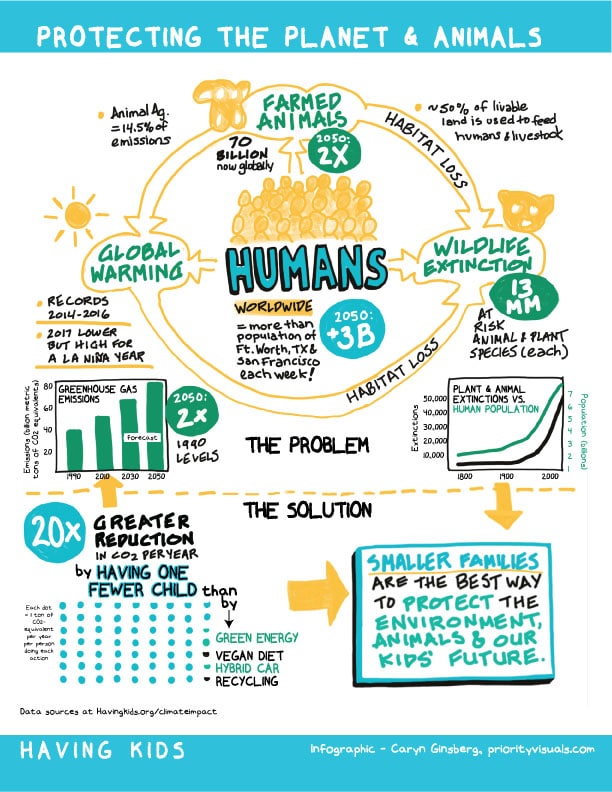
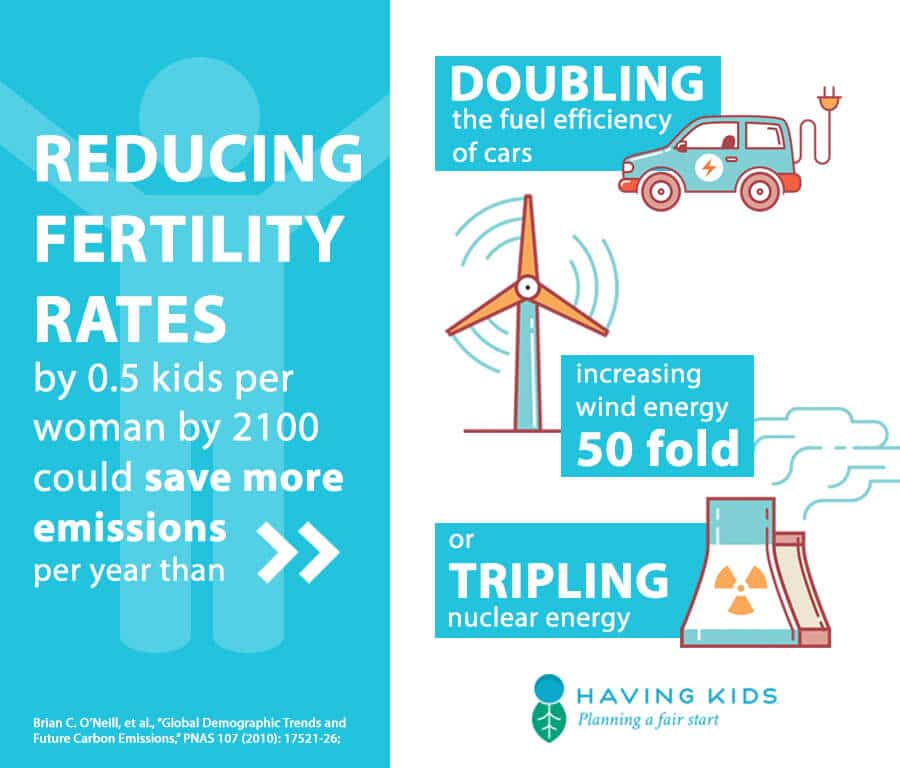
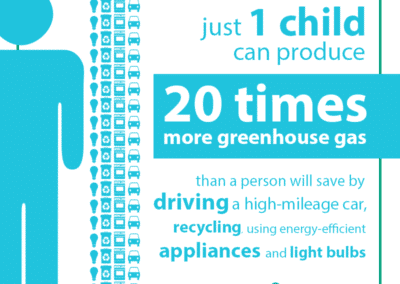
Having one fewer child actually reduces your carbon footprint more than any other single move you can make. We owe it to future generations to ignore advertiser-bound media pushing women to have kids to grow their economies. Instead, those intending to have small and sustainable families should approach concentrations of power for the wealth – and birth equity – their child has a fundamental right to under the Children’s Rights Convention and other human rights instruments.
This is the time to restart the conversation about family sizes, resources, population, personal choice, climate change and the future of our planet. The science is clear – we get the best outcomes, for everyone, when families plan for and invest more love, time, and attention in each child.
Stabilizing our human population, even through the most fundamental educational and economic advancement of women, has been taboo for too long. Humanity has made terrible mistakes through coercive practices and policies, and stabilizing our population needs to be instead profoundly rooted in improved justice, education, and economic opportunity, especially for women and girls.