Fair Start joins Zero Hour, actor Mark Ruffalo, and dozens of other groups filing amicus brief in support of lawsuit arguing for a constitutional right to nature, which would prompt federal climate action
The Fair Start Movement has joined dozens of organizations together to file an amicus curiae (“friend of the court”) brief in support of a groundbreaking lawsuit brought by the Animal Legal Defense Fund and Seeding Sovereignty, a project of Earth Island Institute, that aims to compel federal government action on climate change based on a constitutional right to nature and wilderness. There is no freedom without nature. It sets the spectrum for autonomy from other persons, the buffer between us and their impacts upon us. The climate crisis is the erosion of the that buffer.
The case is currently pending before the Ninth Circuit Court of Appeals. The case is based simply on the plain meaning of the liberty right “to be let alone,” a constitutional right promised by the Supreme Court and enforced in a variety of contexts, but none as important as this case. While the government routinely protects our right to be let alone in terms of being free from surveillance or intrusion into our homes, it is this version of the right – protecting the ecological baseline of nature in which we can be free from others and thrive – that matters most.
Cat Hughey, Director at Fair Start, had this to say:
“The sacredness of all human life and the more than human life culminates at a moment that we hold space and protections for all equally. The Fair Start Movement holds that the full-fledged experience of humanity exists when we embark on fighting the climate and ecological crisis by ensuring that every child can restore nature and value its health. By environing wilderness and its right, we in turn protect our future generations’ ability to exercise freedom, democracy and, most importantly, keep at bay ecological and social catastrophe.”
The right to be let alone, applied in this case to require the federal government to take the greatest measures possible to stop the climate crisis and restore nature, would ensure our children enjoy the natural world generations past have enjoyed. The Constitution guarantees that.
Nature, like equity and democracy, is part of every child’s right to an ecosocial Fair Start in life, and we have a right to ensure that right by all means effective. No government that fails to ensure that right is legitimate. The Fair Start Movement knows future parents will do what it takes to protect their children’s right to an ecosocial #fairstart in life.
What’s next? The Fair Start Movement intends to file federal litigation challenging a state abortion ban not as a violation of personal privacy, but because such bans interfere with the first and most fundamental human right: Every child’s right to a Fair Start in life.
World Environment Day 2021 provided a crucial opportunity for the United Nations to make good on its promise to reset humanity’s relationship with nature. But by continuing to adhere to a family planning model that allows unfettered growth, despite every opportunity to simply issue statements that would initiate reform, it has failed to honor its pledge at the most fundamental and impactful level.
Our relationship with nature is fundamentally defined by the laws that shape family planning and drive population size, and whether – in those laws – nature or the nonhuman world is seen as a resource for population growth, or instead a check on it.
By adhering to the isolation modeling the UN is enabling a false idea of autonomy and is perpetuating inequity that benefits white colonizing nations. (That colonialism is reflected in the current 1/10 wealth gap between black and white children in the U.S.) Instead the UN should promote birth equity to achieve true autonomy and as a reparations to future generations.
The UN has not taken action. It has failed to link its outdated modeling to the overcrowding and poor public health that helped drive the COVID-19 pandemic. It has failed to condemn China’s new pronatal family planning regime, which is intended to create a baby boom among a population that – because of its size – already poses the greatest threat to the world’s ecologies. Instead the UN has focused on downstream efforts while at the same time profiting, politically, from population-based GDP growth.
Inaction threatens the UN’s credibility. Pronatal policies being rolled out in response to a perceived economic “baby bust” show that our current systems of governance are fundamentally illegitimate. If we are willing to create lots of people in whom we invest relatively little in order to satisfy markets and economies, instead of fewer people in whom we invest more in order to build the democracies that must precede, justify and regulate those markets and economies, we are admitting fundamental illegitimacy, or as the peer-reviewed work shows, the preconstitutionality, of our political systems. This is especially true when doing so exacerbates the climate crisis. In that case, all effective measures to correct this inversion are just.
The costs of ignoring reproductive justice legal reforms are mounting. These include the costs of the relevant climate emissions that could have been avoided since at least 2007, and the role the failure to require equitable family planning has played in driving the massive and growing gap between rich and poor across the globe. The Fair Start Movement is calculating those costs as harms, and believes world leadership must – and one day will – be held fully accountable for them.
Will you join that call? Nothing would have a greater long-run impact on restoring our environment than simultaneously compensating future generations, while helping them become parts of legitimate democracies, via Fair Start investments in their empowerment and resilience.
For demographers and other population experts population decline is the expected and desired outcome of decades of family planning interventions meant to end and reverse unsustainable population growth. Why the media alarmism then?
Kudos to Sarah Kaplan for covering the ongoing debate over whether population growth, or things like inequity, technology, and patterns of consumption, are to blame for the climate and other ecological crises.
Is it wrong to blame overpopulation for the climate crisis? Perhaps it’s better to reframe the question: Is it wrong to blame overpopulation alone for the climate crisis?
Of course.
There are always multiple factors at play, from the growth that fundamentally creates demand to the inequity that’s driving overconsumption and the colonization of nature. The key to success is not to take any of the relevant factors out of our policy reforms, including the fundamental source of the Anthropocene: Treating the planet as a human resource in the design of our systems, from the economy to family planning. Doing so would replicate the mistakes that lead to the crisis. Instead let’s work together to give all kids a #fairstart in life.
Kudos to Alexandra Paul for pushing back against the constant media messaging – often promoted by their advertisers – that falling fertility rates are a bad thing. Her recent letter, published in the LA Times, points out what should be obvious: Growth is not sustainable. She is speaking that truth to the powerful – media and corporate conglomerates – who would exploit future generations as cheap labor, and the Earth with them, to continue growth-fueled profits.
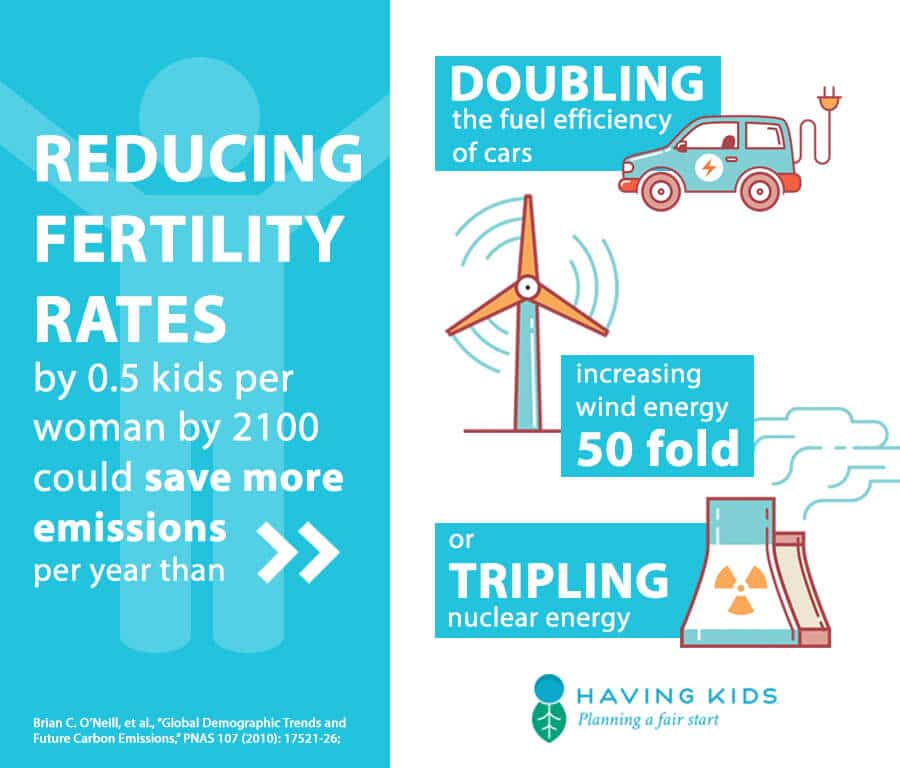
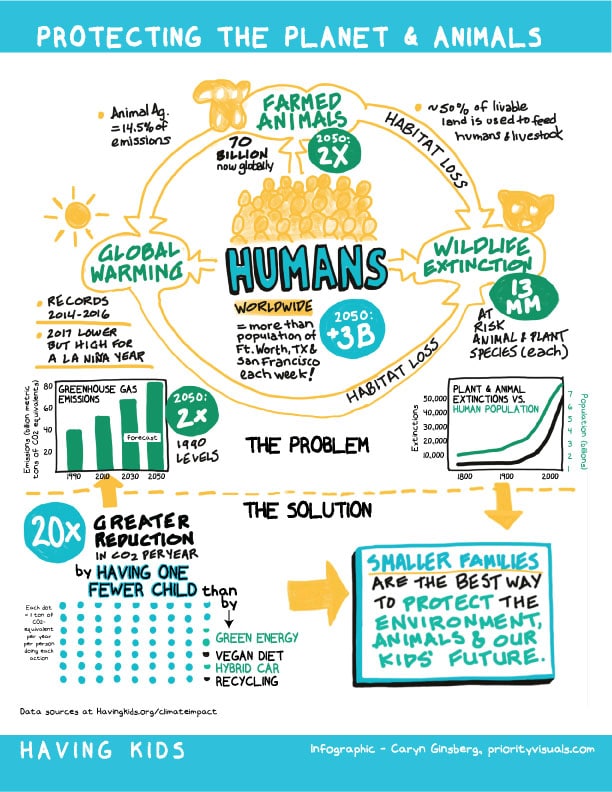
The move towards better planned families is 1) the product of decades of intentional interventions to stave off disaster, 2) emblematic of the liberation of women, and 3) the most effective tool – on a scale of 20x the impact – we have to fight the climate crisis.
Joyce Tischler is widely considered to be one of the founders of modern animal law and a leader in the field of animal protection. She is affectionately known to the many who admire and follow her as the “mother of animal law.” She has inspired generations of animal law attorneys.
What few know about Joyce is that she is also mother to her wonderful daughter Margeve, and understands the crucial connection between family planning and protecting nonhumans. Nothing has a greater impact.
A recent study from Stanford has found that efforts to mitigate climate change could yield trillions in economic benefits.
Let’s learn more from Joyce, on a topic few are willing to even discuss, and please share the video and graphic beneath the video if you want people to know how to have the biggest impact on animals.
Chaos Enabled by Irresponsible Behavior Is the Antithesis of Freedom
What do pandemics like Covid-19, and ecocidal things like the climate crisis, have to do with the idea of human freedom? For some, these events will be perceived as opportunities for governments to limit human freedom. For others, they will seem like limitations on freedom, along with governments’ failure to prevent them. Whatever the view, these events are largely driven by human behavior, which in turn is driven by values and norms, like freedom. How we further these events, and react to them, fundamentally derives in many ways from our perception of freedom and how it limits or justifies behavior. Dealing with these crises could then fundamentally start with examining the concept. Below are three particular perspectives, centered on isolation, inclusion, and creation, respectively.
A common view of freedom is the right to do whatever one wishes, absent some obvious and unjustifiable harm to others. The vision here is that one is and should be autonomous from other people, a vision captured in statements we see all the time: A gym owner in Arizona who refuses to require masks or close his business despite Covid-19, landowners who refuse to comply with the endangered species act, companies in trade associations that push back against consumer regulations, or coalitions fighting regulations that would limit climate emissions. The entire concept proceeds from intentional myopia, or the decision to view oneself in isolation from others, in time and space. It is the maintaining of willful ignorance of how people came to occupy different positions in society, the subtlety of harm, and the importance of things beyond harm – like obtaining the considered consent of others we influence. That myopia makes these claims of freedom easy to contest, but they endure to the extent our political systems position people so that they are – in an antisocial way – unwilling or unable to examine them. Collective problems, like the climate crisis and Covid 19, are primarily seen as presenting a risk that the collective will have a new opportunity to interfere with the will of individuals.
A second and less common view of freedom evades these problems we find in the first view. It takes many forms, but the general idea is to more comprehensively account for one’s position in the collective, and ensure a shared arrangement that allows one to do what one wishes as part of a system that simultaneously allows others to do the same. The goal is to not prevent each other from self-determination in the process. The philosophers: Joseph Raz, in The Morality of Freedom, or Philip Pettit, in a recent Ted Talk, exemplify this more comprehensive view. It cannot easily be picked apart by examining how the autonomy of the individual relates to the collective – they have accounted for these complex and relevant connections. Under this view, both the climate crisis and Covid-19 present direct risks to the autonomy or freedom of all, as well as those in the future. It is consistent with the objective value of people getting to do what they want that we require all to change their behavior in response to these events. This vision is more complex and accurate – but beyond the capacity or willingness of many to grasp.
But the truly myopic, and even the more comprehensive visions of freedom, aside, there is a third view of freedom that involves something unique. Is there something odd about the two visions of freedom just discussed? There is no account of how the people in them came to be. It’s as if they dropped from the sky. But if freedom entails freedom from other people and their unwanted influence, as well as the freedom to do things – like choose among the valuable options in life enabled by particular types of social organization – don’t we have to first account for the creation of people? Don’t we have to assure all some minimum levels of welfare or even equity of opportunity at birth, some meaningful role in controlling their governance, and political entities physically defined by nature so that we can be free from others? In other words – we first need a norm that accounts for the creation of free people.
This third view of freedom – which we might call a fair start, is centered on the act of creating other people to ensure they live as free and equal persons. It is not exclusive of the first two but rather precedes and enables them, and would be furthered through a very specific process of reforming family planning and population policies – specifically treating the act of procreation as more other-determining for the child than self-determining for the parents. It asks: How can we be inclusive without first accounting for the creation of the people to be included? The impact of these family planning reforms would exponentially surpass many of the downstream reforms underway to alleviate child poverty, ensure equity, restore democracy, and protect our environment. So would the long-term impact on the climate crisis, and the impact and risks of pandemics.
Lastly, this third view has a unique feature: Because it always proceeds other behaviors, in that we are before we do, it overrides conflicting interests. We may do whatever it takes to ensure all children a fair start in life or to continuously recreate the people who actually – or physically – comprise free societies.
The crises we face today arise from and depend on values, like freedom. Starting at the source of the problem entails examining what we mean when we use this word, and what it means for others.
And yet people like Matthew Yglesias and the media outlet Vox continue to push women to have kids. Many have said that we should punish climate change deniers for blocking policy reforms that could have mitigated the crisis. But all climate emission flow downstream from the increase in demand population growth creates. It is the fundamental driver. Aren’t the people actually making the crisis worse, usually to grow their investments, just as bad as the deniers? Did Ygelsias pushing women to have kids actually have an impact? The proposals to change federal child tax and care subsidy policy to encourage population growth that followed his advice suggest it did.
Let’s hold him and others, like Lee Raymond, accountable. We have a right to take the resources of wealthy people like Lee and Matthew who profited from poor and unsustainable family planning but never paid that costs that growth imposed on the environment, animals, women, and children. Why? Because every child’s right to an ecosocial Fair Start is the first human right, and it precedes and overrides any other obligation, including property rights.
It’s time to pay up. Those that really profited owe future generations – more than most.
What is Fair Start? It’s about people, not population. It’s about shared values and thinking qualitatively about the future, not using poor and unsustainable family planning to grow economies. Read the Allegory of the River, and why Having Kids talks about constituting democratic communities instead of framing our work around the concept of population, to understand more. Let’s make family planning truly inclusive, and geared around creating democratic communities where everyone has a voice.
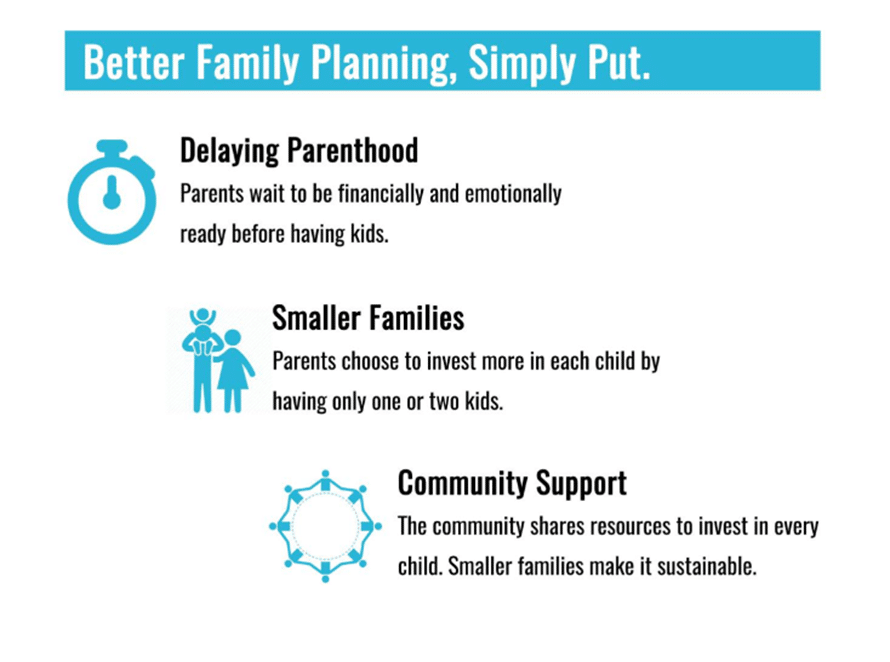
It’s simple: Fair Start family planning means smaller families sharing resources to invest more in every child. For some, the closest analog for this new model would be responsible family planning incentives. But Fair Start resources are actually entitlements held by future children, and funded through non-traditional means. Those opposed to remodeling favor our current system of unsustainable families, unearned privileges, and undemocratic influence, over giving kids a fair start in life.
All kids have a fundamental human right, ecologically and socially, to a #fairstart in life. It’s the first human right. Help us secure it against those who threaten our future.
Groups and individuals from around the world are signing on to an effort to change the old model that focuses on what parents want toward a new model that focuses on what all kids need. The new model, called Fair Start family planning, is the beginning of real social justice. The reform can begin with the United Nations secretary general simply acknowledging the need for change.
Sign on, and urge any organization you support or can influence — nonprofit or for-profit — to also sign on. Sign here, or contact us at info@fairstartmovement.org for more information.
What’s the most effective way to protect the planet and fight the climate crisis? Fair Start reproductive justice policies, which have ten to twenty times the impact of less fundamental changes. We are only in this ecological mess because world leaders failed to make sure family planning policies worked.
By 2100, world population could vary by billions of people depending on whether the average woman in the world has one child more or one child fewer.
Simply stated, the current family planning model used by United Nations was developed prior to awareness of climate change, the disproportionate impact of early childhood development on human well being, how birth conditions and early development exacerbate inequality and other factors. This old model makes our future less secure, healthy and equitable.