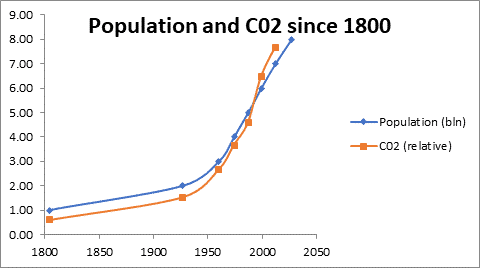
Faced with these facts Bryan’s reaction is to double-down, and simply push women to have more kids to further build the unsustainable pyramid schemes that prop up Bryan, Elon Musk and others like them. He makes four obvious mistakes in his opinion piece (framed as an article) which show the fundamental cause of the crises we face today.
He conflates economies with democracies: Per Bryan, “Declining population growth really does pose existential challenges to America, and without more children, the country really does face a future that is less innovative, less wealthy, and less vibrant.” The ideal of the United States is democracy, but inequity, growth and ecocide has degraded that ideal, and traded it for the gross domestic product (probably preference-based utility) that is the base value from which Walsh operates. He’s talking about an America of crowded shopping malls, not town halls in biodiverse nature where people are actually free. That freedom is a value we can test and measure with a simple inversion test. That inversion test – which Bryan’s proposal fails – has survived five positive peer-reviews. Bryan, conversely, has no expertise in population ethics, and his opinions conflict with leaders in this space.
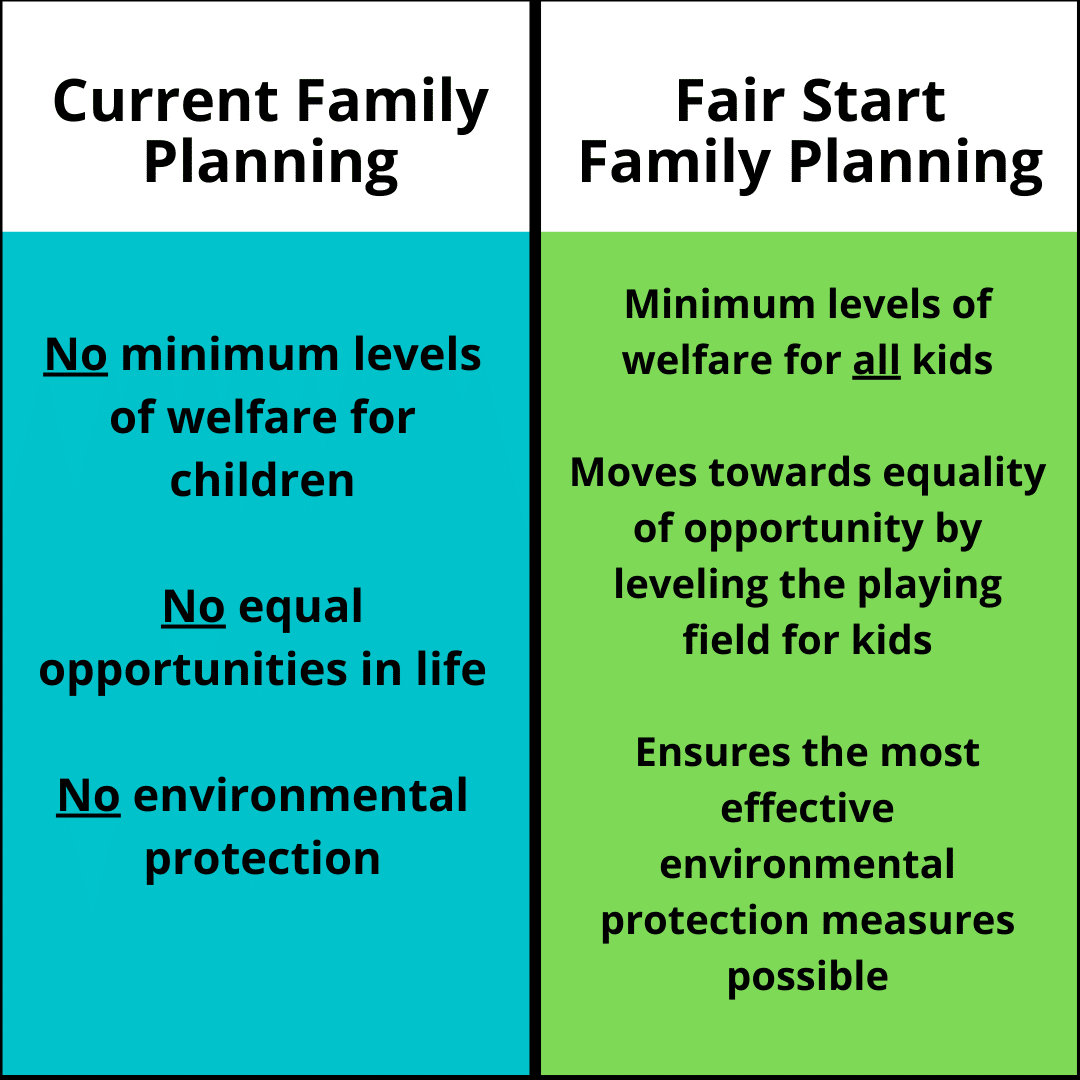
Bryan undercuts all of the values he purports to promote: Per Bryan, “[t]he progressive agenda should be about empowering people to live the lives they desire, to pursue their own path to happiness, and children can and should be part of that. Conservatives are right that a baby bust without end threatens America’s future…” Nowhere does he promote minimum levels of welfare for children, equal opportunities in life for children, restoration of nature and climate restoration, or democracy where citizens actually have influence on systems of governance. These are the basic values that comprise a good life. The United States, like most nations, has used family planning policies throughout the past several decades that treated the act of having children as a matter of parental autonomy, rather than ecosocial child equity (children have the most at stake when it comes to having kids), rather than acting in compliance with the values that underlie the Children’s Rights Convention – which is the standard by which we judge whether we are actually creating democracy. Byran’s writing reflects these mistakes.
People like Bryan Walsh can be useful in this regard, and targeting him and other powerful people publicly to show truth can save millions of lives.
Bryan is using his position to impose costs on others, relative to a democratic baseline. We can make examples of people like Bryan, ensuring they account for their role in the crises we face today, and taking from them the relative wealth and power future generations deserve as we physically constitute true democracies though climate restoration funded by birth equity redistributions of wealth. Bryan only has to address the points above in his work, or to agree to publicly debate them, in order to actually free people. He just have to tell the truth. And while the average citizen does not have the power of a Vox editor, they have the capacity to be activists, and approach Bryan and confront him simply as a citizen who is harming others.
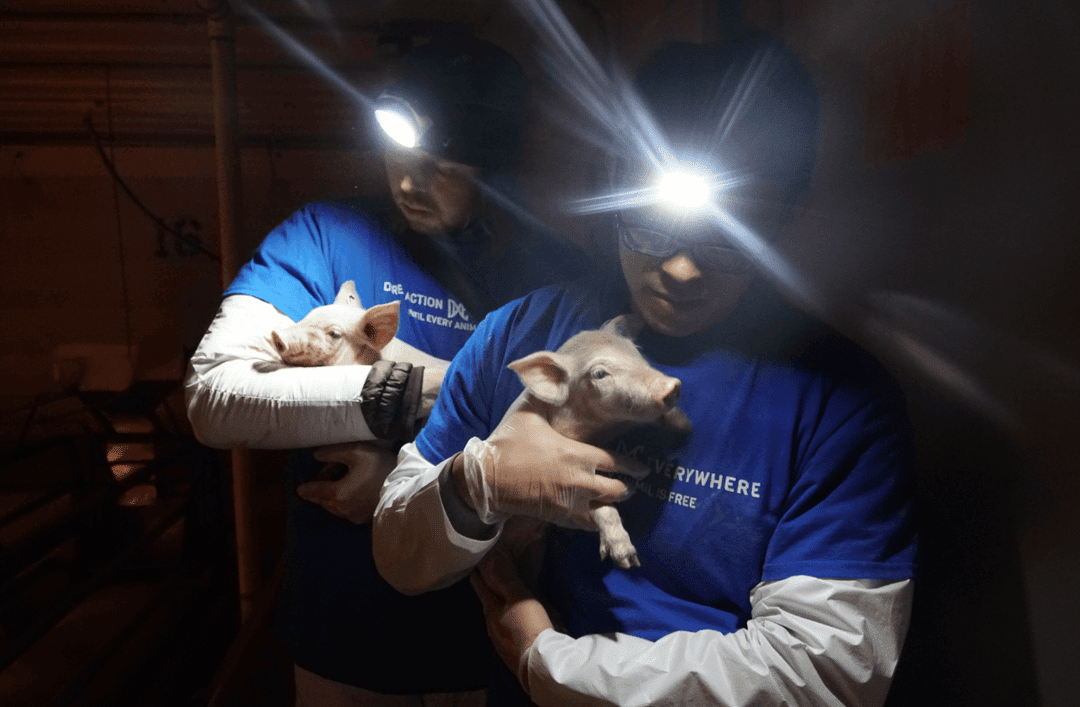
TAKE ACTION: In his article Bryan accepts that “very real suffering that will be unavoidable thanks to warming, especially in poorer countries.”: He is willing to accept the suffering of others – especially children in the global south, while protecting his own children from that suffering, and rather than taking simple steps to prevent it.
Think about that as you engage Bryan in person or online – https://www.linkedin.com/in/bryan-walsh-9881b0/, in a peaceful and lawful way, to admit his mistakes, and to pay for the benefits he and his family received in a system that was imposing costs – ecologically and socially – on others. Use him as a fulcrum to bend the arc of our species away from exploiting children for economic growth, and towards justice.
Leading literature on political theory suggests we can recoup those costs by all means effective because fair creation norms – the ensure climate restoration and birth equity – precede government’s authority to issue property rights to the contrary.
The immigration issue she raises does not alter this problem – those children will be born somewhere, and rather than exploiting them Prarthana should be promoting systems that ensure they are born and raised in ecosocial conditions that comply with the Children’s Convention.
TAKE ACTION: Urge Prarthana at her LinkedIn to change course and promote investing in children, not exploiting them for growth.
And urge Fortune’s editor here to run articles that build a better future, not more of the same thinking that created the ecocide and inequity we face today. Fortune has the resources to improve our future, or continue systems that hurt people. They should choose the future.
Don’t get scammed about which issues really matter when it comes to protecting animals. If we take animal personhood seriously their liberation should override political processes as fundamental rights do, for example, favoring a “right to rescue” over waiting for statutory personhood. But that move in isolation may threaten chaos to some who fear change. One solution?
Based on a recent Newsweek whistleblower article, use family and equity reforms to make those processes the inclusive ideal they were meant to be, building a social contract from the zero power baseline of nonhuman autonomy, and investing enough in each child as we go to limit growth in a way that preserves the influence of each law-making / self-determining voice in our democracies.
Summary
Most theories of animal law, rights and liberation focus myopically on immediate relations between humans and animals – like Peter Singer’s focus on diet, or the many large organization’s focus on animal cruelty laws. Few if any focus on fundamental legal or political theories, like theories of intergenerational justice or family law reforms, despite the fact that this area of inquiry and human behavior has the greatest impact on the greatest number of animals and shows clear alignment between human and nonhuman interest that surpass other areas of law. Scan “animal law” casebooks or other materials and you will see this, with no inclusion of basic legal theory concepts like political obligation, including theories that account for basic things like normativity, or that actually empower citizens.
That gap allowed some funders and many organizations (including academic institutes) to focus on less effective work, like food systems reform, because they are less politically risky, much easier to market, and enable profitable investments in growing industries like plant-based foods. Many benefitted from this misplaced focus at cost to animals, in what one Nobel Laureate called a pyramid scheme of growth, often lying (or greenwashing) about their impacts. This went beyond ignorance, with many entities receiving animal rights funding actually urging growth, enabling things like restrictive abortion bans. Or the use of growth-based profits to fund the popularization of growth-based philosophies that undercut nonhuman autonomy and legality at the same time.
The result is a social movement that largely ignores the fundamental driver of nonhuman animal suffering and death – the proliferation of humans over their world – the very thing that also drove the climate crisis, a thing that now threatens to cause more suffering than any human action in the history of the world. While environmental, child-welfare, and human rights and democracy movements experienced the same gap, the impact on nonhumans was the most destructive.
The myopia included blindly accepting massive generational birth inequity that is tantamount to white supremacy, and embracing macro-propertyhood of the nonhuman world which was undoing the micro-personhood benefits that many animal protection organizations routinely use to fundraise. Many calling themselves animal organizations thus chose policy areas that would benefit far fewer animals than the trillions the underlying family policies they simply accepted threatened – a form of deadly fraud.
Ask any organization or funder claiming to benefit animals how they have accounted for the impact of children being born into the world on their claims. Whether they are investing in those children, or exploiting them for growth, matters to animals. Below is a roadmap to close this gap and ensure reparative justice – the payment of actual claims – that actually liberates humans and nonhumans together by 1) inverting the movement from top down control to bottom up empowerment whereby governance is aligned with animal liberation, and 2) by temporalizing the work to account for empathy in future generations, rather than exploiting them for economic growth at cost to nonhumans.
Talking about animals rights while driving them into extinction
There are reasons to question the nature of what we often call animal law, rights, protection, welfare, etc. Just putting the word “animal” in a phrase or sentence does not help animals, and can do more harm than good.
This is a problem that can be corrected by treating animal law as inherently requiring inclusivity, and below I lay out the steps for doing so. The result is a conception of animal law that starts with our becoming, through a focus on autonomy and family reforms, a species consistent with mutual liberation. How?
We begin with the full conception of the nonhuman, liberated complete biodiversity, and the ideal of law – normativity because it is the will of the ruled. That is the genesis of unified animal personhood, and the mutuality between humans and nonhumans, and to think otherwise is to commit a fallacy.
The dominant of law, rights, welfare, protection, etc., because it can coerce results, is animal law. Impact, and for the right reasons, is what matters. Adding billions of people to the world without regard to how they will impact nonhumans, when doing that in the past created the crises we face today, and while touting laws that are riddled with exemptions and rarely enforced, is not a beneficial impact.
“Animal law” is really human law that happens to refer to animals, while excluding legal and practical protection for the vast majority of nonhumans (animals in factory farms and in research), and designating the vast majority— wildlife—as property, quietly bundled into an anthropocentric concept of the environment as a human resource designated to absorb and be altered by things like greenhouse gas emissions. That concept begins with a companion concept of future children as the property of their would-be parents that simultaneously disregards the autonomy of the nonhuman world.
That bundling is macro-propertyhood, always undoing the micro-personhood that many animal protection organizations routinely use to fundraise.
Any conception of animal law without reforming this – on balance – hurts animals, and does not address the fundamental and existential threat to nonhumans – the fact that we are replacing them.
How might our thinking of “animal law” or other terms that imply a benefit to nonhumans have been different? Were, long ago, humans to have seen themselves as equal parts of a complex ecology rather than a dominant species capable of shaping the world to its needs, we would have been obligated—in family, food, land use, and dozens of other policy areas—to limit ourselves existentially to just such an ecology.
That means smaller families, parenting delay and readiness, and redistribution to wealth to incentivize these things and ensure equal empowerment of children. This is a comprehensively effective model with a 1/2 dozen positive peer-reviews. Simply said, the same nonsense that having kids is a matter of parental autonomy rather than an interpersonal matter of constituting future societies is the same thing that degraded participatory democracy, causes mass animal suffering and extinction, triggered the climate crises, and blew a gulf between rich and the impoverished.
The solution to that, described above in bold, would have required fundamentally challenging the anthropocentric nature of our legal systems, as well as the entitlements of concentrations of wealth and power, something many of the originators of the term “animal law” and other protective terms evaded doing. To the extent Peter Singer evaded these reforms with a misleading focus on farmed animals — rather than all future animals and future persons’ relations with those animals—as the majority for whom we should be concerned if we want to maximize probability of impact, he played a large role in this misdirection. The climatological effects of that misdirection, alone, cannot be overstated, preventing family reforms that could have saved countless animal lives and creating room reforms that exacerbate the situation. Those articulating (or framing) what nature (in the case of Our Children’s Trust) or animal liberation (in the case of Singer) is, are most dangerous because they move the goalposts / cloud the ideal. Singer’s utilitarianism and focus on market preference satisfaction has enabled a humanized world. And now that the climate crisis proves he was wrong under his own standard, by likely reducing overall utility, he’s still not admitting it.
Reversing pronatal family policies now would mean a lot fewer babies being born, immediately, as the entitlements/incentives and other changes kick in (and arguably the only block to massive resource relocation is a lie about the justifiability of current entitlements that benefits us at cost to future generations). The vast majority of those babies would have not only have immediately begun to eat animals, they would have caused all the other ecocide humans cause. In a more concrete sense, the fact that our family norms would have done nothing to halt the creation of children in certain conditions, and that this in turn degrades the ecological conditions they need to survive, just seems nutty. Want to see how this works? Google this: “conviction child abuse biting,” count the stories, and you will see what I mean. If there were no way to halt these things from occurring none of this would matter. But I backing education standards into family planning and funding the process would halt them.
In other words, there is no such thing as anthropocentric animal law, unless you want to disregard the function of law—to protect its subjects. Thinking there is commits the common mistake of trying to magically separate humans from their language and ideation as well as the ecologies in which they live, a mistake with massive consequences given the climate crisis.
The misnomer argument is true for conceptual reasons, in that a fundamentally ecocentric system necessitating smaller populations of prosocial persons would have maintained the capacity to be more reflective of its human subjects, but also practical reasons—because requiring our systems to be actually inclusive of its subjects so that they can meaningfully participate, and hence ecocentric rather than anthropocentric, would have avoided much of the climate crisis which now threatens the system such “law” was meant to protect. Surely there is no concept of law, including positivism, that would not require its obligations to actually relate to and ideally reflect the inclinations of its subjects, something dependent on their actuality, their quantities and qualities. If the core condition of positivism is to treat law as obligatory because it derives from social sources, how can we do that without first accounting for people and their role in the process, e.g. their being subject to democratic attenuation through growth?
The pathway forward is to treat an ecocentric future, and democracy where the average person maintains the quantitative and qualitative capacity to actually have an impact on the outcomes, as the precondition for the legitimacy of any norms and to alter rights and obligations accordingly. This starts with family law and policy oriented around deep ecology and equity, as a pathway towards true animal law and protection. This answers the otherwise open question left by many theorists, of who the people should be that will actually carry animal-benefitting theories into action. That pathway is animal protection in the most comprehensive sense because it actually includes the full biodiversity of nonhumans, as well as the future persons with whom they would interact.
This is a pathway that could be bricked by an untold number of activists creating compelling narratives about the next big social movement, bottom up, limiting and decentralizing human power, rather than simply waiting for institutional change to come from the top down. Bottom line? We should not take a concept like law, reasonably seen as something that is the product of participatory democracies reflective of the will their constituents, which is itself a concept consistent with animal liberation when you look at the family policies necessary to achieve such systems, and pervert it to serve neither ideal.
In my almost two decades of working in “animal law” I saw the concept become a commodity organizations would use to fundraise – regardless of whether it was on balance helping animals, as if the proliferation of people using the these two words together was what we value. It should not be. Impact, and for the right reasons, is what matters. Adding billions of people to the world without regard to how they will impact nonhumans, when doing that in the past created the crises we face today, and while touting laws that are riddled with exemptions and rarely enforced, is not a beneficial impact.
When I left the Animal Legal Defense Fund in 2022 we were potentially doing more harm to animals than good, promoting the idea of effective animal cruelty laws while rarely if ever prosecuting the companies engaged in the vast majority of cruelty, undercutting direct action activists while fundraising using their hard-earned content and high-risk work, opting for family and ecological baseline policies that would put many more animals in harms way than we were taking out, and alienating the crucial social justice movements we needed in order to de-silo animal rights by ignoring the need for DEIJ reforms, changes in employment policies, and unionization.
All of this suggests the need for a certain matrix when thinking about animal law, which in its ideal form may simply be a perfectionist view of law itself, which is necessary if we are to actually account for the physical and day-to-day relations between powerful humans and vulnerable nonhumans. How do we maximize consent in those relations? (And yes, consent can be measured and quantified, much like utility, but unlike utility consent is primary, necessary to justify the governance that makes systems of utility – like economies – possible). Town halls precede shopping malls if actually take democracy seriously.
The matrix would have two axes. The first, 1) where personhood as consensual relations bookends one end of a continuum, would be 2) bookended on the other end by propertyhood (the total control of animals in a CAFO, unlimited procreative “autonomy” that appropriates future children, and anthropocentric approaches to environmentalism for example).
To be specific, there are specific actions that could further the many forms of social justice, benefitting humans and nonhumans alike: Open rescues at factory farms in extremely oppressed communities timed with Fair Start resource-demand occupations targeting the concentrations of wealth and power that own the farms; climate reparation interventions targeting pro-growth interests to pay climate restoration-level amounts to ensure birth equity; flash-mob demands that executive directors at large nonprofits who shilled for concentrations of wealth and power tell the #wholetruth about what they did.
Many advocates choose to orient from and reify unjust systems that exploit animals, rather than confronting and overcoming those systems even in simple and incremental ways. But protest and other direct action movements can be more effective than the best charities, a truism that – in the context of animals – relies on the incredible transparency activists can create.
All of this is to say that if we are going to fight for animals we owe them an examination of all assumptions, and a backing out from those assumptions to assessing raw power in its naked form, and how to limit it – for their sake and ours.
Professor Philip Alston at NY is a leader in the field the field of international human rights. But like many in the field, he has relied on a failing system has put parental autonomy over child equity when it comes to family and family planning law and policy. That has fundamentally caused the climate and inequity crises we face today.
The Children’s Rights Convention sets out what children need to physically constitute just, sustainable and legitimate democracies, and it was designed to address the fundamental or familial political relations that make up the systems we all support (through taxes and otherwise), benefit from, are responsible for, and from which we cannot separate. What we often think of as population is really a matter of fundamental power relations.
And yet the current and almost universal paradigm for family and population policy does nothing to ensure all children are born and raised in conditions that comply with the Convention. That paradigm is based on what is called the constitutive fallacy: Basing our individual obligation to follow the law on things like top down written constitutions rather than just and sustainable family policies that actually empower people bottom up to constitute just and legitimate nations, and do and should account for our actual relations and lived experiences. Law and policy derive from basic systems of rights, which are mandatory obligations.
The powerful do not need those obligations; the vulnerable, including nonhumans and future generations, do.
Philip Alston is influential. Getting him to admit that he UN knowingly used family planning policies that were illegitimate, and harmed people, would go a long way towards fixing the problem.
So if we wish to make the world a better place, we have to change the way we plan families.
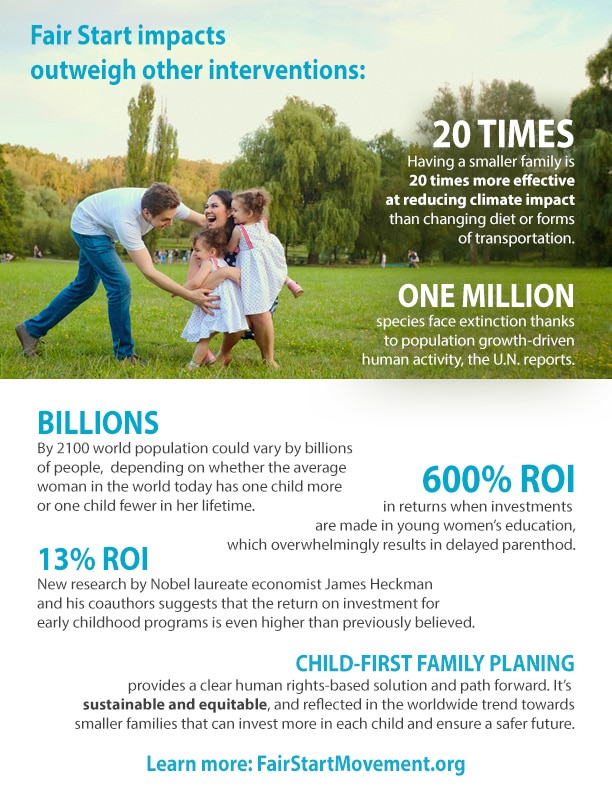
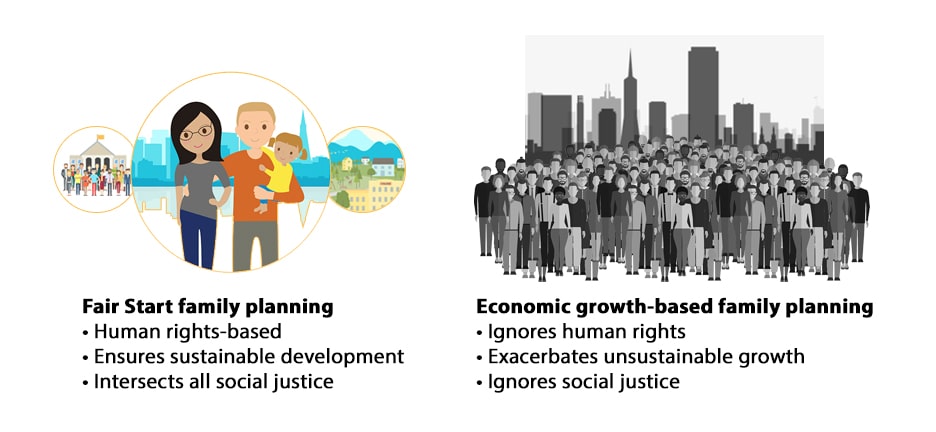
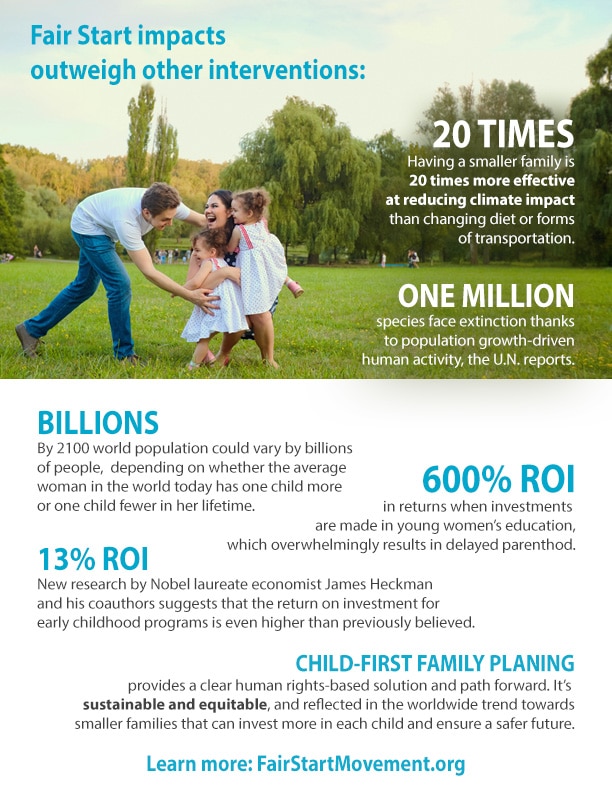
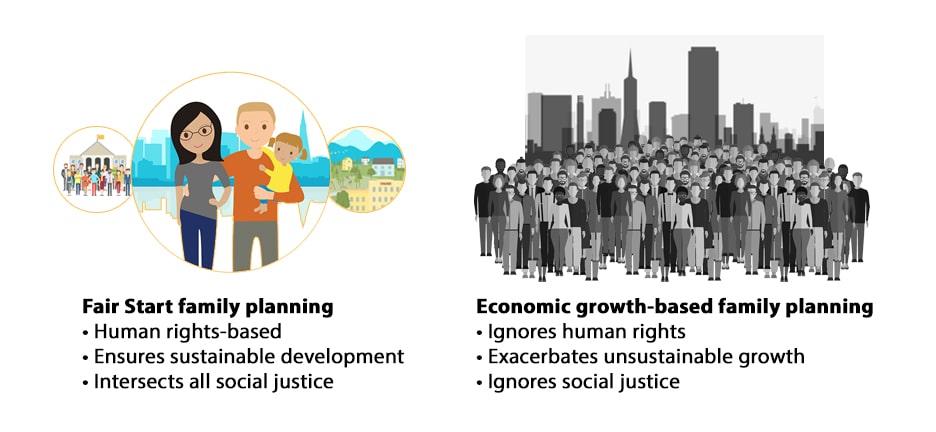
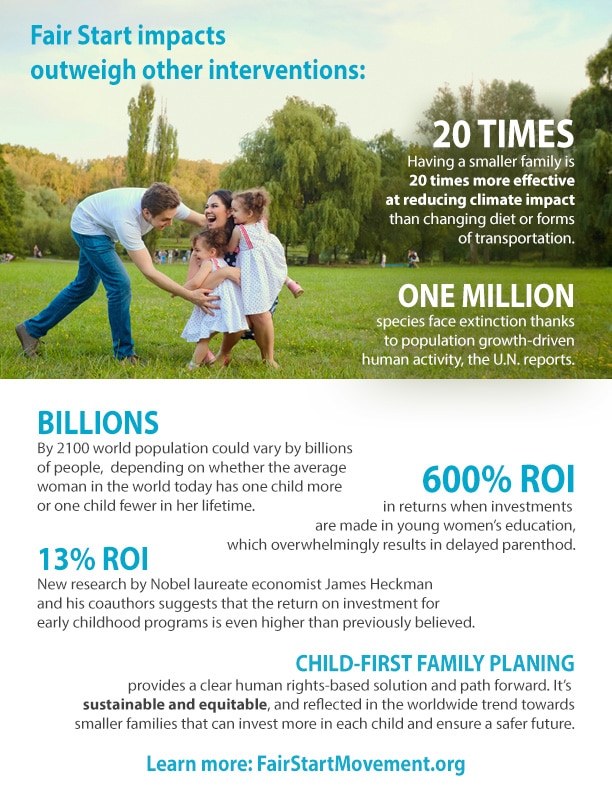
Fair Start helps shift unjust concentrations of wealth and power towards funding policies that instead empower all children with equal opportunities in life and a natural, biodiverse environment, by incentivizing and entitling well-planned, well-located, sustainable and more equitable families. In short, we promote fundamental justice and freedom by actually accounting for, and improving, fundamental power relations between people, and between people and their ecologies. This is not charity – this is fundamental justice, or ensuring that the true costs of wealth are paid back into communities in the most effective way possible.
Dietary change also does little to ensure equal opportunities among children, or to build democracy.
Here’s what to do: Almost every organization has workplace employment policies that quietly exacerbate child inequity. We can change that by urging leadership at those companies to adopt scaling of certain discretionary benefits.
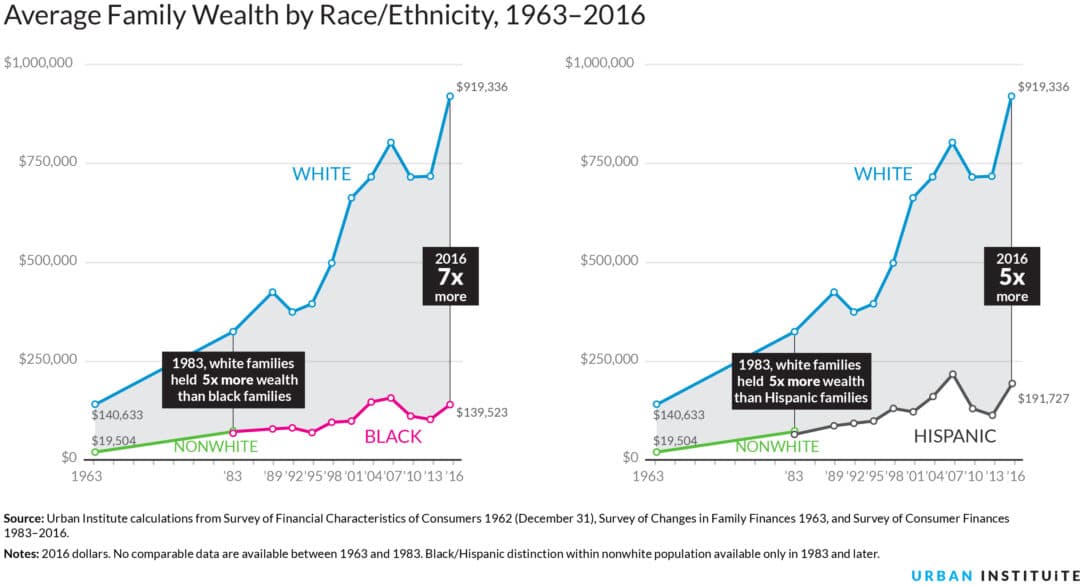
We encourage corporations, for-profit and non-profit, to adopt more equitable discretionary benefits that would start to level the playing field for the children of employees, using the base principle that discretionary benefits impacting kids should be scaled inverse to wages. We should do this to avoid passing massive privilege – including race-based privilege – through a process that fundamentally impacts the majority: future persons and nonhumans.
The Climate Crisis Happened Because World Leaders Evaded Regenerative Family Policies. Enacting Those Policies Now Is a Must Do.
Anytime you hear that something is sustainable, or even better, regenerative, consider asking the person making that claim what family policies underly it. Businesses and sham nonprofits claim to be sustainable all the time. And yet inevitably they are intentionally undoing progress on things like climate emissions by pushing population-growth policies that produce unmaintainable profits through cheap labor, and lots of consumers.
That lie – using family policies to undo with one what we do with the other – fundamentally created the climate crisis. Taking the money the lie created, from companies like Exxon, and using it to fund truly regenerative family reforms does the greatest good in the long run.
Don’t confuse chaos with freedom. Truly free people will fundamentally limit and decentralize the power (including subtle power like climate emissions, the impact of bad parenting on children and communities, massive disparities of wealth, etc.) others have over them, and by all means effective. And that limiting starts where power begins, with better family policies that focus on what children need, and the degree to which we are willing to actually empower (versus exploit) them. There is no other way to enable people in a democratic and bottom-up way. The act of deriving political obligation and freedom from something other than a just creation norm that actually accounts for fair power relations is a scam perpetrated on the vulnerable by powerful people.
Free people – on both ends of that creation – will condition their obligation to follow the law on their actually being empowered, assessed via a simple inversion test, in functional democracies where children are born and raised in conditions that comply with the democracy-building Children’s Rights Convention.
That test shows whether someone is orienting from a fundamentally just or unjust position. Fair and empowering creation is what obligates us to follow the law because it ensures we help make it. And we can start empowering people with discourse and direct action that makes property rights conditional on investing what we need in children and paying the true costs of wealth. Property is contingent on our constituting democracies where we are actually empowered – in order to obtain the resources to fund better family planning and stop things – like constant violence – that flow at the bottom from disempowerment. Many funders are recognizing this and acting accordingly, and you can too.
Fair Start is bottom-up democratic override using the first human right, rather than top-down authority.
The Ministry for the Future is a climate fiction (“cli-fi”) novel by American science fiction writer Kim Stanley Robinson published in 2020. Set in the near future, the novel follows a subsidiary body, established under the Paris Agreement, whose mission is to act as an advocate for the world’s future generations of citizens as if their rights are as valid as the present generation’s.
In contrast, the Fair Start Movement looks back toward the base cause of the climate crisis (and buttressing crises like deadly inequity): The failure of world leaders in the Twentieth Century to implement the Children’s Rights Convention and zero-baseline modeling as the standard for family policy, and as the first and overriding human right – a right that would override property rights of entities like Exxon, because such property rights can only be legitimately assigned after we have physically constituted functional democracies where people have influential voices through fair family policy.
Being free entails changing the way we create power relations at birth.
We then use a simple test to see who among us is continuing that failure, versus truly free people who are targeting concentrations of wealth and power to limit and decentralize that influence into functional systems of democracy. Limiting and decentralizing how? It involves taking back the costs that were imposed on women and children, described above.
* Special update: After writing this open letter Professor Philip Pettit of Princeton University called the claims in it “home truths” and allowed us to share his good words publicly. Take action below to urge Gerken to admit the fallacy in her work and support Fair Start legislation that moves us towards the first condition of being free.
Dear Dean Gerken,
This is a great headline: “‘You cannot be an academic or a lawyer and not believe in free speech’: Dean of Yale Law.” And the points you make are compelling. Yale Law School (YLS) is clearly taking a position on the value of free speech in the context of elevating controversial speakers, including some who might reinforce unjust hierarchies based on the history of colonization (Elon Musk leaving South Africa during apartheid with the wealth his family made under it would be an example).
YLS and its alums will have intimate knowledge of what concentrations of wealth and power – like working on or with the Supreme Court – look like, even when those concentrations are totally attenuated from the citizens over which they have authority. Would YLS take a position on ensuring liberating power relations through family reforms that should precede free speech forums, especially if the changes needed to ensure that would – by empowering people with meaningful voices in participatory democracies – would long-run mitigate the climate crisis?
And from your work on democracy, I will assume you want those relations to be formed bottom-up, in which case there seems to be only one pathway:
Free people will fundamentally limit and decentralize the power (including subtle influences like climate emissions, the slow dilution of democracy, the concentration of wealth, power and control in a few, and the impact of bad parenting on communities) others have over them. They will not allow themselves to be subject to political systems where they are not actually empowered. How do they do this? Fair Start family reforms, like climate restoration and #birthequity baby bonds to physically constitute democracy and consensual governance using an inversion test, ensure that people are actually empowered long-run – in places like town halls – to make the ultimate rules under which all must live.
This evades the undemocratic concentrations of power that – as Robert Tsai saw – prevent people from constituting true legalities by creating relationships between people that are more empowering than disempowering, relative to a neutral point, like Rawl’s original position. It evades the aborted version of freedom Joseph Raz exposed.
These reforms correct something called the constitutive fallacy: Ignoring the way our creation and development does and (assuming we use baselines like the Children’s Rights Convention) should – fundamentally – constitute actual power relations, between humans, and between humans and the nonhuman world or nature upon which freedom is based. Each person chooses to commit or evade the fallacy in every normative claim they make by accepting or rejecting particular forms of supreme political obligation like written constitutions and choosing to orient from a relatively just or unjust place. If they did not the idea that governmental authority derives from groups of people, the authority of which depends on the individuals in those groups, would make no sense. This is about the creation of power relations and relative self-determination more than “population.”
From your work I will assume you see the U.S. Constitution as supreme, perhaps limited by some form of international law. Could a more supreme norm exist in the form of whatever norm would best account for creating the people from whose authority these other norms derive?
One can imagine this process simply as using good democratic representative ratios to move toward what many see as optimal world population ranges. If government is to derive from the people, there must be a first election in which the people decide who is in their polity. Immigration/emigration might have determined that “first election” at one point, but how can we ignore family policy as a more primary form? We cannot and remain in a preconstitutional modes, choosing things like the creation of large populations in the hopes of geniuses magically emerging rather than seeing the genesis of efficiency as actually developing each child to their full capability, as long as we make that mistake.
Fair Start family reparations override because being just in who we are precedes being just in what we do. And we cannot assign things like property rights that derogate from our being (or constituting the fundamental power relations so that we are) free and equal people. Wealthy people, and the unscrupulous politicians and charities that shill for them, will hide the fallacy, and its overriding nature.
But without these reforms people will continue to try to wrongly empower themselves through acts of violence., and against the wrong targets rather than the people responsible for or who benefitted from the family policies that externalized the costs of their wealth and refuse to change course. They will harm innocents, rather than those extracting personal power from collective freedom by crowding people (including the future majority) out of town halls and into the shopping malls, the move that fundamentally created the climate and other deadly crises we face today.
Freedom requires forums of speech, like democracies, be bounded by objective norms of human rights, the first of which is the right to have children.
Help us make that right ecosocially fair, to decolonize the future and become sufficiently other-regarding to actually constitute just communities.