Category: Campaigns & Accountability

  • The most just and effective reform possible? Take legal action against illegal discounting and legitimacywashing.

    The most just and effective reform possible? Take legal action against illegal discounting and legitimacywashing.

    What’s the most just and effective reform possible? Ensuring every child a measurably fair start in life.

    Why?

    Documents like constitutions and treaties do not constitute legal obligations and nations – only people empowering others can do that, and the first necessary condition of that process is ensuring we account for the costs of ensuring all children enter the word above a “one person, one equal and influential vote” standard of democratic empowerment.

    How do we assess if the costs are being covered? Those who wish to pay the costs  can never compete against those who refuse, those who would use what one Nobel laureate called a growth Ponzi scheme, exploit infants and animals.

    Take anyone’s or any institution’s value assessments and impact claims – these are what situates them in the political system.

    Questions: Is the target making political authority and entitlement to wealth contingent on empowering those subject to these things, and first order- children entering the world? Are they constituting a just future? Are they legitimate?


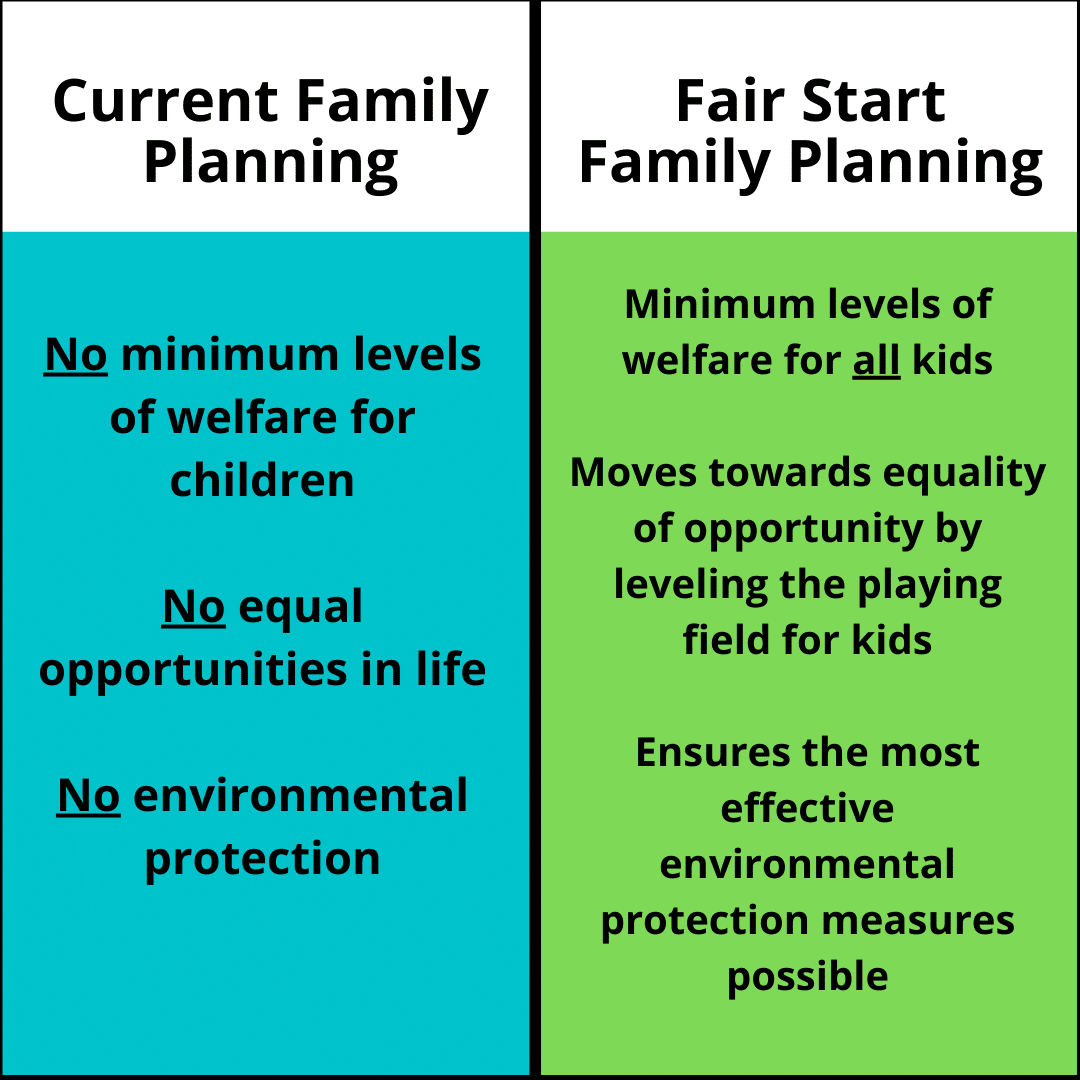
    A split infographic compares Current Family Planning with Fair Start Family Planning, listing differences in welfare, equality, and environmental protection for children, while highlighting how practices like legitimacywashing can undermine genuine progress.


    Are they #illegallydiscounting and disenfranchising future lives?

    Fact: Growing political inequity would have done more to harm their professed values than they have done to further them, and they are likely knowingly omitting the countervailing impacts of that growth in their value assessments and impact claims.

    Anyone can use any AI tool to see this clearly, contrasting claimed impact with the impact of that growth.

    Or use this great tool: FalseClaimsChecker,org


    How Do You Destroy a Planet's Atmosphere? Tell Lies. Fair Start Certification Tells the Truth Infographic

    This is called #illegaldiscounting, a cost/benefit analysis that uses a false premise – legitimate obligation in a legal system that does not empower those subject to it – to enable certain business models.

    It is the inherited practice of the illegal conversion of political freedom into market freedom through an almost universal reproductive rights policy / creation ethic that treats having children as more self-determining form the parents than the child created. Welfare gains and market values do not offset the loss of freedom  – the  loss of objective, measureable self-determination – that the discounting requires. 

    Illegal discounting entails assuming children deserve what they are born with rather than what their rights and political equity require and discounting costs accordingly. It also involves assuming the legitimacy of a political system in which children of color receive a fraction of what white kids get.

    It derives from the privatization of the creation of power relations, an inversion of the meaning of self-determination, by corrupt leaders in the human rights regime decades ago. These leaders subverted racial justice and decolonization efforts by maintaining “separate but equal” ideologies, and the protection of mostly white generational wealth, in the reproductive rights regime over intergenerational justice and a threshold for democratic empowerment of future children.

    The standard does not require claimants to actually further the values they claim, and ignores the need for an objective standard – like a “one person, one equal and influential vote” metric – of who we humans should be.This corruption fundamentally created and drove the polycrisis, in part, because public interest became a race to the bottom, with doing good simply meaning doing better than the terrible actors around us. Instead, the objective standard could have ensured anti-legitimacywashing efforts, a much more evolved concept than greenwashing or humanewashing which deal with problems downstream, rather than upstream and preemptively. Those who refuse to discount could never compete against those who do, using wealth made by not paying the costs of child empowerment / legitimate political systems to continue that process.

    Climate change solutions that magically enrich some children at deadly cost to others are not solutions at all.

    The corruption decoupled political representative ratios from ecological carrying capacities – the resulting inequitable and unsustainable growth – what one Nobel laureate called a Ponzi scheme – has been catastrophic, ensuring vast inequity and ecocide, and moving the freedom and self-determination of many into the banks accounts of a few. That wealth now funds a fantasy world of misleading public impact claims to hide the illegitimacy, with sensational micro victories hiding how daily growth undoes the benefits.

    This enriches some illegally, at deadly cost to others.

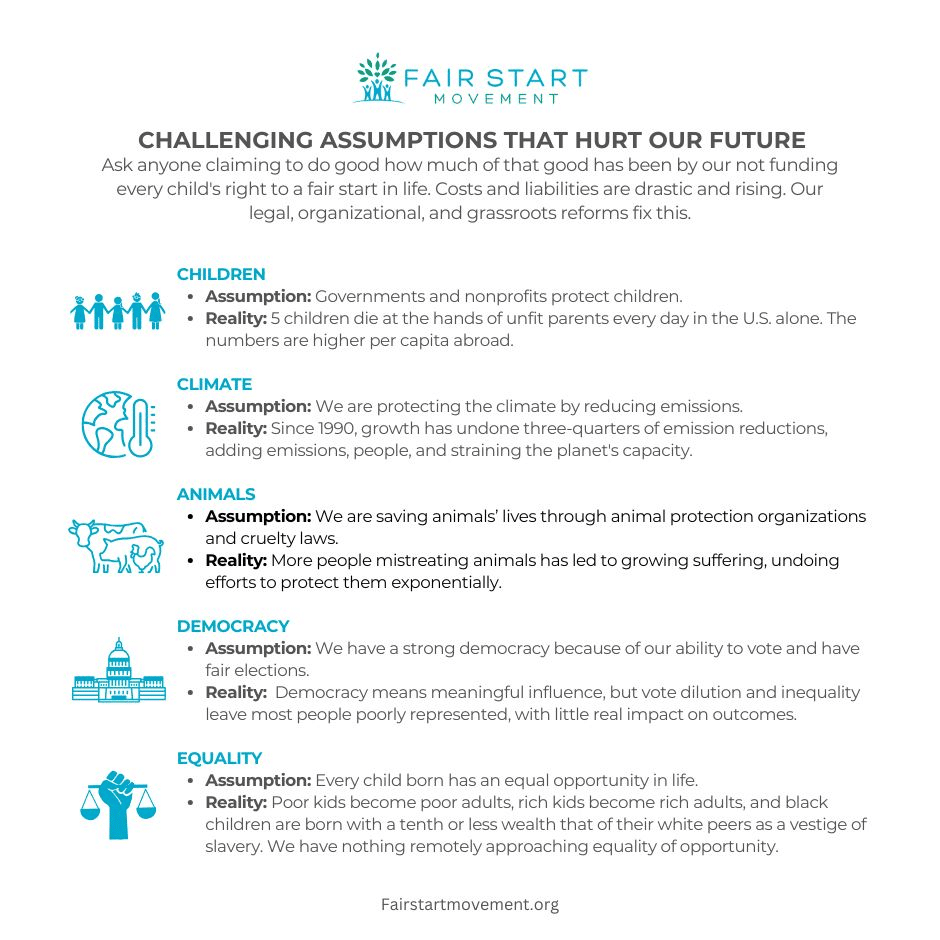
    Infographic from Fair Start Movement detailing how funding every child’s right to a fair start benefits children, climate, animals, democracy, and equality—with brief descriptions and relevant icons for each topic—while highlighting the need to avoid practices like legitimacywashing that can undermine genuine progress.

    It skews the baseline for things like climate reparations by as much as five times, minimizing life-saving liability because it does not account for actual, or birth-based power relations. Instead it looks at them abstractly.

    This has a disenfranchising and discriminatory impact on future generations, relative to things like democratic representative ratios and ecological carrying capacities.

    And it flows from bad research, that led to bad policy:

    If lawyers had gotten it right, economists would not have been able to discount future lives because to be legitimate, legal systems have to maintain “one person, one equal and influential vote” entry threshold under standards for intergenerational justice. Lawyers (like Heather Gerken, former Dean of Yale Law School) did not, and do not, get it right because they intentionally use the legal fiction of reproductive autonomy to block the threshold, and free ride on arbitrary birth positionalities, as well as concentrations of power and wealth (the endowments as Yale, and Ford Foundation, for example) made by not ensuring the threshold, in a way that erodes all of our freedoms and right to self-determination.

    It would be physically impossible to be free / self-determining if we do not now move that wealth to now elevate the threshold, with markers like democratic representative ratios linked to ecological restoration, racial equity etc.

    Those moving the wealth are not being altruistic. They are defending their own political freedom, a reason that has historically, and does today, allow extreme measures.

    Here is what we can do to stop it:

    Take anti-greenwashing legal frameworks and look for #legitimacywashing instead.

    Illegal discounting violates unfair competition and civil rights laws because it disenfranchises future generations relative to a zero / legitimate baseline, and is inherently deceptive and discriminatory.

    It is preemptively illegal, under constitutional law, because the authority to govern derives from the need to empower those subject to that authority. Illegal discounting converts the possibility of democratic participation into unsustainable, inequitable and disenfranchising growth by discounting the lives of future children beneath a threshold of democratic empowerment.


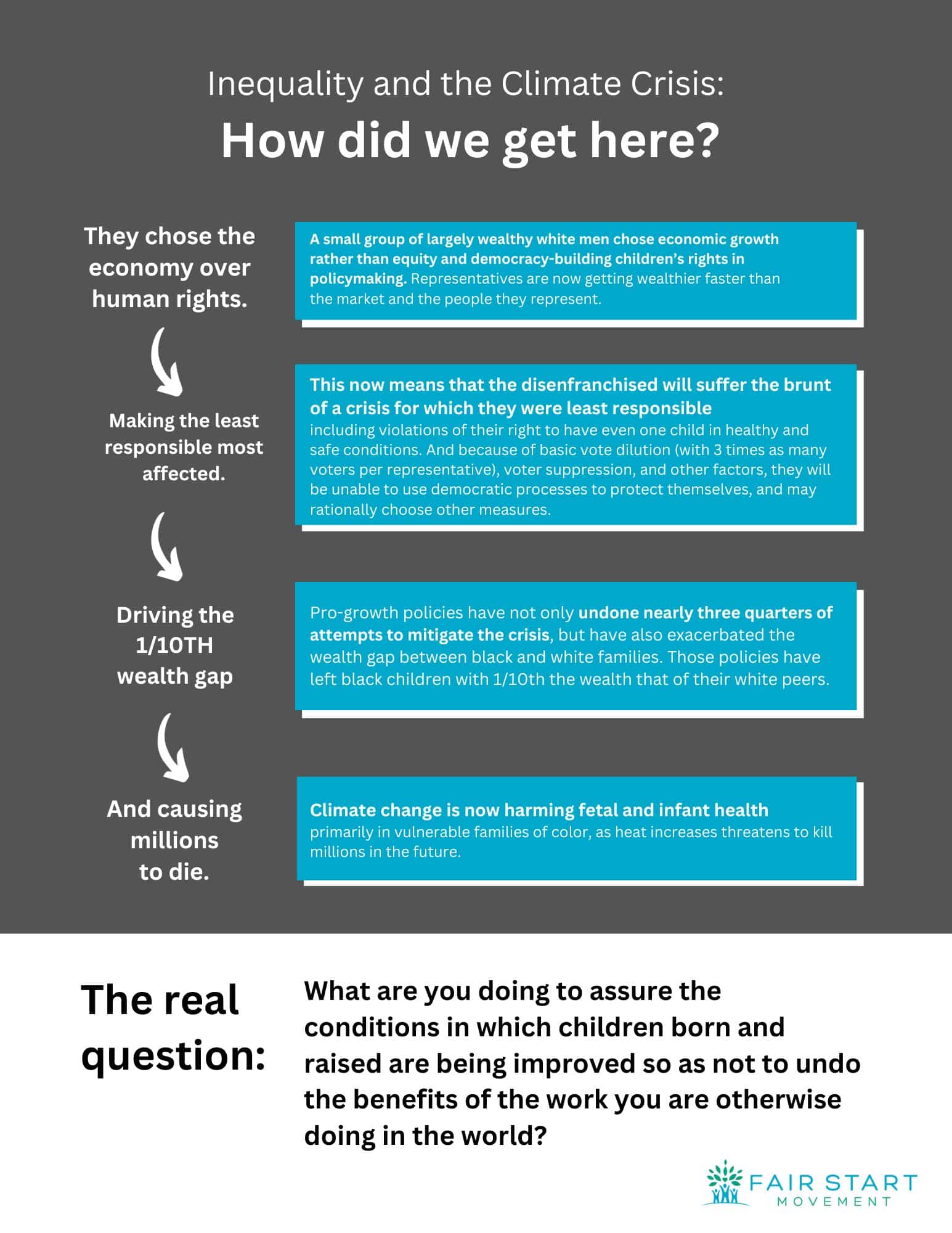
    Infographic titled Inequality and the Climate Crisis: How did we get here? with text blocks explaining causes like prioritizing economy over rights, disenfranchisement, ignoring the 1/10th wealth gap, and impacts on families. It also highlights how practices such as legitimacywashing contribute to the problem by masking systemic failures under a veneer of responsibility.


    Major philanthropic institutions and nonprofits in the United States and Europe use it to preserve status quo generational wealth, over the public interest values they proclaim.

    That means the same institutions that claim to be fighting climate change have for decades been discounting the damages in things like public interest litigation, in some cases with as much as one fifth the accurate damage assessment.

    This is the primary ethical, moral, political, legal question, and because it is existential: Are we valuing others enough to make our benefits and obligations contingent on their empowerment?

    What would it take to empower children as they come into the world with a representative ratio pegged to restorative ecological carrying capacities, and racial/political equity?


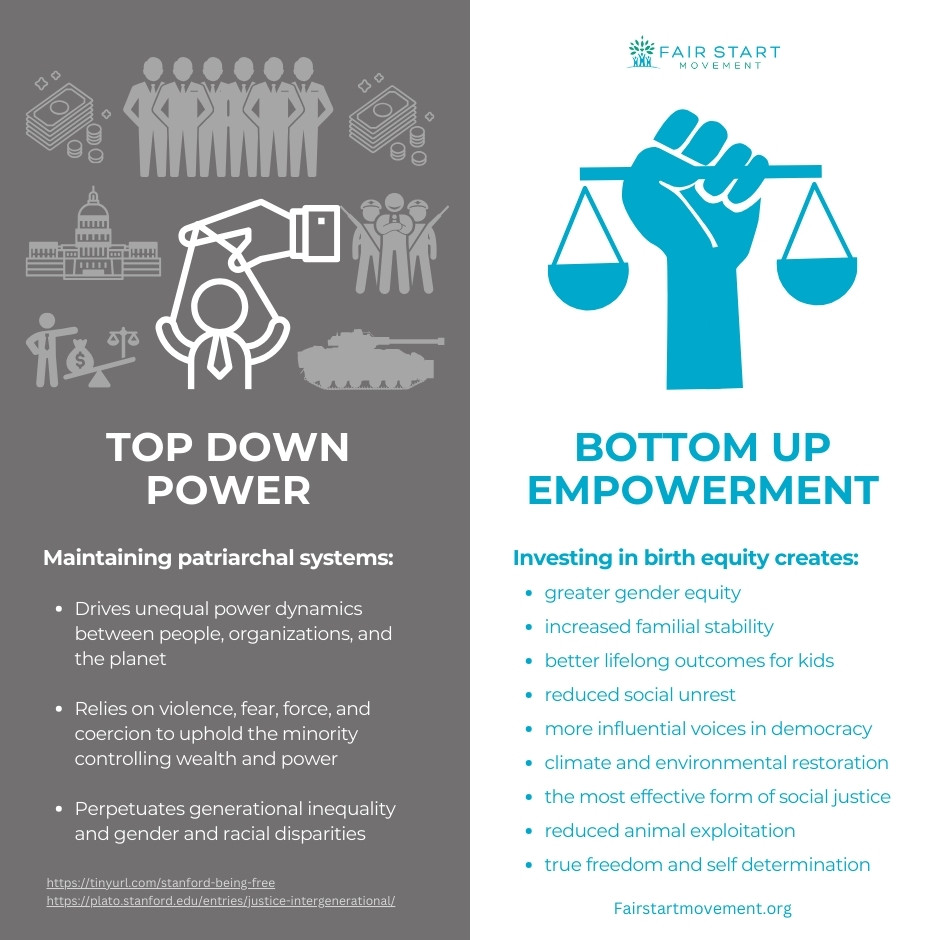
    Top Down Power and Bottom Up Empowerment


    Then challenge the claims and business models as illegal under unfair competition, civil rights and constitutional law. Only this tests whether political authority and entitlement to wealth is contingent on empowerment. Only this accounts for the inseparability of values from obligation.

    The University of Denver recently returned $250k to a funder because of their illegal discounting in regards to their animal law program.

    Read the complaint about that here.

    Fair Start Movement is now assisting Truth alliance.global to make its own claims against the school for the harm it suffered.

    In circles of funders and advocates dedicated to animal protection the question of whether organizations are illegally discounting (ID), devaluing the future lives of animals in their business modeling, is a real issue.

    Those who have benefited from the racist and deadly Anthropocene, and still choose to maintain it through law and policy, are not benefiting animals, and – given the numbers of vulnerable entities involved – are the worst example of the “winners take all” phenomenon of those in power pretending to be leaders in justice.

    How it works in animal protection (much like a Ponzi):

    Funders create their wealth based on inequitable and unsustainable growth – by not paying the costs of empowering children or evading the climate crisis, by discounting black lives, etc. By using illegal discounting, those taking in the wealth do more harm than good to objective values, like animal protection. Fact: The growth creating the wealth kills more animals than as philanthropy it saves.

    The funder then invests in the growth-based food or materials industry to make money, funds nonprofit organizations to create market preference for vegan products through downstream activism (distractivism) – after the harm has occurred, and more animals go into the system with more harm to the environment.

    The funder and their wealthy kids walk away with the proceeds, the activists get paid their salary and their egos get fed, and animals and vulnerable communities are worse off.

    Corrupt lawyers look the other way.


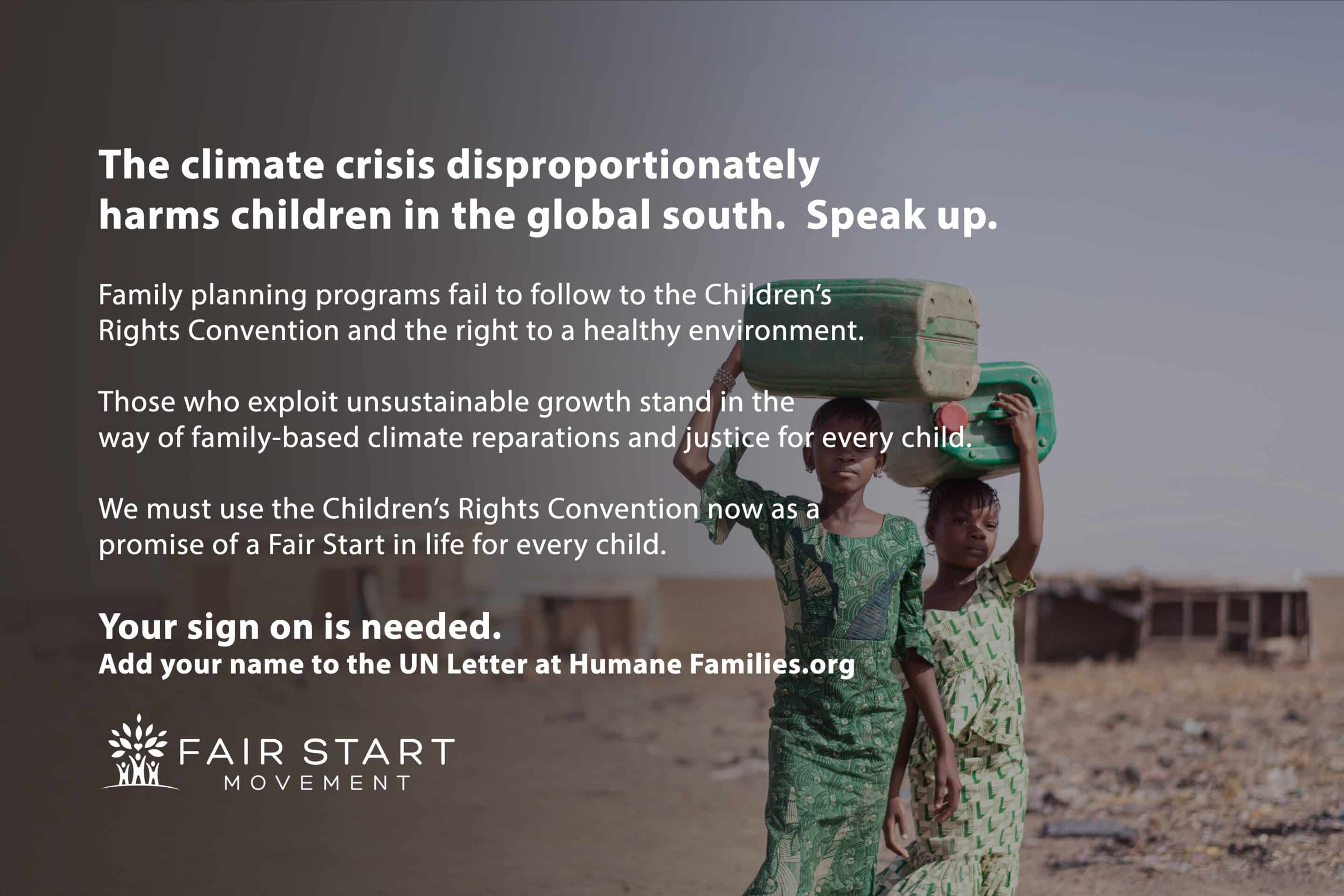
    Climate crisis infographic


    Trump and those like him (mostly white generational wealth) win, because instead of animal protection blocking the inequitable and disenfranchising growth that created him, the animal protection movement enables the growth by creating a fantasy world of downstream victories to hide it.

    Anyone can analyze animal protection claims against inequitable growth (which is tantamount to loss of political equity at a level of illegitimacy) to see this.

    I’ve seen undergraduate students spot the Ponzi. And I’ve seen them understand that fundamental or preemptive causation – because who we should be precedes what we should do, as a premise – would apply to legal cases against the fraud.

    This discounting has gone on a long time, but as the climate crisis death count rises, so does the liability of those engaged in this, and we may be reaching a point where key targets/examples start to fall. This will transition the driver or philanthropy not from charity to investment, but from investment to liability for the polycrisis.

    Anyone can take similar action against similar targets. Learn more here and join the Constitutional Challenge campaign. 

  • An Open Letter from Truth Alliance –  The Denver Model, Equal Valuation of Life, and the Urgent Need for a Fair Start for No Child is worth more than another.

    An Open Letter from Truth Alliance – The Denver Model, Equal Valuation of Life, and the Urgent Need for a Fair Start for No Child is worth more than another.

    To the University of Denver, its leadership, faculty, students, funders, alumni, and the wider public,

    Truth Alliance writes to raise a fundamental concern about how institutions model, value, and report the impacts of their work on people, animals, communities, and future generations.

    We believe the University of Denver’s traditional modeling approach, as we understand it, risks reproducing a “separate but equal” system of valuing life, one in which the interests of some populations, children, communities, animals, or generations can be assigned greater weight than others. In our view, this approach is incompatible with the principle that every child and every human life must be treated with equal dignity and concern.

    We refer to the prior letter Fair Start sent the University.

    Our concern is not simply about one academic model or one institution. It is about the broader consequences of using systems that discount the lives of future generations or treat certain populations as less valuable when calculating public impacts. When a model places a different value on a child’s life because of where that child is born, the wealth of their family, their race, their nationality, or the generation into which they are born, the result can be a deeply unequal distribution of protection, resources, and opportunity.

    Truth Alliance believes that no child is worth more than another. That principle must be reflected not only in constitutional law and civil rights but also in the models, policies, economic calculations, and institutional decisions that shape the future.

    The Question of Public Impact

    We are particularly concerned about the consequences of impact-reporting systems that fail to adequately account for harms imposed on future generations and communities already facing the greatest risks. If a model systematically discounts future life, then the suffering of children who have not yet been born may be treated as less important than the interests of people living today. If the model also fails to account for historic inequalities, the result can be a system that effectively transfers costs from those with greater power to those with less power.


    Family Planning info card


    This is especially alarming in the context of the climate crisis.

    Africa contributes a relatively small share of historical global greenhouse-gas emissions, inequalities yet African children and other global south communities are among those facing severe consequences from climate change. The impacts include:

    • Rising temperatures and increasingly dangerous heat.
    • More frequent and prolonged droughts.
    • Unpredictable rainfall and changing seasons.
    • Crop failures and declining agricultural productivity.
    • Food insecurity and malnutrition.
    • Water scarcity and competition over limited water resources.
    • Livestock losses and threats to pastoral livelihoods.
    • Flooding and destruction of homes and infrastructure.
    • Soil degradation and desertification.
    • Loss of forests, biodiversity, and wildlife habitats.
    • Increased displacement and climate-related migration.
    • Greater risks of disease and public-health emergencies.
    • Disruption of children’s education.
    • Increased poverty and loss of household income.
    • Greater risks to women and girls, particularly in vulnerable communities.
    • Increased conflict and competition over natural resources.
    • Loss of cultural heritage and traditional livelihoods.
    • Growing pressure on already weak health and social-protection systems.
    • Greater exposure of children to long-term and intergenerational harm.

    These are not abstract statistics. They represent real children, families, and communities whose futures are being shaped by decisions made today.


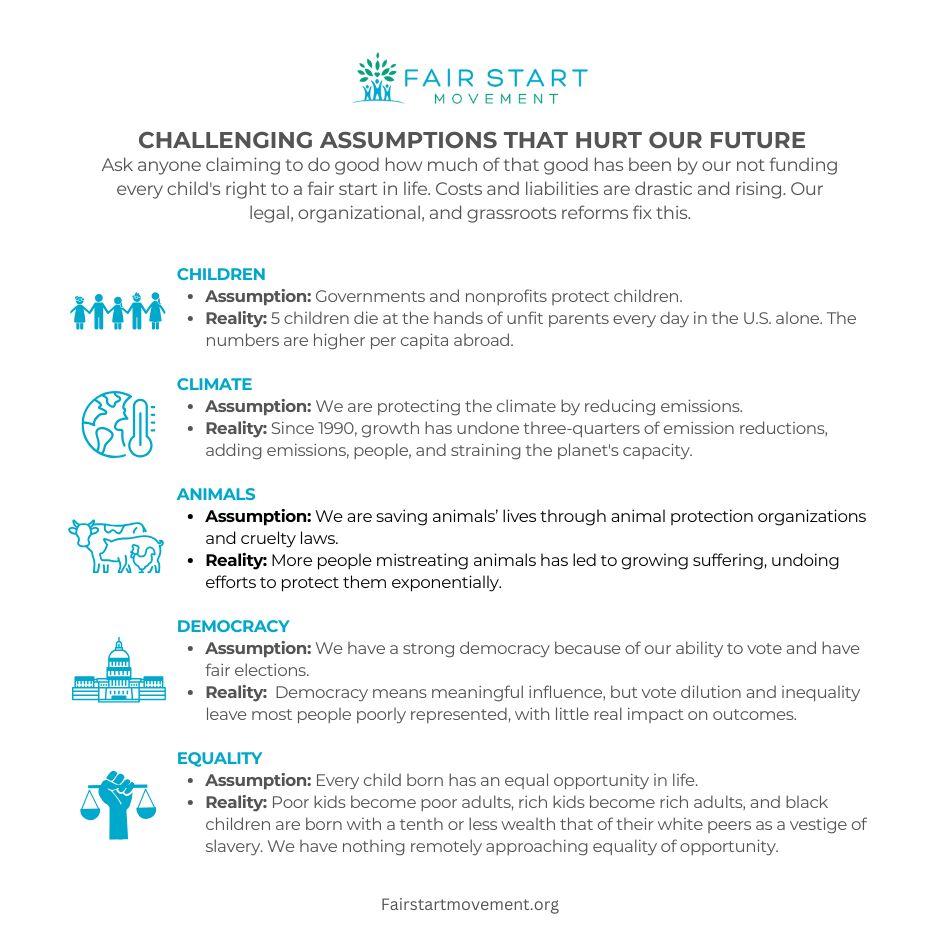
    Challenging assumptions that hurt our future infographic

    A Call for a Different Standard

    Truth Alliance believes that the solution is not simply to improve one model at the margins. Institutions must reconsider the underlying assumptions that determine whose life counts, whose suffering is measured, and whose future is protected.

    We therefore call on the University of Denver and other institutions engaged in public-impact modeling to examine whether their methodologies adequately protect the equal dignity and value of all people including children not yet born. We believe there is an opportunity to move from models that may discount future life toward a Fair Start standard based on the principle that no child is worth more than another.

    Such a framework would seek to ensure that:

    1. Every child is treated as having equal inherent value.
    2. Future generations are not systematically discounted simply because they have not yet been born.
    3. Public policies account for long-term and intergenerational harm.
    4. Historical inequalities are not hidden by statistical assumptions.
    5. Communities facing the greatest risks are not treated as acceptable recipients of disproportionate harm.
    6. Public-impact assessments recognize the full human consequences of environmental, economic, and social decisions.
    7. Institutions are transparent about the assumptions built into their models.
    8. Children and affected communities have a meaningful voice in decisions that determine their future.

    The Cost of Inaction

    Truth Alliance is concerned that failing to reconsider these approaches could contribute to continued and unimaginable harm particularly for children and communities already living at the margins of global protection. When institutions normalize the discounting of future life, the consequences do not remain inside classrooms or academic papers. Models influence policy. Policy influences investment. Investment influences infrastructure. Infrastructure influences communities. And these decisions ultimately shape who is protected and who is left exposed.


    The question before us is therefore not merely technical.

    It is moral.

    It is legal.

    It is constitutional.

    And it is about the future of humanity.

    Truth Alliance and its members believe that a child’s value cannot depend on geography, wealth, race, nationality, generation, or economic status.

    We call upon the University of Denver to engage openly with these concerns, review the assumptions underlying its models and public-impact reporting, and explore a new approach that places equal human dignity at the center of institutional decision-making.

    We further invite scholars, civil-rights advocates, children’s-rights organizations, climate-justice movements, African communities, and affected families around the world to join this conversation.

    The future should not be built on a system that treats some lives as more valuable than others.

    No child is worth more than another.

    That is the standard we believe the law, civil rights, climate justice, and public policy must ultimately uphold.

    Truth Alliance
    No Child Is Worth More than Another

  • Fighting For The Future Saving Animals, Nature, Future Generation, the Real Truth, a Letter Harvard – Letter Included

    Fighting For The Future Saving Animals, Nature, Future Generation, the Real Truth, a Letter Harvard – Letter Included

    Right now, across the world, people are beginning to open their eyes and realize something bigger is happening. We are being told humanity is progressing, that justice is advancing, that the world is becoming fairer — yet every day I see people struggling to survive, wildlife losing habitats, children being born into inequality, and entire ecosystems pushed closer to collapse.

    Dying zebra from climate drought and starvation with two people looking concerned

    People are no longer just looking for hopeful words and polished campaigns. They are looking for truth. Real truth. Because if we truly want to save animals, protect people and give future generations a fighting chance, then we must have the courage to ask whether the systems shaping this world are actually creating meaningful change — or simply becoming better at marketing the appearance of it.


    having kids vegan

    That is the deeper conversation now being raised by the Fair Start Movement in relation to Harvard University and what the organization describes as a “fantasy world of social justice undone daily by birth inequity.”

    This is not about attacking good people.

    There are countless students, researchers, activists and educators who genuinely want to make the world better. Many dedicate their lives to helping vulnerable communities, challenging injustice and fighting for equality. That work matters. But the wider concern being raised is whether some institutions have become too focused on presenting narratives of progress while failing to fully confront the structural systems continuing to produce inequality underneath the surface.

    And that matters more than ever right now.

    The Fair Start perspective argues that many social justice institutions focus heavily on downstream solutions — programs, campaigns, reforms, diversity initiatives and public advocacy — while the upstream conditions driving inequality continue growing stronger every year.

    In simple terms, we may celebrate individual victories while the larger system producing suffering remains largely untouched.

    climate crisis kids

    That is where the idea of “birth inequity” becomes central.

    The argument is that children are not entering the world on anything close to equal ground. Some are born into safety, wealth, opportunity and political influence. Others are born into poverty, instability, environmental decline and systems already stacked against them from the beginning.

    Mom with newborn baby; love

    And as climate instability, economic inequality and ecological collapse intensify globally, those gaps only grow wider.

    The concern being raised is that institutions can sometimes unintentionally create the appearance of meaningful progress by measuring outputs rather than genuine net outcomes. A university can point to programs launched, scholarships funded or initiatives promoted, but the deeper question remains: are the structural conditions affecting future generations actually improving overall?

    Because that is the truth people are beginning to search for now.

    Not branding.

    Not polished narratives.

    Not carefully managed public relations.

    Truth.

    The reality is that across the world we are seeing ecosystems pushed to breaking point. Wildlife is disappearing at terrifying speed. Communities are struggling under economic pressure. Young people are growing up with uncertainty about their future, while millions of children are born into conditions where survival itself becomes harder every single year.

    And yet many institutions continue presenting narratives that suggest society is steadily moving toward fairness and sustainability.

    That disconnect is what people are starting to question.

    For those of us working directly with wildlife and vulnerable communities, these realities are impossible to ignore. I see firsthand how deeply connected everything is. When forests disappear, communities suffer. When inequality grows, ecosystems come under pressure. When people are desperate, wildlife suffers too. The survival of humanity and the survival of nature are tied together whether we acknowledge it or not.

    That is why transparency matters.

    Not to tear institutions down.

    Not to shame people trying to help.

    But to ensure that the work being done in the name of justice, sustainability and equality is actually capable of creating long-term change in the real world.

    The Fair Start discussion ultimately asks a powerful question: are institutions willing to fully examine whether the outcomes they promote publicly still hold true once the wider baseline realities are honestly accounted for?

    Because if we truly care about future generations, then we cannot build systems based only on appearances.

    We need courage.

    The courage to question whether the current path is truly sustainable.

    The courage to confront uncomfortable truths about inequality, growth and ecological decline.

    And the courage to build a world where justice is not simply something spoken about in lecture halls or campaign slogans, but something reflected in the actual conditions people, animals and future generations are living through every day.

    That is the kind of future worth fighting for.

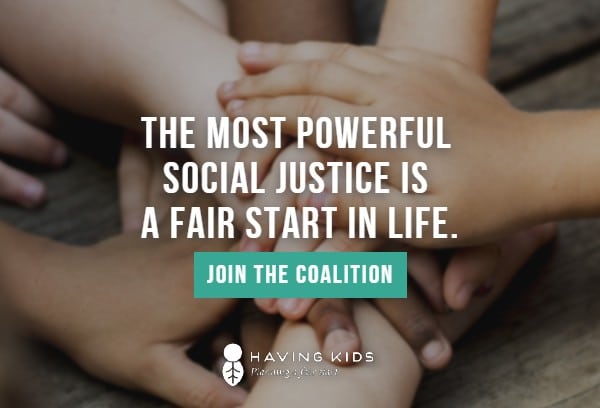
    Several childrens hands placed together in a supportive gesture over a wooden surface, with text reading, The most powerful social justice is a fair start in life. Join the coalition. Logo and Having Kids appear at the bottom.

    A future built not on illusion, but on truth.


    Letter –

    May 8, 2026

    Attorney General Andrea Joy Campbell
    Office of the Attorney General
    Commonwealth of Massachusetts
    One Ashburton Place, 20th Floor
    Boston, MA 02108

    Re: Request for Attorney General Review of Directional Impact Representations and Baseline Omission in Massachusetts Animal-Welfare Institutional Communications Under Chapter 93A

    Dear Attorney General Campbell,

    Fair Start Movement and TruthAlliance.global submit this letter to request review and guidance concerning a specific and recurring pattern in Massachusetts-based institutional communications: the creation of a directional impression of progress through public-facing language that does not disclose the baseline conditions necessary to interpret whether that progress is occurring on balance.

    This submission is narrow and disclosure-focused. It does not allege improper motive, and it does not dispute that the institutions discussed perform real work, expend real resources, and achieve identifiable outputs. The issue is whether public-facing representations—particularly those that operate in donor-facing, student-facing, or credibility-bearing contexts—are structured in a way that invites reliance on an implied trajectory of improvement without providing the baseline information required to evaluate that implication.

    The concern arises from a consistent pattern across multiple Massachusetts institutions. Language is often framed carefully to avoid explicit, measurable outcome claims. Terms such as “committed to,” “working to,” and “seeking to advance” appear frequently in institutional descriptions of animal-law programming and advocacy. At the same time, that language still communicates something to a reasonable reader. It conveys forward motion. It signals that progress is being made, or at minimum that support for the institution contributes to that progress. That signal influences behavior. It shapes donation decisions, student enrollment, partnerships, and policy attention.

    The problem is not the use of aspirational language itself. The problem is that the directional impression created by that language is not accompanied by the context needed to determine whether the implied progress is occurring when broader conditions are taken into account. Public-facing materials do not typically disclose the scale of countervailing forces—continued expansion of animal agriculture, growth-driven demand, ecological degradation, and structural conditions that perpetuate harm across generations. Without that context, the impression created by the language may be materially incomplete.

    This dynamic becomes more pronounced where institutions move from aspirational phrasing into definitive outcome language. In Massachusetts, MSPCA-Angell provides a clear example. The organization describes itself as “positively impact[ing] the lives of tens of thousands of animals each year” and as driving “meaningful, systemic change.” These are present-tense outcome statements. They communicate that impact is occurring and that systems have changed. At the same time, the organization has publicly disclosed that it no longer tracks the metrics used to measure its results. The combination of definitive outcome language and the absence of outcome measurement creates a gap between the impression conveyed and the substantiation available. That gap is not theoretical. It exists at the point where donors decide whether to contribute, and where the public decides whether progress is being achieved.

    A similar issue arises with quantified claims made by Humane World for Animals. Statements that millions of meals have been transitioned or that over a million animals have been improved are specific and concrete. They communicate progress through numbers. But those numbers operate within a broader system that is not disclosed alongside the claim. If the total scale of animal agriculture or confinement grows by more than the improvements cited, the directional impression created by the numbers may not reflect the net trajectory. The claim itself may be accurate in isolation. The impression created by the claim, absent baseline context, may still be incomplete.

    Across these examples, the same structural issue appears. Public-facing communications operate at the level of narrative, while the conditions necessary to interpret that narrative—what is counted, what is excluded, what baseline governs the claim, and how competing forces affect the outcome—are not disclosed at the point of reliance. This is the baseline omission problem. It is not a dispute about values. It is a question of whether the information environment in which decisions are made is complete enough to support those decisions.

    Massachusetts General Laws Chapter 93A provides a framework for addressing this issue. The statute does not require that a statement be literally false to be actionable. It encompasses conduct that creates a misleading impression through omission of material information. Where a representation invites reliance and the meaning of that representation depends on context that is not disclosed, the omission may be material if it would change the understanding of a reasonable audience.

    In this context, baseline conditions are not peripheral details. They are the elements that determine what the claim means. They define whether a statement reflects activity, projected contribution, or demonstrated net outcome. When those elements are absent, the resulting impression may be incomplete in a way that affects decision-making.

    This submission therefore requests that the Office consider whether directional impact representations in Massachusetts animal-welfare communications should be evaluated under a material-omission framework when they omit baseline conditions necessary to interpret implied progress. The request is not for punitive action based on isolated statements. It is for a structured review of whether current practices create reliance risks that can be addressed through disclosure.

    Specifically, we request that the Office consider initiating a Chapter 93A review of how animal-welfare institutions in Massachusetts communicate impact and progress, with attention to whether those communications distinguish between program outputs and net outcomes once baseline conditions are accounted for. We further request consideration of whether guidance should be issued clarifying that aspirational and outcome-oriented language can create materially incomplete impressions when baseline conditions are omitted.

    In addition, we request that the Office review MSPCA-Angell’s use of definitive outcome language in light of its disclosed cessation of outcome measurement, and that it examine whether quantified claims by Humane World for Animals create directional impressions that are supported when evaluated against broader system-level trajectories.

    The remedy sought is disclosure-forward and corrective, not punitive. The objective is to ensure that when institutions communicate impact, the public is provided with the information necessary to understand what that impact means and what it does not mean. This can be accomplished through baseline disclosure: clear statements of what is counted, what is excluded, the time horizon used, the presence of uncertainty, and the distinction between outputs and net outcomes.

    Fair Start’s Tell the Truth framework provides one model for this approach. It asks institutions to align public claims with the baseline conditions that determine their meaning, so that reliance is based on complete information rather than directional impression alone. The framework is designed to be applied cooperatively, allowing institutions to maintain their advocacy while improving the clarity and integrity of their communications.

    We recognize that the institutions discussed are respected and perform meaningful work. This request does not challenge that work. It addresses the structure of the information environment in which that work is presented. Where public trust is involved, clarity is not optional. It is the condition that allows that trust to function as intended.

    We respectfully request confirmation of intake and identification of the division or bureau assigned for review.

    Respectfully submitted,

    Suriya Khan
    Fair Start Movement / TruthAlliance.global
    suriya@fairstartmovement.org
    516-725-3157

  • Inequality, Philanthropy, Animal Protection, The Letter To Yale

    Inequality, Philanthropy, Animal Protection, The Letter To Yale

    There is a growing conversation happening across the world about justice, inequality and the stories institutions tell about progress.

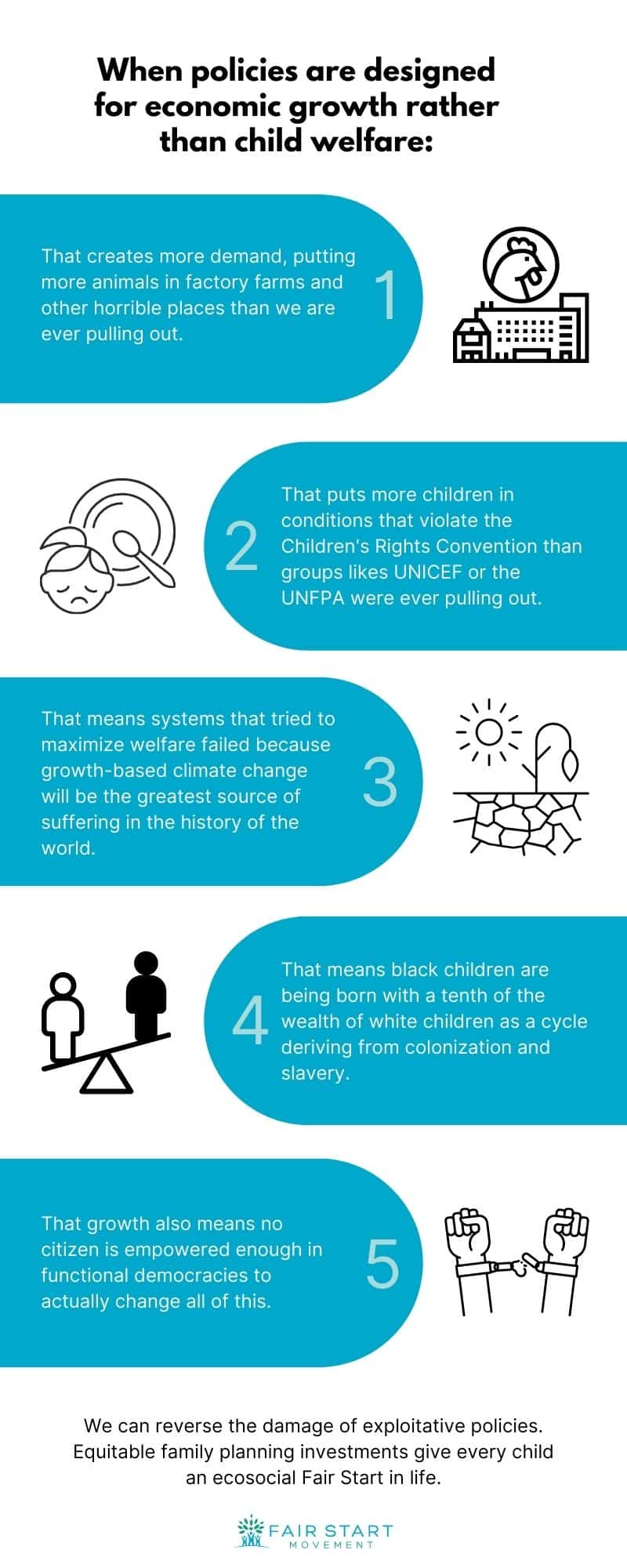
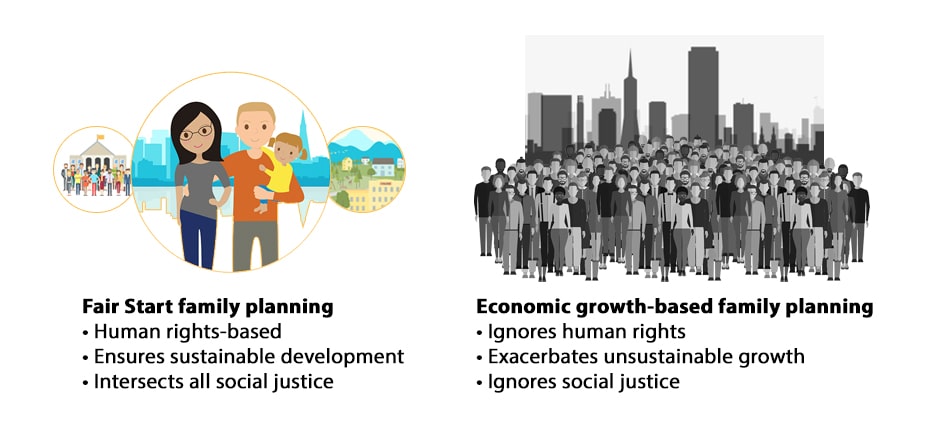
    Illustration compares fair start family planning, showing a diverse family and children, with economic growth-based planning, showing a large, crowded, grayscale group in a city. Lists pros of fair start and cons of growth-based planning.

    Not just in climate activism or animal protection, but in universities, nonprofits, philanthropy and social justice movements themselves.

    People are beginning to ask a difficult but necessary question:

    Are we truly addressing the root causes of suffering and inequality, or are we building narratives of progress while the underlying systems continue producing harm every single day?

    That question sits at the heart of the recent Fair Start Movement article discussing Yale and what the organization describes as a “fantasy world of social justice undone daily by birth inequity.” (Fair Start Movement)

    Importantly, this conversation should not be framed as an attack on individuals trying to create positive change. Many people working in academia, social justice advocacy and philanthropy genuinely care deeply about equity, human rights and creating a better future. Many dedicate their lives to helping vulnerable communities and challenging injustice.

    People sitting around in a circle, a neglected community

    But the article raises a broader systems-level concern.

    It argues that many public-interest institutions may be measuring impact inside incomplete frameworks that fail to fully account for the structural conditions shaping real-world outcomes — particularly inequality at birth, political inequity and the long-term effects of growth-driven systems. (

    At the center of Fair Start’s argument is the idea that “downstream” social justice work can be continuously undermined if the “upstream” systems driving inequality remain unchanged.

    In simple terms, organizations may celebrate important victories — expanded rights, educational initiatives, diversity programs, environmental reforms or social justice campaigns — while larger structural conditions continue reproducing inequality underneath the surface. According to the movement, this creates a perception of progress that may not fully match the deeper realities experienced by the most vulnerable communities.

    The article places particular emphasis on what it calls “birth inequity.”

    This refers to the reality that children enter the world under vastly unequal conditions depending on wealth, race, geography, political influence and environmental stability. Fair Start argues that these starting conditions profoundly shape health, opportunity, democratic influence and long-term survival itself, especially as climate instability and ecological degradation intensify globally.

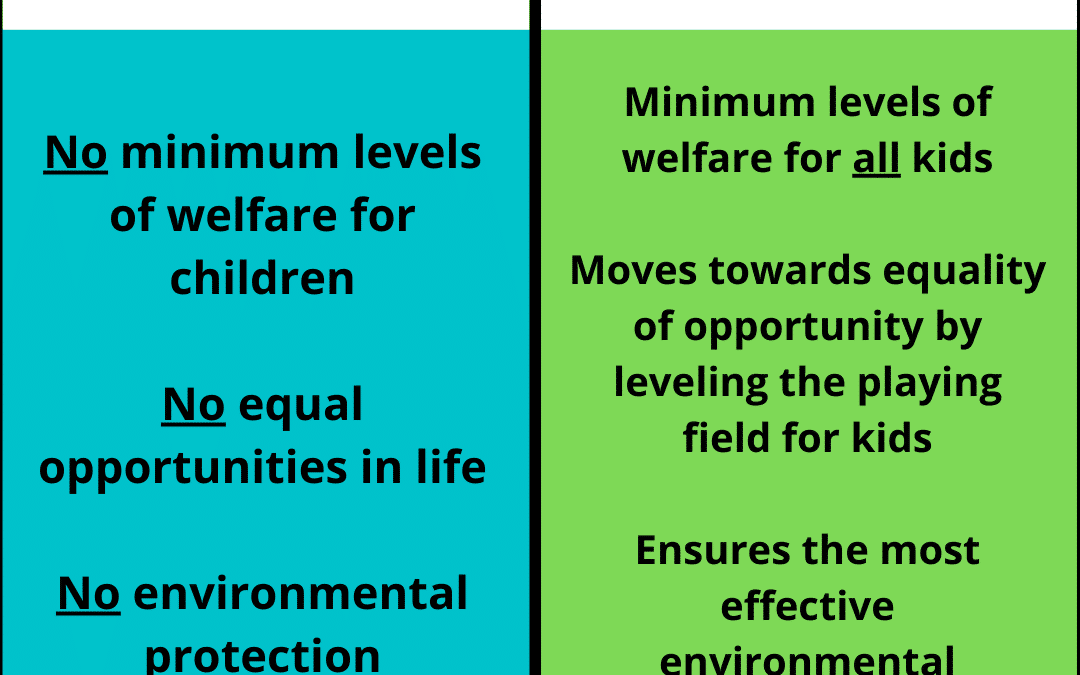
    Two columns compare outcomes. Left (blue): No minimum levels of welfare for children. No equal opportunities in life. No environmental protection. Right (green): Minimum welfare for all kids. Equality of opportunity. Environmental protection.

    The broader concern being raised is that many institutions discuss justice without fully accounting for these baseline inequalities.

    From the Fair Start perspective, if systems continue allowing millions of children to enter conditions of severe inequity, then downstream reforms alone may struggle to produce meaningful net progress over time. The movement argues that many public-facing impact claims fail to fully disclose how structural growth, ecological degradation and political inequality may be undoing the very outcomes organizations publicly celebrate. (Fair Start Movement)

    Whether one agrees entirely with Fair Start’s framework or not, the deeper questions being raised are significant.

    How should institutions measure progress honestly?

    How do we distinguish between symbolic progress and systemic transformation?

    And how do we ensure that public trust is grounded in transparency rather than carefully managed narratives?

    These are questions that are becoming harder for society to ignore.

    Across the world, people are watching ecosystems deteriorate, inequality deepen and political trust erode, even while institutions continue presenting optimistic narratives about sustainability, justice and progress. Increasingly, there is public demand for more honest conversations about whether current systems are truly addressing the root causes of the crises humanity now faces. (Fair Start Movement)

    For those of us working directly with animals, conservation and vulnerable communities, these realities are impossible not to see.


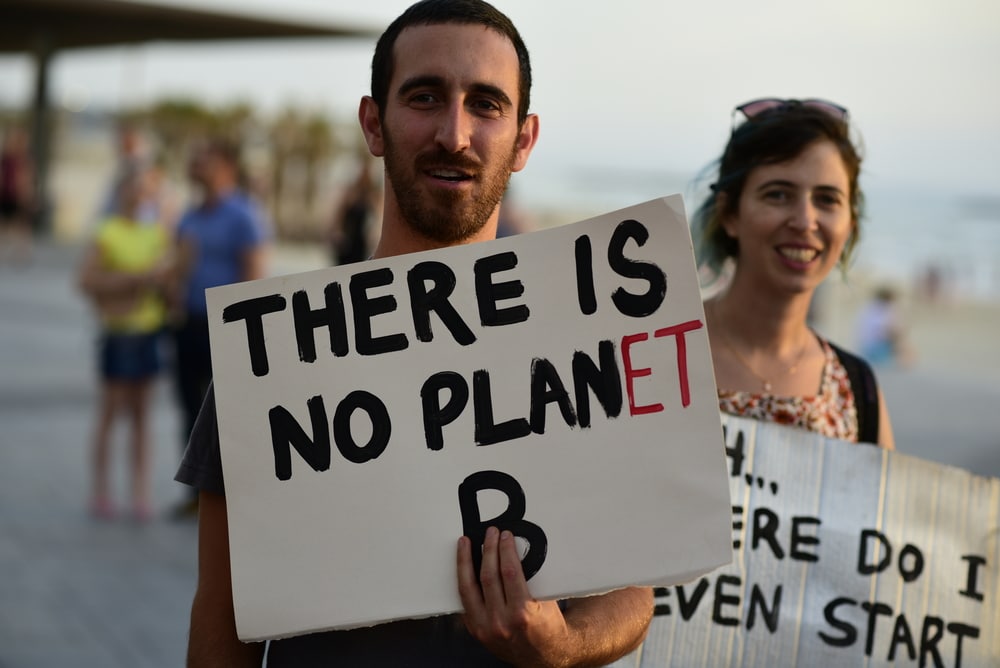
    mass extinction take action

    We see humans and wildlife increasingly competing for shrinking resources. We see communities struggling under economic and environmental pressure. We see ecosystems under stress. And we see how inequality and ecological collapse are deeply connected.

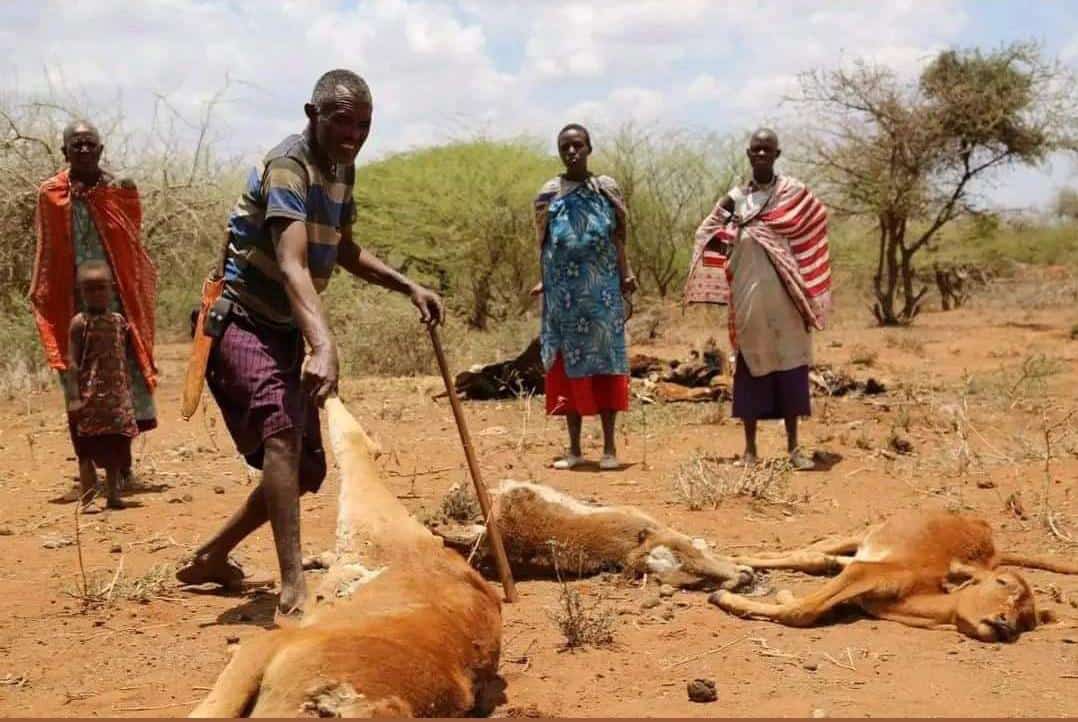
    Climate driven drought in the Amboseli, Kenya - starving cows as people look on

    Because when systems fail people, they also fail nature.

    The Fair Start article ultimately calls for something larger than political ideology or institutional branding. It calls for a deeper level of honesty about how we measure impact, how we define justice and whether the systems currently shaping the world are truly capable of delivering a fair future for the next generation.

    And perhaps that is the most important part of this conversation.

    Not tearing down good people.

    Not attacking institutions.

    But asking whether humanity is finally willing to confront the deeper structural realities underneath the crises we now face — and whether we have the courage to build systems rooted not only in appearance, but in truth.

  • Letters To University of Denver and The Attorney General- Letters included

    There comes a point where we have to stop applauding promises, and start measuring outcomes.

    Across the world, we are seeing major institutions, charities, corporations and organisations present themselves as leaders in environmental protection, sustainability, animal welfare and social progress. Many of the people within these organisations genuinely care. Many begin with honourable intentions. But when operations scale, priorities can shift. Profit margins, public image, fundraising targets and institutional KPIs can begin to outweigh the very mission these organisations were created to serve.

    That is where accountability matters.

    What we are now seeing is a growing dispute over whether certain institutions are using legally and ethically sound baselines when fundraising around animal protection and public-benefit work. In particular, serious concerns have been raised regarding whether publicly promoted animal protection efforts were presented in a way that failed to disclose the wider systems of inequitable growth that continued to undo those same efforts in practice.

    This issue sits at the centre of the letters submitted to the University of Denver and to the Attorney General’s Office in Denver.

    The purpose of these letters is not outrage for the sake of outrage. It is clarification. Transparency. Accountability. They seek to assess the standards used in public-facing animal law and animal protection programming, particularly where institutions represent outcomes to donors, investors and supporters as meaningful progress, while broader conditions may show worsening realities underneath the surface.

    This is not a small issue.

    If an institution claims success in protecting animals, but the surrounding systems continue expanding suffering faster than protections reduce it, then the public deserves to understand that reality honestly. If fundraising campaigns present isolated victories while larger structural growth continues driving exploitation, then those baselines must be disclosed clearly and openly.

    Because outcomes matter more than narratives.

    A quick assessment of broader trends during the relevant period raises difficult questions. Not only were more animals subjected to abuse and suffering than programming efforts were able to prevent, but wider indicators across society also showed increasing levels of human suffering, including rising child neglect, poverty and instability. These baseline failures are not confined to one field. They repeat across environmental policy, social systems, conservation, food reform and public-benefit campaigns whenever outputs are marketed as net success without proper disclosure of the surrounding conditions.

    This is why transparency must become standard practice moving forward.

    The public should know exactly where money goes. Investors should know whether goals are truly being achieved. Donors should know whether campaigns are producing measurable net improvements, or whether they are merely slowing damage while larger systems continue accelerating harm elsewhere.

    Without honest baselines, progress can become an illusion.

    This same issue can be seen far beyond universities or legal programs. Around the world, humans and wildlife are increasingly being pushed into conflict over shrinking resources. Forests disappear. Water systems collapse. Species vanish. Communities face hunger, displacement and instability. And as inequality deepens, more people are forced into survival-driven crime, exploitation and desperation.

    Everything is connected.

    If wildlife disappears, ecosystems collapse. If ecosystems collapse, human survival collapses with them. Nature is not separate from humanity. It is the foundation underneath all human life.

    We cannot build a sustainable future while ignoring the systems driving destruction in the background.

    That is why this moment matters.

    The goal is not to attack good people trying to help. The goal is to create a higher standard — one built on truth, measurable outcomes and transparency. A standard where organisations no longer hide behind carefully crafted narratives while underlying realities worsen year after year.

    Because the world does not need better marketing around compassion.

    It needs courage.

    It needs institutions willing to be honest about what is working, what is failing, and where reform is truly needed. It needs systems where funding reaches the ground effectively, where public trust is earned through measurable integrity, and where protecting animals, people and the planet becomes more than a slogan.

    If we truly want a future where humanity and nature survive together, then accountability is not optional.

    It is the beginning.having kids vegan Letter ‘

    February 11, 2026
    Office of the Dean
    University of Denver Sturm College of Law
    2255 E. Evans Avenue
    Denver, CO 80208
    Re: Open Letter to the University of Denver, Sturm College of Law, Regarding Animal Law
    Programming, Donor-Intent Governance, and Baseline Disclosure in Public “Impact” Claims
    Dean Smith
    Summary of requests
    Within 14 days, provide a written response confirming whether any donor requested
    return of funds connected to the Animal Activist Legal Defense Project and/or Animal
    Law Programming, identify the gift instrument terms and any restrictions, and identify
    the university office handling the request.
    Within 30 days, provide an accounting of the relevant funds (amounts, dates received,
    restrictions, expenditures to date), the policy basis for any decision to deny return, and
    the decision authority.
    Within 60 days, conduct and publish an internal review of the Project/Program’s public
    impact statements to ensure they do not imply net benefit without disclosing baseline
    variables and modeling limits, and adopt a written standard for future impact reporting in
    this programming.
    This letter is submitted to request institutional process and written clarification regarding the
    standards used to assess and publicly represent impact in animal law programming and related
    advocacy, based on information Fair Start activists received after terminating their role in the
    programming. It is not a critique of intent, nor a dispute over values. It is an inquiry into whether
    prevailing impact frameworks omit baseline variables in ways that may misstate net outcomes,
    distort competition among advocates, and impede coordinated correction of known harm. This is
    not infighting among advocates. It is a governance and public-reliance question about what is
    being claimed, what is being measured, and what is being omitted.
    Those engaged in upstream reforms cannot compete with actors who benefit from inequitable
    growth dynamics while funding downstream advocacy and avoiding the implications of that
    growth. This is a collective-action problem: the system rewards omission and penalizes
    disclosure. That is why we are asking for institutional review and formal written answers rather
    than informal discussion.
    Core Issue Under Review: Whether “Impact” Claims are Bounded by Baseline Disclosure
    Total Liberation Colorado (TLC) Packet
    Denver Institutional Complaint
    1
    At the center of this concern is legitimacy. Public claims of value or impact are relative to what?
    They either remain accurate once assessed in full context, or they do not. When institutions claim
    public benefit while omitting legally relevant baseline variables, particularly those related to
    growth, political equity, and the creation of future persons, those claims can become structurally
    misleading even when program outputs are real.
    The core issue is that the standards being used to assess and report “impact” can conflict with
    fundamental human-rights norms and the preemptive basis of legal legitimacy. Institutions
    should not imply net outcomes while omitting whether and how baseline variables are treated
    and what the modeling limits are.
    To evaluate public-benefit claims, Fair Start uses what we refer to as the XYZ test, a minimum
    legitimacy check that asks whether public claims of value or impact (X) remain accurate once
    assessed against baseline inequity impacts during the value assessment and impact reporting,
    relative to children’s rights and political equity standards (Y), and the actual value and impact,
    on balance in the key context, accounting for the correct baseline Y (Z). The point is not that any
    single program controls all macro drivers. The point is that net-outcome implications should not
    be implied without disclosing whether and how these baseline variables are treated, and what the
    modeling limits are.
    This presents an institutional governance issue. Where a law school supports or hosts
    programming that invites public reliance (students, donors, and the broader community), the
    standards used to describe “impact” must be stated with clarity, including any modeling limits.
    Institutions should be cautious about lending professional credibility to impact narratives that
    cannot survive full-context review, because institutional authority can become part of the
    mechanism that normalizes and propagates claims that are not actually being substantiated as net
    outcomes.
    Legal and Compliance Context for Counsel Review (non-exhaustive)
    This complaint is submitted to facilitate counsel review and internal escalation, not to litigate in
    correspondence. The University can evaluate the issues raised here against existing legal and
    compliance frameworks that already govern donor restrictions and public-facing representations,
    including:
    Donor restrictions and gift-instrument compliance for institutional funds under Colorado’s
    Uniform Prudent Management of Institutional Funds Act (UPMIFA), C.R.S. § 15-1-1101 et seq.,
    including provisions addressing release or modification of restrictions and Attorney General
    notice in certain circumstances (see C.R.S. § 15-1-1106).
    Standards governing deceptive or misleading public representations in trade or commerce under
    the Colorado Consumer Protection Act, C.R.S. § 6-1-101 et seq., including deceptive trade
    practices provisions (see C.R.S. § 6-1-105). The relevance here is the governance principle:
    public statements that imply net outcomes should be bounded by disclosed assumptions and
    limitations to avoid materially misleading reliance.
    Baseline non-discrimination and political equity principles reflected in widely accepted
    human-rights norms that legal educators routinely reference, including the International
    Total Liberation Colorado (TLC) Packet
    Denver Institutional Complaint
    2
    Covenant on Civil and Political Rights (ICCPR), particularly Article 24 (protection of children
    without discrimination including by birth), Article 25 (equal suffrage and participation), and
    Article 26 (equal protection and non-discrimination, including on grounds of birth).
    Our relationship to the programming
    As you know, members of the Fair Start Movement assisted in the co-founding and operation of
    the school’s Animal Activist Legal Defense Project and assisted with teaching in the Animal
    Law Program in roughly 2022, including participation in a key launch event that was recorded
    and framed the intended work of the program as a matter of total liberation, including
    environmental restoration.
    We are writing now as part of the Fair Start “Tell the Truth” campaign – while we do not
    represent the funders in any capacity, given our role in recruiting them for Sturm, we are
    communicating information they shared with us.
    The intent of our prior work with the school was, consistent with animal liberation and right to
    rescue advocacy, to eventually end animal propertyhood at both a micro-level, through criminal
    liability and food reforms, and at a macro-level through baseline-corrected family reforms
    needed to ensure net outcomes are not reversed by upstream dynamics. A quick assessment
    shows that not only were more animals subject to abuse and suffering during the relevant time
    period than the programming was able to save, but more children were subject to abuse, neglect
    and suffering than animals saved during that time.
    The programming at Sturm formed in the wake of controversy around another animal protection
    organization hiding historic liability for having used the lower standard for evaluating
    animal/environmental policy. The media covered the baseline controversy explicitly. See:
    https://www.newsweek.com/secret-war-natural-rights-children-opinion-1771365 and

    Former Animal Legal Defense Fund staffers accuse organization of transphobia, union-busting, and more


    Our recent research for litigation against Coca-Cola’s factory farming operations showed 5x or
    more the damages if we account for illegal baselining/discounting, which makes public interest
    interventions that also illegal baseline/discount a deadly charade: See

    Climate Change Is Here, And It’s Killing Millions


    The macro framework is disfavored by funders because while food law and even criminal law
    reforms can ensure good media that support existing entitlements and investments, the family
    law and other reforms that the macro entails pose potential preemptive liability for value
    assessments and impact reporting around micro, downstream-level interventions undone by
    macro, upstream-level forces that illegally enriched some at deadly cost to others.
    That macro framework was not speculative or external to the institution. It was developed and
    publicly articulated in collaboration with University sustainability leadership, including
    co-authored peer-reviewed work involving university staff identified in public materials as
    Clinical Professor and Faculty Director, Center of Sustainability. Fair Start further understands
    that, after an attempted implementation effort with University stakeholders, the professor
    withdrew from participation.
    Total Liberation Colorado (TLC) Packet
    Denver Institutional Complaint
    3
    That was despite extensive peer-reviewed research that shows measurable birth-equity as a
    preemptive legal standard, one that makes accounting for and offsetting birth positionality a
    necessary part of academic neutrality and accurate research. The deadly costs of “separate but
    equal” reproductive rights, versus “no child is worth more than another” will kill millions:
    https://www.kff.org/racial-equity-and-health-policy/disparities-in-access-to-air-conditioning-andimplications-for-heat-related-health-risks/
    Due to the role of key funders involved, who reject the need for assessing value and reporting
    impact in the context of child inequity exacerbated by growth, and who reject macro-level
    reforms that would treat measurable birth equity as a fundamental human right, we do not
    believe the Project or Program ultimately met the macro goals originally contemplated.
    We also understand that funders were aware of the larger context, including prior national
    discussion condemning animal protection efforts that failed to account for countervailing impacts
    of inequitable growth and birth-based political equity.
    During the resulting schism, efforts were made to reframe Fair Start’s work as downstream
    population activity rather than the upstream equity override it is. This included the elevation of a
    partner organization that subsequently received a substantial grant and removed Fair Start-related
    content from its public materials. The effect was to obscure the equity analysis originally
    understood by all parties and to avoid confronting the legitimacy implications of the baseline
    issue described here.
    We are aware that Fair Start’s relationship to a professional funder complicated matters, and we
    have since severed ties and are pursuing similar requests for reforms around conflicts of interest
    standards before the Association of Fundraising Professionals to address the problem.
    Our First Request: donor funds, donor intent, and remedy
    We understand that at least one donor who supported the upstream, baseline-disclosure work
    originally contemplated for this programming later requested return of funds after the upstream
    framework was not implemented, and that the school declined. We request written confirmation
    of:
    ● Whether a return request was made, by whom, and the date received
    ● The gift instrument terms (restrictions, purpose language, any conditions)
    ● The office and decision authority that denied or is evaluating return
    ● The policy and legal basis for denial (including any UPMIFA analysis)
    Requested remedy
    We request one of the following, in writing, with a dated implementation plan:
    Return: full return of the relevant funds to the donor(s), with a closing accounting; or
    Restricted reallocation: transfer of the relevant funds into a segregated, restricted
    account used only for the upstream work that was originally contemplated and that
    resolves the reliance issue at the center of this complaint, including:
    Total Liberation Colorado (TLC) Packet
    Denver Institutional Complaint
    4
    ● Adoption of a written impact-reporting template (baseline disclosure + modeling
    limits + outputs vs net outcomes)
    ● Internal review and correction/disclaimer of any public statements implying net
    outcomes without disclosure
    ● Publication of a short standards memo describing the baseline used for any
    impact language going forward
    Escrow pending review: placement of the funds into escrow pending completion of the
    60-day internal review and any required notice/review by appropriate oversight channels.
    If the University asserts that return or reallocation is not feasible, we request a written alternative
    resolution proposal that is functionally equivalent in integrity terms, including documentation of
    constraints, responsible offices, and next steps.
    Core disclosure standard requested (for institutional adoption)
    We request adoption of a written standard for animal-law programming communications
    that:
    ● States the baseline used for any impact language,
    ● Discloses modeling limits relevant to any net-outcome implications, and
    ● Distinguishes outputs (services performed, cases handled, rescues supported)
    from net outcomes.
    Campaign posture and standards pathway (non-punitive, process-driven)
    This request is process-driven and non-punitive. The objective is early alignment on a
    baseline (not “purity”), with a voluntary, pass/fail diagnostic standards pathway that
    organizations and institutions can use to test whether their metrics and assumptions are
    structurally coherent with their stated missions. The goal is documented governance,
    donor-intent compliance, and corrective disclosure so that public reliance is not induced
    by net-outcome implications the institution is not substantiating.
    Illustration of the standard problem: institutional narratives and campaign dynamics
    Baseline errors are not confined to any one domain. They recur wherever outputs are
    narrated as net outcomes without disclosure. For illustration, we will be addressing these
    same modeling issues in the context of Denver’s 2024 slaughterhouse ban effort
    (Ordinance 309), where competing public-benefit claims in a high-salience context
    illustrate why modeling limits and baseline disclosure matter.
    Preemptive standards referenced
    A central obstacle to reform is the collective action problem. Because major actors
    depend on the same flawed impact standard, any institution that corrects it independently
    can incur disproportionate reputational and competitive harm. Our response has been to
    turn to state law and to legally preemptive standards that align public-benefit claims with
    measurable empowerment and political equity.
    Total Liberation Colorado (TLC) Packet
    Denver Institutional Complaint
    5
    Continued use of prevailing standards for evaluating value and reporting impact out of
    context misaligns legal obligations and the coercive power of the state from the objective
    empowerment and self-determination of those subject to them.
    These standards are outlined here:
    ● https://fairstartmovement.org/fair-start-today-moves-to-standardize-climate-dama
    ge-evaluations-at-the-un-and-override-any-conflicting-standards/
    ● https://fairstartmovement.org/wp-content/uploads/2025/11/Fair-Start-MovementACPHR-Petition-3.pdf
    ● https://markets.businessinsider.com/news/stocks/fair-start-movement-urges-califo
    rnia-attorney-general-to-recognize-full-justice-standard-as-preemptive-of-fraud-cl
    aims-1035104323
    ● https://fairstartmovement.org/fair-start-and-truth-alliance-file-notice-of-preemptiv
    e-standards-with-the-california-attorney-general/
    Recent enforcement efforts, including Truth-in-Legitimacy compliance initiatives at the state
    level, reflect the beginning of an effort to enjoin business models whose public-benefit claims
    rely on these same flawed standards. These efforts operationalize the legitimacy principles
    described above and are relevant to how institutions should evaluate and bound public-facing
    impact claims.
    Public representations at issue
    We are specifically concerned with public statements and materials that could reasonably be read
    as implying net benefit without disclosing baseline variables or modeling limits. For counsel
    review and institutional handling, we request identification and review of the specific items
    below:
    “Supporting animal activists in their efforts to elevate awareness and understanding of
    animal well-being”
    “Developing best practices in the counseling and representation of activists,
    whistleblowers, and investigators”
    “Catalyzing a network of attorneys positioned to advance the welfare of non-human
    animals”
    “Exploring new and compelling narratives designed to elevate understanding of animal
    suffering”
    “Partnering with key stakeholders and supporters, including, without limitation,
    plant-based and other humane producers, academic institutions, non-profit
    organizations, labor activists, reformist professional associations, and environmental
    organizations”
    “Forging a more inclusive, populist, and activist-centered animal welfare movement.”
    Total Liberation Colorado (TLC) Packet
    Denver Institutional Complaint
    6
    “While the AALDP cannot agree to take cases without screening, we are eager to hear
    from activists in need of our assistance. Please contact the AALDP.”
    “Interested in working with the AALDP as a volunteer attorney? Please complete the
    volunteer attorney sign-up sheet.”
    That said, it is less about the claims, and more about the baseline numbers behind the claims, and
    deviation from what would be accurate and legitimate accounting for illegal shifting of
    costs/harms onto the most vulnerable.
    Fair Start states the baseline-disclosure dispute is inseparable from donor intent and institutional
    reliance because at least one donor has stated, “When I made my gift to Sturm in 2022, it was my
    understanding that it would be used for an ecocentric baseline,” and Fair Start further states that
    since January 2023 funders and institutional stakeholders have “doubled down on the
    anthropocentric standard,” creating a material mismatch between what was reasonably
    understood to be funded and what baseline governed “impact/public benefit/liberation”
    representations.
    Anthropocentrism is human-centered valuation; ecocentrism recognizes intrinsic ecosystem and
    nonhuman value, and Fair Start’s position is that the University must state baseline choice
    (including any turn to animal-centric and human-centric systems) with modeling limits because it
    determines whether outputs are being narrated as net outcomes and can create downstream harm
    when donors, students, and the public rely on implied net benefit. Funding for this effort rests on
    a simple premise: the baseline must be explicitly defined, measured, and audited against
    collective-action incentives, with specific protection for those most likely to absorb harm when
    claims outpace evidence, including protected classes under civil-rights and anti-discrimination
    law.
    Fair Start states return requests have been made and should be treated as a reliance signal
    requiring documented resolution, including Frank (A. F. Rothschild, PhD, Director, Center for
    Contemporary Equine Studies) stating the institution should “either return CCES’s grant or
    implement our funding for the designated purpose stated in our Agreement with DU Sturm, as
    promised,” and requests written baseline clarity (promised vs applied), a full accounting, and a
    written remedy of return, restricted reallocation to the designated baseline purpose, escrow
    pending review, or a functionally equivalent integrity remedy.
    Systems shouldn’t teach, assume, or operationalize legal authority unless there is measurable
    empowerment of the people subject to that authority. Otherwise, we’re just automating “separate
    but equal” under a technological veneer.
    Fair Start’s model in Denver is that we don’t build new institutions, we require existing
    institutions to replace non-compliant parts. The same logic would apply to AI governance. If the
    language doesn’t invert toward “no child worth more than another,” it fails the baseline.
    We propose a standardized reusable legal injunction mechanism triggered by
    consumer-protection style action when a public-facing impact/benefit claim materially implies
    Total Liberation Colorado (TLC) Packet
    Denver Institutional Complaint
    7
    net benefit without disclosing the baseline and model limits pushing institutions and government
    to either prove benefit under a stated baseline or correct the claim.
    Our Second Request: participate in the Tell the Truth campaign and assess value and report
    impacts in context.
    Fair Start Movement and TruthAlliance.global offer a legitimacy-based framework grounded in
    the principle that all facts are relative to values, and that value and impact claims either
    constitute or deconstitute legitimate political systems relative to a legally required ideal of
    measurable empowerment.
    Participation in the Tell the Truth campaign, as it relates to the College of Law, would minimally
    include:
    ● A public clarification distinguishing program outputs from net outcomes
    ● An updated impact-reporting template that discloses baseline variables and modeling
    limits
    ● A non-punitive, voluntary pass/fail diagnostic standards pathway that can be used
    ● Internally to test structural coherence of impact language and underlying assumption
    ● A meeting hosted by the College where competing impact standards are evaluated in a
    structured, evidence-based format
    The fundamental driver is illegal baselining/discounting, and birth-inequity based growth that
    enriches funders, but does more harm than good by the advocates’ and funders’ own professed
    values – saving animals. Illegal baselining assumes children deserve what they are born with,
    even as growth degrades their prospects, rather than what rights and political legitimacy require.
    That said, we recognize that fundamental equity reforms are a collective action problem – so we
    ask all as part of the Tell the Truth campaign to back the development and implementation of
    model constitutional injunction to block illegal baselining in business models. If it’s illegal to not
    hire persons of color, it’s illegal to enrich mostly white children at deadly cost to children of
    color.
    See:
    https://markets.businessinsider.com/news/stocks/fair-start-movement-urges-california-attorney-g
    eneral-to-recognize-full-justice-standard-as-preemptive-of-fraud-claims-1035104323
    Unless a person or company claiming to add value to the world can show they were evaluating
    and reporting by accounting for the preemptive costs of having to measurably empower all
    children equitably as they enter the world—and at a standard where those children could protect
    themselves from the climate crisis—the person or company making the claims was using an
    illegal Ponzi/equity-fraud standard and benefiting at deadly cost to others, mostly children of
    color.
    Those willing to account for those costs, to legitimate political systems and engage in the most
    just and effective reforms possible, cannot compete with those who do not – but they don’t have
    to.
    Total Liberation Colorado (TLC) Packet
    Denver Institutional Complaint
    8
    Given the specific funders at issue, a fair application of the baseline would center on the
    on-balance and birth-inequity / growth impacts on animals used in ejiao production, as well as
    the vulnerable populations who rely on these animals and experience the related oppressive
    impacts of the industry.
    Systems shouldn’t teach, assume, or operationalize legal authority unless there is measurable
    empowerment of the people subject to that authority. Otherwise, we’re just automating “separate
    but equal” under a technological veneer.
    Fair Start’s model in Denver is that we don’t build new institutions, we require existing
    institutions to replace non-compliant parts. The same logic would apply to AI governance. If the
    language doesn’t invert toward “no child worth more than another,” it fails the baseline.
    Meeting request
    To resolve these issues efficiently, we request a meeting with the appropriate University
    representatives (College of Law leadership and the office(s) responsible for donor funds and
    public communications for the relevant programming). Proposed agenda:
    donor funds status, accounting, restrictions, and decision authority
    the specific public impact statements identified above and what corrections/disclaimers are
    needed
    adoption of an impact-reporting standard for animal-law programming and next steps with dates
    Conclusion
    We encourage the University of Denver and the Sturm College of Law to address the donor
    funds issue, to correct public representations where necessary, and to engage in the Tell the Truth
    campaign by adopting an impact standard that does not omit baseline variables and that clearly
    distinguishes outputs from net outcomes.
    About FairStartMovement.org and TruthAlliance.global
    Fair Start Movement and TruthAlliance.global are solution-focused, compliance-oriented
    organizations. Our objective is to secure accurate disclosures, lawful handling of donor-restricted
    funds, and governance processes that allow institutions to correct public-facing statements where
    needed. Where an institution is willing to engage, we can provide structured documentation,
    draft disclosure templates, and a defined process for separating outputs from net outcomes in
    impact communications, with clear modeling limits suitable for counsel review and institutional
    adoption.
    Respectfully submitted,
    Name: Suriya Khan
    Email: suriya@fairstartmovement.org
    Phone: 516 – 725 – 3157
    Organization: Fair Start Movement / TruthAlliance.global


    February 11, 2026
    The Honorable Phil Weiser
    Office of the Attorney General
    State of Colorado
    Colorado Department of Law
    1300 Broadway, 10th Floor
    Denver, Colorado 80203
    Re: Request for Attorney General review and investigation concerning University of Denver
    Sturm College of Law animal-law programming “impact/public benefit/liberation”
    representations and donor-restricted funds governance (Total Liberation Colorado packet)
    Dear Attorney General Weiser,
    This letter is submitted as part of the Total Liberation Colorado (TLC) packet and requests
    counsel review and Attorney General attention to an institutional complaint already submitted to
    the University of Denver Sturm College of Law. The complaint concerns animal-law
    programming and affiliated advocacy that publicly describes “impact,” “public benefit,” and
    “liberation,” and raises governance and public-reliance issues where those public-facing
    representations are made without baseline disclosure and where donor-restricted funds
    governance is disputed. While we do not represent the funders in any capacity, given our role in
    recruiting them for Sturm, we are communicating information they shared with us.
    The Attorney General’s role is materially different from the University’s role. The University is
    the institution whose public representations, donor-restricted funds governance, and internal
    review mechanisms are at issue. The Attorney General is the State’s recognized protector of
    charitable interests and charitable assets, with statutory and common-law authority regarding
    trusts established for charitable, educational, religious, or benevolent purposes.
    Factual Posture – Institutional complaint already filed
    FairStartMovement.org and TruthAlliance.global have filed an institutional complaint with the
    University of Denver Sturm College of Law requesting a written response and internal review
    regarding: (a) how animal-law programming and affiliated advocacy assess and publicly
    represent impact; and (b) whether public-facing claims distinguish program outputs from net
    outcomes once baseline variables and modeling limits are disclosed.
    Core disclosure issue (baseline disclosure and net-outcome implication)
    The unifying issue is baseline disclosure: whether public impact language implies net
    benefit without stating the baseline, disclosing modeling limits, and separating outputs
    Total Liberation Colorado (TLC) Packet
    Attorney General Complaint
    1
    (activities performed) from net outcomes (net effects once baseline variables are
    counted).
    For TLC purposes, this is operationalized as an “XYZ” minimum disclosure check:
    X: the public claim of value and impact
    Y: birth inequity impacts during the value assessment and impact reporting,
    relative to children’s rights and political equity standards
    Z: the actual value and impact, on balance in the key context, accounting for the
    correct baseline Y
    The point is not that any single program controls macro drivers. The point
    is that solicitations should not imply a substantiated net-outcome claim if the
    program is not stating its baseline, disclosing modeling limits, and separating
    outputs from net outcomes in solicitation-facing materials and incorporated
    public-facing materials.
    Donor-intent dispute requiring a remedy the Attorney General is positioned to
    supervise
    Fair Start states that a donor who supported the originally contemplated upstream
    baseline-disclosure work requested return of funds after the upstream framework was not
    implemented, and that return was declined. The institutional complaint requests written
    confirmation of: the request, the gift-instrument terms, the decision authority, and the
    policy/legal basis for denial, and requests a remedy in one of these forms:
    A) return of funds (with a closing accounting), or
    B) restricted reallocation into a segregated account used only for the upstream
    baseline-disclosure work originally contemplated (disclosure template adoption;
    internal review and correction/disclaimer of public statements implying net
    outcomes without disclosure; publication of a short standards memo describing
    the baseline used going forward), or
    C) escrow pending completion of the internal review and any required
    oversight/notice steps.
    Fair Start states the baseline-disclosure dispute is inseparable from donor intent,
    charitable-asset governance, and reliance because at least one donor has stated, “When I
    Total Liberation Colorado (TLC) Packet
    Attorney General Complaint
    2
    made my gift to Sturm in 2022, it was my understanding that it would be used for an
    ecocentric baseline,” and Fair Start further states that since January 2023 funders and
    institutional stakeholders have “doubled down on the anthropocentric standard,” creating
    a material mismatch between what was reasonably understood to be funded and what
    baseline governed “impact/public benefit/liberation” representations. Anthropocentrism
    is human-centered valuation; ecocentrism recognizes intrinsic ecosystem and nonhuman
    value, and Fair Start’s position is that baseline choice (including any turn to
    animal-centric and human-centric systems) must be stated with modeling limits because
    it determines whether outputs are being narrated as net outcomes and can induce
    downstream harm when the public relies on implied net benefit.
    Funding for this effort rests on a simple premise: the baseline must be explicitly defined,
    measured, and audited against collective-action incentives (donors, funders, government
    dollars, students, voters, consumers, and future generations), with particular protection
    for those most likely to absorb harm when claims outpace evidence, including protected
    classes under civil-rights and anti-discrimination law.
    Fair Start states return requests have been made and should be treated as a reliance signal,
    including Frank (A. F. Rothschild, PhD, Director, Center for Contemporary Equine
    Studies) stating the institution should “either return CCES’s grant or implement our
    funding for the designated purpose stated in our Agreement with DU Sturm, as
    promised,” and requests a written remedy of return, restricted reallocation to the
    designated baseline purpose, escrow pending review, or a functionally equivalent
    integrity remedy.
    Systems shouldn’t teach, assume, or operationalize legal authority unless there is
    measurable empowerment of the people subject to that authority. Otherwise, we’re just
    automating “separate but equal” under a technological veneer.
    Fair Start’s model in Denver is that we don’t build new institutions, we require existing
    institutions to replace non-compliant parts. The same logic would apply to AI
    governance. If the language doesn’t invert toward “no child worth more than another,” it
    fails the baseline.
    We propose a standardized reusable legal injunction mechanism triggered by
    consumer-protection style action when a public-facing impact/benefit claim materially
    implies net benefit without disclosing the baseline and model limits pushing institutions
    and government to either prove benefit under a stated baseline or correct the claim.
    Reliance and Governance Context (material to review)
    Fair Start states that the upstream baseline-disclosure framework at issue was previously
    developed and publicly articulated in collaboration with University sustainability leadership,
    Total Liberation Colorado (TLC) Packet
    Attorney General Complaint
    3
    including co-authored work involving university staff who were identified in public materials as
    Clinical Professor and Faculty Director, Center of Sustainability, and that the staff member later
    withdrew after attempted implementation with University stakeholders. Fair Start further states
    that the dispute and the requested internal review should be analyzed as a governance and
    reliance issue: the public is invited to rely on “impact/public benefit/liberation” narratives, while
    the underlying baseline and modeling limits that determine whether outputs plausibly translate
    into net outcomes are not disclosed.
    Why Attorney General’s Office
    Colorado recognizes and reaffirms the Attorney General’s powers regarding
    charitable trusts and charitable interests – Colorado law expressly recognizes
    and reaffirms that the Attorney General has powers conferred by statute and by
    common law regarding trusts established for charitable, educational, religious, or
    benevolent purposes. Colorado statutes also preserve the Attorney General’s
    rights and powers with respect to any trust. Colorado appellate authority
    describes the Attorney General as “the recognized protector of public interests in
    charitable trusts,” and explains the enforcement structure that routes these
    disputes to the Attorney General.
    UPMIFA oversight features (restriction governance; notice to the Attorney
    General in modification contexts) – If the disputed funds are governed as
    donor-restricted institutional funds, Colorado’s UPMIFA framework provides
    specific mechanisms for releasing or modifying restrictions and includes notice to
    the Attorney General in court proceedings affecting restrictions, reflecting the
    Attorney General’s participation interest where charitable restrictions are being
    altered or addressed. The institutional complaint’s requested remedies (return,
    restricted reallocation tied to the originally contemplated baseline-disclosure
    work, or escrow pending review) are framed to align with orderly
    restriction-governance analysis and documented authority, rather than informal
    or discretionary handling.
    Standing constraints and the enforcement gap the Attorney General fills –
    Colorado appellate authority explains the structural point that private parties
    commonly face standing barriers in charitable-trust enforcement and that the
    Attorney General is positioned to act to protect the charitable interest. This
    standing architecture is a principal reason this matter is properly routed to the
    Attorney General for review and, where warranted, investigative action.
    Consumer protection and public-reliance lens for materially misleading
    “impact/public benefit” representations – Colorado’s Consumer Protection Act
    includes deceptive trade practices such as false representations about
    Total Liberation Colorado (TLC) Packet
    Attorney General Complaint
    4
    characteristics, uses, or benefits and failures to disclose material information
    known at the time of an advertisement or sale when intended to induce a
    transaction. Separately, the Attorney General has statutory authority to
    independently initiate actions to enforce state laws including the Colorado
    Consumer Protection Act. In this matter, the relevant public-reliance concern is
    whether institutional “impact/public benefit/liberation” representations invite
    donor/student/public reliance while omitting baseline variables and modeling
    limits that determine whether outputs plausibly constitute net outcomes.
    Charitable representations and donor-protection context – Colorado’s
    charitable solicitations framework reflects a public policy interest in protecting
    the public from deceptive or fraudulent charitable solicitations and requires
    registration and non-deceptive solicitation practices. While the TLC packet does
    not presume a conclusion, it requests Attorney General review because the dispute
    concerns donor-intent governance and public-facing representations tied to
    charitable/educational programming where the public is asked to rely on
    “impact/public benefit/liberation” framing.
    Requests to the Colorado Attorney General (time-bound)
    Intake and counsel routing (14 days), confirm in writing:
    a. the office/division assigned for review; and
    b. whether the Attorney General will request documents from the University
    relevant to donor-intent governance and public-facing impact representations.
    Donor-intent governance review and remedy pathway (30 days), request from the
    University (and review for sufficiency):
    a. the applicable gift instrument(s) and any written restrictions or purpose
    language;
    b. the return request(s) (date received; who submitted; what was requested);
    c. the decision authority and documented policy/legal basis for denial (including
    any UPMIFA analysis, to the extent applicable);
    d. an accounting (amounts, dates received, restrictions, expenditures to date);
    e. the University’s proposed remedy: return; restricted reallocation tied to the
    originally contemplated baseline-disclosure work; escrow pending review; or a
    documented alternative that is functionally equivalent in integrity terms.
    Total Liberation Colorado (TLC) Packet
    Attorney General Complaint
    5
    Public-reliance and impact-claim review (60 days), request that the University:
    a. identify the specific public statements/materials most likely to imply net
    outcomes without baseline disclosure;
    b. submit those materials for counsel review; and
    c. adopt a written disclosure template for future impact language that (i) states the
    baseline, (ii) discloses modeling limits, and (iii) separates outputs from net
    outcomes.
    Enforcement
    The TLC packet does not demand punishment for imperfection. It requests documented
    governance, donor-intent compliance, and corrective disclosure so that public reliance is not
    induced by net-outcome implications the institution is not substantiating. Fair Start states its
    standards work is designed so organizations are not punished for imperfection, with an objective
    of early alignment on a baseline (not “purity”) and a voluntary, pass/fail diagnostic standards
    pathway that organizations can use to test whether their metrics and assumptions are structurally
    coherent with their stated missions. This posture aligns with the Attorney General’s role as
    protector of charitable interests and with the Attorney General’s authority to investigate and
    enforce against materially misleading public representations when the facts warrant.
    Attachments / packet materials referenced
    Press release announcing TLC and summarizing the institutional complaint, including the
    XYZ baseline-disclosure standard, donor-intent remedy request, and the requested
    internal review.
    Open letter to the University of Denver Sturm College of Law requesting time-bound
    written answers, donor funds accounting, internal review, and adoption of an
    impact-reporting disclosure template.
    Copy of the Colorado Secretary of State complaint submission and supporting exhibits
    (as included in the TLC packet).
    Respectfully submitted,
    Name: Suriya Khan
    Email: suriya@fairstartmovement.org
    Phone: 516 – 725 – 3157
    Organization: Fair Start Movement / TruthAlliance.global
    Total Liberation Colorado (TLC) Packet
    Attorney General Complaint
    6
    REFERENCES
    ● Colorado Revised Statutes § 24-31-101 (Powers and duties of attorney general;
    subsection recognizing/reaffirming AG powers re
    charitable/educational/religious/benevolent trusts) (2024, as amended effective Jan. 1,
    2025).
    ● Colorado Revised Statutes § 15-1-1005 (Rights and powers of courts and attorney general
    not impaired).
    ● Colorado Revised Statutes § 15-1-1106 (Uniform Prudent Management of Institutional
    Funds Act; release/modification of restrictions; notice/opportunity for Attorney General).
    ● Colorado Revised Statutes § 6-1-105 (Colorado Consumer Protection Act; deceptive
    trade practices).
    ● Colorado Revised Statutes § 6-16-101 (Colorado Charitable Solicitations Act; short title).
    ● Colorado Charitable Solicitations Act, Title 6, Article 16, Colorado Revised Statutes
    (compiled statutory PDF).
    ● Herbst v. University of Colorado Foundation, 2022 COA 38, No. 20CA2067 (Colo. Ct.
    App. Mar. 31, 2022)

  • Urge Former New York Mayor’s Aid Rachel Atcheson to Tell the Truth: She Ignored Inequity That Did More Harm Than She Did Good

    Urge Former New York Mayor’s Aid Rachel Atcheson to Tell the Truth: She Ignored Inequity That Did More Harm Than She Did Good

    As the climate crises and inequality worsen, it’s crucial to look at the inaccurate public interest impact claims and business models that hid the horrors now unfolding.

    Animal impact claims are often the most falsifiable, and culpable, in this regard.

    If one were going to look for how the U.S. animal rights movement contributed to hiding of the polycrisis, as the movement became coopted by food investors, few would be as responsible as Rachel Atcheson. 


    How Do You Destroy a Planet's Atmosphere? Tell Lies. Fair Start Certification Tells the Truth Infographic


    A key aid to disgraced Mayor Adams, she has made wildly inaccurate claims about the environmental and other beneficial impacts of veganism, impacts that have been easily undone by child inequity and the disenfranchising growth that relies on it.

    Despite all her talk, Atcheson’s impact on animal protection relative to the countervailing impacts of growth is negligible. 

    But why is she so problematic? The wealthy who threaten our future use people like Atcheson to hide the full negative impacts of their wealth, and in a place like New York City, that’s a big deal. In many ways she also represents how animal rights became monetized as a food industry, at a time when inequitable growth has put more animals into suffering than ever before, and New York is undergoing unprecedented inequality and commercialization. For people who want to on balance benefit animals, selling out is one of the worst things one can do.

    Real animal activists could never compete against those, like Atcheson, who are willing to be part of a system that does more harm to animals than she does good. And they need not compete – because the model she uses is probably illegal. 

    Fair Start and TruthAlliance.global are now going beyond her claims, and asking whether she and Adams used an illegal business model to hide the worst impacts of the climate crisis, the decline of democracy, and vast inequity.

    Challenging assumptions that hurt our future infographic

    In a letter to the New York Attorney General, Fair Start and TruthAlliance.global explore how illegal baselining – making up standards to claim victory when things are worsening for the worst off – has hidden the deadly impacts of the climate crisis, growing inequity, and political disenfranchisement.

    Our research shows equity fraud (the discounting of future lives, and disenfranchisement of persons of color in particular) has been the largest driver of the terrible harms caused by factory farm entities like JBS. The state’s recent settlement with JBS raises questions about the standards state officials use with regard to that driver.

    Did Atcheson, a vocal animal rights activist and opponent of factory farming, use the same fundamental metric as JBS to exploit future children? Even as that drove more animals into suffering than her work took out? Time and further research will tell. 

    Take action: Urge Atcheson here to start the process of truth and admit that her work ignored inequitable growth in a way that did more harm than she did good. How much harm remains to be seen, but she can at least right now dispel any illusion of helping animals on balance or accurately accounting for inequity. In the future Fair Start activists will be testing her support for a preemptive legal standard that would reorganize basic entitlements to elevate animal protection, as well as other key values. That test will show whether she cares about animals, or is still shilling for food investors.


  • When Accountability Is Diluted, Children in Amboseli Pay the Price Through Unequal Protection, Limited Opportunity, and the Rising Cost of Education

    When Accountability Is Diluted, Children in Amboseli Pay the Price Through Unequal Protection, Limited Opportunity, and the Rising Cost of Education

    Summary “In Kenya’s Amboseli region, many Maasai children are still denied a fair chance at education as poverty, hidden school costs, corruption, colonial-era inequalities, weak local systems, and the growing impacts of climate change continue to make learning and opportunity harder to reach for struggling families cost of education for local children.” When Accountability Is Diluted, Children in Amboseli Pay the Price Through Unequal Protection, Limited Opportunity, and the Rising Cost of Education

    In the heart of Kenya’s Amboseli region, where the iconic Mount Kilimanjaro watches over the land, a more subtle yet equally pressing issue persists: the high cost of education for local children. While many see Amboseli as a haven for wildlife and indigenous Maasai culture, it’s also a place where structural inequalities—fueled by historical and contemporary systems—continue to impede access to quality education. These obstacles intersect with global issues like climate injustice and the enduring effects of white supremacy.
    At the center of this multifaceted struggle is the issue of school fees, which often serve as a barrier to education in a community where poverty and marginalization have deep roots. Local Maasai children, like many across rural Kenya, find themselves caught in a web of equity fraud, where the promise of education remains a distant dream, largely inaccessible to those who need it most.

    The Reality of School Fees in Amboseli
    For many families in Amboseli, school fees are not just a minor inconvenience—they are an insurmountable burden. While education is officially free in Kenya, there are numerous hidden costs associated with sending children to school. These include contributions for textbooks, uniforms, and other necessities, which, when accumulated, often exceed the financial reach of many Maasai families. The average household in Amboseli relies heavily on livestock for income, a livelihood that is vulnerable to the ravages of climate change. Droughts, erratic rainfall patterns, and other environmental stressors directly impact food security and income generation, making it even harder to pay for education.

    Many of these school fees, however, are not just a result of national policies—they are compounded by local corruption and equity fraud. Teachers or administrators sometimes collect additional fees for non-existent services, with funds failing to reach their intended educational purposes. This reinforces a cycle of inequality, where education becomes a commodity for those who can afford it, perpetuating a class divide and further disenfranchising marginalized communities like the Maasai.

    White Supremacy and the Legacy of Colonization
    The historical legacy of colonialism is deeply embedded in the educational system in Amboseli. The British colonizers, in their quest to “civilize” African societies, imposed an educational framework designed to subjugate and control local populations rather than empower them. Though Kenya gained independence decades ago, the residual effects of this system still shape the education infrastructure in many rural regions.
    One of the enduring impacts of this colonial legacy is the persistence of white supremacy in the form of Western-centric curricula and educational standards that fail to recognize the unique needs of indigenous communities like the Maasai. Many children in Amboseli are taught in schools where the language of instruction is English or Kiswahili, languages not spoken by their families. The curriculum often centers around Western ideals and economic structures, which may feel distant or irrelevant to Maasai children who are raised in a pastoralist culture deeply tied to the land and animals.
    The marginalization of indigenous knowledge systems and the lack of representation in education contribute to feelings of alienation. For the Maasai, whose identity is tied to their land, culture, and heritage, this disconnect only reinforces the cultural imperialism that has been entrenched for centuries.

    Decentralization: A Double-Edged Sword
    Kenya’s push for decentralization—a key aspect of its post-independence governance structure—was intended to bring services closer to the people. In theory, local governments would have the autonomy to allocate resources based on community needs. In practice, however, decentralization in Kenya has often resulted in uneven resource distribution and significant disparities in service delivery.
    In Amboseli, the promise of local governance often falls short. While county governments may receive funding to improve educational infrastructure and reduce fees, the lack of accountability, corruption, and a weak local administrative capacity has meant that funds do not always reach the intended schools. This has left Amboseli, a region already grappling with the effects of climate change, without the necessary educational resources to uplift its children.
    The decentralization process also amplifies inequality in regions like Amboseli, where local leaders may prioritize the needs of urban areas over those in more remote, rural communities. This disparity contributes to the feeling that Maasai children are further excluded from the promise of education.

    Climate Injustice: The Silent Killer
    Perhaps the most insidious force affecting education in Amboseli is the slow but persistent rise of climate injustice. The Maasai people, whose livelihoods are tied to livestock, face increasingly hostile environmental conditions due to climate change. Droughts and changing rainfall patterns have led to massive livestock deaths, food shortages, and a subsequent rise in poverty. This climate crisis directly impacts families’ ability to pay school fees, let alone ensure that their children attend school regularly.
    In many parts of Amboseli, children are forced to stay home and help their families cope with the aftermath of climate-induced disasters. This leads to a cycle of intergenerational poverty, where children who are unable to complete their education have fewer opportunities to break free from the poverty that their parents and grandparents have faced.
    What’s worse, climate injustice is not something that Maasai communities have caused—they are among the least responsible for the global climate crisis. Yet, they are among the most affected. This injustice further underscores the need for global solidarity and local action, with initiatives like the Truth Alliance aiming to amplify the voices of those most impacted by environmental changes and educational inequities.

    Reality, equality, equity, and liberation

    Truth Alliance: A Call for Change
    In this context, organizations like Truth Alliance are crucial in advocating for systemic changes that address the root causes of inequity, colonialism, and climate injustice. Their work highlights the need for a more equitable approach to education, one that is locally controlled and culturally relevant, yet supported by national and international frameworks that prioritize the needs of marginalized communities.
    Truth Alliance advocates for educational policies that are inclusive, not just in terms of access but also in how education is delivered. This includes curriculum reforms that embrace indigenous knowledge and perspectives, as well as a push for transparent and accountable management of school fees. They also emphasize decentralization as a tool for local empowerment but with safeguards to prevent the misuse of funds and ensure that resources are reaching those who need them most.
    Above all, organizations like Truth Alliance highlight the need for urgent action on climate justice, calling for both local and global solutions to the environmental challenges that disproportionately affect communities like the Maasai. Climate change is not a distant issue—it is a present reality, and its effects on education, particularly in rural areas like Amboseli, cannot be ignored.

    Conclusion: Moving Forward with Equity and Justice
    The story of education in Amboseli is a complex one, woven together by the threads of history, culture, climate, and systemic injustice. School fees, equity fraud, white supremacy, decentralization, and climate injustice are all intertwined in a way that continues to limit the educational opportunities available to Maasai children. However, through the tireless efforts of organizations like Truth Alliance, there is hope for change.
    True transformation will come when the voices of the most marginalized are heard, when education becomes an instrument of liberation rather than exclusion, and when the global community takes collective responsibility for addressing the root causes of climate injustice. It is only through this holistic approach that communities like Amboseli will see the dawn of a more equitable future for their children—one where access to education is a right, not a privilege.

  • Compliance Is Not Equity: The Quiet Failure of Measurement Systems

    Compliance Is Not Equity: The Quiet Failure of Measurement Systems

    Summary “When children are missing from the baseline, they are missing from the future we claim to improve.”

    In equity-focused work, the language is no longer the problem. Inclusion, participation, and disaggregation are now standard practice across institutions. Yet despite this apparent progress, measurement systems continue to produce results that feel increasingly disconnected from lived reality.

    People planting vegetables

    The issue is not a lack of frameworks, it is the overreliance on them.

    Too often, measurement has become an exercise in compliance rather than a test of truth. Baselines are constructed to meet requirements, indicators are selected to align with reporting structures, and results are presented in ways that satisfy expectations. On paper, everything is in order. In practice, critical gaps remain unexamined.

    This is where the distinction between equality and equity is most often diluted. Equality is easy to standardize; equity is not. Equity requires confronting uneven starting points, structural barriers, and unequal distributions of benefit. Yet many measurement systems, even when disaggregated, continue to rely on frameworks that prioritize comparability over complexity. The result is a form of reporting that appears rigorous while quietly flattening the very differences it is meant to address.

    Baselines are particularly vulnerable to this distortion. The question is not simply whether a baseline exists, but whether it is complete. Who is missing? Which conditions were not captured? What forms of exclusion were normalized or overlooked at the outset? When these questions are not explicitly addressed, progress can be reported within a constrained frame that excludes those most affected.

    There is also an institutional dimension that cannot be ignored. Measurement is rarely neutral. It is embedded within systems of funding, performance management, and public accountability. Under these conditions, there is a natural tendency to favor stability over disruption to produce results that confirm progress rather than challenge it. This does not require bad intent. It only requires incentives that reward coherence more than accuracy.

    For professionals operating within these systems, the real risk is not failure to measure, but failure to question what is being measured and why. When methodologies are accepted without scrutiny, and when baselines are treated as technical formalities rather than political and ethical choices, measurement loses its critical function.


    Family Planning info card


    If equity is to mean anything in practice, then measurement systems must be subjected to the same level of scrutiny as the policies they are designed to evaluate. This includes confronting uncomfortable possibilities: that some reported gains are partial, that some populations remain invisible, and that some successes are overstated.

    Until this happens, compliance will continue to be mistaken for progress and measurement will continue to reassure more than it reveals.


  • Accountability Is Not Optional: Who Answers When Systems Fail Children?

    Accountability Is Not Optional: Who Answers When Systems Fail Children?

    Summary “In many complex systems, responsibility becomes so spread out that preventable inequalities harming children continue without clear accountability, even though true fairness means ensuring every child is equally protected, supported, and given a real chance to thrive”

    In complex systems that shape public outcomes, responsibility is often widely shared and in the process, diluted. When outcomes improve, institutions claim success. When they fall short, responsibility becomes less clear. Challenges are attributed to complexity, limited resources, or external conditions. Over time, this creates a system where decisions carry impact, but not always accountability.

    This gap becomes most visible when we look at the outcomes experienced by children. In many contexts, children continue to face preventable harm whether through environmental exposure, limited access to essential services, or unequal living conditions. These outcomes are not accidental. They result from a series of decisions: how resources are allocated, which risks are prioritized, and whose needs are addressed first.

    Two columns compare outcomes. Left (blue): No minimum levels of welfare for children. No equal opportunities in life. No environmental protection. Right (green): Minimum welfare for all kids. Equality of opportunity. Environmental protection.

    Consider extreme heat.
    In many cities, rising temperatures are a known and growing risk. Yet some neighborhoods, often lower-income areas, have fewer trees, less shade, and limited access to cooling. Children in these environments face higher exposure to heat-related illness. The risk is predictable, documented, and recurring.

    The question is not whether the danger is known.
    The question is: who is responsible for ensuring those children are equally protected?

    Yet accountability for these decisions is rarely direct.

    Institutions operate within defined mandates, measuring success against internal targets. Funders evaluate impact based on reported results. Professionals rely on established frameworks to guide their work. Each part of the system may function as intended, but the combined outcome can still fall short of fairness.

    When this happens, a critical question must be asked:
    Who is responsible for the gap between intention and outcome?

    Accountability requires more than meeting predefined goals. It requires questioning whether those goals are sufficient especially when they leave the most vulnerable at risk.

    At the center of this issue is a simple standard: no child is worth more than another.

    If this principle is taken seriously, then accountability cannot stop at process; it must extend to outcomes. Demonstrating effort is not enough; there must be responsibility for whether systems deliver equal protection and opportunity in practice.


    This has implications at every level.

    Institutions must assess not only whether their programs function, but whether they meaningfully reduce disparities.
    Funders must look beyond reported success and consider whether their investments contribute to lasting fairness.
    Professionals including researchers, policymakers, and advocates must ensure that the frameworks they use do not overlook or minimize unequal impacts.

    Accountability also requires transparency.

    Clear and honest reporting is essential to understanding where systems succeed and where they fall short. Without it, gaps remain hidden, and improvement becomes difficult. Transparency allows problems to be identified early and addressed before harm becomes entrenched.

    There must also be consequences.

    When systems consistently produce unequal outcomes, maintaining the status quo is itself a decision. Inaction or insufficient action shapes who benefits, who is protected, and who is left behind.

    This is not only about individual responsibility. Many inequities are systemic, built over time through layers of decisions and practices. But complexity cannot become an excuse to avoid accountability.

    It must instead strengthen the commitment to act.

    A system that values fairness must be designed to detect imbalance, respond to it, and correct it. This requires clear standards, consistent evaluation, and a willingness to change when outcomes do not align with principles.

    Ultimately, accountability is what turns values into practice.

    Without it, commitments to equity remain aspirational. With it, they become measurable, enforceable, and real.

    Because when systems fail to protect children equally, the issue is not only what went wrong it is whether anyone is prepared to answer for it and to ensure it does not continue