Tag: Population Economics & Demographics

  • Having Kids Petitions CDC to Support New Earth Day Population Policy to Avoid Next Pandemic

    Having Kids Petitions CDC to Support New Earth Day Population Policy to Avoid Next Pandemic

    Poor family planning and population growth enabled COVID-19 and will enable the next pandemic

    In preparation for Earth Day, the national organization Having Kids has petitioned the Centers for Disease Control and Prevention to support dramatic changes in family planning policies that would substantially reduce the initial threat, transmission, and impact of pandemics such as COVID-19. Those changes will also halt the destruction of our environment, which heightens the threat and impact of pandemics.

    Read the letter here.

    The facts are clear: As the World Health Organization has recognized, overcrowding exacerbates epidemics and is perhaps the most fundamental threat to public health.

    Human overpopulation is a key factor in the spread of a variety of diseases, and this now includes the novel coronavirus. Yet this fundamental driver is often ignored in policymaking. The U.N. has issued world population projections with massive variability. That variability will drastically impact the threat that diseases pose to humanity worldwide. 

    That variability, and the projected population growth, represent missed opportunities to invest more in public health and specifically in the development and health of every new child born, which in turn exacerbate the initial risk, transmission, and impact of disease. That variability also  represents missed opportunities to eliminate economic and health inequities, which both exacerbate pandemics and are compounded by them. That variability represents the threat of further worldwide ecocide, which worsens the threat of pandemics in a variety of ways, including through the acceleration of the climate crisis. 

    There exists a clear, and human right-based, pathway toward reform that the CDC is obligated, under its mandate, to support. 

    “We can fight pandemics and change the direction the world is headed by promoting smaller and more equitable families,” Having Kids Executive Director Erika Mathews says. “We just have to start a serious conversation about ensuring the future we all want.” 

    Having Kids is a 501(c)3 nonprofit organization dedicated to reforming family planning by replacing parent-centered family planning models with the human rights-based and child-first Fair Start model. 

  • New York Times: Population Is About People and Shared Values, Not Economic Growth

    New York Times: Population Is About People and Shared Values, Not Economic Growth

    It’s downright jarring to see the New York Times report on the climate crisis and mass extinction with alarm but subtly treat low birthrates as similarly threatening to our future. Smaller families are the most effective way to mitigate the threat of the climate crisis and many other environmental and social dilemmas.

    Lower birthrates might be a threat to unsustainable growth-based economics, where we see babies as free money in the form of new consumers, cheap future labor, and compliant taxpayers. But lower birthrates are a boon to shared values like investing more in each child and creating a safe and healthy environment. And they are a boon at the key moment in human development where those values matter most of all. 

    What matters most is the people with whom we and our kids will share this planet as its ecology degrades. That is the most fundamental question of all.

    Take action: Contact the Times at nytnews@nytimes.com and urge them to deal with the values at stake and not to promote unsustainable growth.

  • It’s Not About Population. It’s About an Intergenerational Revolution.

    It’s Not About Population. It’s About an Intergenerational Revolution.

    The media is abuzz these days about women not having enough kids. It’s an odd thing to hear, given that population will continue to explode by billions of people in the decades to come, exacerbating the population-driven climate crisis, and causing untold suffering

    Are we missing a more important conversation though?

    Let’s start with the premise that framing is crucial. 

    Whether we think about population, or start from a different concept, framing could change everything about how we perceive the subject. The debate surrounding “population” tends to focus on quantity, which is actually misleading. Shouldn’t we think of people in the world, and the act of having kids, as more qualitative? Shouldn’t we be talking about quality of life? The truth is that what we think of as population is actually at least four things: 

    1. The quantity of the people we create.
    2. Their qualities, like empathy, and other key traits that will determine how people socialize and that are largely a product of early childhood development. These are inextricable from things like the levels, or quality, of personal well-being and development they are ensured.
    3. Their positioning in life relative to other children (the opportunities they have in life, with some kids today born billionaires and others born slaves, etc.). This positioning includes the inevitable attenuation from one another that comes with population growth.
    4. Their relation to their ecologies, i.e. are generations degrading the systems on which they depend?

    These four things are inevitably intertwined in the act of having kids. That act is more complex than the traditional concept of population implies, and can capture.

    Moreover, population is not some exogenous policy area we can choose to work in, or ignore. The people on the planet today, and how they limit what’s possible, are largely the product of what was done or not done in past family planning systems. We just have to shift and temporalize our thinking, or overcome the cognitive dissonance of temporal myopia, that makes it hard for us humans to see this. If a policy choice involves people, it involves family planning. Family planning, and the failure to plan, is the foundation of everything social. People are the first building blocks of any policy, and that which creates people, develops their traits, and gives them agency most accounts – and in free societies should most account – for the quality of life on this planet.

    It’s time for a new, and more helpful, conversation. 

    Given that the population is always changing and is the product of our actions, it’s probably more accurate to use a verb, and to focus on the cause (having kids) before the effect (population growth). The concept of “constituting,” as in the reference to “We the People” in the United States’ and other constitutions, could be ideal.

    Remember, framing matters. Technically, we were not constituted as a nation; if we value each person equally, we have to believe that we constantly reconstituting as future children enter the word. Constituting captures, much better than population, the antecedent, normative, dynamic and endogenous nature of the thing, and proceeds from a perspective of needing to justify the social organization (or the social contract) around us, or the power others have over us. That’s the perspective from which free and equal people would orient.

    “Constituting,” as opposed to “population,” captures the fundamental human rights-based lens or perspective free people would have when thinking about the people with whom they share communities: How is the power others have over us justified? Are we constituting a community of free and equal people, or something else, like a hierarchical economy? What control do you really have over the rules under which you are forced to live? Aren’t you worth more than being one vote lost in a sea of millions of votes, for presidents and other antiquated figureheads with massive control over our lives? 

    Why does this change in framing matter? 

    For some, it lets them see past myths, like the myth that population, or the people with whom we share and will share the world, is something amorphous and out of our control. Or, the myth that some kids are born into fortunate conditions, with what they need to succeed in life, while others are simply not. That’s nonsense. Our birth conditions have nothing to do with fortune, God, or some invisible force at work. Inequity at birth is simply humans’ failure to ensure fair start family planning. Thinking about how we constitute, and beyond population, helps us see this. 

    What’s another myth? Often we limit our thinking, “inside the box,” to current nation-states. We assume they are the fundamental political entity, and all that is possible. In other words, a lot of population-driven thinking wrongly assumes we are stuck with the countries that exist today. This is exemplified by the media’s reaction to falling birth rates in China, and calls to strengthen China’s economy with larger families. China is perhaps the greatest threat in the world to human rights, democracy, and nature – why would any free person want to strengthen the country or its economy, rather than see it disintegrate into the various groups it colonized? Can’t we imagine better societies, and political entities, than the countries we have now? New frames let us see past myths. 

    And for others, moving past the concept of population, and towards constituting, goes past simple myth-breaking and will lead to effective ways to promote human freedom. 

    The U.S. Constitution was born of a revolution to ensure that people could constitute independent, or free and equal, people. But for many reasons, the Constitution was never applied intergenerationally. And human rights and democracy are in decline today. Instead of constituting communities of people where everyone has a voice over the rules under which they live, we have media pushing women to have kids in failing social systems, and in the face of ecological crisis, to further inflate the economy. Instead of seeing communities as a free and equal people in a town hall, the politicians, pundits and companies pushing women to have babies envision a world of crowded shopping malls. But how you would see people and want them to be in a democratic town hall, versus a shopping mall, is very different. 

    People who want to grow economies push women to have more kids, with less investment in each child, and no minimum level of welfare, or equity, for each child born. In these schemes people are just economic inputs, rather than citizens who must be sufficiently developed to co-rule their democracies. In these constant-growth schemes, it’s OK to push more and more children through failing educational, welfare, healthcare and other systems. In this worldview it’s perfectly acceptable – if not desirable –  that the average American adult reads at the level of an eighth-grader. The idea of endless growth proceeds from state-based, and top-down, views of people as consumers and labor, rather than a bottom-up view of people as citizens with control over the world around them. Constant-growth systems push in the opposite direction from inclusive family planning systems that would create, or constitute, true democracies of capable and self-determining people. 

    The constant-growth worldview is antithetical to the personal autonomy that would be promoted and protected by a human right to nature, guaranteed minimum levels of well-being for children, and limitations on the right of abusive parents to have unlimited numbers of children who will be seized and spend much of their lives in state custody. Make no mistake – the people pushing poor family planning because they see babies as money are hurting people, and at the most fundamental level. They help ensure that children are born into horrible conditions, a culture where women are expected to have children, the exacerbation of the climate and other ecological crises, and the dominance of massive economic systems where the average citizen has no effective role in making the rules under which they are forced to live.

    We can reverse the exploitation of future generations, and nature, by using Fair Start family planning to take resources from the entities at the top – both public and private – who have benefited from growth at cost to kids and our communities, and instead investing those resources in ways that give kids a fair start in life. And because constituting comes first, and involves the very first rights and obligations that lead us to become free and equal, the process overrides other rights and obligations – like property claims – that interfere. We are before we do, and the process of constituting – and thereby legitimating our societies – overrides everything.

    It’s time to truly constitute, from the roots up.

    Let’s move past the concept of population and towards the action of constituting free and equal societies. We cannot be free until we account for and include the people with whom we do and will share this world, the way we would in a democratic town hall, rather than ignoring them the way we would – and those entities in control would want us to – in a shopping mall. 

    Where do we go from here?

    It’s time for another American revolution, but this time, a bottom-up intergenerational one that – simply by demanding more for each child – actually ensures the constitution of capable people democracies require. The social contract only works if it is made intergenerational, and if we constitute as such. Doing so will free us from ourselves and from the hegemony we hold over each other.

    The revolution begins with parents demanding the resources they need, and deserve, from those who are destroying our future in order to give all kids a fair start in life.  Parents have a right to those resources, in exchange for responsible and cooperative planning, and it’s time we help parents take them. 

    TAKE ACTION: 

    1. Speak out for the building of true human rights-based democracies by fighting for every child’s right to a fair start in life, as well as your fundamental right to nature, at the same time. These are the ethical borders of free communities. We cannot be free until these two rights are established, from the United Nations, and down through every member state.

    2. Then lets turn our attention to the United States, and urge Elizabeth Warren, at 202-224-4543, 1) to use a child-centric and inclusive family planning model, 2) to seek bi-partisan support from Republicans who – like Democrats – should support family planning systems that ensure future citizens rather than economic inputs, and 3) to link her extensive child-care proposals to ecologically and socially regenerative future child entitlements. 

    3. And finally lets urge Lee Raymond, https://fairstartmovement.org/he-helped-create-the-climate-crisis-tell-him-to-make-it-right-for-kids/, to lead by example and voluntarily relinquish the extensive resources he and his family have taken by harming future generations, so that they may be used for Fair Start family planning. Those most capable, and responsible, must pay. 

    Constituting free and equal communities is the first and overriding human right. We are before we do. Let’s start at the source.

  • Economists to Women: Make More Babies AND Work More

    Economists to Women: Make More Babies AND Work More

    Yesterday, Bloomberg added to the chorus of demographic decline alarmism. This time, the authors don’t even make an attempt at subtlety. “Population growth is vital for the world economy.” Yep, it’s about money.

    Corporate interests exercise influence in the media and over politicians to promote higher fertility. And economists’ solution to the global trend toward smaller families? Put the burden on women to have more children and to work more. As if they don’t shoulder enough already. 

    Family planning, for most of our species’ history, has involved thinking that bigger is better. It’s a patriarchal perspective, showcased by tycoons who push women to have more kids, despite how doing so will exacerbate the climate crisis. More kids mean more consumers, a larger workforce to supply a cheaper labor force, and complaint taxpayers.  

    And for these regressive thinkers, the Earth is still a resource to be divvied up and owned. Big business and big government supporters both love growth and their attack dogs are brutal haters. They are targeting people for simply asking questions about population growth in a presidential town hall. They don’t care about democracy, which has always required smaller communities of highly developed people. For big family supporters, strength, size, and the exploitation of future generations, or power rather than reason, is the goal.

    There is a way out. We can confront this greed and create the freedom that comes with true human rights and democracy. Fair Start family planning does just that. It puts children first and enables would-be parents to raise children in a safe and habitable world. It is the most effective way to improve child welfare, reduce the gap of economic inequity, and protect our environment. In fact, it is ten-to-twenty times more effective than downstream alternatives such as choosing a Prius or a vegan diet. 

    Here’s how it works:  

    Communities ensure that parents have the resources to plan families and guarantee kids a fair start in life. Each of us delay parenthood until we are financially and emotionally ready, and we then choose to have small and sustainable families that put less demand on our shared resources and our world.

    Here’s the best part.

    We are giving all kids a fair start in life AND doing what is most effective to mitigate climate change. It’s a win/win for all, as our world should be! Fair Start planning is a community approach to creating a world we all want to live in for generations to come. 

    Lean more and TAKE ACTION. 

  • Population Control or Responsible Parenting? Take Action to Protect Your Future.

    Population Control or Responsible Parenting? Take Action to Protect Your Future.

    Bernie Sanders grabbed headlines this week by saying that he would consider policies around population control, given our degrading environment.

    Why does the debate matter? Smaller families working together to plan a fair start for every child is the best way to protect kids, our environment, and our democracies – ten to twenty times more effective than anything else we can do. And yes, parents have a moral right and responsibility to protect their kids. If the government won’t do it they will.

    What does that mean? They are morally obligated to protect children’s future by targeting concentrations of resources that could be used to fund Fair Start family planning, targets that – given the state of emergency – have no legitimate claim to the resources they are hoarding. Candidates and celebrities should be talking about a peaceful process for this form of intergenerational justice – not about the misnomer of population control. Instead it’s about becoming free and equal people, through Fair Start family planning – the first and overriding human right. 

    Family planning is the only form of truly fundamental change. Period. Engage with the candidates and with celebrities, make them answer the hard questions by any mean effective, tell us how you did it, and we will publicize your story.

    Tell Candidates to Answer the Real Questions

    Population is not some amorphous thing. It’s about us, it’s about the people around us, and the children being born every second around the world. It’s about creating a “We the People,” where free communities self-govern, and make the rules they live under. Candidates are either promoting that process through Fair Start family planning, or they are degrading our environment and our democracies by ignoring future generations. These are the key questions: What is the minimum standard of living each child should be guaranteed before they are born? How will we level the playing field between kids born rich and born poor, and instead give every child a fair start in life? How will we encourage smaller families where we can invest more in each child, and rebuild a safe and natural environment?

    TAKE ACTION: Tell Bernie to start talking about kids’ right to a fair start in life. It’s about people, not population. What standard of living do the candidates children enjoy, and wouldn’t it be great if every child had those things? Bernie – tell us how you will make that happen through better family planning policies. Tweet him @BernieSanders, or engage with him in person.

    TAKE ACTION: Tell Naomi Klein to drop the false dichotomy – population is not an exogenous issue. It’s the “we” in all of her statements. The state of the world today, the people in it, the inequality, the climate crisis, etc., are all the product of family planning policies of the past. Humans don’t fall from the sky. Let’s start to get ahead of the problem. You cannot be egalitarian and not change our current isolationist model of family planning to Fair Start family planning instead. Tweet her at @NaomiAKlein, or engage with her in person.

    Tell Celebrities to Start Modeling Responsible Behavior

    It’s not just about politics. Celebrities have a massive influence on family planning decisions around the world, and while some – like Harry and Meghan – are stepping up, others – like the Baldwins – are not. Celebrities probably have a greater impact on family planning decisions than politics. They need to answer the questions posed above too.

    TAKE ACTION: Tell the Baldwins to explain publicly how they intend to help all families give their kids a fair start in life. Tweet Alec at @AlecBaldwin, or engage with the couple in person.

    The future is defined by the people being born today. Step up for your and your family’s future.


  • Elon Musk: Care About Population? Start Helping People.

    Elon Musk: Care About Population? Start Helping People.

    Two billionaires got a lot of press recently by saying that underpopulation threatens humanity. It’s not the first time Elon Musk has suggested women are not having enough babies. It’s nonsense to say that depopulation poses any threat to our species – look at the numbers. Falling fertility rates are a good thing, and are part of the transition to a more sustainable world population – a process the world intentionally started in the Twentieth Century.

    So why do Musk and others worry about lower fertility rates? 

    So this is the bottom line: The question is not whether we should push women to have more kids so that people like Musk can exploit them. The question is whether we will take back the wealth and resources these people are unjustly holding, and use those resources to give kids a fair start in life.

    TAKE ACTION: Tweet Musk, @elonmusk, and urge him to change positions on family planning, and embrace values like nature, fairness, and democracy over wealth and power.

  • “Have kids because it’s good for the economy.”

    “Have kids because it’s good for the economy.”

    Last month we wrote to Wajahat Ali, urging him to abandon the old “just have babies” position on policy and instead promote smaller families with greater investment in every child. Today, Jessica Blome, a mother from Oregon and a model for Fair Start family planning, is asking Ali to engage in a debate.

    It comes down to a simple question: do we want policies that improve child welfare, or ones that perpetuate inequality and push kids into substandard circumstances?

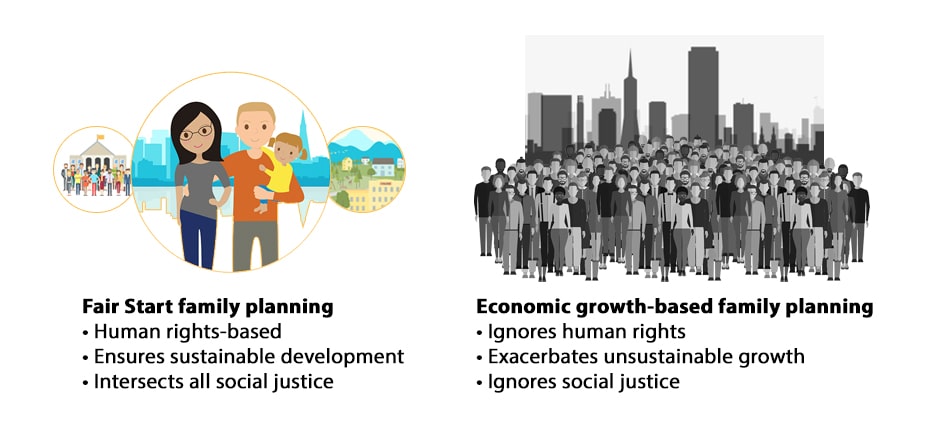
    Illustration compares fair start family planning, showing a diverse family and children, with economic growth-based planning, showing a large, crowded, grayscale group in a city. Lists pros of fair start and cons of growth-based planning.

    The Economy Argument is Wrong

    The media loves to post articles by economists panicking over lower fertility rates. Politicians on both sides of the aisle buy into the message as well, having their views shaped by corporate interests. Just look at Marco Rubio who has directly urged Americans to “have kids because it’s good for the economy”. It’s not limited to the U.S. though. Hungary’s President has proposed paying women to have more kids. The basis of the argument is that more consumers and a larger, cheaper labor force are good for business. (See our previous post on the cash-for-babies scheme.) But the “good for the economy” argument is wrong. Higher GDP doesn’t translate into shared wealth for all. A high GDP means that a very wealthy few are made even more wealthy. But it ignores the well-being of everyone else – including kids, and masks the impact that inequality has on democracy. In other words, a “good economy” doesn’t that we’re doing well as a nation. The graphic below illustrates just how lopsided wealth is in the U.S.

    A line graph titled Distribution of Family Wealth (2016) shows family wealth across percentiles, with most values low or negative until rising sharply after the 90th percentile, peaking at over  million at the 99th percentile.

    A Better Way

    Do we really want to treat children as cogs in the economy? Let’s start instead by building true human rights-based democracies out of the people that will actually comprise them. Let’s shape policies to improve the conditions in which children are born, and ensure a fair start in life to help them become more successful, thoughtful, engaged citizens. Fair Start family planning makes that possible.

    TAKE ACTION:
    Will Ali accept our invitation on this debate Fair Start versus economic fueled family planning? Send him a Tweet @WajahatAli and ask him.


  • Consumption or Family Size: Which Matters for Climate?

    Consumption or Family Size: Which Matters for Climate?

    Care about consumption and its impact on the planet? Many argue that consumption, not population is the real climate crisis. But the truth is, consumption and people are inextricably linked. We have to address both.

    Demand isn’t created by dirty companies. Demand comes from people. Focusing only on carbon, plastic, and such plays right into the hands of global corporations like Unilever, Walmart and Amazon who depend on increasing birth rates to fuel spending for their products. Yes, bad industrial players must be held accountable. And we’re on our way to doing that. But if we’re only addressing carbon output, we’re ignoring the source of the problem: unsustainable population growth. Choosing to have a smaller family however, is the best way to mitigate our impact on the planet.  

    Looking only at emissions also ignores several critically important issues including water scarcity, mineral depletion, deforestation, and habitat loss. As the Center for Biological Diversity explains,“If we address one without the other, the end result will still be humans continuing to take more than our fair share from the planet.”

    The Center for Biological Diversity also stated:

    “A 2009 study of the relationship between population growth and global warming determined that the “carbon legacy” of just one child can produce 20 times more greenhouse gas than a person will save by driving a high-mileage car, recycling, using energy-efficient appliances and light bulbs, etc. Each child born in the United States will add about 9,441 metric tons of carbon dioxide to the carbon legacy of an average parent. The study concludes, “Clearly, the potential savings from reduced reproduction are huge compared to the savings that can be achieved by changes in lifestyle.”

    One of the study’s authors, Paul Murtaugh, warned that: “In discussions about climate change, we tend to focus on the carbon emissions of an individual over his or her lifetime. Those are important issues and it’s essential that they should be considered. But an added challenge facing us is continuing population growth and increasing global consumption of resources. . . . Future growth amplifies the consequences of people’s reproductive choices today, the same way that compound interest amplifies a bank balance.”

    The consumption vs. population debate.

    The finger pointing is generally toward high fertility rates in developing countries and high consumption in developed countries. However, it’s not an either/or scenario. It’s an evolving situation. As nations develop, their standard of living increases along with consumption rates. We are on track for exponential population growth paired with a drastic increase in consumption. Taking an incomplete approach is a recipe for disaster.

    Is consumption outpacing population growth?
    It is in some cases. Consider that food demand outpaces sustainable supply. According to the 2018 Global Agricultural Productivity Report, “for the fifth straight year, global agricultural productivity growth is not accelerating fast enough.” How can we continue to feed a growing population without a global effort for sustainable population planning?

    The U.N. has also warned that one million species are at risk of disappearing due to habitat loss, among other human activities, in the sixth mass extinction already underway. “A quarter of catalogued animal and plant species are already being crowded, eaten or poisoned out of existence,” its IPBES Global Assessment Report report states. Should we be concerned then about consumption or crowding? The answer is both – as confirmed by a UN Report released in May. 

    We have the power to determine the future for our kids.
    Most of us agree that a crowded planet is not something we want. But we fail to make the connection that our decision to have a large or small family is what determines how the world will look. The Fair Start Model is one way that we can work together to ensure that all kids get what they need to thrive – including a habitable planet. Let’s save room for animals, for nature, and for our kids to enjoy the only planet we have by planning smaller families.

    TAKE ACTION:
    Join us in urging the U.N. Secretary-General to issue a statement recommending sustainable family planning for World Population Day. RSVP to our event, help us share the event, and send him a message here.

  • Measles: How to Think About Disease Transmission

    Measles: How to Think About Disease Transmission

    Our brains are more apt to deal with obvious and immediate threats, like a nation’s military standing ready for invasion, than potentially more dangerous threats like the transmission of infectious diseases. One example of this is how we miss the clear role of poor family planning-driven population growth in the spread of diseases.

    This is true whether in the case of measles, the yearly flu epidemic, or others cases like the Zika virus and Ebola. As we become a more crowded planet – with 11 billion of us projected by the end of the century, the risk of disease outbreaks intensifies. “Increased population densities and unhealthy living conditions in urban slums can ease the transmission of infections,” as Population Action International stated.

    Add to that, the connectedness of our world which allows for a near-instant global spread of infectious diseases. As author and professor, Lewis Dartnell from the University of Westminster warned, “…the modern world of densely-packed cities and intercontinental airplanes provide the perfect conditions for new diseases to spread to huge numbers of people before any sort of effective quarantine could be implemented. Even if perhaps only 20% of the global population became sick at the same time, enough vital services and infrastructure could grind to a halt that our whole technological, deeply-interlinked, civilisation could collapse.”

    Here’s a challenge: Scan the dozens of news stories each day about the new measles epidemic and look for any reporters who connect the issue to crowding or need for family planning. It’s as if there is no connection between the growth of population and spread of disease.

    Ignoring the role of crowding in the things that happen around you is threat to you, your kids, and your future. Family planning defines the world around us. We can do better. Start at the source. Learn more here.