Advocating for Sustainable Food Systems: Insights from Miyoko Schinner
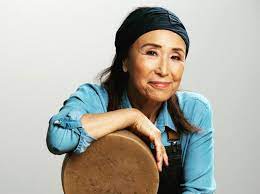
Miyoko Schinner is a renowned vegan chef, entrepreneur, and advocate for plant-based living. She’s a prominent figure in the vegan community and her insights on sustainability, animal welfare, decolonization and the culinary aspects of plant-based diets are widely respected.
The Fair Start Movement, dedicated to advocating for equitable food systems and guaranteeing fair start for all children, recently engaged with Miyoko in an enlightening conversation. This interview sheds light on their collaborative efforts toward sustainability, food justice, animal rights protection and other ethical issues.
Listen to the interview below!
Interview Context: The discussion between Miyoko Schinner and Carter Dillard centered on the shared goals of promoting sustainable, plant-based diets and addressing food disparities in communities.
Miyoko has been passionate about animal rights since she was 12, when she went vegan. Her early recognition of the impact of dietary choices on animal welfare, coupled with her subsequent journey as a prominent figure in the vegan community, likely provides her with a unique perspective and depth of understanding regarding the ethical, environmental, and health-related aspects of veganism and the larger context of decolonizing food and other systems.’
Animal Rights Advocacy and Strategy
Advocating for animal rights requires a nuanced approach, particularly in today’s diverse and often polarized social and cultural landscape. Engage in conversations with empathy and respect for differing viewpoints. Acknowledge that people may have varying cultural, religious, or personal beliefs that influence their perspectives on animals and engage respectively, but not timidly.
By integrating humility into advocacy efforts and addressing the multifaceted nature of animal rights in today’s society, advocates can foster meaningful conversations, build bridges, and contribute to positive changes in animal welfare.
Animal rights advocates from Western countries should approach advocacy in Africa with cultural sensitivity. The concept of ‘white saviourism’ is a narrative of Western superiority and the idea that Western intervention is necessary for solving local issues. Recognize and respect diverse cultural relationships with animals and wildlife, avoiding the imposition of Western ideals.
The Movement Extends Far Beyond Financial Incentives or Gains
The idea is rooted in the belief that those most affected by climate change, often in developing or vulnerable communities, should receive compensation or support for the damages and losses incurred due to climate-related disasters or environmental degradation, and allocating losses and benefits.
Reviving Community Spirit and Fostering Equity in Society
The essence of community, once a cornerstone of human existence, holds the key to addressing the growing disparities and fostering fairness in our shared spaces. Building Solidarity and Collaboration that amplifies impact, creating a web of support that uplifts the most vulnerable.
Miyoko’s Children Project
Miyoko runs a project that impacts hundreds of children. To be a part of it and support learn more here.
Key Takeaways:
In this insightful dialogue, Miyoko and Carter Dillard highlighted:
The critical role of plant-based diets in mitigating environmental impact.
Strategies for addressing food deserts and enhancing access to nutritious meals.
Collaborative efforts in advocating for policy changes to support sustainable food systems.
The dialogue between Miyoko Schinner and the Fair Start Movement exemplifies the importance of collaborative efforts in advocating for sustainable food systems. Their insights inspire us to reflect on our choices and work towards a more equitable and environmentally conscious future.
In the pursuit of a more equitable world, discussions between advocates such as Miyoko Schinner and Carter Dillard shed light on pivotal themes: Sustainability, advocating for animal rights, and addressing climate reparations.
Discussions like this, emphasizing the ethical treatment of all living beings, including animals is highly commendable. Animal rights advocacy extends beyond personal dietary choices but aims to transform societal norms by fostering empathy and redefining humanity’s relationship with animals.
Their conversation delved into the interconnectedness of these themes, emphasizing the importance of ethical considerations, justice, and responsibility in advocating for animal rights, addressing climate change, and striving for positive societal changes beyond financial incentives.
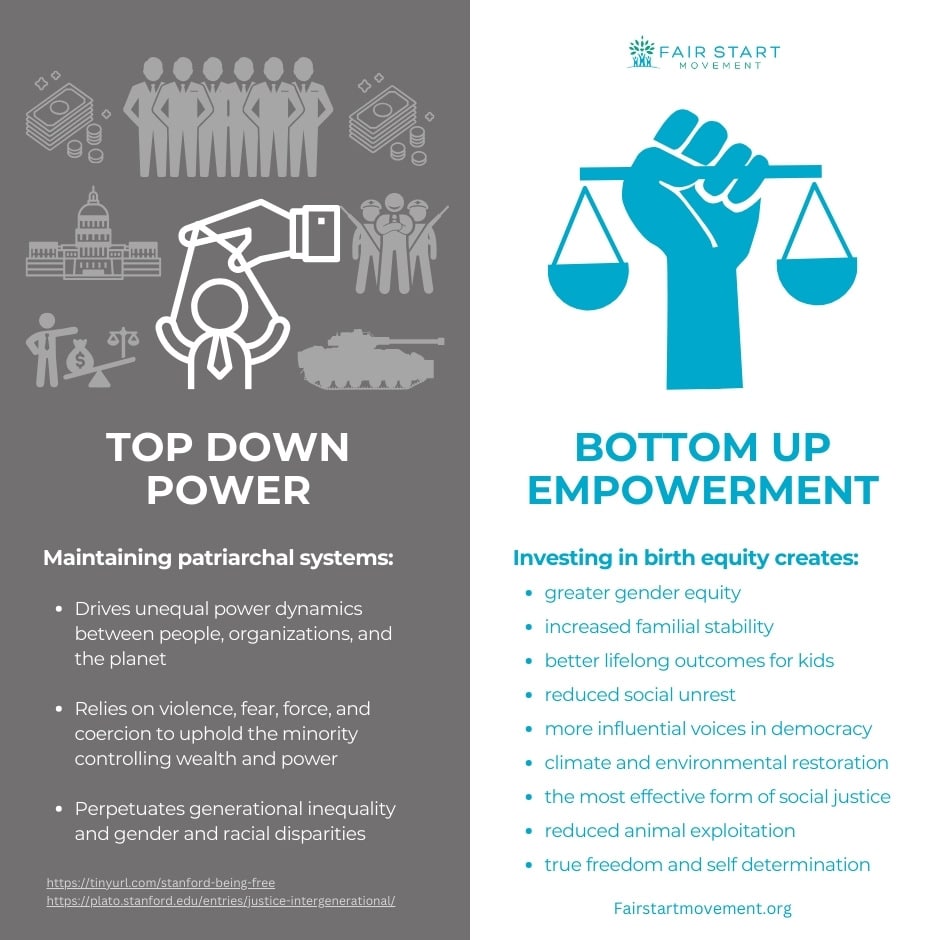
The essence of this urgent appeal lies in the recognition that our current norms and policies lack a crucial element—a just creation norm that centers on children’s rights and birth equity as fundamental benchmarks for assessing costs and benefits. It’s a call for a paradigm shift, urging us to become a society capable of inclusively evaluating decisions based on the well-being of our children. This call is underscored by the looming climate crisis, which poses an existential threat to future generations. Our current growth-driven systems are proving to be exploitative, particularly for vulnerable communities and the generations to come.
Born in response to the threats against children’s rights, the Fair Start Movement offers a universal model built upon the principle of self-determination. This model aims to eliminate threats and serve as the bedrock for legitimate and inclusive policymaking. Central to this endeavor is the acknowledgment that investing in children and ensuring birth equity is not just a gesture of goodwill; it’s a moral obligation. Prioritizing these aspects propels sustainable development, protects our environment, and upholds the rights of generations to come.
As we stand at this critical juncture, it is a collective responsibility for entities, policymakers, and individuals to rally behind these reforms. It’s a joint commitment to center children’s rights and birth equity in our policymaking, charting a course towards a future that is not only sustainable but also fair and inclusive.
In conclusion, the importance of establishing a fair start for all, anchored in the empowerment of our children and the preservation of our planet, cannot be overstated. Let us band together in this noble pursuit to create a world where every child has the opportunity to thrive in a sustainable and equitable environment.
My journey towards becoming a climate justice activist was not straightforward.
I was born in Kabarole western Uganda from a poor family of 10 children of which four are males and six females am the third born child my parents were poor to give us basic needs in life. My parents forced me to get married to old man at age of 16 years , my parents wanted dowries to support my younger brothers and sisters , I dropped out school after completing primary seven and obeyed my parents to and get married .
During my stay in marriage I got challenges with my husband and divorced him with a lame child, then my parents chased me away from home and left to be maid for church priests in town, I exhibited discipline and commitment to my job then one day one priest picked interest of sponsoring to back to school, I started a gain schooling up to Nursing Profession but my dream was to be a doctor. Growing up in a big family it was challenging, my parents used to depend on agriculture of food crop and we had small portion of land that could not provide us enough food. Fortunately, I got a job to work in the refugee settlement in western Uganda where I was getting salary to support my younger sisters and brothers, witnessed how refugees struggle in the Refugees settlement.
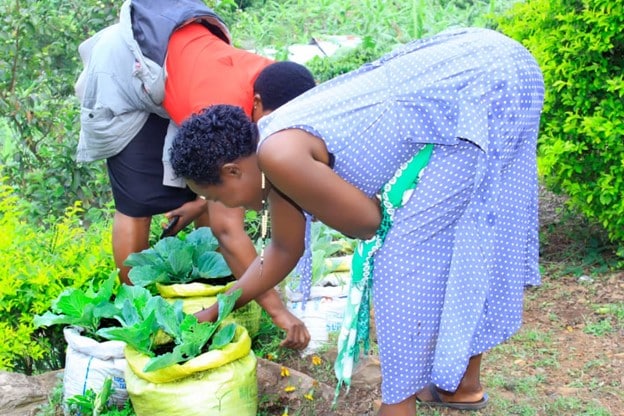
At the age of 27 and nurse by professional, I began my activism passion by engaging in planting trees, community gathering teaching them importance of family planning and delayed parenthood, teaching adolescent girls how to cope up with puberty stages and advising them on prevention of sexually transmitted and how to use sanitary pads .My passion to discourage early girls marriage , teenager pregnancy while promoting girls education and improving food security in the community and desire to make a difference led me to continue my activism work. I’m focused on various areas such as agroforestry, sexual reproductive health for adolescent girls, water accessibility and women and children rights. I have also mentored students in various schools to create climate awareness through singing, poems, storytelling and skits about climate change.
Her work did not perish, and I was soon called to start Rejoice Africa Foundation as the co-founder. In this role, I have participated in the development of Rejoice Africa Foundation.
However, I realized that creating systemic change was not enough. I understood that the fight against climate change required a shift in mindset and individual responsibility. I embarked on a mission to build a mindset shift change by encouraging people to take responsibility for their actions through a human rewarding system.
My work as a climate justice activist has not been easy for me, but I remain focused to meet my goal of saving the next generation.
The future are in our hands , if we don’t respond to climate change , soon the earth will reach on climate devastating situations and it will be hard to reverse this.
More specifically as described by Stanford University, we urge climate and biodiversity restoration, via a right to eco-social birth equity, as the fundamental standard for cost/benefit analysis and assessing how costs are externalized, including a reduction to 280 or less parts per million climate emissions, and progressive wealth transfers as birth equity and development entitlements.
Many are already giving reparations for this reason., correcting the fundamental mistake that caused the crisis. Rising climate crisis costs urge a fundamental shift in which we catalyze the best return on sustainable development investments – funding young girls’ future – by prioritizing Eco- social birth equity entitlements. Recipients attempt to empower each child enough to offset the capacity for influencing the basic rules equally, relative to the nature around them. Our attorneys represent communities most harmed by the climate crisis.
Rejoice Africa Foundation is a nonprofit organization registered in Uganda and full operates in Uganda. Rejoice Africa Foundation is doing Seeds for the future. Children from Global south are demanding climate reparation and they should be done in a transparent and effective manner.
An anonymous funder from Global North wanted to give $300000 USD charity donation to Rejoice Africa Foundation, but withdrew the ledge when he learned that the organization defended the human right to reparations. Charity, rather than obligation, is all the donor wanted. When Rejoice Africa Foundation decided to ask the funder to pay as the reparations because his wealth was derived from causing harm to children from global south. The funder decided to be muted and declined supporting Rejoice Africa Foundation. Accessing funds for nonprofit organizations operating in global south have met hindrances and Rejoice Africa Foundation remained without funds but telling the truth.
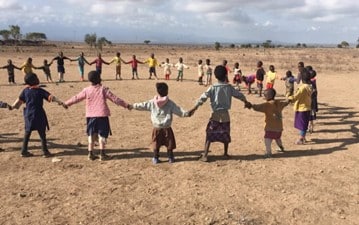
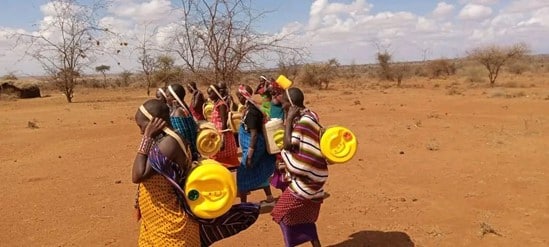
Amboseli love is a nonprofit community based registered to operate in Amboseli community in Kenya. Maasai families, whose wealth is determined by the number of livestock they own, could not always afford to send their children to school. Also, attending school regularly during times of drought can be difficult for Maasai children as families may need to travel great distances in order for their livestock to graze. Livestock is everything to the Maasai community, drought periods livestock die in large number, so many of the Maasai children will not attend to schools because they lack school fees,
Using anything less than children’s rights as a baseline for climate reparations reduces the amounts victims will receive, and limits the way they can be used. We are pursuing emergency relief before the United Nations Human Rights Council to establish this baseline as at least a provisional measure.
Such a turn towards rights could begin by always asking this question: What are you doing to invest in resourcing young women to have their children in a time, place, manner, and with the necessary safeguards that protect those children and their rights, including birth and developmental equity, and avoids those children degrading their own environment in deadly ways?
Rather than minimizing the harm created by using – in our language and otherwise – an lesser baseline, we correctly use a standard that:
The extreme wealth we see in the world today was made by through a system of unsustainable growth, and illegitimate cost/benefit models, that forced costs on most vulnerable and degraded the climate in a way that is taking millions of innocent lives.
The most just and effective solution is to calculate those costs and use them to pay young women to ensure they have any children at a time, place and with resources that compensate the harm and protect the child and their environment. This replaces illegitimate political systems with no functional protections in the having and rearing of children, and thus none for the ecologies those children would consume.
We begin by simply asking: What are we doing to assure the conditions in which children born and raised, including their environment and role models, are being improved so as not to undo the benefits of the work we are otherwise doing in the world? In asking the question we are looking for those who use child welfare policy to undo the values they claim to promote and are thus being unjust and ineffective.
Why lawyers?
Lawyers, tasked with interfacing between citizens and their legal obligations, are key to upholding the legitimacy of any law-making political system. And since at least the Enlightenment, the legitimacy of political systems has been contingent upon those systems including and representing their subjects. Any obligation to follow the law, like laws that entitle wealth, derives from our participation in making it.
The system of assessing costs and benefits never started justly, with family planning that would actually ensure children’s rights. Instead it exploited them for economic growth, a move that destroyed our environment to enrich a few.
It was the freedom of some – mostly white privileged men – to exploit birth and generational positionality at cost to others and their true (o mutual) freedom.
As such we are not included as influential and equal participants. We do not offset equally each other’s capacity to influence the rules (e.g., equal influence over the rules of our democracies) we must live by and thus the power others have over us, even when moving towards that ideal would be as simple as investing in parenting delay and equity funds, which create smaller and more equitable families.
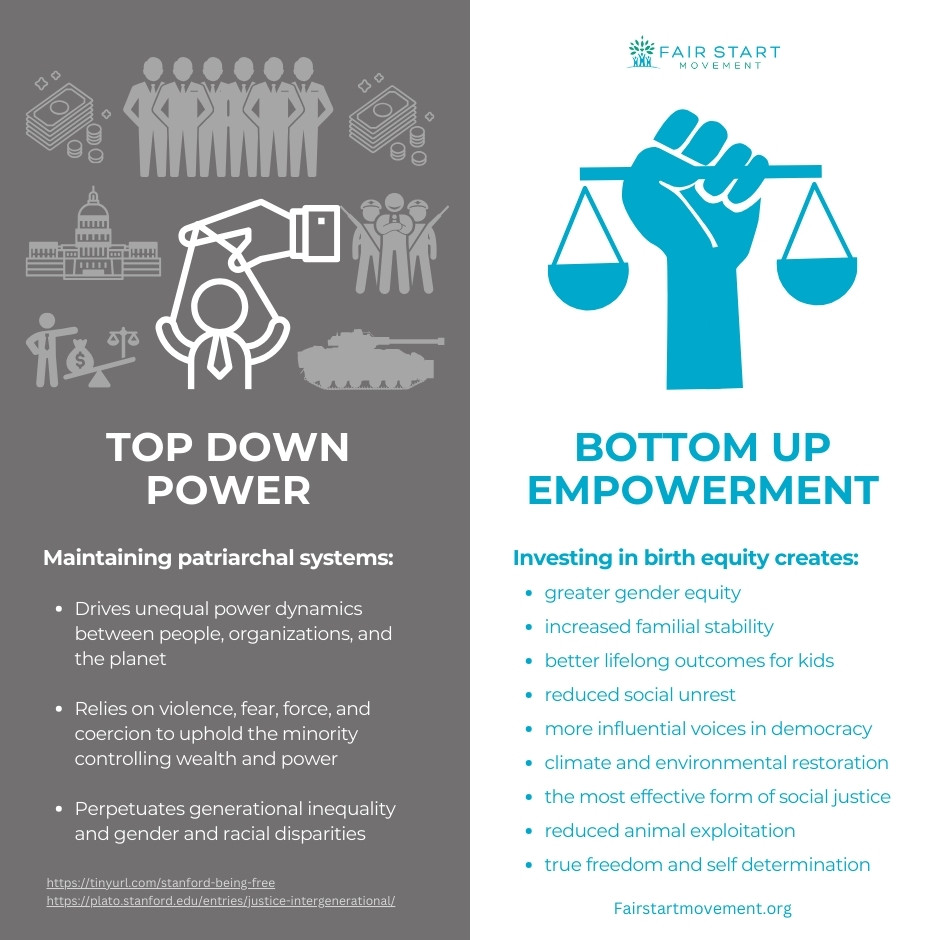
It is this dynamic inclusion of voices as political equals, as a duty to them and from below, not might-makes-right coercion from above around rules vulnerable future persons would not agree to, that legitimates systems.
Justice starts with protecting the most vulnerable, future children and thus indirectly the nonhumans they would otherwise consume, to ensure climate/biodiversity restoration via birth equity (defined as an equal and influential role in one’s democracy) and thus a form of modernizing Diversity-Equity-Inclusion – and-Justice that ensures mutual self-determination for all.
How could there be a binding social contract that does not even begin justly, with minimum thresholds all would want for their birth and development, assessed with simple metrics? To the extent legitimacy is remised on the self-determination or sovereignty of the government’s constituents, this is where it would have to start.
They chose to deny future children the values their lives reflected, e.g., seeking minimum thresholds of personal welfare, expecting equal access to opportunities, participating in and adhering to political/legal systems that purported to represent the governed, using and enjoying an environment relatively conducive to human and nonhuman health, enjoying a right to have a child in relatively safe conditions, etc.
Free people will prioritize the demands over competing interests, and adhere to a fundamental system of obligation that empowers its members.
The baseline error can be summed this way: Why could the most vulnerable could not use their role in their democracy to evade the climate crisis and the death and cataclysmic inequity it will bring, and to protect their own kids and the nonhuman world those children need?
The lies lawyers told, that systems were legitimate even when they did not include and represent their subjects, ensured they could not. Lawyers should know all of this, and act on it, if they want to avoid benefitting from a system that harms others.
Below is a form letter that can be used to begin to empower a climate justice tribunal that would employ a system of just and effective human rights.
Summary of the issue
Reliance on any basic norm, political obligation, or fundamental baseline for cost/benefit assessment other than a just and inclusive (pro)creation norm is a logical fallacy. In other words, to properly assess costs and benefits we have to first become groups of people capable of doing so in a way that is actually inclusive and reflective of the group constituents. This means that things like the Children’s Rights Convention and even more demanding birth and development standards (like climate and biodiversity regeneration through a peremptory norm to birth equity) regeneration would preempt state constitutions and state-issued property rights. Who we should be always comes first, indisputably derives from our social birth and development, and is objective and measurable when geared to the basic value of a capacity for relative self-determination and valuable autonomy. This child-rights based legitimacy would replace unsustainable and extractive growth systems harshly criticized by Nobel laureates.
An Alternative Way to Think About Legitimate Policymaking: Always Starting With Birth Equity and Children’s Rights, and Investing in Democracy Rather Than Exploiting Children’s Positionality for Economic Growth
Dear [entity impacting child and animal welfare],
The Fair Start Movement was formed as a reaction to climatological and other threats to children’s rights, and has developed a universal model – based on the fundamental value of self-determination – to eliminate the threats and be used as the basis for all inclusive and legitimate policymaking. Rising climate crisis costs urge a fundamental shift in which we catalyze the best return on sustainable development investments – funding young girls’ future – by prioritizing, enlarging, and treating them instead as human rights-based ecosocial birth equity, planning and relocation entitlements.
We simply ask: What are we doing to assure the conditions in which children born and raised, including their environment and role models, are being improved so as not to undo the benefits of the work we are otherwise doing in the world?
[Examples of misleading claims and insufficient (and now deadly) standards].
We ask you to take two actions, detailed below of this letter to avoid the death of millions in the future.
First, we ask that you publicly support the use of an objective standard for any claims, like “sustainable,” “green,” “wellbeing,” “equitable,” “child welfare,” “democratic,” “humane,” “regenerative,” “restorative,” “inclusive,” etc. likely to create a perception of ecosocial environmental impact in the listener. and thus, impact children’s rights. According to a senior Environmental Protection Agency administrator, greenwashing and growth washing, including using a subjective standard for relevant terms, has helped create a fantasy world of climate misinformation – beneficial to the one making the statement – that is likely to kill millions. This is a crucial matter of meta-ethics, and the fantasy worlds of subjective value that created the climate crisis.
Second, we ask that you support the use of the provisional standard described above as the fundament of all legitimate policymaking, in our action before the United Nations, and to support the direct action demands of young women for birth-equity based family planning and climate reparations geared around children’s rights and, minimally, the Children’s Rights Convention.
Both are geared to avoid irreparable harm to children, and repetition of the fundamental mistakes that caused the climate crisis, by making child-rights the basis of all legitimate policymaking.
This divided social justice / public interest movements into less effective silos – like misperceptions of animal rights – that did not threaten the status quo the way birth-equity (equally empowering shares in your democratic system of voting) would have. This in turn undercut democracy, leading to the oligarchic threats the United States faces today.
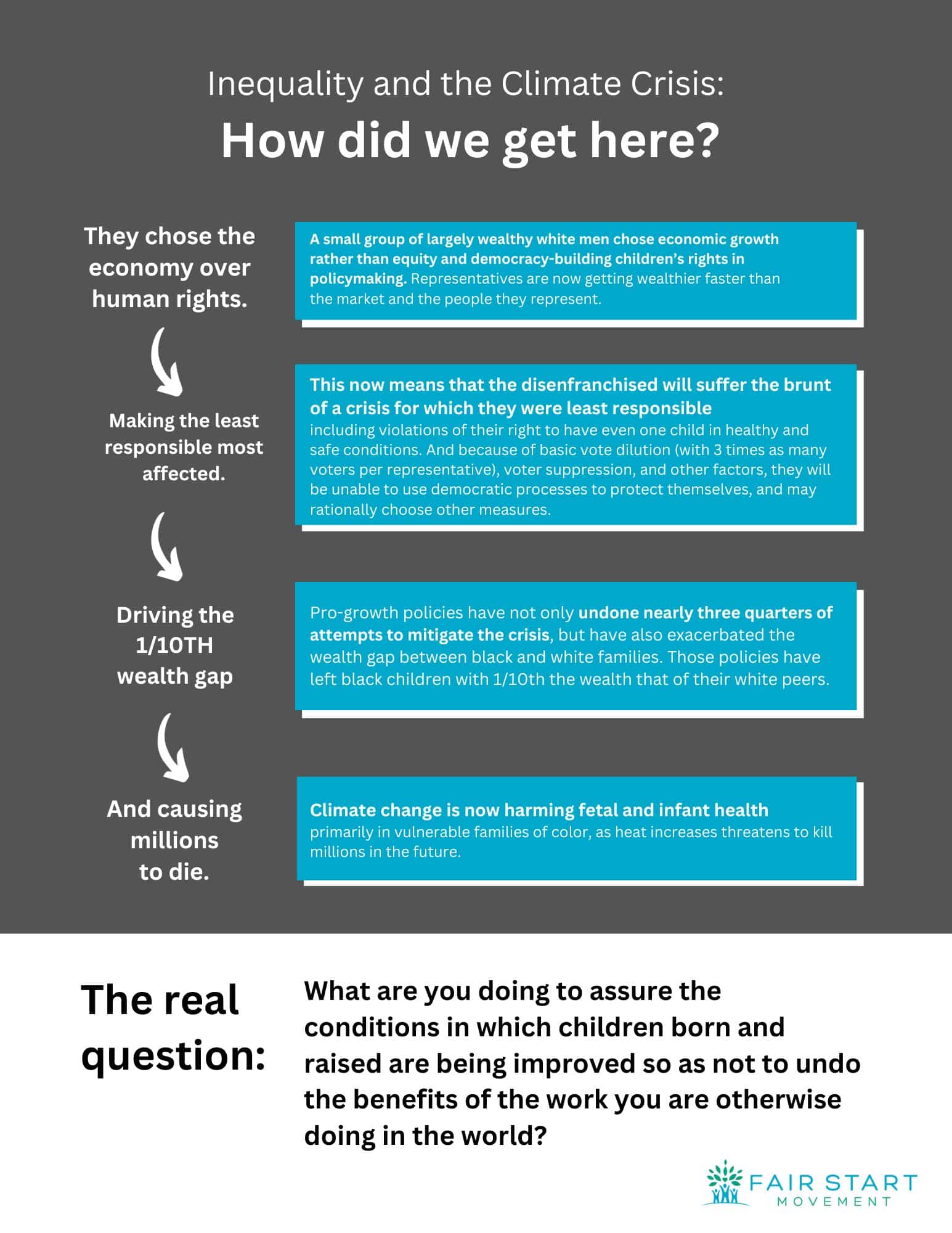
This now means they – the disenfranchised – will suffer the brunt of a crisis for which they were least responsible, including violations of their right to have even one child in healthy and safe conditions. And because of basic vote dilution, voter suppression, and other factors, they will be unable to use democratic processes to protect themselves, and may rationally choose other measures. And in the face of all of this, many governments driven by industry are paying women to have more children with no easy safeguards like “survive and thrive” baby bonds in place, while wealthy families and foundations reliant on growth fund charities engaged in distractivism.
This right and obligation precedes and overrides any property rights – to extreme wealth for example – that were made by externalizing costs at risk to those children. in part because the democracy necessary to authorize and legitimate our actions is a logical impossibility without a primary right to equitable, empowering, inclusive family planning. Persons, not documents, constitute nations and political obligations. Humans and the basic power relations between them constituted at birth are real, documents like constitutions are symbolic. The victims of crimes no official was there to prevent know this well.
The Fair Start Movement was formed as a reaction to threats to those rights, and we urge instead they –and the fundamental value of self-determination – be used as the basis for all policymaking.
Rather than minimizing the harm created by using – in our language and otherwise – an lesser baseline, we correctly use an objective and evidence-based standard that:
A Growing Body of Peer-Reviewed Research Back the Idea Children’s Rights Should Start All Policymaking
The research supports the idea that children’s rights specify who we should be, and who we should be is the first condition of policymaking. Nations cannot constitute, i.e. create their authority and subjects’ obligation, without starting from children’s rights because they would bypass the first obligation, e.g., what your creator owed you in terms of your and their mutual self-determination. That determination could occur in say a town hall, you, and they with equal capacity at the podium, and empowered enough to offset each other equally in any group setting. Empowered to look into the eyes of others without fear or deference, in setting the basic rules for how the groups of free persons – according to this leading political theorist – should operate.
The justice system you observe and defer to today starts with no protection for most vulnerable., and benefits you at cost to others. It exploits children’s birth positionality and the vulnerability of the nonhuman world those children would consume to create economic growth, thus benefitting a few at deadly cost to most others. But we need to ensure each child minimum thresholds of wellbeing and development – to treat them fairly – so they can be included in the cooperative enterprise of lawmaking, and of thus being obligated to follow the law. There is no value that can be separated from who we should be, and the objective list of norms – children’s rights – that limit the negative influence others have over us, and make self-determination, as opposed to being determined by the wealthy, possible
One way to envision the difference would be as between a shopping mall in which business owners try to fill the thing in order to maximize profit, and a rule-making town hall in which citizens fill it while ceding an equal capacity to influence outcomes to all members. This is not capitalism or socialism, but constitutionalism, the creation of duty-based systems that enable member obligation and authority by actually – physically – limiting and decentralizing influence. The unique value of investing in young girls is both evidence of how this can work, and a toehold for major reforms. Reliance on basic norms other than a just creation norm as a logical fallacy.
Self-serving Academic Debates Exacerbating the Climate Crisis and Death Count
Abstract academic debates about population ethics, often funded by concentrations of wealth and power reliant on inequity and growth, threaten to exacerbate the results of the climate crisis by forestalling law and policy reforms. Many of the debates derive from the same Eurocentric vestige of colonialism described above – the historic entitlement of wealthy families to exploit birth positionality relative to colonized nations – nesting in the human-rights regime. Most of the academics in these debates contradict in their writings the basic values they exhibited throughout their lives, e.g., seeking minimum thresholds of personal welfare, expecting equal access to opportunities, participating in and adhering to political/legal systems that purported to represent the governed, using and enjoying an environment relatively conducive to human and nonhuman health, enjoying a right to have a child in relatively safe conditions, etc.
You can identify these academics because they will avoid discussions of how shared values interrelate to the actual creation of power relations. They will silo off values, like animals’ rights, from who the humans the performance of those rights depend on should be. They will avoid discussions of their full positionality. They will avoid explicitly conditioning state authority on empowering each person equally. If the micro-liberation of nonhumans looks like open rescues at factor farms, the macro would look like these “real new deal” social contract demands for reparations in exchange for child-centric planning that would ensure a truly climate-restored and bio-diverse future in which humans are empathetic enough to be inclined to treat nonhumans well. But many academics, whose interests do not align with macro reforms, ignore the latter.
These academics often assist funders in coaptating the values, imitating and redefining things like animal rights and mutual self-determination of humans and nonhumans, creating something that looks like the value but more aligned with their interests.
A classic example of this are academics and their funders backing the sale of vegan food products as a form of animal rights because they are invested in the companies that produce them, even when the family and growth policies they rely on does exponentially more harm to animals (and humans) than their food advocacy does good. As another example, many Effective Altruists frame their work in terms of altruism rather than obligation to avoid questions of race and other reparations owed on their wealth, and in terms of the distant future to avoid questions of the constant and ongoing violations of children’s rights required to create the climate-destroying growth that created their wealth.
They will orient from and reinforce outdated conceptions of power that favor elites, over the vulnerable. They will avoid explicitly conditioning state authority on empowering each person equally. Given their privileged intergenerational positionality, and the fact that they sent their lives generally relying on and participated in legal/political systems of coercive obligation premised on the idea of self-determination (evidenced through things like the holding of elections) and justified obligation that benefitted them at deadly cost to others, they should at least begin from a default or provisional position of extending those values to future generations.
Climate Change Alters the Legitimacy of Fundamental Power Relations That Derive From Birth and Development
We Ask That You Support These Two Reforms to Avoid Minimizing Reparations and Exploiting Children. The Moves? Speak Truth to Power, Then Limit and Decentralize It by All Nonviolent Means Effective.
Will you publicly support the use of the objective standard above – the provisional baseline – for any claims, like “sustainable,” likely to create a perception of ecosocial environmental impact in the listener. and thus, impact children’s rights? It’s easy to understand that the rules that determine when, where, with what resources, in what conditions, etc. women have children can undo the beneficial impacts of all the work done to protect children, animals and the environment, ensure equity, restore democracy, protect the right of future generations to have kids safely and sustainably, the etc. Look at historical annual reports of organizations claiming progress in this area in the 1960s and 70s. Those were all misleading and in a deadly way. The organizations – including Singer’s – were embracing family policies that were quietly undoing progress in all of those areas to enrich a few, ensuring the catastrophic situation in which we find ourselves today.And many organizations today are trying to do the same thing today to future generations.
Everyone has used terms that expressed or implied public benefit, but measured against the true north on a moral compass of science the background systems they usually did not question and in fact implied the legitimacy of, were benefitting the claimant while unleashing significant and increasing harm toinfant humans and nonhumans alike. That true north is what we can use, regardless of human processes and language, to assess damages and create new policy.
Will you support the use of the provisional baseline described above, in our action before the United Nations, and to support the direct action demands of young women for climate and birth equity planning reparations geared around children’s rights and the Children’s Rights Convention. Children’s rights specify who we should be?
What other obligation could possibly precede who we should be?
We owe our first obligation to other members of our nations, as they enter and develop, horizontally, rather than vertically to the powerful – the wealthy or politicians. To think otherwise is to replace the real – authority derived from the people – with the symbolic: documents or representatives.
This is not altruistic. This about liberation. Neither I nor you can be free in world with people who did not get enough what they needed growing up to constitute groups of free and equal persons actually capable of asserting authority and obligating persons to follow laws, especially when that allows the creation of so many people that we lose nature, which is simply the relative absence of the power of other persons. That is the logic of relative self-determination in a world with more than one person. Free persons will condition state authority on their actually being empowered as citizens. They will condition state authority first on a means of choosing who influences them.
Not backing these or comparable reforms means supporting the status quo that allows this: Alaska is using wealth made by killing children in the most vulnerable nations to exacerbate that process using family policy. They’ve found a way to increase fossil fuel production and then use the profits to subsidize larger families and the need for greater fossil fuel production.
The truths and standards discussed in this request protect the vulnerable at all costs. Thanks for considering.
These efforts urge concentrations of wealth and power to offset the harms they are causing, and their wealth externalized on future generations by paying family planning and birth equity and development reparations that change the location, timing, manner, and with what resources women have children to ensure those children thrive rather than suffer because of the wealth-driven climate crisis.
This is not altruistic. This about liberation. Neither I nor you can be free in world with people who did not get enough what they needed growing up to constitute groups of free and equal persons actually capable of asserting authority and obligating persons to follow laws, especially when that allows the creation of so many people that we lose nature, which is simply the relative absence of the power of other persons. That is the logic of self-determination in a world with more than one person.
Many in positions of power like Peter Singer evade this discussion and refuse to exit a political system that benefits them at deadly cost to others. How they handle this issue – from their position of wealth and entitlement – screams that it’s not their life on the line; that it’s other lives, and other parents’ children’s lives, on the line. Singer’s evasions are unique give his urging policies to liberate animals, the benefit of which were undone by family and growth policies. Also, by siloing off the liberation of nonhumans from social justice more generally, he ensured concentrations of white wealth and privilege, at cost to general justice.
For example, Elon Musk makes money selling electric cars to a growing population that needs them because that growth is destroying our atmosphere. The policies that ensured that growth also ensured birth-based black poverty relative to the massive head-start position in which white South African Musk was born, and a dilution of the average citizens power to use their democracies to reverse things like the climate crisis and birth inequity. Those policies did more harm, especially using a metric like self-determination, than Musk and his car sales did good. This is not about population as much as power relations, and not about growth as much as inequity, understood as an equal and influential role in determining the rules – formal and informal – one has to live under. If every child that could be born in South Africa at the time of Musk’s birth had equity in governance, had a role in making the rules, would they have chosen the outcomes we see today? If exclusion was a violation of human rights, can we take back that amount of wealth that derived from the violation? Who would choose to use the same form of legitimacy that enriched a few at deadly cost to a blameless billion?
Remember that – and that their wealth was created at cost to your freedom and the lives of others – when you engage those in positions of power as co-subjects in a shared democracy and bring them the reality of their position.