Tag: News & Fair Start Headlines

  • What Is Legitimacywashing? Lewis Bollard of Coefficient Giving is a Perfect Example.

    What Is Legitimacywashing? Lewis Bollard of Coefficient Giving is a Perfect Example.

    The facts: 

    Extreme Heat Is Rising Faster for Black Americans, and Researchers Say the Gap Is Growing

    Trump Has Now Moved to Roll Back Civil Rights and Hide Liability for Rising Climate Deaths 

    How did this happen? 

    Prominent public interest advocates like Lewis Bollard of Coefficient Giving have for decades made completely inaccurate claims of progress – and in his case, successfully reducing animal suffering – that have hidden the growing political, social, and ecological costs of the polycrisis.

    Bollard was never accounting for the way growth and overshoot was always undoing the value he added to the world and the impact he had, growth that was ensuring more demand for animals and more emissions. He was not accounting for children brought into the world without the resources they need to deal with these impacts, and with less political influence to change the system harming them.

    Relative to what was he helping animals?


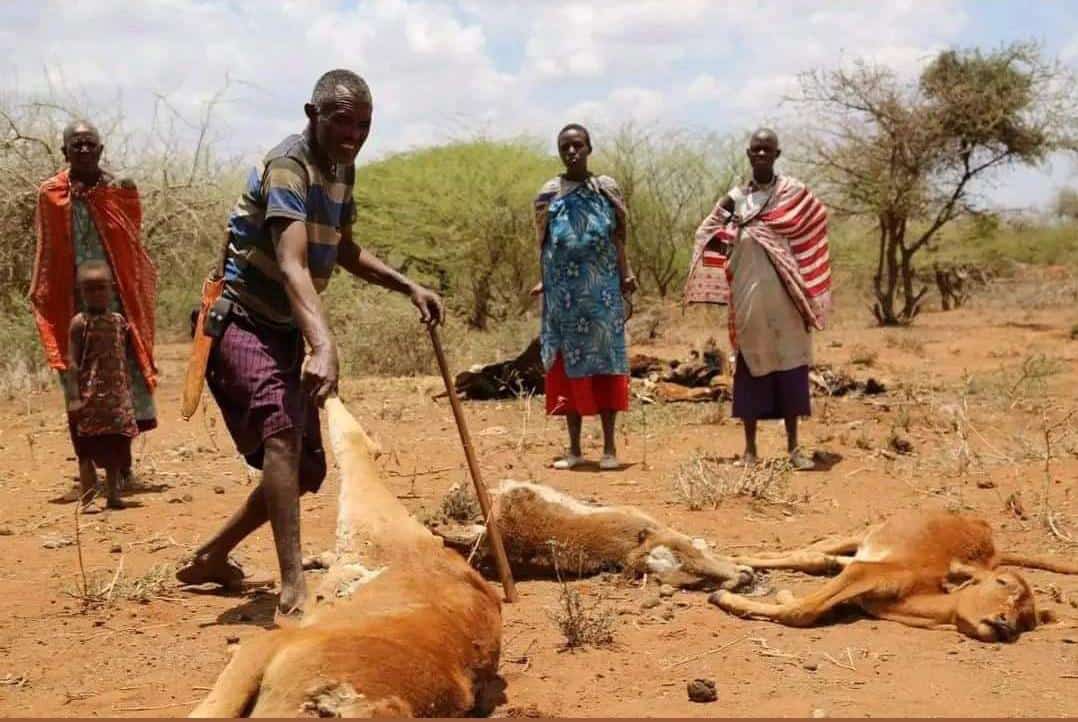
    Starving cow


    He and those like him benefit from the fantasy world of progress he helped create, and at deadly cost to others. His models preserved the same status quo birth inequity that created and maintained Donald Trump, when animal liberation would have required a total rethink in policy pointed towards total liberation.

    Instead the models he used assumed the legitimacy of a random birth lottery, one that uses growth to disenfranchise.

    Bollard’s work thus starts by quietly disvaluing the future lives of the animals he claims to protect, and in a way that has ensured benefits for him and cost to the most vulnerable.

    Given massive standing birth disparities, this entails illegally shifting costs by treating children of color as worth fewer resources, more risk, and less political influence than white children. It derives from the historic subversion of decolonial and racial justice movements via “separate but equal” reproductive rights systems that effectively blocked empowerment thresholds of intergenerational justice, ensuring that voting power was never correlated to real world ecological, political, and social thresholds.

    When someone makes a value assessment or impact claim we always have to ask, relative to what? Unless the value assessment and impact claims are made first relative to a “one person, one equal and influential vote” standard, they are not made as part of a legitimate (or sufficiently inclusive) system.

    It’s legitimacywashing.

    What are the costs of decades of such out-of-context claims? Look at prospects for black families facing climate change with limited access to air conditioning.  
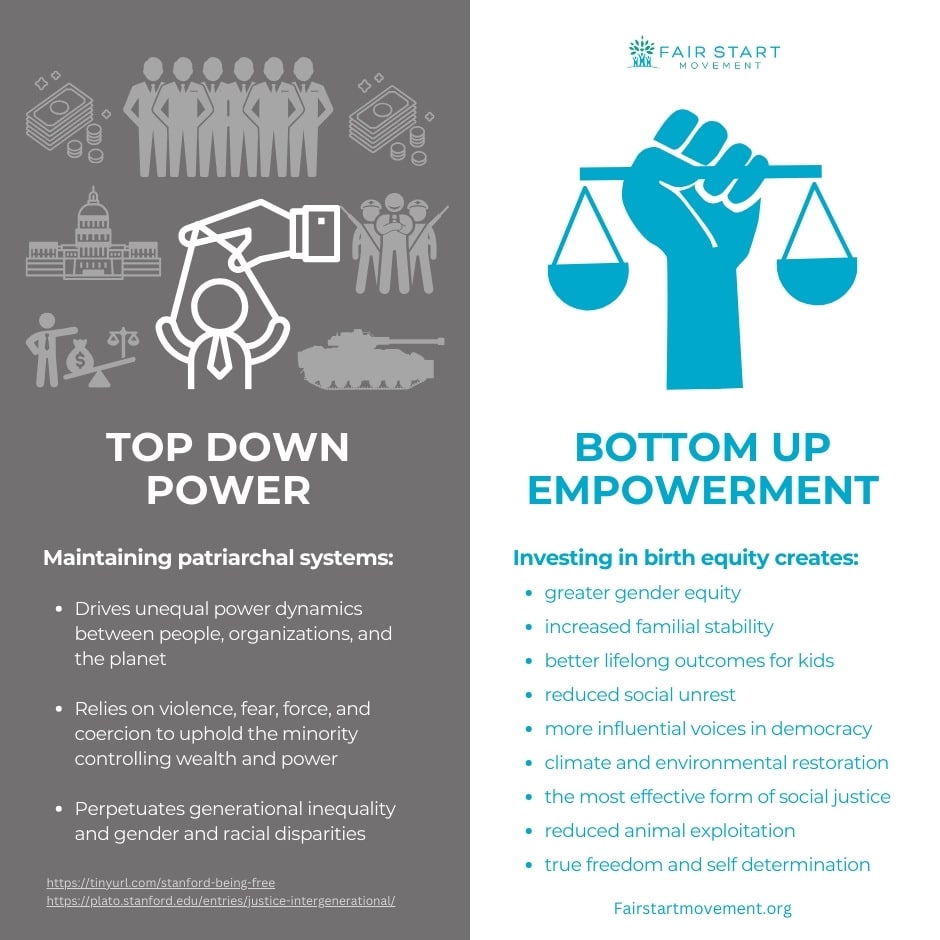
     

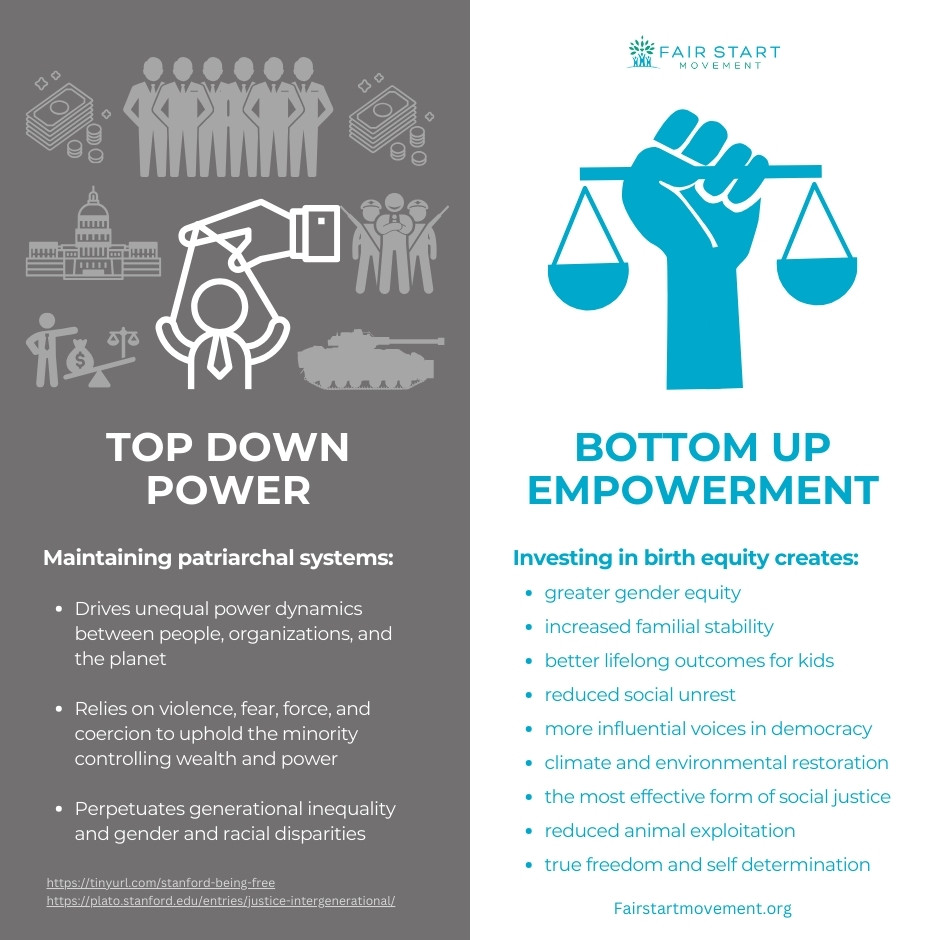
    Infographic comparing Top Down Power vs. Bottom Up Empowerment for birth equity, listing social impacts of each approach—including potential risks like legitimacywashing when using top-down strategies. Includes icons of people, scales, graduation cap, and supportive hands.


    The claims and underlying models Bollard uses are based n manufactured numbers to replace political freedom with economic growth, and in a way that skews the baseline for life-saving climate reparations in order for Bollard and the funders behind him to benefit at deadly cost to others. 

    Fair Start activists have seen a history of organizations like the Humane World for Animals – where Bollard worked – and the Animal Legal Defense Fund intentionally omitting information from their valuation models and impact claims regarding the largest driver of the outcomes at issue – growing birth-based constitutional inequity – to personally benefit, and in a way that has disenfranchised communities of color. 

    Micro, downstream victories have hidden the way macro, upstream forces were undoing them every day.

    Bollard’s statements are false under preemptive state and federal unfair/unconstitutional competition and civil rights laws because there is no valuation and impact reporting outside of one’s birth positional context, birth-empowerment is inseparable from all other values, and accounting for costs of children entering the world relative to that threshold (constituting) is what justifies the benefits one gets.
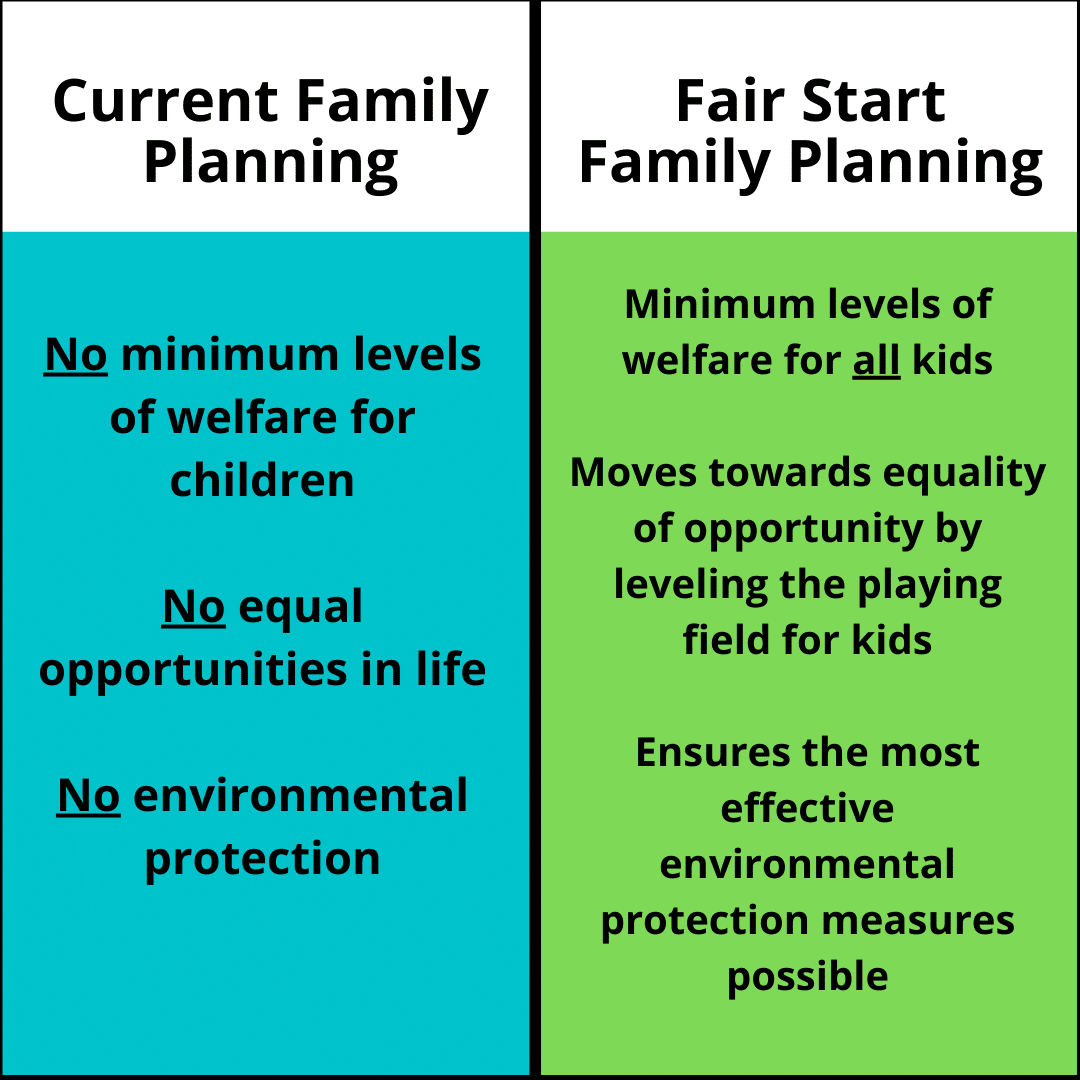
     

    A split infographic compares Current Family Planning with Fair Start Family Planning, listing differences in welfare, equality, and environmental protection for children, while highlighting how practices like legitimacywashing can undermine genuine progress.


    There are no legitimate valuation/business models and reporting systems that value others beneath the threshold of their being minimally empowered, because that empowerment is what justifies all of our benefits. 

    Their discounting the lives of others does more harm than Bollard does good, by his own metrics, like safe temperatures and influence over political systems, and is skewing the baseline for things like climate reparations and voting rights, putting millions at risk.

    A revision of the FalseClaimsChecker.org will explore this question and quantify the results:

    How much of Lewis Bollard’s wealth-based benefits, including influence, was made by triple dipping? Factoring in his privileged birth positionality in a reproducive rights regime devoid of protections for animals and which treats children of color as deserving less than white kids, 2) the benefits accrued since from that system (growth/inequity-based income, and benefits  public interest work and omissive reporting), at illegal cost, including the  constitutional disenfranchisement of, or reduction of the voting power, of vulnerable black communities?

    The fix? 

    Governments can’t interpret the constitution or any of their authority – including state and federal unfair/unconstitutional competition and civil rights laws in ways that disenfranchise persons, especially to the point of risking their lives. Birth-positioned constitutional benefits land at the level of individuals – so do liabilities. 

    Fair Start will be urging California to take action regarding Bollard’s models and claims.

    One can’t talk about value out of the context of a system of legitimately empowering others – starting with children entering the world – because governments would have to treat that as fraud by omission in that the claimant would be getting benefits without paying the costs. And if the governance didn’t act, they themselves would slip into illegitimacy and those otherwise subject to their political power would be obligated to take control.

    One way to start? We can all tell the truth and admit that legitimacywashing in our valuation models and impact reporting did more harm to our values than we did good. Without reform we triple dip: 1) Benefiting from arbitrary birth positionality, in terms of things like nationality, race and intergenerational positioning, 2) getting the benefits of a growth economy without paying the costs it imposes on others, and then 3) engaging in public interest work that omits the countervailing of impacts of growth so we don’t have to pay the costs.

    Do better than Bollard. 
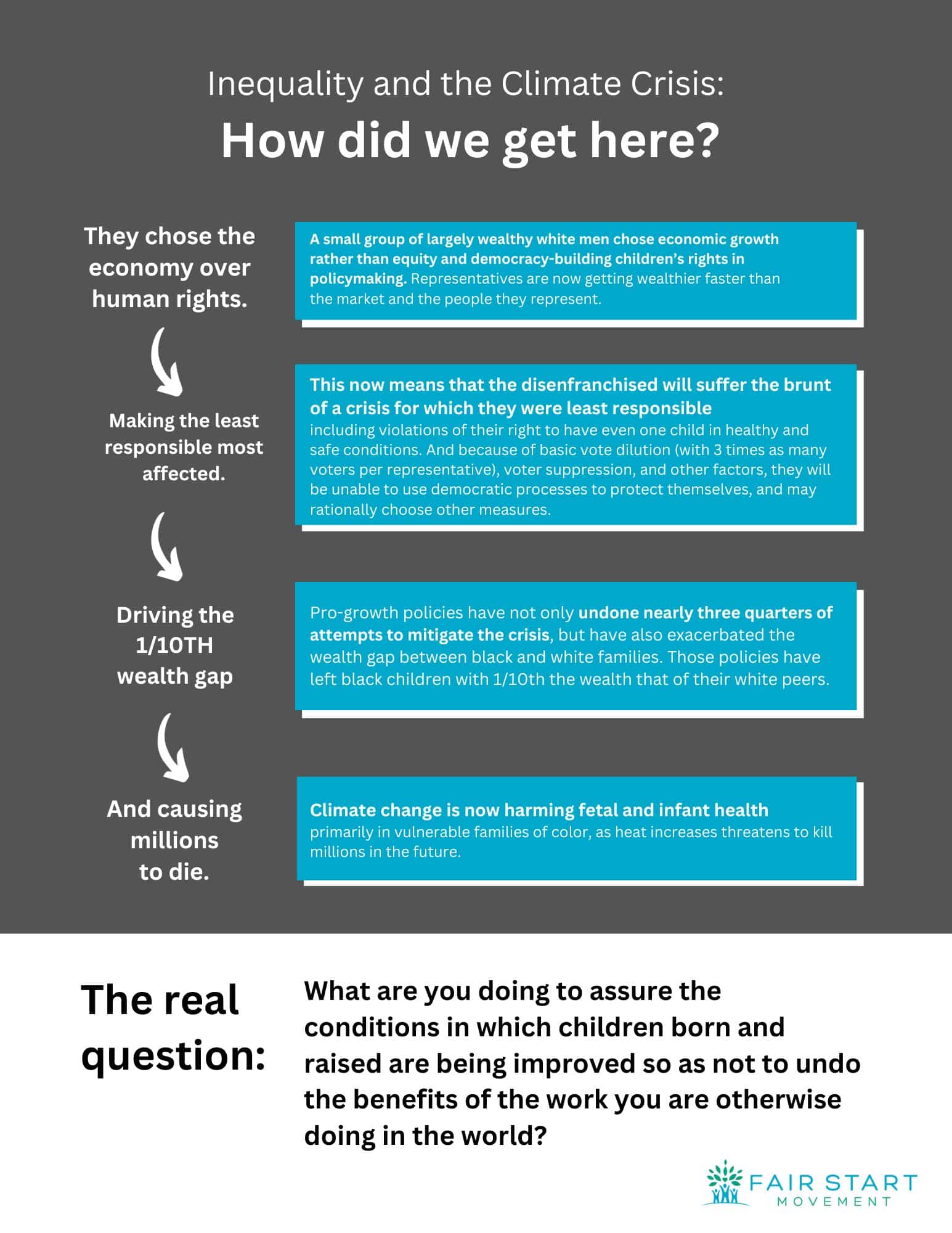
     

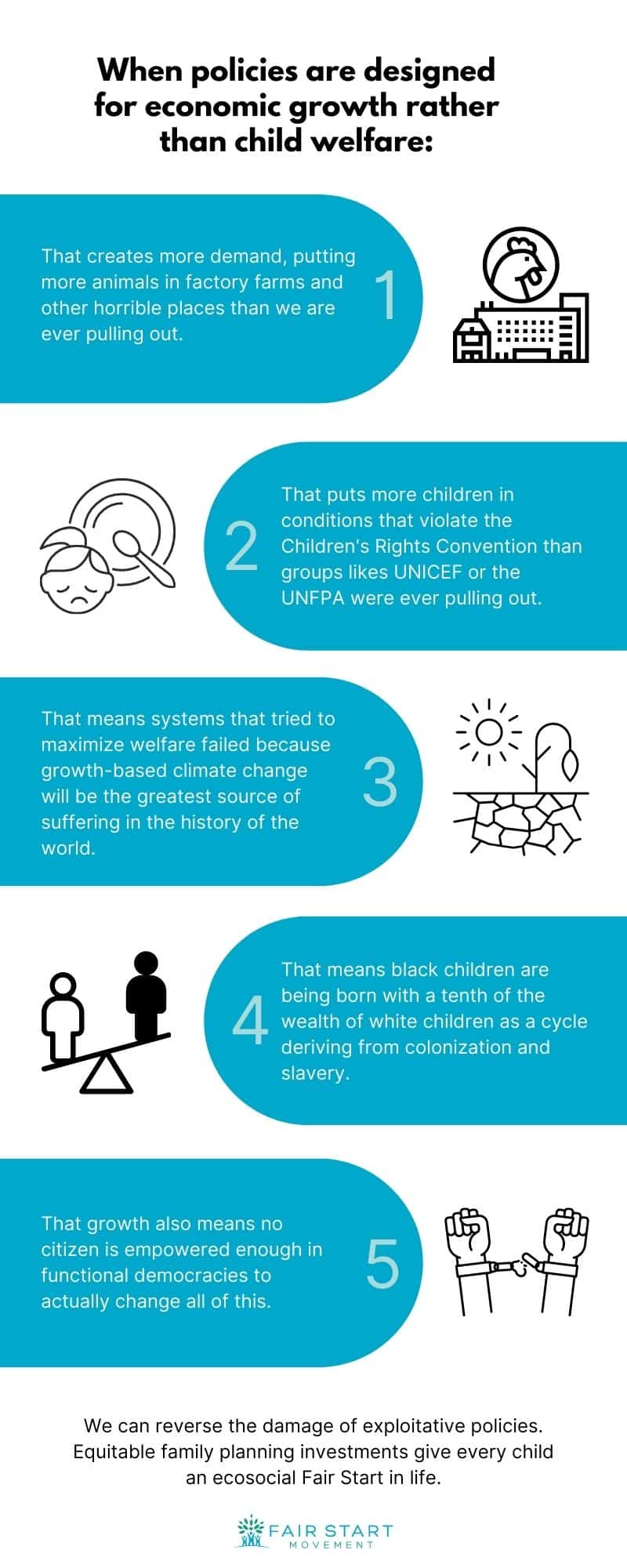
    Infographic titled Inequality and the Climate Crisis: How did we get here? with text blocks explaining causes like prioritizing economy over rights, disenfranchisement, ignoring the 1/10th wealth gap, and impacts on families. It also highlights how practices such as legitimacywashing contribute to the problem by masking systemic failures under a veneer of responsibility.

  • The most just and effective reform possible? Take legal action against illegal discounting and legitimacywashing.

    The most just and effective reform possible? Take legal action against illegal discounting and legitimacywashing.

    What’s the most just and effective reform possible? Ensuring every child a measurably fair start in life.

    Why?

    Documents like constitutions and treaties do not constitute legal obligations and nations – only people empowering others can do that, and the first necessary condition of that process is ensuring we account for the costs of ensuring all children enter the word above a “one person, one equal and influential vote” standard of democratic empowerment.

    How do we assess if the costs are being covered? Those who wish to pay the costs  can never compete against those who refuse, those who would use what one Nobel laureate called a growth Ponzi scheme, exploit infants and animals.

    Take anyone’s or any institution’s value assessments and impact claims – these are what situates them in the political system.

    Questions: Is the target making political authority and entitlement to wealth contingent on empowering those subject to these things, and first order- children entering the world? Are they constituting a just future? Are they legitimate?


    A split infographic compares Current Family Planning with Fair Start Family Planning, listing differences in welfare, equality, and environmental protection for children, while highlighting how practices like legitimacywashing can undermine genuine progress.


    Are they #illegallydiscounting and disenfranchising future lives?

    Fact: Growing political inequity would have done more to harm their professed values than they have done to further them, and they are likely knowingly omitting the countervailing impacts of that growth in their value assessments and impact claims.

    Anyone can use any AI tool to see this clearly, contrasting claimed impact with the impact of that growth.

    Or use this great tool: FalseClaimsChecker,org


    How Do You Destroy a Planet's Atmosphere? Tell Lies. Fair Start Certification Tells the Truth Infographic

    This is called #illegaldiscounting, a cost/benefit analysis that uses a false premise – legitimate obligation in a legal system that does not empower those subject to it – to enable certain business models.

    It is the inherited practice of the illegal conversion of political freedom into market freedom through an almost universal reproductive rights policy / creation ethic that treats having children as more self-determining form the parents than the child created. Welfare gains and market values do not offset the loss of freedom  – the  loss of objective, measureable self-determination – that the discounting requires. 

    Illegal discounting entails assuming children deserve what they are born with rather than what their rights and political equity require and discounting costs accordingly. It also involves assuming the legitimacy of a political system in which children of color receive a fraction of what white kids get.

    It derives from the privatization of the creation of power relations, an inversion of the meaning of self-determination, by corrupt leaders in the human rights regime decades ago. These leaders subverted racial justice and decolonization efforts by maintaining “separate but equal” ideologies, and the protection of mostly white generational wealth, in the reproductive rights regime over intergenerational justice and a threshold for democratic empowerment of future children.

    The standard does not require claimants to actually further the values they claim, and ignores the need for an objective standard – like a “one person, one equal and influential vote” metric – of who we humans should be.This corruption fundamentally created and drove the polycrisis, in part, because public interest became a race to the bottom, with doing good simply meaning doing better than the terrible actors around us. Instead, the objective standard could have ensured anti-legitimacywashing efforts, a much more evolved concept than greenwashing or humanewashing which deal with problems downstream, rather than upstream and preemptively. Those who refuse to discount could never compete against those who do, using wealth made by not paying the costs of child empowerment / legitimate political systems to continue that process.

    Climate change solutions that magically enrich some children at deadly cost to others are not solutions at all.

    The corruption decoupled political representative ratios from ecological carrying capacities – the resulting inequitable and unsustainable growth – what one Nobel laureate called a Ponzi scheme – has been catastrophic, ensuring vast inequity and ecocide, and moving the freedom and self-determination of many into the banks accounts of a few. That wealth now funds a fantasy world of misleading public impact claims to hide the illegitimacy, with sensational micro victories hiding how daily growth undoes the benefits.

    This enriches some illegally, at deadly cost to others.

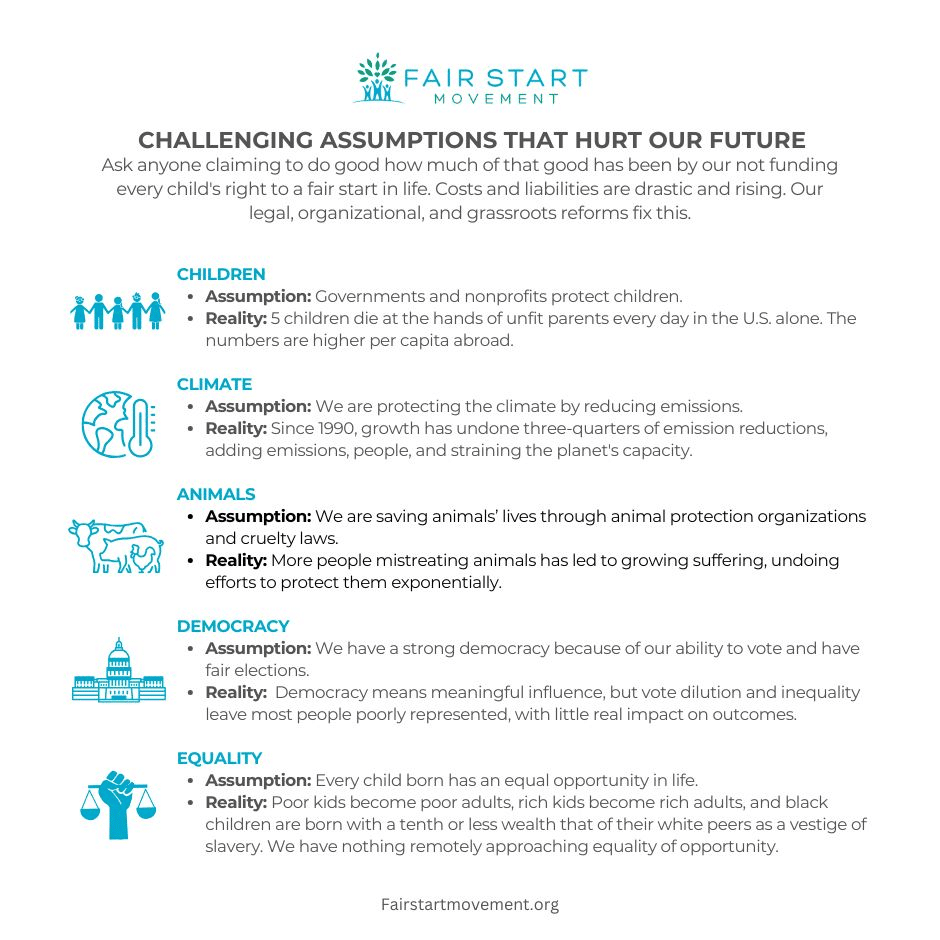
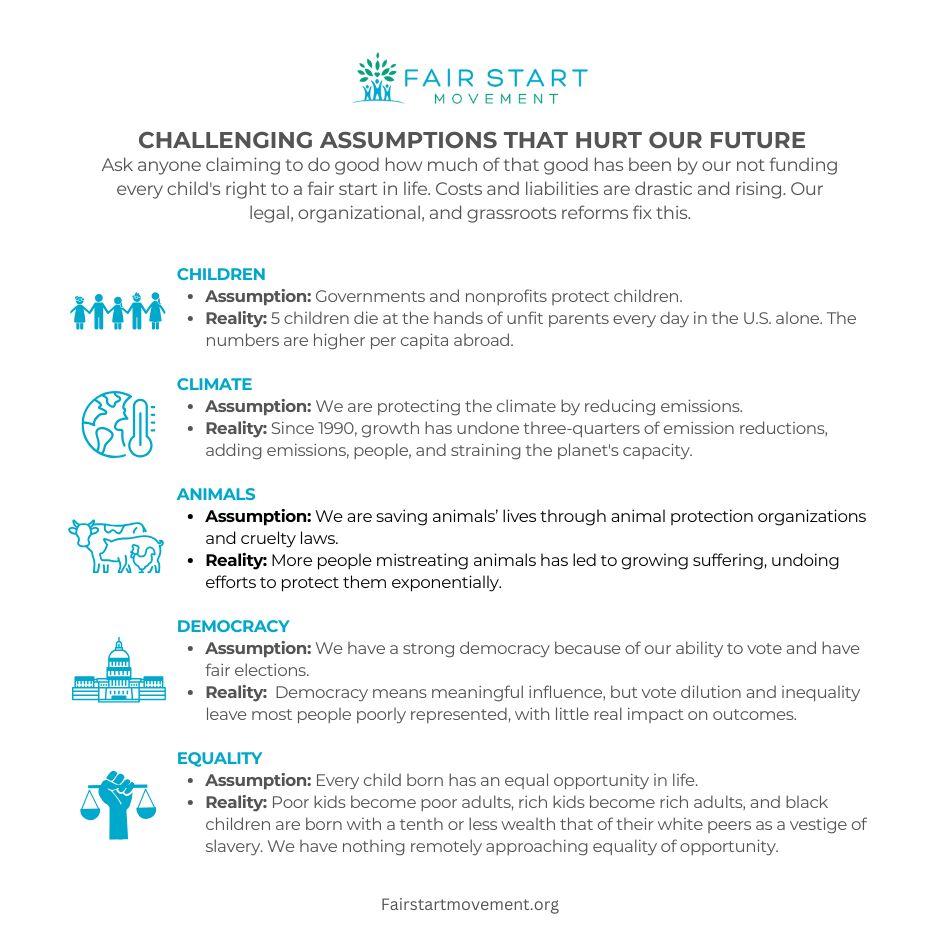
    Infographic from Fair Start Movement detailing how funding every child’s right to a fair start benefits children, climate, animals, democracy, and equality—with brief descriptions and relevant icons for each topic—while highlighting the need to avoid practices like legitimacywashing that can undermine genuine progress.

    It skews the baseline for things like climate reparations by as much as five times, minimizing life-saving liability because it does not account for actual, or birth-based power relations. Instead it looks at them abstractly.

    This has a disenfranchising and discriminatory impact on future generations, relative to things like democratic representative ratios and ecological carrying capacities.

    And it flows from bad research, that led to bad policy:

    If lawyers had gotten it right, economists would not have been able to discount future lives because to be legitimate, legal systems have to maintain “one person, one equal and influential vote” entry threshold under standards for intergenerational justice. Lawyers (like Heather Gerken, former Dean of Yale Law School) did not, and do not, get it right because they intentionally use the legal fiction of reproductive autonomy to block the threshold, and free ride on arbitrary birth positionalities, as well as concentrations of power and wealth (the endowments as Yale, and Ford Foundation, for example) made by not ensuring the threshold, in a way that erodes all of our freedoms and right to self-determination.

    It would be physically impossible to be free / self-determining if we do not now move that wealth to now elevate the threshold, with markers like democratic representative ratios linked to ecological restoration, racial equity etc.

    Those moving the wealth are not being altruistic. They are defending their own political freedom, a reason that has historically, and does today, allow extreme measures.

    Here is what we can do to stop it:

    Take anti-greenwashing legal frameworks and look for #legitimacywashing instead.

    Illegal discounting violates unfair competition and civil rights laws because it disenfranchises future generations relative to a zero / legitimate baseline, and is inherently deceptive and discriminatory.

    It is preemptively illegal, under constitutional law, because the authority to govern derives from the need to empower those subject to that authority. Illegal discounting converts the possibility of democratic participation into unsustainable, inequitable and disenfranchising growth by discounting the lives of future children beneath a threshold of democratic empowerment.


    Infographic titled Inequality and the Climate Crisis: How did we get here? with text blocks explaining causes like prioritizing economy over rights, disenfranchisement, ignoring the 1/10th wealth gap, and impacts on families. It also highlights how practices such as legitimacywashing contribute to the problem by masking systemic failures under a veneer of responsibility.


    Major philanthropic institutions and nonprofits in the United States and Europe use it to preserve status quo generational wealth, over the public interest values they proclaim.

    That means the same institutions that claim to be fighting climate change have for decades been discounting the damages in things like public interest litigation, in some cases with as much as one fifth the accurate damage assessment.

    This is the primary ethical, moral, political, legal question, and because it is existential: Are we valuing others enough to make our benefits and obligations contingent on their empowerment?

    What would it take to empower children as they come into the world with a representative ratio pegged to restorative ecological carrying capacities, and racial/political equity?


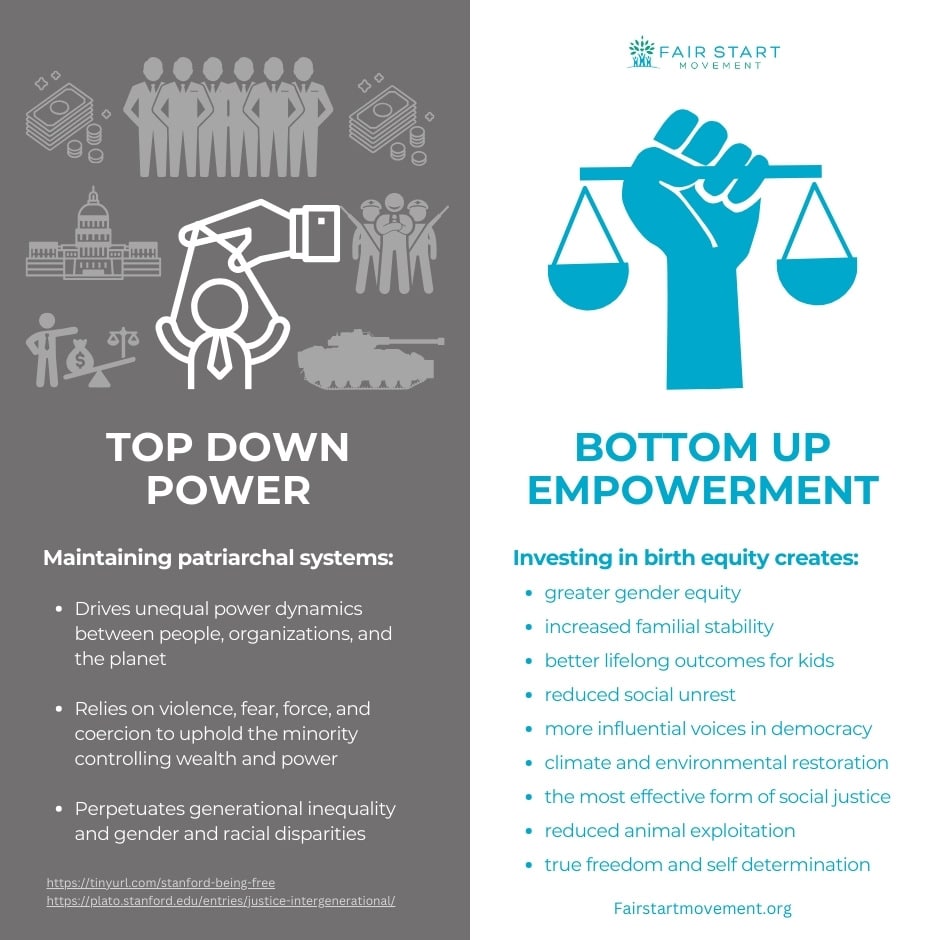
    Top Down Power and Bottom Up Empowerment


    Then challenge the claims and business models as illegal under unfair competition, civil rights and constitutional law. Only this tests whether political authority and entitlement to wealth is contingent on empowerment. Only this accounts for the inseparability of values from obligation.

    The University of Denver recently returned $250k to a funder because of their illegal discounting in regards to their animal law program.

    Read the complaint about that here.

    Fair Start Movement is now assisting Truth alliance.global to make its own claims against the school for the harm it suffered.

    In circles of funders and advocates dedicated to animal protection the question of whether organizations are illegally discounting (ID), devaluing the future lives of animals in their business modeling, is a real issue.

    Those who have benefited from the racist and deadly Anthropocene, and still choose to maintain it through law and policy, are not benefiting animals, and – given the numbers of vulnerable entities involved – are the worst example of the “winners take all” phenomenon of those in power pretending to be leaders in justice.

    How it works in animal protection (much like a Ponzi):

    Funders create their wealth based on inequitable and unsustainable growth – by not paying the costs of empowering children or evading the climate crisis, by discounting black lives, etc. By using illegal discounting, those taking in the wealth do more harm than good to objective values, like animal protection. Fact: The growth creating the wealth kills more animals than as philanthropy it saves.

    The funder then invests in the growth-based food or materials industry to make money, funds nonprofit organizations to create market preference for vegan products through downstream activism (distractivism) – after the harm has occurred, and more animals go into the system with more harm to the environment.

    The funder and their wealthy kids walk away with the proceeds, the activists get paid their salary and their egos get fed, and animals and vulnerable communities are worse off.

    Corrupt lawyers look the other way.


    Climate crisis infographic


    Trump and those like him (mostly white generational wealth) win, because instead of animal protection blocking the inequitable and disenfranchising growth that created him, the animal protection movement enables the growth by creating a fantasy world of downstream victories to hide it.

    Anyone can analyze animal protection claims against inequitable growth (which is tantamount to loss of political equity at a level of illegitimacy) to see this.

    I’ve seen undergraduate students spot the Ponzi. And I’ve seen them understand that fundamental or preemptive causation – because who we should be precedes what we should do, as a premise – would apply to legal cases against the fraud.

    This discounting has gone on a long time, but as the climate crisis death count rises, so does the liability of those engaged in this, and we may be reaching a point where key targets/examples start to fall. This will transition the driver or philanthropy not from charity to investment, but from investment to liability for the polycrisis.

    Anyone can take similar action against similar targets. Learn more here and join the Constitutional Challenge campaign. 

  • An Open Letter from Truth Alliance –  The Denver Model, Equal Valuation of Life, and the Urgent Need for a Fair Start for No Child is worth more than another.

    An Open Letter from Truth Alliance – The Denver Model, Equal Valuation of Life, and the Urgent Need for a Fair Start for No Child is worth more than another.

    To the University of Denver, its leadership, faculty, students, funders, alumni, and the wider public,

    Truth Alliance writes to raise a fundamental concern about how institutions model, value, and report the impacts of their work on people, animals, communities, and future generations.

    We believe the University of Denver’s traditional modeling approach, as we understand it, risks reproducing a “separate but equal” system of valuing life, one in which the interests of some populations, children, communities, animals, or generations can be assigned greater weight than others. In our view, this approach is incompatible with the principle that every child and every human life must be treated with equal dignity and concern.

    We refer to the prior letter Fair Start sent the University.

    Our concern is not simply about one academic model or one institution. It is about the broader consequences of using systems that discount the lives of future generations or treat certain populations as less valuable when calculating public impacts. When a model places a different value on a child’s life because of where that child is born, the wealth of their family, their race, their nationality, or the generation into which they are born, the result can be a deeply unequal distribution of protection, resources, and opportunity.

    Truth Alliance believes that no child is worth more than another. That principle must be reflected not only in constitutional law and civil rights but also in the models, policies, economic calculations, and institutional decisions that shape the future.

    The Question of Public Impact

    We are particularly concerned about the consequences of impact-reporting systems that fail to adequately account for harms imposed on future generations and communities already facing the greatest risks. If a model systematically discounts future life, then the suffering of children who have not yet been born may be treated as less important than the interests of people living today. If the model also fails to account for historic inequalities, the result can be a system that effectively transfers costs from those with greater power to those with less power.


    Family Planning info card


    This is especially alarming in the context of the climate crisis.

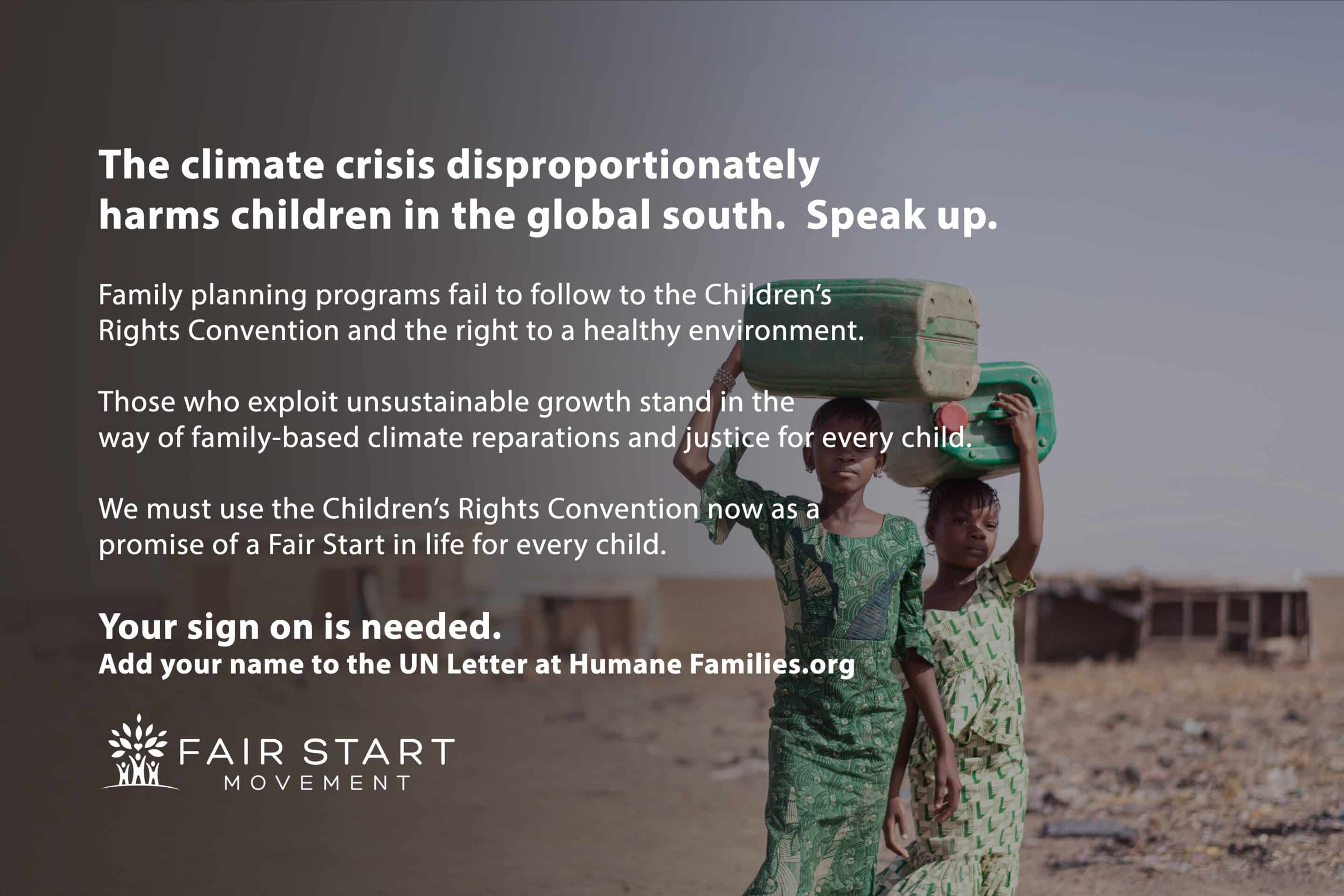
    Africa contributes a relatively small share of historical global greenhouse-gas emissions, inequalities yet African children and other global south communities are among those facing severe consequences from climate change. The impacts include:

    • Rising temperatures and increasingly dangerous heat.
    • More frequent and prolonged droughts.
    • Unpredictable rainfall and changing seasons.
    • Crop failures and declining agricultural productivity.
    • Food insecurity and malnutrition.
    • Water scarcity and competition over limited water resources.
    • Livestock losses and threats to pastoral livelihoods.
    • Flooding and destruction of homes and infrastructure.
    • Soil degradation and desertification.
    • Loss of forests, biodiversity, and wildlife habitats.
    • Increased displacement and climate-related migration.
    • Greater risks of disease and public-health emergencies.
    • Disruption of children’s education.
    • Increased poverty and loss of household income.
    • Greater risks to women and girls, particularly in vulnerable communities.
    • Increased conflict and competition over natural resources.
    • Loss of cultural heritage and traditional livelihoods.
    • Growing pressure on already weak health and social-protection systems.
    • Greater exposure of children to long-term and intergenerational harm.

    These are not abstract statistics. They represent real children, families, and communities whose futures are being shaped by decisions made today.


    Challenging assumptions that hurt our future infographic

    A Call for a Different Standard

    Truth Alliance believes that the solution is not simply to improve one model at the margins. Institutions must reconsider the underlying assumptions that determine whose life counts, whose suffering is measured, and whose future is protected.

    We therefore call on the University of Denver and other institutions engaged in public-impact modeling to examine whether their methodologies adequately protect the equal dignity and value of all people including children not yet born. We believe there is an opportunity to move from models that may discount future life toward a Fair Start standard based on the principle that no child is worth more than another.

    Such a framework would seek to ensure that:

    1. Every child is treated as having equal inherent value.
    2. Future generations are not systematically discounted simply because they have not yet been born.
    3. Public policies account for long-term and intergenerational harm.
    4. Historical inequalities are not hidden by statistical assumptions.
    5. Communities facing the greatest risks are not treated as acceptable recipients of disproportionate harm.
    6. Public-impact assessments recognize the full human consequences of environmental, economic, and social decisions.
    7. Institutions are transparent about the assumptions built into their models.
    8. Children and affected communities have a meaningful voice in decisions that determine their future.

    The Cost of Inaction

    Truth Alliance is concerned that failing to reconsider these approaches could contribute to continued and unimaginable harm particularly for children and communities already living at the margins of global protection. When institutions normalize the discounting of future life, the consequences do not remain inside classrooms or academic papers. Models influence policy. Policy influences investment. Investment influences infrastructure. Infrastructure influences communities. And these decisions ultimately shape who is protected and who is left exposed.


    The question before us is therefore not merely technical.

    It is moral.

    It is legal.

    It is constitutional.

    And it is about the future of humanity.

    Truth Alliance and its members believe that a child’s value cannot depend on geography, wealth, race, nationality, generation, or economic status.

    We call upon the University of Denver to engage openly with these concerns, review the assumptions underlying its models and public-impact reporting, and explore a new approach that places equal human dignity at the center of institutional decision-making.

    We further invite scholars, civil-rights advocates, children’s-rights organizations, climate-justice movements, African communities, and affected families around the world to join this conversation.

    The future should not be built on a system that treats some lives as more valuable than others.

    No child is worth more than another.

    That is the standard we believe the law, civil rights, climate justice, and public policy must ultimately uphold.

    Truth Alliance
    No Child Is Worth More than Another

  • African Children Do Not Matter  When the Global North Measures Humanity in GDP

    African Children Do Not Matter When the Global North Measures Humanity in GDP

    “Every child matters. Every child deserves a fair start. And no country’s economic status should determine the value of a child’s life”

    There is a painful question that the world has avoided for far too long:

    Do African children truly matter to the global system?

    The answer, when we examine how resources are distributed, whose lives receive urgent attention, and whose suffering is treated as normal, is deeply uncomfortable.

    Too often, it appears that the lives of children in Africa are valued according to economics rather than humanity. When a child is born in a wealthy country, their future is protected by systems that recognize education, healthcare, nutrition, safety, and opportunity as fundamental rights. When a child is born in a poor African community, their suffering is often explained away as poverty, population growth, weak institutions, or a lack of development.

    The difference is not the value of the child.

    The difference is the value the global system assigns to the place where the child was born.


    GDP Has Become a Measure of Whose Lives Matter

    The global economic system often speaks the language of Gross Domestic Product GDP. Countries are ranked according to economic growth, productivity, investment, trade, and national income.

    But GDP does not measure the value of a child’s life.

    It does not measure whether a child goes to school hungry. It does not measure the trauma of losing a parent. It does not measure the dignity of a child who has no clean water. It does not measure the dreams of a young girl who is forced to leave school because her family cannot afford basic necessities.

    Yet the international system frequently behaves as though economic output is the most important measure of progress.

    This creates a dangerous hierarchy of human worth.

    A child in Africa may be surrounded by natural resources, fertile land, renewable energy potential, and enormous human creativity, yet still grow up without the basic conditions necessary to thrive. Meanwhile, the global economy continues to extract value from the continent while too many African communities remain trapped in poverty.

    The question is not simply why Africa is poor.

    The question is who benefits from Africa remaining poor.


    The Global North Cannot Claim to Value Children Equally

    Governments, corporations, universities, foundations, and international institutions frequently speak about universal human rights. They publish reports about children, climate change, gender equality, and sustainable development.

    But words are not enough.

    If every child is truly equal, then the child in Uganda should matter as much as the child in the United States, Europe, or any other wealthy region.

    If childhood is a universal right, then a child’s access to food, healthcare, education, clean water, safety, and a future should not depend primarily on the GDP of their country.

    Yet global priorities often tell a different story.

    Billions can be mobilized during financial crises. Massive investments can be made in technology, infrastructure, defense, and economic expansion. But when children in Africa need direct support, the response is often framed as charity.

    This is where we must challenge the system.

    African children do not need to be treated as objects of charity. They need to be treated as human beings with equal rights and equal value.

    Charity Is Not the Same as Justice

    For decades, Africa has received development assistance, humanitarian aid, and charitable interventions. Many of these efforts have saved lives and supported communities, and the people working within them deserve recognition.

    But charity alone cannot solve structural inequality.

    A system that repeatedly creates inequality cannot repair that inequality simply by giving small amounts of money to those who have been harmed.

    Justice requires us to examine the structures behind poverty.

    It requires us to ask why African countries with enormous natural resources can remain economically vulnerable. It requires us to examine the legacy of colonialism, unfair trade relationships, debt, extractive industries, climate injustice, and unequal access to global finance.

    It also requires us to confront a difficult reality: the world often expects Africa to develop using systems that were not designed to prioritize African children’s wellbeing.

    Climate Change Reveals the Inequality Clearly

    The climate crisis makes this inequality impossible to ignore.

    African communities have contributed relatively little to historical global emissions compared with many industrialized economies, yet millions of African children face droughts, floods, food insecurity, extreme heat, displacement, and disease.

    A child cannot choose the carbon emissions of previous generations.

    A child cannot choose where they are born.

    Yet children are paying the price.

    When climate discussions focus primarily on economic growth and carbon markets, the human being can disappear from the conversation.

    We must ask a different question:

    What does climate justice mean for a child in Africa?

    It means that the child must have clean water.

    It means access to nutritious food.

    It means protection from extreme heat.

    It means resilient schools and healthcare systems.

    It means the right to grow up without being forced into migration because their community can no longer sustain life.

    Climate justice must be measured in human lives—not only in GDP, carbon credits, or economic indicators.

    The Problem Is Not That African Children Have Less Value

    African children are not less intelligent.

    They are not less capable.

    They are not less deserving.

    They are not less human.

    The problem is that the global system has created unequal starting points and then often uses those unequal outcomes to justify further inequality.

    Global north folks  chose separate but equal and reproductive autonomy over reproductive equity – that caused the polycrisis and allowed theme to move wealth to their families in the process.

    the wealth in the global north being made at cost to children in Africa, and that wealth now owed to ensure legitimacy.

    A child born into poverty is told they must work harder.

    A child born into wealth is given opportunities.

    One is expected to overcome systemic barriers through individual effort. The other benefits from systems built over generations.

    This is not a fair competition.

    This is why the idea of a fair start matters.

    Every child should have a meaningful opportunity to survive, develop, learn, and participate in society. A fair start does not mean every child receives exactly the same resources. It means that no child should be condemned to a lesser future simply because of the circumstances of their birth.

    A universal legitimacy lever that challenges institutions and systems that fail to recognize the equal value of every child. Truth Alliance have activists like Mwesigye, Pirrette,  Jenipher Jones, Zahara, Esther,mthabisi George  and others,To advance Black birth equity and make the equal worth of every child a fundamental  standards of legitimacy, arguing that societies like Africa cannot claim true legitimacy while structural inequalities continue to determine which children receive protection, opportunity, and a fair start in life. No child is worth more than another.

    Challenging assumptions that hurt our future infographic

    We Must Stop Measuring Africa Only by What It Produces

    Africa is often discussed in terms of what it can produce for the global economy: minerals, oil, agricultural commodities, labor, markets, and investment opportunities.

    But Africa is more than a resource base.

    African children are more than future workers.

    African communities are more than markets.

    Human beings should never be valued primarily according to their economic contribution.

    If the global North is serious about human rights, it must move beyond a system where GDP determines whose suffering receives attention and whose future receives investment.

    The real measure of a society is not how wealthy it is.

    The real measure is how it treats those with the least power.

    A New Global Standard Is Necessary

    The world needs a new standard for measuring progress.

    We should ask:

    How many children are safe?

    How many children are healthy?

    How many children can access quality education?

    How many children have clean water?

    How many children are protected from exploitation?

    How many children have a genuine opportunity to shape their future?

    And most importantly:

    Would we accept this level of suffering if these children were born somewhere else?

    That is the question the global community must confront.

    African children matter not because they will become productive workers, consumers, taxpayers, or contributors to GDP.

    They matter because they are human beings.

    Their lives have value before they produce anything.

    Their dignity should not depend on the wealth of their country.

    Their future should not be determined by the economic interests of powerful nations.

    The world must move beyond a system that measures Africa by GDP while measuring African children by survival.


  • When the Heat Rises, Africa Has the Least Protection and Too Many Childhoods Are Treated as Normal

    When the Heat Rises, Africa Has the Least Protection and Too Many Childhoods Are Treated as Normal

    “The greatest injustice is not only that the world is warming, it is that those with the fewest resources are carrying the heaviest burden. And no child should be considered normal when it denies a child the dignity they deserve.”

    Climate change is no longer a distant warning; it is a daily reality across Africa. Rising temperatures, prolonged droughts, and unpredictable seasons are affecting how people live, work, and survive. Yet the greatest challenge is not the heat itself, it is that millions of Africans face these conditions with the fewest resources to prepare, respond, or recover.

    For many communities, livelihoods depend on rainfall, healthy pasture, and reliable water sources. When crops fail or livestock die, the consequences are immediate: food disappears from family tables, incomes collapse, and children often bear the heaviest burden through hunger, interrupted education, and declining well-being.

    Heat deaths infographic

    Children experience the climate crisis in deeply personal ways. Many walk long distances to school under extreme heat, often without adequate water, shade, or footwear. Overcrowded classrooms with poor ventilation make learning harder, while climate-related economic shocks push some children out of school to help support their families. Climate change is therefore not only an environmental issue it is increasingly shaping education, health, livelihoods, and the future of entire communities.

    At the same time, many hardships that children endure have become so familiar that society rarely questions them: walking hours to school, missing classes because there is no water at home, or carrying responsibilities that belong to adults. Resilience is admirable, but a child’s ability to endure hardship is not proof that hardship is acceptable. Childhood should be defined by opportunity, protection, and dignity not by what a child can survive.

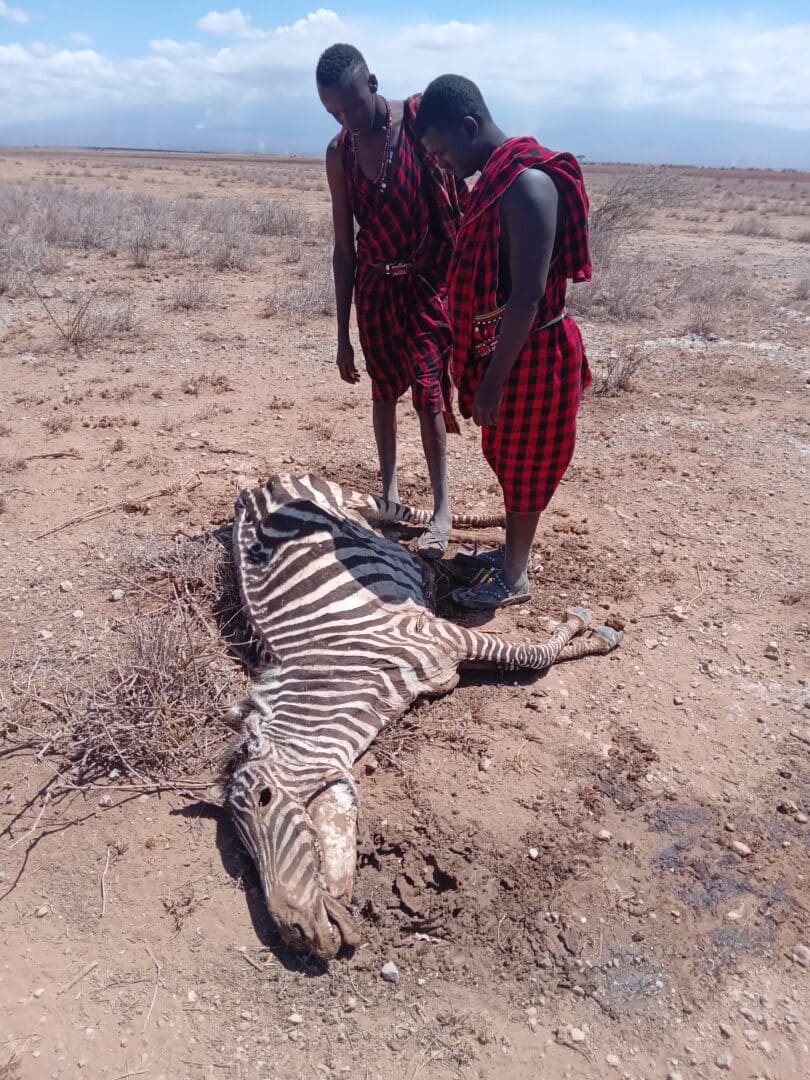
    Dying zebra from climate drought and starvation with two people looking concerned

    Perhaps the greatest injustice is that Africa has contributed the least to the climate crisis, yet faces some of its most severe consequences. The answer cannot be resilience alone. Communities need investment: access to information, technology, infrastructure, safe schools, water systems, and financial resources that allow families to adapt and thrive.

    Climate action must reach the communities where these realities are already being lived every day. And child equity requires more than counting how many children are reached it requires asking what conditions we continue to allow children to live with.

  • Wealthy Public Interest Organizations Helped Ensure the Climate Crisis. Now They Are Hiding Liability.

    Wealthy Public Interest Organizations Helped Ensure the Climate Crisis. Now They Are Hiding Liability.

    It’s common to see public interest organizations and governments challenging greenwashing or humanewashing as a means of protecting the environment. But are they using arbitrary criteria for what is green, or humane? Relative to what standard have they been making progress if we have arrived at the current polycrisis?

    At FairStartMovement.org (FSM) our research has shown that growth – and hiding the impacts of growth through growthwashing – are easily the largest driver of harm to animals and the environment.

    Our research further shows that framing the issue as “growth” itself is inaccurate though helpful to begin to introduce audiences to the issues. Growth is not accurate because people are not reducible to numbers that ignore the more influential relations formed as children enter the world. Those relations present a primarily qualitative issue, one that first has to do with empowerment.

    The growth of the past several decades was first enabled by antiquated “separate but equal” reproductive rights policies that illegally discounted and disenfranchised future lives by ignoring a “one person, one equal and influential vote” standard for intergenerational justice in favor of preserving status quo birth inequity and mostly white generational wealth – harming mostly lives of color. The codification of “separate but equal” between 1948-1968 by the emerging human rights regime represented a power grab by elites to protect generational wealth, and avoid intergenerational justice obligations.

    The move removed any threshold for intergenerational justice that would have maintained empowering conditions, including birth equity, low climate emissions and reasonable representative-ratio levels. The move used a narrow misconception of what it means to be free from power – one that assumed political authority and existing entitlements rather than legitimating them by actually empowering the children born into the world.


    Inequality info graphic


    The policies, by ensuring unsustainable growth that diluted the average role one has in influencing the outcomes of their political systems, commercialized human freedom – basing the idea of freedom around free-market isolation and the disembedding of the person from their political systems, rather than empowerment.

    To understand Illegal discounting / equitywashing we can simply ask: How are we accounting for empowering children as they came into the world at a “one person, one equal and influential vote” level – enough for them to simply vote to end the climate crisis, autocracy, inequity, etc? The notion that they have that level of influence – that they are anywhere near self-determining – is ludicrous. And the fact is, our assessing value and reporting impact without this accounting hid the daily decline, and made it all worse.

    Forget words like sustainable, green, humane, etc. Organizations appear to have never met a basic standard of legitimacy, 

    The problem thus goes beyond growthwashing, into something called equitywashing (or illegal discounting) – the act of 1) assuming children deserve what they are born with rather than what measureable empowerment and political legitimacy requires, and 2) omitting the role of inequitable growth in value assessments and impact claims.

    The alternative was, and is, to treat children entering the world beneath a recognized threshold of measurable empowerment as a constitutionally impermissible cost. It’s treating no child as worth more than another.


    Don't Get Scammed: Charities, Media and Big Business Use Family Policy to Quietly Undo Progress. Ask This One Question Before Giving, Believing, or Buying Infographic

    Constitutions and treaties don’t create legal obligations, only actually empowering others does that.

    And that empowerment depends on whether we account for its costs, assess value, and report impact accordingly – and thus engage in a truly constitutional discourse. One either accounts for the benefits one enjoys as requiring the measurable empowerment of others, or one does not – and the things we say give away whether we do that, or not.

    We can use the things we say we test whether we are accounting for legitimacy, and AI-assisted tools can help that process.

    Can you think of and describe conditions in which those relations would form that does not involve that accounting? No – that’s impossible, as is being self-determining without truly empowering others. 

    The fix? Because they do not do that, equitywashing leads to false claims that disvalue human and nonhuman lives, and by metrics we all use like safe temperatures, influence over our political systems, equality of opportunity, etc.

    Anyone impacted by those false claims can use consumer protection law to target the claims, and because the underlying business model that causes the claims often violates civil rights and other laws, advocates can use those laws to block use of the underlying model itself. These equity actions trigger something unique: They force governments to decide whether they are are interpreting their laws and own authority as contingent on the measurable empowerment of those subject to that authority – on a one person, one equal and influential vote standard – or choose to use some other standard.

    Those willing to pay the costs of legitimacy could never compete against those who refuse to, but the former don’t have to compete: governance requires empowering those subject to it, and interpreting laws to require the same.

    In 2023 I published several Newsweek articles on illegal baselining / illegal discounting at U.S. nonprofits. I published the article after resigning from the Animal Legal Defense Fund, which had engaged in illegal discounting / equitywashing, and had withdrawn federal litigation that would have forced the organization to deal with the issue.

    Again, the practice of illegal discounting derives from historic subversion of racial justice movements described above, and exponentially reduce environmental damage evaluations, a move that enriches some children – like the children of those funders driving nonprofit agendas – at illegal and deadly cost to the most vulnerable communities in the world.

    The practice is part of a historical trend of nonprofits setting low environmental standards and engaging in performative work, something that now exposes them to liability as the climate crisis unfolds. The situation is exacerbated by a lack of accountability mechanisms – like market forces or constituencies – in philanthropy.


    Family Planning info card


    As part of a 2024 fellowship I did with the MAHB at Stanford University, and based on extensive peer-reviewed research, FSM began to publish popular articles on interventions to end the equitywashing/ illegal discounting, and using animal liberation (where one finds the most falsifiable claims) as a vector for change.

    In 2024 my employer, the University of Denver, consistent with their funders’ illegal discounting, retaliated by removing me from a grant I had developed for the University, including extensive planned litigation, and I resigned my position. The animal law programming, including how it assesses and reports value, represents the use of wealth made through a birth-inequity system to create a charade version of animal liberation, one that by preserving the status quo, does vastly more harm to animals than the program does to benefit them.

    It provides a window into how the polycrisis formed, and at the most fundamental level: How we value others, and assess and report our impacts on the world.

    In 2025 around litigation I helped bring against Coca Cola, Inc. for equitywashing, I began a fellowship at Emory University based on a forthcoming book on using a “preemptive constitutional discourse” about what it means to empower future generations as a requirement for national legitimacy. The research is built into a tool: FalseClaimsChecker.org. This work is designed to use clearly out-of-context impact claims to get at and preempt the underlying modeling using a simple “one person, one vote” standard to block the illegal discounting and equitywashing under state law, using unfair competition litigation.

    Said simply, the tool looks for fake numbers in claims, which originate from the false assumption that there is any form of freedom outside of being birth-empowered to a level of political self-determination. It’s accurate to call those numbers “fake” or “false” because they derive from the legal fiction that having children is more determinative for the parents than the children born or communities they come to comprise, with no level of infant-health-as-enfranchisement (relative to a neutral or zero position) required. Infants arbitrarily born into deprivation relative to others – racially, generationally, nationally, etc. – are not constitutionally positioned to be relatively self-determining, or part of a legitimate, inclusive, and empowering system.

    Our research now shows false claims by prominent public interest advocates dating back decades.


    Challenging assumptions that hurt our future infographic

    In 2026 the funder I had brought on at the University of Denver and various allies made public demands on the University of Denver – including threatening the first ever political equity /constitutional injunction litigation.

    In 2026 the Coke litigation terminated in-part because of a lack of funding from animal protection philanthropists avoiding the equitywashing issue, but the University of Denver returned key donor funds, and TruthAlliance.global is now making renewed public demands on the school to end its illegal discounting – in part because it constitutes unfair competition, and violates state and federal civil rights laws.

    This work has now culminated in an open letter and forthcoming campaign to urge Coca-Cola, Inc. to end illegal discounting.

    The efforts, unlike other campaigns, account for how the the public interest sector – from government, to philanthropy, to nonprofits – enabled many of the current crises because the sector used no fixed baseline or goalpost in assessing public interest outcomes and equitywashed by failing to adhere to the legal “floor”of a one person, one equal and influential vote standard. This is evident in looking at simple metrics like permissible climate emissions, minimum standards for early childhood development, functional representative ratios for political systems, etc. against the legitimacy, or legitimacy/child empowering, standard.

    Instead public interest organizations use and have used constantly moving goalposts to ensure the ability to claim progress, and justify their positioning. That’s illegal, and  flows from the racist “separate but equal” standard and policy embedded in near-universal reproductive rights systems which acted to protect generational wealth (particularly at foundations), and which accepted as a given that children of color deserve fewer resources, more risk, and diminished influence in their political systems.

    Performative public interest interventions, equitywashing, and illegal discounting are costing lives.

    Key public interest organizations face serious liability for decades of false claims, and are now taking actions to hide it. FSM activists have been removed from public interest fora, seen Wikimedia pages deleted, have had funders drop their funding, have seen their social media posts censored – and many other forms of retaliation – all for raising these questions. 

    Our experience has shown that like any sector, public interest entities will not only avoid admitting their mistakes, and as detailed in current proceedings before the African Union, will in many cases attempt to sabotage revelations of those mistakes.

    TAKE ACTION: If you are supporting a public interest organization, assess their claims using FalseClaimsChecker.org and urge them to end illegal discounting.

    In most cases, the discounting does more to harm their stated missions than they do to further them. An easy way to start the process is through the Tell the Truth and Commit Campaign – in which we simply admit that illegal discounting did more to harm our values than we did to further them, and commit to treating children entering the world beneath a threshold of legitimating empowerment as constitutionally impermissible. 


    Top Down Power and Bottom Up Empowerment infographic


  • Every Truth Told Is a Step toward Freedom from Harm

    Every Truth Told Is a Step toward Freedom from Harm

    These words are more than quotes; they are an invitation to reflect on the power of honesty and the responsibility we all share in creating a safer, fairer world. Real change rarely begins with comfort. It begins when someone has the courage to say, “This is not right,” and is willing to back that statement with evidence, compassion, and a commitment to finding solutions.

     Why Truth Matters

    Many forms of harm continue because they remain unseen, misunderstood, or ignored. Whether the issue is injustice, inequality, environmental destruction, or the challenges faced by vulnerable communities, meaningful progress starts when the truth is acknowledged. Truth helps us understand reality as it is not as we wish it to be. It challenges assumptions, exposes problems that require attention, and creates opportunities for better decisions.

    The Counterstream post model and The New York Times articles, do not meet a true zero-baseline approach to equality. A zero-baseline framework requires measuring success by whether inequalities are being reduced for all children equally, regardless of where they are born. Therefore they are inaccurate without explicitly confronting unequal outcomes and the root causes that sustain them, storytelling alone cannot achieve genuine climate justice or equality. Every truth told should move us toward freedom from harm by challenging the systems that value some children’s lives more than others.

    Wikipedia Deleting a page of Fair Start Movement cannot delete the truth and hide liability. Vulnerable  Communities will always find new ways to preserve their history, challenge inequality, reveal harms, and uphold a zero baseline where every child’s life carries equal value And African have come up with its Wikipedia page

     “Without truth, we cannot build trust. Without trust, lasting change becomes difficult”.

     Truth Is the Beginning, Not the End

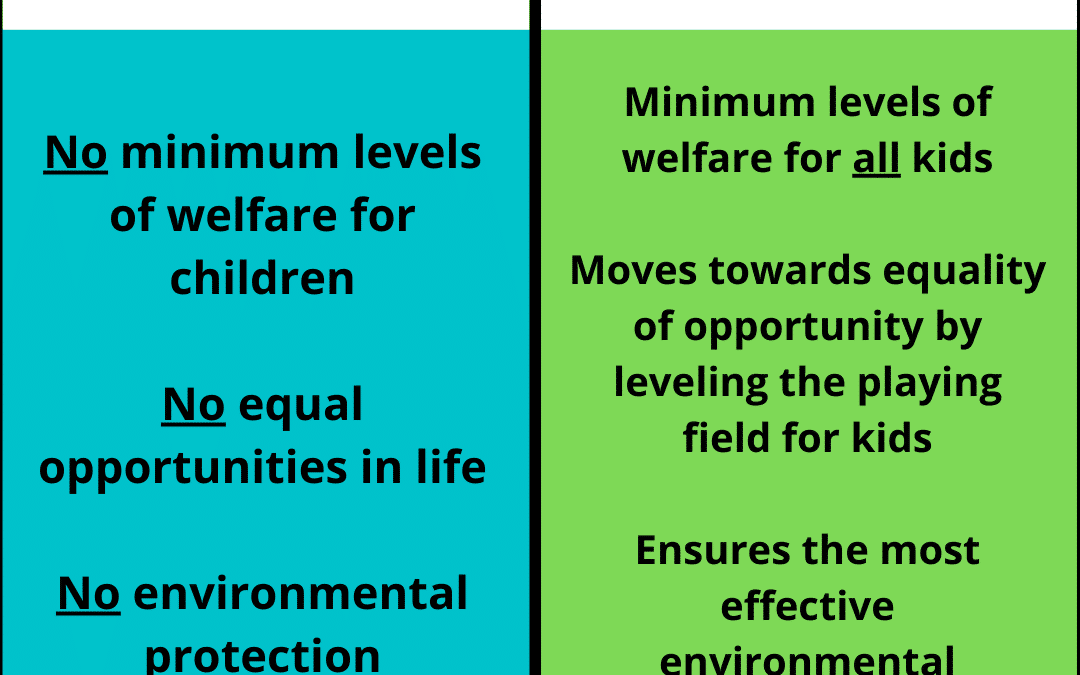
    Two columns compare outcomes. Left (blue): No minimum levels of welfare for children. No equal opportunities in life. No environmental protection. Right (green): Minimum welfare for all kids. Equality of opportunity. Environmental protection.

     Speaking the truth is only the first step. Lasting impact comes when truth leads to action.

    That action may include:

    • Listening to people whose voices have been overlooked.
    • Supporting research and evidence-based solutions.
    • Holding ourselves and our institutions accountable.
    • Working together to address the root causes of harm rather than only responding to its symptoms.

     Constructive action transforms truth into positive change.

    Courage Creates Change

    History is filled with examples of individuals who chose honesty over silence. Their willingness to question accepted ideas, expose injustice, or advocate for those without a voice often became the catalyst for social progress. Speaking the truth is not always easy. It may involve disagreement, criticism, or uncertainty. Yet respectful, evidence-based dialogue remains one of the strongest foundations for solving complex problems.

     You’re Voice Matters

    You do not need to hold a public office or lead a large organization to make a difference. Every conversation that promotes understanding, every decision guided by integrity, and every effort to protect others from harm contributes to a better future. Change grows through the collective actions of ordinary people who choose honesty, compassion, and responsibility every day.

     Join Us in Making a Difference

    Challenging assumptions that hurt our future infographic

    Every truth told is a step toward freedom from harm. If we want a world where every person can live with dignity, opportunity, and hope, we must be willing to seek the truth, share it responsibly, and act upon it. Together, we can build communities that value transparency, justice, and compassion. Together, we can reduce harm and create opportunities for future generations. The journey begins with one truthful conversation.

     Will you join us in making a difference?

  • Fighting For The Future Saving Animals, Nature, Future Generation, the Real Truth, a Letter Harvard – Letter Included

    Fighting For The Future Saving Animals, Nature, Future Generation, the Real Truth, a Letter Harvard – Letter Included

    Right now, across the world, people are beginning to open their eyes and realize something bigger is happening. We are being told humanity is progressing, that justice is advancing, that the world is becoming fairer — yet every day I see people struggling to survive, wildlife losing habitats, children being born into inequality, and entire ecosystems pushed closer to collapse.

    Dying zebra from climate drought and starvation with two people looking concerned

    People are no longer just looking for hopeful words and polished campaigns. They are looking for truth. Real truth. Because if we truly want to save animals, protect people and give future generations a fighting chance, then we must have the courage to ask whether the systems shaping this world are actually creating meaningful change — or simply becoming better at marketing the appearance of it.


    having kids vegan

    That is the deeper conversation now being raised by the Fair Start Movement in relation to Harvard University and what the organization describes as a “fantasy world of social justice undone daily by birth inequity.”

    This is not about attacking good people.

    There are countless students, researchers, activists and educators who genuinely want to make the world better. Many dedicate their lives to helping vulnerable communities, challenging injustice and fighting for equality. That work matters. But the wider concern being raised is whether some institutions have become too focused on presenting narratives of progress while failing to fully confront the structural systems continuing to produce inequality underneath the surface.

    And that matters more than ever right now.

    The Fair Start perspective argues that many social justice institutions focus heavily on downstream solutions — programs, campaigns, reforms, diversity initiatives and public advocacy — while the upstream conditions driving inequality continue growing stronger every year.

    In simple terms, we may celebrate individual victories while the larger system producing suffering remains largely untouched.

    climate crisis kids

    That is where the idea of “birth inequity” becomes central.

    The argument is that children are not entering the world on anything close to equal ground. Some are born into safety, wealth, opportunity and political influence. Others are born into poverty, instability, environmental decline and systems already stacked against them from the beginning.

    Mom with newborn baby; love

    And as climate instability, economic inequality and ecological collapse intensify globally, those gaps only grow wider.

    The concern being raised is that institutions can sometimes unintentionally create the appearance of meaningful progress by measuring outputs rather than genuine net outcomes. A university can point to programs launched, scholarships funded or initiatives promoted, but the deeper question remains: are the structural conditions affecting future generations actually improving overall?

    Because that is the truth people are beginning to search for now.

    Not branding.

    Not polished narratives.

    Not carefully managed public relations.

    Truth.

    The reality is that across the world we are seeing ecosystems pushed to breaking point. Wildlife is disappearing at terrifying speed. Communities are struggling under economic pressure. Young people are growing up with uncertainty about their future, while millions of children are born into conditions where survival itself becomes harder every single year.

    And yet many institutions continue presenting narratives that suggest society is steadily moving toward fairness and sustainability.

    That disconnect is what people are starting to question.

    For those of us working directly with wildlife and vulnerable communities, these realities are impossible to ignore. I see firsthand how deeply connected everything is. When forests disappear, communities suffer. When inequality grows, ecosystems come under pressure. When people are desperate, wildlife suffers too. The survival of humanity and the survival of nature are tied together whether we acknowledge it or not.

    That is why transparency matters.

    Not to tear institutions down.

    Not to shame people trying to help.

    But to ensure that the work being done in the name of justice, sustainability and equality is actually capable of creating long-term change in the real world.

    The Fair Start discussion ultimately asks a powerful question: are institutions willing to fully examine whether the outcomes they promote publicly still hold true once the wider baseline realities are honestly accounted for?

    Because if we truly care about future generations, then we cannot build systems based only on appearances.

    We need courage.

    The courage to question whether the current path is truly sustainable.

    The courage to confront uncomfortable truths about inequality, growth and ecological decline.

    And the courage to build a world where justice is not simply something spoken about in lecture halls or campaign slogans, but something reflected in the actual conditions people, animals and future generations are living through every day.

    That is the kind of future worth fighting for.

    Several childrens hands placed together in a supportive gesture over a wooden surface, with text reading, The most powerful social justice is a fair start in life. Join the coalition. Logo and Having Kids appear at the bottom.

    A future built not on illusion, but on truth.


    Letter –

    May 8, 2026

    Attorney General Andrea Joy Campbell
    Office of the Attorney General
    Commonwealth of Massachusetts
    One Ashburton Place, 20th Floor
    Boston, MA 02108

    Re: Request for Attorney General Review of Directional Impact Representations and Baseline Omission in Massachusetts Animal-Welfare Institutional Communications Under Chapter 93A

    Dear Attorney General Campbell,

    Fair Start Movement and TruthAlliance.global submit this letter to request review and guidance concerning a specific and recurring pattern in Massachusetts-based institutional communications: the creation of a directional impression of progress through public-facing language that does not disclose the baseline conditions necessary to interpret whether that progress is occurring on balance.

    This submission is narrow and disclosure-focused. It does not allege improper motive, and it does not dispute that the institutions discussed perform real work, expend real resources, and achieve identifiable outputs. The issue is whether public-facing representations—particularly those that operate in donor-facing, student-facing, or credibility-bearing contexts—are structured in a way that invites reliance on an implied trajectory of improvement without providing the baseline information required to evaluate that implication.

    The concern arises from a consistent pattern across multiple Massachusetts institutions. Language is often framed carefully to avoid explicit, measurable outcome claims. Terms such as “committed to,” “working to,” and “seeking to advance” appear frequently in institutional descriptions of animal-law programming and advocacy. At the same time, that language still communicates something to a reasonable reader. It conveys forward motion. It signals that progress is being made, or at minimum that support for the institution contributes to that progress. That signal influences behavior. It shapes donation decisions, student enrollment, partnerships, and policy attention.

    The problem is not the use of aspirational language itself. The problem is that the directional impression created by that language is not accompanied by the context needed to determine whether the implied progress is occurring when broader conditions are taken into account. Public-facing materials do not typically disclose the scale of countervailing forces—continued expansion of animal agriculture, growth-driven demand, ecological degradation, and structural conditions that perpetuate harm across generations. Without that context, the impression created by the language may be materially incomplete.

    This dynamic becomes more pronounced where institutions move from aspirational phrasing into definitive outcome language. In Massachusetts, MSPCA-Angell provides a clear example. The organization describes itself as “positively impact[ing] the lives of tens of thousands of animals each year” and as driving “meaningful, systemic change.” These are present-tense outcome statements. They communicate that impact is occurring and that systems have changed. At the same time, the organization has publicly disclosed that it no longer tracks the metrics used to measure its results. The combination of definitive outcome language and the absence of outcome measurement creates a gap between the impression conveyed and the substantiation available. That gap is not theoretical. It exists at the point where donors decide whether to contribute, and where the public decides whether progress is being achieved.

    A similar issue arises with quantified claims made by Humane World for Animals. Statements that millions of meals have been transitioned or that over a million animals have been improved are specific and concrete. They communicate progress through numbers. But those numbers operate within a broader system that is not disclosed alongside the claim. If the total scale of animal agriculture or confinement grows by more than the improvements cited, the directional impression created by the numbers may not reflect the net trajectory. The claim itself may be accurate in isolation. The impression created by the claim, absent baseline context, may still be incomplete.

    Across these examples, the same structural issue appears. Public-facing communications operate at the level of narrative, while the conditions necessary to interpret that narrative—what is counted, what is excluded, what baseline governs the claim, and how competing forces affect the outcome—are not disclosed at the point of reliance. This is the baseline omission problem. It is not a dispute about values. It is a question of whether the information environment in which decisions are made is complete enough to support those decisions.

    Massachusetts General Laws Chapter 93A provides a framework for addressing this issue. The statute does not require that a statement be literally false to be actionable. It encompasses conduct that creates a misleading impression through omission of material information. Where a representation invites reliance and the meaning of that representation depends on context that is not disclosed, the omission may be material if it would change the understanding of a reasonable audience.

    In this context, baseline conditions are not peripheral details. They are the elements that determine what the claim means. They define whether a statement reflects activity, projected contribution, or demonstrated net outcome. When those elements are absent, the resulting impression may be incomplete in a way that affects decision-making.

    This submission therefore requests that the Office consider whether directional impact representations in Massachusetts animal-welfare communications should be evaluated under a material-omission framework when they omit baseline conditions necessary to interpret implied progress. The request is not for punitive action based on isolated statements. It is for a structured review of whether current practices create reliance risks that can be addressed through disclosure.

    Specifically, we request that the Office consider initiating a Chapter 93A review of how animal-welfare institutions in Massachusetts communicate impact and progress, with attention to whether those communications distinguish between program outputs and net outcomes once baseline conditions are accounted for. We further request consideration of whether guidance should be issued clarifying that aspirational and outcome-oriented language can create materially incomplete impressions when baseline conditions are omitted.

    In addition, we request that the Office review MSPCA-Angell’s use of definitive outcome language in light of its disclosed cessation of outcome measurement, and that it examine whether quantified claims by Humane World for Animals create directional impressions that are supported when evaluated against broader system-level trajectories.

    The remedy sought is disclosure-forward and corrective, not punitive. The objective is to ensure that when institutions communicate impact, the public is provided with the information necessary to understand what that impact means and what it does not mean. This can be accomplished through baseline disclosure: clear statements of what is counted, what is excluded, the time horizon used, the presence of uncertainty, and the distinction between outputs and net outcomes.

    Fair Start’s Tell the Truth framework provides one model for this approach. It asks institutions to align public claims with the baseline conditions that determine their meaning, so that reliance is based on complete information rather than directional impression alone. The framework is designed to be applied cooperatively, allowing institutions to maintain their advocacy while improving the clarity and integrity of their communications.

    We recognize that the institutions discussed are respected and perform meaningful work. This request does not challenge that work. It addresses the structure of the information environment in which that work is presented. Where public trust is involved, clarity is not optional. It is the condition that allows that trust to function as intended.

    We respectfully request confirmation of intake and identification of the division or bureau assigned for review.

    Respectfully submitted,

    Suriya Khan
    Fair Start Movement / TruthAlliance.global
    suriya@fairstartmovement.org
    516-725-3157

  • Inequality, Philanthropy, Animal Protection, The Letter To Yale

    Inequality, Philanthropy, Animal Protection, The Letter To Yale

    There is a growing conversation happening across the world about justice, inequality and the stories institutions tell about progress.

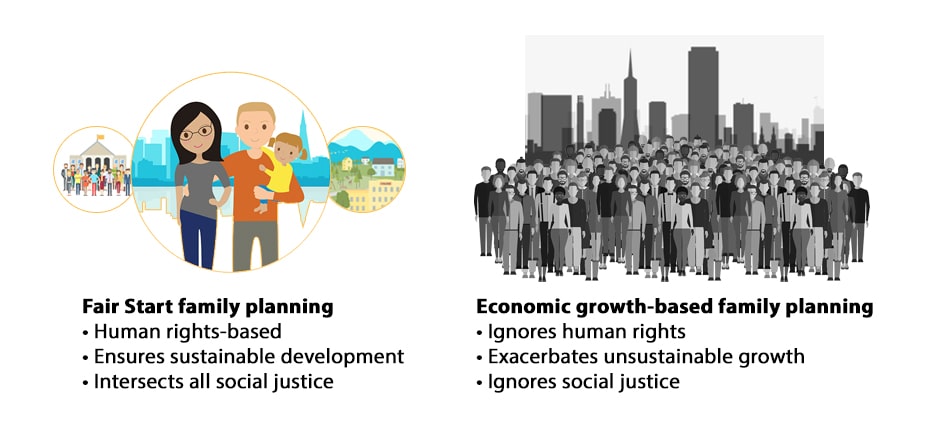
    Illustration compares fair start family planning, showing a diverse family and children, with economic growth-based planning, showing a large, crowded, grayscale group in a city. Lists pros of fair start and cons of growth-based planning.

    Not just in climate activism or animal protection, but in universities, nonprofits, philanthropy and social justice movements themselves.

    People are beginning to ask a difficult but necessary question:

    Are we truly addressing the root causes of suffering and inequality, or are we building narratives of progress while the underlying systems continue producing harm every single day?

    That question sits at the heart of the recent Fair Start Movement article discussing Yale and what the organization describes as a “fantasy world of social justice undone daily by birth inequity.” (Fair Start Movement)

    Importantly, this conversation should not be framed as an attack on individuals trying to create positive change. Many people working in academia, social justice advocacy and philanthropy genuinely care deeply about equity, human rights and creating a better future. Many dedicate their lives to helping vulnerable communities and challenging injustice.

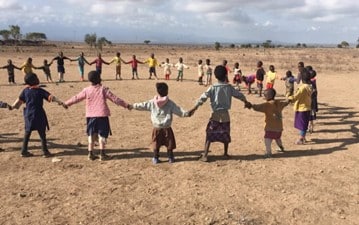
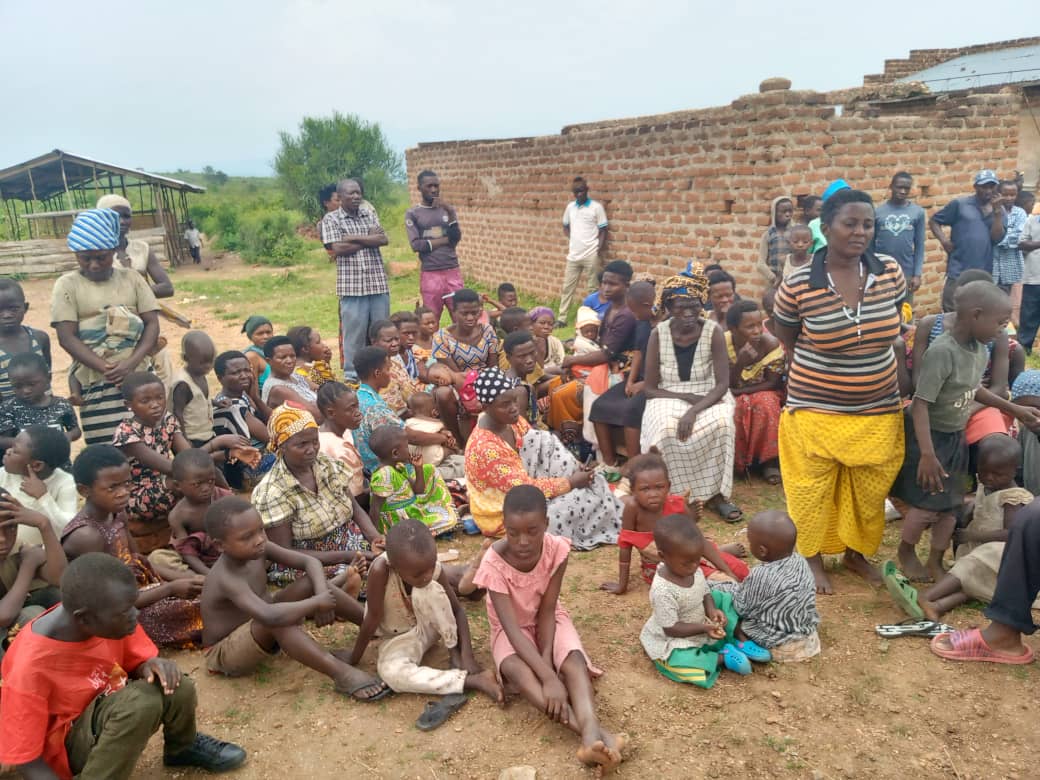
    People sitting around in a circle, a neglected community

    But the article raises a broader systems-level concern.

    It argues that many public-interest institutions may be measuring impact inside incomplete frameworks that fail to fully account for the structural conditions shaping real-world outcomes — particularly inequality at birth, political inequity and the long-term effects of growth-driven systems. (

    At the center of Fair Start’s argument is the idea that “downstream” social justice work can be continuously undermined if the “upstream” systems driving inequality remain unchanged.

    In simple terms, organizations may celebrate important victories — expanded rights, educational initiatives, diversity programs, environmental reforms or social justice campaigns — while larger structural conditions continue reproducing inequality underneath the surface. According to the movement, this creates a perception of progress that may not fully match the deeper realities experienced by the most vulnerable communities.

    The article places particular emphasis on what it calls “birth inequity.”

    This refers to the reality that children enter the world under vastly unequal conditions depending on wealth, race, geography, political influence and environmental stability. Fair Start argues that these starting conditions profoundly shape health, opportunity, democratic influence and long-term survival itself, especially as climate instability and ecological degradation intensify globally.

    Two columns compare outcomes. Left (blue): No minimum levels of welfare for children. No equal opportunities in life. No environmental protection. Right (green): Minimum welfare for all kids. Equality of opportunity. Environmental protection.

    The broader concern being raised is that many institutions discuss justice without fully accounting for these baseline inequalities.

    From the Fair Start perspective, if systems continue allowing millions of children to enter conditions of severe inequity, then downstream reforms alone may struggle to produce meaningful net progress over time. The movement argues that many public-facing impact claims fail to fully disclose how structural growth, ecological degradation and political inequality may be undoing the very outcomes organizations publicly celebrate. (Fair Start Movement)

    Whether one agrees entirely with Fair Start’s framework or not, the deeper questions being raised are significant.

    How should institutions measure progress honestly?

    How do we distinguish between symbolic progress and systemic transformation?

    And how do we ensure that public trust is grounded in transparency rather than carefully managed narratives?

    These are questions that are becoming harder for society to ignore.

    Across the world, people are watching ecosystems deteriorate, inequality deepen and political trust erode, even while institutions continue presenting optimistic narratives about sustainability, justice and progress. Increasingly, there is public demand for more honest conversations about whether current systems are truly addressing the root causes of the crises humanity now faces. (Fair Start Movement)

    For those of us working directly with animals, conservation and vulnerable communities, these realities are impossible not to see.


    mass extinction take action

    We see humans and wildlife increasingly competing for shrinking resources. We see communities struggling under economic and environmental pressure. We see ecosystems under stress. And we see how inequality and ecological collapse are deeply connected.

    Climate driven drought in the Amboseli, Kenya - starving cows as people look on

    Because when systems fail people, they also fail nature.

    The Fair Start article ultimately calls for something larger than political ideology or institutional branding. It calls for a deeper level of honesty about how we measure impact, how we define justice and whether the systems currently shaping the world are truly capable of delivering a fair future for the next generation.

    And perhaps that is the most important part of this conversation.

    Not tearing down good people.

    Not attacking institutions.

    But asking whether humanity is finally willing to confront the deeper structural realities underneath the crises we now face — and whether we have the courage to build systems rooted not only in appearance, but in truth.