Category: Children’s Rights

  • Why Animal, Enviro, Social Justice Orgs Should Support Better Family Planning

    Why Animal, Enviro, Social Justice Orgs Should Support Better Family Planning

    Do you work with a social justice organization, like an environmental, child welfare, animal protection, or human rights group? If so, one of the best ways to further your organization’s mission in by promoting Fair Start family planning.

    Why?

    For example – many animal protection advocates focus on changing diets as a way to protect animals from the horrors of factory farming and wildlife from the horrors of climate change that is partially driven by factory farming. The impact of this approach has been completely overridden by recent population growth, which is set to continue.

    Isn’t it time to work upstream? 

    • Fair Start family planning is not just effective. It is comprehensively effective, or intersectional. It aligns environmentalism, animal protection, and human rights in one unifying campaign to reform the way we plan families. This isn’t just a matter of using words like intersectional to appear thoughtful. The creation of future generations is something that connects us all.

    Social justice organizations could magnify their impact exponentially by including family planning reform in their programming. For some organizations, there is the option of including Fair Start advocacy in their lawful civil disobedience programs. How could they do this specifically?

    In addition to current work organizations could lawfully target entities like Exxon who are harming untold numbers of children and animals through their impact on climate and other aspects of the environment, and who have special obligations to fund Fair Start family planning systems given the harm they have caused.

    It’s time to create fundamental change, and be effective and intersectional at the same time. Social justice work starts with people, and in the long run, people start with family planning. It’s time for to ensure a fair start for all kids. Learn more at HavingKids.org. 

    TAKE ACTION:
    Join us in urging the U.N. Secretary-General to issue a statement recommending sustainable family planning for World Population Day. RSVP to our event, help us share the event, and send him a message here.


  • Consumption or Family Size: Which Matters for Climate?

    Consumption or Family Size: Which Matters for Climate?

    Care about consumption and its impact on the planet? Many argue that consumption, not population is the real climate crisis. But the truth is, consumption and people are inextricably linked. We have to address both.

    Demand isn’t created by dirty companies. Demand comes from people. Focusing only on carbon, plastic, and such plays right into the hands of global corporations like Unilever, Walmart and Amazon who depend on increasing birth rates to fuel spending for their products. Yes, bad industrial players must be held accountable. And we’re on our way to doing that. But if we’re only addressing carbon output, we’re ignoring the source of the problem: unsustainable population growth. Choosing to have a smaller family however, is the best way to mitigate our impact on the planet.  

    Looking only at emissions also ignores several critically important issues including water scarcity, mineral depletion, deforestation, and habitat loss. As the Center for Biological Diversity explains,“If we address one without the other, the end result will still be humans continuing to take more than our fair share from the planet.”

    The Center for Biological Diversity also stated:

    “A 2009 study of the relationship between population growth and global warming determined that the “carbon legacy” of just one child can produce 20 times more greenhouse gas than a person will save by driving a high-mileage car, recycling, using energy-efficient appliances and light bulbs, etc. Each child born in the United States will add about 9,441 metric tons of carbon dioxide to the carbon legacy of an average parent. The study concludes, “Clearly, the potential savings from reduced reproduction are huge compared to the savings that can be achieved by changes in lifestyle.”

    One of the study’s authors, Paul Murtaugh, warned that: “In discussions about climate change, we tend to focus on the carbon emissions of an individual over his or her lifetime. Those are important issues and it’s essential that they should be considered. But an added challenge facing us is continuing population growth and increasing global consumption of resources. . . . Future growth amplifies the consequences of people’s reproductive choices today, the same way that compound interest amplifies a bank balance.”

    The consumption vs. population debate.

    The finger pointing is generally toward high fertility rates in developing countries and high consumption in developed countries. However, it’s not an either/or scenario. It’s an evolving situation. As nations develop, their standard of living increases along with consumption rates. We are on track for exponential population growth paired with a drastic increase in consumption. Taking an incomplete approach is a recipe for disaster.

    Is consumption outpacing population growth?
    It is in some cases. Consider that food demand outpaces sustainable supply. According to the 2018 Global Agricultural Productivity Report, “for the fifth straight year, global agricultural productivity growth is not accelerating fast enough.” How can we continue to feed a growing population without a global effort for sustainable population planning?

    The U.N. has also warned that one million species are at risk of disappearing due to habitat loss, among other human activities, in the sixth mass extinction already underway. “A quarter of catalogued animal and plant species are already being crowded, eaten or poisoned out of existence,” its IPBES Global Assessment Report report states. Should we be concerned then about consumption or crowding? The answer is both – as confirmed by a UN Report released in May. 

    We have the power to determine the future for our kids.
    Most of us agree that a crowded planet is not something we want. But we fail to make the connection that our decision to have a large or small family is what determines how the world will look. The Fair Start Model is one way that we can work together to ensure that all kids get what they need to thrive – including a habitable planet. Let’s save room for animals, for nature, and for our kids to enjoy the only planet we have by planning smaller families.

    TAKE ACTION:
    Join us in urging the U.N. Secretary-General to issue a statement recommending sustainable family planning for World Population Day. RSVP to our event, help us share the event, and send him a message here.

  • A Plea to Hilaria Baldwin

    A Plea to Hilaria Baldwin

    Dear Hilaria,

    We know you love your kids and want what’s best for their future. Recently when asked about having more kids you said: “They’re My Favorite Things in the World So Why Not?” “Why not keep going?”

    We are asking you to use your status as an influential public figure to speak out on the connection between family planning, the climate crisis and other environmental and social crises, and to choose to foster and/or adopt your next child.

    Thank you for considering setting a vital example.

    Sincerely,

    Erika and Willow

    The Phelps-Mathews Family
    The Phelps-Mathews Family

    Join Erika and Willow by tweeting @hilariabaldwin to urge her to consider adoption.

  • Confronting Fears About Better Family Planning

    Confronting Fears About Better Family Planning

    Why would anyone oppose the idea of promoting smaller families? Most people care about the worsening state of our climate, and the rights and welfare of both humans and animals. But many are also aware of the unsettling history of coercive reproductive activities imposed on certain groups and powerless individuals. It is because of that fear that some balk at suggestions to encourage more thoughtful family planning, like policies that encourage smaller families that can invest more time, love, and energy in each child. They would rather avoid the topic entirely.

    But that knee-jerk reaction misses the larger picture. Poor family planning is the source of our greatest social and environmental crises, and the genesis of inequity and disempowerment. We cannot claim to be addressing things like anthropogenic climate change, extinction, inequity, and child welfare without targeting the source of those crises, and opening our minds to a whole new way of family planning that involves cooperation, rather than isolation.

    The status quo perpetuates inequality and oppression.
    We believe we are free in our reproductive decision making. But temporalize your thinking, think of the future child and their relations with others, and things become more morally complex. The truth is, our current system perpetuates oppression by falling far short of providing a fair start in life.

    Poverty, inequality, abuse, family instability, low social mobility, poor health, interaction in an unequal criminal justice system, limited access to quality education and opportunities in life – they are passed on, generation to generation. The U.S. has been called the most unequal society in the developed world. Inequality is also rising across the globe as the world population grows exponentially. Without greater family planning investments with citizens and communities working together to ensure a fair start for kids, this unlevel playing field will only continue to worsen. If we are not starting upstream to address this problem we are not dealing with the source of inequity.

    Wall Street and faith-based interests already exert massive influence on family planning policy and reproductive choice.
    These forces exert their power over lawmakers and other elected officials to shape policies that ensure larger families and higher fertility. Of course we know there are socially conservative groups and the religious right who oppose access to family planning choice and steer the views of so many people in the United States. But few are aware of the role of the capitalism in advancing pro-natalist policies. Economists and corporations largely subscribe to an agenda of infinite economic growth. It’s an agenda that relies on bringing more and more children into the world to fuel a system of workers, consumers, and taxpayers that benefit a small percentage of people at the top in what many have recognized as a Ponzi scheme pyramid. Just look at the many voices like Marco Rubio, who tell Americans that we need to have more kids because “it’s good for the economy”.

    Shouldn’t we push back by advocating for policies that put children and the planet before the economy? Who wouldn’t want to improve lives and give citizens a more equitable opportunity to succeed?

    It’s About Improving Choice.
    We can protect reproductive rights and pursue better family planning. It’s not an either-or proposition. Think of it as choice-plus. Family planning shouldn’t only be about the availability of contraceptives. It should also include education about the benefits to parents and children on delaying parenthood and having smaller families. That’s family planning in the truest sense of term. Why not arm young people with the information to make better choices for their future?

    The way to create more inclusive, equitable, and sustainable results for our communities is by encouraging delayed parenthood and smaller families.
    Decades of research prove that, bar none, better family planning is the most effective way to increase social mobility and reduce inequality. When parents wait to have kids, they are better positioned to succeed financially and emotionally. When parents choose to have smaller families, there are more resources to go around. Communities and parents can invest more in each child, rather than dividing dollars, time, and attention among many more kids.

    Fair Start family planning takes it a step further to shift the unfair distribution of resources from going the top, to the rest of society who needs it to have a fair shot at opportunities to succeed.

    The aim of Fair Start family planning is to inform and provide – to strengthen investments, access, education, and resources to reduce inequality, increase inclusiveness, and put communities on a path to a sustainable future.

  • Washington Post: Want Democracy? Connect the Dots to Family Planning

    Washington Post: Want Democracy? Connect the Dots to Family Planning

    [et_pb_section fb_built=”1″ admin_label=”section” _builder_version=”3.22″][et_pb_row admin_label=”row” _builder_version=”3.25″ background_size=”initial” background_position=”top_left” background_repeat=”repeat”][et_pb_column type=”4_4″ _builder_version=”3.25″ custom_padding=”|||” custom_padding__hover=”|||”][et_pb_text admin_label=”Text” _builder_version=”3.27.4″ background_size=”initial” background_position=”top_left” background_repeat=”repeat”]

    The Washington Post recently reported on a troubling trend in the United States: attacks on the value of higher education. The Washington Post is correct that education matters for democracy. A society made up of uneducated people, vast inequality, and greed as the primary motivator is the antithesis of a democracy. Democracy must come before economics.

    But if the Washington Post values democracy over economics when it comes to education policy, why does it reverse that stance when it comes to family planning?

    The Washington Post has itself promoted ideas that have created the situation they now bemoan. For example, they encourage Millenials to have more kids because “it’s good for the economy”. However, we know that encouraging fertility for the sake of the economy only serves to drive further inequality and weaken democracy.

    If we value democracy, we have to ensure that the conditions in which people are actually born and raised foster democracy. Downstream and after-the-fact approaches are a farce, and build inequality more than democracy. Yes, education matters for democracy. But not family planning matters even more. Why? The point of education is to ensure free and equal citizens, but family planning – more than education – determines the people we become.

    The Washington Post isn’t connecting the dots, and suffers (as we all do) from temporal myopia. The myopia is not limited to the issue of education. It’s overriding in things like our view of child care policies (where else do we ignore the source of need), preventing mass extinction, and certainly in climate change mitigation, where we routinely ignore the most important behavior change.

    What’s the solution? Through better family planning policies we could afford to make college free and obligatory. That may be what real democracy requires.

    We can break our temporal myopia, and change the way we see the world.

    Take action: Urge Washington Post’s editor @PostBaron to embrace democracy at its source, and abandon its promotion of economic-growth based family planning.


    [/et_pb_text][/et_pb_column][/et_pb_row][/et_pb_section]

  • Are Falling U.S. Birth Rates Really A Problem?

    Are Falling U.S. Birth Rates Really A Problem?

    It’s rare that you will see media from opposite ends of the political spectrum take the same policy positions, but outlets from the Wall Street Journal to the Washington Post are apoplectic about the fact that women in the United States are having fewer kids. Why? There will be less consumer demand with fewer people, future labor will be more scarce and costly, and the tax base could shrink. And while low fertility countries have performed well economically, our fear is that falling birth rates in the U.S. could threaten long term economic growth. 

    What’s wrong with this picture? The United States is a democracy before it is an economy, and falling birth rates are wonderful for democracy.

    • All things equal, smaller families can invest more time, love, energy, and resources in each child. This in turn results in greater academic achievement, lifelong success, and more thoughtful and engaged citizens. That may not matter if we want to produce depressed, low skilled workers with low civic participation. It matters a lot if we want to produce citizens capable of sustaining a democracy. And that’s something which the United States could do a lot better.
    • The opportunity to invest more in each child aside, smaller families will eventually allow each person to play a greater role in governance. As Jean-Jacques Rousseau understood long ago, the larger democracies get the harder it is for each citizen to influence the policies that influence their lives. One gets lost in the crowd.
    • A nation where more than half of the populace is disenfranchised is not a democracy. Falling fertility rates are the culmination of decades of efforts to liberate women. Yes, being a mother is a lot of work and conflicts with time that could be spent influencing public affairs. Falling fertility rates are part of empowering women and leveling of the playing field.
    • Arbitrarily pushing people to have kids – irrespective of readiness – results in actual cases of child abuse and neglect, and massive inequality. That’s not how people in a democracy would treat future citizens. Ensuring parental readiness and child development would be a priority. Should we be holding the people pushing for more kids, who care more about their investments than people, personally accountable for those kids’ suffering?

    So is falling fertility really a problem? Smaller families mean greater individual investment in each child, which is in important factor in reducing inequality and improving social mobility, and thus a stronger economy.

    But If you primarily care about your investments, and see this country just as an economy, falling fertility rates could still seem threatening. If you care democracy, you might think the opposite. Better family planning can create a more democratic and equitable system. What’s the difference between an economy and human right-based democracies? They differ based on the people that comprise them. In the former people are willing to trade human rights for wealth. In the latter they are not.

    Luckily, most people probably don’t see children as labor inputs and future taxpayers. That’s a good thing. And so are smaller families.

    Take action: Urge media reporting on falling fertility rates to cover the values at stake. Here’s one reporter who got it wrong. Reply with your comments here. The United States is a democracy, and we should put our values before our investments.

  • Fox News Says Inequality is OK. What Does That Mean for Kids?

    Fox News Says Inequality is OK. What Does That Mean for Kids?

    Fox News personality John Stossel said “there’s nothing wrong with inequality.”

    Are Stossel and Fox News ok with the 41% of U.S. kids living in or near poverty and the life long harm caused by disadvantages early in life?

    HOW INEQUALITY HURTS KIDS

    There’s no question – inequality is harmful to kids. Studies have documented examples of rising inequality decreasing child welfare:

    inequality kids

    Here are the facts on childhood inequality:
    • Inequality affects kids for life. Unequal opportunities translate into unequal lifelong outcomes by the time children reach the age of five. 3

    Children who grow up poor are more likely to be poor as adults. Furthermore, the likelihood increases with each year of poverty that is experienced. – PBS Frontline

    • The impacts of inequality are more damaging the longer it is experienced. The longer a child is poor, the greater the risk of poverty in adulthood, and of experiencing lifelong health problems and involvement in the criminal justice system. 4

    The longer you grow up in poverty, the harder it is to graduate. PBS Frontline

    Disparities have been created through histories of discrimination and opportunity denial, and they dissipate slowly.– Population Studies Center and Survey Research Center

    The child poverty rate for blacks and Hispanics is more than double the rate for whites and Asians. Higher unemployment rates and lower earnings contribute to the gap. – National Geographic

    INEQUALITY IS RISING

    We all believe in fairness, whether liberal or conservative. But some fail to recognize that the playing field is not level. The reality is that socioeconomic status is inherited.

    1. The rich are getting richer, and it gets passed onto their kids.

    child inequality

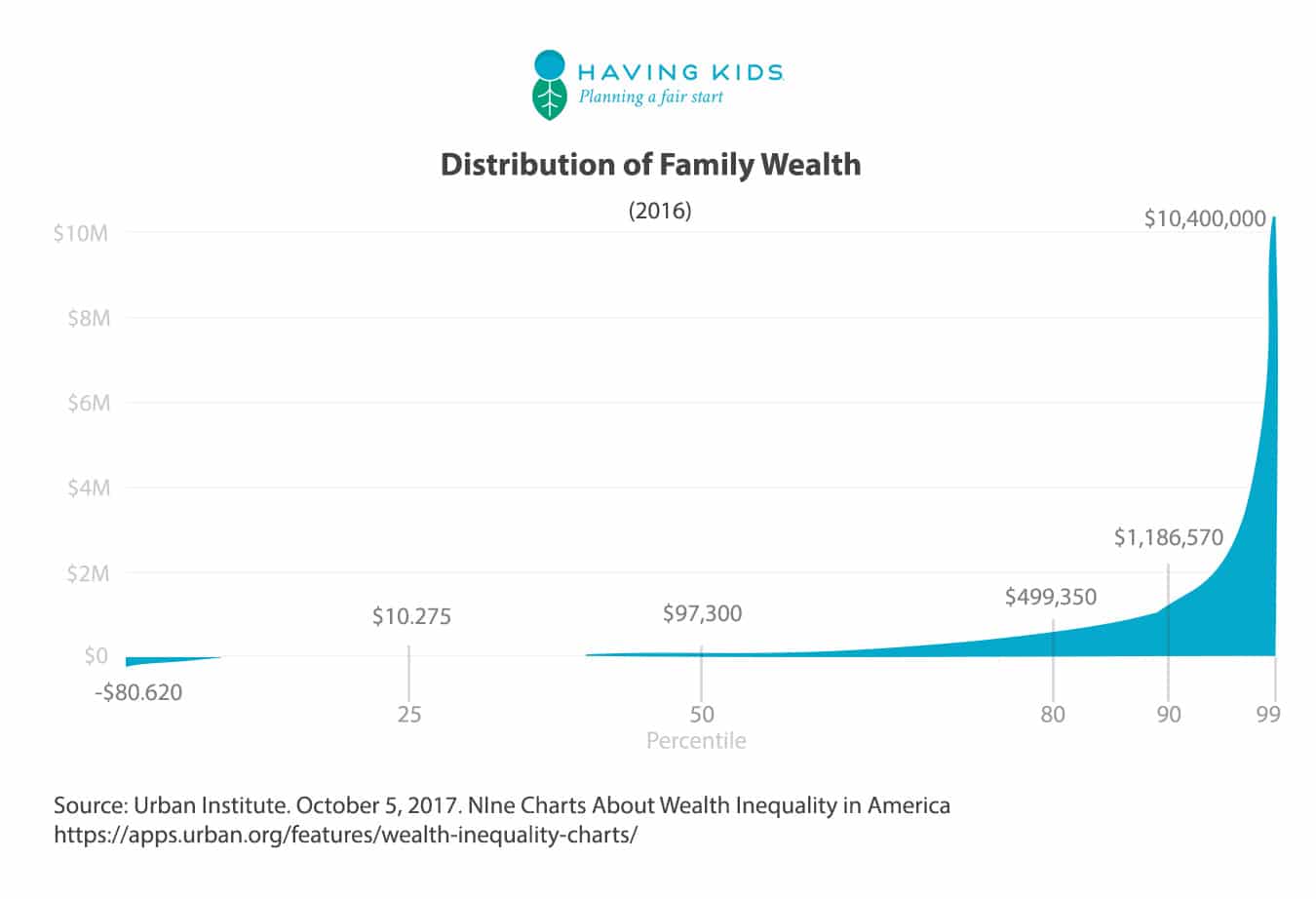
    A line graph titled Distribution of Family Wealth (2016) shows family wealth across percentiles, with most values low or negative until rising sharply after the 90th percentile, peaking at over $10 million at the 99th percentile.

    1. Kids born poor stay poor, and social mobility is declining.

    Although overall poverty is declining, poverty is increasing among infants, especially for black and Hispanic children. Social mobility is declining and the condition of those in severe poverty is worsening. That is why a more equitable system to ensure a fair start is as important as ever.

    child inequality
    Source: Stanford Center on Poverty and Inequality

    “The proportion of U.S. children who go on to earn more than their parents has dropped sharply since 1940, when the rate topped 90 percent.” – Equality of Opportunity Project

    The bottom line? Inequality harms kids and it’s getting worse.

    As 2020 candidates propose solutions to inequality, will the response from the right be to deny that inequality is a problem? Inequality must be addressed to give kids a fair start. Fair Start family planning offers a real social contract that brings reasonable people on left and right together.

    This can be accomplished with a cooperative family planning framework. Fair Start family planning brings us together to invest in all kids, to improve equity and create a better society.

    TAKE ACTION
    We can do something about inequality. Help get a guaranteed minimum income (GMI) for kids in Washington D.C., where inequality is higher than any other state in the U.S. GMI that is tied to family planning is even more effective. Ask D.C. Mayor Bowser, @MayorBowser to pursue GMI tied to family planning to give kids a fair start.

  • Climate Crisis: Act Now to Protect the Future for Kids

    Climate Crisis: Act Now to Protect the Future for Kids

    Despite attempts the United Nations and others to reduce carbon dioxide and other greenhouse gases, levels are now at an all time high. The growth in emissions tracks world population growth, which is the greatest driver of climate change and a threat multiplier.

    What can you do to protect yourself and the ones you love?

    Understand that you have a fundamental human right to resources to ensure your child a fair start in life. Choosing to have a smaller family is, without comparison, the best way to mitigate the threats of climate change. The right to nature and a fair start in life is the first and supreme human right. If you are willing to plan responsibly, you have a moral claim against those that are able to pay – including the government and wealthy individuals.

    Demand your rights, and help others make their demands. Communities who are most impacted by climate change, and are literally being driven from their homes, and morally entitled to target those most responsible for Fair Start funding (which would include offsetting the impacts of climate change). Help them do so, by directly confronting those responsible, or calling for governments to recognize and protect the fundamental right to a fair start in life. Would-be mothers who are concerned about the future, and are forgoing having children, have a moral claim against those who are creating the predicament. Engage those people directly, and speak out against government policies that promote having larger families that threaten our future.

    Having Kids means caring for the future, and that means taking effective action now. Let’s change to conversation from what parents want to what kids need. 

  • How to Overcome Inequality and Exclusion? Start With Better Family Planning

    How to Overcome Inequality and Exclusion? Start With Better Family Planning

    Most of the world’s legal systems, and the cultures they shape, treat family planning like this: It is each individual’s personal or private right to decide how many children they want to have, the conditions in which those children will be born, and the opportunities in life those children will have. It’s a model focused exclusively on what would-be parents want in the here and now. That approach to planning our families derives from a cognitive dissonance called temporal myopia that leads us to ignore the long-term consequences of our actions. There is also nothing inclusive about that system. Nothing about it deliberately includes future children in their community, in any meaningful way that would ensure their voice is heard. It is less than ideal, for lots of reasons.  

    It isolates parents from their communities, creating a wall between the two.

    It prevents both communities and parents from working together to ensure that when children are born they get what every child needs. That includes even basic things like basic nutrition, health care, and a loving home. These basic needs are expressly or implicitly guaranteed by the Children’s Rights Convention. But because of the way we plan families, where the community is alleviated of its obligations in the planning process – many children never get them. Downstream solutions, like state protective interventions, are an insufficient band-aid. The Turpin family – and the long-term torture of the thirteen children – provides a jarring example. They abused over a dozen kids under the nose of their community, for years. That is isolation parenting. The Turpins not alone. Roughly 700,000 children are abused in the U.S. annually.  

    The traditional isolation model, the one even the United Nations promotes, helped ensure what happened in the Turpin family, and in similar cases every day around the world. In sum, in the isolation model, future children are treated as the property of the intending parents. This is discussed more below.

    It perpetuates inequality.

    The isolating way we plan our families also ensures (and was designed to ensure) massive inequality. Poor kids become poor adults, and rich kids become rich adults, with the latter inheriting both obvious and subtle benefits they never earned. Racial and ethnic disparities that have persisted are a consequence of that. Elites, in turn, create policies that ensure larger families and population growth, bringing more and more children into the world to fuel a system of workers, consumers, and taxpayers that benefit a small percentage of people at the top in what many have recognized as a Ponzi scheme pyramid. The United States was founded on opposition to birth-based hierarchies, like the British monarchy. How is it then that we are controlled by someone like Donald Trump, who was born in a such dominant positioning to others? Isn’t that odd? It’s not if you begin to examine and question the way we plan families, and how it perpetuates inequality and injustice.
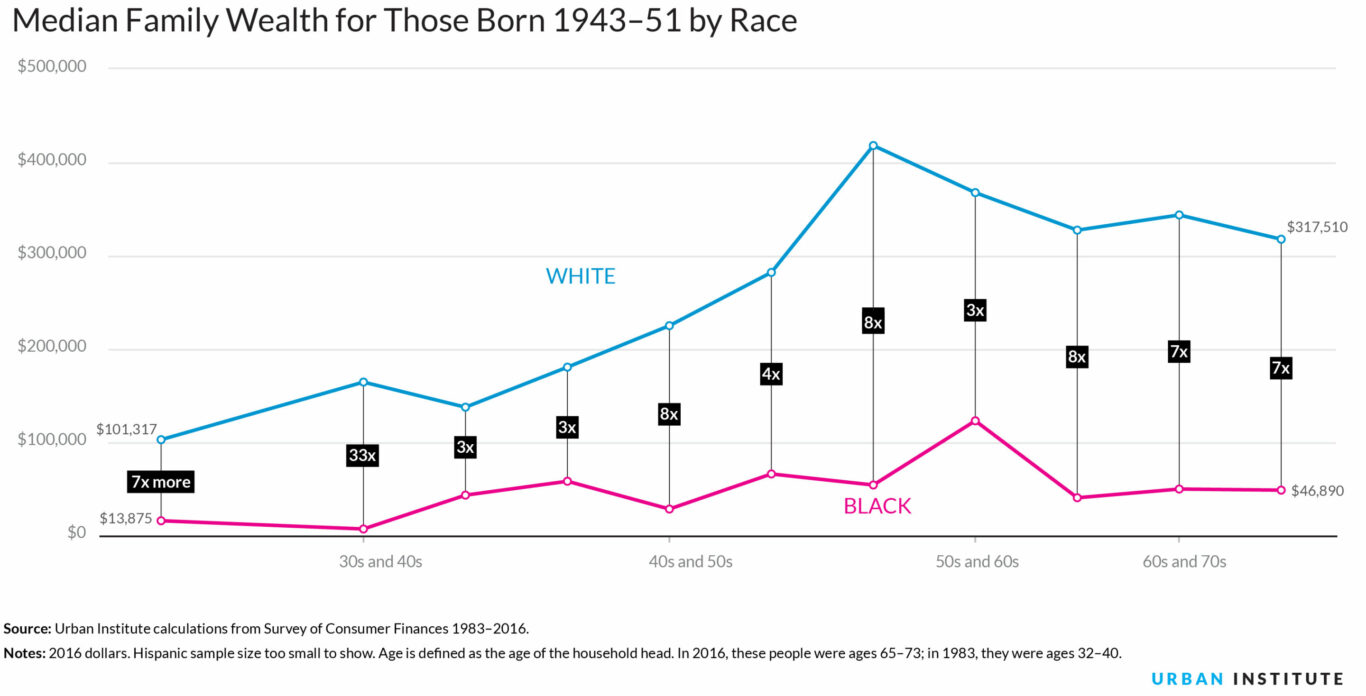
    Line graph comparing median family wealth of White and Black people born 1943–51, showing White families with consistently higher wealth than Black families through their 30s to 60s. Data points highlight the wealth gap.

    It imposes severe environmental costs.

    This should be obvious, but a family planning model that protects people like the Duggars, a disturbing illustration of exponential growth, has not-so-great consequences for nature, the nonhuman world, and the environment upon which humans rely. Large families, and the population growth they created, are the fundamental source of climate change. Does that mean consumption does not matter? No. But the irrefutable truth is that consumption and family planning are inextricably linked, or two sides of one coin, and addressing consumption begins with revising how humans see themselves in relation to the earth, which in turn begins with the examining the meaning of our creation, relative to the ecosystems around us. We are, before we consume. The numbers matter. And here is the simple fact: By 2100, world population could vary by billions of people, depending on whether the average woman in the world today has one child more or one child fewer in her lifetime.

    It treats people and animals as property.

    The isolation model of family planning did something else, something at the most fundamental levels of society. It ensured that our societies, and the legal constitutions upon which they are based, would be positioned to treat both future children and non-humans – the most vulnerable entities in the world – as property. In the almost universally-accepted isolation model, would-be parents would have total control over future children (think the Turpins again here), and over the nonhuman world, which is treated as a human resource to be colonized and used. The nexus, between the human and nonhuman world, is property to be taken and controlled. If we don’t reform family planning systems, we never address that fundamental problem. In contrast, more ethical systems, replace the contradiction of procreative autonomy with more accurate values. With a better family planning model we can liberate both future children, as well as animals and their habitat, at the same time, and stop the former from being used to colonize the latter.  

    It’s time to change the isolating parent-focused model to one that includes the needs of future children and the community, and integrates the two together.

    It’s called Fair Start family planning.

    What’s that? It’s simple: Smaller families sharing resources to give every child a fair start in life. This child-centered model fixes several mistakes in the parent-focused model, and centers family planning around inclusivity and equity. It is nonpartisan at the most fundamental level, derived from fundamental and widely shared values, and it is designed to capitalize on falling fertility rates, steering them into better qualitative outcomes. Fair start family planning is fairness and inclusivity, on caffeine.     

    There is resistance, of course. Those at the top of the pyramid, and the politicians that represent them, are leaning on women to have more and more kids in order to create consumer demand, a class of cheap future labor, and a larger tax base. That is exactly why Trump and his family were behind barely-noticed reforms to the Child Tax Credit in 2018 that were expressly designed to urge women to have more kids. Let’s be clear what this means. Congress will pay you for each kid you have, regardless of whether you neglect and abuse those kids, or simply have them in to totally failing state systems out of which charities are struggling to pull kids every day. Why? Kids equal economic growth, and that equals money for elites. People who oppose family planning reform are godsends for companies like Unilever that will profit from the growth to come.  

    What is one way elites, who benefit from the constant flow of consumers, cheap future labor, and compliant taxpayers produced by poor family planning, keep the system in place? They fear-monger by intentionally conflating better family planning with many of the horrible reproductive rights violations of the past, like eugenics. They elide the complex intersectionality at the heart of family planning. But do you really think Fox News cares about equity? They and many other reactionary entities create endless propaganda to keep discussions of family planning taboo, and this lever for real social change hidden.

    Doing effective social justice work means considering where people come from, the conditions in which they are born and raised, and whether the process that brought them into the world and provided for them is just. That is step one. If you don’t work on reforming family planning systems you are missing what could be the most influential factor in your work, others will be busy controlling that process, and what they do will have nothing to do with justice.