Category: Children’s Rights

  • An Open Letter from Truth Alliance –  The Denver Model, Equal Valuation of Life, and the Urgent Need for a Fair Start for No Child is worth more than another.

    An Open Letter from Truth Alliance – The Denver Model, Equal Valuation of Life, and the Urgent Need for a Fair Start for No Child is worth more than another.

    To the University of Denver, its leadership, faculty, students, funders, alumni, and the wider public,

    Truth Alliance writes to raise a fundamental concern about how institutions model, value, and report the impacts of their work on people, animals, communities, and future generations.

    We believe the University of Denver’s traditional modeling approach, as we understand it, risks reproducing a “separate but equal” system of valuing life, one in which the interests of some populations, children, communities, animals, or generations can be assigned greater weight than others. In our view, this approach is incompatible with the principle that every child and every human life must be treated with equal dignity and concern.

    We refer to the prior letter Fair Start sent the University.

    Our concern is not simply about one academic model or one institution. It is about the broader consequences of using systems that discount the lives of future generations or treat certain populations as less valuable when calculating public impacts. When a model places a different value on a child’s life because of where that child is born, the wealth of their family, their race, their nationality, or the generation into which they are born, the result can be a deeply unequal distribution of protection, resources, and opportunity.

    Truth Alliance believes that no child is worth more than another. That principle must be reflected not only in constitutional law and civil rights but also in the models, policies, economic calculations, and institutional decisions that shape the future.

    The Question of Public Impact

    We are particularly concerned about the consequences of impact-reporting systems that fail to adequately account for harms imposed on future generations and communities already facing the greatest risks. If a model systematically discounts future life, then the suffering of children who have not yet been born may be treated as less important than the interests of people living today. If the model also fails to account for historic inequalities, the result can be a system that effectively transfers costs from those with greater power to those with less power.
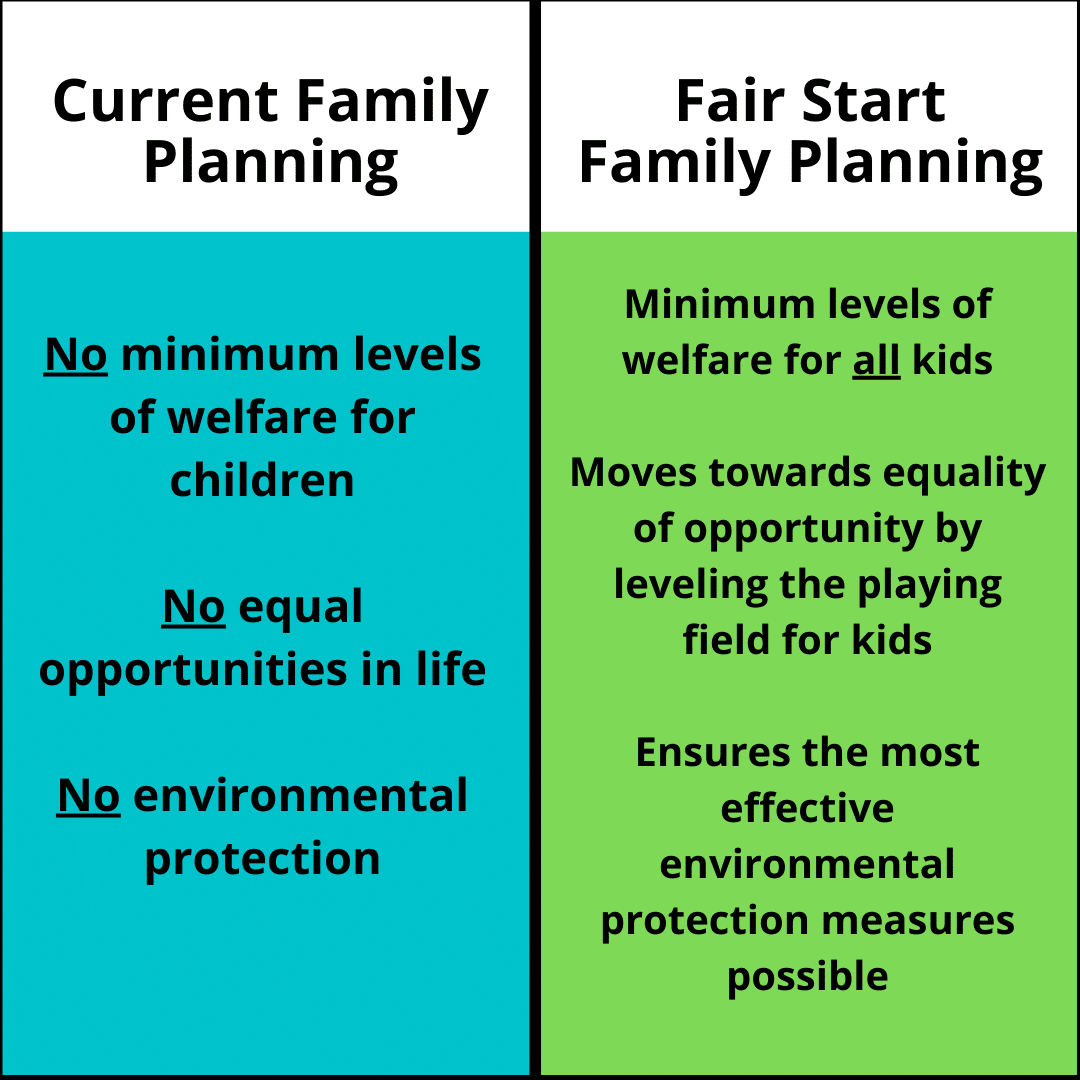
     

    Family Planning info card


    This is especially alarming in the context of the climate crisis.

    Africa contributes a relatively small share of historical global greenhouse-gas emissions, inequalities yet African children and other global south communities are among those facing severe consequences from climate change. The impacts include:

    • Rising temperatures and increasingly dangerous heat.
    • More frequent and prolonged droughts.
    • Unpredictable rainfall and changing seasons.
    • Crop failures and declining agricultural productivity.
    • Food insecurity and malnutrition.
    • Water scarcity and competition over limited water resources.
    • Livestock losses and threats to pastoral livelihoods.
    • Flooding and destruction of homes and infrastructure.
    • Soil degradation and desertification.
    • Loss of forests, biodiversity, and wildlife habitats.
    • Increased displacement and climate-related migration.
    • Greater risks of disease and public-health emergencies.
    • Disruption of children’s education.
    • Increased poverty and loss of household income.
    • Greater risks to women and girls, particularly in vulnerable communities.
    • Increased conflict and competition over natural resources.
    • Loss of cultural heritage and traditional livelihoods.
    • Growing pressure on already weak health and social-protection systems.
    • Greater exposure of children to long-term and intergenerational harm.

    These are not abstract statistics. They represent real children, families, and communities whose futures are being shaped by decisions made today.
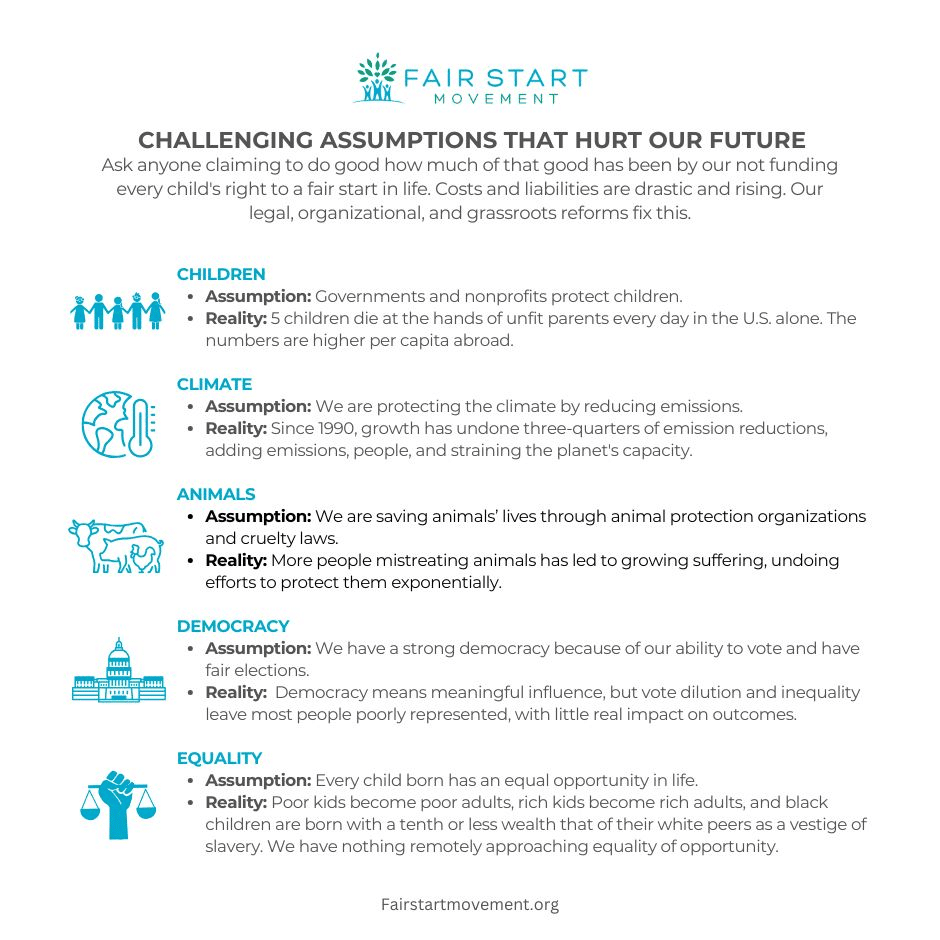
     

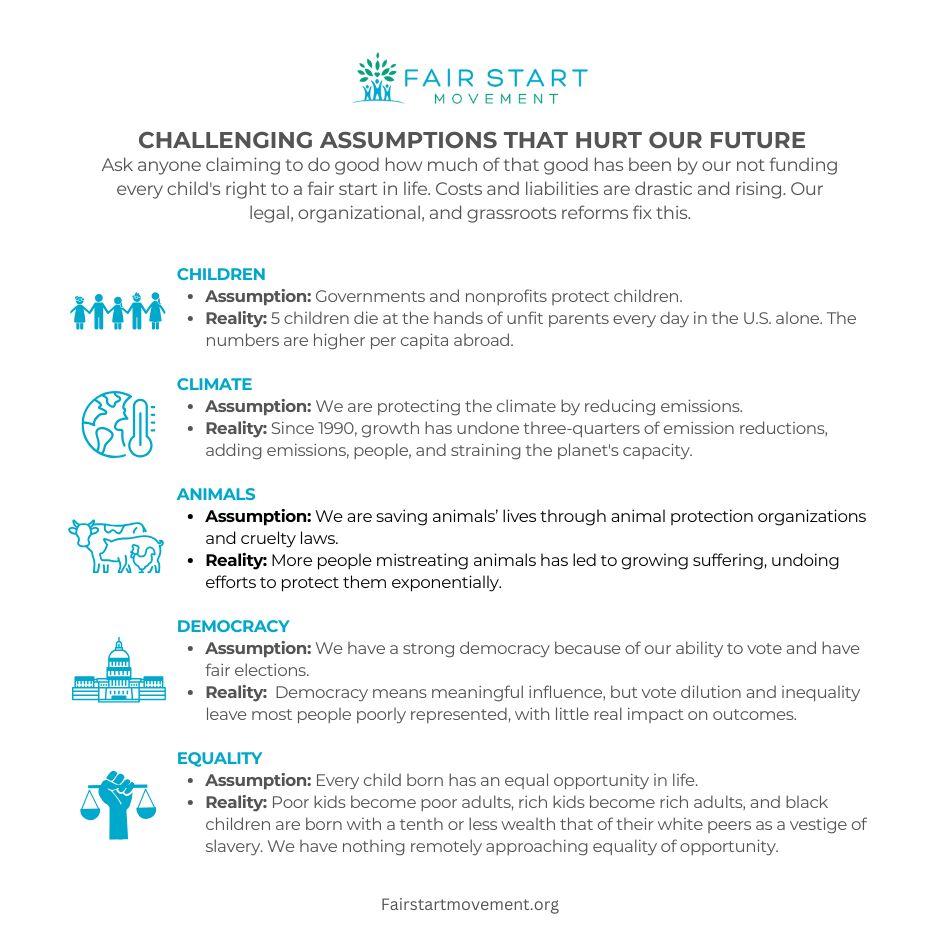
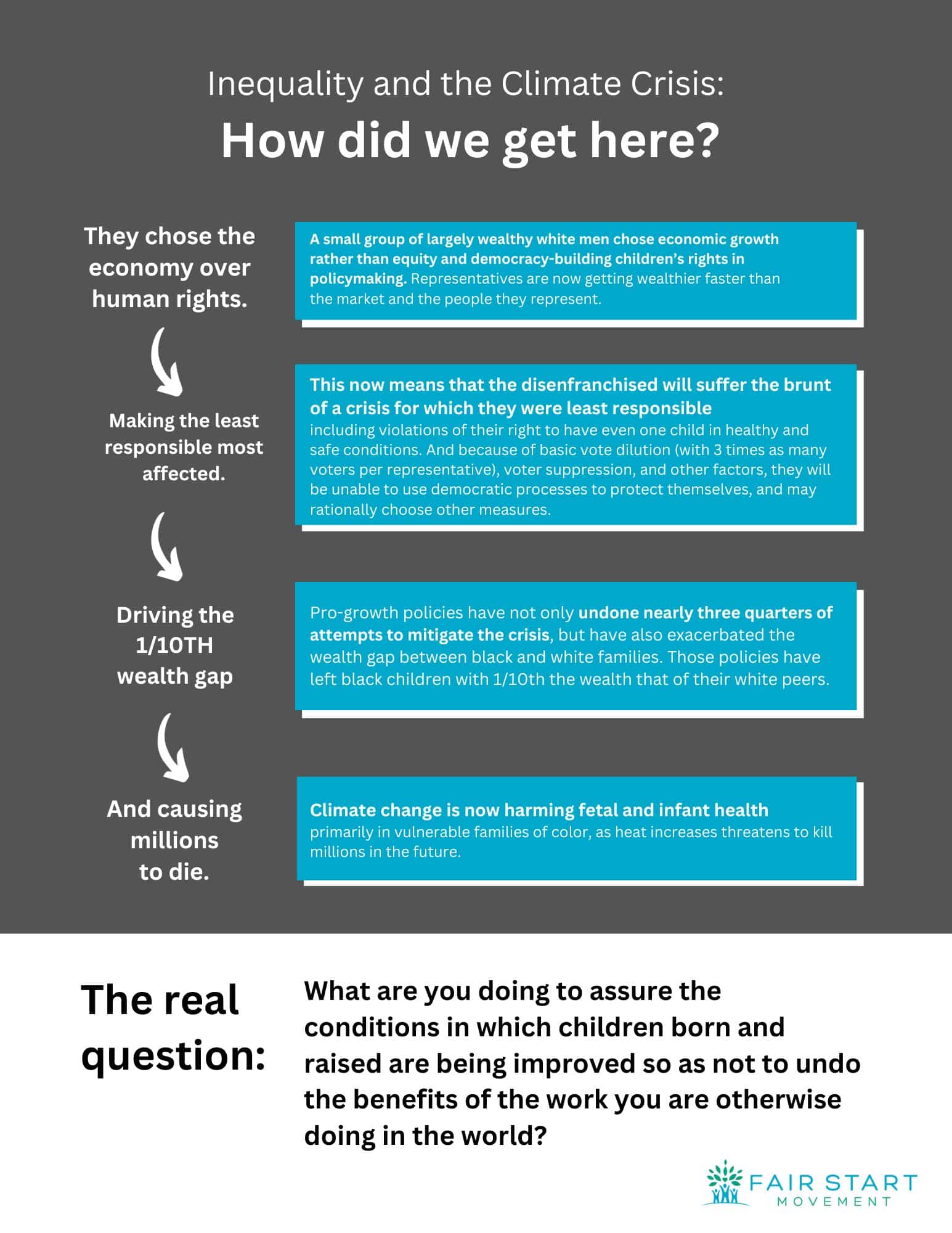
    Challenging assumptions that hurt our future infographic

    A Call for a Different Standard

    Truth Alliance believes that the solution is not simply to improve one model at the margins. Institutions must reconsider the underlying assumptions that determine whose life counts, whose suffering is measured, and whose future is protected.

    We therefore call on the University of Denver and other institutions engaged in public-impact modeling to examine whether their methodologies adequately protect the equal dignity and value of all people including children not yet born. We believe there is an opportunity to move from models that may discount future life toward a Fair Start standard based on the principle that no child is worth more than another.

    Such a framework would seek to ensure that:

    1. Every child is treated as having equal inherent value.
    2. Future generations are not systematically discounted simply because they have not yet been born.
    3. Public policies account for long-term and intergenerational harm.
    4. Historical inequalities are not hidden by statistical assumptions.
    5. Communities facing the greatest risks are not treated as acceptable recipients of disproportionate harm.
    6. Public-impact assessments recognize the full human consequences of environmental, economic, and social decisions.
    7. Institutions are transparent about the assumptions built into their models.
    8. Children and affected communities have a meaningful voice in decisions that determine their future.

    The Cost of Inaction

    Truth Alliance is concerned that failing to reconsider these approaches could contribute to continued and unimaginable harm particularly for children and communities already living at the margins of global protection. When institutions normalize the discounting of future life, the consequences do not remain inside classrooms or academic papers. Models influence policy. Policy influences investment. Investment influences infrastructure. Infrastructure influences communities. And these decisions ultimately shape who is protected and who is left exposed.


    The question before us is therefore not merely technical.

    It is moral.

    It is legal.

    It is constitutional.

    And it is about the future of humanity.

    Truth Alliance and its members believe that a child’s value cannot depend on geography, wealth, race, nationality, generation, or economic status.

    We call upon the University of Denver to engage openly with these concerns, review the assumptions underlying its models and public-impact reporting, and explore a new approach that places equal human dignity at the center of institutional decision-making.

    We further invite scholars, civil-rights advocates, children’s-rights organizations, climate-justice movements, African communities, and affected families around the world to join this conversation.

    The future should not be built on a system that treats some lives as more valuable than others.

    No child is worth more than another.

    That is the standard we believe the law, civil rights, climate justice, and public policy must ultimately uphold.

    Truth Alliance
    No Child Is Worth More than Another

  • African Children Do Not Matter  When the Global North Measures Humanity in GDP

    African Children Do Not Matter When the Global North Measures Humanity in GDP

    “Every child matters. Every child deserves a fair start. And no country’s economic status should determine the value of a child’s life”

    There is a painful question that the world has avoided for far too long:

    Do African children truly matter to the global system?

    The answer, when we examine how resources are distributed, whose lives receive urgent attention, and whose suffering is treated as normal, is deeply uncomfortable.

    Too often, it appears that the lives of children in Africa are valued according to economics rather than humanity. When a child is born in a wealthy country, their future is protected by systems that recognize education, healthcare, nutrition, safety, and opportunity as fundamental rights. When a child is born in a poor African community, their suffering is often explained away as poverty, population growth, weak institutions, or a lack of development.

    The difference is not the value of the child.

    The difference is the value the global system assigns to the place where the child was born.


    GDP Has Become a Measure of Whose Lives Matter

    The global economic system often speaks the language of Gross Domestic Product GDP. Countries are ranked according to economic growth, productivity, investment, trade, and national income.

    But GDP does not measure the value of a child’s life.

    It does not measure whether a child goes to school hungry. It does not measure the trauma of losing a parent. It does not measure the dignity of a child who has no clean water. It does not measure the dreams of a young girl who is forced to leave school because her family cannot afford basic necessities.

    Yet the international system frequently behaves as though economic output is the most important measure of progress.

    This creates a dangerous hierarchy of human worth.

    A child in Africa may be surrounded by natural resources, fertile land, renewable energy potential, and enormous human creativity, yet still grow up without the basic conditions necessary to thrive. Meanwhile, the global economy continues to extract value from the continent while too many African communities remain trapped in poverty.

    The question is not simply why Africa is poor.

    The question is who benefits from Africa remaining poor.


    The Global North Cannot Claim to Value Children Equally

    Governments, corporations, universities, foundations, and international institutions frequently speak about universal human rights. They publish reports about children, climate change, gender equality, and sustainable development.

    But words are not enough.

    If every child is truly equal, then the child in Uganda should matter as much as the child in the United States, Europe, or any other wealthy region.

    If childhood is a universal right, then a child’s access to food, healthcare, education, clean water, safety, and a future should not depend primarily on the GDP of their country.

    Yet global priorities often tell a different story.

    Billions can be mobilized during financial crises. Massive investments can be made in technology, infrastructure, defense, and economic expansion. But when children in Africa need direct support, the response is often framed as charity.

    This is where we must challenge the system.

    African children do not need to be treated as objects of charity. They need to be treated as human beings with equal rights and equal value.

    Charity Is Not the Same as Justice

    For decades, Africa has received development assistance, humanitarian aid, and charitable interventions. Many of these efforts have saved lives and supported communities, and the people working within them deserve recognition.

    But charity alone cannot solve structural inequality.

    A system that repeatedly creates inequality cannot repair that inequality simply by giving small amounts of money to those who have been harmed.

    Justice requires us to examine the structures behind poverty.

    It requires us to ask why African countries with enormous natural resources can remain economically vulnerable. It requires us to examine the legacy of colonialism, unfair trade relationships, debt, extractive industries, climate injustice, and unequal access to global finance.

    It also requires us to confront a difficult reality: the world often expects Africa to develop using systems that were not designed to prioritize African children’s wellbeing.

    Climate Change Reveals the Inequality Clearly

    The climate crisis makes this inequality impossible to ignore.

    African communities have contributed relatively little to historical global emissions compared with many industrialized economies, yet millions of African children face droughts, floods, food insecurity, extreme heat, displacement, and disease.

    A child cannot choose the carbon emissions of previous generations.

    A child cannot choose where they are born.

    Yet children are paying the price.

    When climate discussions focus primarily on economic growth and carbon markets, the human being can disappear from the conversation.

    We must ask a different question:

    What does climate justice mean for a child in Africa?

    It means that the child must have clean water.

    It means access to nutritious food.

    It means protection from extreme heat.

    It means resilient schools and healthcare systems.

    It means the right to grow up without being forced into migration because their community can no longer sustain life.

    Climate justice must be measured in human lives—not only in GDP, carbon credits, or economic indicators.

    The Problem Is Not That African Children Have Less Value

    African children are not less intelligent.

    They are not less capable.

    They are not less deserving.

    They are not less human.

    The problem is that the global system has created unequal starting points and then often uses those unequal outcomes to justify further inequality.

    Global north folks  chose separate but equal and reproductive autonomy over reproductive equity – that caused the polycrisis and allowed theme to move wealth to their families in the process.

    the wealth in the global north being made at cost to children in Africa, and that wealth now owed to ensure legitimacy.

    A child born into poverty is told they must work harder.

    A child born into wealth is given opportunities.

    One is expected to overcome systemic barriers through individual effort. The other benefits from systems built over generations.

    This is not a fair competition.

    This is why the idea of a fair start matters.

    Every child should have a meaningful opportunity to survive, develop, learn, and participate in society. A fair start does not mean every child receives exactly the same resources. It means that no child should be condemned to a lesser future simply because of the circumstances of their birth.

    A universal legitimacy lever that challenges institutions and systems that fail to recognize the equal value of every child. Truth Alliance have activists like Mwesigye, Pirrette,  Jenipher Jones, Zahara, Esther,mthabisi George  and others,To advance Black birth equity and make the equal worth of every child a fundamental  standards of legitimacy, arguing that societies like Africa cannot claim true legitimacy while structural inequalities continue to determine which children receive protection, opportunity, and a fair start in life. No child is worth more than another.

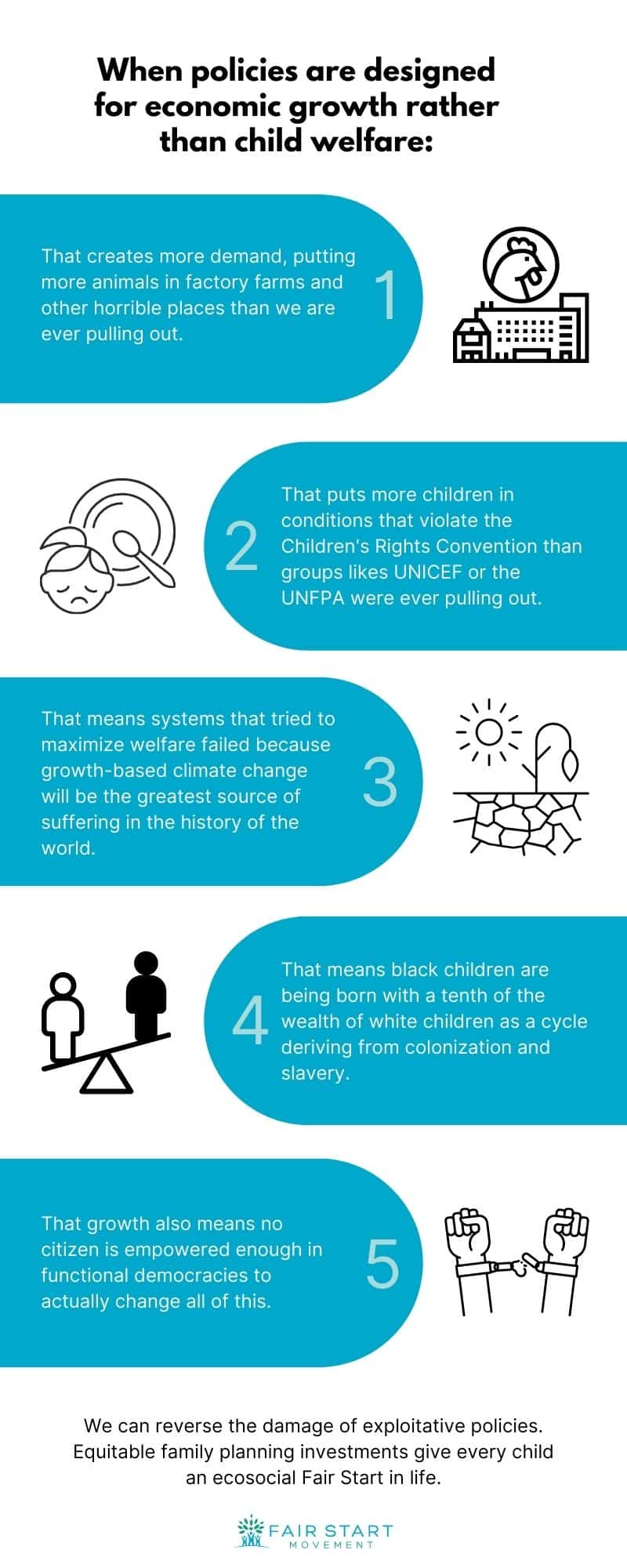
    Challenging assumptions that hurt our future infographic

    We Must Stop Measuring Africa Only by What It Produces

    Africa is often discussed in terms of what it can produce for the global economy: minerals, oil, agricultural commodities, labor, markets, and investment opportunities.

    But Africa is more than a resource base.

    African children are more than future workers.

    African communities are more than markets.

    Human beings should never be valued primarily according to their economic contribution.

    If the global North is serious about human rights, it must move beyond a system where GDP determines whose suffering receives attention and whose future receives investment.

    The real measure of a society is not how wealthy it is.

    The real measure is how it treats those with the least power.

    A New Global Standard Is Necessary

    The world needs a new standard for measuring progress.

    We should ask:

    How many children are safe?

    How many children are healthy?

    How many children can access quality education?

    How many children have clean water?

    How many children are protected from exploitation?

    How many children have a genuine opportunity to shape their future?

    And most importantly:

    Would we accept this level of suffering if these children were born somewhere else?

    That is the question the global community must confront.

    African children matter not because they will become productive workers, consumers, taxpayers, or contributors to GDP.

    They matter because they are human beings.

    Their lives have value before they produce anything.

    Their dignity should not depend on the wealth of their country.

    Their future should not be determined by the economic interests of powerful nations.

    The world must move beyond a system that measures Africa by GDP while measuring African children by survival.


  • When the Heat Rises, Africa Has the Least Protection and Too Many Childhoods Are Treated as Normal

    When the Heat Rises, Africa Has the Least Protection and Too Many Childhoods Are Treated as Normal

    “The greatest injustice is not only that the world is warming, it is that those with the fewest resources are carrying the heaviest burden. And no child should be considered normal when it denies a child the dignity they deserve.”

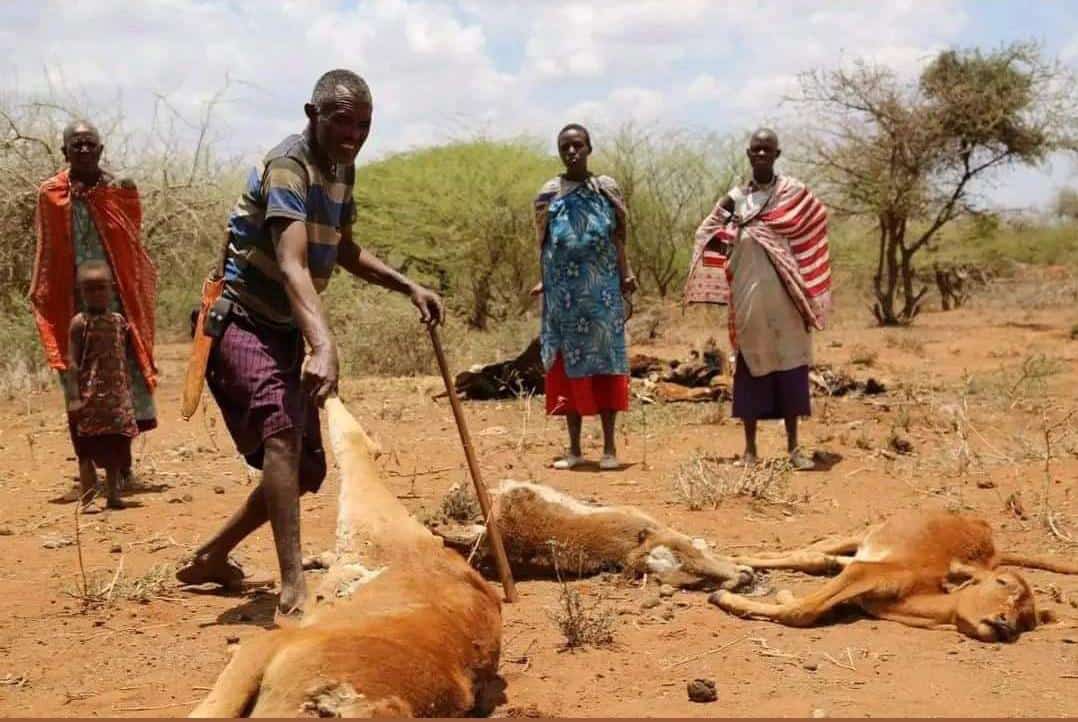
    Climate change is no longer a distant warning; it is a daily reality across Africa. Rising temperatures, prolonged droughts, and unpredictable seasons are affecting how people live, work, and survive. Yet the greatest challenge is not the heat itself, it is that millions of Africans face these conditions with the fewest resources to prepare, respond, or recover.

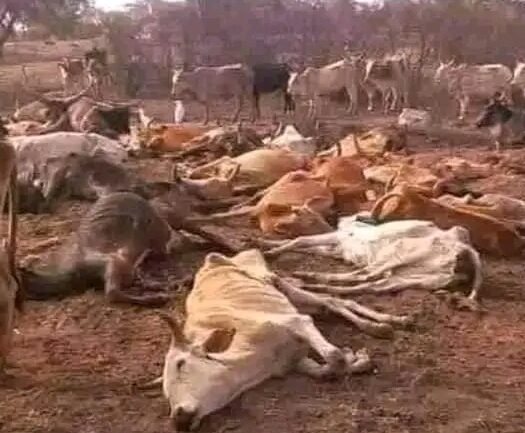
    For many communities, livelihoods depend on rainfall, healthy pasture, and reliable water sources. When crops fail or livestock die, the consequences are immediate: food disappears from family tables, incomes collapse, and children often bear the heaviest burden through hunger, interrupted education, and declining well-being.

    Heat deaths infographic

    Children experience the climate crisis in deeply personal ways. Many walk long distances to school under extreme heat, often without adequate water, shade, or footwear. Overcrowded classrooms with poor ventilation make learning harder, while climate-related economic shocks push some children out of school to help support their families. Climate change is therefore not only an environmental issue it is increasingly shaping education, health, livelihoods, and the future of entire communities.

    At the same time, many hardships that children endure have become so familiar that society rarely questions them: walking hours to school, missing classes because there is no water at home, or carrying responsibilities that belong to adults. Resilience is admirable, but a child’s ability to endure hardship is not proof that hardship is acceptable. Childhood should be defined by opportunity, protection, and dignity not by what a child can survive.

    Dying zebra from climate drought and starvation with two people looking concerned

    Perhaps the greatest injustice is that Africa has contributed the least to the climate crisis, yet faces some of its most severe consequences. The answer cannot be resilience alone. Communities need investment: access to information, technology, infrastructure, safe schools, water systems, and financial resources that allow families to adapt and thrive.

    Climate action must reach the communities where these realities are already being lived every day. And child equity requires more than counting how many children are reached it requires asking what conditions we continue to allow children to live with.

  • Why Policy Change Alone Is Not Enough for High-Risk Children Need Direct Reparations

    Why Policy Change Alone Is Not Enough for High-Risk Children Need Direct Reparations

    Policy reform is important, but it must be matched with direct, decentralized reparations that support high-risk children and strengthen local communities. Combining strong laws with community-based reparations  helps ensure vulnerable children receive the practical support they need to survive and thrive. 

    Across the United States, millions of dollars are spent every year on litigation, lobbying, and policy advocacy. Lawyers, advocacy organizations, and philanthropists work tirelessly to influence laws on issues such as animal welfare, child protection, reproductive rights, and family planning. These efforts have contributed to important legal and policy reforms of the reparations.

    Yet an important question remains:

    Who is investing directly in the children who face the highest risks today?

    People carrying water containers on their backs

    Policy change is essential, but laws alone do not feed a hungry child, provide clean water, improve access to healthcare, or create economic opportunities for struggling families. For children living in extreme poverty, conflict, or climate-related crises, change must also happen within their communities

    The Missing Piece: Decentralized Support

    Many interventions remain centralized, with funding concentrated in national institutions, legal campaigns, or large international organizations. While these efforts can influence systems, they often leave local communities with limited resources to respond to the daily needs of vulnerable children.

    Decentralized community initiatives can help bridge this gap by:

    • Supporting families before children fall into crisis.
    • Empowering local women’s groups and community leaders.
    • Strengthening household food security and livelihoods.
    • Expanding access to basic health services and education.
    • Building community resilience to climate and economic shocks.

    Local organizations are often the first to identify children at greatest risk, yet they frequently receive only a small share of global funding.

    Policy Should Be Matched with Practice

    People planting vegetables

    Legal advocacy and policy reform should not compete with direct community Reparations they should reinforce one another. A child benefits most when strong laws are accompanied by practical support that reaches families where they live. This means investing in local organizations, communities, women’s groups, and grassroots initiatives that understand local realities and can respond quickly.

    A More Balanced Approach

    The goal should not be to reduce investment in policy advocacy. Rather, it should be to create a better balance between changing systems and strengthening communities.

    Protecting children requires both:

    • Effective laws that uphold children’s rights.
    • Sustainable reparations that enable families and communities to protect children every day.

    Without local implementation, even the strongest policies risk leaving the most vulnerable children behind.


  • Freedom for Some, Hardship for Others – Why Every Child’s Life Must Be Valued Equally

    Freedom for Some, Hardship for Others – Why Every Child’s Life Must Be Valued Equally

    Summary – While some people enjoy abundant opportunities, security, and freedom, millions of children in Uganda and sub sub saharan Africa and other vulnerable communities continue to face preventable poverty, disease, and limited opportunities due to enduring structural inequalities and decision-making systems that undervalue future lives, underscoring the need for policies that recognize the equal worth, dignity, and freedom of every human being regardless of where or when they are born. Freedom for Some, Hardship for Others. 

    Challenging assumptions that hurt our future infographic


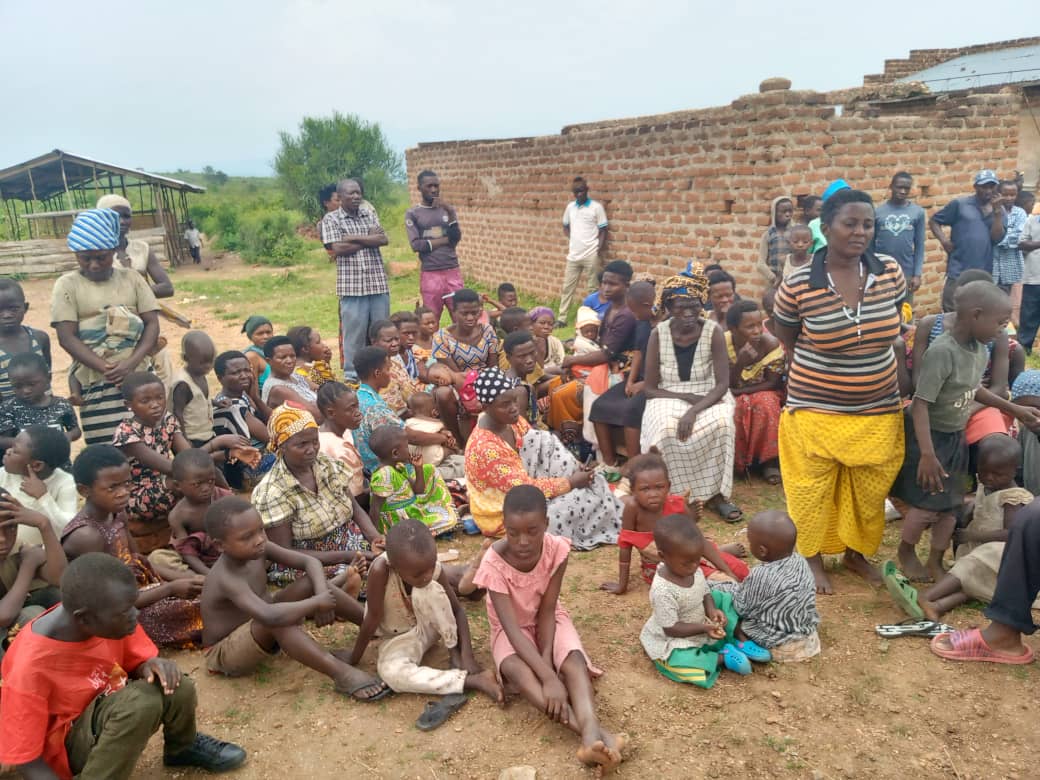
    A family in a wealthy part of the United States may enjoy reliable access to food, clean water, healthcare, education, economic opportunity, and the freedom to travel the world, attend major sporting events, and pursue their aspirations with confidence. At the same time, many children in Uganda continue to face hunger, water scarcity, preventable diseases such as Ebola, and limited access to essential services.

    This contrast is not simply the result of individual choices. It reflects global economic and political systems that have historically concentrated wealth, power, and opportunity in some regions while leaving many communities in the Global South with fewer resources, less self-determination, and greater exposure to preventable risks.

    As Samuel has requested, we must confront the deeper question of freedom. Freedom is not merely the absence of constraints for those who are already privileged. Genuine freedom requires that every person has a meaningful opportunity to live, develop, and pursue their future. When children lack access to healthcare, clean water, education, and protection from preventable disease, their freedom is restricted long before they have the chance to exercise it.

    This concern extends beyond Uganda. Vulnerable communities in Uganda and elsewhere also experience disproportionate exposure to poverty, environmental hazards, inadequate healthcare, and economic insecurity. Policies and models that systematically place lower value on the lives and futures of disadvantaged populations contribute to these inequalities, regardless of where they occur.

    One important example is the practice of discounting future lives and future harms in economic and policy analysis. When future human lives are valued less simply because they occur later in time, decisions may systematically underinvest in preventing long-term suffering, disease outbreaks, climate impacts, and structural poverty. In practice, such approaches can disproportionately harm those who are already most vulnerable, including children in Uganda and marginalized communities in Uganda.

    Family Planning info card

    Truth Alliance “It is difficult to think about these issues only in terms of the future, because the consequences are already with us today. The children and future generations of Uganda and other parts of Sub-Saharan Africa are paying the cost of decisions that were not addressed 40 or 50 years ago. Many racial justice advocates, policymakers, and institutions recognized inequality, yet the underlying structures that perpetuate unequal opportunities and unequal protection from harm were never fully corrected. The result is that today’s generation continues to bear the burden of preventable poverty, disease outbreaks, climate vulnerability, and limited opportunities for self-determination. Political leaders, including President Trump and others before and after him, operate within systems whose costs often fall disproportionately on the world’s most vulnerable communities. We should not continue passing these burdens from one generation to the next. Every generation has a responsibility to confront injustice rather than defer it. That is why we seek change today to ensure that future generations inherit greater equality, greater freedom, and a world where no child’s life is valued less than another because of where they were born.”

    Peter and Erica have the opportunity to lead by example. By revisiting and reforming modeling approaches that rely on discounting future lives, they can help advance a framework that recognizes the equal worth and dignity of every human being, regardless of where they live or when they are born. Such a shift would strengthen efforts to protect both present and future generations from preventable harms.

    This is not a call for charity alone. It is a call for fairness, consistency, and equal concern for all people. If every child has equal worth, then justice requires more than addressing symptoms. It requires confronting the structural inequalities and decision-making frameworks that allow some populations to flourish while others continue to face preventable poverty, disease, hunger, and insecurity.

    There is already an example of this kind of consideration. Bobak Bakhtiari has committed to reconsidering and changing his modeling approach in recognition of these concerns. Peter and Erica could help lead the way as well by adopting models that better reflect the equal value of all human lives and the importance of protecting the freedoms and opportunities of future generations.

    A world in which some enjoy extraordinary freedom while others face preventable suffering is neither inevitable nor just. The challenge before us is to build systems that recognize that no child and no human being is worth less than another, and that every person deserves an equal opportunity to survive, thrive, and determine their own future.

  • Pierrette Kengela’s Letter To Dean Smith – Letter Included

    Pierrette Kengela’s Letter To Dean Smith – Letter Included

    What is happening right now is bigger than one university, one legal program, or one public dispute.

    Across the world, people are beginning to ask deeper questions about institutional accountability, transparency and truth. Whether in conservation, climate policy, social justice, public health or animal protection, the same concern keeps appearing: are institutions presenting real impact, or carefully managed narratives of impact?

    UN Warns Earth 'firmly on track toward an unlivable world'

    That question now sits at the center of growing concerns surrounding the University of Denver Sturm College of Law’s animal-law programming.

    And importantly, these concerns are no longer coming only from activists or campaigners.

    On February 18, 2026, public health and systems governance specialist Pierrette Kengela submitted an expert perspective letter to Dean Smith of the University of Denver Sturm College of Law. Writing in his independent expert capacity, Kengela outlined growing cross-sector concerns regarding what he describes as “baseline transparency” and “impact integrity” in public-interest programming.

    Fales Claims Check.org

    His letter matters because it places this issue into a much wider global context.

    Kengela’s work focuses on child rights, intergenerational accountability, institutional integrity and African Union–aligned policy work examining long-term social and structural outcomes. In his letter, he explains that across multiple sectors there is increasing technical concern about how institutions communicate public-benefit impact to donors, students, stakeholders and the wider public.

    At the center of that concern is one enormously important distinction:

    The difference between “program outputs” and genuine “net outcomes.”

    In simple terms, institutions may report actions taken, services delivered, advocacy campaigns launched or legal cases supported. Those are outputs. But the deeper question is whether overall conditions genuinely improved once the surrounding baseline realities and structural drivers are fully accounted for.

    And that distinction changes everything.

    Because if underlying systems continue expanding suffering faster than interventions reduce it, then institutions have a responsibility to communicate that reality honestly.

    Kengela’s letter explains that this issue is now increasingly recognized across public health, climate accountability and governance sectors as a matter of evidence integrity and informed public reliance. Public-facing impact claims, he argues, should be clearly bounded by transparent assumptions, modelling limits and honest disclosure of baseline conditions.

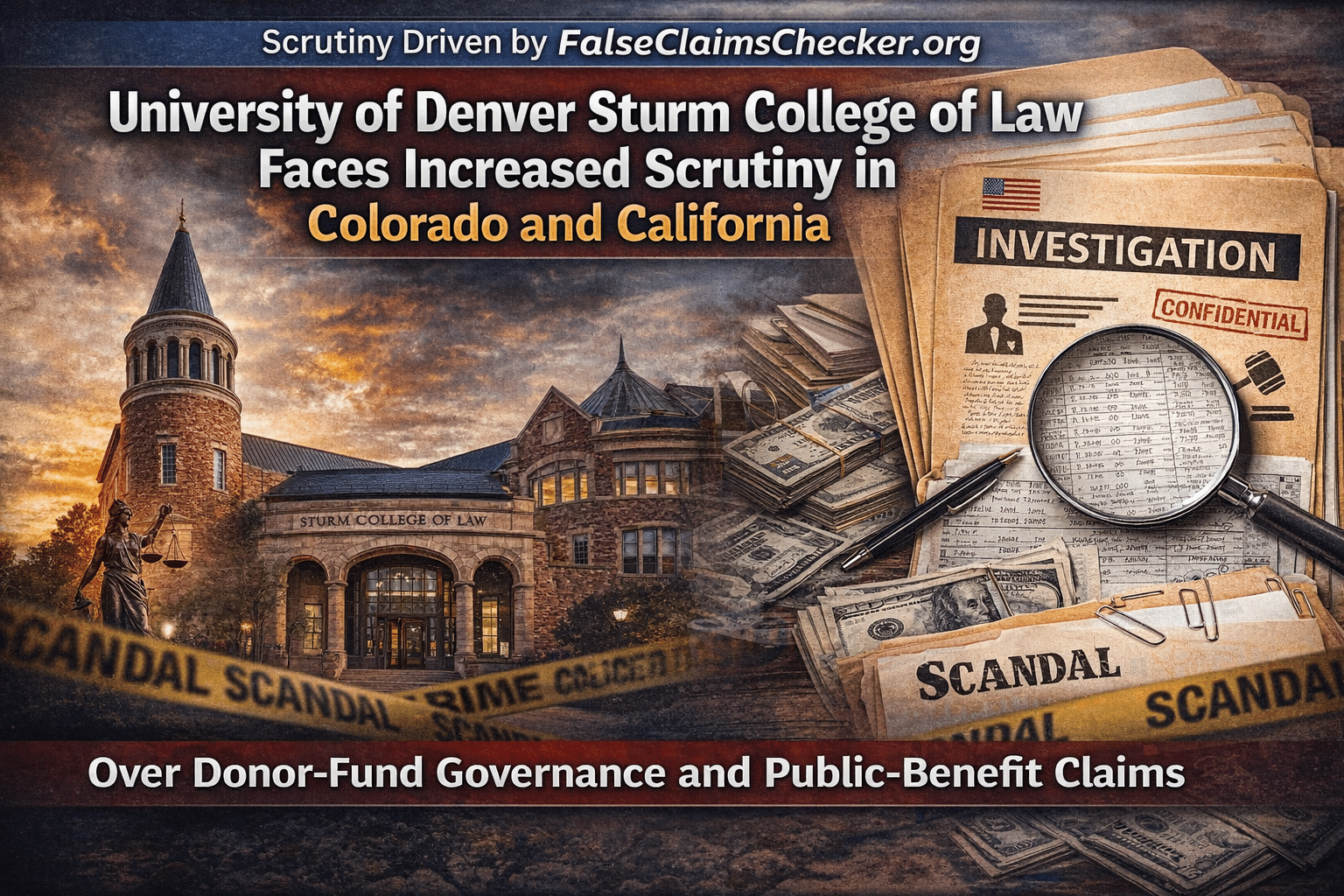
    Image showing the University of Denver Sturm College of Law with police tape, a gavel, and a magnifying glass over files labeled “Investigation” and “Scandal.” Text highlights scrutiny in Colorado and California over donor funds.

    That is not an attack on advocacy.

    It is a call for credibility.

    The concerns raised around Sturm’s animal-law programming center on whether public-facing impact language may imply meaningful net progress in animal protection without sufficiently disclosing the wider structural conditions shaping those outcomes. In other words, whether downstream successes are being publicly emphasized while upstream systems driving harm remain outside the accounting framework.

    This matters deeply because law schools are not ordinary institutions.

    Lady Justice on a desk by a scale on a desk near laptop
    Lady Justice on a desk by a scale on a desk near laptop

    They train future legal professionals. They shape public discourse. They carry institutional authority. And when legal institutions communicate impact to the public, donors and students, there is an expectation that those representations are grounded in rigorous evidence and methodological integrity.

    Kengela’s letter warns that when baseline assumptions remain implicit, program outputs can unintentionally be interpreted as evidence of broader net progress even when underlying structural conditions remain unchanged or continue worsening.

    We see this problem across the world every day.

    Wildlife conservation campaigns celebrate rescues while habitats continue disappearing at industrial scale. Sustainability initiatives market progress while ecosystems collapse in the background. Social justice organizations report outputs while inequality deepens year after year. While there are many great rescues happening, and conservation efforts are working, with rewilding and many species have been saved from extiction due to conservation efforts.  Many species are in rapid decline, with direct conflict with people.  Such as the lion.

    A male lion with a brown mane lies in tall grass, mouth open as if roaring or panting, surrounded by green vegetation.


    And meanwhile, ordinary people are left believing the systems are working.

    This is why transparency matters.

    Not to destroy institutions, but to strengthen them.

    Not to undermine advocacy, but to ensure public trust in it.

    Kengela repeatedly emphasizes in his letter that this is ultimately a governance issue. From a public health and institutional integrity perspective, he argues that transparent disclosure of assumptions and modelling limitations is essential so that donors, students and the public can accurately understand what institutional metrics do — and do not — establish.

    Because impact should never depend on selective visibility.

    And that is the wider issue now being confronted.

    Around the world, institutions have become incredibly skilled at marketing compassion. But increasingly, people are beginning to ask whether those narratives are supported by full accounting of the systems underneath them.

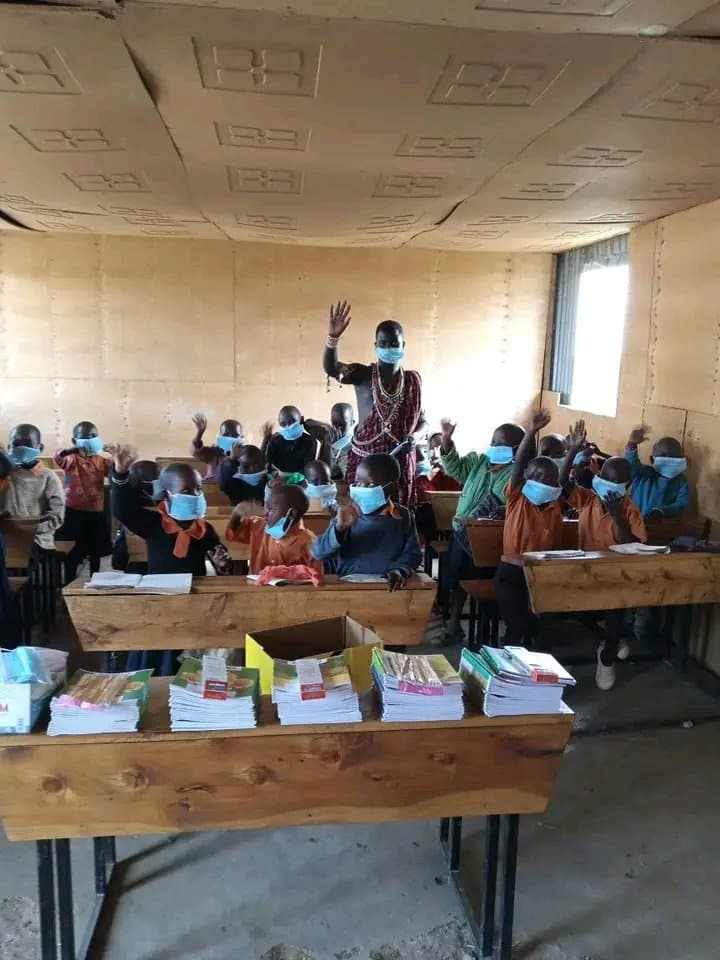
    People in a class room

    The world does not need more carefully managed branding around justice, sustainability or animal protection.

    It needs honesty.

    It needs institutions willing to openly examine whether the outcomes they publicly promote remain true once baseline realities are fully disclosed.

    Because if we truly want to protect animals, protect people and create a sustainable future, then accountability cannot be treated as an inconvenience.

    It must become the standard.

    And perhaps most importantly, it must begin with the courage to tell the whole truth — even when the full picture is uncomfortable.


    Letter –

    February 18, 2026
    Office of the Dean
    University of Denver Sturm College of Law
    2255 E. Evans Avenue
    Denver, CO 80208
    Subject: Expert Perspective on Baseline Transparency and Impact Integrity in Animal
    Law Programming
    Dear Dean Smith,
    I write in my individual expert capacity as lead of the African Union–focused petition on birth
    equity and intergenerational accountability, and as a public health and systems governance
    specialist working at the intersection of child rights, equity, and institutional integrity.
    My engagement on this issue is informed by cross-sector work examining how public-interest
    claims are evaluated in contexts where structural conditions, including child-rights protections,
    intergenerational equity, and climate-related vulnerability, materially shape real-world
    outcomes. Across these domains, there is increasing technical emphasis on ensuring that
    institutional impact language is analytically bounded by clearly stated assumptions and
    methodological limits.
    I am aware that FairStartMovement.org and TruthAlliance.global have filed an institutional
    complaint with the University of Denver Sturm College of Law requesting written clarification
    and internal review regarding (a) how animal-law programming and affiliated advocacy assess
    and publicly represent impact and (b) whether public-facing claims clearly distinguish program
    outputs from net outcomes once baseline variables and modelling limits are disclosed.
    I offer this perspective to support careful institutional reflection on the methodological and
    governance considerations raised in recent correspondence regarding impact representation in
    animal law programming. At its core, the issue under discussion, namely, the use of impact
    language that may imply net outcomes without explicit baseline disclosure, is increasingly
    recognized across multiple sectors as a matter of evidence integrity, informed reliance, and
    sound institutional governance.
    This perspective is offered in the spirit of strengthening methodological clarity and informed
    institutional practice. It does not seek to adjudicate underlying policy positions or advocacy
    viewpoints. Rather, from a governance and public-reliance perspective, the central
    consideration is whether public-facing impact representations are appropriately bounded by
    transparent baseline assumptions, clear modelling limits, and a disciplined distinction between
    program outputs and net system outcomes.
    Context: Growing Cross-Sector Attention to Impact Integrity
    Across multiple sectors, including global health, climate accountability, and social justice
    programming, there is growing recognition that program outputs (e.g., services delivered, cases
    supported, or interventions undertaken) must be clearly distinguished from net outcomes once
    relevant baseline conditions and modelling limits are considered.
    This distinction reflects well-established evaluation principles concerning attribution,
    materiality of assumptions, and the decision-usefulness of public-facing evidence. It is not a
    matter of perfection, but of analytical clarity and institutional credibility.
    From a child-rights and intergenerational equity perspective, the question is straightforward:
    public-benefit claims carry the greatest legitimacy when institutions clearly state the baseline
    assumptions under which those claims are made and disclose any material limits in the
    underlying models. Doing so protects donor intent, supports informed public understanding,
    reduces the risk of reliance on overstated impact narratives, and strengthens confidence in
    academic and advocacy work alike.
    Cross-Sector Observations from AU-Aligned Work
    The African Union–oriented work I help lead has emphasized that systems of accountability
    across sectors increasingly require attention to how structural conditions, including
    intergenerational equity dynamics, shape the real-world effects of well-intentioned
    interventions. Across multiple policy environments, we have observed that where baseline
    conditions and distributional assumptions remain implicit, program outputs can be
    inadvertently interpreted as net progress even when underlying structural drivers of harm
    remain unchanged. This is not unique to any single field; it is a recurring systems-governance
    challenge with implications for evidence integrity, public reliance, and the credibility of
    impact-oriented work.
    During AU-aligned policy work and related cross-sector reviews, our analyses have similarly
    emphasized the importance of testing whether publicly communicated program gains remain
    robust once underlying structural conditions and distributional baselines are made explicit. In
    practice, this involves examining (i) the stated program outputs, (ii) the baseline conditions and
    equity assumptions under which those outputs are interpreted, and (iii) the extent to which the
    institution has bounded any net-outcome implications through appropriate methodological
    disclosure. Where these elements are not clearly aligned, even well-intentioned impact
    narratives can outpace what the available evidence is positioned to substantiate.
    In that spirit, I respectfully encourage continued academic engagement with evolving best
    practices in impact transparency, baseline disclosure, and methodological clarity, particularly
    where public-facing programs may reasonably be understood by external stakeholders as
    demonstrating net social benefit.
    Institutional Relevance for Academic Programs
    Universities play a uniquely important role in modelling careful, evidence-based
    communication for the broader public. Processes that review impact language, clarify
    modelling assumptions where needed, and ensure alignment between program descriptions and
    measurable outcomes can only strengthen institutional trust. This is particularly important in
    fields such as animal law and social justice advocacy, where stakeholders, including students,
    donors, and community partners, may reasonably rely on institutional representations when
    making financial, legal, or professional commitments. Where baseline conditions materially
    shape net outcomes, transparent disclosure is not merely a technical preference but an element
    of sound governance and informed public reliance.
    I note the University of Denver’s role in legal scholarship and animal law education and
    encourage a constructive, evidence-grounded dialogue on these questions as the field continues
    to evolve. Engagement with emerging standards on baseline clarity and impact framing offers
    an opportunity for academic institutions to lead proactively in strengthening methodological
    rigor across the sector, consistent with the broader accountability principles increasingly
    recognized in global health, sustainability, and intergenerational equity work.
    From a public health and governance perspective, the distinction between reported outputs and
    demonstrated net outcomes is not merely semantic; it is central to risk interpretation, resource
    allocation, and institutional credibility. Where baseline conditions materially influence
    downstream effects, good practice increasingly favors transparent disclosure of key
    assumptions so that donors, students, and the public can accurately interpret what program
    metrics do, and do not, establish.
    Sincerely,
    Pierrette Kengela
    Public Health Expert
    Lead Contributor, AU Birth Equity Petition
    Founder, Joy4All Global Initiative

  • Compassion? A Marketing Strategy?

    For too long, institutions across the world have learned how to market compassion better than they measure outcomes.

    That is the deeper issue now emerging around the University of Denver Sturm College of Law’s animal-law programming and the wider concerns being raised regarding public-facing impact claims, donor representations and institutional accountability.

    At the centre of this dispute is a simple but enormously important question:

    What happens when institutions present “impact” to the public while excluding the baseline realities that determine whether any genuine net progress actually exists?

    Because that is where trust begins to break down.

    The public narrative surrounding Sturm’s animal-law brand has been built around rescue-adjacent work, activist defence, clinics, advocacy and legal reform. These are all emotionally compelling and highly marketable areas of work. But concerns now being raised publicly suggest that the impact framework being relied upon may exist inside a controlled accounting model — one that measures visible downstream successes while failing to fully account for the larger upstream systems continuing to expand suffering overall.

    And that distinction changes everything.

    Because if an institution highlights isolated victories while excluding the broader baseline drivers that continue increasing harm, then what is being presented may no longer reflect true net impact. It becomes a selective narrative rather than complete accounting.

    This is not simply a philosophical disagreement about activism.

    It is a question of evidence integrity.

    The TIPOC argument being raised is fundamentally about transparency. It argues that truth in public impact claims requires institutions to disclose the context necessary for those claims to be properly understood. A law school, of all places, understands how omission works. A statement does not need to be technically false in order to become misleading. If favourable variables are included while unfavourable baseline conditions are excluded, the public can easily be led toward conclusions the full evidence may not support.

    And when that narrative is tied to donor funding, recruitment, institutional prestige and moral authority, the stakes become even higher.

    Because this is not just about branding.

    It is about whether public trust is being earned honestly.

    The concern being raised is that institutions can continue producing marketable “wins” indefinitely if they operate inside incomplete accounting systems. Downstream advocacy will always appear successful if the underlying baseline conditions driving harm are kept outside the frame. Meanwhile, the harder upstream work — work that might actually reduce the baseline pipeline of suffering itself — becomes politically difficult, financially inconvenient and structurally unsupported.

    That creates a dangerous equilibrium.

    One where omission becomes normalised because honesty becomes competitively disadvantageous.

    This matters profoundly within legal education.

    A law school is not simply another nonprofit organisation producing awareness campaigns. It is a credentialing institution responsible for training future professionals to think rigorously, analyze evidence carefully and communicate claims responsibly. If impact language is allowed to imply net societal benefit without complete accounting, then students risk learning the worst possible lesson: that moral language can substitute for analytical integrity.

    That is not justice.

    That is narrative management.

    And this is why formal accountability measures are now being demanded publicly and in writing.

    The requests being raised are not vague emotional complaints. They are structured governance demands.

    They include calls for a written response issued under the Dean’s authority identifying who holds responsibility for impact claims, donor representations and program oversight. They include requests for documented legal review by University counsel examining public-facing materials, internal methodologies and the standards used to define institutional “impact.”

    There are also calls for escalation beyond the program’s own internal incentive structures, including involvement from wider University leadership and oversight mechanisms designed specifically for situations where reputational protection risks overriding accountability.

    Record preservation has also been demanded immediately, including internal drafts and communications, because institutions under scrutiny often attempt to quietly revise narratives after concerns become public.

    Most importantly, there are calls for public corrections wherever net outcomes may have been implied without genuine net accounting.

    Because silent edits are not accountability.

    They are damage control.

    The broader issue here extends far beyond one university.

    Across conservation, sustainability, public health and social justice sectors, the same structural problem keeps appearing: institutions learning how to market virtue while avoiding full disclosure of the systems-level realities underneath.

    But the world does not need better narratives anymore.

    It needs honesty.

    Because if organisations truly want to protect animals, protect people and protect the future of this planet, then impact cannot be measured through selective visibility.

    It must be measured through truth.

  • The Silent Force That Undermined the Voting Rights Act

    The Silent Force That Undermined the Voting Rights Act

    The Supreme Court has sharply limited the Voting Rights Act, deepening an already severe state of racial inequity in the United States.

    But this outcome did not come out of nowhere. It reflects decades of entrenched inequality at birth and the accumulation of generational wealth that has concentrated power in the hands of a few. Rather than fully confronting the country’s racist history, past generations built a system that appeared to move gradually toward equality. In reality, it was fragile—a house of cards. Persistent inequity at birth has done more to erode democratic values than to advance them.

    Government authority ultimately derives from empowered people. The Court’s authority, like that of any institution, depends on a far more demanding standard of racial equity than what the Voting Rights Act alone provides—a standard the Court itself is now failing to meet. Its legitimacy rests on an interpretation of the Constitution that requires real, birth-based empowerment of those subject to its authority.

    Put simply, the Court’s authority depends on every citizen having an equal voice in government—and that begins with equity at birth.

    By that measure, the United States falls far short.

    Family Planning info card

    Centering equity in public policy would force government to account for whether people are truly empowered in their daily lives—especially given the conditions into which they are born and that are shaped by public power. This perspective has been emphasized by scholars and advocates who stress the foundational importance of birth equity.

    There is nothing inherently special about Supreme Court justices. Their authority is conditional, and like anyone else, they can make flawed claims. If you examine how they justify their authority, you may find assumptions that do not hold up under scrutiny—particularly in a system where many people have little real control over political outcomes.

    This raises a fundamental question: authority relative to what standard? Documents alone do not constitute a nation. A nation is constituted by people—by the conditions under which they are born and the extent to which those conditions allow for meaningful empowerment.

    The Fair Start Movement aims to advance this principle through litigation, despite resistance from some institutions.

    Inequality info graphic

    If it is illegal to operate a business that explicitly excludes people of color, it should also be illegal to structure systems that enrich some children while imposing deadly costs on others—disproportionately children of color. Such models obscure accountability, particularly as the climate crisis intensifies, and reflect broader patterns in academic and policy spaces: shifting standards away from meaningful measures of human well-being while still claiming progress.

    Any individual or organization claiming to create value should be able to demonstrate that they accounted for the fundamental obligation to ensure that all children are meaningfully empowered from the start—at a level that allows them to withstand systemic threats like climate change, autocracy, and extreme inequality. Without that, such claims risk resting on a flawed baseline that benefits some while imposing severe costs on others.

    The Supreme Court is no exception. Its legitimacy depends on whether it operates within a framework of genuine empowerment. If it does not, then its authority should be questioned—not out of disregard for institutions, but in pursuit of a more just and meaningful standard of legitimacy.

  • Urge Former New York Mayor’s Aid Rachel Atcheson to Tell the Truth: She Ignored Inequity That Did More Harm Than She Did Good

    Urge Former New York Mayor’s Aid Rachel Atcheson to Tell the Truth: She Ignored Inequity That Did More Harm Than She Did Good

    As the climate crises and inequality worsen, it’s crucial to look at the inaccurate public interest impact claims and business models that hid the horrors now unfolding.

    Animal impact claims are often the most falsifiable, and culpable, in this regard.

    If one were going to look for how the U.S. animal rights movement contributed to hiding of the polycrisis, as the movement became coopted by food investors, few would be as responsible as Rachel Atcheson. 


    How Do You Destroy a Planet's Atmosphere? Tell Lies. Fair Start Certification Tells the Truth Infographic


    A key aid to disgraced Mayor Adams, she has made wildly inaccurate claims about the environmental and other beneficial impacts of veganism, impacts that have been easily undone by child inequity and the disenfranchising growth that relies on it.

    Despite all her talk, Atcheson’s impact on animal protection relative to the countervailing impacts of growth is negligible. 

    But why is she so problematic? The wealthy who threaten our future use people like Atcheson to hide the full negative impacts of their wealth, and in a place like New York City, that’s a big deal. In many ways she also represents how animal rights became monetized as a food industry, at a time when inequitable growth has put more animals into suffering than ever before, and New York is undergoing unprecedented inequality and commercialization. For people who want to on balance benefit animals, selling out is one of the worst things one can do.

    Real animal activists could never compete against those, like Atcheson, who are willing to be part of a system that does more harm to animals than she does good. And they need not compete – because the model she uses is probably illegal. 

    Fair Start and TruthAlliance.global are now going beyond her claims, and asking whether she and Adams used an illegal business model to hide the worst impacts of the climate crisis, the decline of democracy, and vast inequity.

    Challenging assumptions that hurt our future infographic

    In a letter to the New York Attorney General, Fair Start and TruthAlliance.global explore how illegal baselining – making up standards to claim victory when things are worsening for the worst off – has hidden the deadly impacts of the climate crisis, growing inequity, and political disenfranchisement.

    Our research shows equity fraud (the discounting of future lives, and disenfranchisement of persons of color in particular) has been the largest driver of the terrible harms caused by factory farm entities like JBS. The state’s recent settlement with JBS raises questions about the standards state officials use with regard to that driver.

    Did Atcheson, a vocal animal rights activist and opponent of factory farming, use the same fundamental metric as JBS to exploit future children? Even as that drove more animals into suffering than her work took out? Time and further research will tell. 

    Take action: Urge Atcheson here to start the process of truth and admit that her work ignored inequitable growth in a way that did more harm than she did good. How much harm remains to be seen, but she can at least right now dispel any illusion of helping animals on balance or accurately accounting for inequity. In the future Fair Start activists will be testing her support for a preemptive legal standard that would reorganize basic entitlements to elevate animal protection, as well as other key values. That test will show whether she cares about animals, or is still shilling for food investors.