Category: Children’s Rights

  • The Need for Evolved Family Planning

    The Need for Evolved Family Planning

    Humans are still evolving. But our family planning models are stuck in the past, and do not factor in things like the impact on our ecology, sustainability, inequality, or human rights and democracy. The models were designed decades ago by men who thought domination of the natural world, and of vulnerable entities, was the destiny of our species. They were wrong, and we are all paying the ecological and social costs of their mistakes today. We can do better.

    What is Fair Start family planning? 

    Communities ensure that parents have the resources to plan families and guarantee that all kids have the resources they need for a fair start in life.

    Each of us delays having kids until we are ready to be good parents, and have small and sustainable families that put less demand on our shared resources and our world.

    It’s simple: Fair Start family planning means smaller families sharing resources to invest more in every child. For some, the closest analog for this new model would be responsible family planning incentives. But Fair Start resources are actually entitlements held by future children, and funded through non-traditional means. Those opposed to remodeling favor our current system of unearned privileges, and undemocratic influence, over giving kids a fair start in life.

    What the Fair Start Model Does

    The Fair Start model addresses the biggest problems affecting kids such as poverty, inequality, and neglect. The model breaks down the barrier between family planning and child welfare, aligning need with resource. The model links 1) where and when children enter the world, with 2) the provision of what those kids need for a fair start in life. In making that link the model has the greatest impact on child welfare, equality, animals and the environment – exponentially more impact than downstream approaches. In so doing the model corrects for cognitive dissonances that prevent us from seeing that how we plan families, more than any other one thing, determines the quality of life on Earth. By focusing our attention on future children the model temporalizes our thinking, allows us to plan ahead, requires us to cooperate, and thereby helps ensure the best outcomes. What’s a good analogy? In many ways our remodeling of family planning looks like the revision of the norms, in the late 20th Century, around using seat belts. Small improvements can lead to massive benefits.


    Fair Start family planning is the most effective way to simultaneously:

    protect children, promote equality and democracy, and preserve

    a healthy planet.

    The proven impacts are 10 to 20 times higher than traditional downstream attempts to protect kids, animals, and the environment.

    Building Freedom Through Human Rights-Based Family Planning 

    The model shifts the focus of family planning from a narrow focus on just the parents to a broader one that includes the interests of the future child, the parents, and the community. This embodies the inclusivity of human rights and democracy. The model moves us away from a sense of parenting as an isolated activity to a proactive and cooperative system that expands our capacity for care-giving beyond our own bloodline. The model is all about making family planning a community effort that is deliberately inclusive – deliberately including future children into the community, oriented around the shared ideal of equality. Families having kids in isolation from the community ensures that inequality, as well as social and ecological degradation, continues. That way of planning our families has undone much of the progress the child welfare, environmental/animal, and human rights and democracy movements tried to make in the past few decades – just look at the numbers.

    But by working together as parents and communities, we can build resilient, cooperative, and conscientious populations, that are approaching the United Nations low variant projections, and that can thrive in challenging future environments. That’s the Fair Start model. Fundamental change means changing who we are, and will be, through better family planning. Nothing else comes close. 

    Because of its fundamental nature the Fair Start model creates true freedom: The freedom that comes with being given real opportunities in life, the freedom of living in functional communities where you can have confidence in the people around you, the freedom of smaller and autonomous democracies where you have a role in creating the rules under which you live, the freedom of nature, and the safe and healthy environment that comes with it. This all begins with children’s right to a fair start in life. It is the lexically primary human right, the right that most makes us who we are, and it overrides all conflicting interests. Fair Start family planning moves the world from demographic and economic transition to a human rights-based, qualitative, equitable and democratic transition.

    The relatively few people in the world who have power, both in business and government, push against this freedom because their power lies in exploiting the large and vulnerable populations poor family planning creates. If you value child welfare, equality, nature, or democracy – and the freedom they represent – you will push back.

    Its time to truly empower people – right from the start. Read here for more detail.

  • “Have kids because it’s good for the economy.”

    “Have kids because it’s good for the economy.”

    Last month we wrote to Wajahat Ali, urging him to abandon the old “just have babies” position on policy and instead promote smaller families with greater investment in every child. Today, Jessica Blome, a mother from Oregon and a model for Fair Start family planning, is asking Ali to engage in a debate.

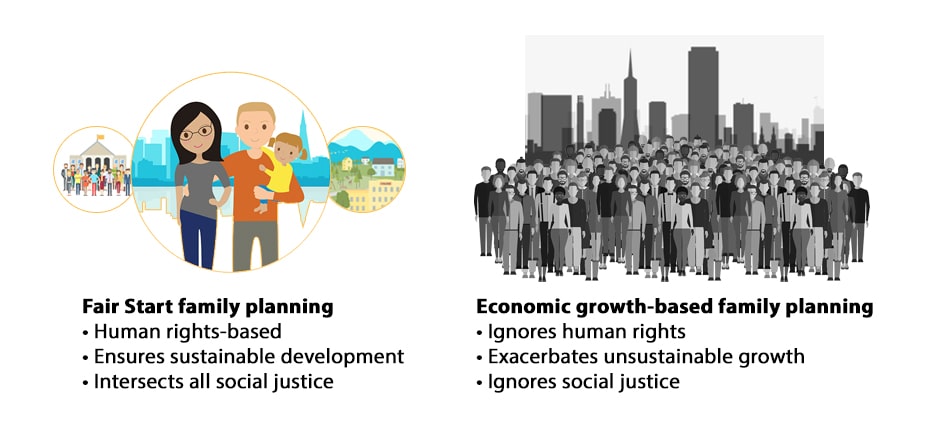
    It comes down to a simple question: do we want policies that improve child welfare, or ones that perpetuate inequality and push kids into substandard circumstances?

    Illustration compares fair start family planning, showing a diverse family and children, with economic growth-based planning, showing a large, crowded, grayscale group in a city. Lists pros of fair start and cons of growth-based planning.

    The Economy Argument is Wrong

    The media loves to post articles by economists panicking over lower fertility rates. Politicians on both sides of the aisle buy into the message as well, having their views shaped by corporate interests. Just look at Marco Rubio who has directly urged Americans to “have kids because it’s good for the economy”. It’s not limited to the U.S. though. Hungary’s President has proposed paying women to have more kids. The basis of the argument is that more consumers and a larger, cheaper labor force are good for business. (See our previous post on the cash-for-babies scheme.) But the “good for the economy” argument is wrong. Higher GDP doesn’t translate into shared wealth for all. A high GDP means that a very wealthy few are made even more wealthy. But it ignores the well-being of everyone else – including kids, and masks the impact that inequality has on democracy. In other words, a “good economy” doesn’t that we’re doing well as a nation. The graphic below illustrates just how lopsided wealth is in the U.S.

    A line graph titled Distribution of Family Wealth (2016) shows family wealth across percentiles, with most values low or negative until rising sharply after the 90th percentile, peaking at over $10 million at the 99th percentile.

    A Better Way

    Do we really want to treat children as cogs in the economy? Let’s start instead by building true human rights-based democracies out of the people that will actually comprise them. Let’s shape policies to improve the conditions in which children are born, and ensure a fair start in life to help them become more successful, thoughtful, engaged citizens. Fair Start family planning makes that possible.

    TAKE ACTION:
    Will Ali accept our invitation on this debate Fair Start versus economic fueled family planning? Send him a Tweet @WajahatAli and ask him.


  • Kids as Parents? Tell Massachusetts To Stop Child Marriage

    Kids as Parents? Tell Massachusetts To Stop Child Marriage

    Kids shouldn’t be parents. And that’s just one of many reasons to eliminate child marriage.

    It’s usually something we associate with far away, theologically governed countries, but child marriage is a problem in the U.S. – and it’s perfectly legal. At least nearly a quarter million minors under the age of 18 were married in the United States between 2000 and 2015, according to Unchained At Last. Some were as young as 10 years old. 

    How many U.S. states allow marriage under 18? All 50 of them and the District of Columbia. 25 states have no minimum age whatsoever.

    “A 2-year-old technically could marry. A middle school child is allowed to marry [here in Pennsylvania],” Fraidy Reiss, Founder of Unchained At Last explained in an interview last month. Some have called child marriage a loophole for pedophiles. Outside of marriage, sex with a minor is considered rape. But if the perpetrator marries the victim, suddenly it’s legal. The child has been sentenced to a life of exploitation.

    Massachusetts and many other states are now grappling with minimum age requirements for marriage. Conservatives are standing by century-old laws under the guise of protecting religious and cultural traditions.

    But marriage before age 18 has been called a human rights abuse by our own U.S. State Department. And for good reason. On top of stripping autonomy from minors and allowing them to be sexually abused, there are a number of statistics that show that underage marriage isn’t what politicians romanticize it to be:

    A partially obscured couple sits close together, overlaid with bold white text listing statistics about negative relationship outcomes, including divorce, abuse, health risks, and poverty.
    From Full Frontal With Samantha Bee, June 14, 2017

    And while family planning programs and services aim to help young people delay parenthood, what about those who have parenthood forced upon them though underage marriage? As you might imagine, kids make terrible parents.

    The problem with the debate is that our system of human rights and democracy has already settled it. Children should be free to be children. They have rights to bodily and other forms of autonomy and development, with which marriage interferes. They have those rights for their own benefit, and because functional democracies require a level of good parenting that kids cannot provide. Parents who wait until they are ready, have kids with far more successful outcomes.

    Kids are the future. Do you really want them raised by other kids?

    Take action: Contact Massachusetts Speaker of the House Robert A. DeLeo and explain why child marriage is a bad idea for our future.

  • The Royals Embrace Smaller Families. Will the United Nations Do the Same?

    The Royals Embrace Smaller Families. Will the United Nations Do the Same?

    Congratulations to royal family members Harry and Meghan for publicly embracing the idea smaller families, and opening up about the the ecological and social impact of family planning.

    In 2017 Having Kids publicly urged Prince William and Kate Middleton to embrace a more sustainable family planning ethic.

    Shortly after, we wrote to Meghan and Harry as well. Is it time to abandon the idea that the number of children a person has, and the conditions in which she/he has them, is “nobody’s business?” We think it is.

    THE FACTS ARE CLEAR:

    Kudos to Meghan and Harry. Now we need to begin to factor in equity, and cooperatively plan to give all kids a fair start in life.

    Take Action: Urge the United Nations to follow suit and embrace a better family planning model.

  • Fair Start Report: Why wait until children are harmed before we act?

    Fair Start Report: Why wait until children are harmed before we act?

    Having Kids unveiled the Fair Start Order campaign in late 2017 and began petitioning state agencies to consider Fair Start Orders and legislation in 2018. We monitor the news for child abuse coverage and strategically select particularly egregious cases to target for Fair Start Orders. So far, we have campaigned for five states to adopt Fair Start Orders, offering our professional in-depth assistance.

    Our new report: Time to Get Serious About Preventing Child Abuse? lays out why we chose those states and what’s happened there since we offered our help. The report also considers the future of the Fair Start Order campaign and how we can best help protect children from child abuse.

    Don’t we have a duty to ensure that children are not subjected to abuse by known offenders? Having Kids advocates for Fair Start judicial orders in cases of criminal abuse and neglect. Fair Start orders prevent abusers from having, and thereby harming, additional children as a condition of probation. These child-centered judicial orders are noncoercive, progressive, constitutional and reflect all five aspects of the Fair Start model. Child abuse presents an ideal context in which to begin the remodeling of our family planning systems. Fair Start orders do more than prevent child abuse. They allow parents to focus on rehabilitation so that they can be ready and capable of providing kids with a safe and supportive environment.

    Take Action Today

    You can help us prevent child abuse on a national level by contacting senate committee members and telling them that you support Having Kids’ proposal for a Fair Start amendment to the Child Abuse and Prevention Treatment Act.

    Email Ranking Member senator Patty Murray

  • Is Growing Up Poor OK?

    Is Growing Up Poor OK?

    Recently a reader left this comment on our Facebook post about Hilaria Baldwin.

    A Facebook comment discusses objections to the idea that only middle-class people should have children, sharing a personal story about a happy childhood in a low-income family and criticizing family planning as resembling eugenics.

    We would like to respond. Firstly, let’s not sugarcoat poverty.  

    41% of U.S. kids are born in or near poverty. Yes, children can be loved and have happy memories. But don’t children also deserve a minimum standard of well-being? Is it ok that children live with hunger, poor health, unsafe neighborhoods, less attention from parents who have to work multiple low wage jobs, and numerous other harms? 

    An infographic titled How Inequality Hurts Kids lists consequences of inequality: physical trauma (abuse, housing insecurity, unsafe neighborhoods), health issues (malnutrition, obesity, lack of care), and brain development impacts.

    health inequality

    Being born poor also means that children do not develop at the same level as their non-poor peers. An unlevel playing field sets them up for a lifetime of struggling, from performance in school to low wage work as adults. Don’t kids deserve better? Shouldn’t they get a fair start?

    e

    A child wearing worn sneakers sits on a wooden surface. Overlaid text reads: Economic Inequality. Children who grow up poor are more likely to be poor as adults. The likelihood increases with each year of poverty. – PBS Frontline.

    Why not help parents delay parenthood until they’re ready so that they can pursue higher education and financial stability? When parents delay parenthood, they give their kids a better chance for better outcomes in health, emotional development, and academic achievement. Decades of research indicates this. 

    But readiness is not only about income. Parents that have abused children in the past and are likely to again are not ready to have more. Wealthy would-be parents may not be ready if they are not prepared to give their kids the time, love, attention, or emotional and familial stability that they need. To the extent that income correlates with political influence, that factors into giving a kids a Fair Start in developing democracies.

    Family planning is the most effective way to reduce poverty and inequality. Early interventions are up to 13 times more effective than after the fact, reactive approaches. Parents who choose to have smaller families – only one or two kids, are able to invest more time and resources in each child, setting them up for great success throughout their lifetimes.

    Imagine a family planning model that considers what future children want instead of only looking at the perspective of would-be parents. When we do that, the premise of the comment totally changes. Children have a right to a fair start in life, and thus have a right to resources to get that fair start. Communities and governments have a duty to provide that through efforts like Guaranteed Minimum Income tied to family planning. Parents can help give them a fair start by delaying parenthood and having smaller families.

    Children and parents do better when parents wait, and have smaller families. It is a win-win. Family planning investments and frameworks like the Fair Start Model make this possible. 

    With regards to the eugenics assertion, eugenics are what we get without the Fair Start model. Like the development of genetically-edited babies in China and now Russia. Unlike the current isolation model of family planning which allows this, the Fair Start model prevents both eugenic and euphenic manipulation because it ensures parents the right to have kids.

    Still have questions? Read our deep dive into the Fair Start family planning model, then ask us!

  • Urge Grist to Talk About Sustainable Family Planning

    Urge Grist to Talk About Sustainable Family Planning

    [et_pb_section fb_built=”1″ admin_label=”section” _builder_version=”3.22″][et_pb_row admin_label=”row” _builder_version=”3.25″ background_size=”initial” background_position=”top_left” background_repeat=”repeat”][et_pb_column type=”4_4″ _builder_version=”3.25″ custom_padding=”|||” custom_padding__hover=”|||”][et_pb_text admin_label=”Text” _builder_version=”4.7.7″ background_size=”initial” background_position=”top_left” background_repeat=”repeat” hover_enabled=”0″ sticky_enabled=”0″]

    It’s great that Grist, the environmentally minded media outlet, is recognizing that media isn’t doing their jobs when they spend a lot more time covering news of the royal baby than climate change. But is it time for Grist to aggressively report on better family planning policies as the most comprehensive and effective way to mitigate the variety of harms climate change is causing?  

    Environmentalists have long treated family planning as a taboo subject. It’s glaringly absent from the Green New Deal. But it’s time to break taboo. The businesses that are destroying our environment are breaking it, and urging parents to produce more babies to increase consumption, and to increase a glut of cheap labor and taxpayers for the future. 

    We know how to fix this.

    A better family planning model and policies – with a focus on smaller and more equitable families – are likely the most effective solution to most of the world’s crises today. Remodeling family planning is the most comprehensive and effective way to promote the UN’s Sustainable Development Goals, and in some cases proves twenty times more effective than other reforms. Simply stated, the current family planning model used by the United Nations is the fundamental source of the problem. It ensures unsustainable population growth in a way that degrades equality, democracy, and our environment.

    This archaic model predates our understanding of climate change, the impact of early childhood development, the way birth conditions and early childhood can exacerbate inequality, etc. Many better models have been proposed, including one by leading political theorist Sarah Conly, and Having Kids’ own model, the Fair Start approach (detailed here).

    Take action:

    Contact Grist CEO here and urge him to help Grist to break the taboo and aggressively report on better family planning policies. It’s the most comprehensive and effective way to mitigate the harms of climate change. 

    [/et_pb_text][/et_pb_column][/et_pb_row][/et_pb_section]

  • Guest Blog: San Francisco Public Health Professional Addresses Family Planning

    Guest Blog: San Francisco Public Health Professional Addresses Family Planning

    Recently a public health professional in California contacted Having Kids to discuss the impact of family planning on the lives of children. This is what they had to say.

    As a public health professional working for the City and County of San Francisco, I am passionate about improving outcomes for at-risk youth and families. Over the years, I have contributed to the evidence-base on what works in mental health and behavioral health care. My greatest interest lies in prevention work, intervening early enough in life to ensure that children get the love and support they need to thrive and become healthy adults. It’s a passion that pervades my personal life, as I plan to foster and adopt my first child – a decision I’ve made for ethical reasons and one that reflects caring for those in need rather than creating new need.

    Child welfare is an issue that has risen to near-crisis level in San Francisco. The hasty decision to close our Juvenile Hall is evidence of a broken system whereby community organizations, child welfare and juvenile justice fail to effectively work together on developing long-term solutions, in one of the wealthiest cities in the world. The affordable housing crisis is driving many in the next generation into the streets.   

    Families are one of the strongest socializing forces in our lives

    Unfortunately, many children come from homes with considerable conflict, putting them at high risk for negative health outcomes. In San Francisco, children and families that come into regular contact with human service agencies, like Child Welfare, Juvenile Probation, and Behavioral Health generally have low socioeconomic status and experience chronic stress related to this. It is common to see children, and their siblings, with mental diagnoses such as oppositional defiant disorder, major depression, and PTSD. 

    A substantiated allegation of abuse or neglect can result in a child being removed from their home, however, this is often too late as trauma can permanently impact developing minds. Also, removal from the home brings additional challenges. Children removed from the home may already have attachment issues due to a lack of a stable family environment and they are now being asked to trust multiple providers (case workers, doctors, foster parents, probation officers, etc.). Given the lack of consistent relationships in their lives, they do not know who they trust, and lose a sense of identity and place, putting them in a very vulnerable position for exploitation. In fact, 60% of all sex trafficking victims have a history of involvement with the child welfare system.  Oakland is considered a national hub for child-sex trafficking.

    Similarly, juvenile justice-involved youth can be removed from the home. They tend to be older and more criminally sophisticated, and it is therefore challenging to find foster/resource families. Instead, youth are placed in group home facilities, or, depending on the nature of the crime, a more secure facility. In California, the cost to maintain a youth in a group home facility is approximately $10-12K per month with negative outcomes such as running away, early mortality, being in and out of the prison system in adulthood, mental health and behavioral health issues, and chronic homelessness. Teens and youth with multiple placements present a significant barrier to reunification.

    All of this creates a pipeline for human trafficking, and horrific cases of domestic violence. I’ve seen the moms and kids stuck in this world with my own eyes. And I know the problem began long ago, in families where the children were being set up for failure. The opioid crisis has only amplified to levels that are breaking public health and child welfare systems around the country.  

    A big challenge is how can we intervene early enough to impact children’s lives so that they can thrive and become healthy, contributing members of society? A major challenge is keeping up with the pace of this public health crisis whereby so many children and their siblings are experiencing early neglect and trauma, essentially becoming pawns of the “cradle to prison” pipeline.

    Family planning is prevention work

    By changing the way we plan families, we take prevention work to another level, finding ways to encourage all parents to have smaller, more equitable and better-planned families, thereby reducing the scale of this crisis and re-purposing resources to focus on evidence-based services that improve long-term outcomes. Programs such as the Perry Preschool Program which focuses on the developmental growth of at-risk children and resulted in a 7–10% per year return on investment based on increased school and career achievement, as well as reduced costs in remedial education, health, and criminal justice system expenditures.

    As a society, we need to create policies that uphold the rights of children. Smarter family planning leads to better outcomes. Period. It is time to take a long-range prevention approach and embrace better family planning models like Fair Start.

  • Wajahat Ali and What it Means to Invest in Children

    Wajahat Ali and What it Means to Invest in Children

    Everyone at Having Kids was happy to see Wajahat Ali’s TED Talk “The case for having kids.” The presentation breaks the taboo that surrounds talking about the need for better family planning policies and closes with a plea to invest in current and future generations. It is clear to us that Mr. Ali loves children and wants the best for them. We do, too, so we reached out to urge him to build upon his important work and consider the details of what it means to truly invest in children.

    Read our letter to Mr. Ali about investing in future generations.

    Urging people to simply “have babies” plays into the pyramid Ponzi scheme mentality of using future generations as tools for economic growth. Mr. Ali’s talk, however well intentioned, could do more harm than good. Only truly human rights-based family planning policies will set our children free from a system based on greed. Poor family planning is the norm, and it causes real harm every day. Children are born into starvation and horrific abuse, the gap between rich and poor is widening, and climate change is only beginning to wreak havok.

    Our Fair Start family planning model is designed to invest in future generations. We can shift the world’s thinking from isolationist family planning focused on what parents want, toward an approach that helps everyone. We need a more comprehensive and cooperative focus that considers what children and the community need. The Fair Start model creates a system that maximizes child welfare, equity, and sustainability.

    We are asking Mr. Ali to use his status as an influential public figure to keep breaking taboos around discussing family planning. We are also urging him to be clear that helping future generations doesn’t mean just “having babies.” It means planning a Fair Start.

    Sincerely,

    Erika and Willow, and Carter

    The Phelps-Mathews Family
    The Phelps-Mathews Family

    Join Erika and Willow by tweeting @WajahatAli and politely asking him to consider the Fair Start model.