Author: Fair Start Movement

  • Global families, not large families

    Global families, not large families

    The concept of child sponsorship is nothing new. We’ve all seen ads about helping a child for some small amount of money per month. But still, childhood poverty persists, and inequality in America is actually getting worse. 

    Recently we saw one such ad from the christian charity organization World Vision whose “Chosen” initiative flips the script by having children choose their sponsor.

    What if a system like this could be the first choice for parents looking to grow their families? What if instead of having a third, fourth, or fifth biological child, parents chose to keep their families small and direct the resources a new child would need to a child in the world today who chooses sponsorship?

    A plan like this would this lead to declines in the devastating impacts of childhood inequality. Plus, smaller families are the most effective way to mitigate the global threat of climate change, so the whole world would benefit. 

    TAKE ACTION: Ask the United Nations to lead by example and recommend smaller families. 

  • Elon Musk: Care About Population? Start Helping People.

    Elon Musk: Care About Population? Start Helping People.

    Two billionaires got a lot of press recently by saying that underpopulation threatens humanity. It’s not the first time Elon Musk has suggested women are not having enough babies. It’s nonsense to say that depopulation poses any threat to our species – look at the numbers. Falling fertility rates are a good thing, and are part of the transition to a more sustainable world population – a process the world intentionally started in the Twentieth Century.

    So why do Musk and others worry about lower fertility rates? 

    So this is the bottom line: The question is not whether we should push women to have more kids so that people like Musk can exploit them. The question is whether we will take back the wealth and resources these people are unjustly holding, and use those resources to give kids a fair start in life.

    TAKE ACTION: Tweet Musk, @elonmusk, and urge him to change positions on family planning, and embrace values like nature, fairness, and democracy over wealth and power.

  • Urge Surfrider Foundation to Address Family Planning

    Urge Surfrider Foundation to Address Family Planning

    Climate change and other population-driven crises are the greatest threats to our oceans. Better family planning policies are the greatest solution.

    So why is it still taboo to talk about? Why do so many concerned parents have to remain anonymous in order to speak out?

    Urge the Surfrider Foundation to lead the way to transparency and sustainability by talking a stand on the need for better family planning policies. Tweet @surfrider and urge them to consider the letter below.

    A letter to Dr. Chad Nelsen at the Surfrider Foundation shares a story about the authors son learning to surf, alongside two child drawings: one of a surfer riding a wave, and another of a turtle swimming underwater. A young student stands next to a science project display about algal blooms, pointing to information and images on a poster board in a classroom setting. A letter addressed to a leader, urging action on climate change by promoting smaller families to reduce impact on oceans. It is signed by Anonymous mother in California at the bottom.

  • Prioritizing the Male Pill

    Prioritizing the Male Pill

    Today Having Kids announced a campaign to prioritize the male pill. It’s time to expedite the approval and mass marketing of the male pill and other long-acting reversible male contraceptives. Why is there no male pill on the market today? 

    It seems regulators forgot to consider the environmental impacts of blocking approval. According to extensive research by Having Kids, there is no evidence that federal regulators ever considered impacts of their inaction on world ecosystems, or the way that failure exacerbates climate change, and a host of other man-made environmental crises, like ocean acidification and mass extinction. Instead, regulators stopped prior approval protocols for reasons that have a lot to do with gender bias, and at the same time federal policy was openly encouraging  population growth and limiting access contraception and abortions, as a cheap way to grow the economy. That policy has only gotten worse. 

    “Our federal government ignored the environmental impact of its decision to approve things like Viagra, but not the male pill,” according to Erika Mathews, Executive Director of Having Kids. “It did so while employing sexist rationales about unacceptable side effects women experience all the time, and in the face of other policies that push women to produce cheap labor and voracious consumers to inflate the economy.”

    Having Kids’ campaign will lobby Congress and regulators for a massive increase in funding and prioritization of approval as a matter of national security, given the impact approval would have on the social and ecological environment. 

    According to Erika, “If our government had done the assessment correctly we would have had the male pill and other forms of male contraceptives years ago. Instead they made the situation worse.” Let’s start prioritizing the male pill.

  • The Need for Evolved Family Planning

    The Need for Evolved Family Planning

    Humans are still evolving. But our family planning models are stuck in the past, and do not factor in things like the impact on our ecology, sustainability, inequality, or human rights and democracy. The models were designed decades ago by men who thought domination of the natural world, and of vulnerable entities, was the destiny of our species. They were wrong, and we are all paying the ecological and social costs of their mistakes today. We can do better.

    What is Fair Start family planning? 

    Communities ensure that parents have the resources to plan families and guarantee that all kids have the resources they need for a fair start in life.

    Each of us delays having kids until we are ready to be good parents, and have small and sustainable families that put less demand on our shared resources and our world.

    It’s simple: Fair Start family planning means smaller families sharing resources to invest more in every child. For some, the closest analog for this new model would be responsible family planning incentives. But Fair Start resources are actually entitlements held by future children, and funded through non-traditional means. Those opposed to remodeling favor our current system of unearned privileges, and undemocratic influence, over giving kids a fair start in life.

    What the Fair Start Model Does

    The Fair Start model addresses the biggest problems affecting kids such as poverty, inequality, and neglect. The model breaks down the barrier between family planning and child welfare, aligning need with resource. The model links 1) where and when children enter the world, with 2) the provision of what those kids need for a fair start in life. In making that link the model has the greatest impact on child welfare, equality, animals and the environment – exponentially more impact than downstream approaches. In so doing the model corrects for cognitive dissonances that prevent us from seeing that how we plan families, more than any other one thing, determines the quality of life on Earth. By focusing our attention on future children the model temporalizes our thinking, allows us to plan ahead, requires us to cooperate, and thereby helps ensure the best outcomes. What’s a good analogy? In many ways our remodeling of family planning looks like the revision of the norms, in the late 20th Century, around using seat belts. Small improvements can lead to massive benefits.


    Fair Start family planning is the most effective way to simultaneously:

    protect children, promote equality and democracy, and preserve

    a healthy planet.

    The proven impacts are 10 to 20 times higher than traditional downstream attempts to protect kids, animals, and the environment.

    Building Freedom Through Human Rights-Based Family Planning 

    The model shifts the focus of family planning from a narrow focus on just the parents to a broader one that includes the interests of the future child, the parents, and the community. This embodies the inclusivity of human rights and democracy. The model moves us away from a sense of parenting as an isolated activity to a proactive and cooperative system that expands our capacity for care-giving beyond our own bloodline. The model is all about making family planning a community effort that is deliberately inclusive – deliberately including future children into the community, oriented around the shared ideal of equality. Families having kids in isolation from the community ensures that inequality, as well as social and ecological degradation, continues. That way of planning our families has undone much of the progress the child welfare, environmental/animal, and human rights and democracy movements tried to make in the past few decades – just look at the numbers.

    But by working together as parents and communities, we can build resilient, cooperative, and conscientious populations, that are approaching the United Nations low variant projections, and that can thrive in challenging future environments. That’s the Fair Start model. Fundamental change means changing who we are, and will be, through better family planning. Nothing else comes close. 

    Because of its fundamental nature the Fair Start model creates true freedom: The freedom that comes with being given real opportunities in life, the freedom of living in functional communities where you can have confidence in the people around you, the freedom of smaller and autonomous democracies where you have a role in creating the rules under which you live, the freedom of nature, and the safe and healthy environment that comes with it. This all begins with children’s right to a fair start in life. It is the lexically primary human right, the right that most makes us who we are, and it overrides all conflicting interests. Fair Start family planning moves the world from demographic and economic transition to a human rights-based, qualitative, equitable and democratic transition.

    The relatively few people in the world who have power, both in business and government, push against this freedom because their power lies in exploiting the large and vulnerable populations poor family planning creates. If you value child welfare, equality, nature, or democracy – and the freedom they represent – you will push back.

    Its time to truly empower people – right from the start. Read here for more detail.

  • “Have kids because it’s good for the economy.”

    “Have kids because it’s good for the economy.”

    Last month we wrote to Wajahat Ali, urging him to abandon the old “just have babies” position on policy and instead promote smaller families with greater investment in every child. Today, Jessica Blome, a mother from Oregon and a model for Fair Start family planning, is asking Ali to engage in a debate.

    It comes down to a simple question: do we want policies that improve child welfare, or ones that perpetuate inequality and push kids into substandard circumstances?

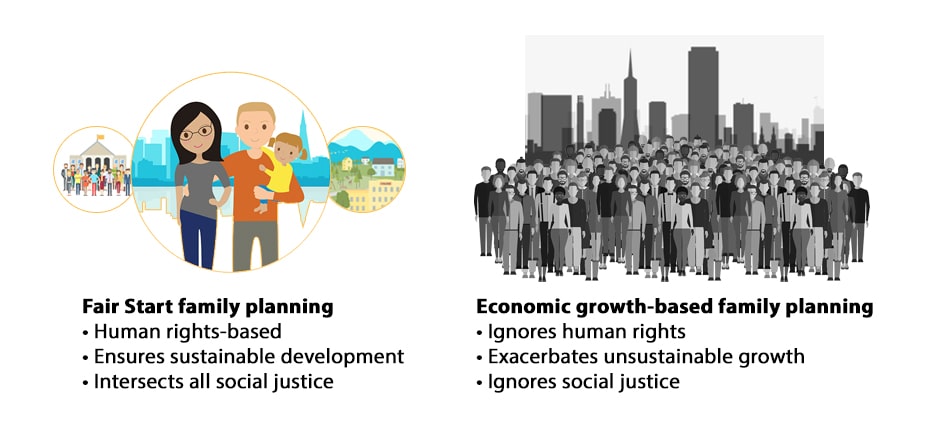
    Illustration compares fair start family planning, showing a diverse family and children, with economic growth-based planning, showing a large, crowded, grayscale group in a city. Lists pros of fair start and cons of growth-based planning.

    The Economy Argument is Wrong

    The media loves to post articles by economists panicking over lower fertility rates. Politicians on both sides of the aisle buy into the message as well, having their views shaped by corporate interests. Just look at Marco Rubio who has directly urged Americans to “have kids because it’s good for the economy”. It’s not limited to the U.S. though. Hungary’s President has proposed paying women to have more kids. The basis of the argument is that more consumers and a larger, cheaper labor force are good for business. (See our previous post on the cash-for-babies scheme.) But the “good for the economy” argument is wrong. Higher GDP doesn’t translate into shared wealth for all. A high GDP means that a very wealthy few are made even more wealthy. But it ignores the well-being of everyone else – including kids, and masks the impact that inequality has on democracy. In other words, a “good economy” doesn’t that we’re doing well as a nation. The graphic below illustrates just how lopsided wealth is in the U.S.

    A line graph titled Distribution of Family Wealth (2016) shows family wealth across percentiles, with most values low or negative until rising sharply after the 90th percentile, peaking at over  million at the 99th percentile.

    A Better Way

    Do we really want to treat children as cogs in the economy? Let’s start instead by building true human rights-based democracies out of the people that will actually comprise them. Let’s shape policies to improve the conditions in which children are born, and ensure a fair start in life to help them become more successful, thoughtful, engaged citizens. Fair Start family planning makes that possible.

    TAKE ACTION:
    Will Ali accept our invitation on this debate Fair Start versus economic fueled family planning? Send him a Tweet @WajahatAli and ask him.


  • Kids as Parents? Tell Massachusetts To Stop Child Marriage

    Kids as Parents? Tell Massachusetts To Stop Child Marriage

    Kids shouldn’t be parents. And that’s just one of many reasons to eliminate child marriage.

    It’s usually something we associate with far away, theologically governed countries, but child marriage is a problem in the U.S. – and it’s perfectly legal. At least nearly a quarter million minors under the age of 18 were married in the United States between 2000 and 2015, according to Unchained At Last. Some were as young as 10 years old. 

    How many U.S. states allow marriage under 18? All 50 of them and the District of Columbia. 25 states have no minimum age whatsoever.

    “A 2-year-old technically could marry. A middle school child is allowed to marry [here in Pennsylvania],” Fraidy Reiss, Founder of Unchained At Last explained in an interview last month. Some have called child marriage a loophole for pedophiles. Outside of marriage, sex with a minor is considered rape. But if the perpetrator marries the victim, suddenly it’s legal. The child has been sentenced to a life of exploitation.

    Massachusetts and many other states are now grappling with minimum age requirements for marriage. Conservatives are standing by century-old laws under the guise of protecting religious and cultural traditions.

    But marriage before age 18 has been called a human rights abuse by our own U.S. State Department. And for good reason. On top of stripping autonomy from minors and allowing them to be sexually abused, there are a number of statistics that show that underage marriage isn’t what politicians romanticize it to be:

    A partially obscured couple sits close together, overlaid with bold white text listing statistics about negative relationship outcomes, including divorce, abuse, health risks, and poverty.
    From Full Frontal With Samantha Bee, June 14, 2017

    And while family planning programs and services aim to help young people delay parenthood, what about those who have parenthood forced upon them though underage marriage? As you might imagine, kids make terrible parents.

    The problem with the debate is that our system of human rights and democracy has already settled it. Children should be free to be children. They have rights to bodily and other forms of autonomy and development, with which marriage interferes. They have those rights for their own benefit, and because functional democracies require a level of good parenting that kids cannot provide. Parents who wait until they are ready, have kids with far more successful outcomes.

    Kids are the future. Do you really want them raised by other kids?

    Take action: Contact Massachusetts Speaker of the House Robert A. DeLeo and explain why child marriage is a bad idea for our future.

  • The Royals Embrace Smaller Families. Will the United Nations Do the Same?

    The Royals Embrace Smaller Families. Will the United Nations Do the Same?

    Congratulations to royal family members Harry and Meghan for publicly embracing the idea smaller families, and opening up about the the ecological and social impact of family planning.

    In 2017 Having Kids publicly urged Prince William and Kate Middleton to embrace a more sustainable family planning ethic.

    Shortly after, we wrote to Meghan and Harry as well. Is it time to abandon the idea that the number of children a person has, and the conditions in which she/he has them, is “nobody’s business?” We think it is.

    THE FACTS ARE CLEAR:

    Kudos to Meghan and Harry. Now we need to begin to factor in equity, and cooperatively plan to give all kids a fair start in life.

    Take Action: Urge the United Nations to follow suit and embrace a better family planning model.

  • Fair Start Report: Why wait until children are harmed before we act?

    Fair Start Report: Why wait until children are harmed before we act?

    Having Kids unveiled the Fair Start Order campaign in late 2017 and began petitioning state agencies to consider Fair Start Orders and legislation in 2018. We monitor the news for child abuse coverage and strategically select particularly egregious cases to target for Fair Start Orders. So far, we have campaigned for five states to adopt Fair Start Orders, offering our professional in-depth assistance.

    Our new report: Time to Get Serious About Preventing Child Abuse? lays out why we chose those states and what’s happened there since we offered our help. The report also considers the future of the Fair Start Order campaign and how we can best help protect children from child abuse.

    Don’t we have a duty to ensure that children are not subjected to abuse by known offenders? Having Kids advocates for Fair Start judicial orders in cases of criminal abuse and neglect. Fair Start orders prevent abusers from having, and thereby harming, additional children as a condition of probation. These child-centered judicial orders are noncoercive, progressive, constitutional and reflect all five aspects of the Fair Start model. Child abuse presents an ideal context in which to begin the remodeling of our family planning systems. Fair Start orders do more than prevent child abuse. They allow parents to focus on rehabilitation so that they can be ready and capable of providing kids with a safe and supportive environment.

    Take Action Today

    You can help us prevent child abuse on a national level by contacting senate committee members and telling them that you support Having Kids’ proposal for a Fair Start amendment to the Child Abuse and Prevention Treatment Act.

    Email Ranking Member senator Patty Murray