Tag: Educational Guides & Resources

  • How to Give All Children in Washington, D.C. a Fair and Equal Start

    How to Give All Children in Washington, D.C. a Fair and Equal Start

    What Inequality Looks Like in Washington, D.C.

    Inequality is inherited. It affects kids for life. Unequal opportunities translate into unequal lifelong outcomes by the time children reach age 5.

    And the impacts of inequality are more damaging the longer it is experienced. The longer a child is poor, the greater the risk of poverty in adulthood and of experiencing lifelong health problems and involvement in the criminal justice system.

    Inequality, therefore, is a welfare issue. Studies have documented examples of rising inequality decreasing child welfare. Affluence plays a role, too. The growing divide between low-income children and their peers reduces opportunities for low-income children throughout their lives.

    Poor kids become poor adults, and rich kids become rich adults, with the latter inheriting both obvious and subtle benefits they never “earned.” Racial and ethnic disparities that have persisted are a consequence of that. Inequality disproportionately affects children of color in the United States.

    There is perhaps no city in the U.S. where inequality between rich and poor, and between black and white, is more evident than in the District of Columbia. 

    Washington, D.C., has a higher level of income inequality than any state in the country, with households in the top 20% of income having 29 times more income than the bottom 20%. The bottom fifth of Washington, D.C., households earned just 2% of total D.C. income in 2016, while the top fifth had a staggering 56%.

    White families in D.C. are 81 times richer than black families on average. Moreover, the effects of economic inequality persist throughout lifetimes and across generations, with the District of Columbia having among the lowest economic mobility in the nation. 

    With the cost of living in D.C. being 450% of the federal poverty line, the city is becoming a harder place for poorer people and families to live. Add to this growing inequality and the fact that D.C. residents don’t have voting congressional representation (i.e., they’re faced with taxation without representation), and you have a largely disenfranchised, largely black population.

    In addition, Congress restricts D.C.’s ability to raise revenue. The federal government pays no taxes on the land it uses or exempts in D.C., exempts itself from payment in lieu of taxes, and imposes added requirements on public services, such as the police force. Congress exempts those who work in Washington, D.C., but live just miles away in the states of Virginia and Maryland from contributing even 5% or less of their state taxes to the district.

    How to Create Intergenerational Equality in D.C.

    So how can we create intergenerational equality in the district?

    One surefire way is a guaranteed minimum income for children.

    Social welfare policy has been around since the passage of the English Poor Law in 1601. Social programs for child well-being became official United States government policy in 1935 with the passage of the Aid to Families with Dependent Children as part of the Social Security Act of 1935.

    Currently, guaranteed minimum income schemes are being implemented in nearly all European countries (except Italy, Greece, and Turkey) in order to eliminate and overcome the problems associated with poverty.

    The D.C. Council considered a guaranteed minimum income for its residents in 2018, recognizing the importance of combating such gross inequality. The Council commissioned a report by District’s Office of the Budget Director on the potential for such a program, and the report concluded that a guaranteed minimum income “could provide the District with a new, comprehensive tool to alleviate poverty in the city” and, in turn, improve child well-being, family stability, and health outcomes among the district’s residents.

    However, the report cited concerns that a guaranteed minimum income for Washington, D.C., residents would hurt D.C.’s total GDP and employment and would reduce its federal funding for social welfare programs. The report ultimately recommended refining the proposal before proceeding with any legislation.

    (It should be noted that the report arbitrarily limits its consideration of the economic benefits of guaranteed minimum income to increased personal spending. A more comprehensive and accurate accounting would include the savings that result from the improved health and safety of the districts’ residents, such as reduced public expenditure on medical and crime-prevention services.) 

    The Fair Start Guaranteed Minimum Income Solution

    In light of this stark disparity between rich and poor and black and white, between federal officials and D.C. residents, Having Kids believes there should be a Fair Start guaranteed minimum income program for Washington, D.C., children, funded through taxation of a specific group of residents of D.C.: The 100 wealthiest federal legislators and all D.C.-based lobbyists registered under the Lobbying Disclosure Act of 1995. 

    As Cory Booker said in an interview about his guaranteed minimum income legislation, the American Opportunity Accounts Act (also known as “baby bonds”), in the U.S. Senate in 2019, “It would be a dramatic change in our country to have low-income people break out of generational poverty.” The bill aims to level the playing the field by giving all American children the opportunity to generate wealth.

    This Having Kids Fair Start Guaranteed Minimum Income proposal shrinks the wealth gap by specifically contemplating (1) household resources per capita, (2) level of access to public services such as health, education, transportation, and (3) above all, the relationship between children’s fair starts in life and their abilities to become successful, productive future citizens and taxpayers. 

    As D.C. license plates say, “No Taxation Without Representation.” D.C. supplements the federal government’s activities; these transient and wealthy D.C. residents should return the favor. 

    Constituting and Statehood

    The United States Constitution was born of a revolution rooted in the belief that a group of people could constitute independent — free and equal — peoples. But for many reasons, the Constitution was never applied intergenerationally, and it was never applied to the District.

    The United States, therefore, has a capital city where the citizens have no voting voice in the nation’s legislature in a world where human rights and democracy are in decline.

    Like the U.N. did with the Global South, Congress should begin work to decolonize the District of Columbia. It should give D.C. residents statehood and finally allow its (mostly black) citizens a voice in a working democracy. As Eleanor Holmes Norton, D.C.’s lone nonvoting “representative” in the House of Representatives, said about the 2020 Washington, DC, Admissions Act, “Congress has two choices: It can continue to exercise undemocratic authority over the 700,000 American citizens who live in the nation’s capital, treating them, in the words of Frederick Douglass, as ‘aliens, not citizens, but subjects,’ or it can live up to the nation’s promise and ideals, end taxation without representation.”

    — Alexandra Stupple

  • New Podcast: Scam of the Century, or How the Wealth Bubble Was Taken From Women and Children

    New Podcast: Scam of the Century, or How the Wealth Bubble Was Taken From Women and Children

    How did we end up in a world with massive wealth in the hands of a few and ecosystems crashing as our climates degrade? The answer is surprising. Rather than invest in early childhood development, at the crucial phase in the middle of the Twentieth Century, world leaders chose population growth and the creation of mass consumers, cheap labor and large bases of taxpayers.

    The Fair Fair Start Movement and Christine Dimmick’s Be the Change are pushing back. Listen to the podcast.

    And read the book.

    A podcast webpage displays an episode titled Smaller Families for a Sustainable Future with a photo of a serious man overlaid by large text, #BE THE CHANGE. Episode details and media player are visible on the right.

    WHY FAIR START?

    Governments are failing children’s right to an eco social fair start in life. 

    We know that early childhood experience is pivotal to lifetime outcomes. Why are we waiting for adverse childhood experiences to occur before acting? 

    Children deserve equitable conditions, right from the beginning. A fair start in life is the first human right – it overrides all others. It is what children are entitled to under the Children’s Rights Convention, and what allows them to eventually be free from the power of others, and truly self-determining.

    Because legitimate governance derives from people, who derive from the norms that create them, there are no such things as just societies, political legitimacy and freedom without the sort of Fair Start reforms discussed in this site. Without them we are always coming from an unjust place. 

    How do we change course? Many are joining this simple discourse, in which we recognize that all wealth is subject to future generations’ right to fairness, and that wealth transfers should act as an incentive and entitlement for better – and equitable – family planning. Ensuring an eco-social #fairstart in life for all kids can have ten to twenty times the long run impact on the key social and ecological crises we are facing today relative to other interventions.

    It is the most effective and just thing we can do. We may achieve it by extraordinary means, because there is no justice without it.

  • We Were Scammed Out of Freedom and Justice. Let’s Take Back What We Deserve.

    We Were Scammed Out of Freedom and Justice. Let’s Take Back What We Deserve.

    Moving wealth from the top of the economic pyramid to incentivize better family planning and sustainable families is the best way to do the most good

    The crises we face today, from the climate to massive economic inequality, did not magically appear. They are the product of a scam in the middle of the Twentieth Century, in which world leaders in government and business embraced poor family planning and population growth over promoting parental readiness, sustainable families, and investing more in kids. Instead that money, through a process of isolating families and encouraging growth, went to the top of the wealth pyramid. Those who acted stole resources that should have gone into future generations, by externalizing the costs that human rights and democracy would have required them to internalize. They didn’t even interpret the relevant rights in ways that would protect future generations equally.

    Several hands of different skin tones are stacked together. Overlaid text reads, The most powerful social justice is a fair start in life. Join the coalition. The Fair Start Movement logo appears at the bottom.
    When else would justice begin?

    Today many are fighting to change this, get the wealth back, and use it to most effectively reverse the crises we face. We can separate those people from the politicians, fake charities and others protecting the wealth bubble at the top – and hurting our kids – with a simple language test.

    For any policy claim being made, urge the person making it to account for the relative self-determination (or what we often think of as freedom) of the people who will be involved – long-term – in the policy. How do they account for how the people will be empowered by the conditions in which they are born, how they will be ensured equal opportunities in life without their economic birth position of riches or poverty carrying forward, how will they be assured influential voices in their democracy, and provided the freedom of nature. In other words, force them to explain how we can be coming from a just place without ensuring every child a #fairstart in life? (Hint: We can’t)

    It’s not about counting people, it’s about making people count. The borders of just and inclusive nations are not lines on a map; they are comprised of people who trust one another, and engage in consensual and inclusive governance.

    For example, if environmentalists claim to be protecting a river, force them to account for the way population growth will drive the climate crisis in ways that will degrade the river and increase demands for its use. Many environmental and animal protection groups raised millions to protect natural spaces that they knew would be destroyed by population growth, growth they were helping promote – furthering the Anthropocene. If child protection advocates claim to be investing more in kids with tax policy for example, as them why they permit children to be born into poverty in the first place, rather than incentivizing better – and even equitable – family planning. If groups claim to promoting democracy, ask them to account for how poor family planning and population growth is diluting our individual roles to the point of meaningless, and degrading the civil qualities of the people around us. But the first norm has to be to simply to create normative people, which can best be visualized as a functional constitutional convention of principles – free people – not representatives, and not with the expectation that the norms will require coercion or incentives because they are not truly reflective of the people involved.

    Our world is the way it is because we never held those claiming to promote values to actually account for the truth: People are the most important factor in all policy, and people don’t fall from the sky. If officials or groups do not prioritize giving all kids a #fairstart in life, they are part of the problem, not constituting us as free and equal people (and hence preconstitutional or “precons”) and protecting the bubble of wealth at the top of the pyramid in ways that will hurt our kids.

    We are at a fork. The choice is clear. Let’s take what our kids deserve and build truly consensual governance. Now, how?

    To constitute ourselves as free people means to limit and decentralize the power people have over one another, and we do that by promoting a simple discourse in which intending parents agree to planning caring, and sustainable families in exchange for their future children’s entitlement to #fairstart funding and incentives taken from the top of the wealth pyramid. That’s a true, or physical, social contract, which is inclusive of the majority of persons – those who will live in the future. It reflects the alleviation of power differentials, the sort rich have over poor, parents have over children, and we all have over our natural ecologies. That is what it means to be sufficiently other-regarding, or empathetic, to constitute ourselves as free people.

    We can take the wealth at the top of the wealth pyramid – as matter of the first human right, one that overrides government processes and property rights – and use it to bend the arc of the future to create greater welfare, equity, meaningful democracy, and nature. Or we can leave it at the top and have a future with greater inequity, less nature, and bloated democracies that don’ work. We can become free people, and defeat the precons. The wealth bubble at the top is big enough to bend the arc, and incentivize, the future we deserve. Let’s move that wealth forward.

    Take Action

    Moving wealth from the top of the economic pyramid to incentivize better family planning and equitable families is the best way to do the most good

    1. Help us build the discourse of constituting, and of freedom. If someone puts property over people, they are part of the problem. Contact us at ashley@fairstartmovement.org to learn more, and support the Unite America campaign by urging Congress to act.
    2. Urge the UN to interpret the relevant human rights, including the right to have children, to protect all generations equally.
    3. Support a federal executive order – the Tell the Truth order – that would require the disclosure of corporations and nonprofits role in the scam described above, so that we can hold people accountable.
    4. Promote constitutional amendments, in your state, that would ensure all children an ecosocial #fairstart in life as the first and overriding human right.
    Promotional image for the book Justice as a Fair Start in Life by Carter Dillard, featuring the book cover, a discount offer, and a summary of the author’s background and achievements.

  • How to See and Fix the Fundamental Mistake at the Heart of Our Climate, Inequality and Other Crises

    How to See and Fix the Fundamental Mistake at the Heart of Our Climate, Inequality and Other Crises

    There is a common mistake in all of our language and thinking that drives many of the crises we face today. Our brains have trouble perceiving how time and space interact, and this usually leads to bad long-term decision making. For example, we know promoting a universal norm of sustainable families is one of the best ways to mitigate the climate crisis, but most policies around the world today are pushing in the opposite direction, incentivizing women to have more children.

    The same can be said for the gap between rich and poor, which is inherited from the injustices of the past, and the policies we choose to address the gap.

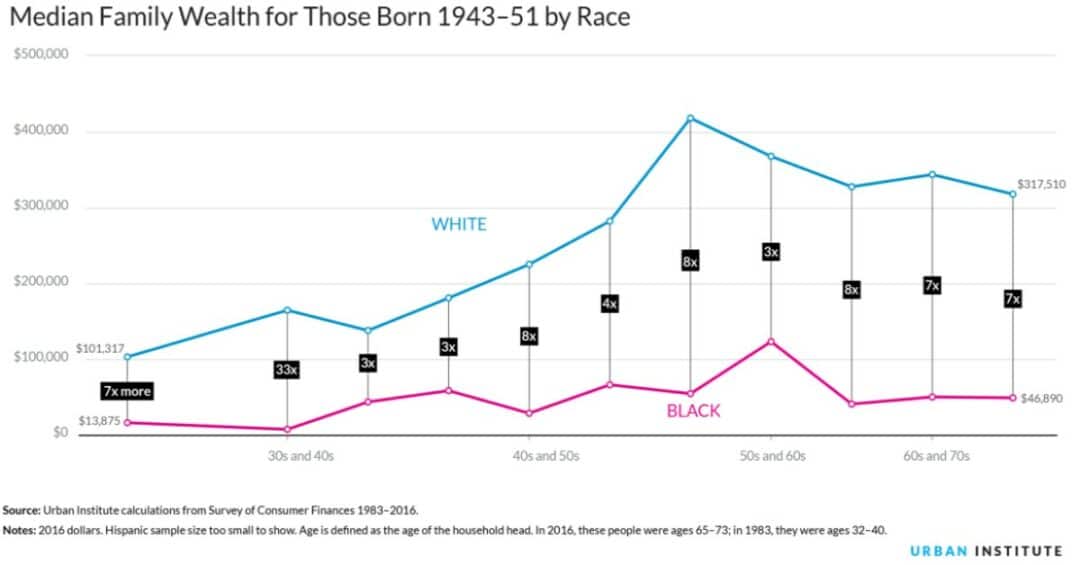
    A line graph compares median family wealth by age for White and Black Americans born 1943–51. White wealth is consistently much higher, peaking at 7,500 in their 60s, while Black wealth peaks at ,800.

    This cognitive dissonance creates a special problem when it comes to systems of justice and freedom, normally things that we first deal with through laws, nations’ constitutions, and international human rights conventions. This is the problem: We tend to think of constitutions, or other fundamental and dominant systems of norms, statically. We think of them as fixed things. That is incorrect. The legitimacy of systems of governance derives from people, and people are not static. They are constantly being born and dying. They are dynamic. And most people, all of whom matter, will live in the future. What lies at the base of things like justice and freedom – the dynamic “we” in “We the People” – is more fluid than our brains usually perceive.

    It is thus more accurate and true to our values of deriving legitimate governance from the people themselves (per a recent peer-reviewed article), to say that we are constantly constituting as we create new persons, not constituted by god-like founders in the past. We have to account for justice and freedom in the fundamental and ongoing formation of power relations, in the act of having children and ensuring their capacity to consent to the power of others. We thus “constitute” by accounting for the key stages in our development, early childhood and the creation of things like empathy, and the collective impact of that on our ability to socially self-determine. This is how we truly come together, or constitute, as free and equal people. We surpass our constant confusion about what it means to be free by seeing that such a state of being first lies in who we are – the fundamental power relations formed between us as we are created – before freedom can emerge, or not, in what we do.

    Making that change, using a verb, frees us from what might be called the constitutive fallacy, an erroneous deference to power structures that oppresses us – like property entitlements that prevent equal opportunities in life for all. Or treating the planning of our families – the creation of children – as “nobody else’s business.” That sense of privacy was not meant to protect would-be parents or children, but was instead designed for concentrations of wealth and power to evade collective obligations to give kids a fair start in life via things like family planning incentives/entitlements pegged to literal birth equity.

    How does the verb form free us? If we are dynamically constituting, then that process – limiting and decentralizing power to ensure future generations are free – becomes the dominant norm or ubernorm. We have to first and constantly make a free “We the People.” It precedes and overrides other norms. If we value justice and freedom (or self-determination over top-down systems of influences outside of ourselves like coercion or even incentives, which we can think of as simple sticks and carrots), we have to start from the premise that governance derives its legitimacy – its compelling oughtness – from the norm which through our creation ensures consensual governance.

    We have to create future generations in ways that assure they are relatively self-determining, part of a system of laws that reflects their will, and as such free from all forms of power to which they cannot consent.

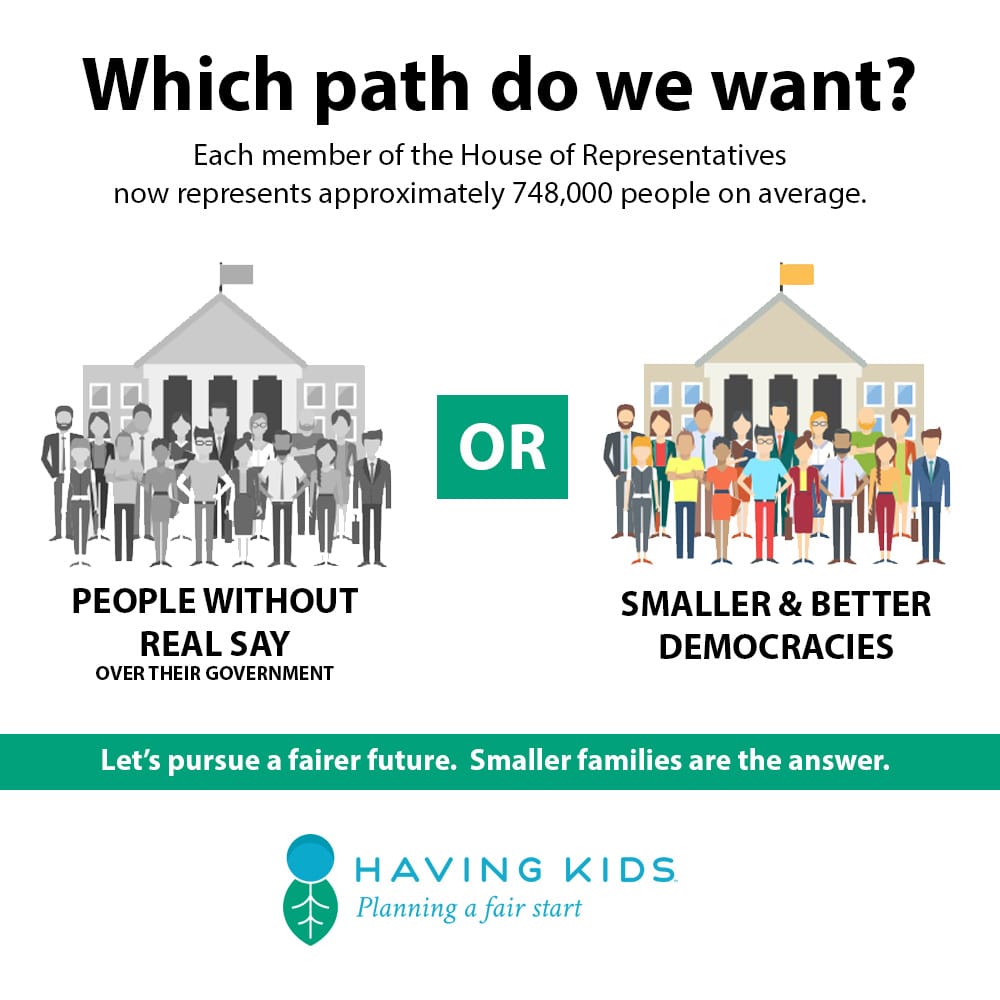
    An infographic compares two options: on the left, gray figures under “People without real say over their government,” and on the right, colorful families with “Smaller & better democracies.” Text promotes smaller families for fairer representation.

    Using the verb constituting may feel nebulous, leaving us lost in time and space without the familiar static concept of a written constitution, sitting under glass in some far-away place, or militarily defended lines on a globe that define some amorphous “we.” There is a simple way to fix this. If we are constituting or in motion, we will necessarily be focused on where we are going, prioritizing a universal and child-centric (as opposed to parent-centric) system for planning our families that ensures justice and freedom for the majority (those that will live in the future) of persons. We will be sufficiently other-regarding – and free enough – to physically constitute just communities.

    In the Fair Start Movement a collective of diverse people are discussing what it means to physically constitute those communities, using the simple and most basic value parameters of 1) minimum levels of welfare approaching birth equity for all, 2) an effective voice for everyone in more participatory democracies, and 3) restoration of nature, or the nonhuman world, which we can also think of as nonpolity, or the original positions/states of nature that undergird all theories of freedom. These values, just relations between people, and freedom, are simply inseparable from who we are and should be. And who we are and should be first depends on our creation. It’s about people, not population, and a physicalizing of justice through an existential norm that would include all other forms of traditional justice, e.g. distributive, environmental, intergenerational, procedural, retributive. We cannot be free if we carry pre-ordained hierarchies into our creation.

    In other words, if we don’t start from a just people policy that gives all kids an ecosocial Fair Start in life, we can never proceed from a just position. We can never really be free. Our language and vision for the future will not orient from any of the values that comprise freedom.

    A four-panel meme showing brain images that progressively light up as the captions advance: from denying global warming, to recognizing overconsumption, to choosing a smaller family, to advocating for future children’s needs.

    As we move to correct the fallacy in our thinking, we will find ourselves divided between free people, and those who are entrenched in preconstituting modes (whom we might call “precons”), often because they benefit at cost to others from those modes. The divide, at this first and uniquely critical border of human power, is binary: We either support sufficiently just beginnings and are sufficiently other-regarding to constitute, or not. We either constitute/maintain polities and their citizenry in the position of being able to effectively participate in a constitutional convention, and have the capacity to consent to others’ power, or we give up the pretense of being free and equal people.

    How can we identify precons? While forthcoming federal policies requiring disclosures regarding the role large companies play in the climate and other crises will help out these people, we can force the conversation with a few questions: How do they account for freedom and justice if not in the ongoing formation of power relations, as we have children? How could they care about children without caring about the conditions in which they are born? Is one’s birth position really a matter of fortune, or the result of things we can control? Is procreation more self, or other, determining? How can we consent to others’ power over us without accounting for the fundamental formation of power relations? If we value welfare, equity, democracy, or nature, wouldn’t we want to reflect those values in the norms that create us? Won’t we want to avoid relegating untold numbers of children to an ecologically degraded future with no guaranteed levels of resource or resilience?

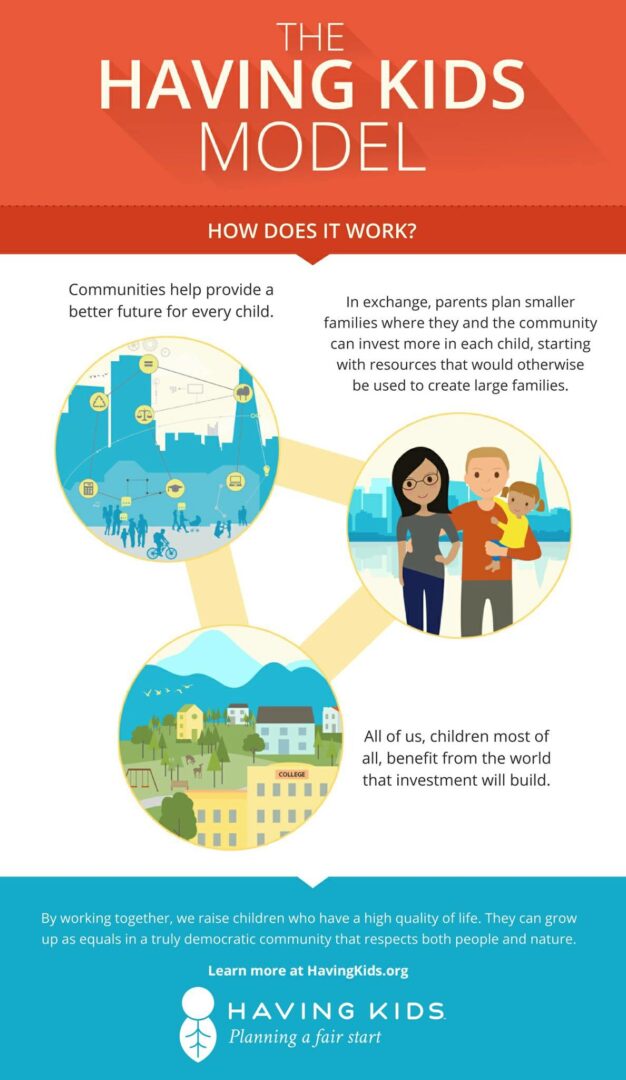
    Infographic explaining the Having Kids Model: communities invest in children’s futures, parents plan smaller families, and all children benefit from increased resources and a supportive environment. Includes illustrations and text.

    TAKE ACTION:

    These facts are indisputable: 1) Many benefitted from the mistakes described above by placing costs – ecological and social – on others. They did so in violation of multiple universal human rights that would have otherwise allowed us to constitute as free and equal people. And they did so in part by hiding the impact of the unjust family planning policies from which they were benefitting, instead using distracting downstream policies to prevent effective upstream reforms. 2) Most justly and effectively compensating future generations, who should be treated as a majority, for those violations requires targeting those precons most responsible, and those precons who benefitted the most, from blocking the process of constituting. They stand between us and legitimate systems of governance. 3) We right the fundamental wrong by taking and using portions of their concentrated power and wealth, measured against the relevant fundamental baseline, to constitute free and equal groups of future people via the effective vehicle of Fair Start incentives/entitlements.

    Free people will demand these resources, and be opposed by precons, who should be treated as the fundamental threat to our freedom.

    In other words these entities, like Exxon, should pay for the costs they externalized on others. And they must do so by complying with the first and overriding human right – Fair Start. We can spread this modeling, and this simple discourse: “Part of your wealth is my and my future child’s family planning entitlement and incentive.” If justice is meant to protect the most vulnerable, and it is, then it starts by protecting future persons, including nonhumans, which are the most vulnerable entities in the moral universe.


  • 10 Guides for Effective Nonprofit Management

    10 Guides for Effective Nonprofit Management

    By Jenna Sherman, of parent-leaders.com

    Have you recently become interested in the philosophy behind the Fair Start Movement? From family planning reform to environmental activism, there are so many ways that people can get involved in order to establish a more equitable society for children and parents. Maybe learning about this concept has even sparked your interest in starting your own nonprofit! If you’re considering this major undertaking, check out these resources first.

    The First Steps

    Starting a nonprofit doesn’t happen overnight. Here are a few tasks that belong on your checklist!

    • Want to build your nonprofit around family planning? Read up on the movement to find out how your nonprofit can become part of it!
    • Work out everything from your fundraising strategy to your overall message in your initial business plan.
    • Next, you need to think about your budget — be realistic about how much you expect to bring in and spend.
    • Finally, you can begin hiring your first team members! Look for candidates with a combination of skills and passion.

    Money Matters

    How can you bring in funds for your organization? And how can you ensure that your money goes far? These financial management tips will help!

    • These strategies can make your fundraising efforts more effective.
    • From tracking important dates to distributing paychecks on time every month, a payroll software and calendar template that automatically does calculations for you is a great tool.
    • Don’t forget about everything you’ll need to take care of come tax season! Check out your reporting requirements ahead of time.
    Several hands of different skin tones are stacked together. Overlaid text reads, The most powerful social justice is a fair start in life. Join the coalition. The Fair Start Movement logo appears at the bottom.

    Great Management Skills

    You want to polish your leadership skills and motivate your team to succeed. These resources are full of essential management recommendations.

    You might feel simultaneously excited and nervous about starting your nonprofit. At first, you will have a lot to learn about nonprofit management! But as time goes on, you’ll realize that you’re making a real impact, and building a brighter future is possible.

    Want to create a better world for all children? Get involved with the Fair Start Movement. Sign up on our website today to find out how you can lend a hand to our campaigns!

    Photo via Pexels

  • How Does the Fair Start Model Work?

    How Does the Fair Start Model Work?

    Guest author: Mary Jean

    We all deserve the best life. Whether you want a happy kid, a happy cat, a healthy environment to live in, or a happy community, all of it can be done with the right policies and carefully designed models. This is where the fair start model also comes into play. It focuses on how intending parents are planning to give their kids a fair start to their life. Communities and families must go hand in hand to make the future secure and bright for the kids and to provide them with a better living standard from the very beginning. Here is what you need to know about the fair start model:

    What is a Fair Start Model?

    To be precise, the fair start is a child-centric family planning model. It advocates the benefits of having small, sustainable, and equitable families invest more in every child and give them the rights they are entitled to. It helps our mindsets shift from ‘what the parents want’ to ‘what child will need.’ The future of a child is a major concern in the fair start model. 

    The fair start model plays a major role in eradicating problems like child poverty, environmental crisis, bloated democracies, and economic inequalities. Overpopulation leads to inequality and gives rise to grave global concerns, primarily being the inequitable living condition that further leads to exploitation of basic human rights. 

    How Does This Model Work?

    Those who plan to have a child prepare themselves economically and socially first in order to fulfill their responsibility in a better way.

    Together, communities and governments play their part to give all kids a fair start in life, leading them to a secure future, and a socially and economically stable lifestyle. 

    These efforts become fruitful through a universal ethic of equitable and sustainable families.

    What Are the Benefits of the Fair Start Model?

    The model keeps kids from falling prey to issues like poverty, and distress from being neglected. The modeling erases boundaries between child welfare programs and family planning by linking needs with resources. Since the model is centered upon when and where the kids will arrive, and what kids will need to have a fulfilling start in life, it urges parents to give themselves enough time to prepare themselves for starting a family. How we plan our families is what majorly determines the quality of lives we will live, both at the societal and individual levels. 

    Shifting our focus towards a better future incoming generations surely results in the best outcomes. It gives people an agency over their lives that frees them from excess financial burdens that are one of the major causes of mental health issues. Moreover, family planning curbs the overpopulation that is leading to environmental crises – like the water crises un many parts of the world. For saving future generations, a fair start model is the need of the hour!

    Three children sit at a checkered table. One covers his eyes, the middle rests his face on his hands, and the third covers her mouth. Toy cars are on the table and a window with trees is in the background.

    Conclusion:

    The fair start model is undeniably an all-in-one solution. It benefits all the basic domains of the world, such as ecology, economics, democracy, and human rights. It provides us with a solution to live the best of our lives even within our limited resources. You can play your part to bring the much-needed change in our family planning system by practicing the fair start model. Save the planet and resources for future generations to come. 

  • Growth Economics Created the Climate Crisis. Why Are Politicians and Media Pushing Women to Have Kids? Ask NYT’s Editor

    Growth Economics Created the Climate Crisis. Why Are Politicians and Media Pushing Women to Have Kids? Ask NYT’s Editor

    Fact: Falling fertility rates and eventual population decline will have the most beneficial long-run impact on the climate and other ecological crises. And yet influential media like the New York Times, and politicians pushed by businesses that rely on unsustainable growth, continue to urge women to have more kids. That is what even progressive Joe Biden is trying to do with his Ivanka Trump-inspired increased child tax credits.

    For demographers and other population experts population decline is the expected and desired outcome of decades of family planning interventions meant to end and reverse unsustainable population growth. Why the media alarmism then? 

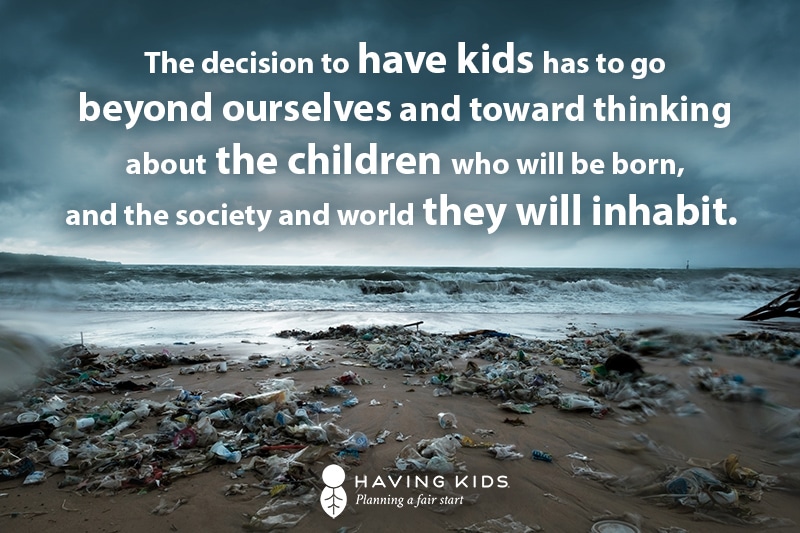
    A beach littered with plastic trash under a cloudy sky. Overlaid text reads: The decision to have kids has to go beyond ourselves and toward thinking about the children who will be born, and the society and world they will inhabit.

    Between the time those interventions were begun and today, neoliberalism and unsustainable growth-based economics that externalizes costs – like the climate crisis and birth inequity, has become the zeitgeist. The Times itself wrote about the same. But fanciful ideologies aside, growth remains unsustainable. The more interesting question is how the arc of population growth became so high to initiate the climate crisis, and who among those who have benefitted from that mistake will pay to compensate the future generations who certainly will be harmed – through no fault of their own.

    Justice begins with an ecosocial #FairStart in life.

    TAKE ACTION: Engage and urge the Times editor and his family to address the #FairStart question, and how we will redistribute power – including influential media platforms – to compensate future generations.

    A circular infographic titled “Fertility Delay Incentives to Planning” shows a leaf in the center with four benefits: Delayed Parenthood, Better Family Planning, Guaranteed Minimum Income, and Equal Opportunity & Education for all kids.
  • A Deeper Dive on Every Child’s Right to a Fair Start as the First Human Right: The Constitutive Fallacy.

    A Deeper Dive on Every Child’s Right to a Fair Start as the First Human Right: The Constitutive Fallacy.

    Introduction

    Zero Baseline (or “Fair Start”) Modeling (ZBM) corrects critical errors in all theories of social organization (from states, to corporations, to families etc.) that center around how we derive legitimacy, and political obligation, in the process of organizing. These errors retard personal sovereignty, or relative states of self-determination, and hence freedom. While there are several errors that drove the development of the ZBM, they can be summed up as the “constitutive fallacy,” or the belief that legitimacy and obligation can be fundamentally derived from anything other than the norms that determine our creation, and hence determine our initial relations and forms of organization. 

    The ZBM is a proposed creation norm to correct the fallacy and to legitimate forms of social organization. It operates primarily by 1) treating social contract theories of political obligation as inherently intergenerational (such that we are constituting states rather than having been constituted in the past), 2) prioritizing relative self-determination (relative to zero, or the absence of human influence, including 300ppm and lower climate crises baselines required to meet restorative/ecocentric/rewilding standards of environmental protection) as a value, but one that should diminish as members are added to the contract and the sovereigns displace one another, and 3) expanding our conception of power to include any form human influence or affect, like climate emission and bad parenting. The ZBM thus serves 1) as an interpretation of the moral and legal right to have children – one focused on collectively giving all children an ecosocial fair start in life as a means of limiting and decentralizing human power so that it can be subjected to norms, and 2) a formula by which to assess optimal world population. 

    The following discussion will situate the ZBM in the relevant literature, detail some of the costs of the constitutive fallacy, and finally present the ZBM in more detail as a basis to move social organization from top-down relations based on coercion, or incentive, towards bottom-up relations based on inclusive systems of relative self-determination derived from child development. 

    Line graph showing world population (billions) from 1950 to 2100. It displays observed values, median projection, 80% and 95% prediction intervals, and scenarios for ±0.5 child, with population rising then diverging in future projections.

    Situating the ZBM in the Literature 

    The ZBM combines work from several theorists and overlapping subjects, most obviously: 

    • Hans Kelsen’s work on the basic norm, 
    • deontological population ethics, 
    • social contract, natural law, and Rousseau’s democratic theory, 
    • the intergenerational justice work of Lukas Meyer, Axel Gosseries and David Archard, 
    • theories of political obligation, constitutional identity, baselining, as well as personal and political autonomy, 
    • the work of Joel Feinberg on children’s right to an open future,
    • related work from Sarah Conly, Christine Overall, Onora O’Neill on the right to have children, 
    • Hugh LaFollette’s proposals for parental licensing, 
    • And the practical realm of family law and reproductive rights.

    That said, the ZBM is unique because it corrects the constitutive fallacy where it appears in the work above, like the common presumption that the claimant is who they should be, were created justly, and as such operate from the position of a justifiable social organization. Instead of political obligation theories like “fair play,” or relying on the harm principle for measuring liberty, the ZBM reserves legitimacy for states of affairs in which people were created fairly. Unlike many theories on the right to have children, the ZBM rejects procreative autonomy, and even places autonomy in the form of choosing not to have children subsequent to collective obligations not to have them if they would fall below minimum thresholds of civic quality necessary for a democracy. 

    The failure to develop and implement a just creation norm, like the ZBM, has created significant social and ecological costs. The following will discuss some of these costs, before moving onto a more detailed discussion of the model as a solution, and as a baseline to seek restorative justice. 

    Several childrens hands placed together in a supportive gesture over a wooden surface, with text reading, The most powerful social justice is a fair start in life. Join the coalition. Logo and Having Kids appear at the bottom.

    The Underlying Errors 

    The errors – almost all conceptual – underlying the fallacy include, among others: 1) Treating things like national constitutions, or even rules of recognition, as the fundamental norms or grundnorms, when in fact the norms that determine our creation would have preceded these forms. 2) Using abstracted conceptions of the person focused on adulthood, and rationality, that are insufficiently dynamic to account for the key early stages and drivers of personal development, and the cumulative and collective impact of that development. And specifically for liberalism, 3) the failure from Locke to Rawls to account for how (the harm principle aside) the creation of persons controls their relative states of self-determination (e.g., vote dilution), and how this failure to account disenfranchises the majority of constituents, or future persons, who along with nonhumans are the most numerous and vulnerable category of moral entities.  

    The underlying errors also include using 4) limited conceptions of human power (and the borders of that power), e.g. that are focused on coercion, as opposed to using a conception that includes all human influence or affect, 5) myopic conceptions of autonomy that are self-contradicting, e.g. procreative autonomy and which presume we are whom we should be rather than the products of unjust creation norms, and in 6) in population ethics, using a concept of persons focused on quantity, when the concept of population inevitably at least five incommensurable and primarily qualitative values discussed below. 

    The Costs of the Errors

    There are many costs that flow from the fallacy and underlying errors. Because the fallacy enabled in 20th Century a misinterpretation of the right to have children that focused on procreative autonomy and parental subjective desire rather than the objective needs of future children, population growth exploded past optimal levels, and continues to do so, backed by pronatal policies. That continued explosion drives the climate crisis and other ecocides, child poverty, massive inequity, and the degradation of systems of human rights and democracy. Because of the fallacy – which ironically seeded subjectivism, unlimited power (parental) and “might makes right,” at the fundament of human rights – neoliberal, colonial and patriarchal systems were able to use future generations and the nonhuman world as resources to fuel economic growth. 

    They used the misinterpretation to enable that growth (and subjectivism more generally) over systems of early childhood and civic development. This had the result of physically constituting economies, or shopping malls, rather than the antecedent systems of democracy, or town halls, that regulate economies. Often this process used religion as the driver, in violation of separation principles. The trend continues today, as falling fertility rates – a phenomena with twenty times the long-run impact reducing climate emissions – are treated by the dominant discourse an economic “baby bust.” 

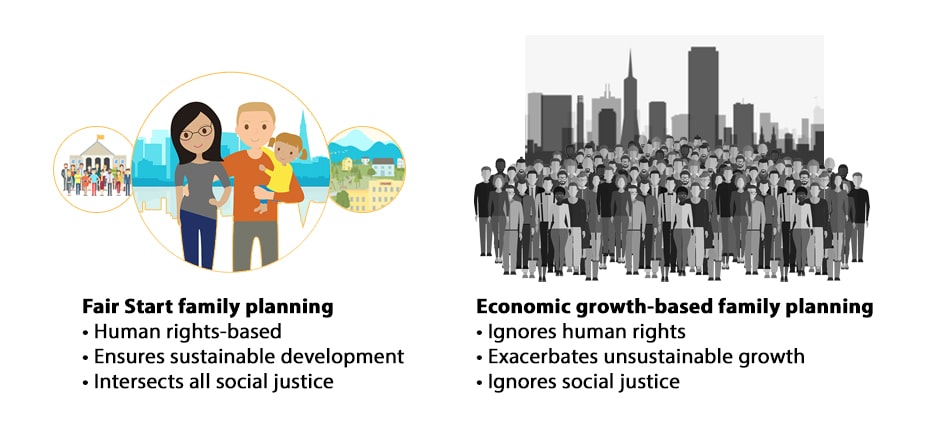
    A comparison chart showing Fair Start family planning with a diverse family and city background on the left, and Economic growth-based family planning with a large monochrome crowd and cityscape on the right. Key points are listed under each type.

    The Solution to the Constitutive Fallacy: ZBM

    If the constitutive fallacy involves skipping the step of creation in determining the justifiability and legitimacy of relations, the solution involves a norm that literally creates normativity, or the inclusion of relatively self-determining and reasonable agents into social organizations that reflect their constituents. In other words, if we want just systems we must begin with a just creator or creation norm, one who gives all children a Fair Start in life. That will in turn allow us to maintain the constant and antecedent “we,” or group of free and equal people, necessary to constantly reconstitute participatory democracies that empower their members to actually control the rules under which they live. 

    The Fair Start grundnorm or ZBM  (the constituting norm) is comprised of four interdependent evaluative requirements, or objective values that act as necessary conditions that enable true human subjectivity and choice: To minimize the loss of political autonomy in a human-rights-based democracy, and hence maximize consent, integration, and justified political obligation, would require, as a matter of lexical primacy, that (1) each new entrant be of a minimum constitutive quality or capable of constituting with others, (2) that there be a maximum number of members constituting the human-rights-based democracy, (3) that they enter relative to each other so that they exclude equally, and (4) that they are capable, given their quality, quantity, and relativity, of reconstituting their legalities relative to (or approaching) some level of nonpolity, or nature, that represents their capacity to convert power into law. 

    The existence of these four variables are inevitable in the act of procreating. The grundnorm thus necessitates backdating the standards, e.g., requiring conditions of entry that ensure constitutive quality and emancipation, rather than ignoring entry and subsequently excluding persons as insufficient in some way. 

    A circular infographic titled “Fertility Delay Incentives to Planning” shows a leaf in the center with four benefits: Delayed Parenthood, Better Family Planning, Guaranteed Minimum Income, and Equal Opportunity & Education for all kids.

    The values that comprise the grundnorm, which try to maximize obligation and autonomy through entry, role, and exit are the following: Treating procreation as the improved continuation of the parent’s life (“improved continuity,” or IC), a minimum level of welfare at entry, the nexus or zero-baseline point at which the values are first determined, fairly defined by the welfare of other entrants (> MW(F)). A qualitative threshold of a minimum quality of equitable individual sovereignty defined by the standard for emancipation, or reason (> E). A quantitative threshold of a maximum number of individual sovereigns defined by a minimum of individual sovereign roles, or capacities, in their democracy (< R). And finally, a quantitative threshold of a maximum number of individual sovereigns defined by nature (< N), the nexus or zero-baseline point or balance point at which the values are last determined. 

    To constitute is to maximize relative self-determination by approaching – given that constituting is dynamic – the zero baseline, or beginning to make people count or count, on a simple scale of 0, 1, 2 . . . 0

    The thresholds above can be set using existing legal standards we claim to already adhere to, like basic parental fitness, the Children’s Rights Convention, biodiversity and wilderness restoration targets, education benchmarks, federalism and representative ratios, redistribution polices that attempt to create equality of opportunity, etc. The model will show that, by our own standards existing in law today, we are not who we should be or who we claim to be, but the products of a truly original sin.  

    The model above represents the implied and justified antecedent “we” in any normative claim, assuming the fundamental value of relative self-determination, or the grouping of persons from which the claimant is operating and in which they matter. At its base, democracy involves the capacity to influence, which in turn begins with the existence of the person. If we take democracy (or individual sovereignty, from the appropriate and more compelling individualized perspective) seriously, we must focus on the creation of individuals and thereby unravel the age-old legal conundrums of balancing community and autonomy, unified independence, and ordered liberty. 

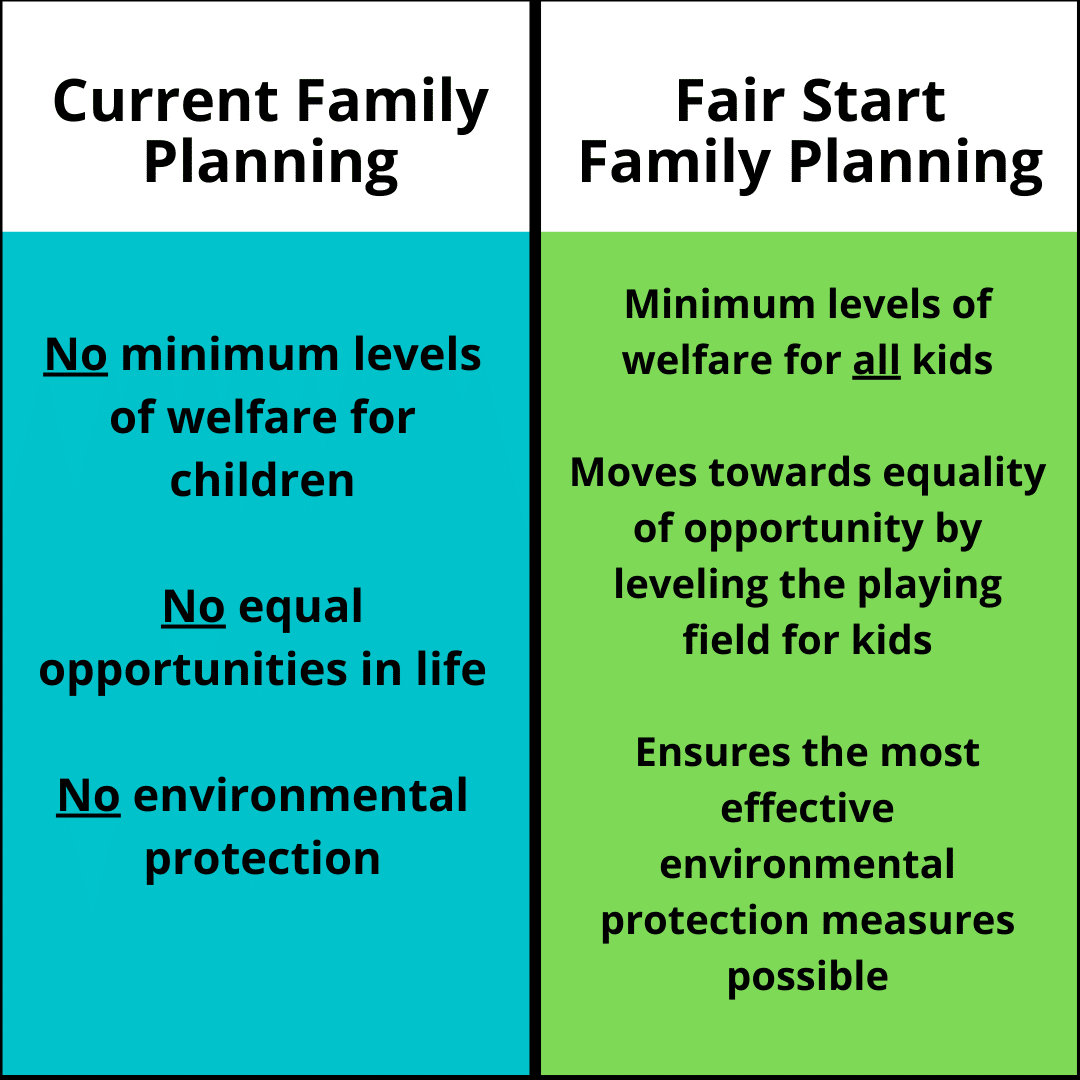
    A comparison chart of Current Family Planning vs. Fair Start Family Planning. The left side lists negatives of current planning; the right side highlights positive outcomes of fair start planning for welfare, equality, and environmental protection.

    Taking Action

    Beyond theory, the ZBM is the subject of a growing social movement demanding a shift from preconstitutional, parent-focused, and subjective family planning systems to a future child focused Fair Start system that – as grundnorm – should be treated as the fundamental and overriding human right. The vision and mission of the work involve bending the world population arc downwards, using a universal policy of families working together to plan for and equitably invest more in each child. The goal is to create a future of truly democratic communities surrounded by nature, constituted of free and equal people who each have a meaningful role in making the rules under which they live, and where each was empowered by the conditions in which they were born and raised. 

    The movement uses a simplified application of the ZBM, and includes dozens of legal, policy, institutional, cultural and direct action interventions supporters can use to further the change. The interventions include, among other things, international law reforms, celebrity appeals and Fair Start family modeling, tax measures, litigation, contraceptive funding, demands for climate compensation relative to the zero baseline, corporate divestment campaigns, and fact checking and reporting on claims relevant to the modeling. 

  • WaPo and the Population v. Consumption Debate: Three Questions to Move Forward on What Is Destroying Our Environment

    WaPo and the Population v. Consumption Debate: Three Questions to Move Forward on What Is Destroying Our Environment

    Kudos to Sarah Kaplan for covering the ongoing debate over whether population growth, or things like inequity, technology, and patterns of consumption, are to blame for the climate and other ecological crises.

    Is it wrong to blame overpopulation for the climate crisis? Perhaps it’s better to reframe the question: Is it wrong to blame overpopulation alone for the climate crisis?

    Of course.

    There are always multiple factors at play, from the growth that fundamentally creates demand to the inequity that’s driving overconsumption and the colonization of nature. The key to success is not to take any of the relevant factors out of our policy reforms, including the fundamental source of the Anthropocene: Treating the planet as a human resource in the design of our systems, from the economy to family planning. Doing so would replicate the mistakes that lead to the crisis. Instead let’s work together to give all kids a #fairstart in life.

    Here are three questions to help tie all of the relevant factors together, and move forward.

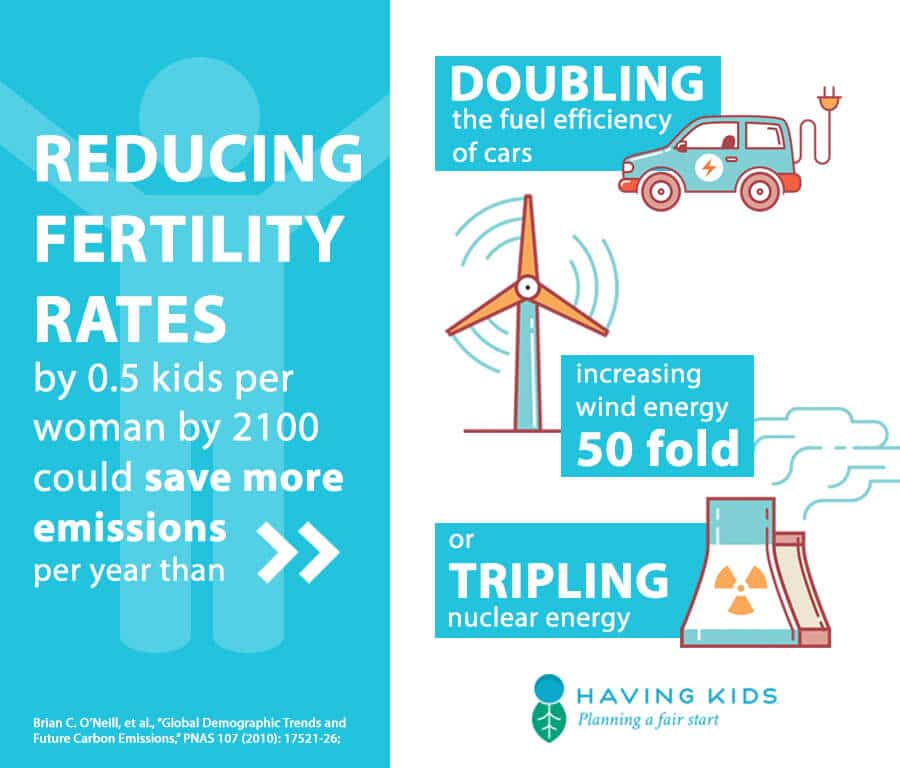
    Infographic showing ways to reduce carbon emissions: reducing fertility rates, doubling car fuel efficiency, increasing wind energy 50-fold, and tripling nuclear energy. Includes icons of a car, windmill, and nuclear symbol.