I agree with recent thoughts from journalist and political commentator Fareed Zakaria: Democrats need to get back to bread-and-butter issues, start building things again, focus on gas prices, food prices, etc.
The culture wars are too divisive. I met 10 people recently, citizens and naturalized citizens from the Caribbean (Haiti, Trinidad, Jamaica), Europe (England), the USA and Africa (Nigeria), all of whom are concerned. Five have switched from the Democratic Party to independent, due to the culture wars, saying there’s too much emphasis on sexual orientation by politicians and people. There is no teacher, anywhere on this earth, who’s waking up and going to teach harmful sexual ideas to their students.
We are watching lies, misinformation and such disrespectful behaviors by certain groups who claim to be the moral police. We all care about all students receiving a quality public education and having opportunities to succeed. In my humble opinion, a lot of students are being taught hate, division, bigotry, racism and fear at their homes, places of worship and other places before they enter a school. I firmly believe that the foundation for everything starts in the homes.
There is a time and place for everything and everyone. The Democrats are the “party of the big tent,” with all welcome. Well, we still don’t have a message and we allow Republicans to control the narrative on every single issue. I’m terrified about democracy vs. autocracy.
Florida continues to see tens of thousands of children abused each year, with many of them dying in the process. And the state care system, despite changes, continues to fail them.
Jessica Campos and Prof. Delcianna Winders are champions for animals, working hard to protect them from abuse, and exploitation, in a variety of ways.
But they know we lose that battle if we do not go upstream, and deal with the way unsustainable and inequitable family systems are driving animal suffering and death, and leaving open the door for continued attacks on women by men that would force them to have children.
Per Jessica:
“The decision of not having kids, for me, was set in my early 20s because of overpopulation. I thought – why bring more kids? There are too many already needing homes. I also agree with the Taking Animal Rights Seriously article. It’s not fair that animals have to be killed mercilessly just for consumption. Low population is good for the environment and also for traffic congestion. There’s a lot of benefits that I see as a whole in not having kids.”
And Delcianna said this:
“It’s time we tackle the taboo topic of procreative ethics. Given the deeply troubling history of eugenics, the subject is fraught and may seem best avoided. But evading it denies millions of women access to basic family planning, exacerbating the climate crisis, global inequality, and more. For the sake of humans, animals, and the environment, we must grapple with procreative ethics and work toward just, rights-centered, and sustainable family planning policies.”
TAKE ACTION:
There are dozens of ways to change family policies and bend the arc of who we are becoming towards justice. Act now.
Care about freedom? Make sure the people with whom you share the world are people born and raised to participate in liberating democracies, rather than top-down systems of coercion/incentive. There is no way to be really free without this.
Care about good parenting and happy families? Make sure families are planned and ready. That move pays off.
Please Fund Children’s Bonds Because Children Deserve Them
Dear Warren,
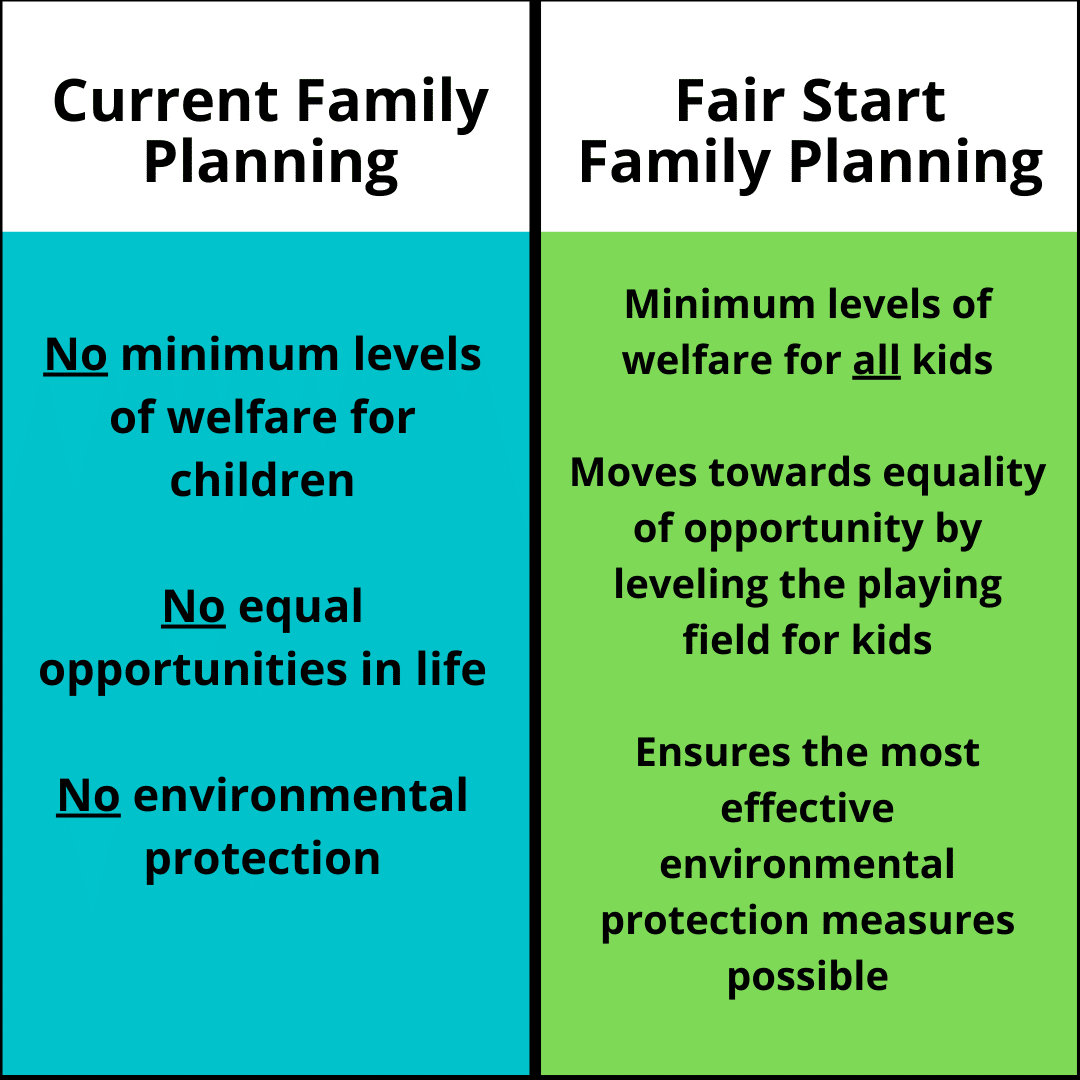
Fair Start Movement’s mission is to replace parent-centric subjective family planning systems with a child-centric model that ensures children are born and raised in conditions consistent – minimally – with the Children’s Rights Convention. Thank you for being a leader in the efforts to assure family planning needs are being met worldwide.
Given recent discussions of your possibly funding a world children’s savings bank, if these reports are true, we urge one simple guideline for such a plan. We urge that the gift recognize that the wealth of many was built on a system of unsustainable growth, per one Nobel Laurate, that included billions of persons having and raising children in conditions that did not satisfy the standards children and their parents deserve, the standards eventually codified in the Children’s Rights Convention. That explosive and unsustainable growth – at increasing cost to children as the climate worsens – enabled the wealth. Because that wealth was produced under a system that externalized its costs, disadvantaged children have moral and legal claim to part of the wealth as a form of restorative justice.
If your plans are to give as reported, please say it is because the children are entitled to it, and as part of a fair system of ecosocial family planning, one which actually complies with the requirements of the international human rights regime.
Without this change, we risk a future where the system by which we made our wealth does more harm to future generations than our philanthropy can do to help them.
Thanks for considering, and for your work to date.
In a 6-3 ruling, the U.S. Supreme Court overturned Roe. v Wade on June 24, 2022. This is a pivot point and a wake-up call that it is past time to address the injustice set in place by this ruling. It allows children to be born poor, and others rich. Some begin life in dangerous and unhealthy conditions, while others begin with guaranteed health and safety,
We can oppose the forces that killed Roe for what it does to women, but also because of what it does to children, equality, our environment, and participatory democracy.
It’s a pivot point because no government is legitimate, and we are under no obligation to follow its rules, if that government pursues policies that do not ensure the equal empowerment of its citizens, ensuring they comprise town halls instead of filling shopping malls. Texas fails this test.
As the Fair Start Movement will argue in court next month, the forces of justice must restore and create equal and just societies. Huge swaths of people have been stripped of fundamental rights with this ruling. As unwanted children are forced onto this earth by indifferent government officials, their parents will demand, and if necessary, take their dues from the concentrations of wealth and power responsible for this travesty.
A decent proportion of the next generation will be born through force, not consent. The child has no say in the matter, and his mother has none at all. Healthy communities and families grow when every individual has a say in what’s good for the whole. Consent is the key. This generation could grow up without proper education, and in many instances, without proper care and nurturing from a family that wasn’t prepared to have them. They will see governance as somebody else’s problem – from the shopping mall, not the town hall.
We will level the playing field for all kids ecosocially because justice demands a Fair Start in life. This decision has swept away any hope for our ideals in the near term. That’s why this fight is more important than ever.
Here’s what Brooke Morales, one emerging leader in the fight against oppression had to say:
“The overturning of Roe v. Wade harms women, children, and society. It allows a woman’s right to choose to be revoked, it does not guarantee children a fair start in life, and it exacerbates societal crises we face today. To ensure that children are born into equitable conditions, action must be taken. We cannot allow children to be forcibly subjected to the poverty cycle or environmental injustices. The decision to have children must be more carefully addressed, with every involved party taken into account.”
– Brooke Morales, Fair Start Movement
Why Does Family Planning Reform Enable Redistribution of Wealth? It’s About Baselines.
If you believe in freedom, it’s impossible for a group of people to just define what the world should look like for others. The baseline, or what the world should look like, is instead itself a group of relatively self-determining – or free – people. And that requires limiting the power each one of us has over one another by ensuring a restored, natural and biodiverse environment.
It requires all children to be empowered through things like a fair start in life that ensures true equality of opportunities in life (not the world today where the rich control the lives of the poor), as well as more functional democracies where each voice can actually be heard. Read more.
Rich nations are refusing to pay for the harm they caused poor nations through systems that created the climate crisis. But nations and the rich families they are protecting have a baseline problem. They cannot assign and defend property rights while simultaneously violating the right of all to be free. We have the right to take back the wealth and use it to offset the harms, through things like equitable family planning, by all means effective. Help us target the Raymond family, one of the worst violators, to pay what they owe. Contact Ashley@FairStartMovement.org.
Harvard President Larry Bacow says that Harvard is committed to confronting the climate crisis. Harvard fundamentally built its wealth and prestige on an unsustainable system of growth – family policies – that externalized their costs on others and did nothing to protect nature from the Anthropocene. Is Harvard reversing its position on those family policies? Is it employing a restorative standard for climate mitigation? It is pointing the world towards optimality, or growth that will multiply unforeseen threats – the very thing that happened with greenhouse gasses?
If Harvard is not changing course on family policies Bacow’s statements are misleading, with growth remaining the fundamental driver of the crisis. You cannot make any claim of a policy impact that does not start with, and become fundamentally contingent upon, people and the family policies that create them. And in a democracy, those people – comprised as relatively self-determining – are the baseline to assess costs and benefits.
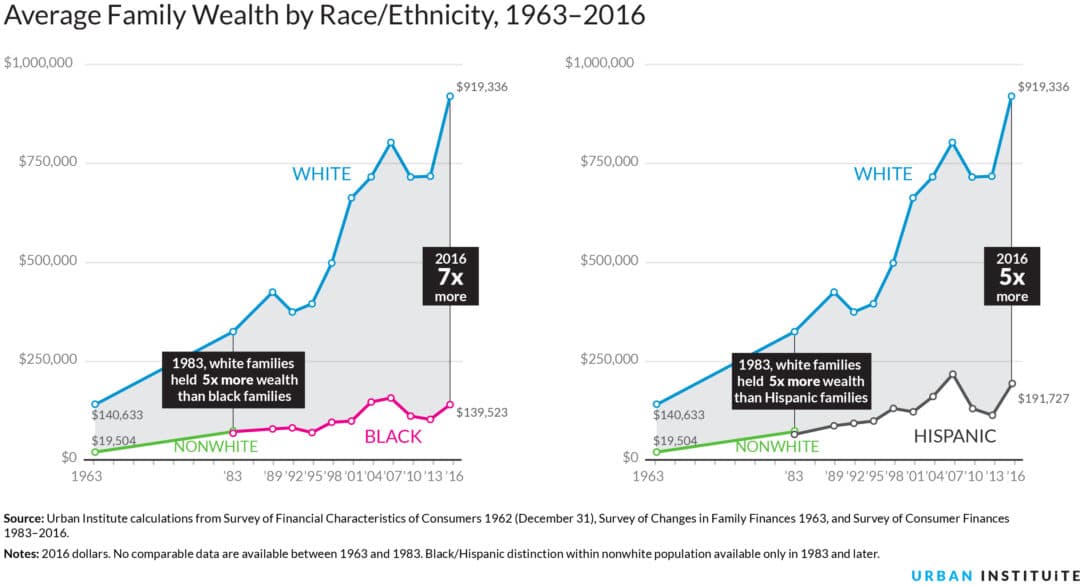
The same questions can be raised with Harvard’s recent purported commitments to racial justice, child welfare, animal rights, or human rights and democracy. Is it embracing redistributive policies that eliminate the massive birth-wealth gap between black and white children? Does it apply the Children’s Rights Convention as a standard for family planning? What is it doing to prevent our species from overrunning and eliminating others? Growth and inequity have ensured the average person will have little if any impact on their systems of governance. Is Harvard reversing that process?
Quietly undoing downstream fixes with upstream anthropocentric growth and birth inequity is disingenuous, has concentrated power in a few, and foisted social and ecological costs on others. Harvard is one of those concentrations. The family policies it tacitly accepts, which pretend that our social and ecological positions are a matter of some magic fortune, are the fundamental source of injustice. The greatest act of justice, for the vast majority who will live in the future, means recovering those costs and using the wealth to plan just and sustainable families where power is physically limited and decentralized.
Urge Larry Bacow to tell us all the truth about these matters. Contact him here:
617 495 1502 Email: president@harvard.edu
We cannot afford to lose ground on these issues having missed the fundamental driver and allow concentrations of wealth and power to use people to further exacerbate power differentials.
We are writing to urge you to dissolve the barrier between family planning policies and children’s rights policies. If instruments like the Children’s Rights Convention are meant to be effective they must be applied to the majority of children, those who will live in the future.
Growth-biased policies both fail to take into account the needs of current children and harm future children, whose rights and well-being are increasingly under threat due to the worsening climate crisis, resource depletion, rising inequality, unemployment, and political instability. In fact, the best interpretation of the Children’s Convention (“CRC”) considers the rights of future children just as much as the rights of children who exist today, which makes the Convention the centerpiece standard for family planning.
The key to achieving just and sustainable family planning policies involves balancing procreative autonomy with procreative obligations, such that the rights of intending parents to have children are balanced with the rights and well-being of potential children. We need new norms that place children’s rights at the center of every family planning decision, affirming the right of every child to enter a family and community that is prepared to provide for her physical and cognitive development, education, and health. Such norms, in turn, allow true adult autonomy or relative self-determination in the long run.
It’s not about population/numbers. We either bring kids into select and safe conditions, or we are being fundamentally unjust.
We Have to Admit That Failure to Apply the Convention in Family Planning Hurt Women and Children
Collectively, we have yet to reckon with birth rates and family size as drivers of the current crises in human and planetary health. While maternal and child welfare has improved worldwide, the reality is that outcomes are poor: costing the lives of nearly 300,000 women and over 5 million infants and children each year. Recent studies, of course, do not reflect the horrific impacts the climate crisis will have on those outcomes.
These outcomes could have been avoided had family planning policies oriented around the objective needs of future children, like those specified in the Convention, rather than around the the oft-cited “rights” of parents to have children–including patriarchy, the preservation of oligarchic family structures, and the needs of population growth-based economies. The reorientation could have easily been implemented by prioritizing child equity in family planning, and using progressive taxation on the wealthiest to fund family planning incentives and entitlements. That change would have also moved the world towards more optimal and sustainable population levels, and allowed us to meet sustainable development goals and climate mitigation targets.
Change begins with our admission that if children deserve certain things, then future children do as well. From this admission follows changing the policies that surround family planning and permissible birth/child development conditions, and moving from a parent-centric model based on autonomy (which ignores future child welfare) to a future child-centric model based on equity.
Failure to do this is encourage men to use their wealth and positions of power to push women to have more children to be used as consumers, workers, and taxpayers. This degrades the capacity for participation each person would have in a functional democracy, and exacerbates the climate crisis. They want us to believe that one’s birth entry position – rich versus poor, in nurturing or horrific conditions – is a matter of fortune, or an act of god. Instead it is the absence of just family planning policies and the UNFPA’s failure to apply the Convention prospectively exacerbates this.
There Is a Clear Policy Pathway for Implementing Child-Centric Family Planning Policies to Comply with the Convention
To develop the political will and the policy framework to advance these changes, we need a US federal entity to oversee children’s issues and advocate for children’s rights across all levels of government. Additionally, federal adoption of other key CRC principles – child impact statements and the best interests of the child standard for all budget and policy decisions – will advance children’s interests. Within this structure, the very initial steps towards dissolving the barrier between family planning and children’s rights will involve changing the discourse around family planning and the Convention in five specific ways:
First, we can adopt family planning policy reporting as part of ESG disclosure frameworks. This should include past, present, and anticipated policies. The inclusion as part of the framework would begin to create a culture among institutions – public and private – of factoring in family planning as the key driver or open multiplier of all crucial ESG impacts.
Second, we can urge the United Nations Human Rights Council to interpret Article 16 of the UDHR and relevant provisions of the international bill of human rights as requiring just and sustainable family planning that can be practiced by all generations in perpetuity. This would require that reproductive rights be balanced with the obligations of intending parents towards potential children – current and future, with the understanding that future generations have the same human rights we do.
Third, the UN Secretary General, and heads of the UNFPA, UNICEF and UNEP, can provide informal statements that support the reading of Article 16 above, and that treat the Convention as the centerpiece of family planning policies, capable of being implemented with the redistribution, incentive, and entitlement policies discussed above. Informal statements lay the groundwork for changes at the level of population conventions, and eventually binding treaty interpretations.
Fourth, we should reorient more traditional reproductive rights frameworks that focus on preventing pregnancy around state obligations to ensure conditions that produce self-determining citizens rather than economic inputs in a system of unsustainable growth. That state interest precedes and enables individual rights, creating the context in which they occur, but is currently absent from the discourse. Again, the focus here involves replacing procreative autonomy, which is a contradiction in terms, with procreative justice/equity, which in turn allows true adult autonomy or relative self-determination in the long run. While many might not readily accept that well-cared for kids make better citizens, that argument is based on a conceptual error. The people making it have a conception of good government that does not account for how the people in that system actually relate, e.g. how vastly disparate opportunities in life – which start at brith – carry over to disparate input in the political system.
Fifth, we can begin to support true equity in birth and childhood development, honoring the ideal of equal opportunities in life, by reforming the child tax credit system to promote parental readiness, a leveling of the playing field for all children, and a universal ethic of sustainable families. As with the other reforms, this reform goes “upstream” to protect children by improving the conditions in which they are born and raised through redistribution of wealth as family planning incentives/entitlements, which are especially needed to offset – or help repair – the harm we have caused future generations.
Conclusion
The best interpretation of the CRC applies it to future, and not just extant, children.