Category: News & Fair Start Headlines

  • Want Democracy for Your Kids? Do this.

    Want Democracy for Your Kids? Do this.

    When supporters of President Trump stormed the Capitol Building in January, business leaders, and prominent members of both political parties, condemned the act as a direct assault on democracy. The deadly attack was wrong for many reasons, but not because the Capitol represents a functional democracy.

    It’s hard to understand why anyone believes Congress – a handful of people – could democratically represent the diverse and changing interests of the hundreds of millions of people that live in the United States. If democracy is characterized by self-rule or the decentralization of power, what Congress purports to do instead is run a large republic where powerful interests disproportionately control outcomes, rather than engage in the true democracy simply characterized by an extremely decentralized system of local control where each person’s voice matters and is heard.

    We react strongly to the spectacle of what happened at the Capitol in part because it is sensational. Decades of corporate lobbyists invading the Capitol and slowly degrading the way it represents each person equally – and especially those most vulnerable – is less sensational. It’s not better – in many ways it’s worse and more impactful – but our brains don’t process it the same way. (In the linked TED talk Peter Singer focuses on our welfare and our cognitive limits, but the same lesson could be applied to self-determination and democracy).

    While contrasts have been drawn between the police response to the attack versus the response to the George Floyd riots, we can also look to the disproportionate response police had to the Occupy movement, especially in Wall Street’s back yard. We may not be surprised then when the captains of corporate America swiftly condemned the attack on the Capitol. Violence reminds us that there is a form of power other than money.

    If we really wish to ensure justice and to prevent further bloodshed, perhaps we should focus on making each voice heard and matter – whether it is the sort dying to end the constant killings of deeply disenfranchised black men by police, or the sort of voice intent on protesting the federal governance of our massive and deeply unequal population as undemocratic. If we don’t, these voices will raise their level of conflict, and violence.
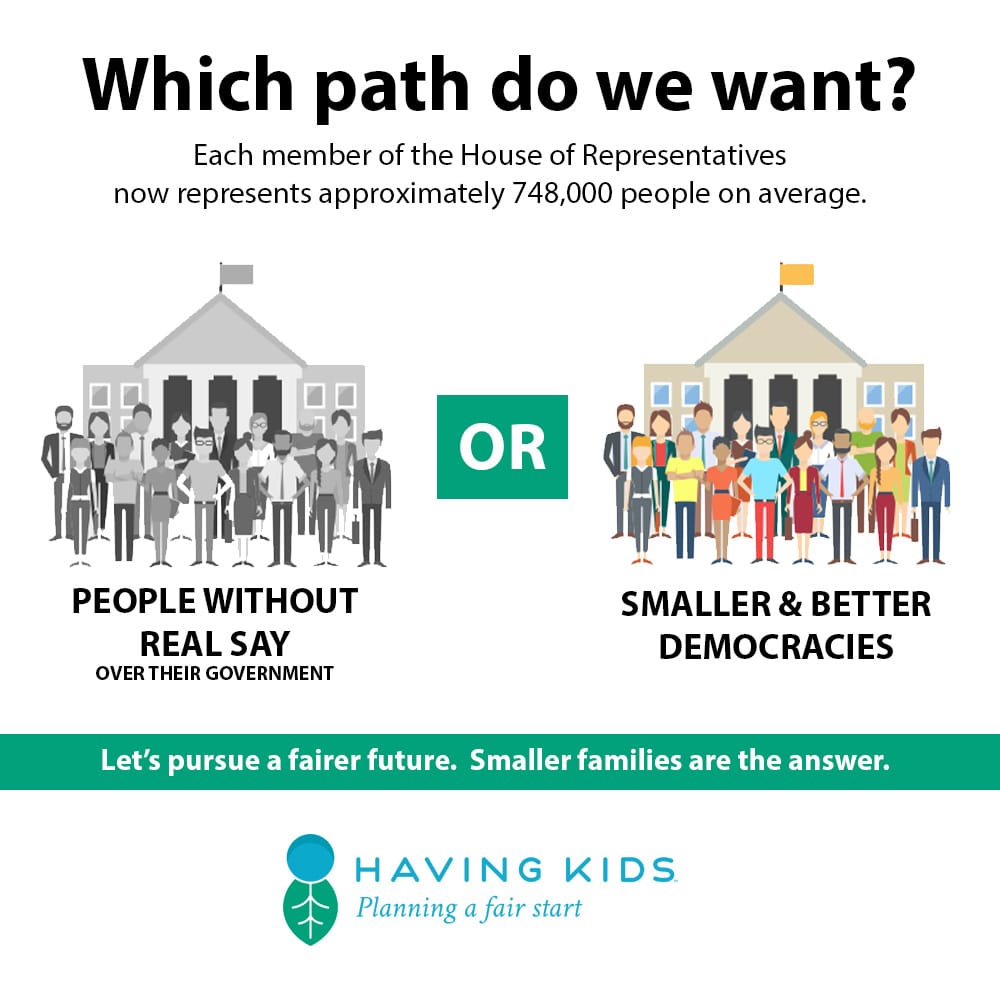
    Infographic compares two groups: one large, gray crowd labeled People Without Real Say by the government, and one small, colorful group labeled Smaller & Better Democracies. Text suggests smaller families improve democracy.

    How could we possibly increase each person’s role in governance? Traditionally our moderately federalized system pushes population growth as a means of expanding national power, then based on constitutional rules, it counts up everyone and apportions their representatives. Instead of exploiting future generations as a means of growth, what if we changed the way we have and raise kids to equitably invest more in them and in ways designed to give each a voice in hyper-decentralized future governance? Instead of assuming that the written Constitution magically ensures our representation, we could physically decentralize both private and public concentrations of power by taking resources and investing them in a smaller future population developed for self-rule. While that process must prioritize eliminating racial inequity, it is inherently nonpartisan.

    In this way, we could begin to constitute democracies out of people, more than out of words, and build communities around our role in planning them, more than around racial or class identities. We could incentivize early fostering and adoption of children in need using the funds – like child tax credits – that currently incentivize having larger families. We could also do it by redistributing wealth from the top of the economic pyramid through enhanced “baby bond” legislation meant to ensure birth equity and tie future children’s needs to better family planning. Giving a voice  – in this way – can mean giving what both margins, left and right, want respectively, albeit over the span of a few generations: Greater equity for the former, and greater autonomy for the latter.

    The best part? If developing future generations to engage in equal self-rule is something that logically precedes the political processes we are accustomed to, we don’t need the government to begin the decentralization of private and public power. We can instead join as liberals and conservatives to target the power of both big business and big government, which in divided political camps we respectively object to, based on the simple truths that every child deserves to get a fair start – both ecologically and socially – in life, and that every child deserves to eventually matter in the processes that govern their day to day lives.

    They have that first human right, and as their protectors, we may ensure it for them by all means effective.

    Take action: Urge you representatives in Congress to support the United America campaign.
  • Guest Author: Time for a New Sustainable Development Goal, One That Truly Works?

    Guest Author: Time for a New Sustainable Development Goal, One That Truly Works?

    Dear World Media,

    Hope for the Earth – at last.

    Today the United Nations Development Programme presented their apologies for having run down our home and the home of a myriad of other species by choosing to completely ignore the content of the Meadows Report. Finally they acknowledged that the Earth has finite resources and that we borrowed recklessly both from future generations and other species.

    As of today a new world Sustainable Development Goal (SDG) has been added:

    SDG 0: Small families for all.  Its aim is to encourage people to stop at a great maximum of two offspring in the name of justice and fairness: Fairness to others, to other species and even to their own children.

    It was finally recognised that a large cohort of elderly people are easier to manage than floods, subsidence, droughts, hurricanes and rising temperatures. It was also realised that the risk of future pandemics locking us all in was not worth carrying on as we are. And last but not least it was realised that they were starting to look ridiculous.

    We thank the United Nations for having the humility to recognise that for the last forty years they were led up the garden path by various funders and interest groups. One big cheer for better things to come

    Wishful thinker

    Take action: Urge UN leadership to abandon the isolation family planning modeling in favor of Fair Start.

    About the author:

    Esther started being concerned about the wounds inflicted to the Earth aged 11 in 1976. She also understood at that time that there were already then far too many humans, considering their acquisitive and wasteful behaviour. Climate change was on her radar very early on, not least because her father was a physicist specialised in thermo-dynamics who left the oil industry in the 1970s to work on renewables. She had a strong link to nature and has been devastated seeing everything taken over and crushed by the human enterprise and all other species disappeared under piles of concrete in a soul crushing manner. When she was young she wished for a couple of children but as time went on she concluded that if her and her husband had any, those children would have a ghastly future ahead of them, so they didn’t try. As such she represents a growing swath of childfree voices in tune with Dave Benatar South African Prof of Philosophy who wrote a book in 2008 entitled “Better never to have been, the harm of coming into existence”: The Case for Not Being Born | The New Yorker

  • Nudging Cal Flyn, a Brilliant Mind, on Family Planning Reform

    Cal Flyn is wise to call attention to the issues of population growth and family planning is her recent article in the Guardian.

    What matters more than the people with whom we and our kids share the world, and will in the future?

    Cal however could be making a simple, but crucial, error: She might be assuming that replacement is the baseline for determining family planning policies and ideal fertility rates. Given that current and anticipated population levels are unsustainable – something the climate crisis reminds us of every day – replacement is not ideal.

    Instead, there is an optimal world population range – probably well below the ecocidal levels we see today. How do we know what is optimal? Think of what you value: Nature, democracy, fairness, and love. Those values create a world very different from the future we get from trying to maximize gross domestic product. These values create the world thoughtful and caring parents want for their children.

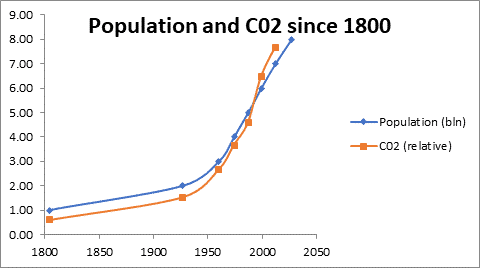
    Line graph showing global population (in billions) and CO2 (relative) from 1800 to 2050. Both lines rise slowly at first, then sharply increase around 1950, with population slightly above CO2 in recent decades.

    Moving towards it is the fundamental policy focus for sustainable development. Moving quickly will prove ten to twenty times more effective at eliminating poverty, inequity, and ecological crises, as well as restoring democracy, than downstream and after-the-fact alternatives. Optimal, not unsustainable replacement, is our collective endeavor.

    As part of this process, the slow return of nature is the long-expected consequence of decades of unified international efforts to avert the disasters that flow from overpopulation. We should welcome the change as a symbol of success. It is part of saving our own species.

    What’s an easy way to actually make change? Mixing fertility delay incentives in with child tax credits, and making all of it steeply progressive to ensure all kids a Fair Start in life.

    TAKE ACTION: BY NOT ENSURING ALL KIDS AN ECO-SOCIAL FAIR START IN LIFE THE UNITED NATIONS SECRETARY GENERAL @ANTONIOGUTTERES IS IGNORING HUMAN RIGHTS. URGE HIM TO CHANGE COURSE.

  • Guest Opinion: Practical Solutions to Common Concerns of Parents Working From Home

    Guest Opinion: Practical Solutions to Common Concerns of Parents Working From Home

    Guest author: Emily Graham, MightyMoms.net

    Emily is mother to two daughters, cares about their future, and supports the Having Kids approach. Neither she nor Having Kids received any compensation for this piece.

    Having a baby or toddler as a coworker may sound pretty cute. If you’re a parent who is currently trying to perform this juggling act, though, you know just how stressful things can get. You may have even found yourself in situations where you felt overwhelmed, including the examples below. This is why we are giving you some practical tips for overcoming them, courtesy of Having Kids. 

    “My home is a mess!”

    Chaos and toddlers seem to go hand-in-hand. The first thing you should do to tame the clutter and mess is to cut yourself some slack. If you’re caring for a younger child while working from home, you’re basically working overtime at two full-time jobs. 

    Now, if things have gotten out of control, you can also use some free tips to get your home organized, fast. When you have a few minutes, go around one room and pick up clutter. Also, try to spend a little time cleaning each day so your house stays fresh and doesn’t overwhelm you. Last but not least, open a window for some fresh air. Then, take a deep breath and relax after all of that hard work.

    “I’m working in pajamas” 

    Look we get it — wearing your pajamas is convenient and seemingly smart when you’re chasing after a toddler in-between work and chores. You may feel comfortable working in the same clothes you wore to bed, but as it turns out, spending a few minutes on getting yourself ready for the day will actually help you be more productive. Essentially, you’re letting your brain know it’s time for work. 

    That isn’t to say that you should wear a three-piece suit and fancy heels to work from home. How would you ever keep up with a constantly exploring child in that getup? Instead, put together a few casual looks that can take you from Zoom meetings to zooming after kids. Need to shop for new clothes? Look for promo codes and coupons from stores like Belk to find functional and fashionable outfits for a lot less. 

    “I’m constantly interrupted!”

    There are only two things that will help in this emergency situation: realistic expectations and boundaries. We’ll get to boundaries in just a moment, but first, let’s go over some ways you can create better schedules and routines for your family. You need to plan your work week ahead of time and talk your schedule over with your kids, if possible. If you have a partner or spouse, come up with expectations for how you will split parenting duties. 

    Next, enforce your schedule and routine with boundaries. That may look like working during naptime with toddlers and babies since you can’t very well explain boundaries to them. It could also include setting up your very own office space to create some physical separation. 

    “Sleep is non-existent for me.”

    Not getting enough sleep is a common concern for parents of younger children. But you really do need quality sleep to thrive and avoid burnout. In fact, one trick you can use is to focus on quality rather than quantity. Johns Hopkins recommends trying to rest in cycles of two to four hours, which will hopefully coincide with your kids’ naptimes. Even if you can’t sleep, resting helps! 

    Another important tip for working parents is shutting off electronics before you try to fall asleep. This goes for your work phone and laptop, too, since the light from screens can make it more difficult for your eyes and brain to relax. If you have a habit of checking emails or social media while in bed, stopping now will help you get the quality sleep you need. 

    Working at home with a baby or young child in the mix shouldn’t make you feel burned out or overwhelmed. Having a plan and sticking to consistent routines can help you maximize your productivity. It’s also extremely important that you set boundaries to maintain some order. 

    Donate to Having Kids, a non-profit dedicated to giving every kid a fair start. 

  • South Korea: Change The Population Policy Landscape for the World

    South Korea: Change The Population Policy Landscape for the World

    South Korea is in the midst of making demographic history, with the country’s population itself declining. While other countries have seen the same process unfold, South Korea is unique in that the fall is part of one of the best family planning policy reforms the world has seen. The positive impact on the climate crisis, and on improving each citizen’s role in the democratic process, is astounding. South Korea is showing that nations can break the suicidal collective action problem of a permanent birth and population growth race, to instead help move the world towards an optimal and sustainable world population level.

    The State Pushing Women to Have Kids

    Forces at the top of the population exploitation pyramid Nobel Laureate Stephen Chu once pointed out are fighting back, sounding alarms about South Korea heralding the end of the world. They do not care about the impact falling populations have on values like welfare, nature, and equity. They care that the pyramid – atop which they live – is changing and the free money of unsustainable population growth might be disappearing. These forces said the same about falling population in Japan years ago and impacts on quality of life – and were wrong.

    Unfortunately, South Korea is caving to forces at the top of the wealth and population pyramid, and paying and pushing women to have more kids. In this way, South Korea is a battle ground for whether we stick to unsustainable, nationalistic and pre-constitutional replacement fertility models, or transition to Fair Start family planning systems that use nature as a baseline, and are truly compliant with human rights.

    We should choose the latter, and rather than prop up the wealthy, we should constitute new democracies where each person matters.

    What can we do in this fight for human rights and the future?

    It’s time to change the discourse. This is not about numbers. This is about people, and the first human right – the right to a fair start in life. It’s time to find the wealthy entities and their mouthpieces in the media pushing unsustainable growth, the people driving the exploitation rather than investment in future generations.

    An infographic titled The Fair Start Model explains how parents, communities, and small sustainable families work together to ensure a fair start and high quality of life for all kids.

    It’s time to take the resources they took, the wealth, and instead invest it in future generations. We have the right to take what is necessary for the Fair Start right by all means effective because it comes before – and overrides – property rights. We are before we do. The wealthy collected their power in violation of that right; they never paid the costs they should have. It’s time for them to pay now.

    Step one in this transition?

    The United Nations and Secretary General Antonio Guterres are obligated by the international bill of human rights to support Fair Start, and our just demands, prior to our engaging targets at the top of the wealth pyramid. They are obligated to speak truth with us to the power at the top, and support the just actions to come.

    Urge the United Nations to recognize every child’s right to a Fair Start in life. Tell them to choose justice over greed and inequity.

  • Time for Antiracism in Biden’s Family Plan? It’s Called the Unite America Plan.

    Time for Antiracism in Biden’s Family Plan? It’s Called the Unite America Plan.

    We Should Level the Playing Field for All Kids. Full Stop.

    President Joe Biden has put forth a massive child care and tax proposal to keep child care centers open, help low-income families with child care, and offer tax relief on the cost of having kids.

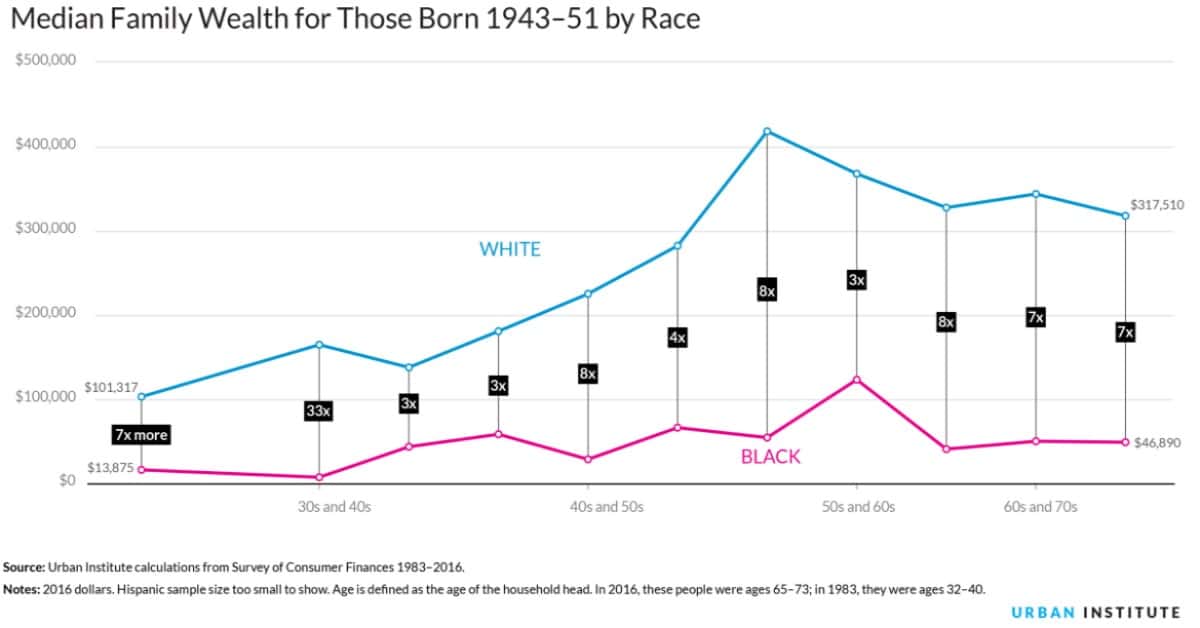
    There is just one problem: It’s not really meant to eliminate the massive wealth gap between minority and white families in the United States. Because of slavery and historical injustice, black families have one tenth the wealth of white families. White families also possess more than 4 times the income of Hispanic/Latino families. The impacts are especially hard on kids, rippling forward into future generations in never ending cycles that make a mockery of any legitimate form of social contract. It’s time to get real.

    How could Biden’s plan help end the cycle?

    1) Cut all benefits to wealthy families who don’t need the funding. 

    2) Use those savings as cash incentives to power up family planning and early childhood investment systems in the United States to 

    a) target child abuse by amending the federal child abuse law, 

    b) incentivize delaying having kids until parents are really ready, and 

    c) promote more sustainable and equitable families for all regardless of income, as well as fostering and adoption – changes that have twenty times the impact on climate emissions, relative to short term fixes. Those changes – made as part of recognizing our sacred constitutional right to nature –  would create massive long-run savings and catalyze sustainable development. We could start to give all kids a Fair Start in life.

    d) Back programs like Smart Beginnings up in time to focus on family planning, and based upon redistribution of wealth in ways that give all kids a Fair Start in life.

    Cory Booker has already proposed a vehicle called baby bonds through which – if made progressively scaled and seriously bumped up – the modernizing changes could be accomplished.

    Opponents to these changes will want to use President Biden’s plan to reinforce inequality and incentivize unsustainable population growth, using babies to grow the economy. Names like Ivanka Trump, Marco Rubio, Mitt Romney, and growth-minded people at Vox like Matthew Yglesias want to use child care, and especially child tax credits, as incentives for women to have kids to reverse falling birth rates. That’s short-sighted, and ignores every child’s right to a socially and ecologically #fairstart in life. It’s certainly not antiracist. It divides us.

    Changing the way we plan for and invest in families – doing it in a socially and ecologically sustainable way – is thinking ahead and creating long-run change. The impacts would be ten to twenty times other things we could do to address the climate, inequity, and decline of democracy crises. Better family planning also has a massive impact on pandemics, improving our response and reducing risks. It’s time to raise the baseline for conditions at birth to set kids up for success for life and build a better future by recognizing the obligations of those at the top. That’s how we come together – or deliberately include future generations in democratic communities – and truly unite America around a common core. We rebuild Main Street by creating a middle class through future generations, at cost to Wall Street and through the elimination of poor and unsustainable family planning.

    In this way we can proceed from fundamental values, and achieve the personal autonomy the political right values, by applying the equity the political left values – but specifically prioritizing children. We can take power away from big business and big government, the entities the left and right respectively oppose, and invest it in future generations. Learn more here.

    That’s truly uniting, and being antiracist, at the same time.

    The Having Kids Unite America campaign is not simply a Green New Deal – it’s a Real Deal, or a new and intergenerational social contract to ensure a #fairstart in life for all kids.

    TAKE ACTION: Add your name to urge President Biden to improve the child care rescue package and share the campaign with the hashtag #UniteAmericaforkids.

  • The Logic of Fair Start Policies and Animal Rights (Including Human Ones)

    The Logic of Fair Start Policies and Animal Rights (Including Human Ones)

    These are the facts, and they are not in dispute.

    1) All reasonable people agree reforms are needed to respond to the climate crisis.

    2) All reforms, with a few small exceptions – from the Paris Accords to more conservative carbon markets – assume an environmental baseline where the nonhuman world is a human resource, and protecting human health and safety is primary and exclusive of animal protection.

    3) That baseline, or standard, is offensive to the animal rights movement – the nonhuman world should be nonhuman habitat where others species are free. That is what animal liberation means.

    4) Had world leaders, including environmentalists, embraced that higher, animal rights-oriented baseline in the mid-Twentieth Century the way deep ecologists had advised we not be facing a climate crisis because that standard prohibits many things – including explosive population growth and ecocide – that precipitated the climate crisis. That failure will cause untold suffering – hence seeing the nonhuman world as a resource is also offensive to human rights.

    5) There are things we can do to change our approach to the environment, nonhumans, and future generations to reverse the mistake world leaders, including environmentalists, made. A large coalition of groups has sued to use the higher or nonhuman baseline because the Constitution, and its surrounding literature, imply it is constitutionally required.

    6) Part of the suit involves changing the way we plan families, an urgent requirement of intergenerational justice that is also implied in our constitutional principles. In democracy, what matters most is the people with whom we share and will share our communities and the world, and those people don’ fall from the sky. Let’s protect and invest in them.

    Get real – and fight for your and your kids’ right to nature and all children’s right to a #fairstart in life.

  • Share your story. Make an impact. Join the Fair Start movement.

    Share your story. Make an impact. Join the Fair Start movement.

    Logo
    The biggest impact of all? Changing the way we plan families.
    Make a difference today by sharing your “why” for taking part in the Fair Start movement, and we might use your video in our campaigns:

    • Record a 10- to 30-second video clip of you sharing why we need to rethink family planning policy to finally end child abuse and advocate for smaller families to protect our planet and wildlife.• Share your video on social media by using the hashtag #FairStartStories
  • The Animal Mortality Calculator: Knowledge for the Foundation of Animal Rights

    The Animal Mortality Calculator: Knowledge for the Foundation of Animal Rights

    How many other animals in total – farmed, wildlife, animals in research, etc. – die to support the current lifestyle of a human individual?

    The answer is that we don’t really know. Fair Start aims to find out and, in partnership with several researchers, is engaging in a new research project that hopes to tell the truth about our existential relationship with other animals. Here is some of the background:

    For survival, humans depend completely on Earth’s ecosystems and the services they provide us, they are also called ecosystem services. These include the production of healthy air and water, food, medicines, disease management, removal of toxins, building materials, fuel, climate regulation, buffering of storms, spiritual fulfillment, and aesthetic enjoyment. Ecosystem services are primarily provided by the activities of biotic flora and fauna interacting with nonliving (abiotic) elements in nature that provide the nutrients and minerals to support a planet once teaming with life.

    Today, we have entered a period of mass extinction that rivals the extermination of the dinosaurs and 76% of life on Earth. However, unlike past extinction events caused by natural global pulses, our species has already caused the extinction of nearly 60% of assessed vertebrate populations and these trends are accelerating (WWF, 2016). Beyond the massive loss of species and wildlife populations, the abject suffering that humans are causing on the planet is significant. These human-induced adversities should not be assumed inevitable, and are due to human psychological shortcomings that can be remedied through equal access to information, resources, and security.

    The vast and detrimental changes to Earth’s ecosystems are largely to meet rapidly growing human demands for food, fresh water, timber, fiber, minerals, and fuel at levels that are unsustainable and based on irresponsible human overpopulation, consumption and false-dependency on economic growth (Global Humanitarian Forum, 2009; Millennium Ecosystem Assessment, 2005; WWF, 2014; 2016). Although our demands on Earth’s ecosystems have led to substantial gains in human physical well-being and economic development for a few, the long-term costs are now being observed in the forms of climate change, habitat destruction, pollution, disease, war, displacement, hunger, and mass mortality in humans and nearly all other life forms (e.g., Ceballos, et al., 2015; Cohen, et. al., 2017; Dockery & Evans, 2017; Raworth, 2012; Rockstrom et al., 2009).

    We now know that we as a species have so degraded and destroyed parts of our life-support system that our health, well-being and survival as a species is threatened and a sharp unplanned decline in our population has become very probable. It is increasingly clear that environmental problems cannot be resolved through technical solutions alone and that these ecological issues are forcing us to rethink what development and progress means, and to consider the size and activity of our population with new urgency (Hickey, Rieder & Earl, 2016). These threats are not as new as some might think, with one of the most prominent calls to action coming from the Limits to Growth studies, first published in 1972 (Meadows, Meadows, Randers, & Behrens, 1972).

    Additionally, destruction and despoliation of the environment has not happened in a vacuum, nor with only the suffering of our species as collateral damage. At no time in human history has the suffering and death of other species been so numerous, prevalent and profound. Much science has come forth to successfully quantify and describe the sentience of nonhuman animals with whom we share Earth (e.g., Bekoff, 2006; Darwin, 1998; Fossey, 2000; Goodall, 2000; Griffin, 2001; Marino & Allen, 2017; Masson & McCarthy, 1996; Moss, 2000; Poole, 1998, Shanor & Kanwal, 2011). Recently, insects have been shown to have emotional states not different from our own (Paul & Mendl, 2016; Perry, Baciadonna & Chittka, 2016). Logic, therefore, would dictate that, like humans, other species suffer needlessly and we have a moral obligation to reduce and alleviate such trauma, much of which is caused by nonessential human behaviors.

    The enormity by which humans torture and kill other animals is indefensible. The numbers in a single year are in the billions in the U.S. alone. If human nonessential activities were killing billions of humans each year, it would be considered apocalyptic on an unprecedented scale. Here is a breakdown of some of the data. Cows: 30.6 million adults; 487,700 calves (USDA, 2017) Pigs: 118.2 million (USDA, 2017) Sheep and Lambs: 2.24 million (USDA, 2017) Chickens: 8.9 billion (USDA, 2017) Wildlife: Diffuse numbers, but just one example is 3.2 million killed intentionally in

    2015 by the U.S. government, primarily to serve the interests of the livestock industry and agribusiness, that serve the consuming public (USDA, 2016). Other significant numbers are killed every year as “road kill”, by hunters, captured to serve as pets, die due to pollutants, habitat destruction, and more.

    While the sharing of the numbers of animals used in animal agriculture may appear out of step with our current mass extinction event and environmental harms, animal agriculture has been found to be the second largest contributor to human generated greenhouse gases and the leading cause of water and air pollution, deforestation and biodiversity loss (Koneswaran & Nierenberg, 2008). Therefore, the suffering and killing of nearly 70 billion animals in agriculture per year, literally leads additionally to the suffering and death of countless wild animals and the deterioration of the natural environment.

    About the Animal Mortality Calculator

    The objective of this project is to develop the algorithms to calculate the average number of animals that die to support the lifestyle of one human individual. This calculation will serve as a basis for an educational tool of the organizations, Fair Start and the Institute for Human-Animal Connection to garner further support from people everywhere for the responsibility to protect other species. A consideration for animal protection that has largely been avoided is the fact that a decreasing and healthy human population is the best protection for all animals, including humans.

    A key behavioral objective of this project is increased support of the Fair Start Model (Fair Start , 2016) by animal advocates and the general public through recognition that continued human population growth means more suffering and loss of life of other species with eventual ecological and industrial collapse, and that we have choices on limiting personal family size. The magnitude of the issues humans have caused and now face today can be psychologically overwhelming, therefore the provision of solutionary pathways for our species is of utmost importance to deflect the development of apathy and avoidant tendencies. This project will also result in multiple scientific publications in peer-reviewed scientific journals.

    Informing Family Planning

    Thoughtful parents are concerned about the world in which the next generation will inherit and inhabit. Jessica Blome, a mom from California shared her thoughts:

    “When I thought about starting a family, I sought advice from family and friends, discovered the world of mommy blogs, considered the latest parenting trends, and consulted with my healthcare provider. My husband and I researched the costs of childcare and education. We questioned whether we would be able to balance work and family. We wondered how to best position our child, so she could get into the best schools, what kinds of opportunities or barriers she would face when she grew up, and what her world will look like when she does. And when we got pregnant, we hoped our daughter would be able to enjoy nature, appreciate non-human animals, and live in a healthy environment. 

    As my daughter makes her way through primary school, I wonder if I truly understand how my family planning choices impact the environment, animals, and nature. What am I doing to make it more or less likely that my daughter will live in a thriving, healthy environment, free from cruelty to all animals? If that were something I could know, I’d want to know. Should we all want to know? Wouldn’t we add that calculation to our list of considerations before having a family and while raising children?

    Seeking protection for non-human animals and our planet is not in opposition to having a family. The Animal Mortality Calculator has the potential to inspire parents like me to plan families that reduce the human impact on farmed animals and ecosystems while creating a sustainable future for all children.” 

    Interested in assisting with this project? We are seeking researchers and modelers. Email us at Ashley@faairstartmovement.org for more information on funding, volunteer, and other opportunities.