Category: Children’s Rights

  • Take Action: Thirteen Kids Tortured in Perris House of Horrors

    Take Action: Thirteen Kids Tortured in Perris House of Horrors

    Having Kids is calling on Governor Brown, as well as the California Bureau of Children’s Justice, to investigate the “house of horrors” in Perris, California where parents apparently shackled and tortured up to thirteen children over an untold number of years. Under law, the state was ultimately responsible for the children, and Having Kids is asking the Governor to investigate the responsible agencies in Riverside County for having failed to protect these children.   

    Read the letter here. 

    To prevent this from happening again, Having Kids is also asking the Governor to work with California legislators to pass legislation that authorizes courts, in specialized cases, to issue orders preventing abusive and neglectful parents from having additional children. (For details, please see fairstartmovement.org/theproblem/ and fairstartmovement.org/solution-fair-start-orders/)

    Why would we allow the culture of family planning and familial privacy that caused this disaster to continue?

    Anne Green, Executive Director of Having Kids, had this to say: “Will such a law help the Turpin children? No. But it will mean beginning to take family planning and parenting seriously, so as to prevent more victims like the Turpin children.”

    “It will reflect the simple and irrefutable principle that parents known to abuse and neglect children should not have more. If California takes its responsibility to protect children seriously, it will learn from the disaster of the Turpins and make necessary changes.”

    In just the past year, national statistics estimate 1,670 to 1,740 children died from abuse and neglect, despite underreporting. This means at least four children die every day from child abuse. The recent opioid crisis in the U.S. has only accelerated the problem, with new foster care cases involving parents using drugs hitting the highest point in more than three decades of record-keeping, accounting for 92,000 children entering the system in 2016, according to data by the U.S. Department of Health and Human Services.

    Take action: Write Governor Brown and ask him to act on our letter as soon as possible.

  • Child-first vs. Parent-first Family Planning

    Child-first vs. Parent-first Family Planning

    Having Kids promotes a child-first family planning model. What does that mean? Put simply, it means planning families around what kids need in the long-term, rather than simply around what parents want in the short-term. For example, teenagers may want to have kids because they think it’s trendy. But because kids themselves don’t make great parents, a child-first family planning approach would prioritize minimizing teen pregnancy. An adult couple may want to have five or six kids because of family tradition or religion. But given the impact each person places on the environment, including degrading our atmosphere and changing our climate, parents engaged in child-first family planning would be encouraged to rethink that decision. Only the child-first model promotes fundamental values like fairness, equality, and democracy.

    Right now, parent-first family planning is the dominant model in most places. It treats the idea of having as many kids as parents want – whenever and wherever – as the personal and private decision of the parents. It’s all about the parents. Because of that model, many think it’s OK that some kids come into the world with a massive head start, in a position to dominate others because of their parents’ wealth. This model opens the door for some to push for policies that encourage women to have more kids in order to fuel economic growth and nationalism. Because of the parent-first model, many think there’s no such thing as a time when one is “ready” to have kids – why would there be if the point of having kids is to find personal fulfillment?

    The parent-first model encourages people who are not ready to be good parents to have kids, pushes people to have kids who will later come to regret it, and pushes more and more kids through a completely broken system that can’t provide even basic things like health insurance. That model is filling our already crowded world with millions more people. Line graph showing world population from 1950 to projections for 2100, with observed data, median forecast, prediction intervals, and sample trajectories. Population could range from 8 to 15 billion by 2100.

    One of the ugliest aspects of the parent-first family planning model is the push by many economists for larger families – literally paying parents to have kids – in order to create workers to pay for their parents’ retirement. That approach prioritizes parents’ investment and retirement accounts over a safe and healthy environment, minimum standards at birth for every child, and a fair start in life.

    Changing to a child-first family planning model is not as hard as it seems. Right now there are serious proposals in Washington to create simple cash-payments to families of children in need, and in some cases payments for all kids, via what are called “baby bonds,” or $20,000 accounts available to all children when they turn 18. Could these proposals be amended to become cooperative family planning measures instead, where the funds are made contingent on some modest form of family planning and co-payment? By having parents contribute five percent of the amount before they have their first child, for example, we could improve the welfare of those in need even more. Improving child welfare is vital, but it doesn’t really work if we don’t think ahead enough to act before a child is born.

    The future, for us and for our kids, is being defined by the family planning decisions happening around us. The best thing we can do to improve the future is to change from a family planning model focused on what parents want in the short-term, to one that focuses on what children need in the long-term.

    Join the conversation at Having Kids.

  • Television Shows Are Pushing Women to Have More Kids. Why, and Can You Help Stop It?

    Television Shows Are Pushing Women to Have More Kids. Why, and Can You Help Stop It?

    [et_pb_section bb_built=”1″ admin_label=”section”][et_pb_row admin_label=”row”][et_pb_column type=”4_4″][et_pb_text admin_label=”Text”]

    We all know that celebrities influence our purchasing habits, but as role models they also influence other choices, like how we plan our families. They help create culture – the images in our heads about what a family should look like, and how many children ideal families have. Celebrities have the potential to not just sell products, but push women to create more consumers and demand for those products – and businesses know this. That has massive consequences for society and our environment, with small changes in average family size today causing enormous differences in total world population in the future.

    And that’s why the controversy and backlash surrounding reality television stars Chip and Joanna Gaines decision to have a fifth child matters. The decision they are modeling will help determine what our future holds, and the science is crystal clear: Family planning has the greatest long–term impact on climate change, economic inequality, and other things that define the quality of our and children’s lives. Some groups are promoting the Gaines family as effective role models for accelerating population growth, and urging other women to follow their lead. Conservative media sources are publishing fake news claiming the U.S. population is falling, when in fact it will grow by almost 100 million in the next 50 or so years.

    The timing of the Gaines announcement, as well as the advertising of other shows promoting giant families like the notorious Radford family in Britain, comes after Trump and his supporters pushed through tax incentives expressly designed to promote larger families, with Paul Ryan specifically urging women to have more kids. The push for more kids comes while Congress is refusing to fund children’s health insurance, and after recent studies show infants in the U.S. are dying at an alarming rate from lack of care. More kids, less care?

    The Problem

    Proponents of large families are willing to make a trade-off many of us may not be willing to make.

    Religious, racial, and other motivations aside, the mainstream reason for today’s push for larger families is economic. Despite a world population headed for almost 10 billion people by 2050, many economists are pushing to accelerate that growth as a way to fuel economic growth, higher gross domestic product, greater returns on investments, etc., and evade specific demographic impacts like an older populace reliant on fewer younger workers to support them. The economic impacts of reduced fertility are highly controversial – with lots of debate between economists about what smaller families will actually do to economies, and what economic growth that actually benefits the average person would look like and take to create.

    But even assuming smaller families reduce economic growth, are we really willing to exacerbate climate change, accelerate the extinction of other species, and further destroy our degraded environment just to make more money? An entire population of sea turtles is being now being turned female because of the climate change that human population is driving. Do we really want to worsen the environment children will inherit? If we care about nature, should we be pushing back against those promoting larger families? If we think about our daily lives, the overcrowded cities, endless traffic, stories of environmental collapse, and growing social divides, does it make any sense to say we just aren’t adding people quickly enough?

    A recent survey by Having Kids suggests that people are ready, and it might be time, to push back against celebrities modeling poor family planning.

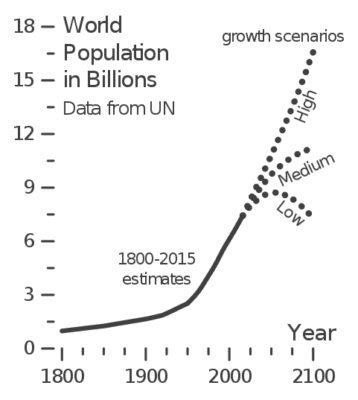
    A line graph shows world population (in billions) from 1800 to 2100, steeply rising after 2000 with three future growth scenarios: high, medium, and low. Data is from the UN, with estimates for 1800-2015.
    By Bdm25 – Own work, CC BY-SA 4.0

    The Solution

    The push for larger families, from taxes to celebrities, relies on an underlying and outdated family planning model, developed decades ago, that is all about what parents want. Under that model, parents should decide to have kids based on whatever makes the parents happy in the short-term, rather than planning their families around what kids need in the long-term. And as such, parents are left easy targets for politicians and businesses that profit from urging them to have more kids. The parent-first model does more than just destroy our and our kids’ environment – it is widening the gap between rich and poor, degrading our democracies, and bringing kids into abusive and neglectful homes.

    Having Kids instead promotes a child-first Fair Start family planning model is that designed around what all kids need in the long-term. The model urges parents to wait to have their first child, urges them to work with the community to get the resources they and their child need for a fair start in life, and promotes smaller and more equitable families.

    Parents are beginning to adopt the Fair Start model, and pushing back against the trend of celebrities modeling larger families. You can too, and speak out for a better future for all.

    Learn more at HavingKids.org. Your future depends on better family planning for all. Protect yourself and the ones you love.


    [/et_pb_text][/et_pb_column][/et_pb_row][/et_pb_section]

  • Population Crisis in India: Time for Child-First Family Planning?

    Population Crisis in India: Time for Child-First Family Planning?

    As India’s population continues to explode and eventually surpass China’s, calls for population control measures are getting louder. But the calls are often framed as attacks between religious groups, blaming each other for the growth, as India’s historic family planning system continues to struggle and impede basic forms of development, human rights, and environmental protection.

    Is there a way out?

    Having Kids recently called out Trump and the United States for violating international law by pushing pronatalist policies, in contravention of the Universal Declaration of Human Rights “right to found a family” provision, which requires a collective action norm to establish family planning systems that are child-focused, with parents and communities making decisions and structuring resources to bring children into the world only above certain thresholds of wellbeing, like those required by the Children’s Rights Convention.

    Rather than remain mired in religious blame games that exemplify parent-centered thinking, as the population crisis only deepens, India should move towards a child-first family planning system. The solution is about loving the children we will have enough to give them what they need, right fro the start, and cooperating in a way that allows that.

    Having Kids stands prepared to fund a study implementing child-first and human rights-based family planning in India, and will be reaching out to India’s leaders this year to reinforce that offer.

    Want a better world? Let’s move from a family planning system focused on what parents want, to one focused on what kids need – right from the start.

    That’s love – in action.

  • The Problem (WARNING: Disturbing Content)

    The Problem (WARNING: Disturbing Content)

    A father of four, who had previously abused two young children, is finally imprisoned after he fractured his four-year-old son’s ribs, deliberately burned him, and left him permanently scarred from whippings.

    A couple is sentenced to life in prison after leaving their nine-month-old twin daughters, who each weighed about eight pounds when investigators found them, to starve to death in playpens filled with maggots. The couple told authorities they felt overwhelmed taking care of the children with limited help while working long hours.

    A parent and others are sentenced for abusing a five-year-old boy over the course of several months. They beat the boy so severely that he suffered two strokes and had multiple broken bones. He had been locked in a room, bound with duct tape over his eyes, beaten with belts and a hammer, and had been kicked in the genitals until he bled.

    Parents are sentenced for torturing and killing their three-year-old, who died from blunt force trauma to the stomach. There was evidence they had previously used torture as punishment, as investigators found whip marks, cigarette burns, and fingernail gouges.

    A mother is convicted of locking her special needs son in a bathroom for a year. He was found lying on a blanket, unable to use his legs because he was too weak.

    A father is convicted of beating his child with two-by-four wooden boards, pipes, and dog leashes; on one occasion the boy spent eleven days in the hospital.

    A mother is convicted of beating her five-year-old to death; the girl died from internal bleeding.

    The list could go on for a very long time…

    These are just a few of the endless stories of children, tortured and often killed by their own parents, in just the past year.

    National statistics
    , despite underreporting, show an estimate of  1,670 to 1740 children dying from abuse and neglect in the U.S. each year.

    What if we could prevent these things from happening?

    We can prevent these horrors by changing the way we plan families. Moving from a subjective and parent-first model to an objective and child-first family planning model is the necessary first step. Making that change involves 1) Understanding that our after-the-fact public child welfare systems are a failure; 2) Identifying the underlying issues that drive the problem; 3) Promoting judicial Fair Start court orders that move our society to take family planning seriously. In short, we, as a society, need to prove we are intent on actively preventing the torture and killing of children, rather than simply waiting around to react to it.

    The Obvious Problem: A Pipeline from Poor Family Planning, to Abusive Homes, to Horrific State Systems

    Studies link child abuse to poor family planning. That seems like an obvious connection. But rather than focus on interventions before parents have children, the go-to solution to all of the horror stories described above has been for the state to wait until a child has been repeatedly abused, put them into the public child welfare system, and prevent the abusive parents from having custody of any more children.

    That solution, by itself, is obviously insufficient. Obviously, the children have already been abused, but also, state systems are a spiraling down failure as more and more children get shuffled into them.

    Here are just a few examples:  

    In Indiana judges have taken to the press, saying the state child protection system is drowning after the state director resigned saying that current state policies “all but ensure children will die.”

    In Kentucky an oversight panel that reviews child abuse deaths and serious injuries is urging the state put more money into child protection services, saying its social service agency remains “grossly underfunded, under-resourced and understaffed.” The panel reviewed 59 cases of child deaths and 91 cases in which children nearly died from suspected abuse or neglect during 2016 alone.

    An in-depth investigation in Arizona suggests the state and the foster-care system is itself a hotbed of abuse and neglect.

    In North Carolina an investigation found that more than 120 children have died in the state within a year of their parents or caregivers being referred to a state agency; more than 30 of the children were killed by being beaten to death, shot, drowned, smothered, or poisoned by drugs. In many states, the abuse is compounded by homeschooling, which is used as means of hiding children from authorities.

    The recent opioid crisis in the U.S. has only accelerated the problem. Foster care cases involving drug-using parents have hit the highest point in more than three decades of record-keeping, accounting for 92,000 children entering the system in 2016, according to data by the U.S. Department of Health and Human Services.

    The Underlying problem: A Debate About the Right to Have Children and Family Planning Models

    In a landmark case, one state supreme court, faced with this unwinnable scenario, found a way out.

    They approved as constitutional a court order preventing a recidivist defendant from having children until he was able to show that he was able to care for them. Sadly, not all of the justices on the court agreed. One said this: “Men and women in America are free to have children, as many as they desire. They may do so without the means to support the children and may later suffer legal consequences as a result of the inability to provide support.”

    Is that right? Is it really the case that parents have no responsibility to be ready before they have kids? It doesn’t matter how many kids parents have, the impacts on the children and the community are irrelevant, and taxpayers should just continue to fund the cycle of abuse and failure described above?

    Is that really what we believe?

    In the next post, we will discuss the solution.

  • Having Kids Is Offering House Speaker Paul Ryan 25K in Exchange for a Vasectomy

    Having Kids Is Offering House Speaker Paul Ryan 25K in Exchange for a Vasectomy

    Paul Ryan is pushing women to have more kids, saying that “he did his part” by having three kids. Ryan wants women to produce more workers for the economy, which is part a larger Republican push that includes an increase in child tax credits they tout as a way to nudge people to create bigger families.

    It’s a move some are calling an outtake from “The Handmaid’s Tale.” Ryan’s version of good family planning means pumping out lots of kids and hoping for the best.

    What’s wrong with that? 

    Given that having smaller families is the most effective way for the average person to mitigate climate change, and that the Pentagon recognizes climate change as a national security threat, Ryan’s push amounts to threatening national security. Shouldn’t we be having fewer children and investing more in each child to build a resilient and highly developed future populace that can thrive, despite climate change?

    Ryan’s push also ignores an obvious fact: Even with lower birthrates U.S. population is still projected to climb drastically, adding another 100 million people in the next fifty years. What about the quality of your daily life – from climate change, to the cost of housing, to hours spent in traffic, to the level of parenting that went into the people around you, etc. – suggests we just don’t have enough people? Does that really feel like the problem?

    Ryan’s push would also exacerbate what David Brooks called pediacracy, or the locking in of economic inequality from birth, something he blames for “ruining America.” That, plus Ryan’s tax reform policies which are themselves expected to exacerbate inequality, amount to chipping away at the social foundations of the country. At what point does the gap get big enough that the foundation gives? At what point should it give? Why push more children through a system that increasingly fails to develop them, and increasingly hurts moms and kids? If we are desperately trying to fix a particular system, is pushing more people through it a good idea?

    Our Offer to Ryan

    This is the offer we sent Ryan today, who despite his working-class rhetoric, comes from the privileged position of a wealthy family. It addresses all of the problems above, and would allow Ryan to lead in shifting the country to better family planning.

    Having Kids, Inc. will pay you, Paul Ryan, $25,000 on the conditions that you 1) undergo a successful vasectomy procedure within the next two months, as well as 2) publicly announce that you have donated an amount of your choice to a charity of your choice for the purpose of moving at least one child living in a U.S. household falling beneath the 2017 Federal Poverty Guidelines closer to a fair start in life, i.e. closer to the privileges and opportunities in life that your own children now have.

    An Alternative Proposal

    The best way to address the twin threats of climate change and growing inequality is to directly link our child development and family planning systems, and incentivize smaller families that cooperatively plan for and invest more in each child. It’s call Fair Start family planning. It’s not only sound policy, but it’s mandated as fundamental human right, the best interpretation of the Universal Declaration of Human Rights guarantee of the “right to found a family.”

    What would that mean exactly? Recently, Republicans moved to modify tax-advantaged “529” educational savings accounts to allow fetuses to become beneficiaries. Instead, why not work with states to fully fund those accounts for prospective parents and children, including college tuition, through progressively scaled contributions that also require some cooperative and progressively scaled contribution from parents, before they have kids? Learn more about that here.

    Anne Green, Executive Director of Having Kids, has this to say. “Having kids means thinking about the future, and better family planning policies that will produce sustainable, equitable, and democratic communities. What children need to become parts of the economy is a lot less than what they need to be capable participants in a democratic community, and democracy comes first.”


  • What You Said About Large Families, Irresponsible Parenting

    What You Said About Large Families, Irresponsible Parenting

    By now, you’ve seen the viral video of a polar bear starving on Canada’s Baffin Island, a symbol of the impacts of the climate change. The underlying driver of anthropogenic climate change is poor family planning. That’s why, as numerous studies have shown, the best way for the average person to mitigate climate change is by choosing smaller families.

    So it’s pretty simple. If we are not brave enough to deal with unsustainable family planning models that have driven climate change, we are not doing what is required to in the long run to protect animals like the bear on Baffin Island. Poor family planning is the underlying problem and the root cause.

    Six adults sit in a row outdoors, dressed formally. The words Unsustainable and We need to do better appear above them, with HavingKids.org in yellow text at the bottom right.As much as we would like to think otherwise, and as much as they would protest to the contrary, celebrities and other public figures serve as role models. This impacts everything from product purchases to lifestyle choices, including family planning. Very large swaths of the populace are extremely invested in the lives and choices of their favorite celebrities.

    Having Kids saw this in the strong and often furious reaction to our Open Letter to the Royals. We were told to mind our own business, that more royal rich white people were a good thing, and that we worry about other populations.

    But public figures create space for conversations. They make the abstract real and relevant, and we want the voices of people like you that that care about the planet, the future, to be heard. The future belongs to all of us. 

    When former celebrities Tori Spelling and Dean McDermott went chasing publicity by having another child, even Tori’s mom said enough was enough. We wondered what the public thought. Here are the results of our poll:

    “Given that the world population is set to grow by another 2½ billion people by 2050, and that larger families are biggest drivers of climate change, should Dean McDermott and Tori Spelling continue to have children?”

    No: 96%  Yes: 4%

    “If they should not, would there be any public or government interventions, like tax disincentives, that should be used to discourage them?”

    Yes: 88%  No: 12%

    “Does your right, and the right of future generations, to have a healthy natural environment and biodiversity outweigh current individuals’ right to have as many kids as they want?”

    Yes: 90%  No: 10%

    These results support common sense and are the basis for the Having Kids Model. Kids are not props, and should not be brought into existence unless their right to a fair start in life will be met.

    If you agree it is important to stand up for children and want more child-first advocacy, please be a part of Having Kids.

  • Giving Tuesday: Why Donate to Having Kids?

    Giving Tuesday: Why Donate to Having Kids?

    You care about kids. You care about the environment. You care about equality. Why not do something to protect the things you care about, all at the same time?

    You can, simply by helping people work together and think ahead when it comes to planning their families.

    This is the Fair Start family planning model, and Having Kids is finding ways to build it into our legal, corporate, and cultural systems:

    • We all help parents wait, plan, and be ready before they have kids.
    • We also help them fight for the resources they need, and have a right to, to give their kids a fair start in life.
    • We ease this process by helping to promote smaller, cooperative and more equitable families.

    On this Giving Tuesday please consider what Having Kids does, and give what you can.

    The image is a plain white background with no visible objects, text, or features.

  • The Fair Start model, made easy

    The Fair Start model, made easy

    The Atlantic has for some time published a thoughtful series of articles analyzing the reasons people decide to have children. It’s unfair to generalize about such a large body of work, but at Having Kids we think there is a sometimes express and usually implied norm in the articles: That each person has for themselves to decide the timing and number of their children, for their own reasons. The question is posed as: Should I have kids? That reflects the near universal norm underlying family planning today, something we call the Isolation Model.

    We think that’s the wrong question to ask. When parents ask it they are wondering whether they will be able to provide for their child, whether the future world they will bring their child into will be good enough, how the child will impact their lives etc. But they usually don’t see that the answer to that question depends – most of all – on the collective reasons and actions of everyone in the world making that same decision, and having or not having children. Whether you will provide well enough depends largely on your own family circumstances and background, and the systems – cultural, economic, social, political, etc.  – that will assist you in providing. It’s takes a village, as they say. Your child’s future world will be defined by the qualities and quantity of the people in it, something that is mostly determined by family planning decisions today and in the past. Will a child destroy your freedom? That depends on the level of quality at which you parent, and the help you get in the process, both of which depend on the often subtle systems of family planning and parenting in which we live.

    So, the question should not be “should I have kids?” Rather it should be, how should we all plan together to have kids, biologically and otherwise? We can only get what we want, and the future we want for us and for our kids, by working together. One way to do that is to change from the Isolation Model to a collective action model called the Fair Start model. It’s a human-rights based model that’s pretty simple: It treats prospective parents, future children, and the community as equal parties in the process, prioritizes consensual government (or political freedom) as the goal of the process, and models the decisions the parties would make to become free.

    But whatever model we choose, climate change means the time for acting in isolation is over. Thoughtless family planning is the greatest threat to our and our kids’ future. And parents don’t take threats to their children lightly, or stand by while governments do nothing. Having Kids will find parents that care enough about the future to take action, and help them shift our systems of family planning to build the future we all want, and deserve.

    The image is completely blank with a solid white background and no visible objects, text, or distinguishing features.