Category: Children’s Rights

  • Earth Day: Speak Up And Act On Better Family Planning

    Earth Day: Speak Up And Act On Better Family Planning

    Earth Day is this Sunday. Time to start talking about better family planning for everyone.

    Nicholas Kristof, writing for the New York Times, recently examined where humans’ and animals’ interest seem to collide, but eventually flow into alignment. But he missed the biggest confluence of all, the significant drop in average fertility rates around the world. Smaller families have allowed more investment in and development of each child, a pronounced period economic growth, and perhaps our best chance to stave off the worst effects of climate change and the many related environmental catastrophes.

    Recent studies show that air pollution contributed to the deaths of six million people in 2016 alone. The number of deaths would have been reduced if world leaders had done a better job on family planning, had used modeling that reduced overall emissions and consumption, and at the same time had invested more in each person from the start, to make them more resilient. Inaction on family planning helped cause these deaths. When will that change? When will the United Nations Secretary General, for example, take the action we need?

    Smaller families that invest more in each child are the beginning of, and central to, any version of an environmental and animal protection ethic. Better family planning is a fair and win-win balance between what we need and animals need, between the human and nonhuman worlds. Better family planning helps humans and animals at the same time – more so than any of Kristof’s examples.

    For Earth Day, speak up and take action for better family planning now.

  • Will Racism Ever End Without Better Family Planning?

    Will Racism Ever End Without Better Family Planning?

    Denene Millner sketches out the lines of a blueprint for a new and better American Dream, born of the persistence of racism, and need for success to mean more than wealth. It’s a beautiful sketch. But she ends suggesting some form of voluntary economic segregation. “Segregation made the black community self-reliant.” Is there an alternative?Image result for black leaders quotes overpopulation

    Perhaps it lies in her focus on children, and the family. Could racism begin at home? Could home begin with family planning? Martin Luther King recognized the dangers of poor family planning and the growth of our population. What if we couple the solution, smaller families, to a public family planning ethic that treated the decision to bring every child into the world as an act of deliberate inclusivity, with everything that means for economic positioning, racial equality, and equity of opportunities in life.

    Racism persists in part because we tolerate a cavemanish family planning model that treats the act of parents creating and raising children as somehow personal and private, as if it did not create the social world we all share. Doesn’t that treat future children, and the nonhuman world we colonize, as if they were our property, and ours alone to control? Rather than resegregate as Millner might be suggesting, shall we go to the source of our deepest social insufficiencies? Racists don’t fall from the sky – they are born and raised in the shadows and illusion of isolation. We “come together” as future generations enter. Do we want to come together in the way Dr. King envisioned? Better family planning is the key.

  • Today’s Family Planning Is Shaping Your and Your Family’s Future

    Today’s Family Planning Is Shaping Your and Your Family’s Future

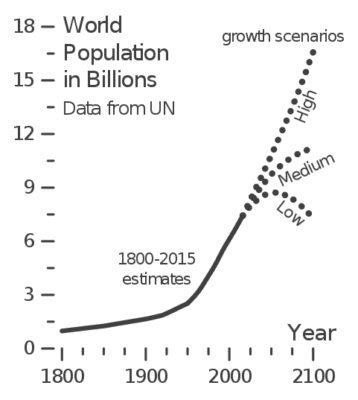
    Many caring and thoughtful people who are concerned about the future of the world are being pushed off the idea of having kids. They are concerned about climate change, the mass extinction of other species, and acidifying oceans filled with plastics. All of those things are driven by exploding population growth.

    A line graph shows world population (in billions) from 1800 to 2100, steeply rising after 2000 with three future growth scenarios: high, medium, and low. Data is from the UN, with estimates for 1800-2015.
    By Bdm25 – Own work, CC BY-SA 4.0

    At the same time, many other families are having as many kids as they can, often for religious reasons, or because it distinguishes them from other families, or because they see their family as a replacement for the community around them.

    Is it fair that some people, often the ones that care the most about our future, are put in the moral dilemma of whether to have children because other people are having so many? Do parents that ignore the risk large families pose to the future have the right to infringe on a well-prepared and thoughtful family’s right to have one or two children?

    Today we have a historic opportunity to protect the future, for ourselves and for our families. We can change the course on that graph. We can embrace the worldwide trend of people choosing smaller families. We can demand fairness, and the better world that better family planning can create.

    Child-first family planning means working with your community to get the resources you deserve to give your child a fair start in life, with equal opportunities relative to their peers, and planning a smaller and sustainable family where you and others can invest more in each child.

    Speak up, and speak out. Other peoples’ family planning decisions are deciding your future. Help them get it right.

  • Urge the U.N. Secretary General to Support Child-First Family Planning

    Urge the U.N. Secretary General to Support Child-First Family Planning

    As the United Nations Commission on Population and Development meets in New York this week, Having Kids is urging Secretary General António Guterres to issue a new statement on family planning. Previous Secretary General statements have focused on the rights of parents; Having Kids is urging the Secretary-General to now make a statement that includes the needs of future children and how those needs must shape truly human rights-based family planning models.

    Read the full letter here. 

    Circumstances have changed since former Secretaries General have issued family planning statements; a revised statement is urgently needed.

    • Several studies confirm that smaller families are the best way to confront climate change, as well as other and related environmental crises. If we take climate change seriously, we must laud the benefits of a global family planning ethic that promotes smaller families.
    • The science of early childhood development shows the disproportionate impact the beginning of our lives has on the rest of our lives. This holds true, among other things, for economic inequality.
    • Better family planning is now understood to be an effective way to prevent the conditions that give rise to terrorism and other conflict-based threats to human rights and democracy.

    Take action now. Contact Secretary General Guterres here and politely urge him to consider our request.

    Having Kids is a 501(c)3 nonprofit nonprofit organization dedicated to reforming family planning by replacing parent-centered family planning models with the human rights-based and child-first Fair Start model.

  • Doesn’t Preventing Child Abuse Start with Family Planning?

    Doesn’t Preventing Child Abuse Start with Family Planning?

    April is Child Abuse Prevention month and in the United States the situation is bleak.

    According to the Centers for Disease Control and Prevention, in 2015 at least 683,000 children were abused or or neglected.  1,670 of those kids died.  At the same time, multiple state child welfare systems are failing, in part because of the opioid epidemic, which greatly contributes to the hundreds of thousands of children in foster care.

    But numbers alone don’t tell the real story.

    This week, a national story broke about a Tennessee couple facing criminal charges after allegedly abusing a nine year-old girl in their care, including urging her to kill herself, forcing her to drink water out of the toilet, and making her sleep in the bathtub.  Investigations began after the hungry girl tried to steal food from one of her teachers.  Court records suggest the treatment is consistent with torture.  This comes on the heels of the notorious Turpin family case in Perris, California, where a couple is alleged to have tortured thirteen siblings, over a span of years, in a literal house of horrors.  That case followed thousands before it, an endless sea of abuse, as far back as we can see and with no end in sight.  Child abuse is like a river – children flow downstream, marked with what they have been through in life, if they survive at all, and all we think all we can do is pluck them out of the river one by one and try to care for them.

    Last week, in the wake of story after story of horrible child abuse across the country, Having Kids, a national organization focused on reforming family planning, tried something new.  Child abuse is a national epidemic, and our child welfare systems are simply insufficient – offering a level of care none of us would think fitting for our own children.  And yet by not reforming our family planning systems, we are literally and senselessly pushing kids through those miserable systems.

    Rather than just react to a case of child abuse by demanding punishment for the abusers, Having Kids called on the governor of Tennessee to seek a judicial order in an effort to protect children before the abuse ever occurs.  In the case in question, a couple stands accused of severe long-term neglect of their autistic child.  Having Kids called for a judicial order (called a Fair Start order) that would temporarily prohibit the couple, in the event they are convicted, from having additional children.

    The point was clear:  It’s time for a new rule.  Child abusers should not have children until they can be rehabilitated.  That waiting period protects kids, helps the parents, and alleviates pressure on failing state systems.  It’s a win-win, one that takes seriously the ideas of prevention, and that each child deserves at least a minimum level of wellbeing before they arrive in the world. Fair Start orders are part of what Having Kids calls the Fair Start family planning model. It has three steps: We all help parents wait, plan, and be ready before they have kids. We also help them get the resources they need, and have a right to, to give their kids a fair start in life, by reforming family planning, tax, child protection and social development policies, as well as the culture of parenting those policies have created.  We ease this process by helping to promote smaller, sustainable and more equitable families where we can all invest more of what matters in each child, right from the start.

    There was pushback from some who said the move to institute a judicial Fair Start order in the Tennessee case threatened to violate parents’ moral and legal right to have kids.  Is that true?  Is there a right to have kids in a home where we know there is a history of abuse and neglect, where doing so endangers children, interferes with the parents’ own beneficial rehabilitation, and threatens to burden already failing state systems?  To put the victim of child abuse back in a home with abusers before they are rehabilitated seems outrageous.  Why should we, as a society, accept allowing a new victim to be born into that environment during this time period?  Who benefits from such a limitless right?  Who would argue for such a thing?

    The case in Tennessee against the couple accused of neglecting their autistic child is still pending, and the state may or may not take action.  Regardless, a new approach to ending the sea of child abuse has emerged, and the question of whether we are willing – as a country – to do what it takes remains to be seen.

  • Men Pushing Women to Have Kids. Time to Push Back?

    Men Pushing Women to Have Kids. Time to Push Back?

    [et_pb_section bb_built=”1″ admin_label=”section”][et_pb_row admin_label=”row”][et_pb_column type=”4_4″][et_pb_text admin_label=”Text” background_layout=”light” text_orientation=”left” use_border_color=”off” border_color=”#ffffff” border_style=”solid”]

    Lots of men are getting in on the action of pushing women to have more kids, from the Serbian military which recently vowed that it will “participate in raising the birth rate,” to ball-brained bloggers who decry the impact lower fertility is having on youth sports, to politicians urging women to ignore their futures and hurry up and breed the next generation of taxpayers, consumers, and workers.


    Best of all, Donald Trump is doing everything he can to prevent women from not having kids, by pushing back years of progress on access to family planning, and role modeling an unsustainably large and consumptive family.


    Our species has, for most of its history, accepted the cultural push for larger families and higher birthrates because it benefited us, as a species. The caveman and patriarchal systems approach to family planning, “just have more,” had some merit. That all changed in roughly the Twentieth Century, when world leaders realized that population growth itself posed a grave threat to our species, and launched family planning interventions that cut worldwide fertility rates in half. Yes, that happened.


    There was just one problem – these efforts were based on incomplete information. World leaders in the Twentieth Century did not account for climate change, and a dozen other unforeseen impacts on our social and natural environment, from the acidification of oceans to the massive extinction of other species. They did not account for advancements in the science of childhood development, which today show how family planning impacts the prospects a child has in life, for their entire life. They did not account for how, consistent with those impacts, family planning policies could exacerbate the massive gulf between rich and poor.


    In short, the interventions did not go far enough, and certainly did not account for linkages between the issues above, like how better child development policies could have offset humans’ innate cognitive dissonance around slow-moving threats – like climate change.


    What does all of this mean? Today, as an already unsustainable world population skyrockets towards eleven billion, the men who are pushing women to have more kids are a manifest threat to all of us, and the wellbeing of our children. Their caveman approach to family planning is not just wrong. It’s dangerous. Instead, we should embrace the clear trend towards lower fertility rates as a form of human evolution, the move towards a sustainable population, families that can invest more resources in each child, and the creation of smaller –  and hence more democratic – communities where each person has more of a voice and role in creating the rules under which they live.


    Take action: If you belong to civil society organization, one that protects the environment, children and their futures, democracy and human rights, equality for women, etc. please politely encourage them to consider taking a public stance on the need for better family planning, and encouraging a model that promotes smaller and sustainable families where every child is guaranteed a fair start in life.


    [/et_pb_text][/et_pb_column][/et_pb_row][/et_pb_section]

  • Having Kids Seeks Court Order to Prevent Neglectful Couple from Having Additional Children

    Having Kids Seeks Court Order to Prevent Neglectful Couple from Having Additional Children

    Sharon Helene Robinson and Bradley Dwight Hill of Tennessee have been accused of criminal child neglect after their severely autistic child was found naked, and covered in both human and dog feces, which he was eating. Excrement was also found in the child’s bed. The police reported: “Ms. Robinson stated that she is a meth user and this also contributed to her not caring for her autistic son.”

    Having Kids is petitioning state authorities to seek a Fair Start court order, in the event the couple are convicted, temporarily prohibiting them from having additional children during the pendency of any probation in order to facilitate the couple’s rehabilitation and recovery, and also to prevent the neglect of any future children. Having Kids will eventually also call for specific legislation to authorize Fair Start orders in Tennessee. Having Kids is targeting Tennessee because the state is currently considering legislation HB 2520 / SB2133, regarding coercive family planning and sentencing. The model Fair Start order is noncoercive and seeks to strike a balance between the rights of parents and the needs of future children and the community. The charges against Robinson and Hill show a clear need for that balance, and Fair Start orders can make clear the state’s compelling interest in the welfare of future children, counteracting any dangerous and inadvertent signal HB 2520 / SB2133 might send.

    Learn more about Fair Start orders and why they can help us change a dysfunctional family planning model based solely on what parents want, to a better family planning model based on what all children need.

    National statistics, despite underreporting, estimate that 1,670 to 1740 children die from parental or caregiver abuse and neglect in the U.S. annually. And many of the perpetrators continue to have and abuse additional children. The recent opioid crisis in the U.S. has only accelerated the problem. State child protection systems around the country are in crisis, with multiple state systems failing and clear linkages to increased child abuse. Foster care cases involving drug-using parents have hit the highest point in more than three decades of record-keeping, accounting for 92,000 children entering the system in 2016, according to data by the U.S. Department of Health and Human Services.

    “If even one fewer child is abused, that represents a better world,” said Anne Green, Executive Director of Having Kids. “We can do so much more to protect the most vulnerable.”

    UPDATE: Having Kids has already received a response from Tennessee Governor Bill Haslam. After review of our letter, he forwarded it to Commissioner Hommrich and the Department of Children’s Services. Therefore, Having Kids is now urging supporters to contact Commissioner Hommrich Department of Children’s Services only to respectfully request that action be taken to ensure better family planning that protects parents, children, and the community.

  • Toys R Us Fails To Adapt, Blames Fertility Rates

    Toys R Us Fails To Adapt, Blames Fertility Rates

    In the wake of its bankruptcy announcement, Toys R Us is giving out free family planning advice: Americans, and millennials in particular, are not having enough kids.

    Forget the fact that having large families is the worst way for the average person to exacerbate climate change, otherwise destroy the environment all kids will need to thrive in the future, and lock in the family-based disparity of wealth that is ripping at the fabric of American democracy. What really matters is that Toys R Us exploit more workers to sell more toys, toys that your kids don’t need.

    Toys R Us is worried that smaller families will hurt the U.S. economy. Here’s a thought: The U.S. is meant, primarily, to be a democracy, rather than an economy. What’s the difference? Democracies are by nature smaller, so that each person in them has a voice and plays a role. Their members are not lost in the crowd. Democracies are by nature sustainable, because their future citizens matter. Democracies are made up of free and equal people in whom prior generations have invested much, and right from the start. People in democracies don’t plan families based on how to best sell toys. They plan them based on what children need to thrive as self-determining, free and equal people.

    The move towards smaller families, with parents investing more in each child, represents a move away from the oppressive and unsustainable economies of old towards real democracy, and the end of companies like Toys R Us  – which recently filed for bankruptcy. They should accept the blame for failing to adapt to the 21st century landscape in order to compete with Amazon and other big box and online retailers, rather than pointing the finger at families.

    Toys R Us is wrong on family planning. Tweet @ToysRUs and tell them to stop blaming parents for their business failures.

  • What Do School Shootings Have To Do With Family Planning?

    What Do School Shootings Have To Do With Family Planning?

    Social commentator David Leonhardt is right when he says the teenagers recently killed in Florida “had the misfortune of growing up — of trying to grow up — in a country that didn’t care enough about their lives.”

    He’s also right when he connects the shooting to the seemingly unrelated issue of infant mortality rates in the United States.

    But he might have taken the next logical step, and connected our disvaluing children back to the source – to the dominant parent-first family planning model in the United States, one that allows politicians to openly promote the use of tax incentives to urge women to have more children, children who will serve as workers, consumers and taxpayers to inflate our economy. How can we value children when we will bring them into the world for those reasons, irrespective of the conditions in which they will be born, of whether they will get a fair start in life relative to their peers, and regardless of the impact our collective family planning decisions have on the environment they will inherit?

    The problem Mr. Leonhardt recognizes begins further back in time – in the way we choose to bring children into the world. How do we change that? We can move away from a family planning model that puts parents before kids, towards one that is child first. That change can also begin at the local level. Start the change in your community today.