Category: Children’s Rights

  • How Does the Fair Start Model Work?

    How Does the Fair Start Model Work?

    Guest author: Mary Jean

    We all deserve the best life. Whether you want a happy kid, a happy cat, a healthy environment to live in, or a happy community, all of it can be done with the right policies and carefully designed models. This is where the fair start model also comes into play. It focuses on how intending parents are planning to give their kids a fair start to their life. Communities and families must go hand in hand to make the future secure and bright for the kids and to provide them with a better living standard from the very beginning. Here is what you need to know about the fair start model:

    What is a Fair Start Model?

    To be precise, the fair start is a child-centric family planning model. It advocates the benefits of having small, sustainable, and equitable families invest more in every child and give them the rights they are entitled to. It helps our mindsets shift from ‘what the parents want’ to ‘what child will need.’ The future of a child is a major concern in the fair start model. 

    The fair start model plays a major role in eradicating problems like child poverty, environmental crisis, bloated democracies, and economic inequalities. Overpopulation leads to inequality and gives rise to grave global concerns, primarily being the inequitable living condition that further leads to exploitation of basic human rights. 

    How Does This Model Work?

    Those who plan to have a child prepare themselves economically and socially first in order to fulfill their responsibility in a better way.

    Together, communities and governments play their part to give all kids a fair start in life, leading them to a secure future, and a socially and economically stable lifestyle. 

    These efforts become fruitful through a universal ethic of equitable and sustainable families.

    What Are the Benefits of the Fair Start Model?

    The model keeps kids from falling prey to issues like poverty, and distress from being neglected. The modeling erases boundaries between child welfare programs and family planning by linking needs with resources. Since the model is centered upon when and where the kids will arrive, and what kids will need to have a fulfilling start in life, it urges parents to give themselves enough time to prepare themselves for starting a family. How we plan our families is what majorly determines the quality of lives we will live, both at the societal and individual levels. 

    Shifting our focus towards a better future incoming generations surely results in the best outcomes. It gives people an agency over their lives that frees them from excess financial burdens that are one of the major causes of mental health issues. Moreover, family planning curbs the overpopulation that is leading to environmental crises – like the water crises un many parts of the world. For saving future generations, a fair start model is the need of the hour!
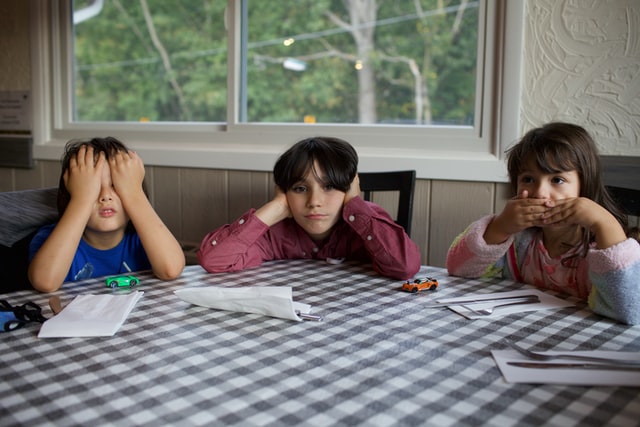
    Three children sit at a checkered table. One covers his eyes, the middle rests his face on his hands, and the third covers her mouth. Toy cars are on the table and a window with trees is in the background.

    Conclusion:

    The fair start model is undeniably an all-in-one solution. It benefits all the basic domains of the world, such as ecology, economics, democracy, and human rights. It provides us with a solution to live the best of our lives even within our limited resources. You can play your part to bring the much-needed change in our family planning system by practicing the fair start model. Save the planet and resources for future generations to come. 

  • Growth Economics Created the Climate Crisis. Why Are Politicians and Media Pushing Women to Have Kids? Ask NYT’s Editor

    Growth Economics Created the Climate Crisis. Why Are Politicians and Media Pushing Women to Have Kids? Ask NYT’s Editor

    Fact: Falling fertility rates and eventual population decline will have the most beneficial long-run impact on the climate and other ecological crises. And yet influential media like the New York Times, and politicians pushed by businesses that rely on unsustainable growth, continue to urge women to have more kids. That is what even progressive Joe Biden is trying to do with his Ivanka Trump-inspired increased child tax credits.

    For demographers and other population experts population decline is the expected and desired outcome of decades of family planning interventions meant to end and reverse unsustainable population growth. Why the media alarmism then? 

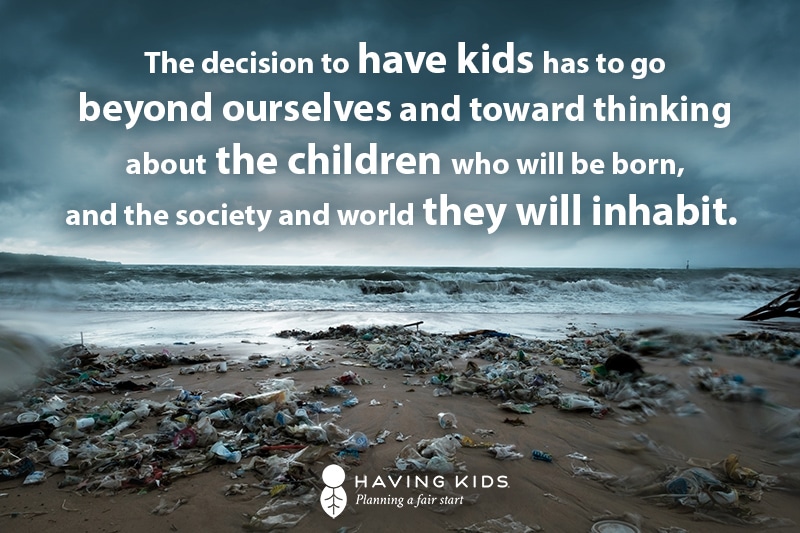
    A beach littered with plastic trash under a cloudy sky. Overlaid text reads: The decision to have kids has to go beyond ourselves and toward thinking about the children who will be born, and the society and world they will inhabit.

    Between the time those interventions were begun and today, neoliberalism and unsustainable growth-based economics that externalizes costs – like the climate crisis and birth inequity, has become the zeitgeist. The Times itself wrote about the same. But fanciful ideologies aside, growth remains unsustainable. The more interesting question is how the arc of population growth became so high to initiate the climate crisis, and who among those who have benefitted from that mistake will pay to compensate the future generations who certainly will be harmed – through no fault of their own.

    Justice begins with an ecosocial #FairStart in life.

    TAKE ACTION: Engage and urge the Times editor and his family to address the #FairStart question, and how we will redistribute power – including influential media platforms – to compensate future generations.

    A circular infographic titled “Fertility Delay Incentives to Planning” shows a leaf in the center with four benefits: Delayed Parenthood, Better Family Planning, Guaranteed Minimum Income, and Equal Opportunity & Education for all kids.
  • Six Best Places To Visit in Southern California With Kids During the Pandemic

    Six Best Places To Visit in Southern California With Kids During the Pandemic

    By Bea Krasner

    Sure, a once-in-a-century virus crash-landed onto Earth — but never fear! We’ve got a list of pandemic-friendly activities for kids in Southern California.

    San Diego Beaches

    San Diego is one of the most scenic places in southern California, and the area beaches are picturesque. So why not plan a sun-and-sand weekend in “America’s Finest City”? If you’re searching for things to do with kids in San Diego, Mission Bay Beach and the neighboring Playa Pacifica Park are great spots for families. Plus, it’s a bucket list item for anyone interested in Americana, as Mission Bay is the largest man-made park in the country. Moonlight Beach, with its gigantic playground, is also a good time.

    Want to wash the sand off your car before returning home? Hit up a drive-through car wash and pop on the Star Wars theme while going through. The kiddos will love it!

    Leo Carrillo State Park

    Going to the Leo Carrillo State Park in Santa Monica, which includes a beach, is a fun day out with the kids. Windsurfing, beachcombing, and fishing are all on tap. Plus, it has tide pools, sea caves, and reefs teeming with natural wonders.

    Malibu Canyon

    With its lurking paparazzo, Runyon Canyon is where celebrities, influencers, and aspiring fame-seekers head for a hike. But if you’re looking to explore with the wee ones, Malibu Canyon is the better choice. Part of Malibu Creek State Park, it’s got hikes for all levels and incredible views. Located about 25 miles from downtown Los Angeles, Malibu Canyon is part of the Agoura Hills in Calabasas.

    Fans of vintage television shows may recognize the area since it was used in many a M.A.S.H. episode.

    Neighborhood Scavenger Hunt

    Staying outside is preferable during the pandemic — so why not do a neighborhood scavenger hunt?

    Parents, we’re not going to sugarcoat it: this option will take a bit of prep on your end. But we think it’s worth it.

    Step One: Stake out a neighborhood. Make a note of both exciting and commonplace things around the town, like benches, statues, murals, and store names.

    Step Two: Make a scavenger hunt card. It can be a list or something resembling a bingo card. You can find examples here, here, and here.

    Step Three: Slap on some sunscreen, make sure the camera phone is charged, and head out the door with materials in hand! Don’t forget to bring pens, pencils, or markers to tick off found items.

    Step Four: Complete the hunt. As a bonus, take pictures of each found object and turn them into a craft or digital art project at home

    This DIY activity is a great way to expose children to people from different walks of life. It can also serve as a teaching tool that introduces children to the realities of systemic inequities and environmental challenges. It’s never too early to bring awareness to the alarming rates of inequality, particularly child inequality, to your young ones. We’ve compiled a fantastic list of child inequality facts that you can share with your kids. 

    Parents interested in solving institutional inequalities should check out the fair start family planning model and movement. 

    Drive-In Movies

    Maybe it’s the gigantic screens or the novelty of watching a film from the car, but for kids, there’s something magical about drive-in movie theaters — and Southern California has lots.

    Options include:

    • Mission Tiki Drive-In Theater — Montclair
    • Paramount Drive-In Theater — Paramount
    • Vineland Drive-In Theater — City of Industry
    • The Roadium — Torrance
    • We Drive-Ins — Santa Monica
    • West Wind Drive-In Theater — Santa Barbara
    • Rubidoux Drive-In — Inland Empire

    Long Beach Aquarium

    Some people call it Long Beach Aquarium, but its official name is Aquarium of the Pacific — and it’s a super Southern California spot to spend a pandemic day with the kids. They have a whopping 11,000 aquatic animals under their care!

    The aquarium is now fully open, but if you want to play it safe, stick to the outside, socially distanced exhibits.

    If you live closer to Monterey, that city’s aquarium is also a treat.

    Things may be a bit different for now, but they’re getting back to normal. In the meantime, play it safe and pick pandemic-friendly activities for a day out with the family.

    Disclaimer: Neither myself nor fairstartmovement.org received compensation for this guest article.

  • Is There A ‘Best’ Way To Parent?

    Is There A ‘Best’ Way To Parent?

    By Jennifer Dawson

    When it comes to the many choices parents must make when they decide to have a child, ‘parenting style’ is one of them. Because parents tend to adopt a blend of styles or strategies, it perhaps befits the topic to do as scientists at Kobe University did in a study, and talk about ‘methods’ instead of ‘styles’. In the study, scientists found that parents tend to use one or more of the following methods when raising children: supportive, strict, indulgent, easy going, harsh, and average (the latter involves having average levels for all other key factors). Although it is impossible to define one specific combination of these factors as ideal, factors certainly emerge that are either positive or detrimental to positive growth and happiness in children.

    Giving Children a Fair Start

    Before discussing parental styles, it is important to clarify that one’s chosen style very much depends on the model of family one chooses to adopt. Having Kids’ Fair Start model aims to help parents make wise choices so that their children can have all their needs met (both material and affective). By planning families better and waiting until they are ready to have children, parents can work on issues that are important to them and their future family – including education and career stability. These, in turn, set up better outcomes for children and increase their chances of a good future. Inequality is something that society as a whole should work to eliminate to give all children a fair start. Currently, around 14.8 million children in the U.S. do not have enough food to eat and around 41% of them live in or near poverty.

    Classic Parental Style Definitions

    In other research (for instance, one study published by the Society for Consumer Psychology), researchers divide parenting into four defined ‘styles’ – authoritative (parents tell children what to do but give reasons for this), warm (parents relate well with children while expecting them to act maturely and follow set rules at the same time as enjoying independence), neglecting (parents offer little guidance and monitoring of a child’s life and activities), and indulgent (parents give children adults’ privileges but do not set responsibilities). In this study, some clear results did emerge. Children who were taught to have responsibilities and follow rules made safer choices, interacted positively with the world around them, and chose healthier diets. The researchers stated, “We found a lot of evidence that demonstrated that it is okay to be restrictive with kids…It’s also important to explain to kids why the restrictions are important.”

    Close-up of an adult holding a child’s hand while crossing a rope bridge. The child, wearing a blue dress, reaches forward for support, and the background is blurred.

    An Example Of Rule Setting: Making Healthy Choices In Life

    Diet is one area which authoritative and warm parents tend to prioritize, as are areas like restrictive use of technology, and an emphasis on the importance of doing homework. This type of parent may take things further, teaching children how to avoid harmful products like BPA – a substance found in a plethora of modern products, including plastic food holders. BPA is known to disrupt the endocrine system and potentially cause or trigger asthma, infertility, early puberty, obesity, and even resistance to chemotherapy. Authoritative and supportive parents may avoid BPA-containing plastics, then, while being honest about the reasons why children have to take glass or BPA-free containers to school. The aim is to interest children in health and to explain why some choices need to be made, even if it means spending time researching healthier alternatives to commonly sourced products.

    Understanding Dos And Don’t In Terms Of Methods

    The Kobe study came to similar findings as the Society for Consumer Psychology research did. Children who had been reared with plenty of support and positive attention earned more money, enjoyed greater academic success, and were happy. Those who were reared very strictly had high levels of achievement but greater stress and lower happiness levels. Attention, interest, and a commitment to helping children understand why specific rules are set up are key. Perhaps, then, the idea isn’t to choose one parenting style, but rather, to give children time, attention and responsibilities, while also explaining reasons for rules and giving children the independence they need to grow into their own person.

    It is difficult (and most probably unfruitful) to strictly define one parenting style that results in success, happiness, health and wellbeing for children. However, studies do show that investing quality time, care and attention in children does make for happier, well adjusted adults in the future. Neglect and strictness with no rhyme or reason do a child little good, and indeed this can be easy to understand for any adult who has ever worked for authoritarian management that left little room for ideas, innovation and independence. In the end, children are not that different from adults after all.

    *Neither the author nor Having Kids received compensation for this piece.

  • Biden’s American Families Plan: Shall We Make It More Just?

    Biden’s American Families Plan: Shall We Make It More Just?

    President Biden is unveiling his American Families Plan this week. It aims to support families with the cost of childcare, expanding child tax credits, providing paid family leave, among other things. But is this enough to meaningfully reduce U.S. inequality (the highest in the developed world) and set up the next generation for a healthy, equitable and sustainable future?

    Leaders on both sides of the aisle already agree that early childhood is critical in positioning kids for success throughout life. Just look at programs like Head Start, SNAP, Medicaid, etc.) The American Families Plan even includes spending for pre-k education. 

    But we need to invest in kids even earlier. We really should be starting from conditions at birth. That is how to truly give kids a fair start in life.

    Given that, shouldn’t we also pursue family planning investments that have more than 50 years of proven results in reducing poverty and improving lives? These are efforts like encouraging delayed parenthood, birth spacing and investing more in each child.

    Yes, family planning decisions are ultimately between parents. But our policies have significant implications for the conditions in which children are born.  

    Therefore, lawmakers must ask key questions as they devise policies if they really want to give kids a fair start in life:

    • How can we help parents be financially ready? 
    • How can we help parents provide stable and healthy home environments?
    • How can we act to reduce inequities and the climate crisis, rather than exacerbate these harms? 
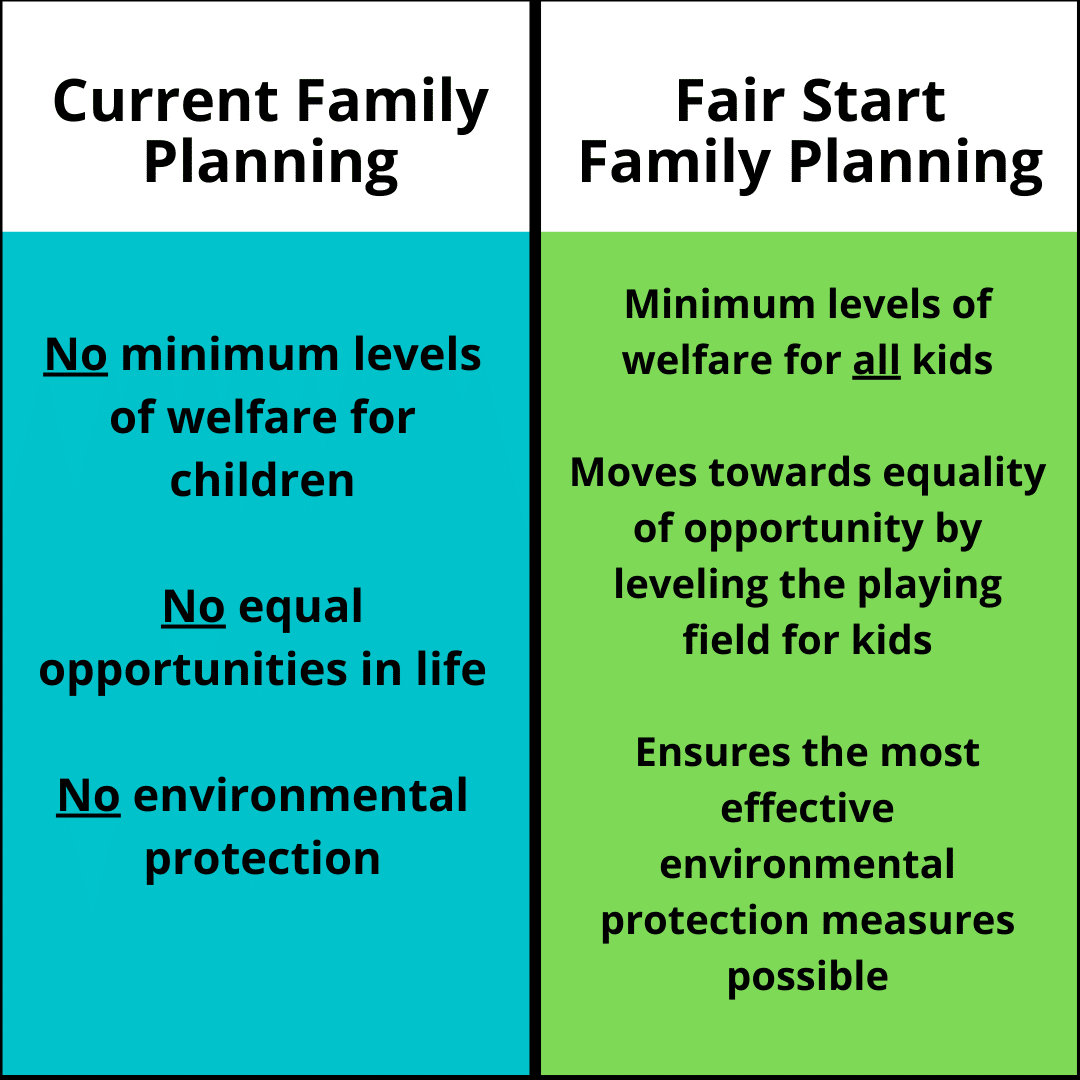
    A comparison chart of Current Family Planning vs. Fair Start Family Planning. The left side lists negatives of current planning; the right side highlights positive outcomes of fair start planning for welfare, equality, and environmental protection.

    Here are a few ways the Biden administration could advance parental readiness and improve equity to give all kids a fair start:

    • Encourage delayed parenthood by releasing funds being held up in the development of the male pill.
    • Making higher education more accessible, allowing parents to better provide for their families throughout their lifetimes. The good news? Tuition-free community college is already included in the American Families Plan!
    • Improve family planning education to arm young people with information about the benefits of delayed parenthood, birth spacing, and focusing resources on kids. Future parents can set themselves up for greater lifetime success and give their future kids a fair start. Why aren’t we giving them this information?
    • Cut all benefits to wealthy families who don’t need the funding.
    • Use those savings as cash incentives to power up family planning and early childhood investment systems in the United States to

    TAKE ACTION: Add your name to urge President Biden to improve his American Families plan. 

  • A Short History of How We Ruined Our Planet and Became Vastly Unequal, and Who to Target for the Fix

    A Short History of How We Ruined Our Planet and Became Vastly Unequal, and Who to Target for the Fix

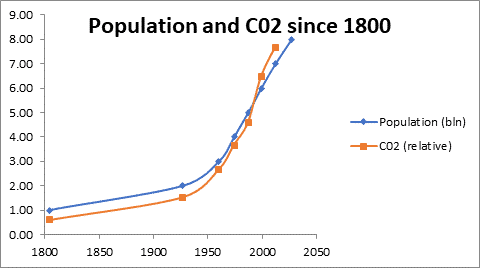
    In the 20th Century world population growth exploded. That growth is continuing, and fundamentally driving massive inequity of wealth and power between the rich and poor as the conditions of our birth hang upon us throughout our lives.

    We are getting more crowded and more divided in an environment that is less hospitable to our species. And yet, family planning reforms can have twenty times the long-term climate impact over other measures, and ten or more times impact on inequity. Why do we rarely discuss them? Below we will examine who benefits from that silence, and how to take them down.

    Line graph showing global population (in billions) and CO2 (relative) from 1800 to 2050. Both lines rise slowly at first, then sharply increase around 1950, with population slightly above CO2 in recent decades.


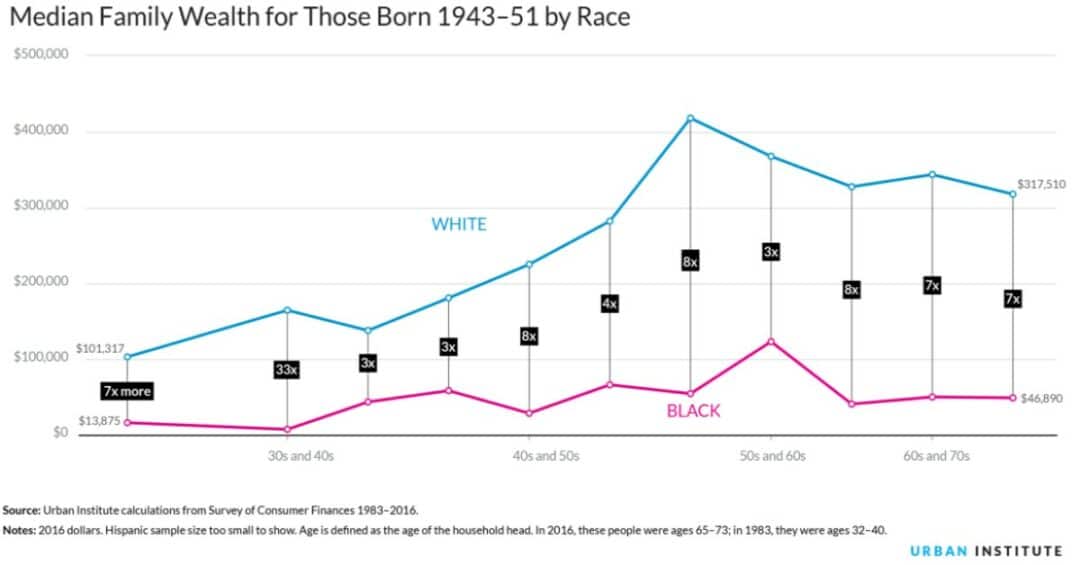
    A line graph compares median family wealth by age for White and Black Americans born 1943–51. White wealth is consistently much higher, peaking at $317,500 in their 60s, while Black wealth peaks at $54,800.

    As the growth explosion began to unfold world leaders scrambled for solutions to the catastrophic social and ecological problems the growth was causing. At the time, in the wake of World War II, human rights had emerged as a fundamental framework for universal policy making and world leaders used it to intervene. While the interventions did set a pathway to reverse the growth, world leaders (mostly men operating under a paradigm of religiosity and ongoing colonization) intentionally misinterpreted the fundamental right to have children in an isolationist way, ignoring the collective obligations around family planning policies and in a way that ensured a certain level of growth. All of this was based on a patriarchal and parent-focused right to have children that ignored the interests of future generations, communities, and the nonhuman world. They intentionally treated family planning as if people lived in caves, isolated from one another.

    That move accomplished several things.

    • First, it ensured continued male control of the family by establishing familial autonomy from justice systems, despite massive power differentials between men and women.
    • Second, it enabled continued population growth, which by creating an ongoing supply of consumers, cheap future labor, and lots of taxpayers, increased economic growth and ensured greater wealth and power for those at the top of the population pyramid. It’s crucial to keep in mind that this was not just about growth in numbers of people, but the model enabled massive inequity, evaded minimum provisions for children, and treated nature as a human resource. The system of exploitation that created the population and wealth pyramid one Nobel Laureate recently noted actually involved four aspects of injustice that, in effect, replaced democracy with marketplaces. And all aspects were hidden behind the veil of familial privacy and autonomy. The things that fundamentally degraded the opportunity for self-rule and equity – family planning and early childhood development – were treated as nobody’s business. This process intentionally replaced citizens who might have voices in their governance with consumers whose choices were limited to markets.
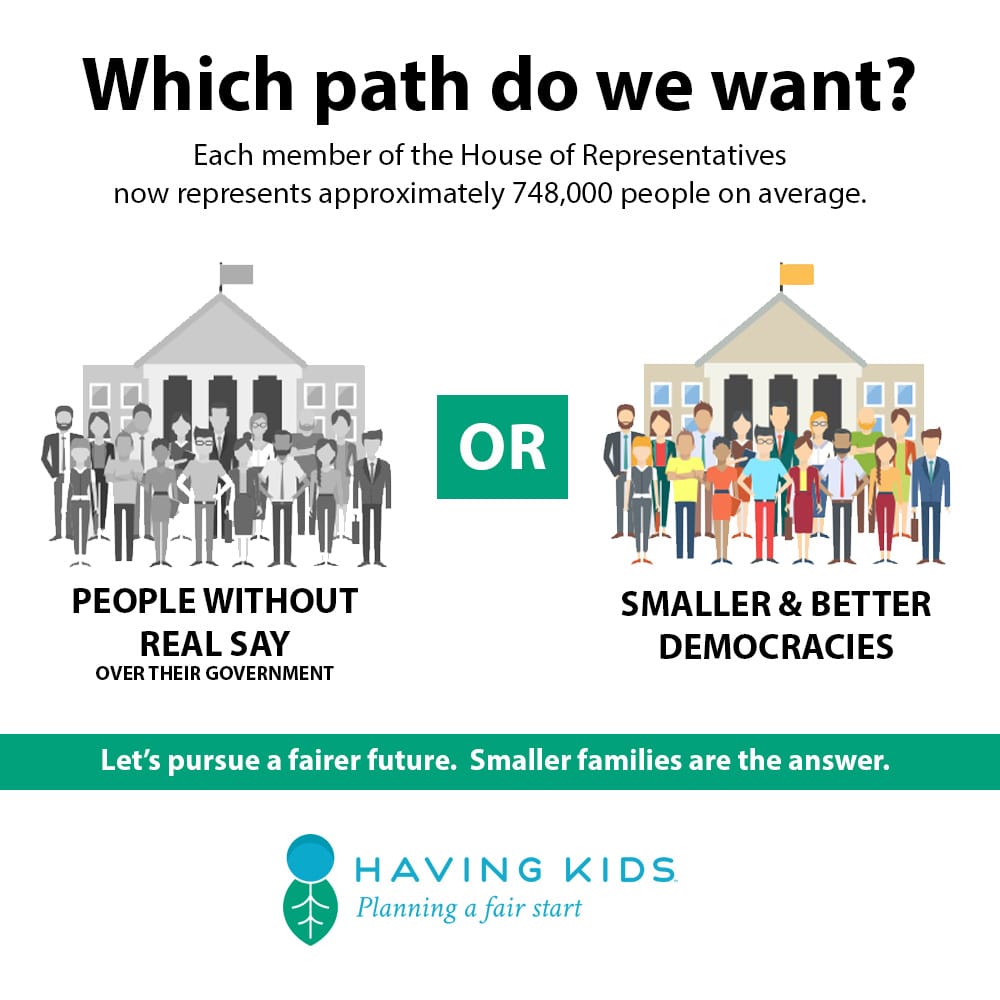
    An infographic compares two options: on the left, gray figures under “People without real say over their government,” and on the right, colorful families with “Smaller & better democracies.” Text promotes smaller families for fairer representation.

    That growth, and our division into cycles of rich and poor families, ensured the ecological and social crises we face today.

    Facts: Those that designed the the isolationist family planning model took risks with relatively unknown factors, like climate emissions, and enabled growth that multiplied – exponentially – their impact. The risks and the harms that resulted and will result would have been avoided through alternative modeling that actually complied with human rights, like Fair Start zero baseline modeling. The modeling moves the world from organizing societies based on coercion, or even self-interest and incentives, towards self-actualization, and maximizing freedom by aligning values in a way that can make us truly self-determining. Look back at theories of social organization, like those based on self-interest, and you will find the proponents hiding the role our creation plays in the process.

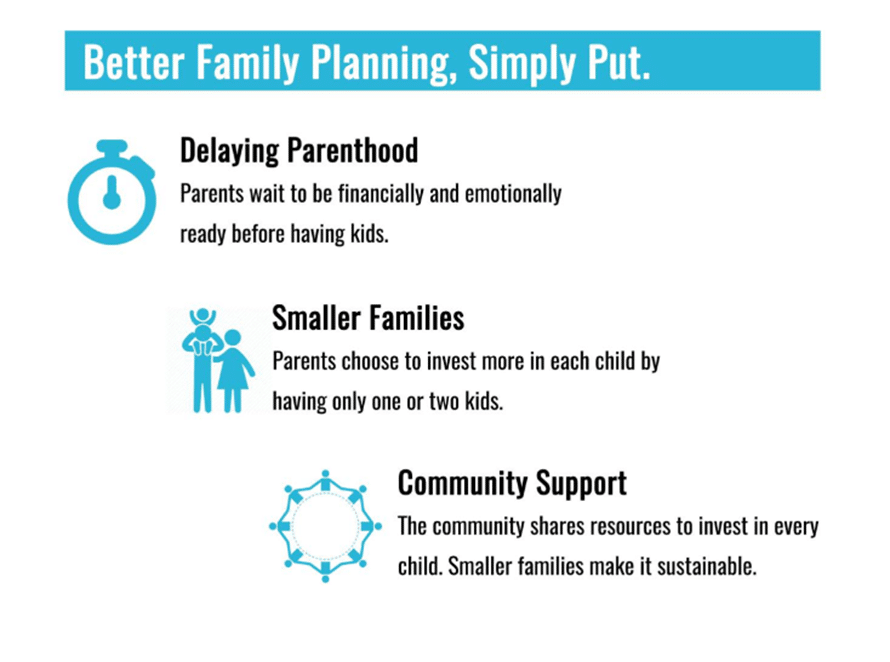
    Infographic titled Better Family Planning, Simply Put with icons and three points: Delaying parenthood, smaller families, and community support, each explained with brief text and blue graphics.

    The people responsible for the continued population explosion in the 20th Century fundamentally created conditions that lead to, and will lead to, massive suffering and death, especially when we consider ongoing intergenerational impacts like the climate crisis. Their followers are continuing to promote growth as a means of enriching themselves, despite impacts on children, animals, and the environment. Now the world stands at a crossroads between continued growth, or a move towards an optimal world population.

    Line graph showing world population (billions) from 1950 to 2100. It displays observed values, median projection, 80% and 95% prediction intervals, and scenarios for ±0.5 child, with population rising then diverging in future projections.

    The solution at this crossroads must be to embrace the family planning and reproductive justice systems that are actually compliant with human rights requirements. That means shifting from our current systems focused on what parents want subjectively, to a system focused on what all children need objectively: An eco-social Fair Start in life. Doing that puts justice over power at the fundament of life. That start is the first human right, and the first necessary condition of freedom, or of not being subjected to others power (including subtle things like bad parenting and climate crises) against one’s will.

    At this crossroads there is a division between free people and pre-constitutionally minded people, or precons (whom we can identify through particular modes of discourse), who refuse to prioritize as the first human right every child’s right to an eco-social Fair Start in life. That start, by limiting and decentralizing human power, has the greatest impact on the most numerous and most vulnerable entities – future generations and nonhumans, and is the most effective solution to the crises we face today with ten to twenty times the impact of downstream measures.

    Understand who precons are – they are blocking a state of affairs where the majority of moral entities can relatively self-determine. They are the fundamental threat to freedom.

    A circular infographic titled “Fertility Delay Incentives to Planning” shows a leaf in the center with four benefits: Delayed Parenthood, Better Family Planning, Guaranteed Minimum Income, and Equal Opportunity & Education for all kids.

    Help us at Having Kids identify and hold accountable those who benefitted the most to pay for what has happened, and those alive today making the situation worse. We have a right to redistribute power by taking their resources to fund Fair Start reforms and there is no greater act of justice that would liberate me, or more vulnerable, entities.

    TAKE ACTION:

    Take a first step action: Urge the United Nations to change course, and adopt Fair Start family planning as the universal standard for reproductive justice. Joe Biden and Congress should do the same and promote Fair Star Bonds as the most effective solution to the interconnected ecosocial crises we face.

    Take a next step action: The children of those most responsible for the climate crisis owe us all – in the form of Fair Start public funding – the wealth their parents took from future generations. Not only did they exploit birth inequity, but they used unsustainable population growth to create their own demand without accounting for the ecosocial costs. Find and legally and politely urge these people to pay what they owe, then share your stories with us so we can publicize them.

    Take a next step action: Engage any group or individual claiming to promote social justice to answer three questions.

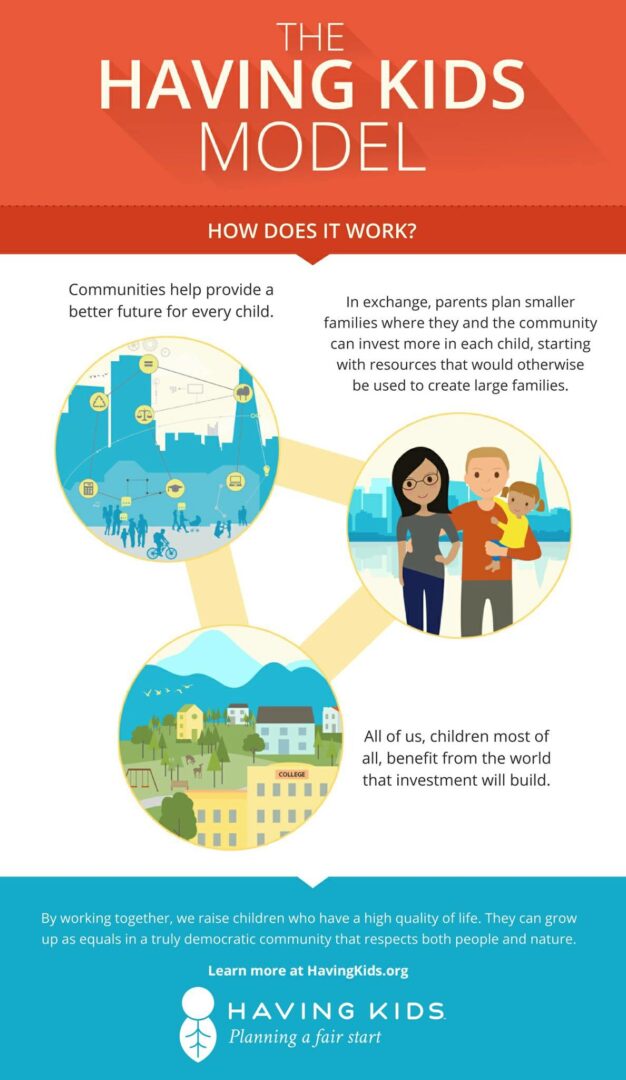
    Infographic explaining the Having Kids Model: communities invest in children’s futures, parents plan smaller families, and all children benefit from increased resources and a supportive environment. Includes illustrations and text.


  • Vox Founder Pushing Population Growth Made the Climate Crisis Worse. Hold Him Accountable.

    Vox Founder Pushing Population Growth Made the Climate Crisis Worse. Hold Him Accountable.

    The Financial Times just published an article detailing the massive impact policies that promote smaller families – for all – have on the climate crisis. Nothing comes close.

    And yet people like Matthew Yglesias and the media outlet Vox continue to push women to have kids. Many have said that we should punish climate change deniers for blocking policy reforms that could have mitigated the crisis. But all climate emission flow downstream from the increase in demand population growth creates. It is the fundamental driver. Aren’t the people actually making the crisis worse, usually to grow their investments, just as bad as the deniers? Did Ygelsias pushing women to have kids actually have an impact? The proposals to change federal child tax and care subsidy policy to encourage population growth that followed his advice suggest it did.

    Let’s hold him and others, like Lee Raymond, accountable. We have a right to take the resources of wealthy people like Lee and Matthew who profited from poor and unsustainable family planning but never paid that costs that growth imposed on the environment, animals, women, and children. Why? Because every child’s right to an ecosocial Fair Start is the first human right, and it precedes and overrides any other obligation, including property rights.

    It’s time to pay up. Those that really profited owe future generations – more than most.

    What is Fair Start? It’s about people, not population. It’s about shared values and thinking qualitatively about the future, not using poor and unsustainable family planning to grow economies. Read the Allegory of the River, and why Having Kids talks about constituting democratic communities instead of framing our work around the concept of population, to understand more. Let’s make family planning truly inclusive, and geared around creating democratic communities where everyone has a voice. 

    It’s simple: Fair Start family planning means smaller families sharing resources to invest more in every child. For some, the closest analog for this new model would be responsible family planning incentives. But Fair Start resources are actually entitlements held by future children, and funded through non-traditional means. Those opposed to remodeling favor our current system of unsustainable families, unearned privileges, and undemocratic influence, over giving kids a fair start in life.

    In a previous blog post, Having Kids argued that his approach — like many others who see babies as economic inputs to be exploited — was actually compelling evidence of the fundamentally unjust nature of our system.

    All kids have a fundamental human right, ecologically and socially, to a #fairstart in life. It’s the first human right. Help us secure it against those who threaten our future.

    A comparison chart of Current Family Planning vs. Fair Start Family Planning. The former lacks welfare, equality, and environmental protection, while the latter ensures welfare, equal opportunity, and environmental protection for all kids.

    Groups and individuals from around the world are signing on to an effort to change the old model that focuses on what parents want toward a new model that focuses on what all kids need. The new model, called Fair Start family planning, is the beginning of real social justice. The reform can begin with the United Nations secretary general simply acknowledging the need for change.

    Sign on, and urge any organization you support or can influence — nonprofit or for-profit — to also sign on. Sign here, or contact us at info@fairstartmovement.org for more information.

  • The New York Times Pushes Women to Have Kids. Take Action.

    The New York Times Pushes Women to Have Kids. Take Action.

    Every crisis we face, from the climate to Covid-19, is a function of family planning laws and policies that actually do nothing to ensure planning. They do nothing to give children minimum levels of welfare, or birth equity, and nothing to promote sustainable environments, or functional democracies where each voice matters. All of these problems, social and ecological, root in the people that comprise them.

    The reasonable reaction to this situation would be to reform these systems to address the problems, especially given the massive impact changes in family planning systems make on things like climate emissions. Any discussion of family planning is an opportunity to do so. So why is the New York Times publishing empty pieces that celebrate thoughtlessly having children and simply hoping for the best? The most recent piece does nothing to address whether a more collective model of planning could mitigate the crises, sets up a false dichotomy of anti/pro-natalism, and spends the rest of the piece dressing the former up as nihilistic and the latter as a glorious leap of faith that even Kant would endorse. The author manages to ignore that if we followed Kant, we would in fact find a universal norm for family planning that did not simply exacerbate the problems and injustice we see today but address them as a collective action problem, a norm like Fair Start.

    Infographic titled Better Family Planning, Simply Put with icons and three points: Delaying parenthood, smaller families, and community support, each explained with brief text and blue graphics.

    The New York Times can do better than push people to have kids with babies = hope messaging. It can address the problem one Nobel Laureate laid bare: Those in power like Times editor Dean Baquet sit atop a population pyramid, the growth of which they are incentivized to promote as a means of expanding their wealth and influence. Baquet and the Times benefit from the growth, but don’t pay its costs. The costs of that expansion, including the inequity that floats Baquet and his son Ari above the masses, are leveled on others, especially on future generations who will suffer in the climate crisis. Family planning is the first border of justice – address that issue, Dean and Ari, and let People Magazine publish thoughtless pieces on hopeful baby making as a solution to the crises causes by the same.

    Take Action: Urge @deanbaquet, or his son Ari, to explain how they intend to promote the reform family planning laws and policies to address the crises we see today, and account for the social and ecological benefits they enjoy, but others will not.

  • Who Are “Precons” and Why Do They Matter?

    Who Are “Precons” and Why Do They Matter?

    For many reasons it’s popular today to want to eliminate divisions between people in an effort to unite. But sometimes divisions are crucial, in identifying racists and racism for example. The same can apply to a new form of division that could move the world towards intergenerational justice, including human rights and democracy, ecological restoration, and birth equity. This form of division can sweep together all of the repressive “isms,” and address them all at once by focusing in on the fundament of injustice: The way we plan families, and the impacts on the most vulnerable and numerous category of entities, future children and nonhumans.

    This is how it works:

    Because of cognitive dissonances the vast majority of people do not account for how power, and human freedom or self-determination, actually operate. Their use of language will show this. Instead of accounting for humans’ dynamic and intergenerational nature, and for how subtle forms of power to which we do not consent dictate our lives – like childhoods (ours and others’ with whom we interact), inequity, changes in our environment, etc. – our brain will default and refocus on icons, like celebs, politicians, institutions, and business leaders. We will ignore how we actually constitute ourselves into groups and create the power relations that actually determine the extent to which we consent to others’ influence over us.

    Three silhouettes depict human evolution: an ape with the words Make babies, an early human labeled Procreative autonomy, and two modern people labeled Cooperative, Fair Start family planning.

    Precons are those who, even when shown the relations behind the icons, choose to ignore them, and as such cannot orient from justifiable forms of social organization like Fair Start.

    Those who refer to the current trend towards reduced fertility rates as “baby bust” are emblematic of this class of persons, and their isolation modeling. They are not accounting for the welfare, equity, self-determination, political empowerment and ecological positioning of the babies to whom they refer. They just want to use those babies as economic inputs to grow the icon of the U.S. economy, usually to grow their own investments. They ignore how these births will improve, or degrade, justifiable, inclusive, and legitimate communities – communities where each voices carries less weight as they grow. Precons, and preconstitutional thinking, for example, seek to make us consumers rather than citizens.

    More simply, precons cannot ethically account for the power relations between the things they objectify.

    Beyond the baby bust, precons take no steps to ensure minimum levels of empathy and socialization in all children, a prerequisite for social cooperation and democracy, because they don’t really believe we are or should be engaged in such things, but are willing to rely on top down rule by violence as a form of governance. Precons hide the actual power relations behind icons, allowing a cycle where big government to  blames big business, and vice versa, for oppression, when in reality it is the concentration of power driven by massive and incapable populaces that are fundamentally at cause. That distraction allows those at the top of our political systems to move the average person even further away from any role in their own governance.

    A circular infographic titled “Fertility Delay Incentives to Planning” shows a leaf in the center with four benefits: Delayed Parenthood, Better Family Planning, Guaranteed Minimum Income, and Equal Opportunity & Education for all kids.

    In contrast, free (or reasonable) people do the relational math between people. They will choose to reject iconarchy in favor of actual relations, and choose to create those relations in ways that maximize self-determination. They will constitute – which simply means to limit and decentralize power – just communities. Liberating our species involves identifying precons, and using them as negative examples in family planning/reproductive justice reforms to ensure future generations are more capable of dealing with human power than we and prior generations have been. It also means finding those who most benefitted from converting citizens into consumers by maintaining preconstitutional family planning systems, and holding them accountable to pay the costs of what they did in the form of funding Fair Start family planning reform.

    Take action to engage in such reforms, and to help us constitute a better world.