Category: Children’s Rights

  • Ready for Something Different? Fair Start Concept Changes Everything

    Ready for Something Different? Fair Start Concept Changes Everything

    The impending overturn of Roe. v. Wade has starkly and publicly revealed the new reality facing the United States. The anti-choice, pro-gun, ‘anti-everything-good’ conservatives are playing their hand face up. They have shamelessly stopped pretending to play by the rules and – if you’re listening – they’re telling us exactly what our future looks like. For 99 percent of us, it doesn’t look good.

    The powers that be – mostly old, white, dusty antiques like Mitch McConnell, Eugene B. Meyer, Donald Trump – are climbing the castle walls in their 50-year strategy to cement in place their power and influence. As the world changes around them, as American society embraces all different stripes of people, the old guard conservatives and the wealthy 1 percent are terrified of losing their grip.

    The Fair Start Movement  approaches this fight from a new and different perspective. We believe that: No government, state or federal, has legitimate standing to mandate the birth of every child conceived unless it is prepared to care for those children beyond the birth canal and give them a Fair Start. free from the climate crisis through a return to nature, and free in terms of having an influential role in one’s democracy.

    At this critical crossroads in human history, we must acknowledge that every child born has a right to start out in decent circumstances. We must account for the wellbeing, equity and personal development of future generations if we are to foster a real democracy where each person’s voice matters. We must accept that our current system destroys the environment and does nothing, in fact takes negative action, to mitigate the oncoming crises. 

    We already see progress. Many people agree with our vision and are committed to real, positive change. As we build a truly democratic population, wherein everyone has a voice that is heard, we will move away from the toxic, crumbling society of today. 

    We will honor individual rights and guarantee universal healthcare. We will return to nature by respecting our place in the ecosystem, giving and taking sustainably. We will escape the domination of the selfish, greedy, wealthy few whose plan for the future – assuming they have one – accounts for their survival alone.  

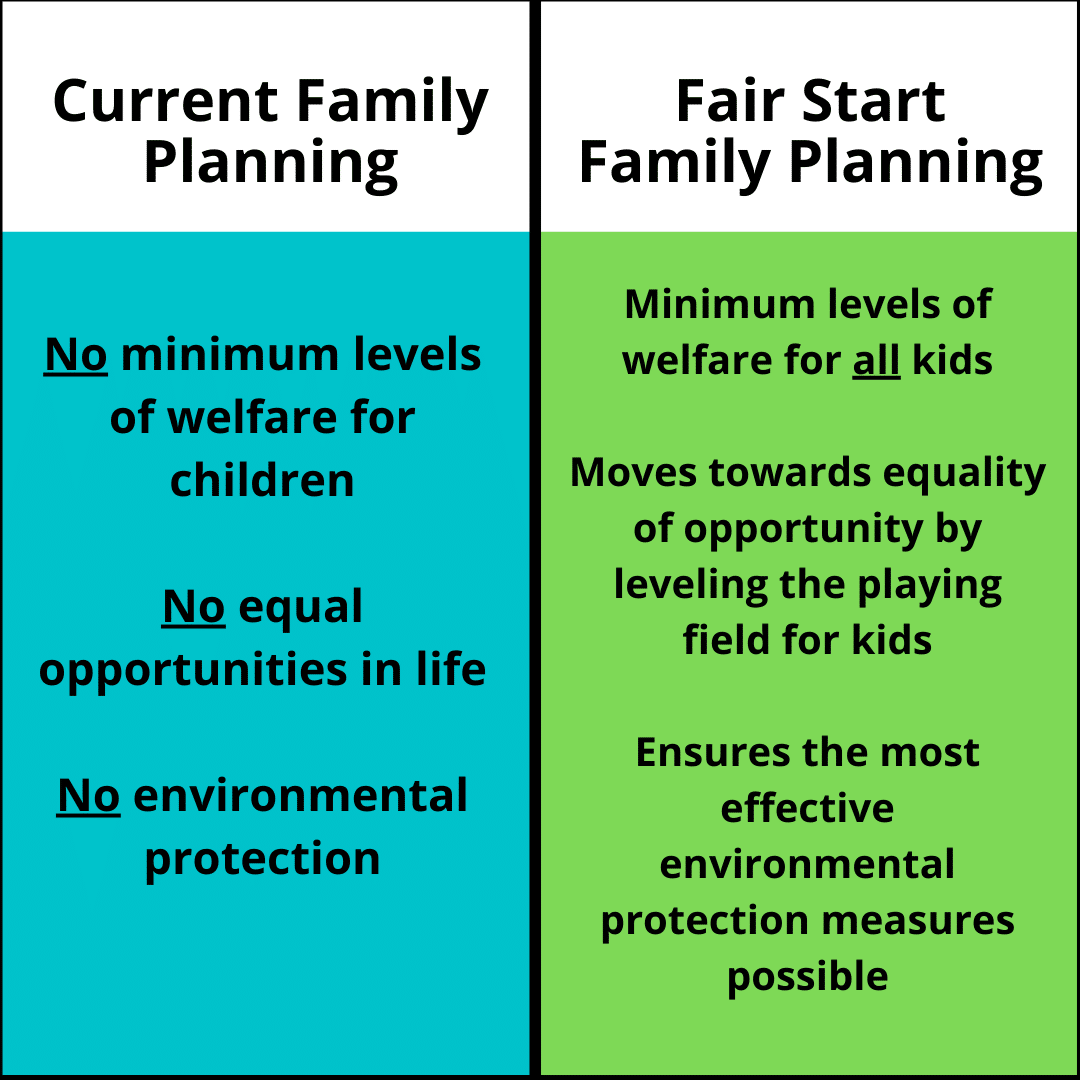
    A comparison chart of Current Family Planning and Fair Start Family Planning. The left side lists negatives: no minimum welfare, no equal opportunity, no environmental protection. The right side lists corresponding positives.

    In the meantime, we must work within the system we have. The State must accept its obligation to invest heavily in common-sense family planning programs and science-based sex ed. Those items alone will automatically lower abortion rates and teach young people the truth about having and growing a healthy family. 

    The State must break its unconstitutional commitment to Christian moral dictates and adopt a reality-based approach to governing. It is absurd and completely unacceptable that 350 million+ people of every faith are governed based on the ethos of bronze-age men. 

    We must shift our paradigm away from the endless-growth-economy fantasy, which demands that mothers continually produce their supply of workers and consumers. Prisoners to boot.

    TAKE ACTION:

    Let’s hold accountable those responsible for the current societal roadmap that pushes the opposite of a Fair Start for our children. Urge any organization you are part of to support and join our Tell the Truth campaign, which would obligate disclosure of this information.

  • Having Kids Urges Federal Government to Prioritize Funding for Male Pill

    Having Kids Urges Federal Government to Prioritize Funding for Male Pill

    The human rights advocacy group Having Kids today urged the National Institutes of Health to prioritize funding and research for male contraceptives like the male pill as a way to improve family planning, and reduce unwanted pregnancies.

    Read our special report, and campaign announcement, here.

    “Having Kids believes that in light of the world’s current population increasing at the rate of 80 million persons a year, and projected to exceed 9 billion by 2050, it is imperative that NIH make research and funding for the development of male contraception an extremely high priority over the next five years,” wrote Katherine A. Meyer, an outside lawyer for the group, in a letter to the National Institute of Child Health and Human Development.

    Meyer noted that while clinical trials of some male contraceptives have shown promise, more research is needed to ensure they are safe and effective.

    “NICHD can play a crucial role in making this a reality,” she wrote.

    The letter noted that groups such as the Population Council and private foundations have funded male contraception research, but can’t afford the large, phase-3 clinical trials required by the Food and Drug Administration. NICHD could give this effort a boost by seeking congressional appropriations for research, and directing current funding toward this clinical research.

    Also today, Having Kids issued an illuminating report and campaign announcement on how federal agencies have failed to take into account population growth when examining the environmental impact of federal actions under the National Environmental Protection Act.

    The report noted that the Council on Environmental Quality, which issues regulations interpreting NEPA, under President Richard Nixon did take population into account. Six months after signing NEPA into law, Nixon said In a letter to Congress that the CEQ “is concerned with all aspects of environmental quality – wildlife preservation, parklands, land use, and population growth, as well as pollution.” Every subsequent CEQ report during the Nixon Administration addressed population in its analysis. But over the last 40 years or so, CEQ stopped identifying population growth as a significant factor affecting the environment.

    Having Kids works to promote sustainable and more equitable families, as a way to help children, restore the environment, and protect animals.

    ###

  • Dear UN: We Can Do Better for Kids

    Dear UN: We Can Do Better for Kids

    Today, Having Kids is calling on the United Nations to back up its commitment to protect children. The international community, including key United Nations agencies, requires minimum standards of care for children. But we don’t apply those same standards in family planning models. Why not? Could we afford to do that, through future child entitlements, if we promoted a universal ethic of sustainable families and shifted the savings? We think so. Help us urge the UNFPA and UNICEF to consider the change. Here’s what we sent to the UN:

    Dr. Natalia Kanem

    Executive Director

    United Nations Population Fund

    605 3rd Ave, New York, NY 10158

    Henrietta Fore

    UNICEF House

    3 United Nations Plaza

    New York, New York 10017

    Dear Directors Kanem and Fore,

    Having Kids is nonprofit organization dedicated to replacing subjective and parent-focused family planning models with the human rights-based and child-focused Fair Start model. We and other organizations have asked the Secretary General of the United Nations to speak out on the need for better family planning models that focus on delay, cooperation, and families that invest more in each child.

    As the impacts of the climate crisis manifest, and studies confirm that simply improving access to family planning services will not accomplish what was previously predicted, there is an urgent need to revisit the ethical models that underlie and drive family planning laws, policies, funding, etc. Can we do better than treating the act of bringing a child into the world as a matter parents decide in isolation from their community? We think so.

    The best reading of the Children’s Rights Convention is that it prohibits children from being born into conditions the Convention is attempting to reform. Preventing violations of the rights of future children, while respecting the rights of intending parents, requires something more internationally cooperative than a model where parents are walled off from others in their decision to have children.

    We believe Fair Start modeling provides one cooperative path forward, and that public statement by the UNFPA and UNICEF regarding changing  the underlying ethical modeling is the necessary first step. We believe it  open the door for things like family planning delay and relocation payments, which under new modeling are more akin to entitlements for future children than incentives for parents.

    More specifically, we are urging you, as heads of the key international organizations responsible for shaping family planning modeling, to speak out about the need for a universal ethic of sustainable families who cooperatively work together to give every child a fair start in life. New modeling, which would require explicitly abandoning old modeling that treats family planning as a matter of parental privacy or autonomy, could be the most effective solution to many of the crises facing the world today.

    A child-first model, based on giving all kids a fair start in life, would advance all 17 of the U.N.’s Sustainable Development Goals. The following is a framework for a possible statement:

    The responsibilities referred to in the ICPD Programme of Action ensure progress toward the Sustainable Development Goals and the goals of the Convention on the Rights of the Child. Helping parents fulfill those responsibilities could be achieved though policies that, without discrimination or coercion, 1) encourage prospective parents to delay parenthood, 2) encourage communities and their governments to ensure all parents the resources they need to give their child equal opportunities in life relative to other children, as well as 3) encourage prospective parents to choose a sustainable family so that they can invest more time and resources in each child.

    We believe new family planning modeling could save countless lives.

    The international community, including key United Nations agencies, requires minimum standards of care for children. But we don’t apply those same standards in family planning models. Why not? Could we afford to do that, through future child entitlements, if we promoted a universal ethic of sustainable families and shifted the savings? We think so.

    Thank you for considering our request.

    Sincerely,

    The Phelps-Mathews Family
    The Phelps-Mathews Family

    Erika and Willow

    Executive Director of Having Kids, and her daughter, age 11

    Having Kids is a 501(c)3 nonprofit nonprofit organization dedicated to reforming family planning by replacing parent-centered family planning models with the human rights-based and child-first Fair Start model.

  • Having Kids Calls on Congressional Leaders to Prevent Child Abuse

    Having Kids Calls on Congressional Leaders to Prevent Child Abuse

    Today the national child-protection organization Having Kids called upon the leaders of the Senate Committee on Health, Education, Labor and Pensions to amend the Child Abuse and Prevention Treatment Act (“CAPTA”) to require states to enact legislation that allows judges to prohibit offenders convicted of certain felonies from having children as a condition of probation.  CAPTA allows states to apply for federal grants for child abuse prevention and treatment programs but also enumerates certain “eligibility requirements” that each state must comply with in order to receive funding.

    Read the full letter here.

    Having Kids’ proposal seeks an amendment to Section 106 of CAPTA to include, as funding eligibility requirements, that a state have Fair Start order legislation enacted.  Such legislation would, in the event of a conviction, temporarily prohibit an offender from having additional children during the pendency of any probation in order to prevent the abuse and neglect of any future children.  While the Congressional Findings from the CAPTA Reauthorization Act of 2010 hold that “substantial reductions in the prevalence and incidence of child abuse and neglect and the alleviation of its consequences are matters of the highest national priority,” national statistics from the past 5 years show that the epidemic of child abuse and neglect in the United States is not improving.  In 2016, there were an estimated 676,000 children across the country who were victims of abuse and neglect, up 3% from 2012.  The number of child fatalities that were the result of abuse and neglect steadily rose each year with 1,750 fatalities in 2016 versus 1,640 in 2012.  That is approximately 5 children dying every day in the United States as the result of abuse and/or neglect.

    “We believe that in order to truly make an impact in the prevention of child abuse, we must ensure that children are not born into potentially life-threatening situations,” said Anne Green, Executive Director of Having Kids. “It is a matter of national importance that we not only take care of abused children after the fact but do all that we can to prevent the abuse from happening in the first place.”

    Take action:
    Email the senate committee members and tell them that you support Having Kids’ proposal for a Fair Start amendment to the  Child Abuse and Prevention Treatment Act.

    Email Ranking Member senator Patty Murray

  • National Adoption Awareness Month: Time For Celebs to Step Up and Do the Right Thing?

    National Adoption Awareness Month: Time For Celebs to Step Up and Do the Right Thing?

    November is National Adoption Awareness month, and an opportunity to change the world. How? Public figures play a large role in many peoples’ family planning decisions – including timing, size, and whether we adopt or have biological children. We follow their lead.

    The world is at a crossroads, and whether the average woman in the world has one child more or one child fewer will decide a lot about the future, and whether all the social and ecological crises we face today are exacerbated, or largely ameliorated.

    What celebrities do, in terms of family planning decisions, will help define our and our kids’ future. This month Having Kids will be urging celebrities to model responsible family planning, and adopt, over choosing a large family. While good hearted everyday people are going out of their way to save children in need, many celebs are modeling totally irresponsible behavior. Shouldn’t we be helping kids in need, and building an ecologically sustainable world?

    TAKE ACTION: Politely urge Joanna Gaines to choose adoption @joannagaines

  • Subsidizing Delayed, and More Equitable, Parenthood: A Policy That Works

    Subsidizing Delayed, and More Equitable, Parenthood: A Policy That Works

    Could taking resources from the wealthy and using those resources to fund delayed parenthood, and a fair start in life for every child, solve many of our ecological and social crises? An article due to be published this winter in the Loyola Chicago Law Review argues that it is.

    The impact of better family planning on sustainable, and even regenerative, development is well-known. But poor modeling in the mid-20th century created barriers between ensuring resources that all children need and coordinating the time, place, and manner in which parents would bring those children into the world. New modeling is removing those barriers, and one emerging policy involves subsidizing delayed parenthood with the aim of improving childhood equity.

    Simply put: The policy shifts power from wealthy (usually white male) elites to women and children through family planning-linked forms of guaranteed minimum incomes.

    These transfers go beyond incentives. They involve the entitlements that are part of every child’s right to a fair start in life. And the evidence is clear: The subsidies mean increased earnings, education, well-being for women and children, and environmentally sustainable prosperity for all.

    Take action: Urge the D.C. council to consider a pilot project implementing the policy.

  • The Real Issue Behind D.C. Statehood: Constituting Ourselves as Free People

    The Real Issue Behind D.C. Statehood: Constituting Ourselves as Free People

    Guest Contributor: Nicole King

    This June, the House of Representatives voted in favor of granting statehood to Washington D.C. “The Washington, D.C. Admission Act” (H.R. 51) would admit most of the current district as the 51st state. For the first time, the District’s 702,455 residents would be represented in Congress. 

    Republicans, however, have been quick to paint the individuals who live in the District as unworthy of representation. Senator Tom Cotton stated, “Wyoming is smaller than Washington by population, but it has three times as many workers in mining, logging, and construction, and ten times as many workers in manufacturing…Wyoming is a well-rounded working-class state. A new state of Washington would not be.” To make matters worse, Senator Steve Dane’s of Montana implied that D.C.’s residents were not “real people” like those found outside of the beltway. 

    Such remarks stand in sharp contrast to the idea that every person – regardless of their career opportunities or zip code – deserves the opportunity to meaningfully participate in democracy. In fact, these comments show a disrespect for basic human rights. The United Nations recognizes that each person is born free and equal and the right to take part in government and public affairs. Yet Senators Cotton and Dane remain steadfast in their views that the District’s population should not enjoy this right.  

    Real Statehood

    While granting D.C. statehood is certainly an important step toward bridging the gap between rights and reality, it is not a sufficient one. A driving cause of this schism remains largely overlooked: our current family planning paradigm prevents us from constituting our societies in a way that allows us to fulfill the rights that we already recognize. By exclusively focusing on the rights and obligations of the human beings that exist today, we miss a critical preceding step: that we constitute ourselves in a way that allows all future human beings to meaningfully participate in making the laws that govern them.

    The U.S. House of Representatives has one voting member for just about every 747,000 Americans. This “representation ratio” is the highest it has ever been in our nation’s history and is significantly higher than in other industrialized countries. Research suggests that as the representation ratio climbs, our democracy becomes less effective. With fewer representatives per capita, individual citizens have to fight harder to be heard by their elected officials. Additionally, the makeup of the legislature is less likely to reflect the demographics of the people they represent – both in terms of race and income level. When faced with representatives who are largely unrepresentative, many communities feel shut out of the policy making process and avoid engaging entirely. 

    Despite these problems, our number of representatives has remained the same since the 1930s, even though the U.S. population has tripled since that time. While the D.C. statehood bill may grant much needed representation for residents of one city, it does not address the fact that almost all Americans are already severely underrepresented and will have painfully little say in shaping the laws that govern their lives for the foreseeable future. 

    Getting Intergenerational

    Adding more representatives to the House may seem like the obvious solution. This strategy, however, is likely to be ineffective in the long term. According to Drew DeSilver, a Senior Writer and the Pew Research Center, we would already need to add nearly 700 members to our current 435 member House in order to achieve the representation ratio we had in the 1930s. This number will only grow as we add a projected 79 million individuals by 2060. As the number of representatives rise, the House runs the risk of becoming unsustainable and unmanageable, mimicking China’s National People’s Congress, which at 2,980 members, is harshly criticized for its inefficiency and largely symbolic existence. 

    Today’s policymakers can help solve this problem by considering the needs of all future children when planning their own families. By giving families access to the resources needed to plan for more sustainable families, policymakers can help parents across the country slow the rate of population growth. This would afford future generations the time and space to organize themselves in ways that are truly democratic, giving each person more time at the podium during townhalls and allowing representatives to truly represent their communities. 

    The District’s residents undoubtedly deserve representation. And so do all future children. We should all use this unique moment in history to ensure that our children’s right to participate in democracy becomes their reality.  

    Take action: Let’s lead in D.C. by moving towards Fair Start family planning.

  • How to Give All Children in Washington, D.C. a Fair and Equal Start

    How to Give All Children in Washington, D.C. a Fair and Equal Start

    What Inequality Looks Like in Washington, D.C.

    Inequality is inherited. It affects kids for life. Unequal opportunities translate into unequal lifelong outcomes by the time children reach age 5.

    And the impacts of inequality are more damaging the longer it is experienced. The longer a child is poor, the greater the risk of poverty in adulthood and of experiencing lifelong health problems and involvement in the criminal justice system.

    Inequality, therefore, is a welfare issue. Studies have documented examples of rising inequality decreasing child welfare. Affluence plays a role, too. The growing divide between low-income children and their peers reduces opportunities for low-income children throughout their lives.

    Poor kids become poor adults, and rich kids become rich adults, with the latter inheriting both obvious and subtle benefits they never “earned.” Racial and ethnic disparities that have persisted are a consequence of that. Inequality disproportionately affects children of color in the United States.

    There is perhaps no city in the U.S. where inequality between rich and poor, and between black and white, is more evident than in the District of Columbia. 

    Washington, D.C., has a higher level of income inequality than any state in the country, with households in the top 20% of income having 29 times more income than the bottom 20%. The bottom fifth of Washington, D.C., households earned just 2% of total D.C. income in 2016, while the top fifth had a staggering 56%.

    White families in D.C. are 81 times richer than black families on average. Moreover, the effects of economic inequality persist throughout lifetimes and across generations, with the District of Columbia having among the lowest economic mobility in the nation. 

    With the cost of living in D.C. being 450% of the federal poverty line, the city is becoming a harder place for poorer people and families to live. Add to this growing inequality and the fact that D.C. residents don’t have voting congressional representation (i.e., they’re faced with taxation without representation), and you have a largely disenfranchised, largely black population.

    In addition, Congress restricts D.C.’s ability to raise revenue. The federal government pays no taxes on the land it uses or exempts in D.C., exempts itself from payment in lieu of taxes, and imposes added requirements on public services, such as the police force. Congress exempts those who work in Washington, D.C., but live just miles away in the states of Virginia and Maryland from contributing even 5% or less of their state taxes to the district.

    How to Create Intergenerational Equality in D.C.

    So how can we create intergenerational equality in the district?

    One surefire way is a guaranteed minimum income for children.

    Social welfare policy has been around since the passage of the English Poor Law in 1601. Social programs for child well-being became official United States government policy in 1935 with the passage of the Aid to Families with Dependent Children as part of the Social Security Act of 1935.

    Currently, guaranteed minimum income schemes are being implemented in nearly all European countries (except Italy, Greece, and Turkey) in order to eliminate and overcome the problems associated with poverty.

    The D.C. Council considered a guaranteed minimum income for its residents in 2018, recognizing the importance of combating such gross inequality. The Council commissioned a report by District’s Office of the Budget Director on the potential for such a program, and the report concluded that a guaranteed minimum income “could provide the District with a new, comprehensive tool to alleviate poverty in the city” and, in turn, improve child well-being, family stability, and health outcomes among the district’s residents.

    However, the report cited concerns that a guaranteed minimum income for Washington, D.C., residents would hurt D.C.’s total GDP and employment and would reduce its federal funding for social welfare programs. The report ultimately recommended refining the proposal before proceeding with any legislation.

    (It should be noted that the report arbitrarily limits its consideration of the economic benefits of guaranteed minimum income to increased personal spending. A more comprehensive and accurate accounting would include the savings that result from the improved health and safety of the districts’ residents, such as reduced public expenditure on medical and crime-prevention services.) 

    The Fair Start Guaranteed Minimum Income Solution

    In light of this stark disparity between rich and poor and black and white, between federal officials and D.C. residents, Having Kids believes there should be a Fair Start guaranteed minimum income program for Washington, D.C., children, funded through taxation of a specific group of residents of D.C.: The 100 wealthiest federal legislators and all D.C.-based lobbyists registered under the Lobbying Disclosure Act of 1995. 

    As Cory Booker said in an interview about his guaranteed minimum income legislation, the American Opportunity Accounts Act (also known as “baby bonds”), in the U.S. Senate in 2019, “It would be a dramatic change in our country to have low-income people break out of generational poverty.” The bill aims to level the playing the field by giving all American children the opportunity to generate wealth.

    This Having Kids Fair Start Guaranteed Minimum Income proposal shrinks the wealth gap by specifically contemplating (1) household resources per capita, (2) level of access to public services such as health, education, transportation, and (3) above all, the relationship between children’s fair starts in life and their abilities to become successful, productive future citizens and taxpayers. 

    As D.C. license plates say, “No Taxation Without Representation.” D.C. supplements the federal government’s activities; these transient and wealthy D.C. residents should return the favor. 

    Constituting and Statehood

    The United States Constitution was born of a revolution rooted in the belief that a group of people could constitute independent — free and equal — peoples. But for many reasons, the Constitution was never applied intergenerationally, and it was never applied to the District.

    The United States, therefore, has a capital city where the citizens have no voting voice in the nation’s legislature in a world where human rights and democracy are in decline.

    Like the U.N. did with the Global South, Congress should begin work to decolonize the District of Columbia. It should give D.C. residents statehood and finally allow its (mostly black) citizens a voice in a working democracy. As Eleanor Holmes Norton, D.C.’s lone nonvoting “representative” in the House of Representatives, said about the 2020 Washington, DC, Admissions Act, “Congress has two choices: It can continue to exercise undemocratic authority over the 700,000 American citizens who live in the nation’s capital, treating them, in the words of Frederick Douglass, as ‘aliens, not citizens, but subjects,’ or it can live up to the nation’s promise and ideals, end taxation without representation.”

    — Alexandra Stupple

  • Education Policy Starts With Fair Start Family Planning Reform. Take Action.

    Education Policy Starts With Fair Start Family Planning Reform. Take Action.

    Joe Biden has plans to reform the American educational system. There is a lot to do. While educational attainment in the United States has been steadily increasing, the levels are still well below what a functional democracy would require, with the average American reading around the level of an Eighth Grader and unable to understand their own constitution, laws or political system.

    How do we make real change? There are three fundamental problems with the way we have been approaching education.

    • We are engaged in family planning reform now because existing systems are failing. So why are we using family planning policies that push more and more kids through these horrible systems? That’s a huge mistake. We should align family planning to maximize the impact of the systems that work.
    • Education policy often fails because there is a fundamental but unacknowledged disagreement about its fundamental role. Many think education is meant to increase economic growth – that babies are destined to be economic inputs. That is wrong. Economies are preceded and justified by functional human rights-based democracies that regulate them. The educational system required for democracies is virtually the opposite as that used for economic growth. Democracies require developing people for town halls, not shopping malls. That means fewer people, highly developed in ways that that make them capable of cooperative self-rule as free and equal people.

    We can fix these problems.

    Take action: Urge Biden’s new Secretary of Education Miguel Cardona @teachcardona to 1) explicitly recognize these problems, and 2) adopt Fair Start family planning as the fundamental human right and guidestar model through which education reform must be engaged.