Author: Carter Dillard

  • One Reason Animal Rights Fail: We Willingly Create Animal Abusers

    One Reason Animal Rights Fail: We Willingly Create Animal Abusers

    Focus in on almost all work done by those who hold themselves out as animal protectionists and you will see them focused on the particular behaviors of those who abuse animals. From research labs, to factory farms, to puppy mills, our brains – given to think in the here and now – see what the abusers do, rather than who the abusers are and how they differ from the people we can aspire to be.

    But the genesis of the abuse comes years before it’s committed, in the creation of the abusers, and if we wanted to maximize our impact on nonhumans we would hone in on that. We would see how humans plan their families, and how that impacts the development of things like empathy and the practice of compassion. From the demand for abusive animal products and services, to the qualities and dispositions of the researchers, ranchers, zookeepers, hunters, etc., we miss the fundamental driver of abuse – demand and supply – by ignoring the laws and policies that determine our creation.
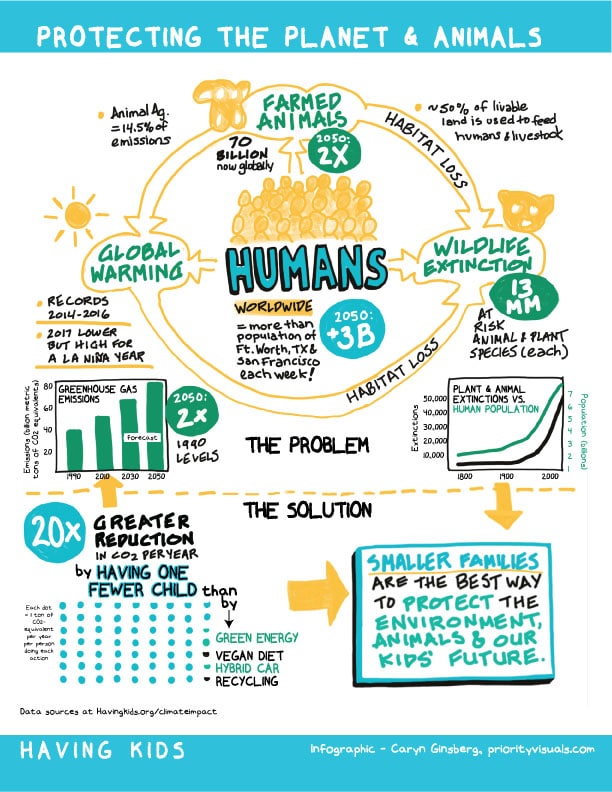
    Infographic illustrating the impact of human activity on the planet and animals, showing links between family size, resource use, global warming, extinction, and proposed solutions like smaller families and sustainable practices.

    But what do we do, specifically?

    Our current and largely aspirational humane education laws and systems are a good start. Though rarely enforced, they are ubiquitous and apply the correct standards. But without linking them to family planning and population policies, they fall far too downstream, and do not do what animals need them to do: Capture the key phase of human development (early childhood), and actually determine the behavior of humans and the impact of future generations.

    The beauty of focusing on responsible parenting is that unlike many forms of animal protection, it is highly intersectional, and its baseline is set by a widely celebrated value: Democracy. The minimum level of empathy and helping tendency we should require of every human, and develop in all future ones, is that necessary to ensure a functional social contract. It’s not about altruism – it’s about legitimate and just systems. Given that our current laws and policies ensure no levels of empathy or comparable qualities whatsoever, nonhumans will benefit greatly (especially when we factor in the quantities of humans at stake) from our pursuing even relatively minimal standards – like Fair Start.

    Take action:

    If you support an organization engaged in animal protection urge them to include in their focus the negative qualities of the abusers, and in their programming humane education, law and policy reforms that use those qualities – like sociopathology – as factors in reproductive justice reform. It’s that reform that does the most good for animals by creating a smaller future world population of people in whom we’ve invested more, the sort of people democracy requires.

  • Who Are “Precons” and Why Do They Matter?

    Who Are “Precons” and Why Do They Matter?

    For many reasons it’s popular today to want to eliminate divisions between people in an effort to unite. But sometimes divisions are crucial, in identifying racists and racism for example. The same can apply to a new form of division that could move the world towards intergenerational justice, including human rights and democracy, ecological restoration, and birth equity. This form of division can sweep together all of the repressive “isms,” and address them all at once by focusing in on the fundament of injustice: The way we plan families, and the impacts on the most vulnerable and numerous category of entities, future children and nonhumans.

    This is how it works:

    Because of cognitive dissonances the vast majority of people do not account for how power, and human freedom or self-determination, actually operate. Their use of language will show this. Instead of accounting for humans’ dynamic and intergenerational nature, and for how subtle forms of power to which we do not consent dictate our lives – like childhoods (ours and others’ with whom we interact), inequity, changes in our environment, etc. – our brain will default and refocus on icons, like celebs, politicians, institutions, and business leaders. We will ignore how we actually constitute ourselves into groups and create the power relations that actually determine the extent to which we consent to others’ influence over us.

    Three silhouettes depict human evolution: an ape with the words Make babies, an early human labeled Procreative autonomy, and two modern people labeled Cooperative, Fair Start family planning.

    Precons are those who, even when shown the relations behind the icons, choose to ignore them, and as such cannot orient from justifiable forms of social organization like Fair Start.

    Those who refer to the current trend towards reduced fertility rates as “baby bust” are emblematic of this class of persons, and their isolation modeling. They are not accounting for the welfare, equity, self-determination, political empowerment and ecological positioning of the babies to whom they refer. They just want to use those babies as economic inputs to grow the icon of the U.S. economy, usually to grow their own investments. They ignore how these births will improve, or degrade, justifiable, inclusive, and legitimate communities – communities where each voices carries less weight as they grow. Precons, and preconstitutional thinking, for example, seek to make us consumers rather than citizens.

    More simply, precons cannot ethically account for the power relations between the things they objectify.

    Beyond the baby bust, precons take no steps to ensure minimum levels of empathy and socialization in all children, a prerequisite for social cooperation and democracy, because they don’t really believe we are or should be engaged in such things, but are willing to rely on top down rule by violence as a form of governance. Precons hide the actual power relations behind icons, allowing a cycle where big government to  blames big business, and vice versa, for oppression, when in reality it is the concentration of power driven by massive and incapable populaces that are fundamentally at cause. That distraction allows those at the top of our political systems to move the average person even further away from any role in their own governance.

    A circular infographic titled “Fertility Delay Incentives to Planning” shows a leaf in the center with four benefits: Delayed Parenthood, Better Family Planning, Guaranteed Minimum Income, and Equal Opportunity & Education for all kids.

    In contrast, free (or reasonable) people do the relational math between people. They will choose to reject iconarchy in favor of actual relations, and choose to create those relations in ways that maximize self-determination. They will constitute – which simply means to limit and decentralize power – just communities. Liberating our species involves identifying precons, and using them as negative examples in family planning/reproductive justice reforms to ensure future generations are more capable of dealing with human power than we and prior generations have been. It also means finding those who most benefitted from converting citizens into consumers by maintaining preconstitutional family planning systems, and holding them accountable to pay the costs of what they did in the form of funding Fair Start family planning reform.

    Take action to engage in such reforms, and to help us constitute a better world.

  • Freedom Though Reproductive Justice: Watch the Values Align

    Freedom Though Reproductive Justice: Watch the Values Align

    Fair Start family planning and reproductive justice reforms are simple and their impact is unrivaled.

    Here is what Fair Start family planning looks like:

    fair start model
    Specific, concrete, and enforceable standards for all three aspects of this Fair Start model are spelled out, in context, here.

    But what makes the modeling unique is the way it frees us, ensuring – through an alignment of values – relative self-determination that is impossible without it. That, and the fact that reproductive justice precedes other forms, means we can purse Fair Start by all means effective, and use it to identify and overcome those that threaten that our and our kids’ freedom.

    For example, the autonomy would-be parents gain through self-development and meeting a standard of readiness to parent aligns with objective, constitutive and naturalistic reasons for having children, parents’ procreative interest in successful relationships with their children, the diminishing interest in having additional children, and the quality–quantity tradeoff of a smaller family or more ecocentric family. These things align with the autonomy a highly loved and developed child experiences in life, and the morally valuable options and equality of opportunities in life they will have, which further aligns with the autonomy created by the gender equity such development allows, cooperativeness within groups, a level of inherent security in groups that avoids the need for top-down limitations on autonomy, as well as fluidity among groups.

    A circular infographic titled “Fertility Delay Incentives to Planning” shows a leaf in the center with four benefits: Delayed Parenthood, Better Family Planning, Guaranteed Minimum Income, and Equal Opportunity & Education for all kids.

    The resulting smaller or more ecocentric populations and high levels of development align with one’s being empowered by having a meaningful voice – not drowned out or diluted by others – in public affairs and the rules under which one must live. This participatory agency aligns with the autonomy created by fulfilling one’s need for meaningful group membership, which in turn aligns with reduced consumption. and personal property that is oriented around nonpolity rather than things like ranking over others.

    And all of these align with a healthy and safe environment and the freedom—or autonomy—from others that is only possible through interaction with the nonhuman world. That is freedom in nature. This in turn aligns with the nonhuman autonomy the animal liberation movement advocates for. Note this alignment spans many types of freedom, from communitarian to libertarian, that might be seen as conflicting, were we not temporalizing our perspective and orienting from creation, a place that could unify values in ways other approaches do not.

    Learn more in our Having Kids White Paper.

    We can assess with a simple test, objectively, whether each of us is choosing to be part of a fundamentally just system in which the values discussed above align and in which we ensure true self-determination, or we are not.

  • A Funder Has Broken From the Fold: Supporting Fair Start Over Population-Driven Investments

    A Funder Has Broken From the Fold: Supporting Fair Start Over Population-Driven Investments

    Many large funders and philanthropists profess a desire to have an impact on things like the climate crisis, economic inequity, and child and animal abuse. The impact of family planning reform on all of these things is unparalleled and well-established. But many high-wealth individuals and foundations resist funding Fair Start reproductive justice reforms because they wish to ensure familial wealth continues to privilege some over others, or because they wish to further increase their wealth through unsustainable population growth that simply expands markets without creating real value.


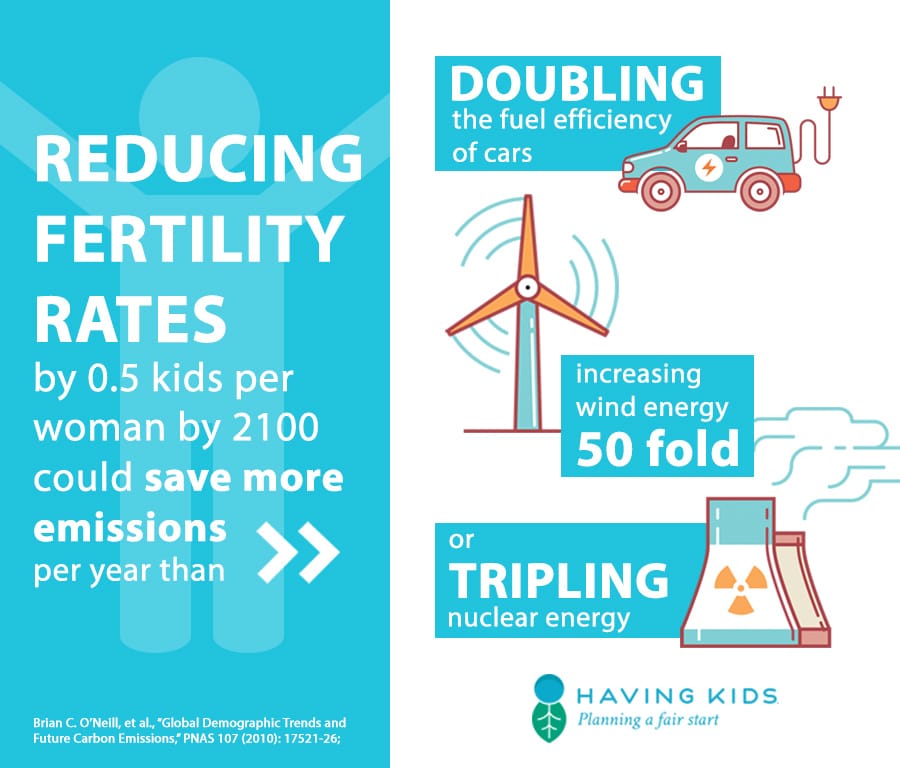
    Infographic comparing actions to reduce carbon emissions: reducing fertility rates by 0.5 kids per woman, doubling car fuel efficiency, increasing wind energy 50-fold, or tripling nuclear energy. Includes icons for each action.

    “I’ve spoken to wealthy individuals who knew inequity and population growth were degrading their philanthropic work on social issues and the environment but were simply unwilling to relinquish the massive head start they wanted to give their kids.”

    – Anon


    Not everyone is on board with that approach. Trisha Hensley recently made a significant gift to Having Kids in order to promote reproductive justice reforms designed to give all kids a Fair Start in life. For her and many others, it simply makes no sense for families and institutions in privileged positions to think their children will really be better off – regardless of the benefits they have been given – in a world with billions of people born into vast inequity, and increasing social and political instability that puts everyone at risk. When it comes to kids, we really do all rise and fall together.

    The most effective way to protect all of our futures is by reforming our family planning policies to prioritize new cooperative family planning models that treat every child’s right to an eco-social Fair Start in life as the overriding human right and obligation.


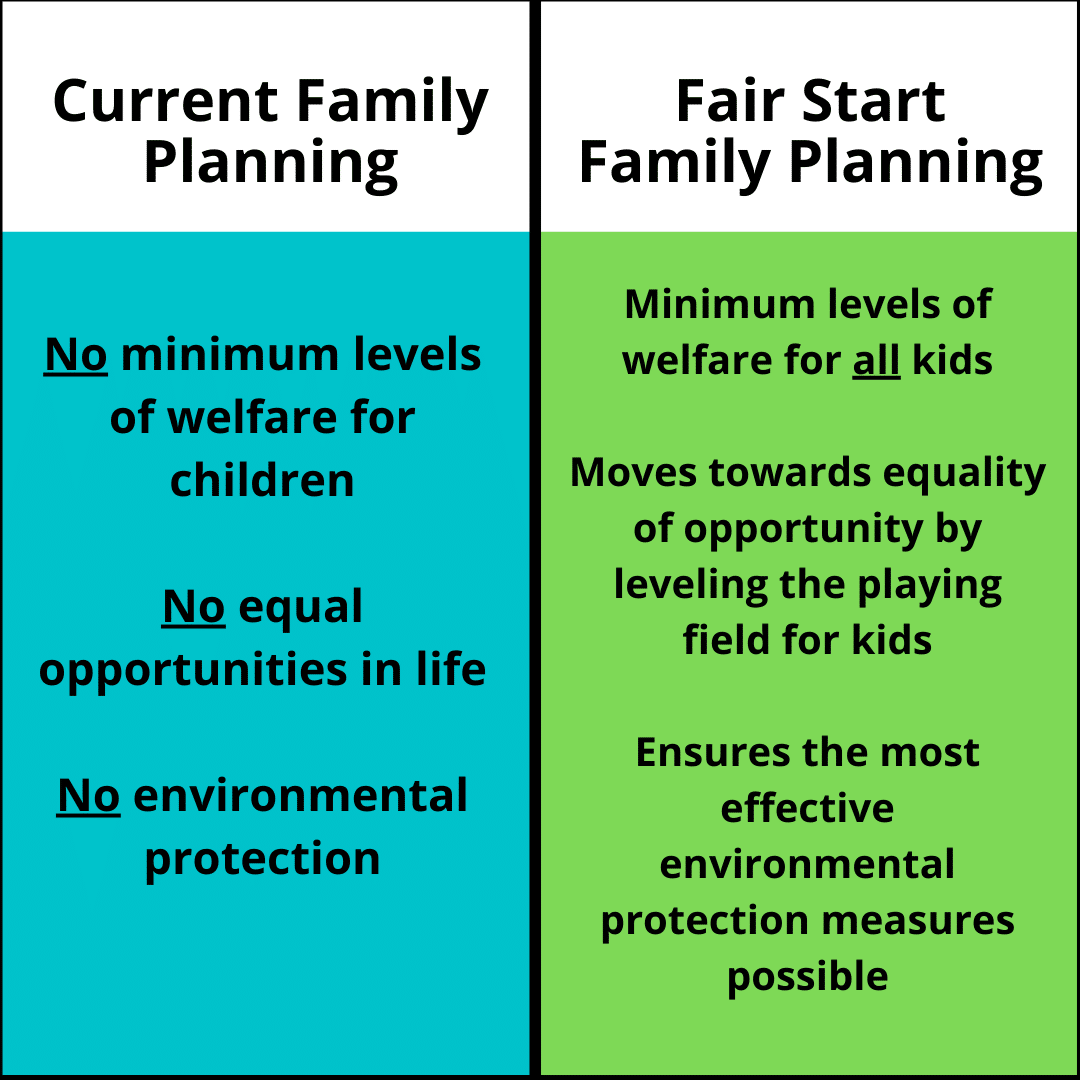
    A comparison chart of Current Family Planning and Fair Start Family Planning. The left side lists negatives: no minimum welfare, no equal opportunity, no environmental protection. The right side lists corresponding positives.
  • Joe Biden: Don’t Build Back. Go Upstream and Create Fundamental Change Through Fair Start Bonds

    Joe Biden: Don’t Build Back. Go Upstream and Create Fundamental Change Through Fair Start Bonds

    Facts:

    Biden’s plan is designed to push women to have more kids in order to grow the economy. It’s the same thing proposed by the likes of Ivanka Trump, Marco Rubio, Mitt Romney, and growth-minded people at Vox like Matthew Yglesias, who want to use child care, and especially child tax credits, as incentives for women to have kids. That’s short-sighted, and ignores every child’s right to a socially and ecologically #fairstart in life. 

    Do we really want Biden and Romney pushing their “be fruitful and multiply” religion on us, making taxpayers fund conditions that will exacerbate the climate, Covid-19, and other crises?

    It’s also something Nobel Laureate Steven Chu criticized as a Ponzi scheme pyramid foisting costs on future generations, for example, through the deficit this will create. 

    Facts:

    This will exacerbate inequality like the 1/10th black-white wealth gap, climate and other ecological crises, and ensure the United States is more crowded in the future, so that the average American’s voice matters even less. It has no minimum level of welfare for kids, nothing to ensure parental readiness or equal opportunity for all kids, and nothing to ensure a sustainable environment and democracies where voices matter. Freedom requires democracy, and that means fewer people in whom we invest more, not pushing women to have kids as economic inputs. We don’t need to create consumers, cheap future labor, and compliant taxpayers who will further enrich people like the Trumps. 

    Fair Start Bonds are better. They encourage smaller families working together to give every child an eco-social Fair Start in life. 

    They involve: 

    A) Congress explicitly encouraging smaller families who will work together to redistribute resources to give all kids a fair start. 

    B) They do this by cutting all benefits for those making over $100k, taxing large families above $400k per child, and using the funds to create a steeply progressive scale of Fair Start payments pegged to income, which are paid out in the form of a mix of refundable credits and baby bonds that increase, nominally, with parental contributions as they delay and prepare to have children (similar to health savings accounts), and then operate normally after children are born. Read our recent proposal to Senator Cory Booker promoting similar legislation in response to the Covid-19 crisis.

    The impacts of this approach are unprecedented.

    Further, C) Congress could take the opportunity to promote Fair Start more generally to embrace a constitutional right to nature through a simple Congressional resolution, act to ensure parental readiness and deter child abuse (something Biden’s plan will exacerbate) by passing Fair Start order legislation, and enable all of the above by funding the approval, marketing and subsidization of the male pill.  

    The crises we face are all interrelated, and all flow fundamentally, from poor and unsustainable family planning systems. 

    We can do better.

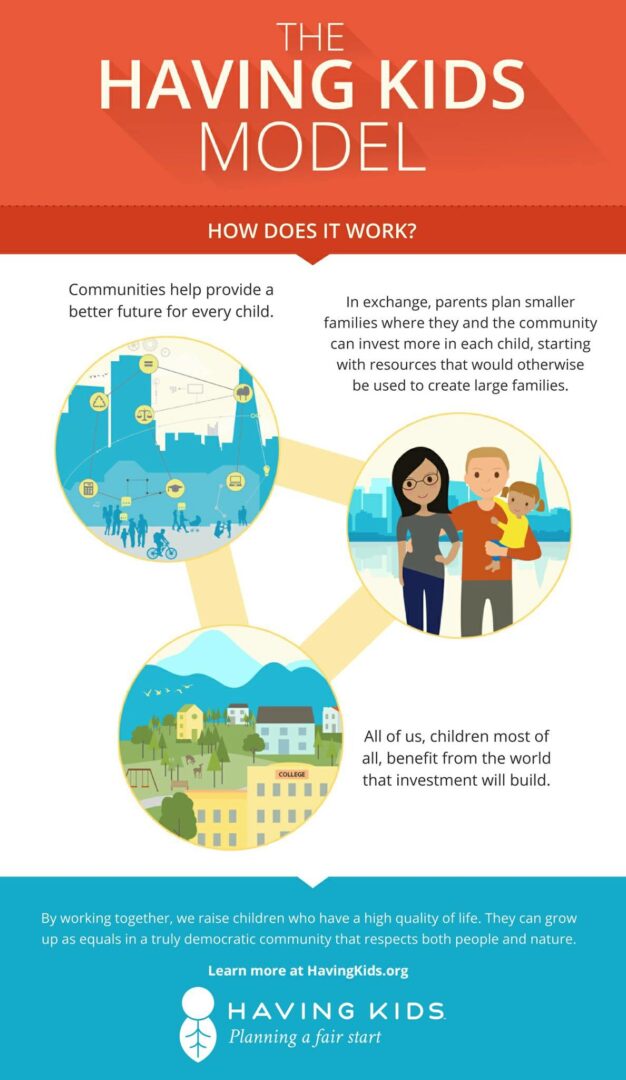
    Infographic explaining the Having Kids model with three illustrated circles showing community support, smaller families, and benefits for all children, connected by arrows. Text describes the process and benefits of investing in children.

    TAKE ACTION: Urge your member of Congress to support Fair Start Bonds.

  • What is the Fair Start Reproductive Justice Revolution?

    What is the Fair Start Reproductive Justice Revolution?

    Because intergenerational justice makes us who we should be, it is inevitably the first and overriding obligation, or that which first constitutes just communities and enables our consent to the power others would have over us.

    Therefore no system, law or policy is legitimate if it does not first promote minimum levels of wellbeing and equity at birth for children, as well as their development for, and inclusion into as adults, self-determining democracies situated in biodiverse and regenerative environments where each of their voices will be politically influential. Any law, policy or system that does not first do these interconnected things – providing children an eco-social Fair Start in life – violates human rights, prevents consensual/inclusive governance, promotes preconstitutional systems of oppression, and is a threat to freedom.

    We ensure intergenerational justice by eliminating, through discourse and praxis, a line of myths which act as barriers.

    A four-panel meme showing brain images that progressively light up as the captions advance: from denying global warming, to recognizing overconsumption, to choosing a smaller family, to advocating for future children’s needs.

    Myths: The right to have children, as a personal and private matter, allows parents unlimited discretion to have children. Some are born wealthy and others poor, as a matter of magical fortune, rather than human decision-making.

    Truth: The idea that the right to have children is self-determining of parents more than other-determining of children is a misinterpretation of the right foisted on us by colonially-minded patriarchs designed to evade our equity-building collective obligation to children, and to maintain population growth as a means of exploiting future generations as consumers, cheap future labors, and compliant taxpayer. Like all rights the right to have children is limited, collective in nature, and base on the needs of future children whose interests are inherently greater than parental interests. Applying those limits – to level the playing field for all kids – can have ten to twenty times the mitigating impact on the crises we face today, including climate, inequity, and child poverty, and would protect the most numerous and vulnerable categories of entities: Future generations and nonhuman entities.

    Myth: Social justice organizations in the fields of equality, human rights, child welfare, environmental and animal protection accounted for the impacts of family planning policies on their missions.

    Fact: Most organizations ignored the impacts of poor family planning and population growth on their missions, and instead mislead supporters, donors, and the general public, something that enabled many of the crises we face today.

    Myth: Intergenerational concepts are too vague to apply in law, policy and practical ethics.

    Truth: Every normative claim uses implied or express pronouns (“pregnant pronouns”) that – because they refer to people – implicate Fair Start and can be modified to promote it. If a claim involves people, it involves a position on Fair Start, which can be achieved in most parts of the world through enacting specific thresholds for 1) parental readiness before having kids, 2) distributions to give all kids a fair start in life, and 3)  smaller and sustainable families. Together these moves represent relative self-determination, or the limitation and decentralization of power.

    Myth: The written constitutions of nations, subject to some international law constraints, are the dominant set of rules under which we must live.

    Truth: The most fundamental and overriding law is that which creates us, or physically constitutes – through procreation and parenting – our communities. That law overrides things like property rights, which would interfere with Fair Start. That law is what most accounts for our lived experience, and should, if we believe that governance derives from sovereign people. Moreover, power is not simply centered in the violence of the state, but includes subtle things like bad parenting and climate emissions, and its borders are represented by actual groups of people, not artificial lines on maps. Those borders can be divided into free people, and people who refuse to further children’s rights to an eco-social Fair Start in life that would allow them to constitute just democratic communities, or precons. The fight for freedom lies at that border.

    Myth: The things people value, and the market demand they create, are naturally occurring and justify free markets over democracy.

    Truth: Valuation, demand and population growth were created by poor and unsustainable family planning that ensured no minimum levels of welfare for children, abysmal levels of education, extreme inequity ensuring cheap labor, and bloated nation-states where the average person had no real voice in political outcomes. Businesses today profit from a system that mass produced consumers instead of developing capable, and truly free, citizens.

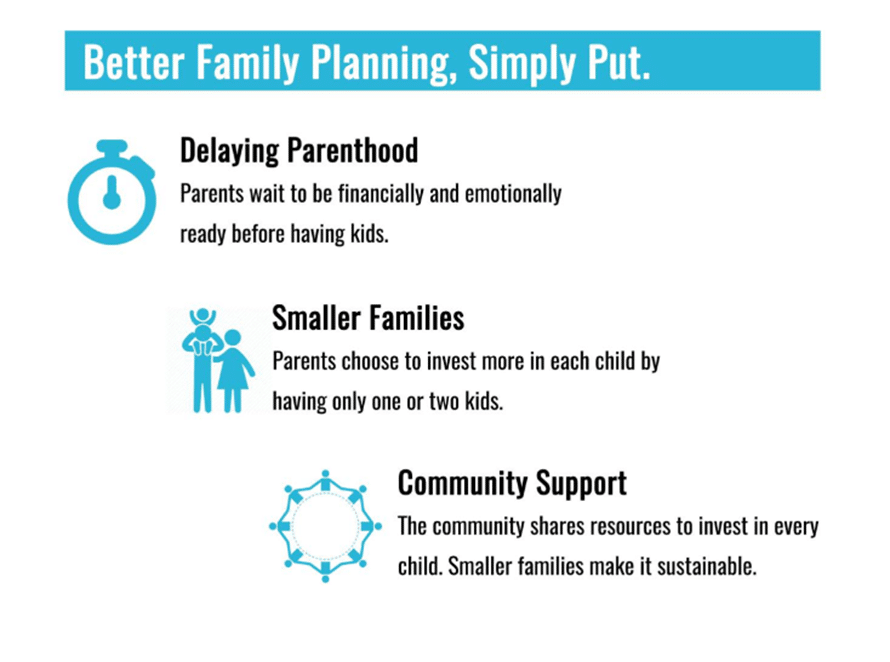
    Infographic titled Better Family Planning, Simply Put with icons and three points: Delaying parenthood, smaller families, and community support, each explained with brief text and blue graphics.
  • Anti-Asian Racism. What’s the Long-Run Fix?

    Anti-Asian Racism. What’s the Long-Run Fix?

    Anti-Asian racism and violence – especially against women – is on the rise.

    What happened in Atlanta is acute, but not isolated. While many organizations, including Having Kids, condemn these acts it’s crucial to find a grounded solution beyond the fleeting reactions of politicians.

    Here is one long-run fix. If racism – and most “isms” – fundamentally arise from humans’ tendency to “other” and degrade people that are not part of their in-group, we need ways to make groups of people more inclusive. Historically government has tried to do that by eliminating formal discrimination, like laws that treated certain races as inferior. This had limited effect. More recently, efforts have focused on structural racism beyond the laws, like changing the way language and other representations can reinforce beliefs about racial inferiority.

    Can we go further?

    Infographic explaining the Having Kids Model: communities invest in children’s futures, parents plan smaller families, and all children benefit from increased resources and a supportive environment. Includes illustrations and text.

    Whether we are part of an in-group, how we perceive others to be related to that group, whether we are really in that group in terms of having an influential voice, etc. – all of these things fundamentally rely on our creation and the family planning norms that determine it. What if instead of ignoring how parents create future generations, we designed systems so that everyone belonged and had a voice? That might work better than simply creating lots of people, jamming them into outdated and massive nation states to maximize economic growth, and simply hoping for good social outcomes that will not happen.

    We can fix this. Help Having Kids create truly inclusive communities where we all belong. Take action.

  • Three Easy Questions to Test Whether Someone, or Some Company, Is Committed to Social Justice and Political Legitimacy

    Three Easy Questions to Test Whether Someone, or Some Company, Is Committed to Social Justice and Political Legitimacy

    In the wake of high-profile stories showing just how deep and intergenerational both racial and economic inequity run in the United States and elsewhere, many are flocking to show that they too are part of social justice reforms. They want systems of governance to be legitimate. Here are three simple questions to test how serious they are, and whether they are doing what’s most effective to protect the most vulnerable, all of our kids’ future, and ensure legitimate systems of democratic governance. The key is to see how these questions interrelate, and go to the core of what it means to be free.

    They can help identify those who wish to constitute just communities, and those who wish to keep us in a states of illegitimate governance, or pre-constitutionality.

    A comparison chart of Current Family Planning and Fair Start Family Planning. The left side lists negatives: no minimum welfare, no equal opportunity, no environmental protection. The right side lists corresponding positives.

    These questions may not be typical or popular. But the work of social justice is meant to liberate the most vulnerable, and that means looking ahead towards the entities most at risk and in need of liberation, regardless of what most people think. In this era have an amazing opportunity to change the world for the better. Don’t let ineffective approaches to social justice knock us off the path.

    Now, take action.

  • New Peer-Reviewed Research: Nations Are Not Constituted in the Past By God-Like Founders. They Are Dynamically Constituting As We Have Children.

    New Peer-Reviewed Research: Nations Are Not Constituted in the Past By God-Like Founders. They Are Dynamically Constituting As We Have Children.

    From grade to graduate school in most nations students are taught that their system of laws – the one they are obligated under the threat of violence to follow – derives its legitimacy from historic constitutions, or agreements, in which god-like founders created a fundamental set of rules. And while teachers usually acknowledge that there are ways for people alive today to amend those rules, even young students will sense that this is a near impossible task given the number, and differences, of the people that would have to be involved.

    If we really think about it the story gets even worse. We live in nations that are so crowded, and where the power is so centralized in a few people, that it is actually irrational to vote. In this story – much like a religion – the average person does not really matter, and recent legislation shows that many in power are intent on making the situation worse. In some ways this story of why we must follow the law is simply insane: How can we be bound by rules that derive from something over which we have such little control?

    New peer-reviewed research by Having Kids is challenging this story, and aims to put the solution – the human right to a socially and ecologically Fair Star in life – at the center of social justice movements.

    How does it do that? If we pay closer attention to the traditional story of why systems are legitimate, we will find that the process described actually begins with the consensual coming together of the people doing the founding or “constituting,” and that the real source of authority and legitimacy in that story is the group of people themselves – not any set of particular rules. As the research shows, if reorient our perspective to see people more dynamically, or intergenerationally, the traditional story begins to make more sense. If we see the story in this new way, we can begin to see clear policy pathways so that everyday people can eventually – in generations to come – be part of the system of laws that control their lives.

    A comparison chart of Current Family Planning and Fair Start Family Planning. The left side lists negatives: no minimum welfare, no equal opportunity, no environmental protection. The right side lists corresponding positives.
    Have you asked any charities you support whether they have adopted Fair Start? Are they undercutting their own missions by ignoring the most important policy move – reforming family planning – of all?

    Changing our view in this way requires a few other changes: It requires changing the way we see political borders, from lines on a globe to seeing them more in terms of actual groups of people. It also requires investing more, and doing it equitably, in children, and – consistent with this investment – encouraging a universal ethic of smaller families. And it requires rethinking federalism, or the decentralization of power, so that “the people” are truly empowered and not lost in the crowd. In other words, it requires creating new democratic communities in the future where people matter.

    Having Kids is helping move along this change in how we see systems of laws – but it will take a long time, as well as overcoming both a lot of regressive thinking and the people intent on using the traditional story of legitimacy, the one that ignores future generations, to hold onto the power they have over us.

    Join our work.