Contact the heads of these key organziations and urge them to support Fair Start family planning or other models that are as effective:
Tweet: • Carter Roberts, @Carter_Roberts, president and CEO of the World Wildlife Fund • Annie Leonard, @AnnieMLeonard, executive director of Greenpeace USA • Michael Brune, @bruneski, executive director of the Sierra Club and urge them to take a stand on the most effective way to protect our future: policies that promote sustainable and equitable family planning.
The zero baseline model (ZBM, or constituting) is a concept used to reform family-planning laws and policies to correct critical errors made in prior modeling. These errors owe to treating the inherently interpersonal act of having kids as a matter personal to only the parents. The problem with previous models (like those based on the harm principle) is that they ignore our collective obligations to invest in children and fail to view the idea of power (and hence consent and determination) in a comprehensive way that includes any form of human influence or affect (such as bad parenting or climate emissions). These errors have hidden key linkages between objective values and choice, like the impacts that crashing ecologies and poor early childhood development have on degrading the choices that legal and political systems can offer their members.
These and other errors have also seeded subjectivity and exploitation in the first and constant step for all human rights systems – the creation of persons – and fundamentally caused the climate crisis, vast inequity, and other threats to our collective well-being. Our daily experience is most determined by the norms that created us and those around us, much more than by any other group of laws or policies, the impact of which is always suspect. And if we believe governance derives from the people governed, our creation and sovereignty should most determine our experience. We improve our experience by improving the creation norms, and by constituting just communities through the limitation and decentralization of power as it applies to the two most numerous and vulnerable entities in the moral universe: Future generations and nonhumans.
What’s the Zero Baseline Model?
Imagine that you are designing a constitution or a similar set of overriding rules and that you want to ensure the people subject to it can exercise some measure of personal freedom or self-determination. For example, you might create a rule that all must be allowed to speak freely or that property rights allow some degree of autonomy from others.
In the process described, you would have skipped a crucial but easily overlooked step: What accounted for the creation of you or anyone making such a list of rules? The first rule is inescapably the rule that creates people, or the creation norm (a concept that can be best understood through practice, using what might be called “pregnant pronouns” thought experiments). That norm would have already determined much about the freedom of the people in the system. While we can imagine the freedom to do certain things, who we are also determines our freedom: the social conditions into which we are born, our positioning relative to others, the ecological conditions into which we are born, how our birth impacts systems of self-rule, etc.
If the obligations that surround our creation must come first and we want those obligations to be comprehensive, they must start at zero, or the reference point of the absence of human power. This step – of being comprehensive – was skipped in the design of almost all political and legal systems that exist today. Instead, political theory treated the absence of human power (states of nature or original positions) as juridical, rather than physical. And instead of focusing on including future generations, those in power set out static rules. They did not keep people, dynamically and intergenerationally, in the position to consent to others’ power and influence — the position in which people must be maintained to continuously constitute just societies.
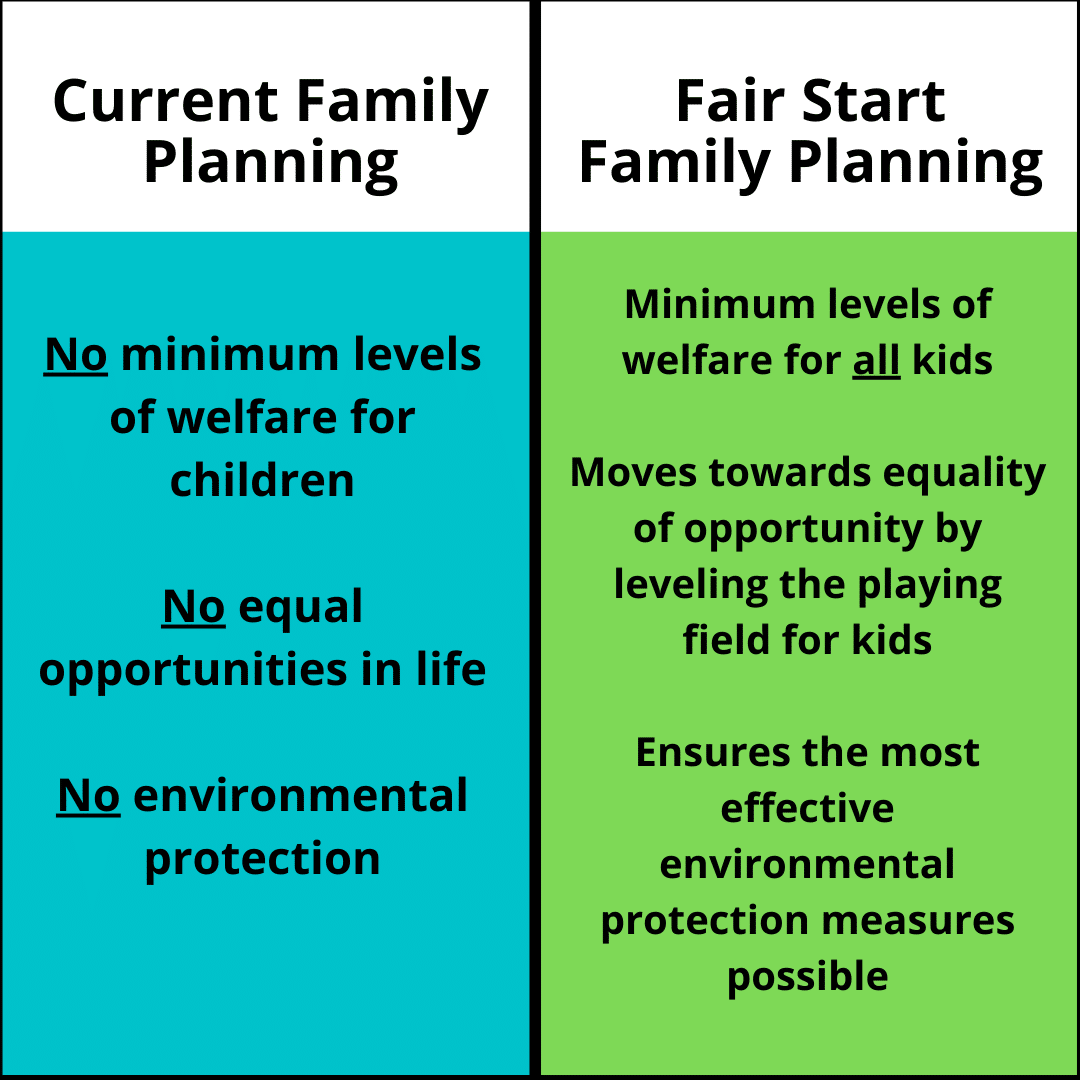
As such, those rules do not guarantee children minimum levels of well-being, equal opportunities in life, effective voices in their systems of governance, or the freedom of a natural world. And they don’t account for the way these rights intersect. The zero baseline model corrects this mistake, limiting and decentralizing undifferentiated human power, or any form of influence or affect, so that relative self-determination or consensual governance becomes possible.
The zero baseline model requires that we treat the act of having kids, or creating persons, as counting/constituting along a scale of freedom and equality that might be represented simply as 0,1,2 . . . 0. That scale, in the real world, looks like this vision of the future and aligns with other approximations of optimal populations. This is correct state of relative self-determination, and it enables us to orient ourselves from the perspective of a justifiable community where our obligations are self-reflective.
We achieve it through things like redesigning our system of family planning incentives to ensure children an eco-social Fair Start in life as the first human right. If achieving an optimal world population is always the first “ought,” because we are before we do, achieving optimal procreative justice in fact precedes even that, and begins with accounting for – or limiting and decentralizing – human power. We also achieve the baseline by identifying and excluding, intergenerationally, a class of pre-constituting persons we might call “precons” by altering the borders of polities from traditional abstract borders to actual borders defined by groups of people, and the nonhuman world.
Using the Zero Baseline Model for Consensual Governance
Correcting that oversight with models like the ZBM is crucial and creates significant benefits. But we must keep in mind that the ideal rules for family planning are complex and that they’re not analogous to traditional notions of population. We must view the creation of persons as more qualitative than quantitative, dynamic in nature, strictly bound by the International Bill of Human Rights, and so on. Rather than counting people, we have to use an approach that makes each person count.
This is one way to think about it: What can we infer from words like “We the people,” which are expressed or implied at the beginning of almost all democratic constitutions? What is assumed about the people within that “we” in terms of their quantity, commonalities, literacy, equality, relationship to nature, and so on? Their ideal positioning, which we can imagine, creates a pathway to understanding freedom from others, or relative self-determination.
The ZBM modeling begins with certain fundamental values that make up the state of being relatively self-determining or free, such as minimum levels of well-being and positive birth conditions for all future children, equality of opportunity, nature or the nonhuman world, and democracies in which each person’s voice is effective. The model then employs these values to fill in the often-skipped step described above, using a simple but comprehensive scale where undifferentiated human power or influence (which can be measured much like a currency) is limited and equally decentralized.
The ZBM scale seeks to start everyone at the same baseline. This includes (1) creating social and ecological policies that ensure equity and autonomy in and between current and future generations; (2) treating every person with the same weight in our assessments of those policies; and (3) establishing an ecological baseline and restoring the natural world with regenerative policies.
The scale, simply put, limits and decentralizes power through child-centric family planning reforms focused on fairness so that we can remain relatively (to zero) self-determining, or free.
Our family planning laws and policies must be redesigned to maintain this scale that, applied in the real world, will mean a future of smaller and truly democratic communities surrounded by nature. They will be constituted of free and equal people. In these communities, each person has a meaningful role in making the rules under which they live, and each is empowered by the conditions in which they were born and raised. That is what freedom looks like. No system can be described as inclusive without accounting for democratically empowering people right from the start.
How Does Better Family Planning Free Us?
The ZBM model makes possible freedom, autonomy, liberty, consent to the influence of others, etc. — which are all simply ways of talking about states of relative self-determination. How can we consent to others’ power, and thereby self-determine, without this scale and the use of a physical reference point to make coherent the idea of being free? We can’t. Without using a baseline of zero, we cannot maintain our future generations as constantly free and equal people, the position implied in phrases like “We the People,” which is a necessary and antecedent condition of constituting just political and legal systems.
And without maintaining that position, we cannot be free from others’ power over us, whether in how others impact our environment (e.g., through climate change), the advantages others have over us based on the social and economic conditions in which they are born (instead, imagine “zero” as people all beginning at the same start line), or the way our individual voices become lost in large crowds. Without anchoring our systems to the reference point of “zero,” or the absence of human power, we remain subject to the unlimited power of others, usually concentrated in small groups with massively disproportionate control.
The zero baseline model replaces traditional, abstract, and arbitrary political and legal borders — such as socially constructed lines on a globe — with borders defined by actual people, their power or influence, and nature or wilderness, putting the real and physical over the symbolic. Under this model, we are constituting as free and equal people, with fluid borders that reflect our sovereignty; without it, we remain in states of preconstitutionality.
For these reasons, the zero baseline model acts as a deontological, anterior, and overriding method for determining the optimal populations of the world, which is a necessary first step in the development of any political or legal system.
How does all of this actually free us? Here is an example: The market values and demand that define our world today are not some naturally occurring phenomenon. They simply reflect a world populace created in violation of human-rights standards (such as the Children’s Rights Convention, or CRC) and defined by extreme birth inequity, rather than a population created through collective investment in our children in order to liberate them into functional democracies where their voices would matter and where they would enjoy the safety and freedom of the biodiverse and natural world — promised in laws like the United States Wilderness Act — that is a byproduct of those democracies. Using dysfunctional family planning systems, the wealthy and political elites created the demand through which they were enriched, including birth-driven hierarchical cultures that encouraged greed and consumption. This is especially true in today’s market-based zeitgeist, a high-stakes game that all are forced to play, driven by an exploding world population.
In other words, by our own professed ideals and laws, such as the CRC and Wilderness Act, we are not who we should be. Zero baseline modeling helps reveal and reverse this easily hidden form of oppression.
What Policies Come From the Model?
In policy, the zero baseline model treats the Universal Declaration of Human Rights Articles 16 and 21 as comprising the overriding constituting norm (or the properly constructed, and thereby limited, fundamental right to have children). This requires refocusing family planning systems to a child-centric focus on the objective needs of future children. This new focus centers on the need to give all children a Fair Start in life, both socially and ecologically, by ensuring the scale above. This means the right to have children looks more like the right to speak freely, which has certain limits (one can’t yell “Fire!” in a theater), than the right not to have children, which is based on autonomy and is absolute.
Rather than seeing lower fertility rates in the 21st century as a “baby bust” threat to economies, the zero baseline model treats them as consistent with humans evolving toward sustainability, with filling functional democracies, and with the currency of relative self-determination (perhaps envisioned as large town halls) that must precede and regulate economies and their currency of utilities, with people capable of trusting one another and engaging in social self-rule. In other words, while pre-constitutional systems created large groups of unprepared people in order to expand power for big business and big government at the top of what one Nobel Laureate called a Ponzi scheme pyramid, constituting ourselves as free and equal people requires investing more in each child to create a smaller population. Without that change, we will continue to bring children into socially and ecologically discriminatory conditions that make relative self-determination impossible.
Crucially, the zero baseline model accounts for how all of these things interrelate — for example, how the restoration of nature improves welfare, how improved welfare reduces inequity, how reduced inequity furthers democracy, etc. Zero is the point of interconnection, or intersection, of objective value and truly subjective choice.
To illustrate this: Studies show that temperature rise from the climate crisis is causing premature birth, which harms the affected children for life. So moving away from a zero, or pre-Anthropocene climate baseline, harms people. At the same time, it does not harm them equally. Rich people can offset the harms more than poor people through efforts like moving, healthcare, and nutrition. So the lack of an equal starting line — or zero baseline — compounds the harms through inequitable distribution. A climate policy of 300ppm or less, combined with Fair Start redistribution — both of which we have specific policies to ensure — is moving toward a zero baseline, or ecosocial fair start in life.
And because this zero baseline proceeds any other norm or rule, it overrides them, enabling us to further it by all means effective. This last part is key to how the model enables reform, because that override can apply to property rights, allowing us to distribute Fair Start resources and incentives over the baseless defenses of the concentrations of power hoarding those resources. In practice, this entails merging the margins, or progressively redistributing the resources (money here is a proxy for power) from the most to the least influential communities through family planning reform to eventually create smaller, more inclusive, and better communities.
What Does This Mean in Practice?
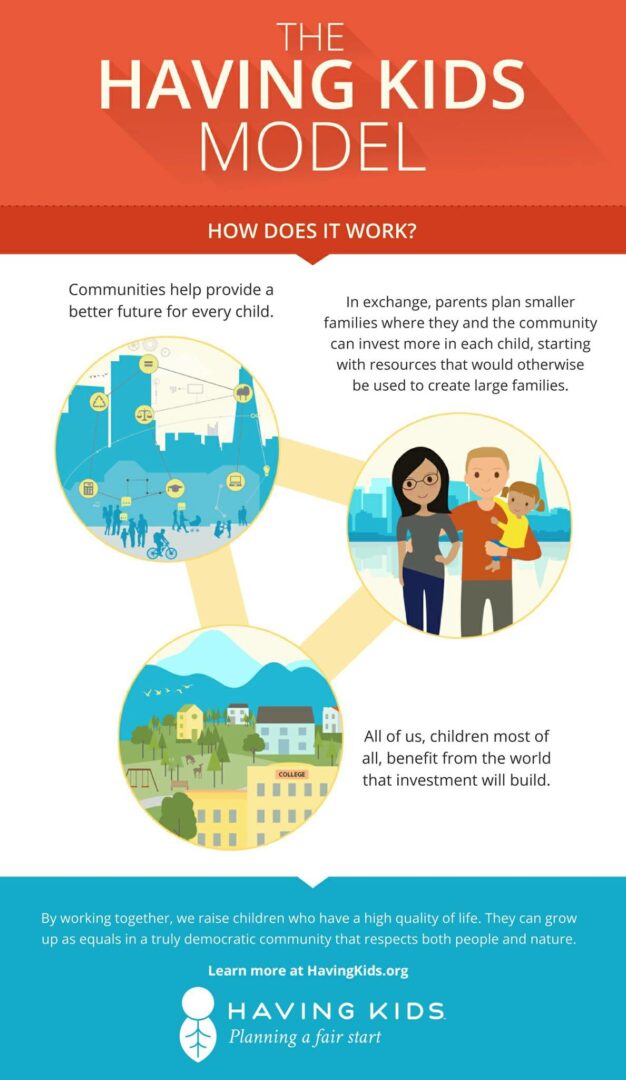
Would-be parents at the bottom of the pyramid of social influence who want to give their future child a fair start in life have an overriding claim to the resources concentrated at the top and may secure those resources by all means effective. Concentrations of power, both private and public, will wish to prevent implementation of the zero baseline model, which limits and decentralizes their power. They will choose policies that favor growth and inequity, preferring to pit people and generations against one another. The organization HavingKids.org was created to help would-be parents and anyone who takes social justice seriously to overcome those concentrations of power, and achieve changes that will have exponentially greater impact on the crises we face today than the alternatives being proposed. We do so in dozens of ways, some of which are described here.
Controversially, the ZBM sets up new borders for liberating political conflict. Per the model, we have to reform family-planning policies in order to be free or operate in relative states of self-determination. No system is legitimate without this change, any more than it would with the absence of free speech. And we do not have to follow the laws of an unjust system. Unlike other and more static explanations for why a system is just or unjust, Fair Start provides the best reason of all: Under that model, we would have been created by an objective, or fair, creator.
In other words, systems must create people in a way that intentionally includes, empowers, equalizes, and frees them, or we may overcome it. As such, the model intentionally divides people between those who would use the ZBM or similar modeling to constitute new political entities that ensure freedom — in the form of minimum levels of welfare and equality of opportunity for all kids, regenerative environments, and the assurance that all have an effective voice in their systems of governance — and those people who are opposed (who we might call “precons”) and who, as such, stand as the fundamental threat to freedom.
To identify the latter, just assess a person’s position in the pyramidic structures of power and test what they are doing to further or impede the values described above: Do they advocate pushing more and more people into the world through failing educational, health, and other systems of development so they can exploit them as consumers, workers, taxpayers?
Abandoning our current and decoying categories, like the political left and right, and using the ZBM to identify the relatively few people alive today who truly prevent freedom by opposing the model and thereby subjugating the two most numerous and vulnerable categories of entities — future persons and nonhumans — is the key to overcoming that oppression. To confront these oppressors and challenge them to engage in Fair Start reforms, we only need to find would-be parents who are willing to fulfill their part of the intergenerational social contract by agreeing to participate in a cooperative family-planning system focused on the objective needs of future children. These would-be parents can – ex-ante – demand that the targeted concentrations of power fulfill their part of the contract. In that struggle, the model acts as a baseline to determine exactly how much those concentrations of power owe. And in that struggle, the would-be parents will be met with the violence those concentrations of power and the state will employ to defend their unjust position as they elevate property over people. That is the process of constituting.
We can promote freedom through better family planning models in a variety of ways, from lobbying public officials to incentivize collectively investing more in kids, to urging public figures to role-model sustainable families, to helping responsible parents speak out against poor family planning systems that threaten our and our kids’ futures.
Learn more at HavingKids.org and join us in the fight for true freedom.
When supporters of President Trump stormed the Capitol Building in January, business leaders, and prominent members of both political parties, condemned the act as a direct assault on democracy. The deadly attack was wrong for many reasons, but not because the Capitol represents a functional democracy.
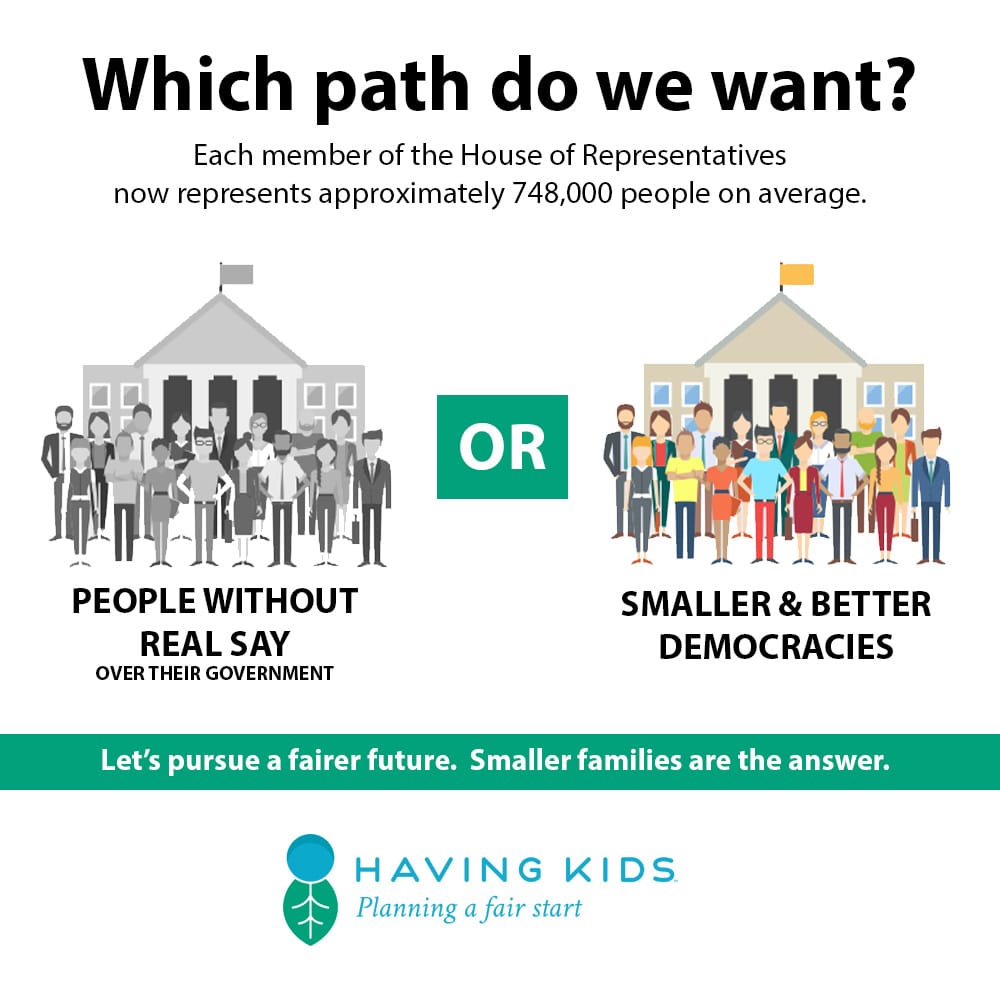
It’s hard to understand why anyone believes Congress – a handful of people – could democratically represent the diverse and changing interests of the hundreds of millions of people that live in the United States. If democracy is characterized by self-rule or the decentralization of power, what Congress purports to do instead is run a large republic where powerful interests disproportionately control outcomes, rather than engage in the true democracy simply characterized by an extremely decentralized system of local control where each person’s voice matters and is heard.
We react strongly to the spectacle of what happened at the Capitol in part because it is sensational. Decades of corporate lobbyists invading the Capitol and slowly degrading the way it represents each person equally – and especially those most vulnerable – is less sensational. It’s not better – in many ways it’s worse and more impactful – but our brains don’t process it the same way. (In the linked TED talk Peter Singer focuses on our welfare and our cognitive limits, but the same lesson could be applied to self-determination and democracy).
While contrasts have been drawn between the police response to the attack versus the response to the George Floyd riots, we can also look to the disproportionate response police had to the Occupy movement, especially in Wall Street’s back yard. We may not be surprised then when the captains of corporate America swiftly condemned the attack on the Capitol. Violence reminds us that there is a form of power other than money.
If we really wish to ensure justice and to prevent further bloodshed, perhaps we should focus on making each voice heard and matter – whether it is the sort dying to end the constant killings of deeply disenfranchised black men by police, or the sort of voice intent on protesting the federal governance of our massive and deeply unequal population as undemocratic. If we don’t, these voices will raise their level of conflict, and violence.
How could we possibly increase each person’s role in governance? Traditionally our moderately federalized system pushes population growth as a means of expanding national power, then based on constitutional rules, it counts up everyone and apportions their representatives. Instead of exploiting future generations as a means of growth, what if we changed the way we have and raise kids to equitably invest more in them and in ways designed to give each a voice in hyper-decentralized future governance? Instead of assuming that the written Constitution magically ensures our representation, we could physically decentralize both private and public concentrations of power by taking resources and investing them in a smaller future population developed for self-rule. While that process must prioritize eliminating racial inequity, it is inherently nonpartisan.
In this way, we could begin to constitute democracies out of people, more than out of words, and build communities around our role in planning them, more than around racial or class identities. We could incentivize early fostering and adoption of children in need using the funds – like child tax credits – that currently incentivize having larger families. We could also do it by redistributing wealth from the top of the economic pyramid through enhanced “baby bond” legislation meant to ensure birth equity and tie future children’s needs to better family planning. Giving a voice – in this way – can mean giving what both margins, left and right, want respectively, albeit over the span of a few generations: Greater equity for the former, and greater autonomy for the latter.
The best part? If developing future generations to engage in equal self-rule is something that logically precedes the political processes we are accustomed to, we don’t need the government to begin the decentralization of private and public power. We can instead join as liberals and conservatives to target the power of both big business and big government, which in divided political camps we respectively object to, based on the simple truths that every child deserves to get a fair start – both ecologically and socially – in life, and that every child deserves to eventually matter in the processes that govern their day to day lives.
What matters more than the people with whom we and our kids share the world, and will in the future?
Cal however could be making a simple, but crucial, error: She might be assuming that replacement is the baseline for determining family planning policies and ideal fertility rates. Given that current and anticipated population levels are unsustainable – something the climate crisis reminds us of every day – replacement is not ideal.
Moving towards it is the fundamental policy focus for sustainable development. Moving quickly will prove ten to twenty times more effective at eliminating poverty, inequity, and ecological crises, as well as restoring democracy, than downstream and after-the-fact alternatives. Optimal, not unsustainable replacement, is our collective endeavor.
As part of this process, the slow return of nature is the long-expected consequence of decades of unified international efforts to avert the disasters that flow from overpopulation. We should welcome the change as a symbol of success. It is part of saving our own species.
TAKE ACTION: BY NOT ENSURING ALL KIDS AN ECO-SOCIAL FAIR START IN LIFE THE UNITED NATIONS SECRETARY GENERAL @ANTONIOGUTTERES IS IGNORING HUMAN RIGHTS. URGE HIM TO CHANGE COURSE.
We Should Level the Playing Field for All Kids. Full Stop.
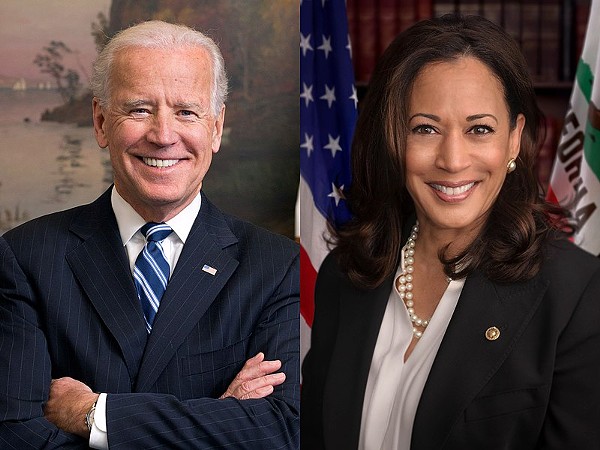
President Joe Biden has put forth a massive child care and tax proposal to keep child care centers open, help low-income families with child care, and offer tax relief on the cost of having kids.
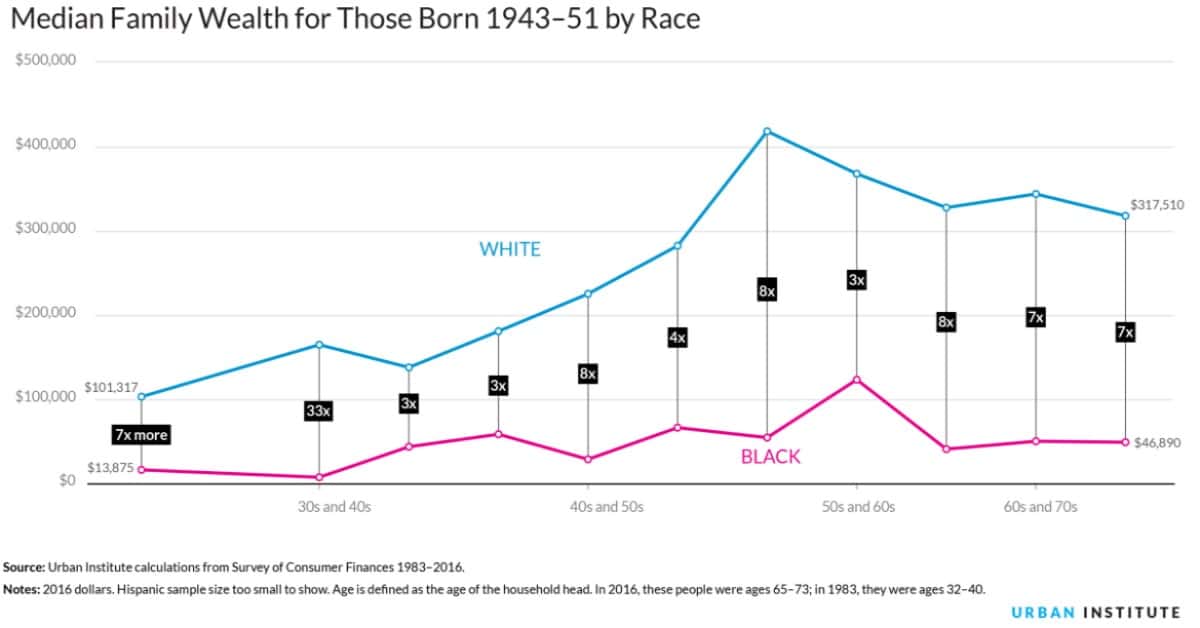
There is just one problem: It’s not really meant to eliminate the massive wealth gap between minority and white families in the United States. Because of slavery and historical injustice, black families have one tenth the wealth of white families. White families also possess more than 4 times the income of Hispanic/Latino families. The impacts are especially hard on kids, rippling forward into future generations in never ending cycles that make a mockery of any legitimate form of social contract. It’s time to get real.
How could Biden’s plan help end the cycle?
1) Cut all benefits to wealthy families who don’t need the funding.
2) Use those savings as cash incentives to power up family planning and early childhood investment systems in the United States to
d) Back programs like Smart Beginnings up in time to focus on family planning, and based upon redistribution of wealth in ways that give all kids a Fair Start in life.
Opponents to these changes will want to use President Biden’s plan to reinforce inequality and incentivize unsustainable population growth, using babies to grow the economy. Names like Ivanka Trump, Marco Rubio, Mitt Romney, and growth-minded people at Vox like Matthew Yglesias want to use child care, and especially child tax credits, as incentives for women to have kids to reverse falling birth rates. That’s short-sighted, and ignores every child’s right to a socially and ecologically #fairstart in life. It’s certainly not antiracist. It divides us.
In this way we can proceed from fundamental values, and achieve the personal autonomy the political right values, by applying the equity the political left values – but specifically prioritizing children. We can take power away from big business and big government, the entities the left and right respectively oppose, and invest it in future generations. Learn more here.
That’s truly uniting, and being antiracist, at the same time.
1) All reasonable people agree reforms are needed to respond to the climate crisis.
2) All reforms, with a few small exceptions – from the Paris Accords to more conservative carbon markets – assume an environmental baseline where the nonhuman world is a human resource, and protecting human health and safety is primary and exclusive of animal protection.
3) That baseline, or standard, is offensive to the animal rights movement – the nonhuman world should be nonhuman habitat where others species are free. That is what animal liberation means.
4) Had world leaders, including environmentalists, embraced that higher, animal rights-oriented baseline in the mid-Twentieth Century the way deep ecologists had advised we not be facing a climate crisis because that standard prohibits many things – including explosive population growth and ecocide – that precipitated the climate crisis. That failure will cause untold suffering – hence seeing the nonhuman world as a resource is also offensive to human rights.
5) There are things we can do to change our approach to the environment, nonhumans, and future generations to reverse the mistake world leaders, including environmentalists, made. A large coalition of groups has sued to use the higher or nonhuman baseline because the Constitution, and its surrounding literature, imply it is constitutionally required.
6) Part of the suit involves changing the way we plan families, an urgent requirement of intergenerational justice that is also implied in our constitutional principles. In democracy, what matters most is the people with whom we share and will share our communities and the world, and those people don’ fall from the sky. Let’s protect and invest in them.
While many nations’ constitutions are clear in protecting the property rights of the wealthy, they are less clear in protecting the nature we and future generations need to thrive. That’s a mistake.
Given that humans need nature to survive, we have a right to nature’s restoration and protection. A lawsuit in the United States is making that case, and will be heard in 2021.
Solving the baseline problem will allow us to trace these calamities — like the unfolding death of the Great Barrier Reef — and help us back to an ultimate source, and, perhaps, to a solution. We can no longer use a baseline for environmental policy that treats nature or the nonhuman world as a human resource. This is the baseline most environmentalists use, and the one that created the Anthropocene era in which we find the world today. A much higher baseline would view nature as something that ought to be a nonhuman habitat or the homes of sentient species who have a right to survive and thrive. This would be a restorative baseline, and the one more consistent with animal liberation. Such a baseline would be most protective against things like climate change and the pandemics it drives. A policy based on this baseline would revolve around ensuring our children have the only environment proven — over millennia‚ that allows humans and all species to thrive. It would seek to eliminate the way the absence of nature in our lives is degrading our psyches.”
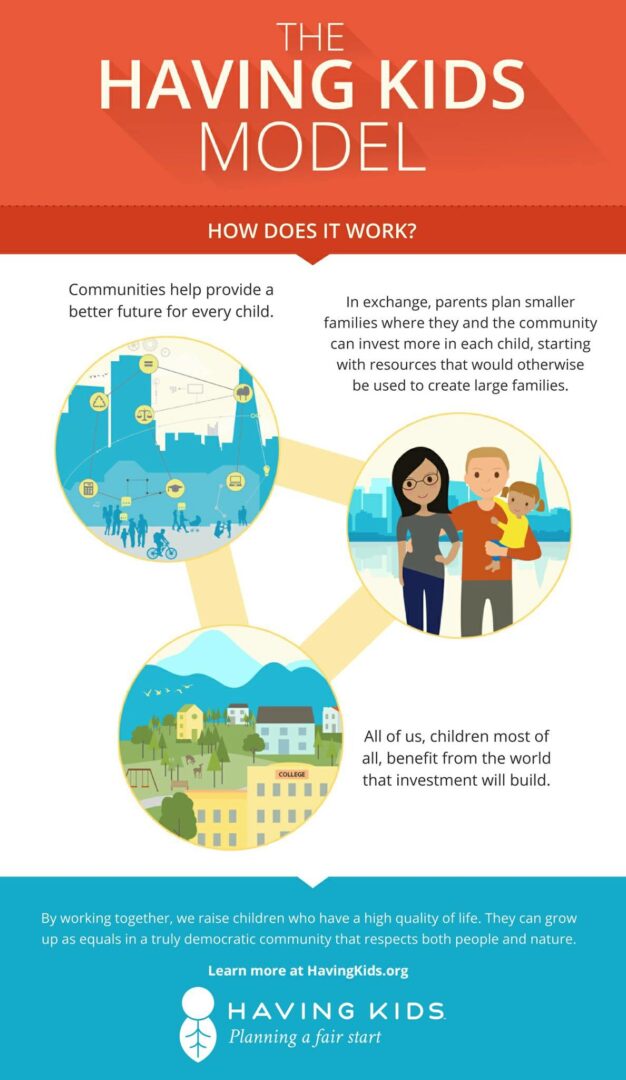
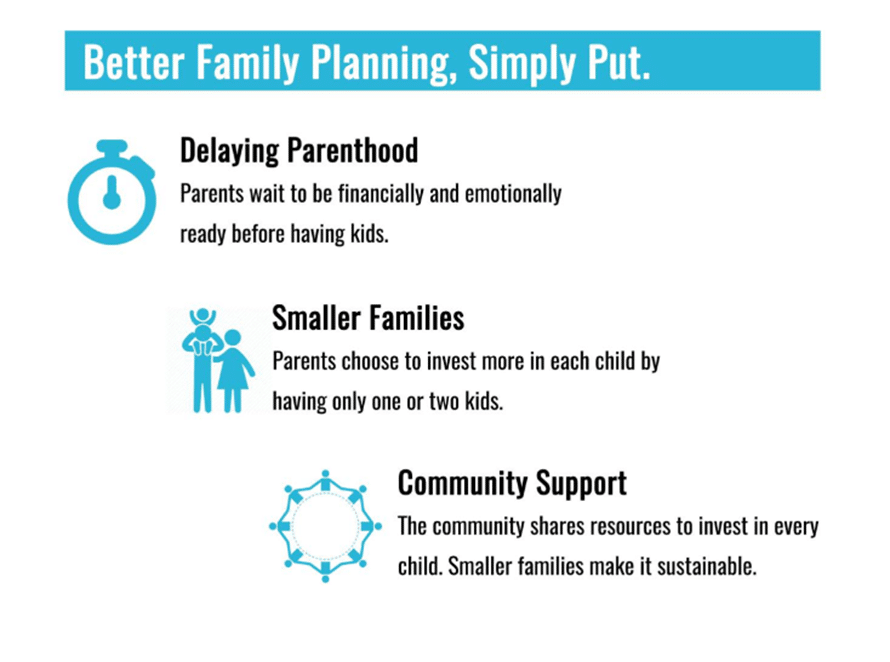
Social movements that try to protect kids, animals, the environment, and democracy tend to see themselves as distinct, and even conflicting. That’s a huge mistake. The most impactful way to further the core missions of all movements lies in making a simple change: Restructure family planning policies, universally, by 1) promoting delayed parenthood, so that people are ready to actually parent, 2) prioritizing giving all kids a Fair Start in life in any political system of resource and stakeholder redistribution, and 3) encouraging smaller families for all, something which helps enable and pay for the first two moves.
So who would be oppose this transition? Big business and big government both thrive on poor family planning, because it creates a wave of consumers, cheap future labor, and taxpayers. Both use growth to increase and concentrate their power, at cost to the development of individuals, real democracy where every voice matters, and nature. The solution? Social justice movements can unify against these concentrations of power, finding reasonable allies on both the political left and the right, who want effective reform that furthers our widely shared values, the decentralization of power, and our actually reaching sustainable development goals. Want more information? Our peer-reviewed white paper on family planning reform can be found here.
Want to help with this unification of social justice movements against the concentrations of power? Please consider donating to HavingKids.org, or signing up to volunteer at info@fairstartmovement.org.
Having Kids is an international human rights organization dedicated to improving family planning systems worldwide with a simple idea: Every child has a fundamental human right to a Fair Start in life, ecologically and socially, which overrides all competing interests. Our modeling is the subject of several peer-review works, and it includes clear policy pathways for implementation.
Our biggest crises — health, economic, and environmental — are complex, but they all point back to a single issue: failures in family planning. This is reflected by the nearly 50% of pregnancies that are unplanned in the United States. If we hope to effectively make progress on the crises we face, it is essential that we stop looking at them as separate issues. They are intersectional; we cannot address them individually. And they demand an informed and coordinated approach from this administration.
They begin with family planning.
Family planning is an economic issue: The U.N. has called the United States the most unequal society in the developed world. Right now, nearly 40% of children in the U.S. live in or near poverty. Unequal opportunities translate into unequal lifelong outcomes by the time children reach age 5. Decades of research indicate that better family planning is the most effective way to break the cycle of poverty. It enables future parents to pursue higher education and achieve career stability, allowing them greater lifetime earning power for families that sets children up for greater achievement and welfare outcomes.
Family planning is a health issue: We have seen both COVID-19 and climate-affected environments disproportionately affect the health of low-income and BIPOC communities. This occurs because economic disparities among these groups translate into health inequalities.
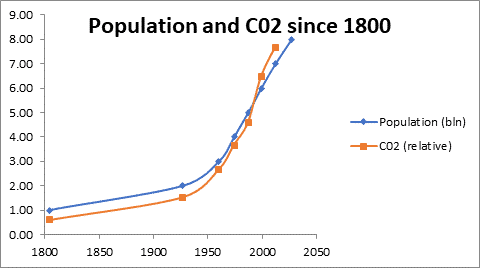
Family planning is a climate issue: Unsustainable population growth is undoing the work to curb carbon and other emissions. It is time to look beyond fossil fuels to the primary and fundamental driver of the climate crisis. We must account for a sustainable population growth if we are serious about reversing course on climate and promising a healthy, habitable future for the next generation.
The policies of the United States and other nations will severely harm future generations if we do not make changes now. Improving the way we plan families is the most important investment we can make for the health and well-being for all children.
Here are three things the Biden administration must do in 2021 to address the social, health, and ecological crises we face today:
Respond to the Climate Crisis by Targeting Its Fundamental Driver
The most effective long-term way to mitigate the climate crisis is by promoting smaller families for all. This move can have 20 times the impact of other policy choices. And there are now clear policy levers that would promote smaller families, and well as parental readiness before having children as another means of improving child welfare. Focusing on building resilient future generations would go beyond the Green New Deal, which lacked this key focus. It would move us toward a true social contract to come together as free and equal people, but one correctly designed to be 360-degree intergenerational.
Multiple studies have confirmed the incomparable impact of new family planning policies. Yet governments and industries that are accustomed to unsustainable population growth have instead embarked on policy initiatives designed to push women to have children.
Your administration has the opportunity to lead on this issue, in part by promoting tax reforms that convert traditional child tax credits into Fair Start baby bonds designed to promote smaller and equitable families. In short? Convert incentives for all people to have kids into a steeply progressive tax system that incentivizes everyone to wait until they are truly ready to parent and to work together to have smaller families with a level entry field for every child.
It should be the administration’s policy that the United States will lead in helping the world reach an optimal population range as soon as possible. This population will be built around the human right to nature rather than continued nationalistic and unsustainable growth policies that consider babies to be economic inputs, treat nature as a resource, and exacerbate the climate crisis, inequity, and child poverty.
Respond to COVID-19 by Making Future Generations More Resilient
In a recent dialogue between Having Kids and the CDC, the agency noted the connection between reduced birth rates and the beneficial impact on our ability to respond to COVID-19. In short? Poor family planning hurts public health, creates overcrowding, and sets the stage for the next public health crisis.
We propose reforming federal family planning policies through forthcoming legislation designed to respond to COVID-19. And we urge cementing these changes by reforming Title X to promote a child’s equitable start in life as the guide-star value. Stimulus packages and regulatory reform provide a unique opportunity to stabilize today’s families while protecting future generations.
Become a World Leader in Human Rights-Based Family Planning
Family planning is a universal human right, and the United States can become a leader in the ongoing development of this right around the world. The best way would be to explicitly support a growing coalition’s call for the United Nations Secretary General to issue an informal statement embracing family planning reform as the first and most fundamental means of addressing the world’s key social and ecological crises, and moving toward the U.N.’s Sustainable Development Goals.
By 2100, world population could vary by billions of people depending on whether the average woman in the world has one child more or one child fewer.
Simply stated, the current family planning model used by the United Nations was developed before awareness of climate change, the disproportionate impact of early childhood development on human well-being, and how birth conditions and early development exacerbate inequality and other factors. This old model makes our future less secure, healthy, and equitable.
The right to have children comes with responsibilities for parents and for communities that protect us all. The United Nations is using a decades-old pro-growth family planning model that ignores those responsibilities and hurts kids. That model is fundamentally driving ecological crises and the climate crisis, child poverty, and growing inequity across the globe. That model exacerbates the risk and impact of pandemics and prevents our reaching the U.N.’s Sustainable Development Goals. That non-inclusive model exploits children more than it invests in them, thereby driving its political illegitimacy.
The United States should take the lead in urging the United Nations to abandon its current family planning modeling in favor of a truly future child-centric and human rights-based Fair Start approach. Our recent letter to the heads of the UNFPA and UNICEF detail the change.
We are hopeful for important progress to be made as we usher in an administration that believes in science and the advancement of human welfare. With these three steps, we believe the Biden administration can become a leader in promoting the evolution of our family planning systems to guarantee every child a fair start in life.