Author: Carter Dillard

  • What Are Pregnant Pronouns? The Key to a Better Future, and Freedom

    What Are Pregnant Pronouns? The Key to a Better Future, and Freedom

    It’s common to see people today sign their messages with a variety of pronouns. That act is meant to liberate people to identify themselves as they see fit – to self-determine, rather than be determined by others’ conceptions of gender, for example. Our language matters and shapes our experience, and self-determination – or freedom – is at the core of human rights.

    Could pronouns be the key to an even larger form of self-determination?

    Yes, and in this simple way. For any claim about ethics, morality, rules, law, policy, etc. – some claim about what people “should” do, we can ask the claimant (politicians, celebrities, philanthropists, thought leaders, etc. ) to specify a few things regarding self-determination, and the pronouns that are express or implied in the claim. Has the claimant accounted for the quantity, constitutive qualities (like empathy), relative positioning of the people (in terms of equity, for example), and ways in which the people will impact their ecologies?

    Keep in mind that groups of people are inherently dynamic, with people constantly being born, and dying. So for the pronouns that relate to who will exist in the future, has the claimant accounted the most basic of values and building blocks of freedom: For ensuring future persons minimum levels of wellbeing, equality, their need for a safe and natural environment, and an influential voice in democratic systems? In other words, has the claimant accounted for the most important factor in any claim that we should do something – the people at stake – and how to ensure those people can self-determine, relative to a zero baseline, rather than be determined by others. In other words, can they account for how all the pieces fit together?

    What we find is that because the creation of people – or having kids – is considered a matter of parental autonomy and private decision-making, we largely overlook people as the key factor (always he first and largest driver) in all prescriptive claims. In almost every legal system in the world today parents who have severely abused children have the right to have more children, even when those children will raised by the state. At the same time those systems do nothing to ensure the average citizen has a right to a safe and natural environment. That sad reality shows how deeply embedded unsustainable population growth – anthropocentrism – is in our systems. And as a result, the most important aspect of policy claims – the creation and sustainable development of each person – is treated as none of our collective business. That reality epitomizes how those at the top pit the most vulnerable against one another, and shows the need for reproductive justices reforms that free us from one another.
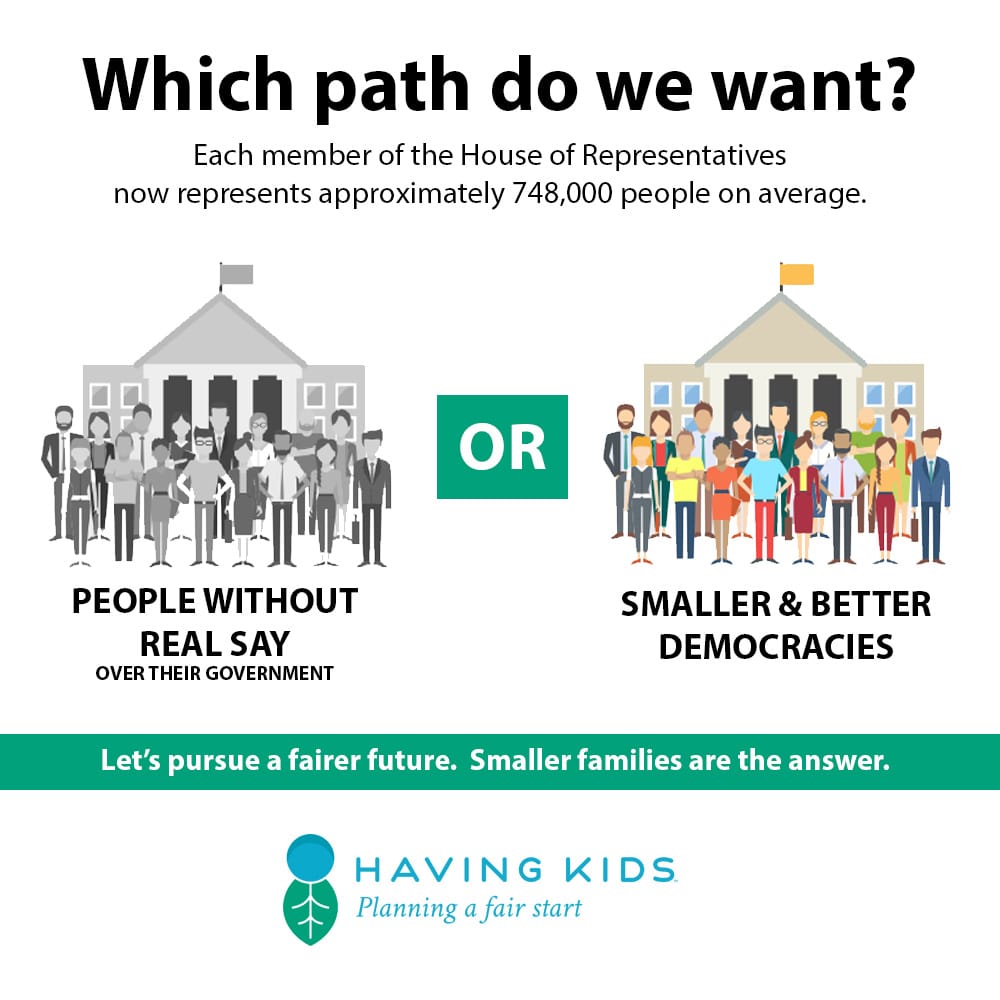
    An infographic compares two options for democracy: one with many people and little individual influence, another with smaller groups and more influence. It advocates for smaller families to achieve better democracies and government representation.

    Urging people to specify their pronouns can help fix this. For example, when governments claim to have a climate policy, we can urge them to account for the actual people causing the emissions, the people subject to them, the people in both categories who will exist in the future, etc. You will be shocked to see how little thought goes into these matters of how people came to be, and will come to be.

    Do you support nonprofits that protect children, animals, the environment, or human rights and democracy? Urge them to explain how population growth – the entry of new persons into the world – impacted their missions, what they did about that impact, and what they are doing now. Again, you will find that most groups did not create the results they claimed to have because they ignored the key factor shaping outcomes. And in terms of for-profit businesses, query how many have produced anything of truly objective value, and how many just rode a wave of valuation, demand and population explosion created by poor and unsustainable family planning that ensured no minimum levels of welfare for children (in blatant violation of things like the Children’s Rights Convention), abysmal levels of education, extreme inequity ensuring cheap labor, and bloated nation-states where the average person had no real voice in political outcomes. Did they simply profit from a system that mass produced consumers instead of developing capable, and truly free, citizens?

    We can sharpen the questions. Have the claimants noticed how their answers group together people who do not trust each other at all, and could not possibly operate in truly consensual, integrated, and democratic systems of relative self-determination? If people don’t trust one another, how can they be in truly consensual systems of governance with one another? For example, if you have to lock your home because you do not trust the people in your country, why would you trust them as citizens empowered to help decide the fate of the nation? How will the claimant deal with this, or what might be called the constitutional dilemma (or Lesser Power Asymmetry) of how to include and empower people in legal systems, at the same time?

    Discourse using the pregnant pronouns elicits and brings to the surface something very specific about all “should” claims: It is ubiquitous that we ignore the people in, and subject to, prescriptive claims. We can’t allow ourselves to make this mistake.

    Our evasion derives from the simple fact that for many reasons, including a series of mistakes in the development of legal and political systems (like seeing power as violent domination rather than more subtle things, like bad parenting and climate emissions), human cognitive dissonances like temporal myopia, cultural taboos, deference to religion’s role in the family, racial and political sensitivities, etc., we ignore people’s creation and how their creation impacts ethics, morality, rules, law, policy, etc. We think of people abstractly, exogenously, and statically, instead of dynamically focusing on their creation, their development and how they constitute themselves together in self-determining democracies where human power is limited and decentralized. And yet, if we truly value people and self-determination, they will always be the first and most important factor in the things we prescribe.

    Why? Because we are before we do, people are always the factor that comes first (or “lexically prior”), and because the vast majority of people and other animals whom we should care about will exist in the future and as such are especially vulnerable, their interests outweigh the interests of people alive today.
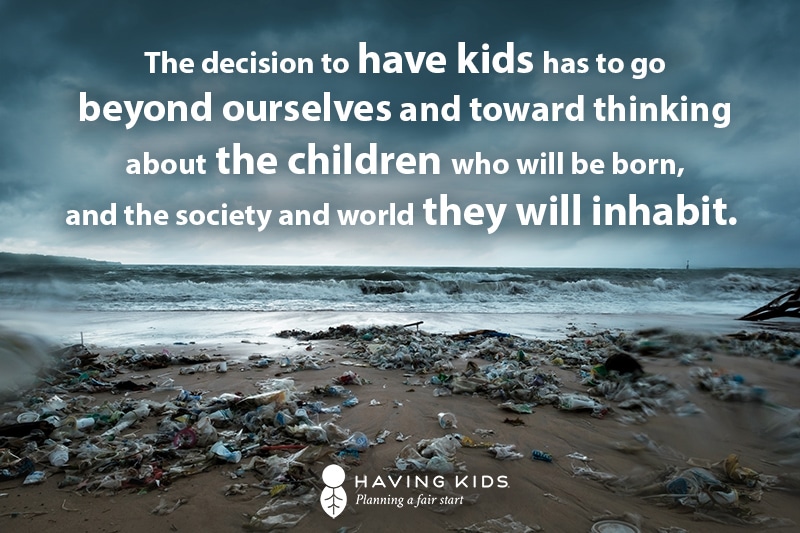
    A beach littered with plastic trash under a cloudy sky. Overlaid text reads: The decision to have kids has to go beyond ourselves and toward thinking about the children who will be born, and the society and world they will inhabit.

    What is the usefulness of the information we get in pregnant pronoun discourse? Questioning people about the pronouns in the things they are prescribing helps us divide people into those committed to freedom, and those who are not. The former will choose to orient their claims from the perspective of, and with pronouns that imply, self-determining people who are assured minimum levels of wellbeing, equity, nature, and democracy. They will orient the creation of future generations – or family planning systems, laws, and policies – from a child-centric perspective, as proof of their empathy, and in way that gives children these things and allows them to constitute themselves in just and relatively self-determining communities. This is not about population; it’s about freeing people.

    A Useful Divide

    The latter, who can be termed precons, will not – either because they cannot empathize with the people their prescriptions impact, wish to exploit rather than invest in them, do not care if those people will constitute themselves as free and relatively self-determining people and instead are content with centralized systems of top-down power, etc. In other words, the discourse helps us identify the people we should not trust in our democracies, where the act of constituting ourselves – intergenerationally – liberates us. Distinguishing between the two and knowing the threats for what they are can mean the difference between building a future where people are free and relatively self-determining, something countless people died in wars of liberation to ensure, and not doing that. No ethic, morality, law, policy – or systems comprised of such things – is legitimate if it cannot hold up in pregnant pronoun discourse as promoting relative self-determination, and we may be obligated to violate the prescription and its systems in favor of systems that do.
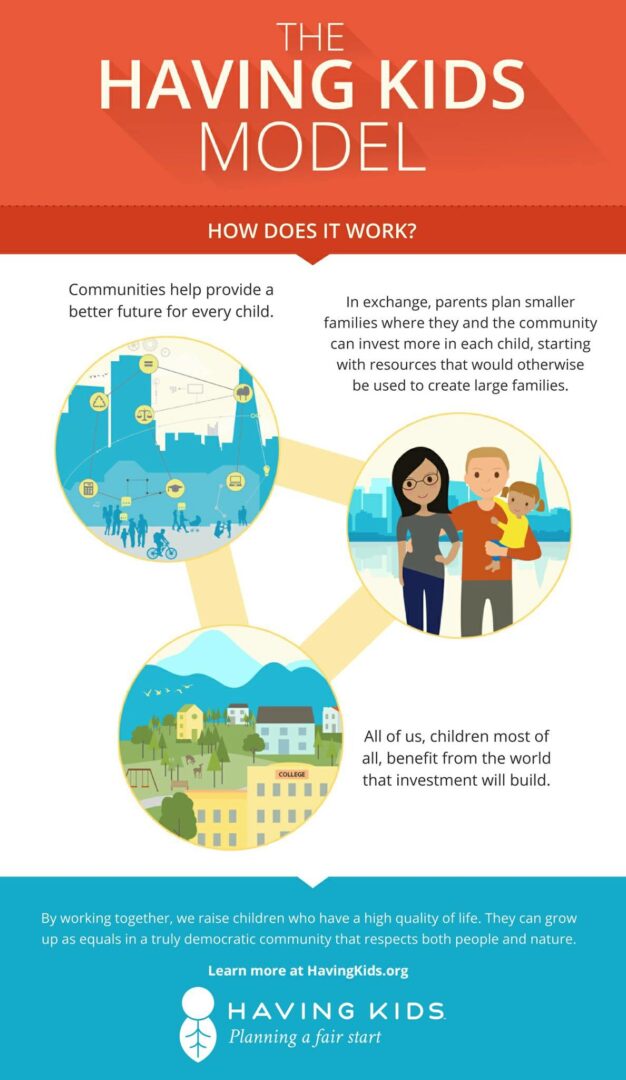
    Infographic explaining the Having Kids Model: communities invest in children’s futures, parents plan smaller families, and all children benefit from increased resources and a supportive environment. Includes illustrations and text.
  • Connect the Dots To Family Planning

    Connect the Dots To Family Planning

    Family planning is a driver behind many of the crises we read about in today’s news. But journalists rarely connect the dots.

    Help journalists connect the dots! Contact Having Kids at media@fairstartmovement.org. We’ll help you submit editorials and letters to the publications you care about.

    If you belong to a human rights, environmental or animal protection, and/or child protection organization or funder, ask them about their position on family planning. How is their position furthering their mission?

    Speak out and protect your future. A better future means reforming family planning to focus on the child, first and foremost, to give every child a fair start in life.

  • Comprehensive Animal Rights

    Comprehensive Animal Rights

    If you wanted to work to liberate both humans and nonhumans, how would you do it?

    You might promote diet-focused veganism as a way to eliminate the confinement and suffering that humans inflict on nonhumans in factory farms, and to improve human health and well-being at the same time. Or you might focus on early childhood development programs that build children’s empathy in the hopes that they will end up treating other animals — both human and nonhuman — well.

    While effective, neither of those strategies is comprehensive. To be comprehensive, we have to deal with the interactions of future generations of all animals — or what might be called the long-run future — which dwarf the number of interactions occurring today. One way to do that is to apply an accepted ethical framework such as international human rights. To deal with the long-run future within that system, we could combine a forward-looking and child-focused family planning ethic devised around the Children’s Rights Convention, for example, with a nonhuman-focused ecological ethic, in order to minimize the suffering and death that humans impose on animals (which will continue to increase as human population grows), and maximize self-determination for all entities.

    Let’s unpack that statement a little: To be comprehensive, we have to account — at the most fundamental and irreducible level — for how all humans and nonhumans first come to exist and interact. We would have to account for who we are as a species, in terms of the quantity, qualities, relative positioning, etc., of the people on the planet, relative to the nonhuman world. Who are the people impacting animals, and who will they be in the next generation and in the generations after that? The first step in animal rights is accounting for the existential relationship, and perhaps the balance, between humans and nonhumans. It’s hard to have rights when you are extinct and hard to prevent extinction without a family planning ethic that requires preservation of the nonhuman world.

    Rights Are About Protecting the Most Vulnerable Classes: Future Children and Nonhumans 

    And to be comprehensive and actually account for the interconnections, we have to deal with the crucial phase between the nonhuman and human world: the time-space in which humans are conceived, born, raised, and developed in particular ways, and the nexus of the nonhuman world, or a restorative baseline for environmental protection, in that process (e.g., the shortening of pregnancies due to the climate crisis). In other words, we have to account for the fundamental power humans have over the most two vulnerable categories of entities though the act of procreation: future children and nonhumans.

    We would have to ensure that, relative to the touchstone of the nonhuman world, future generations are free and self-determining and are inherently disposed from the very beginning to treat humans and nonhumans in ways that promote the autonomy and well-being of every individual. 

    How do we know this is true? The climate crisis provides a helpful example: Study after study has shown that the most comprehensive and effective way to mitigate the climate crisis that is the greatest threat to future generations of humans is also the most effective way to protect animals: Creating and implementing better family planning laws that promote more equitable and sustainable families.

    Doing so would not only reduce emissions, but would also create resilient, capable, and cooperative people able to best navigate a degraded ecology.

    In other words, the poor family planning laws designed to promote economic growth to benefit elites also ensured countless children were born into poverty, abusive homes, and misery over the past several decades. This, in turn, ensured the extinction of countless species, the creation of factory farming, the onset of the climate crisis, and other examples of nonhuman suffering and death that has only skyrocketed in our lifetimes. Human population growth (which is actually a misnomer for a more complex process), or the act of having kids, was the genesis of it all.

    Had we applied a standard of protecting the nonhuman world as part of the liberation of nonhumans, we humans would have evaded the climate crisis and would be much better off.

    And it’s not just about population growth: Having kids determined things about our qualities (like empathy) and relative inequity that fueled the colonization and destruction of the nonhuman world. It starts, unsurprisingly, with who we are.

    Being Comprehensive Means Applying a Duality

    How, in practice, do we do reverse this catastrophe? Now we are back to the beginning: We can apply a simple duality. First, we can implement a forward-looking and child-focused family planning ethic, one which recognizes that creating a child is more an act of other-determination than self-determination. That means changing from the current family planning paradigm, focused on what parents want, to a paradigm focused on what children need. We can combine that ethic with a nonhuman-focused ecological ethic — which is not the “world’s environment is a human resource” ethic many mainstream environmentalists use and which precipitated the climate crisis — in order to minimize the suffering humans impose on animals and maximize self-determination for all entities. 

    That’s comprehensive (as opposed to consumption-based) veganism and animal rights — and the only approach truly consistent with the precautionary principle. Comprehensive animal rights is an ongoing process of constituting free societies for all. The good news is that better family planning is on trend, much more so than consumer-based and less comprehensive veganism.

    Having Kids uses the duality described above to help accelerate that trend, through actions like:
    • our campaign to urge the United Nations to use a human rights-based family planning model
    • our campaign to reform child-welfare systems to ensure some minimum level of welfare at birth for all kids, and
    • our support for recent litigation to protect our fundamental human right to the existence of the natural, or nonhuman, world and the restored habitat of countless sentient creatures. 

    You have a right to nature, children have a right to a fair start in life, and no one has a right to have children in abusive or neglectful conditions. Understanding these moral facts is the key to comprehensive animal rights, true fourth-dimensional (or temporalized) freedom, and a better future for all. And we can implement these truths by speaking truth to power, and transferring the resources necessary to incentivize better family planning and fair starts in life for all.

    Nothing Matters More Than Who We Are Becoming

    In other words, maximizing impact means first accounting for the volatility in human population growth created by our current family planning systems — or who we will be in the future — and then ensuring that we build future communities where freedom, and the suffering future humans will cause animals, have actually been accounted for. Maximizing impact means working toward a temporalized and comprehensive vision of a human and nonhuman environment — a vision of who we are to be.

    This goes well beyond traditional welfarist population ethics. We are trying to liberate future generations by making them self-determining, not just accounting for our impact upon their ecology, for example. If we value agency, self-determination and humans controlling the norms under which they live, we have to create self-ruling communities — rather than archaic nation states — where those values are manifest. We have to create people with what John Rawls called a “sense of justice,” or a community of truly legal persons capable of complying with norms that protect animals, rather than relying exclusively on traditional animal protection laws that — especially when it comes to farmed animals — are often not worth the paper on which they are written.

    Comprehensive animal rights would mean intentionally constituting future communities of free and equal people by cooperatively and equitably ensuring the requisite time, love, and energy for each child, so that we are investing in future generations rather than exploiting them. 

    This is where Peter Singer (who focused on suffering, rather than power) and other prominent animal rights theorists failed to account for the majority of animal subjugation (both human and nonhuman), the interrelation of that subjugation, and the way it is causing the social and ecological crises we are experiencing right now. They ignored the point when the interactions begin: our creation. And they ignored the need for an orienting baseline to constitute our communities. They also ignored that justifying social organization at this level prevents that subjugation, and the crises, and serves as the foundation of comprehensive animal rights.  Rights developed as a means of protecting the vulnerable from the powerful. And given that future children and nonhumans are uniquely and inextricably vulnerable, systems of rights must begin with them. Want to protect the vulnerable? Focus on the invariably antecedent, and dominant, factor: the creation of their oppressors. 

    How Do We Achieve Comprehensive Animal (Including Human) Rights?

    There is a way forward that aligns the rights of all animals, using the nonhuman world — or the wild — as a baseline for the unified conception of a dynamic social and ecological, or human and non-human, environment. This is what that conception, which goes beyond descriptions toward a normative account of human power properly oriented from its absence, looks like: Families that invest more in each child and can create sustainable and deliberately inclusive communities; a greater voice for each person in their systems of governance as we reorient social organizations around town halls instead of shopping malls; more time off for parents; smaller impacts on the planet, wildlife, and farmed animals as we restore the wild; better outcomes for each child; and more resources to share among families so that everyone can get a fair start in life. 

    It’s a win-win for all animals. It’s the freedom of opportunities to do things in life balanced with the freedom from the unwanted influence of others. There is simply no coherent conception of freedom, or rights, that does not account for this dynamic alignment. In this sense, while nonhumans were unlucky in the power dynamic relative to humans, they are lucky in that their liberated world is a necessary condition for humans to be the best people they can be.

    Having Kids works to move the world in this direction through what we call the Fair Start family planning model, which orients from a zero-baseline, or the nonhuman world. The work is not purely theoretical but involves very specific real-world policy changes. We can advance family planning to improve lives and our planet’s future through many avenues. Here are just a few:

    • Fighting for the fundamental right to nature, or a nonhuman ethic of environmentalism, which is the anchor point for any coherent conception of freedom and the intersection of human and animal rights. This can include direct action to transfer resources in ways that promote and incentivize Fair Start family planning, and other tactics, given the peremptory status of the right.
    • Using expressive and noncoercive approaches to prioritize child welfare and to accelerate a change in family planning culture, highlighting shocking child welfare crises to illustrate the urgent need for reform. Being free means celebrating our right to nature in tandem with responsible family planning — not allowing kids to be born with no minimum guaranteed level of welfare, e.g., into abusive and neglectful conditions. That warped conception of freedom only feeds into growth economics, the consumption of nature, and the exploitation of future generations. It’s not freedom — it’s the powerful using the powerless.
    • Tax policies that encourage large families can be reformed to encourage delaying parenthood, investing more in each child and transferring resources to ensure that every child gets a fair start in life. This would include guaranteed minimum incomes for all children, pegged to better family planning policies.
    • Fully funding the development and availability of new male long-acting contraceptives. These should have been on the markets decades ago — and would have been, were it not for sexist and pronatal policies. 
    • Urging public figures to speak out, given the massive impact that role modeling better and more sustainable family planning can have. Meghan Markle and Prince Harry’s recent statement about their intent to keep their family small was exemplary.

    If it takes a village to raise a child, it takes a village to plan for a child. Please consider promoting a universal ethic of cooperative Fair Start family planning and sustainable, more equitable families. It’s the most effective and comprehensive way to achieve a socially and ecologically regenerative society for all animals, or making sure we are becoming sufficiently other-regarding and socialized enough to actually constitute free societies. Of course, many alive today will resist doing what’s right. But in the end, it’s not about them: It’s about pushing past them toward the next frontier of social justice to save the most vulnerable and numerous category of entities, future children and nonhumans, from the intergenerational hegemony of a small minority of oppressors.

  • Ready for Something Different? Fair Start Concept Changes Everything

    Ready for Something Different? Fair Start Concept Changes Everything

    The impending overturn of Roe. v. Wade has starkly and publicly revealed the new reality facing the United States. The anti-choice, pro-gun, ‘anti-everything-good’ conservatives are playing their hand face up. They have shamelessly stopped pretending to play by the rules and – if you’re listening – they’re telling us exactly what our future looks like. For 99 percent of us, it doesn’t look good.

    The powers that be – mostly old, white, dusty antiques like Mitch McConnell, Eugene B. Meyer, Donald Trump – are climbing the castle walls in their 50-year strategy to cement in place their power and influence. As the world changes around them, as American society embraces all different stripes of people, the old guard conservatives and the wealthy 1 percent are terrified of losing their grip.

    The Fair Start Movement  approaches this fight from a new and different perspective. We believe that: No government, state or federal, has legitimate standing to mandate the birth of every child conceived unless it is prepared to care for those children beyond the birth canal and give them a Fair Start. free from the climate crisis through a return to nature, and free in terms of having an influential role in one’s democracy.

    At this critical crossroads in human history, we must acknowledge that every child born has a right to start out in decent circumstances. We must account for the wellbeing, equity and personal development of future generations if we are to foster a real democracy where each person’s voice matters. We must accept that our current system destroys the environment and does nothing, in fact takes negative action, to mitigate the oncoming crises. 

    We already see progress. Many people agree with our vision and are committed to real, positive change. As we build a truly democratic population, wherein everyone has a voice that is heard, we will move away from the toxic, crumbling society of today. 

    We will honor individual rights and guarantee universal healthcare. We will return to nature by respecting our place in the ecosystem, giving and taking sustainably. We will escape the domination of the selfish, greedy, wealthy few whose plan for the future – assuming they have one – accounts for their survival alone.  

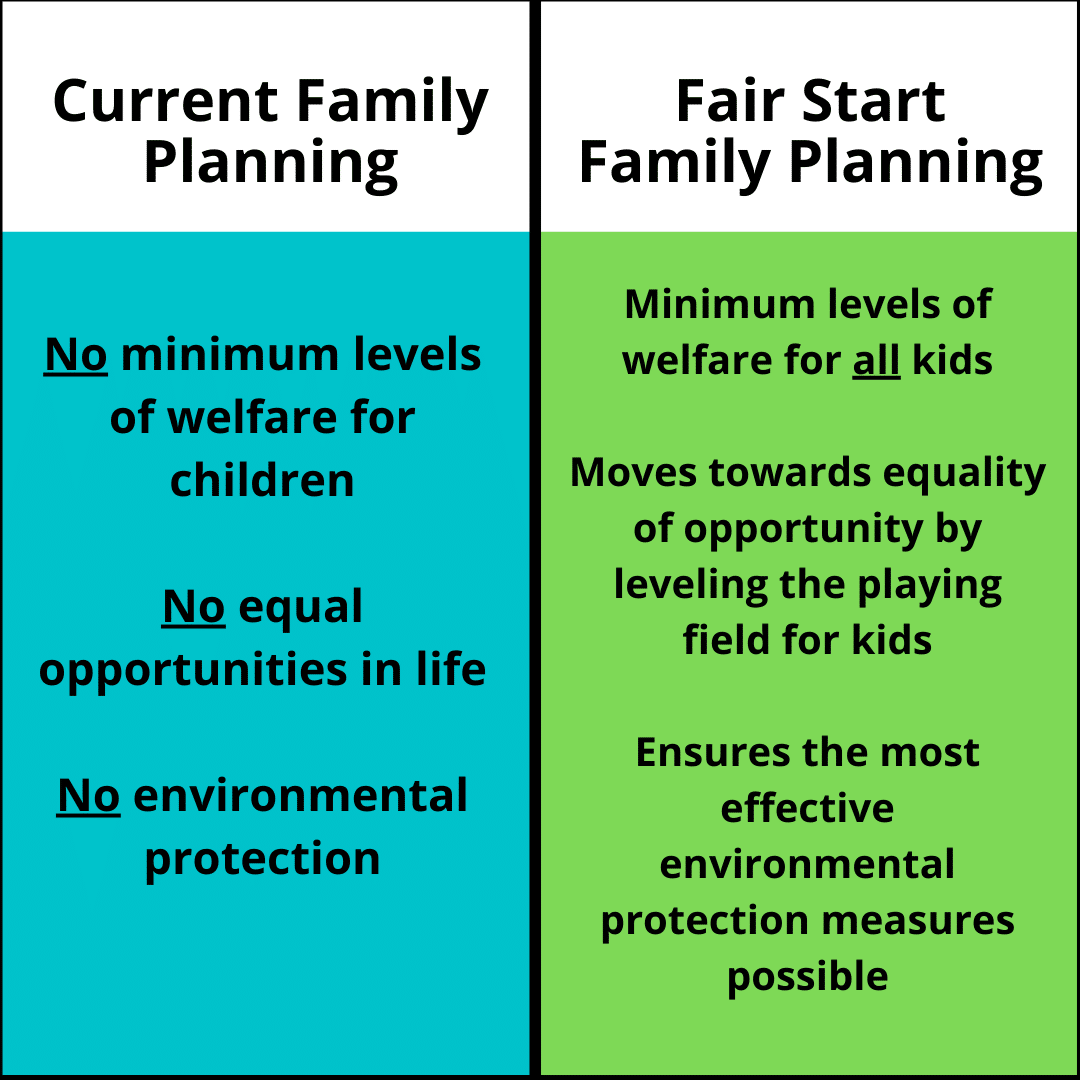
    A comparison chart of Current Family Planning and Fair Start Family Planning. The left side lists negatives: no minimum welfare, no equal opportunity, no environmental protection. The right side lists corresponding positives.

    In the meantime, we must work within the system we have. The State must accept its obligation to invest heavily in common-sense family planning programs and science-based sex ed. Those items alone will automatically lower abortion rates and teach young people the truth about having and growing a healthy family. 

    The State must break its unconstitutional commitment to Christian moral dictates and adopt a reality-based approach to governing. It is absurd and completely unacceptable that 350 million+ people of every faith are governed based on the ethos of bronze-age men. 

    We must shift our paradigm away from the endless-growth-economy fantasy, which demands that mothers continually produce their supply of workers and consumers. Prisoners to boot.

    TAKE ACTION:

    Let’s hold accountable those responsible for the current societal roadmap that pushes the opposite of a Fair Start for our children. Urge any organization you are part of to support and join our Tell the Truth campaign, which would obligate disclosure of this information.

  • Having Kids Urges Federal Government to Prioritize Funding for Male Pill

    Having Kids Urges Federal Government to Prioritize Funding for Male Pill

    The human rights advocacy group Having Kids today urged the National Institutes of Health to prioritize funding and research for male contraceptives like the male pill as a way to improve family planning, and reduce unwanted pregnancies.

    Read our special report, and campaign announcement, here.

    “Having Kids believes that in light of the world’s current population increasing at the rate of 80 million persons a year, and projected to exceed 9 billion by 2050, it is imperative that NIH make research and funding for the development of male contraception an extremely high priority over the next five years,” wrote Katherine A. Meyer, an outside lawyer for the group, in a letter to the National Institute of Child Health and Human Development.

    Meyer noted that while clinical trials of some male contraceptives have shown promise, more research is needed to ensure they are safe and effective.

    “NICHD can play a crucial role in making this a reality,” she wrote.

    The letter noted that groups such as the Population Council and private foundations have funded male contraception research, but can’t afford the large, phase-3 clinical trials required by the Food and Drug Administration. NICHD could give this effort a boost by seeking congressional appropriations for research, and directing current funding toward this clinical research.

    Also today, Having Kids issued an illuminating report and campaign announcement on how federal agencies have failed to take into account population growth when examining the environmental impact of federal actions under the National Environmental Protection Act.

    The report noted that the Council on Environmental Quality, which issues regulations interpreting NEPA, under President Richard Nixon did take population into account. Six months after signing NEPA into law, Nixon said In a letter to Congress that the CEQ “is concerned with all aspects of environmental quality – wildlife preservation, parklands, land use, and population growth, as well as pollution.” Every subsequent CEQ report during the Nixon Administration addressed population in its analysis. But over the last 40 years or so, CEQ stopped identifying population growth as a significant factor affecting the environment.

    Having Kids works to promote sustainable and more equitable families, as a way to help children, restore the environment, and protect animals.

    ###

  • Having Kids Calls on Congressional Leaders to Prevent Child Abuse

    Having Kids Calls on Congressional Leaders to Prevent Child Abuse

    Today the national child-protection organization Having Kids called upon the leaders of the Senate Committee on Health, Education, Labor and Pensions to amend the Child Abuse and Prevention Treatment Act (“CAPTA”) to require states to enact legislation that allows judges to prohibit offenders convicted of certain felonies from having children as a condition of probation.  CAPTA allows states to apply for federal grants for child abuse prevention and treatment programs but also enumerates certain “eligibility requirements” that each state must comply with in order to receive funding.

    Read the full letter here.

    Having Kids’ proposal seeks an amendment to Section 106 of CAPTA to include, as funding eligibility requirements, that a state have Fair Start order legislation enacted.  Such legislation would, in the event of a conviction, temporarily prohibit an offender from having additional children during the pendency of any probation in order to prevent the abuse and neglect of any future children.  While the Congressional Findings from the CAPTA Reauthorization Act of 2010 hold that “substantial reductions in the prevalence and incidence of child abuse and neglect and the alleviation of its consequences are matters of the highest national priority,” national statistics from the past 5 years show that the epidemic of child abuse and neglect in the United States is not improving.  In 2016, there were an estimated 676,000 children across the country who were victims of abuse and neglect, up 3% from 2012.  The number of child fatalities that were the result of abuse and neglect steadily rose each year with 1,750 fatalities in 2016 versus 1,640 in 2012.  That is approximately 5 children dying every day in the United States as the result of abuse and/or neglect.

    “We believe that in order to truly make an impact in the prevention of child abuse, we must ensure that children are not born into potentially life-threatening situations,” said Anne Green, Executive Director of Having Kids. “It is a matter of national importance that we not only take care of abused children after the fact but do all that we can to prevent the abuse from happening in the first place.”

    Take action:
    Email the senate committee members and tell them that you support Having Kids’ proposal for a Fair Start amendment to the  Child Abuse and Prevention Treatment Act.

    Email Ranking Member senator Patty Murray

  • How to Give All Children in Washington, D.C. a Fair and Equal Start

    How to Give All Children in Washington, D.C. a Fair and Equal Start

    What Inequality Looks Like in Washington, D.C.

    Inequality is inherited. It affects kids for life. Unequal opportunities translate into unequal lifelong outcomes by the time children reach age 5.

    And the impacts of inequality are more damaging the longer it is experienced. The longer a child is poor, the greater the risk of poverty in adulthood and of experiencing lifelong health problems and involvement in the criminal justice system.

    Inequality, therefore, is a welfare issue. Studies have documented examples of rising inequality decreasing child welfare. Affluence plays a role, too. The growing divide between low-income children and their peers reduces opportunities for low-income children throughout their lives.

    Poor kids become poor adults, and rich kids become rich adults, with the latter inheriting both obvious and subtle benefits they never “earned.” Racial and ethnic disparities that have persisted are a consequence of that. Inequality disproportionately affects children of color in the United States.

    There is perhaps no city in the U.S. where inequality between rich and poor, and between black and white, is more evident than in the District of Columbia. 

    Washington, D.C., has a higher level of income inequality than any state in the country, with households in the top 20% of income having 29 times more income than the bottom 20%. The bottom fifth of Washington, D.C., households earned just 2% of total D.C. income in 2016, while the top fifth had a staggering 56%.

    White families in D.C. are 81 times richer than black families on average. Moreover, the effects of economic inequality persist throughout lifetimes and across generations, with the District of Columbia having among the lowest economic mobility in the nation. 

    With the cost of living in D.C. being 450% of the federal poverty line, the city is becoming a harder place for poorer people and families to live. Add to this growing inequality and the fact that D.C. residents don’t have voting congressional representation (i.e., they’re faced with taxation without representation), and you have a largely disenfranchised, largely black population.

    In addition, Congress restricts D.C.’s ability to raise revenue. The federal government pays no taxes on the land it uses or exempts in D.C., exempts itself from payment in lieu of taxes, and imposes added requirements on public services, such as the police force. Congress exempts those who work in Washington, D.C., but live just miles away in the states of Virginia and Maryland from contributing even 5% or less of their state taxes to the district.

    How to Create Intergenerational Equality in D.C.

    So how can we create intergenerational equality in the district?

    One surefire way is a guaranteed minimum income for children.

    Social welfare policy has been around since the passage of the English Poor Law in 1601. Social programs for child well-being became official United States government policy in 1935 with the passage of the Aid to Families with Dependent Children as part of the Social Security Act of 1935.

    Currently, guaranteed minimum income schemes are being implemented in nearly all European countries (except Italy, Greece, and Turkey) in order to eliminate and overcome the problems associated with poverty.

    The D.C. Council considered a guaranteed minimum income for its residents in 2018, recognizing the importance of combating such gross inequality. The Council commissioned a report by District’s Office of the Budget Director on the potential for such a program, and the report concluded that a guaranteed minimum income “could provide the District with a new, comprehensive tool to alleviate poverty in the city” and, in turn, improve child well-being, family stability, and health outcomes among the district’s residents.

    However, the report cited concerns that a guaranteed minimum income for Washington, D.C., residents would hurt D.C.’s total GDP and employment and would reduce its federal funding for social welfare programs. The report ultimately recommended refining the proposal before proceeding with any legislation.

    (It should be noted that the report arbitrarily limits its consideration of the economic benefits of guaranteed minimum income to increased personal spending. A more comprehensive and accurate accounting would include the savings that result from the improved health and safety of the districts’ residents, such as reduced public expenditure on medical and crime-prevention services.) 

    The Fair Start Guaranteed Minimum Income Solution

    In light of this stark disparity between rich and poor and black and white, between federal officials and D.C. residents, Having Kids believes there should be a Fair Start guaranteed minimum income program for Washington, D.C., children, funded through taxation of a specific group of residents of D.C.: The 100 wealthiest federal legislators and all D.C.-based lobbyists registered under the Lobbying Disclosure Act of 1995. 

    As Cory Booker said in an interview about his guaranteed minimum income legislation, the American Opportunity Accounts Act (also known as “baby bonds”), in the U.S. Senate in 2019, “It would be a dramatic change in our country to have low-income people break out of generational poverty.” The bill aims to level the playing the field by giving all American children the opportunity to generate wealth.

    This Having Kids Fair Start Guaranteed Minimum Income proposal shrinks the wealth gap by specifically contemplating (1) household resources per capita, (2) level of access to public services such as health, education, transportation, and (3) above all, the relationship between children’s fair starts in life and their abilities to become successful, productive future citizens and taxpayers. 

    As D.C. license plates say, “No Taxation Without Representation.” D.C. supplements the federal government’s activities; these transient and wealthy D.C. residents should return the favor. 

    Constituting and Statehood

    The United States Constitution was born of a revolution rooted in the belief that a group of people could constitute independent — free and equal — peoples. But for many reasons, the Constitution was never applied intergenerationally, and it was never applied to the District.

    The United States, therefore, has a capital city where the citizens have no voting voice in the nation’s legislature in a world where human rights and democracy are in decline.

    Like the U.N. did with the Global South, Congress should begin work to decolonize the District of Columbia. It should give D.C. residents statehood and finally allow its (mostly black) citizens a voice in a working democracy. As Eleanor Holmes Norton, D.C.’s lone nonvoting “representative” in the House of Representatives, said about the 2020 Washington, DC, Admissions Act, “Congress has two choices: It can continue to exercise undemocratic authority over the 700,000 American citizens who live in the nation’s capital, treating them, in the words of Frederick Douglass, as ‘aliens, not citizens, but subjects,’ or it can live up to the nation’s promise and ideals, end taxation without representation.”

    — Alexandra Stupple

  • Education Policy Starts With Fair Start Family Planning Reform. Take Action.

    Education Policy Starts With Fair Start Family Planning Reform. Take Action.

    Joe Biden has plans to reform the American educational system. There is a lot to do. While educational attainment in the United States has been steadily increasing, the levels are still well below what a functional democracy would require, with the average American reading around the level of an Eighth Grader and unable to understand their own constitution, laws or political system.

    How do we make real change? There are three fundamental problems with the way we have been approaching education.

    • We are engaged in family planning reform now because existing systems are failing. So why are we using family planning policies that push more and more kids through these horrible systems? That’s a huge mistake. We should align family planning to maximize the impact of the systems that work.
    • Education policy often fails because there is a fundamental but unacknowledged disagreement about its fundamental role. Many think education is meant to increase economic growth – that babies are destined to be economic inputs. That is wrong. Economies are preceded and justified by functional human rights-based democracies that regulate them. The educational system required for democracies is virtually the opposite as that used for economic growth. Democracies require developing people for town halls, not shopping malls. That means fewer people, highly developed in ways that that make them capable of cooperative self-rule as free and equal people.

    We can fix these problems.

    Take action: Urge Biden’s new Secretary of Education Miguel Cardona @teachcardona to 1) explicitly recognize these problems, and 2) adopt Fair Start family planning as the fundamental human right and guidestar model through which education reform must be engaged.

  • Having Kids: The Unite America Campaign

    Having Kids: The Unite America Campaign

    Let’s Strengthen Biden’s Child Care Policy to Unite America

    Helping families generally finds bipartisan support. And President Joe Biden has put forth a massive child care and tax proposal to keep child care centers open, help low-income families with child care, and offer tax relief on the cost of having kids. These are great moves.

    But like far too many efforts, this proposal is more reactive than proactive.

    Without sustainable and equitable early childhood investments, the rest of us pay to prop up a losing proposition for American families. Continuing with business as usual pushes our current problems, from inequality to the climate crisis, onto future generations. How could Biden’s proposal be better? It could:

    1) Cut all benefits to wealthy families who don’t need the funding. 

    2) Use those savings as cash incentives to power up family planning and early childhood investment systems in the United States to 

    a) target child abuse by amending the federal child abuse law, 

    b) incentivize delaying having kids until parents are really ready, and 

    c) promote environmentally just families for all regardless of income, ensuring resource availability for all, including future generations. Those changes – made as part of recognizing our sacred constitutional right to nature –  would create massive long-run savings and catalyze sustainable development. We could start to give all kids a Fair Start in life.

    Cory Booker has already proposed a vehicle – baby bonds – through which the modernizing changes could be accomplished, and a Missouri House committee just voted to invest more in incentivizing fostering and adoption.  

    Opponents to these changes will want to use Joe’s plan to incentivize unsustainable population growth, and use babies to grow the economy. Names like Ivanka Trump, Marco Rubio, Mitt Romney, and growth-minded people at Vox like Matthew Yglesias want to use child care, and especially child tax credits, as incentives for women to have kids to reverse falling birth rates. That’s short-sighted, and ignores every child’s right to a socially and ecologically #fairstart in life.

    Changing the way we plan for and invest in families – doing it in a socially and ecologically sustainable way – is thinking ahead and creating long run change. The impacts would be ten to twenty times other things we could do to address the climate, inequity, and decline of democracy crises. Better family planning also has a massive impact on pandemics, improving our response and reducing risks. It’s time to raise the baseline for conditions at birth to set kids up for success for life and build a better future by recognizing the obligations of those at the top. That’s how we come together – or deliberately include future generations in democratic communities – and truly unite America around a common core. We rebuild Main Street by creating a middle class through future generations, at cost to Wall Street and through the elimination of poor and unsustainable family planning.

    In this way we can proceed from fundamental values, and achieve the personal autonomy the political right values, by applying the equity the political left values – but specifically prioritizing children. We can take power away from big business and big government, the entities the left and right respectively oppose, and invest it in future generations. Learn more here.

    That’s truly uniting.

    The Having Kids Unite America campaign is not simply a Green New Deal – it’s a Real Deal, or a new and intergenerational social contract to ensure a #fairstart in life for all kids.

    TAKE ACTION: Add your name to urge President Biden to improve the child care rescue package. And share the campaign with hashtag #UniteAmericaforkids