There is a growing feeling across the world that something is not adding up.
People see climate campaigns, sustainability branding, corporate pledges and public-interest initiatives everywhere. We are constantly told progress is being made. Yet at the same time, forests continue disappearing, species continue vanishing, temperatures continue rising and inequality continues deepening across entire generations.

So naturally, people are beginning to ask a difficult question:
If all this progress is happening, why does the world still feel like it is moving toward crisis?
That is the wider issue explored in the recent article published by the Fair Start Movement titled “New York Helped Create a Fantasy World of Climate Progress — Fair Start Is Taking Action to Show the Truth.” The article forms part of the organization’s broader “Tell the Truth” campaign, which argues that many institutions, nonprofits and public-interest organizations may be measuring success inside incomplete frameworks that fail to account for the larger systems driving harm.
Importantly, this conversation should not be viewed as an attack on people trying to do good.
Many individuals inside environmental organizations, charities, universities and advocacy groups genuinely care deeply about protecting people, animals and the planet. Many dedicate their lives to helping others. But the Fair Start argument is that good intentions alone are not enough if the systems used to measure “impact” fail to include the baseline realities shaping outcomes in the real world.

Person giving food to another
And that distinction matters enormously.
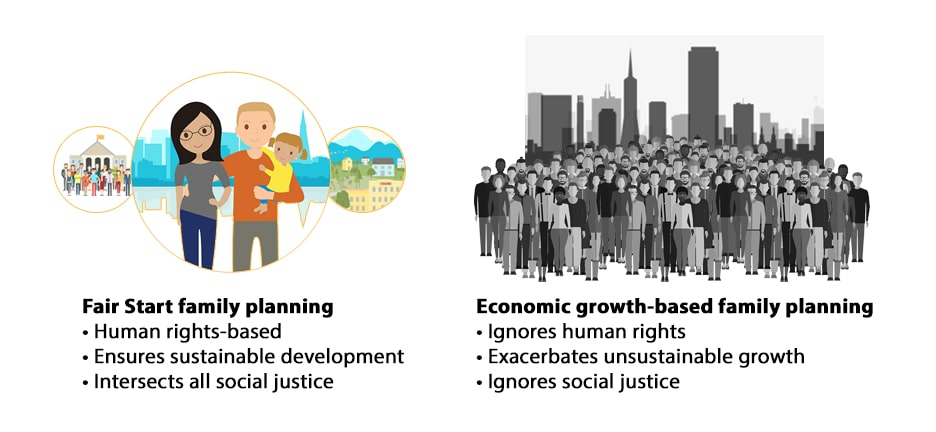
The core concern raised by Fair Start is that institutions often celebrate downstream victories — projects completed, emissions reduced, forests protected, animals rescued, policies passed — without fully accounting for the larger upstream conditions continuing to worsen overall outcomes. According to the campaign, this creates what they describe as a “fantasy world of progress,” where isolated successes are publicly highlighted while wider ecological and social deterioration continues in the background.
In simple terms, the question becomes:
Are we measuring genuine net progress, or are we measuring selective progress inside systems that continue driving larger harm overall?
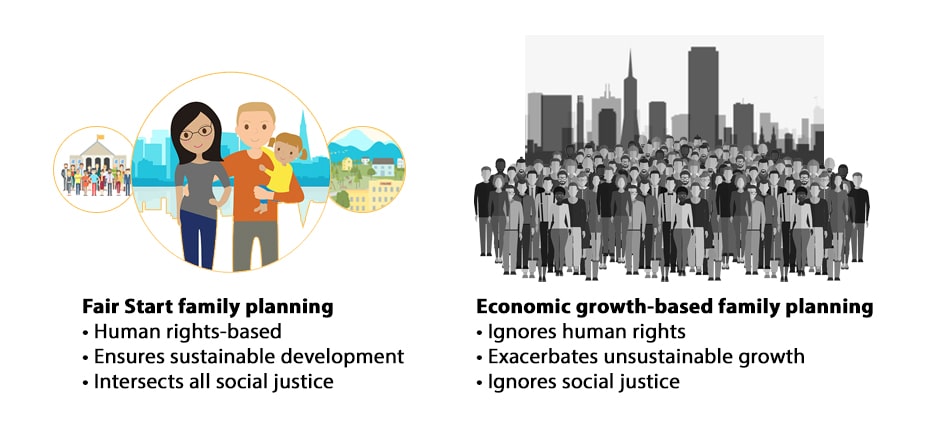
Fair Start argues that many public-interest organizations, governments and institutions have relied on what they call incomplete or distorted “baseline” assumptions when presenting impact claims to the public. Their concern is not merely about data, but about transparency. They argue that audiences deserve to understand the full context behind institutional claims of success, particularly where larger structural conditions may be undoing much of the progress being celebrated publicly.
The campaign places significant focus on climate change, inequality and intergenerational justice. It argues that ecological destruction and social inequality are deeply interconnected, and that the most vulnerable communities — especially children and future generations — often bear the heaviest consequences of systems designed around growth without long-term balance or equity.

Whether one agrees fully with every aspect of Fair Start’s framework or not, the wider questions being raised are important.
How should institutions measure impact honestly?
How do we distinguish between meaningful systemic change and isolated wins that may be outweighed elsewhere?
And how do we ensure that public trust is built on transparency rather than carefully managed narratives?
These are not small questions anymore.
Across conservation, climate policy and public-interest advocacy, there is increasing recognition that outcomes cannot simply be measured through branding, fundraising success or headline achievements alone. More organizations are now being asked to disclose the assumptions, modelling limits and broader systems behind their public-facing impact claims. That conversation is growing globally. (fairstartmovement.org)

At its heart, this is really a conversation about integrity.
Because the world does not need more polished marketing around sustainability while ecosystems continue collapsing. It does not need more carefully crafted narratives around compassion while inequality and environmental instability intensify underneath the surface.
What people are looking for now is honesty.
Honesty about what is working.
Honesty about what is failing.
And honesty about whether current systems are truly creating a livable future for both humanity and the natural world.

For those of us working directly with wildlife, conservation and communities on the ground, these realities are impossible to ignore. We see humans and animals increasingly pushed into conflict over shrinking resources. We see ecosystems under pressure. We see vulnerable communities struggling to survive. And we know that protecting nature and protecting humanity cannot be separated from one another.
Because without healthy ecosystems, there is no long-term future for any of us.

David Goldman / Associated Press via LA TImes
That is why transparency matters so much moving forward.

Not to tear down good people.
Not to destroy institutions.
Letter-
May 8, 2026
The Honorable Letitia James
Office of the New York State Attorney General
The Capitol
Albany, NY 12224-0341
Re: Submission Requesting Baseline-Disclosure Addendum and Settlement-Messaging Guardrails – JBS USA Climate and Sustainability Matter (Assurance of Discontinuance No. 25-067)
Attorney General James:
This submission asks the Office to close a disclosure gap that can survive enforcement itself: absent plain-language baseline disclosure, settlement messaging in a greenwashing matter can operate as an implied credibility signal for the very class of “net” climate representations whose ambiguity gave rise to the enforcement action.
At issue is not a disagreement over values, nor a claim that nothing beneficial may have occurred. The issue is narrower and more administrable. When public-facing impact claims are communicated without the baseline conditions necessary to interpret them, the public is left to rely on an incomplete account of what is being represented. In that setting, settlement communications themselves can become a reliance event.
Purpose and Posture
Purpose. Convert settlement legitimacy into a baseline-integrity requirement. Enforcement outcomes should not function as implied validation of net-benefit narratives unless settlement communications require baseline disclosure that makes the claim falsifiable to the public.
Posture. This is not a dispute about intent, ideology, or whether any emissions-related progress occurred. It is a consumer-protection submission framed around plausibly material omissions and corrective disclosure remedies. The concern is preemptive. It applies at the point at which claims are made and repeated to the public, not only after reliance has already hardened or harm has already diffused.
Factual Posture
On November 3, 2025, your Office announced a $1.1 million settlement with JBS USA Food Company and JBS USA Food Company Holdings arising from alleged misleading climate marketing tied to “net zero” messaging, and stated that JBS USA agreed to reform marketing practices and report annually to OAG for three years.
The Assurance of Discontinuance identifies the covered “Net Zero by 2040” statement and resolves claims under Executive Law § 63(12) and General Business Law §§ 349–350, and includes monetary relief totaling $1.1 million.
Consumer Deception by Omission
Deception analysis turns on the net impression created and whether missing information is material to a reasonable audience’s understanding and decision-making. Material omissions can mislead even absent proof of motive.
In climate “net” claims, baseline omissions are often decisive. The missing information that matters here is not abstract disagreement over climate values. It is the set of plausibly material conditions that determine what a reasonable audience is actually being asked to believe: what is counted, what is excluded, what “net” depends on, how uncertainty is treated, how time horizons and discounting choices affect meaning, and whether the claim reflects a present, verified condition or a contingent future aspiration.
Where those baseline conditions are incomplete, narrowed, or omitted, the resulting representation may not satisfy the minimum conditions necessary for meaningful public evaluation. What appears to be a concrete climate achievement may instead rest on unstated accounting choices, offset assumptions, exclusions, and contingencies that materially alter the claim’s significance. In that setting, the omission is not peripheral. It is part of the claim’s meaning.
Settlement-Optics Reliance Risk
When the State resolves a greenwashing matter, the public naturally treats the resolution as a credibility signal. That is especially true where the resolution is public, formal, and issued by an enforcement authority charged with protecting consumers from misleading representations.
This submission does not claim that OAG endorsed JBS. The point is narrower. Settlement communications are themselves a public reliance event. Without a baseline-disclosure addendum, they can still leave reasonable audiences with an inference of validated net-outcome meaning that the enforcement action was meant to correct.
That risk matters because public-facing claims influence more than immediate purchasing behavior. They shape institutional trust, commercial reputation, counterpart relationships, policy discourse, and the broader public understanding of what counts as climate progress. If enforcement is to preserve its corrective function, it should not allow settlement optics to become a vehicle for credibility laundering through unresolved ambiguity.
Requests
Request 1: Baseline-Disclosure Addendum as a Condition of Ongoing Settlement Messaging
Ask OAG to publish, and require JBS to host and maintain, a plain-language baseline-disclosure addendum that must accompany any continued “net zero” or emissions-reduction messaging covered by, adjacent to, or reasonably derivative of the settled representations.
The addendum should be structured as a checklist completion for each flagship claim:
- A) Claim Translation
State what the claim implies to a reasonable audience versus what is actually promised. - B) Accounting Boundary
Specify Scope 1, Scope 2, and Scope 3 treatment, supplier boundary rules, land-use change treatment, and which entities and brands are in scope. - C) Net Mechanism
Disclose the share of reductions versus offsets or removals, offset types, quality criteria, permanence and leakage assumptions, retirement mechanics, and double-count safeguards. - D) Time and Metric Choices
Disclose the baseline year, interim milestones, time horizon, and metric choices that materially change meaning. - E) Verification and Audit Trail
Name the verifier, frequency, standard used, substantiation availability, and what triggers correction. - F) Decision Thresholds
State what would cause the claim to be treated as no longer supportable, requiring correction or withdrawal.
Request 2: Standardized “What This Does Not Mean” Disclaimers
For statements that could imply verified net outcomes, require short standardized disclaimers that constrain inference, including:
Goal-versus-guarantee language,
Reliance limits describing what audiences should not infer,
Dependency disclosures, including Scope 3 dependence and offset-quality dependence,
Correction triggers identifying what changes the claim’s supportability.
Request 3: Verification Hooks Tied to Existing Settlement Compliance Mechanics
Use the settlement’s existing monitoring infrastructure, including annual compliance reporting and review mechanics, as verification hooks by tying compliance certification to completion and maintenance of the baseline-disclosure addendum for each flagship claim, not solely to phrasing edits.
Request 4: Settlement Communications Guardrail for Similar Cases
Adopt a settlement-communications protocol for greenwashing matters under which no official language is used that can reasonably be read as net-outcome validation unless baseline disclosures and substantiation availability are in place and correction triggers are stated.
Legal Support for a Disclosure-Forward Remedy
This submission seeks compelled, factual, uncontroversial baseline disclosures reasonably related to preventing deception in consumer-facing marketing and settlement-adjacent communications. The requested relief does not require the Office to endorse any ideological position on climate policy. It asks only that where public-facing claims invite reliance, the baseline conditions necessary to interpret those claims are disclosed clearly enough for the public to understand what is being asserted and what is not.
That is consistent with the core consumer-protection concern here. Where a representation depends on unstated boundaries, exclusions, dependencies, or contingent assumptions, the omission of those conditions can materially distort the net impression received by a reasonable audience.
Ripeness
Ripeness is strong because the covered climate claims and settlement communications are already public, the requested relief concerns disclosure and verification mechanics rather than speculative damages quantification, and the settlement already contains compliance infrastructure that can be upgraded into baseline disclosure without departing from ordinary consumer-protection logic.
Requested OAG Actions
Acknowledge intake and identify the bureau or division assigned for review.
Publish an OAG baseline-disclosure addendum template for “net” climate claims and require JBS to host it for covered claims.
Require standardized disclaimers for any “net zero” or emissions-reduction statements that could imply verified net outcomes.
Tie annual compliance reporting to baseline-disclosure completion, maintenance, and correction triggers for each flagship claim.
If settlement communications leave unresolved the baseline conditions that determine what a “net” claim means, enforcement risks correcting deceptive phrasing while preserving deceptive inference. The minimal fix is to require baseline disclosure wherever official resolution may influence public reliance.
About the www.FairStartMovement.org: Unless a person or company claiming to “add value” can prove their impact accounts for the full, preemptive cost of equitably empowering every child at birth, the claim collapses under scrutiny. That means showing conditions where each child enters the world with the health, resources, and real-world influence required to withstand climate risk, systemic inequity, and political exclusion. If those conditions are not measured, disclosed, and met, the claim is built on a distorted baseline. It shifts real costs onto the most vulnerable while preserving benefits for the claimant—turning impact reporting into a mechanism that can obscure harm rather than demonstrate it.
Respectfully Submitted,
Carter Dillard
Carter@fairstartmovement.org
516-725-3157
Fair Start Movement / TruthAlliance.global