Category: Social Justice & Equity

  • Family Planning Reform Starts With Wealth Equality

    Family Planning Reform Starts With Wealth Equality

    Big players in climate destruction owe reparations to women and children impacted by their careless greed. Governments owe them basic human rights.

    When Exxon, other companies, and many governments adopted the Paris Agreement standard for climate policy, which allows significant emissions and warming, these entities were making decisions about what the world should look like. And that vision, for them, sets a baseline against which to measure what’s a cost and what’s a benefit.

    But they made a huge mistake. If you believe in freedom, it’s impossible for a group of people to define what the world should look like for everyone. The baseline, or what the world should look like, is instead itself a group of relatively self-determining – or free – people. This is why so many Nobel Laureates are focused on family reforms.

    That requires limiting the power each individual or government entity has over others by ensuring a restored, natural and biodiverse environment for future generations. It requires that all children are empowered from the beginning by having a fair start in life. 

    It is time to ensure that all children are born with equal opportunities (unlike in the world today, which allows the rich to control the lives of the poor), as well as more functional democracies where each voice can actually be heard.

    How could we know what’s a cost or benefit, or the rules that allot them, without being organized as participatory groups capable of making such decisions? Wouldn’t capacity to participate first depend on the quantity, and civic qualities, of the participants?

    How could we be self-determining or free in an anthropocentric world dominated by a singularly human-centric viewpoint, rather than a natural or nonhuman one that allow humans to consent to the power of others? 

    How do we create a fair start for all – ensuring each person as the capacity to consent to the power and influence of others – without accounting for how people are created and nurtured into adulthood? 

    The bottom line is that a diverse, inclusive, international coalition must debate the issues and create meaningful, realistic policy that can be implemented globally.  We want a town hall, not a shopping mall. Only in the former are we truly empowered, but our family planning policies are crafted to create people for latter. Nothing provides greater evidence that our current family planning system creates commercial, rather than empowering political relations, than the ubiquitous reaction to falling fertility rates as an economic baby bust.

    Fact: Population growth-based economic gains were created by intentionally violating the Children’s Convention, ensuring children would be born and raised in conditions that violated the Convention’s standards. Instead of making the first norm something that created normativity, we used growth to degrade it.

    The Children’s Rights Convention should be our guide, shifting away from seeing people as population to a vision of constituting ourselves dynamically, and qualitatively. It presumes restorative laws and policies that protect wilderness and biodiversity, evading the harm our current anthropocentric policies are inflicting on children. It demands basic human rights that would ensure democracies in which people can meaningfully participate. It’s what lies behind the concept of “We the People,” in the United States Constitution. It’s of freedom from, and freedom to. It’s an alignment of values that often, downstream, appear to conflict. 

    What does seeing the baseline as who we could be, rather than what we do, change things? A focus on who we should be would precede and override all other obligations, including property rights. Just government derives from the people, who should operate from a just position (or creation norm). We cannot assign property rights that deviate from that position by degrading our natural ecology or ignoring the needs of future generations.

    Based on our model – which has been subject to a 1/2 dozen peer-reviews – we can take wealth Exxon Mobil and others collected by degrading the baseline (the environment) while externalizing costs to others, primarily generation after generation of women and children, with or without the government because no obligation can precede or override the existential justice of being free and equal people. It always comes first. And if we could not restore nature and empower people as such, which we can, the baseline serves as a way to measure how compensate future generations.

    We wish to restore empowerment to those affected – to incentivize / entitle / repair ecosocially just and restorative family planning. We want to support women’s right to plan a family, and incentives/entitlements work. And yet our systems have avoided them for decades simply because wealthy leaders did not want to open to door to redistribution, and the logical end-point of fairness that is inevitable.

    The guidelines for doing so are concrete and actionable, consisting of mostly of the standards we use to protect the rights of extant persons, like good democratic representative ratios, birth and development conditions consistent with the Children’s Convention, metrics to assure equality of opportunity, the restoration of the nonhuman world, and realistic measures of parental readiness. Using the correct baseline for fundamentally structuring our societies, in turn, moves us toward a concrete range for optimal world populations.

    Help us shift the foundation we all share – the norms that create and develop us – toward a just position. In a true democracy the norms that emancipate us should be derived from life experience and development, and not top-down pressure from iconic influencers, government coercion or market incentives.

    TAKE ACTION: Urge @Exxonmobil to adopt Fair Start reforms. 

  • “When Wealth Can Buy Speech”, Elon Musk and Twitter

    “When Wealth Can Buy Speech”, Elon Musk and Twitter

    “Behind Elon Musk’s blather about free markets, free speech, and free choice is his goal to be free from accountability,” Robert Reich warns. Like the actions of fellow billionaire Trump, this move to influence the public with false claims and dangerous propaganda threatens democracy. So what does this have to do with a fair start in life? A lot. Unjust birth conditions are the root of inequality. That inequality allows unjust wealth to flow to the hands of a few. When we ensure equity from birth, we build communities where voices are equal and democracy is truly exercised.

  • “We Can Solve the Racial Wealth Gap”

    “We Can Solve the Racial Wealth Gap”

    Kimberly Atkins Stohr, The Emancipator’s senior columnist, a senior opinion writer and columnist at The Boston Globe, and author of “We Can Solve the Racial Wealth Gap” series highlights the black and white financial gap in the U.S. She suggests that a number of solutions are needed to reimagine reparations and dismantle systemic racism that fuels the racial wealth gap. We agree. And those solutions must include policies to ensure equity right from birth if we hope to effectively close that gap, because without a fair start in life, children will be playing a lifelong game of catch up.

  • Earth Day 2022: Climate Reparations, Existential Justice, and Our Open Letter to Exxon

    Earth Day 2022: Climate Reparations, Existential Justice, and Our Open Letter to Exxon

    Earth Day 2022: Exxon Should Pay Reparations for the Climate Crisis That Physically Create Just and Sustainable Communities Through Family Planning Investments

    Dear Exxon Directors,

    The Fair Start Movement (FSM) is a collection of groups and individuals committed to prioritizing every child’s right to an ecosocial Fair Start in life – defined minimally as the birth and development conditions required by the Children’s Rights Convention – as the first and overriding human right. We are writing in honor of Earth Day 2022. We differ from other environmental and children’s rights organizations because we prioritize family planning reforms, making the planning child-centric and oriented around incentives/entitlements that would level the playing field for all children, to achieve change. Child-centric planning is the only truly democratic form, because it is focused on the majority – those who will live in the future.

    In Exxon’s public commitment to address the climate crisis, the company uses a particular ecological goal or baseline for its risk assessments and climate mitigation strategy that – compliance aside – is at least comparable to the goals of the Paris Climate Accord. While we focus on Exxon in this letter, to be clear, the logic applies to many companies and well beyond the energy sector.

    FSM was formed because these goals or baselines are premised on an error. They were developed based on the assumption that nations operate from a place of historical political legitimacy, and can themselves freely define ecological goals, including anthropocentric ones like those of the Paris Accord. That assumption is incorrect. As recent peer-reviewed research shows, nations are constituting, not constituted in the past, and they are either doing so legitimately or not depending on their family policies. Nations cannot simply declare their legitimacy. Legitimacy is a political ideal based relative self-determination that would require, again minimally, that all children enjoy the ecosocial birth and development conditions required by the Children’s Rights Convention.

    Resolving this baseline error involves treating legitimacy as contingent on our ongoing fulfillment of our obligations to future generations.

    A comparison chart contrasts “Current Family Planning” with “Fair Start Family Planning,” highlighting differences in welfare, opportunity, and environmental protection for children, using bolded text and underlining for emphasis.

    Because no nation has properly adhered to its obligations in this regard through just and sustainable family policies, a fact evidenced by the climate crisis, we cannot assume we operate from a place of legitimacy. Instead of preparing children for meaningful roles in their democracies, the world has historically treated children as inputs of economic growth, or as bodies to expand undemocratic political structures like those in Russia.

    In other words, to properly assess costs and benefits we have to first become groups of people capable of doing so in a way that is actually inclusive and reflective of the group constituents. This is simply the ideal of the “we,” in “We the People.” The ideal political we, meaning fundamental power relations defined by the goals of the Children’s Convention, is the primary baseline. We cannot think of, or describe, an ecological outcome that is not first contingent upon family planning outcomes, on at least five levels.

    If we value human self-determination or freedom, we have to begin from an ecocentric – rather than anthropocentric – baseline, because that makes relative self-determination possible, freeing us from the influences of others, including the harmful impacts of even the current rise in global temperature. Humans cannot self-determine when their childhood development is defined by the pollution of others. Moreover, climate goals cannot be limited to ecological outcomes, but should include changes in family policy that maximize the resilience, equity, and democratic cooperability of future generations to thrive despite the crisis. Our creation is the intersection of our values.

    Nothing would have a greater or more comprehensive impact on bettering our future.

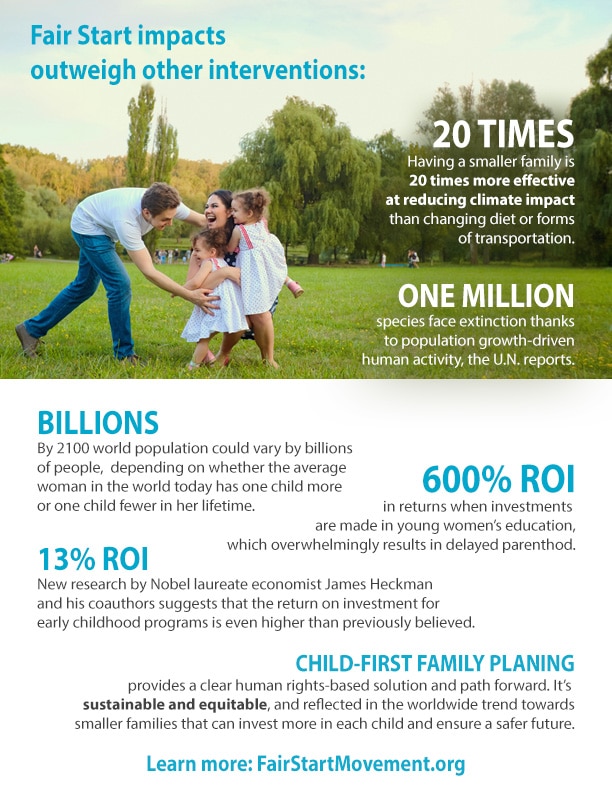
    Infographic explaining Fair Start impacts: Smaller families are 20x more effective at reducing climate impact. One million species face extinction. By 2100, population may double. Early childhood programs offer 13% ROI; family planning yields 600% ROI.

    In other words, if we correct the error described above, the correct goal or baseline must entail our becoming democratic and legitimate groups of free and equal people, which requires concrete and specific restorative ecological policies much more aggressive than the Paris Accord, redistributive and equalizing family planning reforms that recognize the right to nature and level the playing field for all kids, financially and ecologically. A simple litmus test, given these standards, for our being free and equal persons involves whether we first treat the capacity for each person’s self-determination as directly inverse to population growth, relative to a neutral baseline such as the nonhuman world. This is proof that each person is politically, and equally, empowered. Not treating growth as such calls into question the true role of citizens in their own democracy.

    Moreover, because this unifying goal or baseline is primary in nature, it overrides state issued property rights and entitlements enjoyed by Exxon, enabling intending parents claims to wealth at the top as part of their constituting just and sustainable societies. Our becoming just and sustainable people comes first. A helpful analogy relies on what is generally called the “myth of ownership,” which requires that ownership of wealth first account for the societal costs the creation of that wealth entails. Based on our research, the costs to our being free and equal people positioned to truly consent to the influence of others are first costs we must account for.

    We cannot assign property rights in ways that undercut physically constituting and democratically empowering future generations. Our being, and in this case becoming, positioned to determine costs and benefits in a way that is inclusive of the reasoned views of all, is the first baseline.

    Again, we can refer to this helpful summary of the baseline problem. All of the solutions to the problem Professor Solum gives jump to what we should do rather than who we should be, and thus ignore the need to be fair people, in terms of the physical power relations determined by our creation, before we can be positioned/empowered to make fair rules/laws. Ideally we would be created/grouped to look like a functional Rawlsian constitutional convention before fundamentally assessing costs and benefits, hence our being an ideal “We the People,” is the first baseline.  And for that, the minimal guidelines that would apply to family planning would be the standards we hold up for extant persons, like parental fitness, the Children’s Convention, equality of opportunity, restoration-based climate sequestration targets, biodiversity restoration targets, historic voter-representative ratios, etc. Those point us towards the UN low-variant population, something aggressive family planning incentives – funded with claims to wealth at the top of the economic pyramid – could practically help achieve.

    We are writing in the spirit of Earth Day 2022 to urge Exxon to embrace the specific restorative ecological policies described above as the part of the first and overriding human right to a Fair Start in life, and to commit some share of its wealth and resources as Fair Start planning reparations to offset the harm it has done to future generations, relative to baseline discussed above. Exxon could easily practice this change by supporting the child tax credit reforms linked above, while treating them as a fundamental human right.

    This is not about liberal or conservative politics. Family planning redistributions – as primary obligations – can replace wasteful tax obligations that would simply create larger governments which do not reflect the will of the people. This is about a commitment to human freedom and equality of opportunity, enabled by policies that ensure children can develop and physically comprise communities that liberate them from the threats they face today. This is something we all should value. Correcting the baseline error described above enables such a future.

    Please let us know if Exxon will commit to these changes.

    Sincerely,

    The Team at Fair Start Movement  

  • What Are Pregnant Pronouns? The Key to a Better Future, and Freedom

    What Are Pregnant Pronouns? The Key to a Better Future, and Freedom

    It’s common to see people today sign their messages with a variety of pronouns. That act is meant to liberate people to identify themselves as they see fit – to self-determine, rather than be determined by others’ conceptions of gender, for example. Our language matters and shapes our experience, and self-determination – or freedom – is at the core of human rights.

    Could pronouns be the key to an even larger form of self-determination?

    Yes, and in this simple way. For any claim about ethics, morality, rules, law, policy, etc. – some claim about what people “should” do, we can ask the claimant (politicians, celebrities, philanthropists, thought leaders, etc. ) to specify a few things regarding self-determination, and the pronouns that are express or implied in the claim. Has the claimant accounted for the quantity, constitutive qualities (like empathy), relative positioning of the people (in terms of equity, for example), and ways in which the people will impact their ecologies?

    Keep in mind that groups of people are inherently dynamic, with people constantly being born, and dying. So for the pronouns that relate to who will exist in the future, has the claimant accounted the most basic of values and building blocks of freedom: For ensuring future persons minimum levels of wellbeing, equality, their need for a safe and natural environment, and an influential voice in democratic systems? In other words, has the claimant accounted for the most important factor in any claim that we should do something – the people at stake – and how to ensure those people can self-determine, relative to a zero baseline, rather than be determined by others. In other words, can they account for how all the pieces fit together?

    What we find is that because the creation of people – or having kids – is considered a matter of parental autonomy and private decision-making, we largely overlook people as the key factor (always he first and largest driver) in all prescriptive claims. In almost every legal system in the world today parents who have severely abused children have the right to have more children, even when those children will raised by the state. At the same time those systems do nothing to ensure the average citizen has a right to a safe and natural environment. That sad reality shows how deeply embedded unsustainable population growth – anthropocentrism – is in our systems. And as a result, the most important aspect of policy claims – the creation and sustainable development of each person – is treated as none of our collective business. That reality epitomizes how those at the top pit the most vulnerable against one another, and shows the need for reproductive justices reforms that free us from one another.

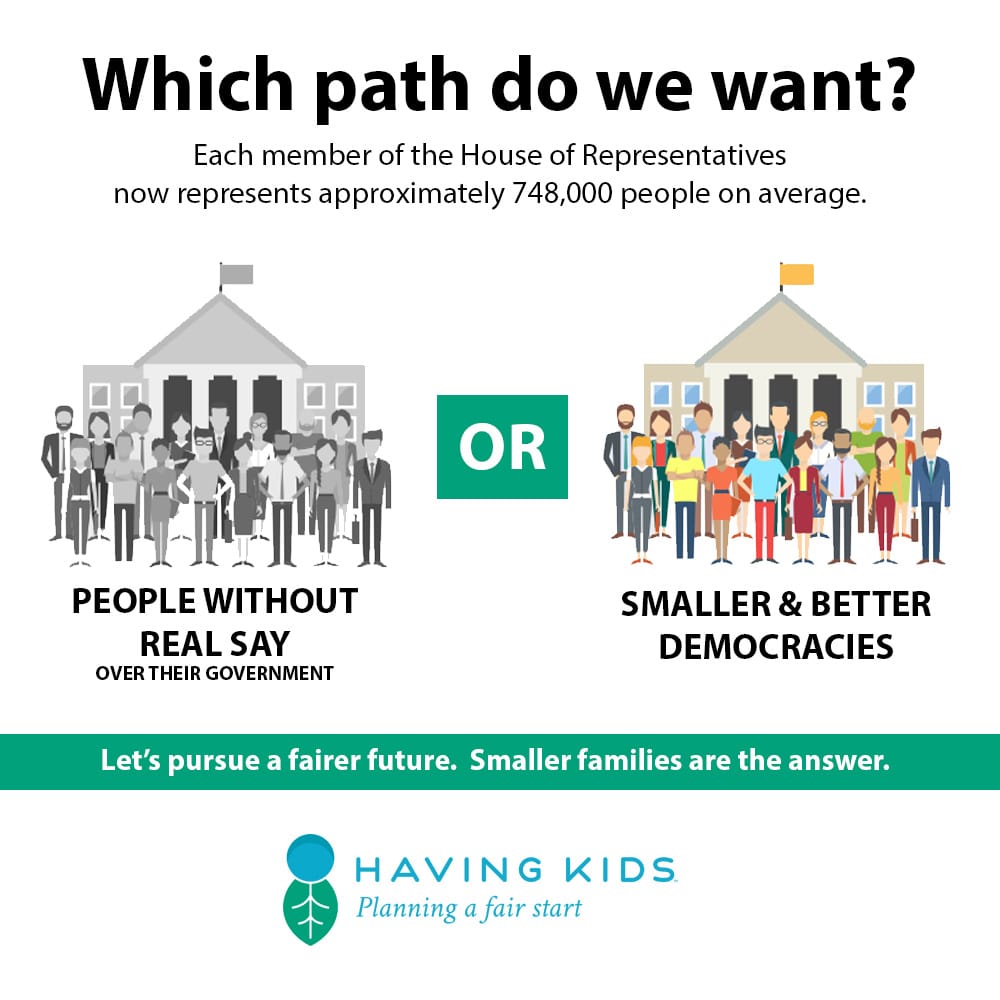
    An infographic compares two options for democracy: one with many people and little individual influence, another with smaller groups and more influence. It advocates for smaller families to achieve better democracies and government representation.

    Urging people to specify their pronouns can help fix this. For example, when governments claim to have a climate policy, we can urge them to account for the actual people causing the emissions, the people subject to them, the people in both categories who will exist in the future, etc. You will be shocked to see how little thought goes into these matters of how people came to be, and will come to be.

    Do you support nonprofits that protect children, animals, the environment, or human rights and democracy? Urge them to explain how population growth – the entry of new persons into the world – impacted their missions, what they did about that impact, and what they are doing now. Again, you will find that most groups did not create the results they claimed to have because they ignored the key factor shaping outcomes. And in terms of for-profit businesses, query how many have produced anything of truly objective value, and how many just rode a wave of valuation, demand and population explosion created by poor and unsustainable family planning that ensured no minimum levels of welfare for children (in blatant violation of things like the Children’s Rights Convention), abysmal levels of education, extreme inequity ensuring cheap labor, and bloated nation-states where the average person had no real voice in political outcomes. Did they simply profit from a system that mass produced consumers instead of developing capable, and truly free, citizens?

    We can sharpen the questions. Have the claimants noticed how their answers group together people who do not trust each other at all, and could not possibly operate in truly consensual, integrated, and democratic systems of relative self-determination? If people don’t trust one another, how can they be in truly consensual systems of governance with one another? For example, if you have to lock your home because you do not trust the people in your country, why would you trust them as citizens empowered to help decide the fate of the nation? How will the claimant deal with this, or what might be called the constitutional dilemma (or Lesser Power Asymmetry) of how to include and empower people in legal systems, at the same time?

    Discourse using the pregnant pronouns elicits and brings to the surface something very specific about all “should” claims: It is ubiquitous that we ignore the people in, and subject to, prescriptive claims. We can’t allow ourselves to make this mistake.

    Our evasion derives from the simple fact that for many reasons, including a series of mistakes in the development of legal and political systems (like seeing power as violent domination rather than more subtle things, like bad parenting and climate emissions), human cognitive dissonances like temporal myopia, cultural taboos, deference to religion’s role in the family, racial and political sensitivities, etc., we ignore people’s creation and how their creation impacts ethics, morality, rules, law, policy, etc. We think of people abstractly, exogenously, and statically, instead of dynamically focusing on their creation, their development and how they constitute themselves together in self-determining democracies where human power is limited and decentralized. And yet, if we truly value people and self-determination, they will always be the first and most important factor in the things we prescribe.

    Why? Because we are before we do, people are always the factor that comes first (or “lexically prior”), and because the vast majority of people and other animals whom we should care about will exist in the future and as such are especially vulnerable, their interests outweigh the interests of people alive today.

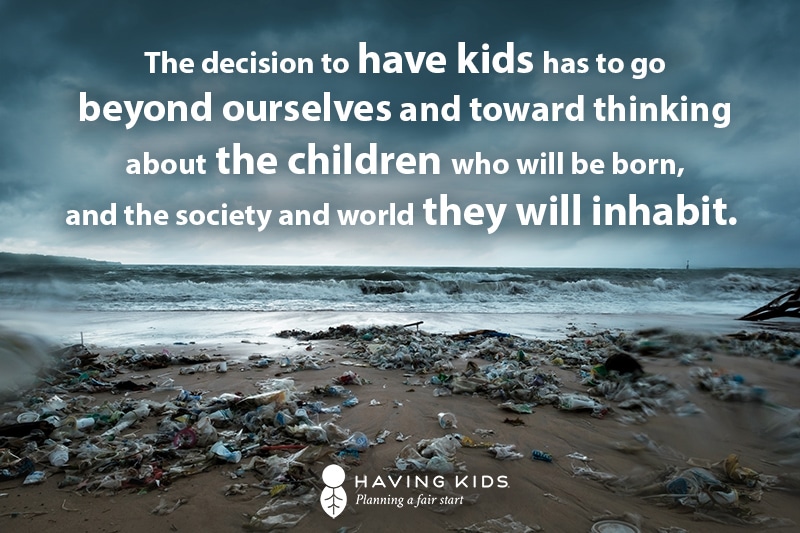
    A beach littered with plastic trash under a cloudy sky. Overlaid text reads: The decision to have kids has to go beyond ourselves and toward thinking about the children who will be born, and the society and world they will inhabit.

    What is the usefulness of the information we get in pregnant pronoun discourse? Questioning people about the pronouns in the things they are prescribing helps us divide people into those committed to freedom, and those who are not. The former will choose to orient their claims from the perspective of, and with pronouns that imply, self-determining people who are assured minimum levels of wellbeing, equity, nature, and democracy. They will orient the creation of future generations – or family planning systems, laws, and policies – from a child-centric perspective, as proof of their empathy, and in way that gives children these things and allows them to constitute themselves in just and relatively self-determining communities. This is not about population; it’s about freeing people.

    A Useful Divide

    The latter, who can be termed precons, will not – either because they cannot empathize with the people their prescriptions impact, wish to exploit rather than invest in them, do not care if those people will constitute themselves as free and relatively self-determining people and instead are content with centralized systems of top-down power, etc. In other words, the discourse helps us identify the people we should not trust in our democracies, where the act of constituting ourselves – intergenerationally – liberates us. Distinguishing between the two and knowing the threats for what they are can mean the difference between building a future where people are free and relatively self-determining, something countless people died in wars of liberation to ensure, and not doing that. No ethic, morality, law, policy – or systems comprised of such things – is legitimate if it cannot hold up in pregnant pronoun discourse as promoting relative self-determination, and we may be obligated to violate the prescription and its systems in favor of systems that do.

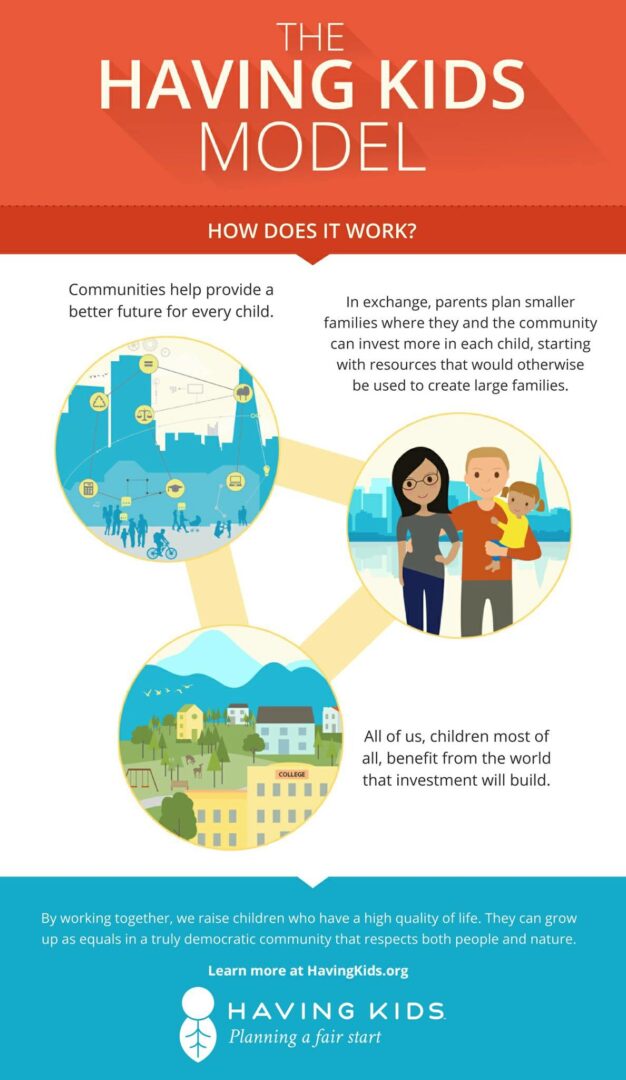
    Infographic explaining the Having Kids Model: communities invest in children’s futures, parents plan smaller families, and all children benefit from increased resources and a supportive environment. Includes illustrations and text.
  • Ezra’s Dilemma: Vox Is Pushing Women to Have Kids, Which Accelerates Species Extinction and Expands Factory Farming

    Ezra’s Dilemma: Vox Is Pushing Women to Have Kids, Which Accelerates Species Extinction and Expands Factory Farming

    [et_pb_section fb_built=”1″ _builder_version=”4.16″ global_colors_info=”{}”][et_pb_row _builder_version=”4.16″ background_size=”initial” background_position=”top_left” background_repeat=”repeat” global_colors_info=”{}”][et_pb_column type=”4_4″ _builder_version=”4.16″ custom_padding=”|||” global_colors_info=”{}” custom_padding__hover=”|||”][et_pb_text _builder_version=”4.16″ background_size=”initial” background_position=”top_left” background_repeat=”repeat” global_colors_info=”{}”]

    Ezra Klein has a dilemma.


    Vox Media reports responsibly on the horrors of factory farming and the climate crisis but openly pushes women to have more kids as a means of creating economic growth. They do so through their tax policy promotions, the work of Matthew Ygelsias, articles denying the science of population and climate, etc. It’s the same approach used by Donald Trump and many right-wing politicians who think of future generations as numbers to inflate the economy, rather than as children who all need a socially and ecologically fair start in life.


    Factory farming and every other animal and environmental crisis is fundamentally driven by human population growth. While Peter Singer is often credited with advancing the philosophy of animal rights, Paul Ehrlich probably did more to actually mitigate animal suffering and extinction through his influential work to slow population growth. Animal liberation, ours and nonhuman, begins with a family planning ethic that promotes sustainable and more equitable families who build empathy and fluid democracy in future generations. It’s not whether we talk about animal rights — it’s how we actually influence nonhumans and their worlds.


    Vox’s “women should have more kids” reporting is slanted, exacerbates the greatest factor driving the climate crisis, and hurts animals. Vox should recognize that any economic growth is first contingent on human rights compliance, which requires more equitable and sustainable families that invest heavily in each child. The human rights regime envisions a future filled with town halls where everyone has a voice, defined by nonhuman habitat. It does not envision a world where the average voice is lost and nature is paved with shopping malls where consumer freedom has replaced political freedom.


    Take Action:


    Learn more about why social justice for all starts with family planning reform and urge Editor Lauren Williams (@laurenwilliams) and Ezra Klein (@ezraklein) to support Fair Start sustainable family planning policies, and to stop pushing women to have kids.


    Also, urge Cory Booker to adopt family planning reform as key aspects of his opposition to factory farming and his support for guaranteed minimum income for children.


    [/et_pb_text][/et_pb_column][/et_pb_row][/et_pb_section]

  • The Human Right to Nature: Time for a Second American Revolution?

    The Human Right to Nature: Time for a Second American Revolution?

    Erika Mathews and her daughter Willow are fighting for their right to nature, the fundamental human right for which we should all be fighting in the face of the climate and other ecological crises. They are plaintiffs in a lawsuit currently on appeal to the Ninth Circuit Court of Appeals, challenging the federal government’s actions and inactions that have led to the climate crisis. Having Kids intends to submit an amicus, or friend of the court, brief in the case.

    The case is straightforward: The Declaration of Independence, parts of the Constitution, and the Supreme Court have made clear that there is a fundamental human right to be let alone, or free from others. The Declaration, in particular, talks about freedom as based on Nature. Being in nature, or wilderness more specifically, is the height of that experience, and given that climate change is the greatest threat to nature, climate change is the greatest threat to that right. How can you be free of others without nature? If climate change is a bad thing, what’s the state of affairs we are changing from, and don’t we have a right to that healthy and natural world? Nature is the buffer between us and others – the thing that individuates us.

    And the right to nature is not just part of our legal system. It’s fundamental to the concept of liberty, a necessary condition for any legitimate form of social contract. The right to nature, conceived specifically as a wilderness or regenerative ecological standard, is the highest environmental baseline possible. It’s the gold standard against which any environmental protection efforts must be judged. We are facing the climate crisis and other ecological catastrophes because we’ve failed to protect this right.

    The Trump administration is taking the position that we have no such right, and that they have the authority to exploit and wipe out nature. Is it time for a second American Revolution? How many died to protect freedom in the past? Those opposed to a right to nature are a threat to our freedom, and to our kids’ freedom. Without nature the social contract is over, the deal is off, and we will be subject to the influence of others against our will. Those behind the climate crisis are like foreign invaders threatening us, and the case before the Ninth Circuit will help decide how we deal with them. Having Kids is deeply committed to the case, in part because better family planning is the best way to restore nature, and protect our rights.

    TAKE ACTION: YOU HAVE A FUNDAMENTAL HUMAN RIGHT TO NATURE. The heads of these companies, along with the Trump administration, are violating it. Find and peacefully engage them to change their ways, tell us how you did it, and we will publicize your story. One very effective way for them to change their ways is through funding Fair Start family planning. Having Kids is starting to make the just and morally undeniable demand for those resources. Together we can protect our rights, and ensure freedom for ourselves and our kids.

  • Despots Use Population to Undermine Democracy. Target Their Base. [w/ Russian Translation]

    Despots Use Population to Undermine Democracy. Target Their Base. [w/ Russian Translation]

    If power derives from the people how we are created matters most of all. Let’s look at Putin and population policy.

    Обратитесь к дочери Путина, Катерине Тихоновой (Контакты — «Иннопрактика» (innopraktika.ru)) с просьбой осудить вторжение и поддержать реформы «Справедливого Старта», которые имеют фундаментальное значение для демократии. 

    What’s unfolding in Ukraine is fundamentally the fault of the United Nations, and a system that – through unsustainable and inequitable family policies – allows top-down power over bottom-up democracy. And while using economic sanctions to respond to military action is a step in the right direction of ending violence, it’s time to go to the next level and empower people over despots from the ground up. The ultimate mistake lies in allowing nations to use future generations to grow their power, rather than empowering future generations as democratic citizens with a voice.

    Putin’s patriarchal family policies – permitted by the United Nations – are a perfect example of what is wrong. They push women to have children to expand state power.

    Imagine if the wealth being spent by Russia on the war in Ukraine were used to improve birth conditions for all children. The impact would be incomparable.

    demographic decline

    Fair Start is pushing back, urging world leaders to make family policies that empower kids for democracy.

    Fair Start is urging Putin’s daughters Katerina Tikhonova and Maria Vorontsova (who can be engaged publicly) wherever they appear to denounce the invasion, use their influence to support democracy in Ukraine, and to support Fair Start reforms that put democracy at the base of who we should be. They had more than a fair start and should want a better beginning for future children in Russia.

    Take action: 

    1. For now we are personally urging our Russian-speaking supporters to politely ask Putin’s daughter Katerina Tikhonova (reachable at Контакты – “Иннопрактика” (innopraktika.ru)) to denounce the invasion, and support the Fair Start reforms that are fundamental to democracy.

    2. We suggest asking International Criminal Court leadership,@IntlCrimCourt and @KarimKhanQC to open an investigation into the commission of war crimes in Ukraine.

    2.  Urge your representatives in Congress to support removing Russia from SWIFT, and to support imposing a NATO no-fly zone. Also, please sign this petition to support the SWIFT action. 

    Build democracy with people, not just policies. 

    Build democracy with people, not just policies. 

  • Open Letter to United Nations Leadership: Condemn Policies Pushing Women to Have Children

    Open Letter to United Nations Leadership: Condemn Policies Pushing Women to Have Children

    Dear Secretary General Gutteres, and Directors Kanem, Andersen, and Russell,

    Several United Nations member states, ignoring the impacts on the climate crisis, the pandemic, human rights, and the sustainable development goals, are intensifying pronatal programs that are designed to push women to have children as a means of expanding economic and other forms of state power.

    These include unsustainable pronatal programs in:

    • Iran (which many human rights organizations have condemned),

    These moves are enabled by the United Nations’ continued misinterpretation and misapplication of the right to have children under Article 16 of the Universal Declaration of Human Rights and the relevant provisions of the International Bill of Human Rights. The United Nations should promote sustainable family planning, not an archaic family planning model that does not reflect the requisite nuances of human rights-based family planning. A growing coalition of prominent organizations is calling for reforms to the modeling.

    Not only do pronatal policies reverse progress in mitigating the climate crisis, but they fundamentally exacerbate the pandemics, which are killing millions. At the same time, faced with the United Nations’ historic failure to adopt a sustainable universal family model, nations like India and Nigeria are struggling on their own to stem disastrous growth.

    Democracy, and respect for the future majority, require that family planning be future child-centric, something that inevitably necessitates collective action rather than isolating families in a misleading choice model, as well as centered on ecosocial fairness.

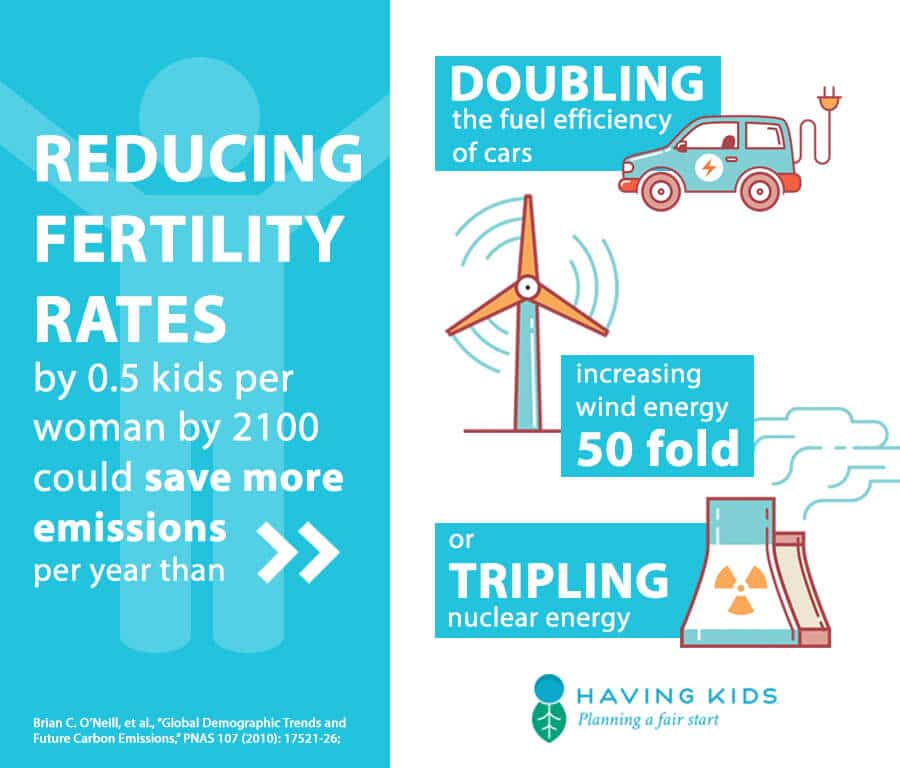
    Infographic showing ways to reduce carbon emissions: reducing fertility rates, doubling car fuel efficiency, increasing wind energy 50-fold, and tripling nuclear energy. Includes icons of a car, windmill, and nuclear symbol.
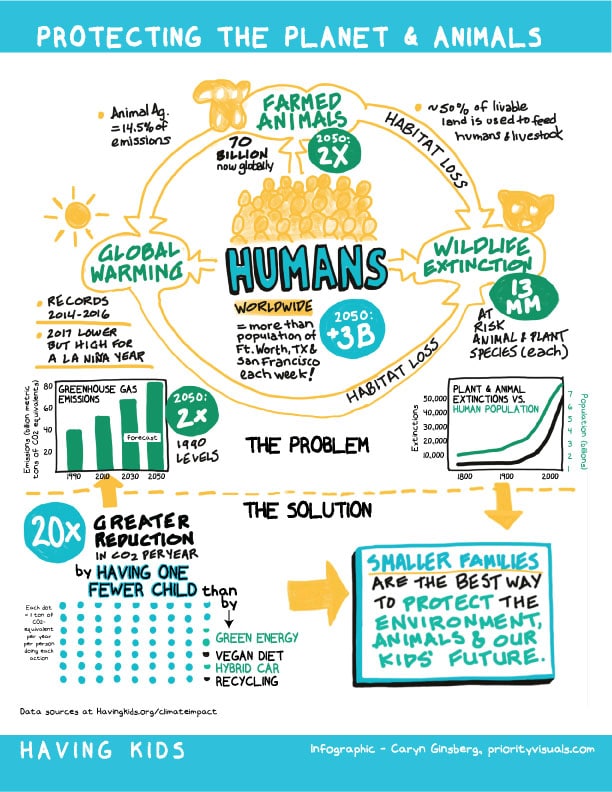
    Infographic showing humans impact on the planet: habitat loss, global warming, wildlife extinction, and farmed animals. Solutions proposed include smaller families, plant-based eating, renewable energy, and recycling.
    • Inaction threatens the UN’s credibility. Pronatal policies being rolled out in response to a perceived economic “baby bust” show that our current systems of governance are fundamentally illegitimate. If we are willing to create lots of people in whom we invest relatively little in order to satisfy markets and economies, instead of fewer people in whom we invest more in order to build the democracies that must precede, justify and regulate those markets and economies, we are admitting fundamental illegitimacy, or as the peer-reviewed work shows, the preconstitutionality, of our political systems. This is especially true when doing so exacerbates the climate crisis. In that case, all effective measures to correct this inversion are just.
    • The costs of ignoring reproductive justice legal reforms are mounting. These include the costs of the climate emissions that could have been avoided since at least 2007, and the role the failure to require equitable family planning has played in driving the massive and growing gap between rich and poor across the globe. The Fair Start Movement is calculating those costs as harms, and believes world leadership must – and one day will – be held fully accountable for them.
    • Because Fair Start and comparable “creation norm” models are peremptory norms that precede other national and international processes and rights (including property rights), the Fair Start Movement is urging young activists to target concentrations of wealth and power to pay for these eco-social harms, derived fundamentally from poor family planning models, by funding Fair Start efforts and incentives.

    Will you join that call? Nothing would have a greater long-run impact on restoring our environment than simultaneously compensating future generations, while helping them become parts of legitimate democracies, via Fair Start investments in their empowerment and resilience.

    Sincerely,

    Ashley Berke, Co-Director at Fair Start

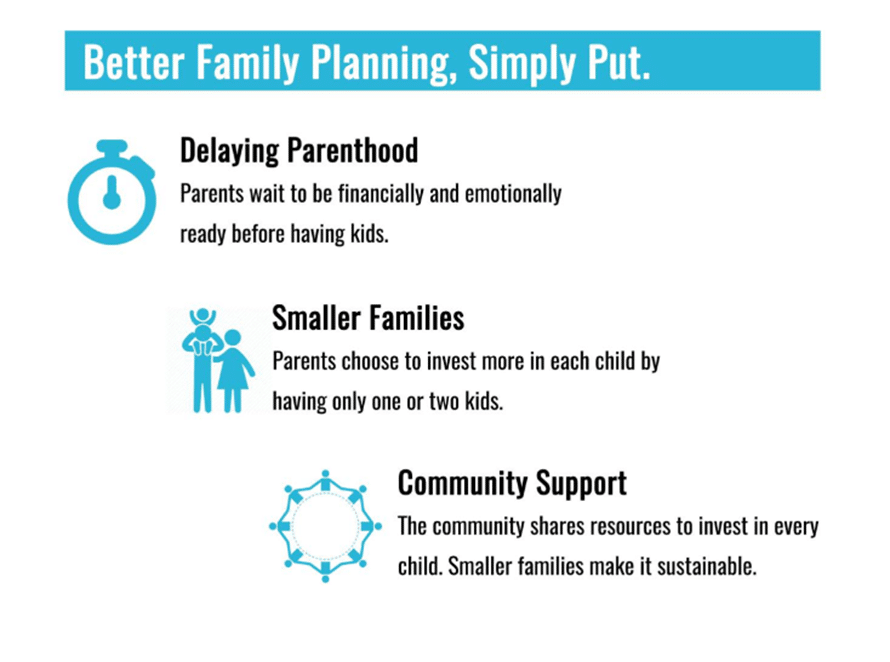
    Infographic titled Better Family Planning, Simply Put with icons and three points: Delaying parenthood, smaller families, and community support, each explained with brief text and blue graphics.