Category: Social Justice & Equity

  • Take Action: Men like Bryan Walsh at Vox Are Pushing Women to Have Kids. Help Him Pay What He Owes Instead.

    Take Action: Men like Bryan Walsh at Vox Are Pushing Women to Have Kids. Help Him Pay What He Owes Instead.

    When faced with a problem they helped cause some people will simply try to distract by saying something that makes no sense.

    Based on his recent article pushing women to have more kids as soon as possible to ensure economic growth, it seems that Bryan Walsh, an editor at Vox, is one of those people. In his prior positions at Time – over a span of many years – he had opportunities to push for impactful changes in policy, like Fair Start family reforms that simply peg family planning policy to standards like the Children’s Rights Convention, that would have not only mitigated the climate crisis but saved children from dying in the ecosystems it has and will continue to destroy.

    Line graph showing global population (in billions) and CO2 (relative) from 1800 to 2050. Both lines rise slowly at first, then sharply increase around 1950, with population slightly above CO2 in recent decades.

    He did not do that, but embraced the anthropocentric policies that created the crisis, and at a time where real change could have been made.

    Bryan is relatively wealthy, white and influential – having risen to his position on a pyramid of inequitable growth that imposed costs on communities of color born with a fraction of his wealth, communities that will absorb the harms he would help cause by exacerbating the climate crisis.

    Faced with these facts Bryan’s reaction is to double-down, and simply push women to have more kids to further build the unsustainable pyramid schemes that prop up Bryan, Elon Musk and others like them. He makes four obvious mistakes in his opinion piece (framed as an article) which show the fundamental cause of the crises we face today.

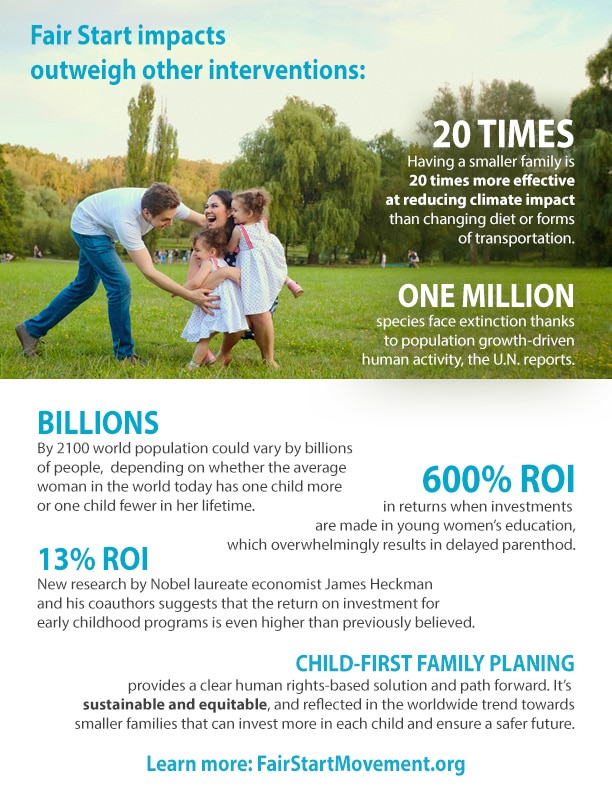
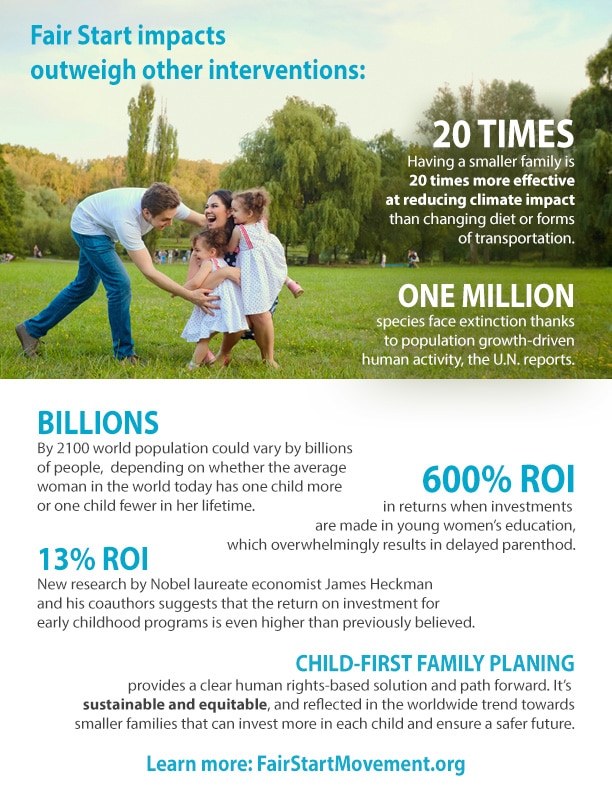
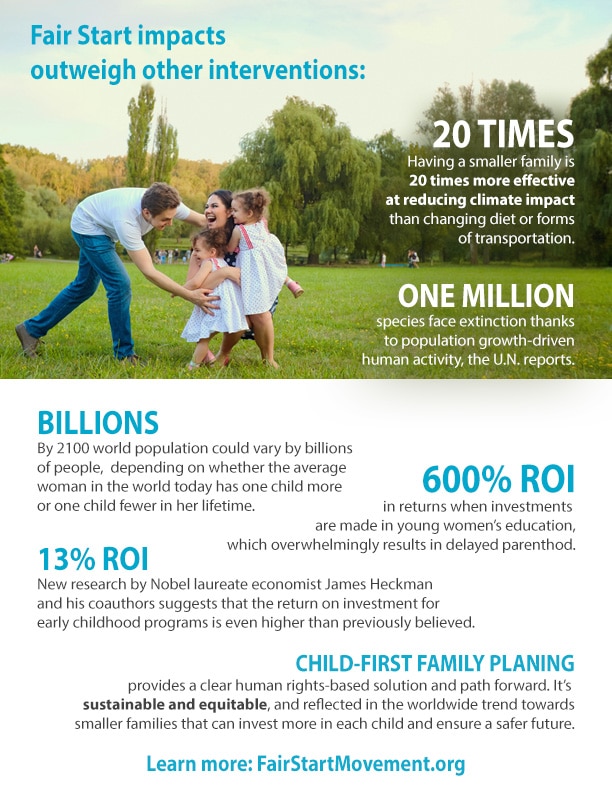
    Infographic about Fair Start family planning, highlighting climate impact, reduced extinction risks, 600% return on investment, findings by Nobel laureate Heckman, and the benefits of smaller families for sustainability.

    • He conflates economies with democracies: Per Bryan, “Declining population growth really does pose existential challenges to America, and without more children, the country really does face a future that is less innovative, less wealthy, and less vibrant.” The ideal of the United States is democracy, but inequity, growth and ecocide has degraded that ideal, and traded it for the gross domestic product (probably preference-based utility) that is the base value from which Walsh operates. He’s talking about an America of crowded shopping malls, not town halls in biodiverse nature where people are actually free. That freedom is a value we can test and measure with a simple inversion test. That inversion test – which Bryan’s proposal fails – has survived five positive peer-reviews. Bryan, conversely, has no expertise in population ethics, and his opinions conflict with leaders in this space.
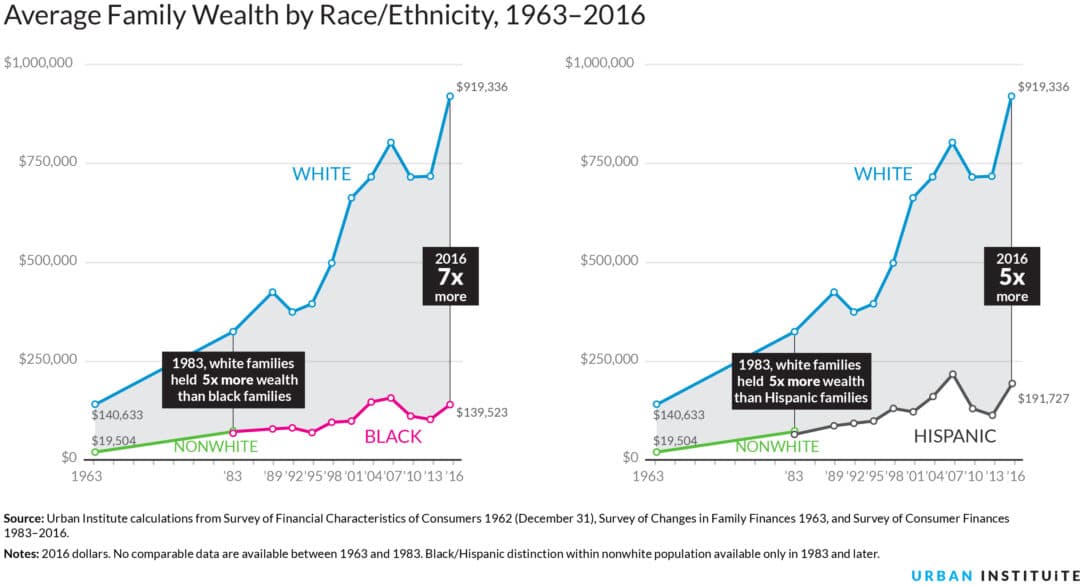
    Line graph comparing average family wealth by race/ethnicity from 1963–2016. White families’ wealth rises steeply, far surpassing Black and Hispanic families, showing large racial wealth gaps widening over time.

    • Bryan undercuts all of the values he purports to promote: Per Bryan, “[t]he progressive agenda should be about empowering people to live the lives they desire, to pursue their own path to happiness, and children can and should be part of that. Conservatives are right that a baby bust without end threatens America’s future…” Nowhere does he promote minimum levels of welfare for children, equal opportunities in life for children, restoration of nature and climate restoration, or democracy where citizens actually have influence on systems of governance. These are the basic values that comprise a good life. The United States, like most nations, has used family planning policies throughout the past several decades that treated the act of having children as a matter of parental autonomy, rather than ecosocial child equity (children have the most at stake when it comes to having kids), rather than acting in compliance with the values that underlie the Children’s Rights Convention – which is the standard by which we judge whether we are actually creating democracy. Byran’s writing reflects these mistakes.

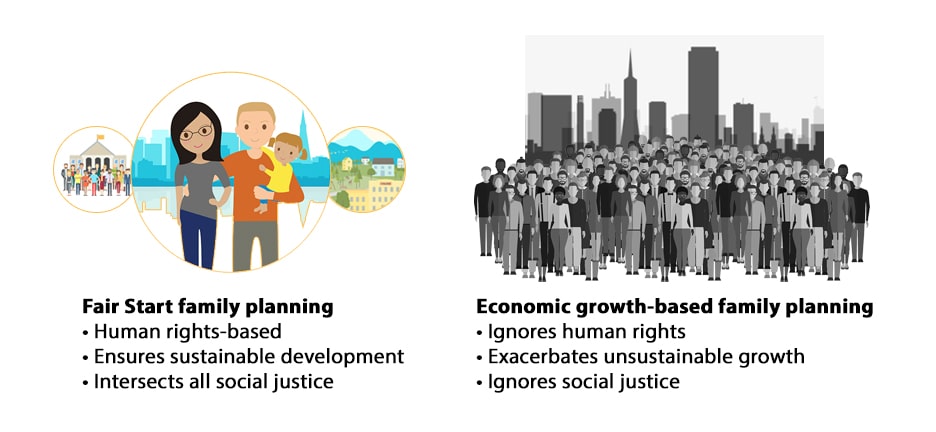
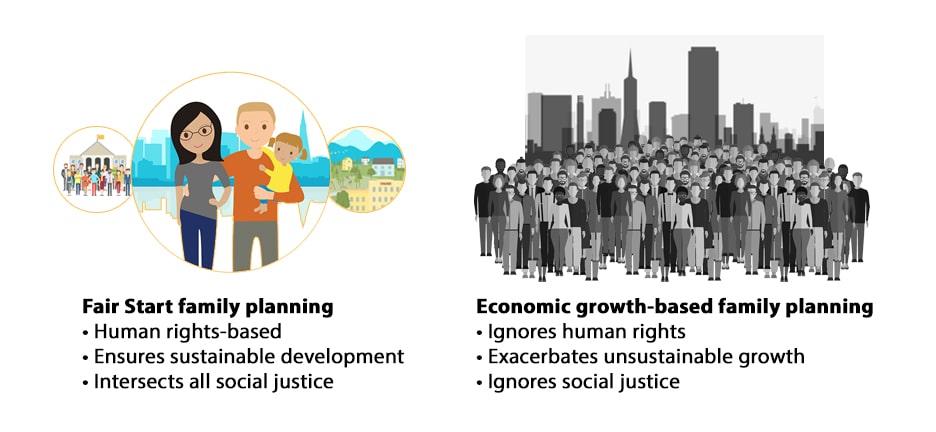
    Two illustrations compare family planning models: At left, a diverse happy family stands together with icons for community and health. At right, a monochrome crowd in a city. Text contrasts fair start (rights-based) with economic growth-based planning.

    People like Bryan Walsh can be useful in this regard, and targeting him and other powerful people publicly to show truth can save millions of lives.

    Bryan is using his position to impose costs on others, relative to a democratic baseline. We can make examples of people like Bryan, ensuring they account for their role in the crises we face today, and taking from them the relative wealth and power future generations deserve as we physically constitute true democracies though climate restoration funded by birth equity redistributions of wealth. Bryan only has to address the points above in his work, or to agree to publicly debate them, in order to actually free people. He just have to tell the truth. And while the average citizen does not have the power of a Vox editor, they have the capacity to be activists, and approach Bryan and confront him simply as a citizen who is harming others.

    TAKE ACTION: In his article Bryan accepts that “very real suffering that will be unavoidable thanks to warming, especially in poorer countries.”: He is willing to accept the suffering of others – especially children in the global south, while protecting his own children from that suffering, and rather than taking simple steps to prevent it.

    Think about that as you engage Bryan in person or online – https://www.linkedin.com/in/bryan-walsh-9881b0/, in a peaceful and lawful way, to admit his mistakes, and to pay for the benefits he and his family received in a system that was imposing costs – ecologically and socially – on others. Use him as a fulcrum to bend the arc of our species away from exploiting children for economic growth, and towards justice.

  • Freedom Without a Fair Start in Life? That’s Impossible

    Freedom Without a Fair Start in Life? That’s Impossible

    Humans are adept at fooling themselves, whether thinking the Earth is flat, or that our ecosystems can absorb limitless amounts of pollution – like climate emissions – before failing. Many might believe they are not racist, but when put to an empirical test, show massive racial bias.

    It’s certainly possible that humans could have imagined and theorized concepts like justice, democracy, freedom and liberty without positioning themselves to actually experience those things. The luminary John Rawls is well known for characterizing justice as fairness, and if the first rule in any set of rules is that which accounts for our creation and existence, then for justice – and the freedom he saw as contingent upon that – to exist our creation should be fair. But that’s never been the case, with some children being born into poverty while others are born with million-dollar trust funds, and generations of past inflicting their destruction of the environment – including our climate – on future generations.

    Two illustrations compare family planning models: At left, a diverse happy family stands together with icons for community and health. At right, a monochrome crowd in a city. Text contrasts fair start (rights-based) with economic growth-based planning.
    Growth limits each person’s time at the podium of democracy.

    But can’t we make it more fair? Yes – there are dozens of ways to do it.

    And here is why we must.

    If government derives from the people, then we have to consent to the power each one of us does and could exercise over one another. And that requires changing the way we plan families to make it more just, at the very least recognizing that children have more at stake in the process of creation that their parents, and using things like the Children’s Convention as a standard for family planning. That move would allow us more consent to each other’s power – ecologically – by restoring nature as a buffer that stops companies like Exxon from threatening us though the climate crisis, and socially by empowering people in a democratic way and with equal opportunities in life.

    This leads to an impossibility theorem: If we reject fairness in creation, we either have to 1) reject the idea that government and the obligation to follow the law flows from people as the ultimate authority, 2) we have to reject the idea that people should be politically equal, e.g. have equal time at the podium, 3) we have to reject the idea that people should be empowered in order to make government legitimate, or 4) we have to define power in strange ways that quickly begin to exclude things like climate emissions and bad parenting, and make no sense. “Power” means any form of human influence, which means national borders on a map are nonsense, and the true border of power/consent is the norm that accounts for our creation.

    Truly free people will ensure they can choose – through Fair Start – who has power over them. Conversely, preconstitutional people, or precons, will block this process. Targeting them to make public examples of their harming others may be the most effective way to change the direction of our future.

    TAKE ACTION: There are dozens of ways to move towards fairness and freedom. You should choose one.

  • Women Today Have to Worry About Having Even One Child Because Some People – Like the Baldwins – Had Huge Families

    Women Today Have to Worry About Having Even One Child Because Some People – Like the Baldwins – Had Huge Families

    The climate crisis is causing many to forgo children, even when they want them. Why consign a child to such an uncertain and dangerous future?

    How did this situation develop? Clearly having large and unsustainable families impacts the right of future persons to themselves have children, as growth degrades our ecosystems.

    Enter the Baldwin family, a wealthy bunch, who don’t seem to make this connection.

    Informational flyer shows statistics about the benefits of family planning, emphasizing reduced climate impact, lower extinction rates, financial returns, and improved women’s education. The flyer promotes child-first family planning.
    Be effective.

    There are ways to eliminate this problem:

    Fair Start helps shift unjust concentrations of wealth and power towards funding policies that instead empower all children with equal opportunities in life and a natural, biodiverse environment, by incentivizing and entitling well-planned, well-located, sustainable and more equitable families. In short, we promote fundamental justice and freedom by actually accounting for, and improving, fundamental power relations between people, and between people and their ecologies. This is not charity – this is fundamental justice, or ensuring that the true costs of wealth are paid back into communities in the most effective way possible.

    A chart with circles of varying sizes showing the impact of different actions on reducing carbon emissions. The largest circle says “Have one fewer child 58.6”. Other actions include living car-free, recycling, and using green energy.

    What’s the solution to the Baldwin problem? How do we prevent some families from impacting others families, and violating their rights?

    TAKE ACTION: Urge the United Nations to do what it should have done decades ago and treat Art. 16 of the Universal Declaration of Human Rights as the first and overriding human right, interpreted in a way that promotes true generational and intergenerational equity.

    TAKE ACTION: Urge Alec Baldwin – @AlecBaldwin – and Hilaria Baldwin – https://www.instagram.com/hilariabaldwin/?hl=en – to support just family planning policies that do not put costs on others.

  • The Fair Start #WholeTruth Campaign: Freedom Begins with the Truth

    The Fair Start #WholeTruth Campaign: Freedom Begins with the Truth

    How did our world get so messed up? Ask anyone claiming to work for the public interest to disclose their approach to family policy.

    TAKE EFFECTIVE ACTION:

    Urge any nonprofit or other public interest organization you support to disclose how – over time – family policies and population growth have impacted any progress made on their organizational values and goals, for example, by cancelling out efficiency-based climate emissions reductions, increasing the number of children subject to abuse or neglect, degrading democracy, or putting more animals into factory farming systems. How will these policies, including accepting the status quo, impact those values and goals in the future?

    The Children’s Rights Convention sets out what children need to physically constitute just, sustainable and legitimate democracies, and it was designed to address the fundamental or familial political relations that make up the systems we all support (through taxes and otherwise), benefit from, are responsible for, and from which we cannot separate. What we often think of as population is really a matter of fundamental power relations.

    And yet the current and almost universal paradigm for family and population policy does nothing to ensure all children are born and raised in conditions that comply with the Convention. That paradigm is based on what is called the constitutive fallacy: Basing our individual obligation to follow the law on things like top down written constitutions rather than just and sustainable family policies that actually empower people bottom up to constitute just and legitimate nations, and do and should account for our actual relations and lived experiences. Law and policy derive from basic systems of rights, which are mandatory obligations.

    The powerful do not need those obligations; the vulnerable, including nonhumans and future generations, do.

    Who we should be, in terms of the norms that create and develop us, precede and justify what we do. And not accounting for this fact, in all we do, leads to misleading results and a fantasy world of progress that does not exist. And yet many funders have pushed ineffective and distracting projects because those projects do not threaten the fundamental power structure, and its role in degrading democracy.

    Two illustrations compare family planning models: At left, a diverse happy family stands together with icons for community and health. At right, a monochrome crowd in a city. Text contrasts fair start (rights-based) with economic growth-based planning.

    We can change this paradigm by recognizing that the extreme concentrations of wealth built today were created by not having to comply with the expensive and growth-reducing ecosocial requirements of the Convention, and by redistributing that wealth in the form of family planning reparations and entitlements that move the world towards the restored climates and natural democracies required by human rights.

    Free people will condition their obligation to follow the law and respect property rights on this change, and on being democratically empowered using a simple inversion test, because only these changes ensure they will not be impacted by others – through even subtle things like the climate crisis and bad parenting – against their will. The obligation to follow the law stems from systems being fair and free, and systems start with family policy.

    And while some nonprofits under pressure from funders have gone out of their way to hide these truths about freedom, many are pushing forward toward a truly free future.

    There are many ways to promote the turn to true fairness. Take action here.

  • Fair Start Files Update to Our United Nations Human Rights Council Petition: Our Overriding Human Right to Nature and Equity

    Fair Start Files Update to Our United Nations Human Rights Council Petition: Our Overriding Human Right to Nature and Equity

    Yesterday the Fair Start Movement filed an update to its original “Fair Start” filing before the United Nations Human Rights Council. We updated our complaint because of the acceleration of the climate crisis, and the failure of governments around the world to respond to the crisis.

    The complaint and update make a few simple demands:

    • First, the United Nations must treat the correct interpretation of universal family policies (which should require climate restoration through birth equity redistribution of wealth in the form of family planning entitlements) as the fundamental and overriding human right.
    • Second, to admit that the United Nations failure to do this previously led to the climate and inequity crises we face today, including violations of future generations’ right to have children in safe and natural environments, and for that right to be safeguarded in perpetuity.
    • Third, to endorse loss and damage payments as overriding property rights, if used for the family planning entitlements described above.

    The original UN Human Rights Council petition can be found here, and our updated filing can be found here.

    Put simply: There is a universal human right that overrides domestic climate policies – most of which are anthropocentric and insufficient – in part because climate emissions do not respect borders and the “business as usual” approaches most governments and groups use disproportionately harm the peoples and nations least responsible for the crisis.

    Infographic explaining Fair Start impacts: Smaller families are 20x more effective at reducing climate impact. One million species face extinction. By 2100, population may double. Early childhood programs offer 13% ROI; family planning yields 600% ROI.
    Be effective.

    As the update argues:

    One clear step towards compliance with the best interpretation of Article 16 (the right to found a family) would be to urge that programming around the education of young women – throughout the world – begin with ensuring they know that all children’s right to an ecosocial Fair Start in life (defined by concrete climate restoration and birth equity measures) – now and for generations to come – overrides all competing rights and interests as the first and peremptory human right, including any conflicting property rights.

    That right should be the standard or baseline for, and the priority use of, evolving loss and damage payments.

    Take Action: Urge the UN Secretary General to support our claim.

  • Lee Raymond, Former Exxon CEO, Exacerbated the Climate Crisis. We Have the Right to Take His Wealth.

    Lee Raymond, Former Exxon CEO, Exacerbated the Climate Crisis. We Have the Right to Take His Wealth.

    [et_pb_section fb_built=”1″ admin_label=”section” _builder_version=”4.16″ global_colors_info=”{}”][et_pb_row admin_label=”row” _builder_version=”4.16″ background_size=”initial” background_position=”top_left” background_repeat=”repeat” global_colors_info=”{}”][et_pb_column type=”4_4″ _builder_version=”4.16″ custom_padding=”|||” global_colors_info=”{}” custom_padding__hover=”|||”][et_pb_text admin_label=”Text” _builder_version=”4.16″ background_size=”initial” background_position=”top_left” background_repeat=”repeat” global_colors_info=”{}”]

    Lee Raymond may have done more to exacerbate the climate crisis than any other one person on the planet. His active burying of the truth of the emerging crisis and how Exxon was responsible stands out among those who have done the greatest harm to our environment.

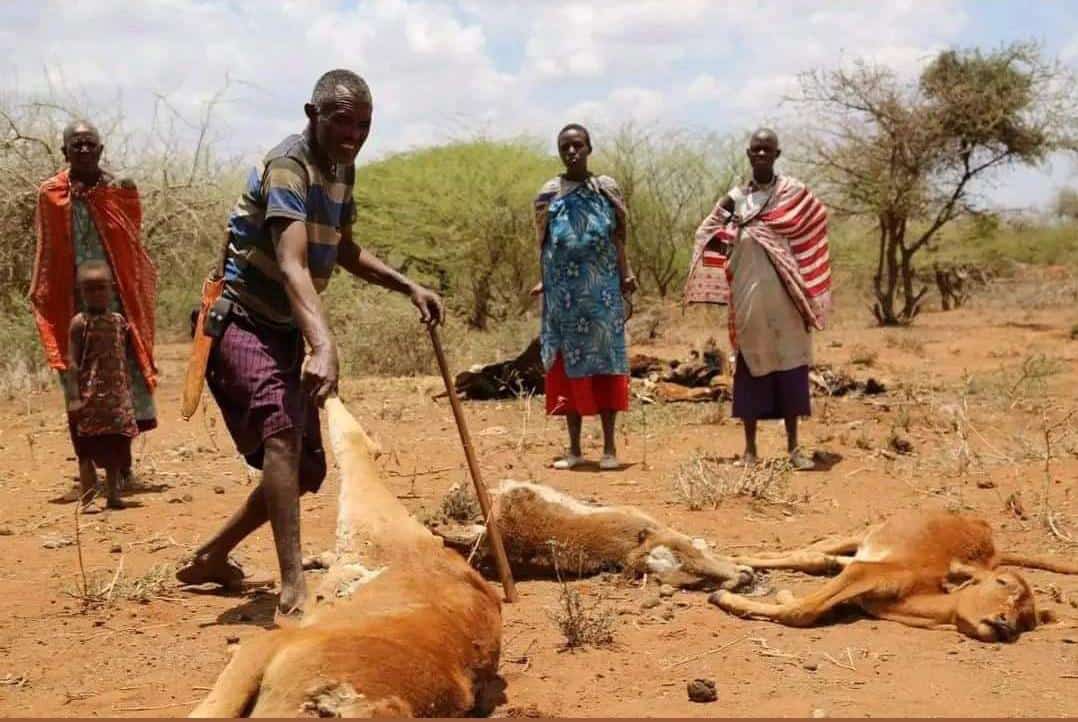
    And yet he and his family – like his son John T. Raymond – are still holding the millions they made through oil and gas, the industry that fundamentally drove the crisis. What they contributed to is literally killing people, exacerbating the deadly droughts in places like the Amboseli.

    What should we do? Our government, and many unscrupulous environmental organizations that helped worsen the climate crisis by choosing not to act, will not tell you the truth. Most politicians and nonprofits are exploiting increased consumption that undoes much of the progress they claim, growth that enriched people like the Raymonds. They will accept a status quo where we do not restore the climate or ensure children equality of opportunity, because they protect concentrations of wealth and power, not people.

    Climate driven drought in the Amboseli, Kenya - starving cows as people look on

    The truth is that the property rights – like those the Raymond family think they have to their wealth – are conditioned on family policies that constitute communities of free and equal people capable of agreeing to give people such rights. We have a right to take the wealth the Raymond family made through hurting the children of Amboseli, if we use it to pay reparations to Amboseli for this purpose.

    Using concentrations of wealth and power to fund family reforms is the most just and effective way to respond to the climate crisis, restoring our environment and building resilience in children at the same time. This would also help guarantee the right to a healthy environment, now recognized by the UN. An ecosocial Fair Start in life for all children is the first human right, and we can ensure it by all means effective. Why? We are before we do, so true justice comes in creation; it is existential.

    Free people who want justice will target concentrations of wealth and power, like the Raymond family, to limit and decentralize the power they would otherwise have over us in this way. Free people will help constitute true democracy though funding parental readiness, birth equity for all children, and sustainable families.

    TAKE ACTION: FIND AND ENGAGE THE RAYMOND FAMILY, IN A PEACEFUL AND LAWFUL WAY, TO PAY WHAT THEY OWE. THAT WEALTH IS NOT THEIRS.

    [/et_pb_text][/et_pb_column][/et_pb_row][/et_pb_section]
  • Take Action: Did Peter Singer’s Population Ethics Undo His Work on Animal Liberation? Absolutely.

    Take Action: Did Peter Singer’s Population Ethics Undo His Work on Animal Liberation? Absolutely.

    Peter Singer is regarded by many as a founder of contemporary animal rights, largely based on his book Animal Liberation. But few realize that he has also taken public and influential stances on family and population policies, in this 2018 public lecture, for example. He avoids making concrete conclusions about population policies in this lecture and elsewhere,

    Nowhere has he advocated for effective interventions – like overriding property rights to wealth in order to fund Fair Start family planning incentives/entitlements – and other peremptory norm measures would have bent the arc of unsustainable growth downwards towards what many see as optimal world population ranges. Those ranges, like all population matters, actually involve people – and the fundamental creation of power relations between them. And power and population ethics begin with human rights, the objective frame that after WW2 should cabin utility, Effective Altruism, and all other lesser and more subjective forms of policy Singer normally employs.

    No alt text provided for this image

    These are the facts. The growth Singer did not seriously address put more animals in places like factory farms than his ethics – interpreted by many as promoting mere dietary changes – took out. That growth also fundamentally exacerbated the climate crisis, which will be the greatest source of human and nonhuman suffering.

    And while fertility rates may be falling, we are far from optimal and many – including Singer’s followers – are pushing to reverse that trend and increase family size to drive economic growth.

    How is animal liberation possible in the face of a wave of human population growth causing massive extinction? How is promoting veganism for what is effectively a small percentage of a growing human population that mostly exploits, tortures, and kills nonhumans true animal rights? How does that growth further human rights when the growth enriched relatively few people, at cost to equality and the political stability it brings?

    No alt text provided for this image

    Singer’s work is based on an error called the constitutive fallacy, or ignoring the way our creation and development do and (assuming we use baselines like the Children’s Rights Convention) should – fundamentally – constitute actual power relations, between humans, and between humans and nonhumans. Who we are might be different mixes of nurture, or nature, or influential power relations, but all flow (and among self-determining peoples should flow) from our creation. We cannot separate values like nature and equity from who we are and our power relations with others, which stem from our creation.

    For example, our economic birth position mostly determines whether we are rich or poor as adults. Another example would be that it is impossible to ensure the empathy people need to treat nonhumans well without addressing the conditions in which people are born and develop because empathy largely depends on years zero to three in childhood maturation.

    Another example would be that if we assume we ought to treat nonumans well, we would have to structure an effective legal system that would obligate that. But because there is such massive attenuation (caused by the growth that is eradicating the nonhuman world) between people and their representatives, we cannot do this. Another example would be world leaders attempting to determine the costs and benefits associated with Anthropocentric environmental baselines like the Paris Agreement, a mistake that only accelerated ecocide, rather than using an organic baseline like being relatively self-determining people and the conditioning of wealth on equitable family planning investments that make that possible. (This last example gels with the constitutive fallacy as political adherence to national constitutions, or even international law, as basic and overriding norms, as opposed to adherence the obviously antecedent and more basic family planning norms that create us, the people.)

    In other words, in Singer’s prescriptions for animal liberation come from outside of who people ought to actually be, in terms of the creation of the fundamental power relations that define them.

    Some have argued that it’s unfair to say that Singer’s population comments (or lack of comments) have “undone” his work for animals, given that virtually no one knows what his views on population are. Per this argument, there are probably zero policy-makers who’ve done anything based on Singer’s population views. Perhaps few or none have decided to procreate or not procreate based on Singer’s silence on the issue.

    This response treats population as something, an issue, that we can separate from what we do. But how can we do anything, or suggest that others should do something, without first determining the acceptable power relations that determine who we are, and should be? We cannot separate what we narrowly think of as population – or who we are – from what we do. The former is always a factor and precedes the latter.

    Singer’s claim that “we should help animals by not eating them” is wrong on its face because the “we” in his claim – the fundamental creation of power relations that permit growth, relations he accepts – does more harm to animals than changing diets does good. That’s the constitutive fallacy at play. And that mistake – not requiring things like the Children’s Convention standard in family planning policies to improve those relations, which would physically constitute just communities – does more than just harm animals. It fundamentally permits anthropocentric changes that cause irrefutable harm to all, against an absolute standard like infant health.

    Backwards family policies fundamentally drive things like extinction, growing levels of birth-based inequity, rising numbers of unhoused persons, the exacerbation of the conditions that drive pandemics, a multiplying of climate impacts on multiple levels, and the degrading systems of participatory democracy. Yet these policies are easily reversible and with policies that actually liberate humans and animals alike by using wealth from the top to incentivize delays in parenting pegged to objective standards of parental readiness, redistribution of wealth between rich and poor kids, and a universal ethic of sustainable families, all of which create functional democracies.

    Don’t confuse chaos with freedom. Truly free people will fundamentally limit and decentralize the power (including subtle power like climate emissions, the impact of bad parenting on communities, massive disparities of wealth, etc.) others have over them, and by all means effective. They will condition their obligation to follow the law on their actually being empowered, assessed via a simple test, in functional democracies.

    No alt text provided for this image

    Singer never seriously addresses this issue, through redistributive birth entitlements that empower us in terms of who we are before turning to what we should do, for example. That mistake of ignoring the primacy of who we should be (and the best answer is fair), given his position of influence and the crucial time for mitigating the climate crisis in which he was working, harmed future generations.

    And as a result his work does not effectively protect nonhumans, promote equity, restore democracy, or even protect considered parental desire. An alternative approach which does not make the error would value each person born, and the value of self-determination, above the growth Singer never seriously opposed.

    Is this type of fairness a threat to the ongoing processes of decolonization. antiracism, and other forms of anti-oppression? Eliminating the massive birth inequity caused by colonization – the one that disempowers the majority of people, those who will live in the future – and doing so while restoring nonhuman autonomy is the height of anti-oppression. Though admittedly, all of this argument flows from Eurocentric framing and should also be done from more indigenous frames.

    No alt text provided for this image

    It would treat ensuring minimum levels of welfare, and freedom, as more important than total welfare indictors like gross domestic product. It would elevate ethics in the creation of people – and the conditioning of political obligation on family planning policies that ensure people will matter – over the constitutions and governments whose authority to assign property and other rights derive from such people, again something Singer never considered.

    TAKE ACTION: Urge Singer to #tellthetruth and admit that his family and population ethics undid his animal liberation ethics. Urge him to support a pivot from parent-centric family planning to child-centric planning. He should admit that before we can engage in Effective Altruism we are politically obligated to constitute just communities – and total liberation – through socially and ecologically regenerative family reforms like Fair Start.

    Without this, his work could in the end do more to protect concentrations of wealth and power than nonhumans.

    He should not allow his work on animal ethics to mislead people from the truth that we are committing ecocide through poor family planning, and should support paying back the costs to freedom that population growth has imposed on future generations. Also urge him to lead by example and treat property claims – like the extreme wealth he helped create in the plant-based industry – as conditional on our fulfilling every child’s right to a fair start in life. That wealth, and the power disparity it represents, is defended by the threat of state violence, not the true justification possible amid fair power relations.

  • Abortion Bans, Climate Crisis, and Attacks on Iranian Women: What’s Hiding Behind It All?

    Abortion Bans, Climate Crisis, and Attacks on Iranian Women: What’s Hiding Behind It All?

    To say patriarchy, or anthropocentrism, or exploitation, would all be correct. But is there something antecedent, something lurking upstream, that precedes these words? Perhaps it is simply the failure to take a base condition like human rights and democracy seriously, seriously enough to let it dictate our fundamental social relations, or the power structures that flow from how we are created or more specifically, pro-created.

    If we took human rights and democracy in any particular nation seriously, we would start all laws, policies, and practices with one rule: We would first treat the capacity for each person’s political self-determination as directly inverse to the creation and emancipation of each child in that nation, relative to a neutral baseline such as the nonhuman world. And that would have meant that we would have been investing a lot more into family planning and child development, what the Children’s Rights Convention requires at a bare minimum.

    One reason we don’t do this is that most nations live under an international consensus (called the Cairo Consensus) controlled by wealthy white people who decades ago chose to privilege their children over poor kids. Under its guidance we wrongly treat the act of having children as more self-determining for the parents rather than other-determining for the children born.


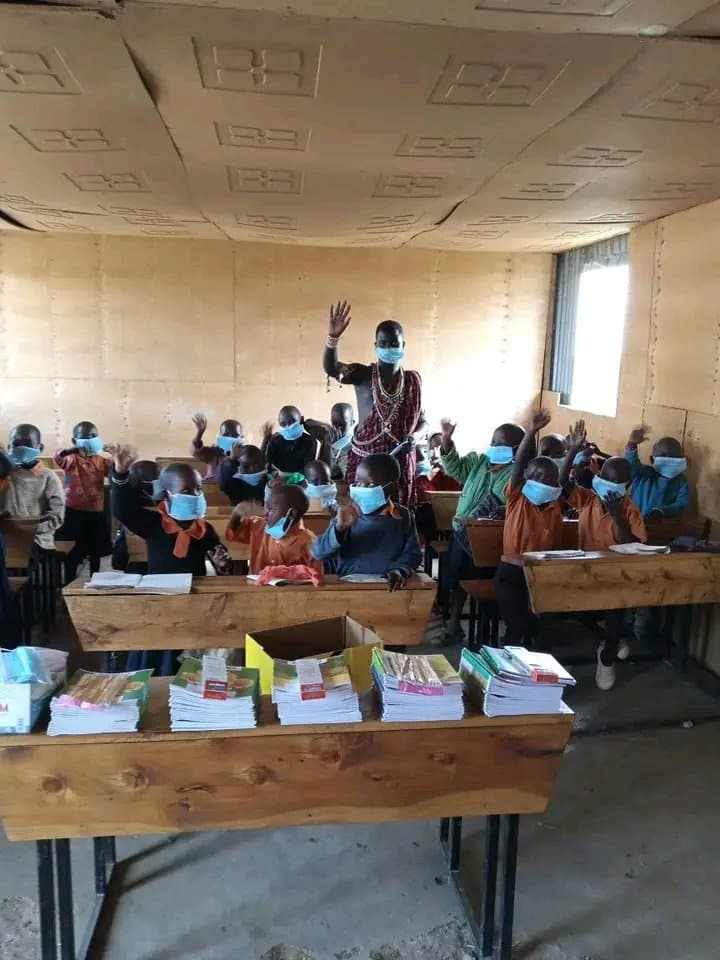
    People in a class room
    An effort in Amboseli Kenya to move to child-centric planning.

    If we imagine a town hall where you were empowered to influence the rules you would have to live, each person would have less time to speak and influence the outcome as more people are added. If we believed in freedom, consensual governance and political self-determination, we would aim – through family reforms – for optimally ranged populations of people who would be relatively self-determining per the formula above. In practice polities/legalities like nation states would use the inversion to know when to divide off into a new entity. While fluid division is unusual in geopolitical affairs, it is actually quite common if we think about other forms of social organization that share power with nation states, like corporations and social movements. And we would start all laws, policies, and practices with such a requirement because who we should be precedes what we should do, and the former is best accounted for by the norms that create us.

    As a practical matter this inversion, and optimal world population ranges, could have been achieved in the 20th Century with progressive scaled family planning obligations/entitlements meant to ensure ecocentrism and equal opportunities in life.

    But that would have only happened if we wish for people to be actually empowered.

    Two panels compare family planning types. Left: diverse family illustration with bright colors, labeled Fair Start family planning with positive points. Right: grayscale crowd in a city, labeled Economic growth-based family planning with negative points.

    If people are empowered equally and thus matter politically – the hallmark of human rights and democracy – this direct inversion relative to a neutral position that makes the concept of self-determination coherent, is inevitable. We would offset each other, politically, and a first order of business before we do anything as a legitimate and inclusive group. Our creation would limit and decentralize the power others have over us. Representative government does not change this, given that we would have to be empowered – to have meaningful time at the podium – to participate in the election of representatives. And while many would argue that massive population growth enabled markets that produced true value – like mass advertising – these arguments miss the point: That to know what’s a benefit and what’s a cost first requires being a group of people capable of assessing such things. Democracy precedes and regulates economy. But because of the Ponzi scheme Chu notes above, these decisions were made for us, not by us.

    If we think that creating lots of people results in innovation, like modern medicine, we should instead realize that actually educating and developing the children who are here now – through things like a college education – does so much more effectively. We will make that investment when we see past the myths: That rich children were just fortunate to be privileged, that some children are just “gifted,” that white children deserve their massive head start in life, etc. If we invest in people, right from the start, rather than exploiting them, we will start to see the things we value align.

    Infographic about Fair Start family planning, highlighting climate impact, reduced extinction risks, 600% return on investment, findings by Nobel laureate Heckman, and the benefits of smaller families for sustainability.

    We will ignore this inversion if we are just faking human rights and democracy, because people won’t really need to matter politically. And if you Google the term “baby bust” you will see that most media in the United States (like the New York Times) do not engage in the inversion. Instead, they choose what Nobel Laureate Steve Chu called a Ponzi fraud scheme. The policies they promote seek to pump more people into the system to create profits for a few at the top. They do not account for justice in the actual creation of power relations, or the need to invest in children, but instead choose to exploit children – and their impoverished birth position – as cheap labor and drivers of consumption/demand. They chose policies that created people for shopping malls, not town halls. And that move fundamentally created the climate crisis.

    But do we really have to respect rules, like the property “rights” of people like Elon Musk, if we played no meaningful role – and could play no such role – in creating such rules? People who value freedom – and the value of relative self-determination – will not.

    Hands united
    This photograph captures interconnection, crucial social bonds that are strained as groups grow for the benefit of a few at the top.

    This inversion would not have allowed this child to starve to death, because policies push population growth rather than equality among children. It would not permit black children to be born with a tenth of less of the wealth of white children, a vestige of slavery. The inversion would have prevented the climate crisis, which was driven by our treating nature as a resource rather than as buffer between us and others, and unsustainable growth as a good thing. The inversion would mean we are not subjected to political systems so overcrowded that it is irrational to vote because we have so little impact.

    The best reason persons would be obligated to follow laws is if their legal system intentionally includes, and reflects the will, of its constituents. That is what makes us free, and the inversion test determines whether we are being equitably empowered – or taking human rights and democracy seriously – and thus included, and thus freed. Refusal to empower people equitably means one is preconstituting (a “precon”), or refusing to constitute just communities. Free people will condition their political obligations on their capacity, as equals, to change those obligations.

    Fair Start enables this.

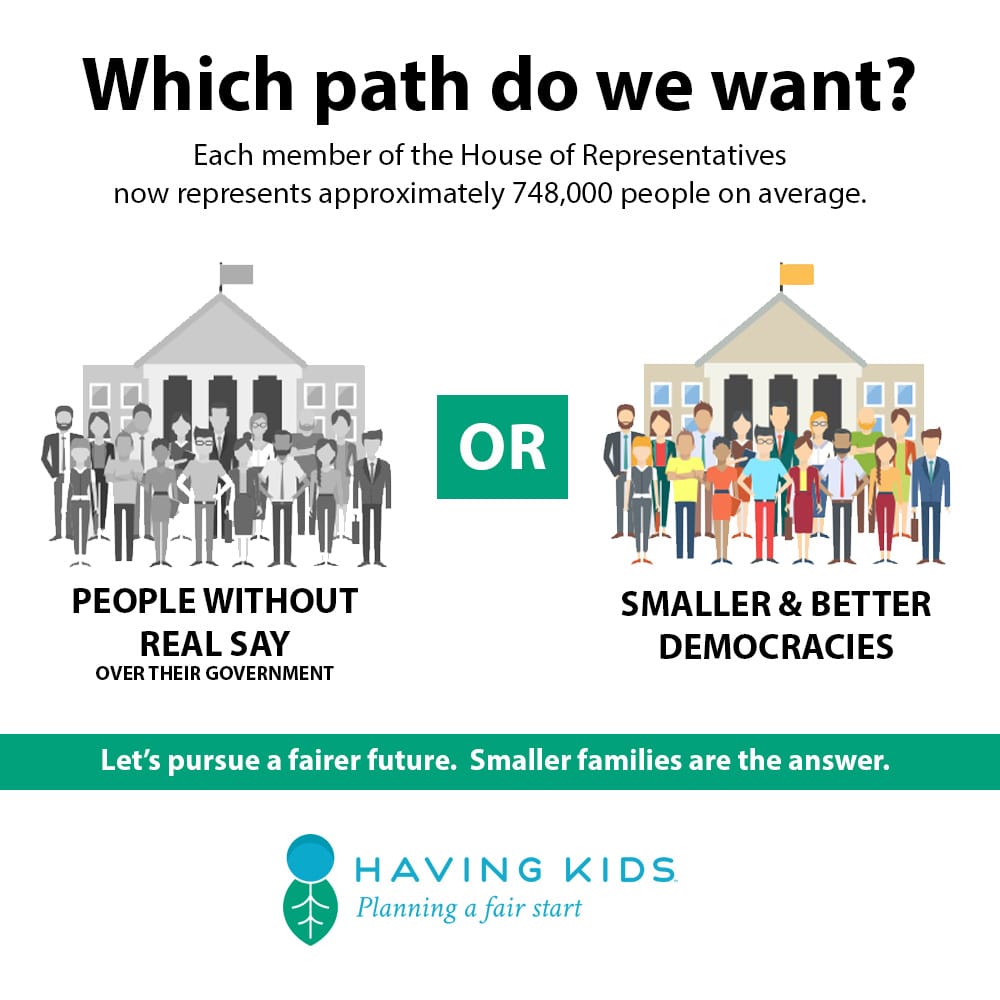
    An infographic compares two options: on the left, gray figures under “People without real say over their government,” and on the right, colorful families with “Smaller & better democracies.” Text promotes smaller families for fairer representation.

    While nations are apt to go to war, perhaps a sea change in our political evolution comes when we use the inversion test to determine who is free, and who is preconstituting, and use discourse (or other means?) to solve this hidden conundrum – the one that lies at the first border of human power, our creation. There is a unity of values if we start justice at the very beginning, in our creation.

    Take action:

    • Also at a macro level, urge anyone making a claims about what a policy should be to account for the actual people in their claim, for the actual power relations that are being fundamentally created by the claimant’s family planning norm. In many cases you will find that the person making the claim is misleading you, undoing the value they claim to be creating – like reducing climate emissions, and instead concentrating power in the hands of a few.
  • How the New York Times Undercuts Democracy by Ignoring Its Source

    How the New York Times Undercuts Democracy by Ignoring Its Source

    David Leonhardt and others have wisely sounded alarms about threats to democracy in the United States. 

    But their analysis misses the key question: How are we actually empowering people to participate in making the rules under which they must live, and limiting the power others have over them – including the destructive power inflicted by the climate crisis?

    Instead Leonhardt and others rush into questions of representation, and partisan politics. It would be better to preface these latter questions with a nonpartisan solution to the fundamental problem: That given the way we plan families, today people are not actually being empowered.

    Two illustrations compare family planning models: At left, a diverse happy family stands together with icons for community and health. At right, a monochrome crowd in a city. Text contrasts fair start (rights-based) with economic growth-based planning.

    That solution could be as simple as steeply redistributive baby bond legislation designed to incentivize family planning that actually gives all children equal opportunities in life, socially and ecologically. There is no need to ignore the long run threat, while dealing with immediate ones.

    Take action: Urge @dleonhardt to cover the story that really matters – how we work together to ensure a natural and democratic future.