Category: Population Economics & Demographics

  • Vox Founder Pushing Population Growth Made the Climate Crisis Worse. Hold Him Accountable.

    Vox Founder Pushing Population Growth Made the Climate Crisis Worse. Hold Him Accountable.

    The Financial Times just published an article detailing the massive impact policies that promote smaller families – for all – have on the climate crisis. Nothing comes close.

    And yet people like Matthew Yglesias and the media outlet Vox continue to push women to have kids. Many have said that we should punish climate change deniers for blocking policy reforms that could have mitigated the crisis. But all climate emission flow downstream from the increase in demand population growth creates. It is the fundamental driver. Aren’t the people actually making the crisis worse, usually to grow their investments, just as bad as the deniers? Did Ygelsias pushing women to have kids actually have an impact? The proposals to change federal child tax and care subsidy policy to encourage population growth that followed his advice suggest it did.

    Let’s hold him and others, like Lee Raymond, accountable. We have a right to take the resources of wealthy people like Lee and Matthew who profited from poor and unsustainable family planning but never paid that costs that growth imposed on the environment, animals, women, and children. Why? Because every child’s right to an ecosocial Fair Start is the first human right, and it precedes and overrides any other obligation, including property rights.

    It’s time to pay up. Those that really profited owe future generations – more than most.

    What is Fair Start? It’s about people, not population. It’s about shared values and thinking qualitatively about the future, not using poor and unsustainable family planning to grow economies. Read the Allegory of the River, and why Having Kids talks about constituting democratic communities instead of framing our work around the concept of population, to understand more. Let’s make family planning truly inclusive, and geared around creating democratic communities where everyone has a voice. 

    It’s simple: Fair Start family planning means smaller families sharing resources to invest more in every child. For some, the closest analog for this new model would be responsible family planning incentives. But Fair Start resources are actually entitlements held by future children, and funded through non-traditional means. Those opposed to remodeling favor our current system of unsustainable families, unearned privileges, and undemocratic influence, over giving kids a fair start in life.

    In a previous blog post, Having Kids argued that his approach — like many others who see babies as economic inputs to be exploited — was actually compelling evidence of the fundamentally unjust nature of our system.

    All kids have a fundamental human right, ecologically and socially, to a #fairstart in life. It’s the first human right. Help us secure it against those who threaten our future.

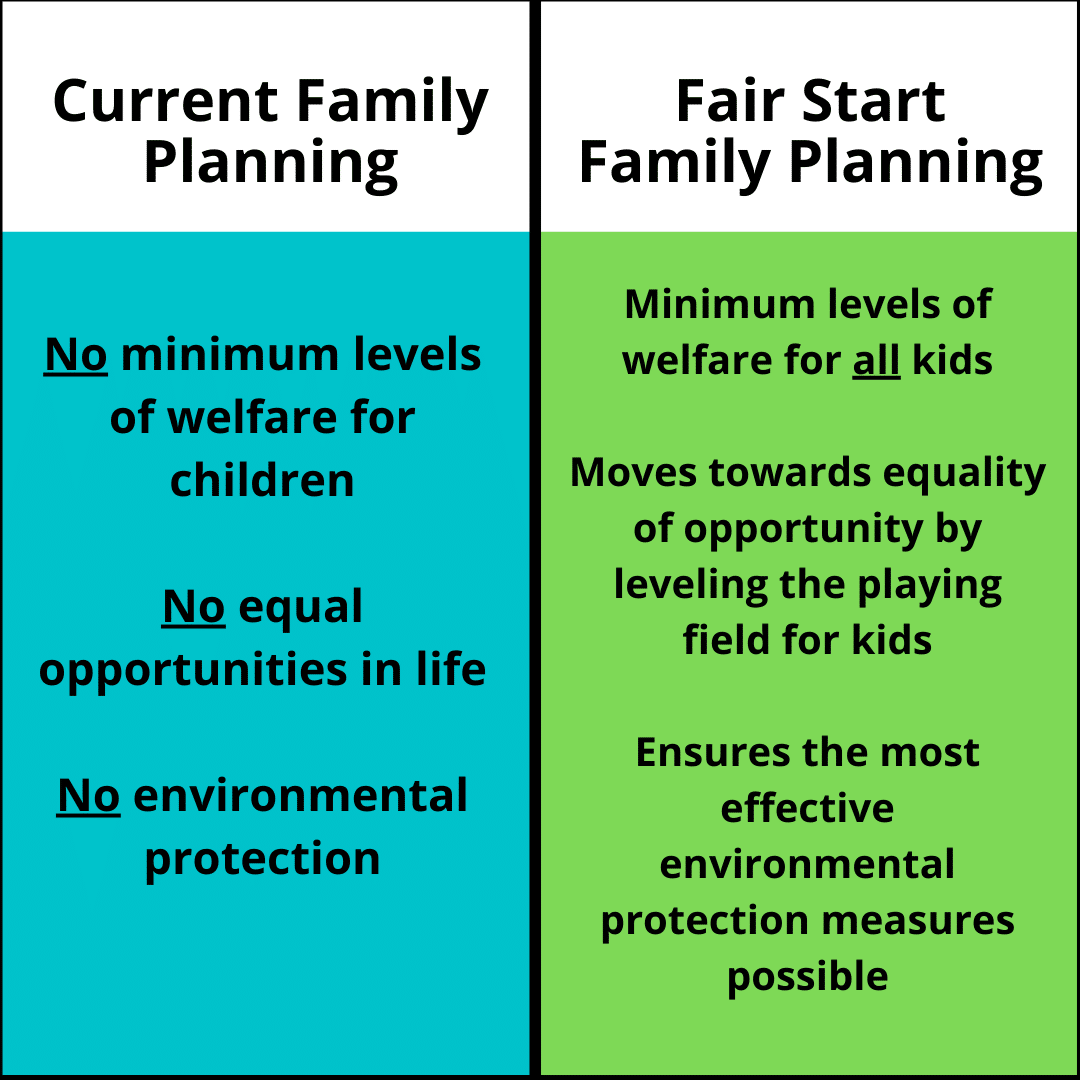
    A comparison chart of Current Family Planning vs. Fair Start Family Planning. The former lacks welfare, equality, and environmental protection, while the latter ensures welfare, equal opportunity, and environmental protection for all kids.

    Groups and individuals from around the world are signing on to an effort to change the old model that focuses on what parents want toward a new model that focuses on what all kids need. The new model, called Fair Start family planning, is the beginning of real social justice. The reform can begin with the United Nations secretary general simply acknowledging the need for change.

    Sign on, and urge any organization you support or can influence — nonprofit or for-profit — to also sign on. Sign here, or contact us at info@fairstartmovement.org for more information.

  • A Funder Has Broken From the Fold: Supporting Fair Start Over Population-Driven Investments

    A Funder Has Broken From the Fold: Supporting Fair Start Over Population-Driven Investments

    Many large funders and philanthropists profess a desire to have an impact on things like the climate crisis, economic inequity, and child and animal abuse. The impact of family planning reform on all of these things is unparalleled and well-established. But many high-wealth individuals and foundations resist funding Fair Start reproductive justice reforms because they wish to ensure familial wealth continues to privilege some over others, or because they wish to further increase their wealth through unsustainable population growth that simply expands markets without creating real value.


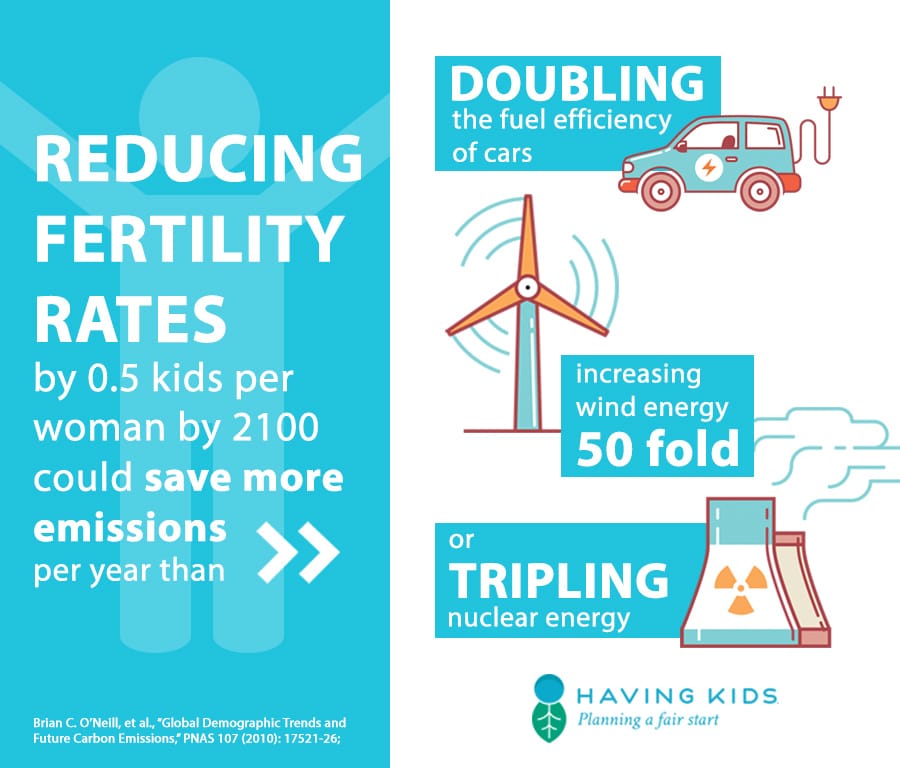
    Infographic comparing actions to reduce carbon emissions: reducing fertility rates by 0.5 kids per woman, doubling car fuel efficiency, increasing wind energy 50-fold, or tripling nuclear energy. Includes icons for each action.

    “I’ve spoken to wealthy individuals who knew inequity and population growth were degrading their philanthropic work on social issues and the environment but were simply unwilling to relinquish the massive head start they wanted to give their kids.”

    – Anon


    Not everyone is on board with that approach. Trisha Hensley recently made a significant gift to Having Kids in order to promote reproductive justice reforms designed to give all kids a Fair Start in life. For her and many others, it simply makes no sense for families and institutions in privileged positions to think their children will really be better off – regardless of the benefits they have been given – in a world with billions of people born into vast inequity, and increasing social and political instability that puts everyone at risk. When it comes to kids, we really do all rise and fall together.

    The most effective way to protect all of our futures is by reforming our family planning policies to prioritize new cooperative family planning models that treat every child’s right to an eco-social Fair Start in life as the overriding human right and obligation.


    A comparison chart of Current Family Planning and Fair Start Family Planning. The left side lists negatives: no minimum welfare, no equal opportunity, no environmental protection. The right side lists corresponding positives.
  • Power Grid Failures Show Threats of Population Growth: Take Action

    Power Grid Failures Show Threats of Population Growth: Take Action

    The recent climate-driven grid failures in Texas highlight a key threat to our children’s future: Systems upon which more and more people are dependent, and which themselves are threatened by that very growth. Nothing exacerbates these “loop” problems, like the ecologies upon which we are dependent and which the climate crisis threatens, more than poor and unsustainable family planning.

    Not everyone is at the same level of risk in these situations. The wealthy people and their families who have benefitted from population growth, like Ted Cruz and his kids (who vacationed in Mexico while poor children in Texas died), find ways to avoid the risk.

    How do we solve this problem? While big government and big business want unsustainable population growth to continue, and who together created the unsustainable family planning systems that create growth by exploiting future generations, human rights point in a different direction.

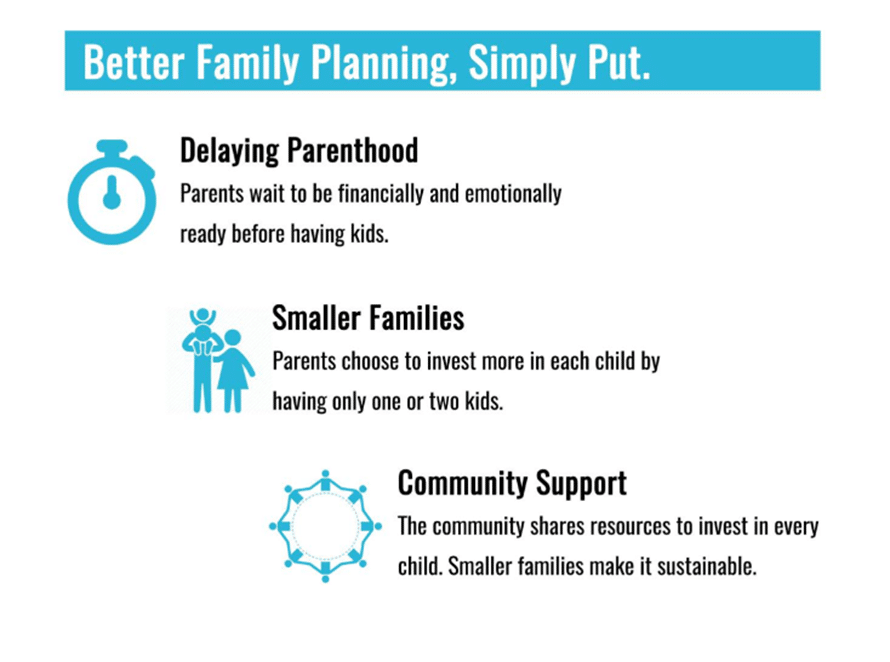
    Infographic titled Better Family Planning, Simply Put with icons and three points: Delaying parenthood, smaller families, and community support, each explained with brief text and blue graphics.

    If we are willing to plan responsibly, we have the right to take the resources necessary from the top – and people like Cruz – in order to ensure all children a Fair Start in life. Why? Because having kids is the first and overriding human right. It comes before the exploitative systems that government and corporations conspired to create.

    Contact Ted Cruz and urge him to support Fair Star reforms that will protect Texans in the long run, and to ensure justice for all.

  • South Korea: Change The Population Policy Landscape for the World

    South Korea: Change The Population Policy Landscape for the World

    South Korea is in the midst of making demographic history, with the country’s population itself declining. While other countries have seen the same process unfold, South Korea is unique in that the fall is part of one of the best family planning policy reforms the world has seen. The positive impact on the climate crisis, and on improving each citizen’s role in the democratic process, is astounding. South Korea is showing that nations can break the suicidal collective action problem of a permanent birth and population growth race, to instead help move the world towards an optimal and sustainable world population level.

    The State Pushing Women to Have Kids

    Forces at the top of the population exploitation pyramid Nobel Laureate Stephen Chu once pointed out are fighting back, sounding alarms about South Korea heralding the end of the world. They do not care about the impact falling populations have on values like welfare, nature, and equity. They care that the pyramid – atop which they live – is changing and the free money of unsustainable population growth might be disappearing. These forces said the same about falling population in Japan years ago and impacts on quality of life – and were wrong.

    Unfortunately, South Korea is caving to forces at the top of the wealth and population pyramid, and paying and pushing women to have more kids. In this way, South Korea is a battle ground for whether we stick to unsustainable, nationalistic and pre-constitutional replacement fertility models, or transition to Fair Start family planning systems that use nature as a baseline, and are truly compliant with human rights.

    We should choose the latter, and rather than prop up the wealthy, we should constitute new democracies where each person matters.

    What can we do in this fight for human rights and the future?

    It’s time to change the discourse. This is not about numbers. This is about people, and the first human right – the right to a fair start in life. It’s time to find the wealthy entities and their mouthpieces in the media pushing unsustainable growth, the people driving the exploitation rather than investment in future generations.

    An infographic titled The Fair Start Model explains how parents, communities, and small sustainable families work together to ensure a fair start and high quality of life for all kids.

    It’s time to take the resources they took, the wealth, and instead invest it in future generations. We have the right to take what is necessary for the Fair Start right by all means effective because it comes before – and overrides – property rights. We are before we do. The wealthy collected their power in violation of that right; they never paid the costs they should have. It’s time for them to pay now.

    Step one in this transition?

    The United Nations and Secretary General Antonio Guterres are obligated by the international bill of human rights to support Fair Start, and our just demands, prior to our engaging targets at the top of the wealth pyramid. They are obligated to speak truth with us to the power at the top, and support the just actions to come.

    Urge the United Nations to recognize every child’s right to a Fair Start in life. Tell them to choose justice over greed and inequity.

  • What Makes Pandemics Worse? Population Growth. Take Action.

    What Makes Pandemics Worse? Population Growth. Take Action.

    Humans are shortsighted by nature. We experience something like the climate crisis or Covid-19, and our usual reaction is to look for an immediate solution like emissions technology or a vaccine. But sometimes solving problems – especially global and interconnected ones – takes stepping back and seeing the larger picture.

    Decades ago world leaders were faced with a choice: Respond to explosive population growth by promoting smaller families and greater investments in child development universally, or take a relatively hands off approach, and hope that falling fertility trends would continue. Most countries chose the latter, which allowed them to grow and to exploit rather than invest in future generations.

    This choice has resulted in a world population that is still skyrocketing towards potentially eleven billion people by 2100. The hands off approach has done little to alleviate poverty and inequity, and has become the fundamental driver behind the climate crisis and every other anthropogenic impact. What’s worse? The hands off approach – pushed by men who controlled their households – did not comply with human rights requirements, which require balancing parents’ right to have kids with an obligation to provide the things all future children need. The human-rights approach to planning families requires that we collectively plan in ways that give all kids a socially and ecologically fair start in life.

    Infographic titled Better Family Planning, Simply Put with icons and three points: Delaying parenthood, smaller families, and community support, each explained with brief text and blue graphics.

    The exploit-rather-than invest approach set the stage for the risk and impact of Covid-19, and is setting the stage for the next pandemic, which could be larger in scale. How?

    1. Overcrowding, or the quantity of people around us, helps pandemics like Covid 19 spread. Worldwide, public health officials are admitting that the failure to contain the pandemic is largely a function of the quantity and civic qualities of the people crowding the planet, which are factors that depend on our family planning policies. India is exemplifying this. Key UN agencies were urged to change modeling well before the pandemic, but did nothing.
    2. Civic qualities that are largely contingent on the conditions of our birth and early development, like our overall health and risk of comorbidities, as well as empathy deficits which are reflected in the refusal of many to engage in easy and life-saving public health measures like practicing social distancing and wearing masks, substantially contribute to the impact of pandemics like Covid-19.
    3. The economic disparities we inherit at birth lead to massive disparities in how pandemics impact different communities, and hence determine the average impact of things like Covid-19.
    4. Our growing population is degrading our natural ecologies, which sets the stage for future and worse pandemics.
    5. The distribution and efficacy of vaccines is being stymied by population size, the refusal of many to participate, and underlying health conditions that can be traced to family planning systems.

    What does all of this mean?

    Part of the response to Covid-19 has to be reforming family planning policies to fulfill human rights obligations, and give every child a Fair Start in life. Given that Fair Start family planning is the first and overriding human right and obligation, we may fulfill it by taking resources from both public and private concentrations of wealth and power, and using them to incentivize better and more cooperative family planning, or smaller families working together to invest more time, love, and resources in every child.

    TAKE ACTION: Urge the Biden administration to reform family planning policies, and do what has the greatest impact on the climate, Covid-19, vast inequity, and other crises we face.

  • New Survey: Education on Family Size and Population Growth

    New Survey: Education on Family Size and Population Growth

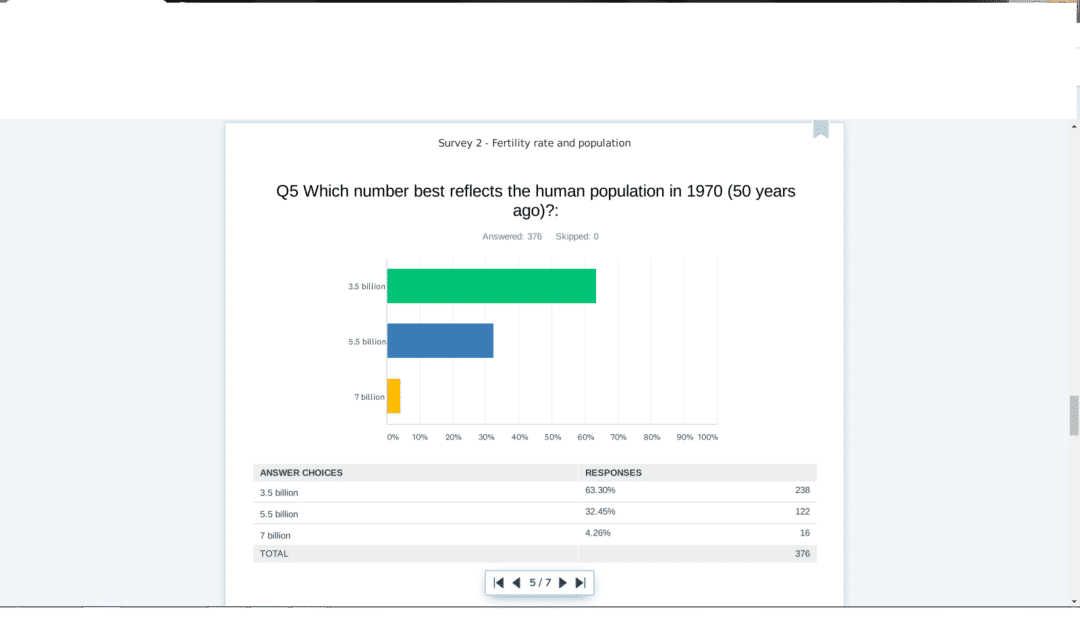
    Having Kids recently surveyed 376 people regarding their understanding of family size and population growth.

    • A significant number of people correctly see a relationship between family size and human population. About 86% of respondents answered affirmatively when asked whether there is a relationship between the number of children a couple decides to have and human population.
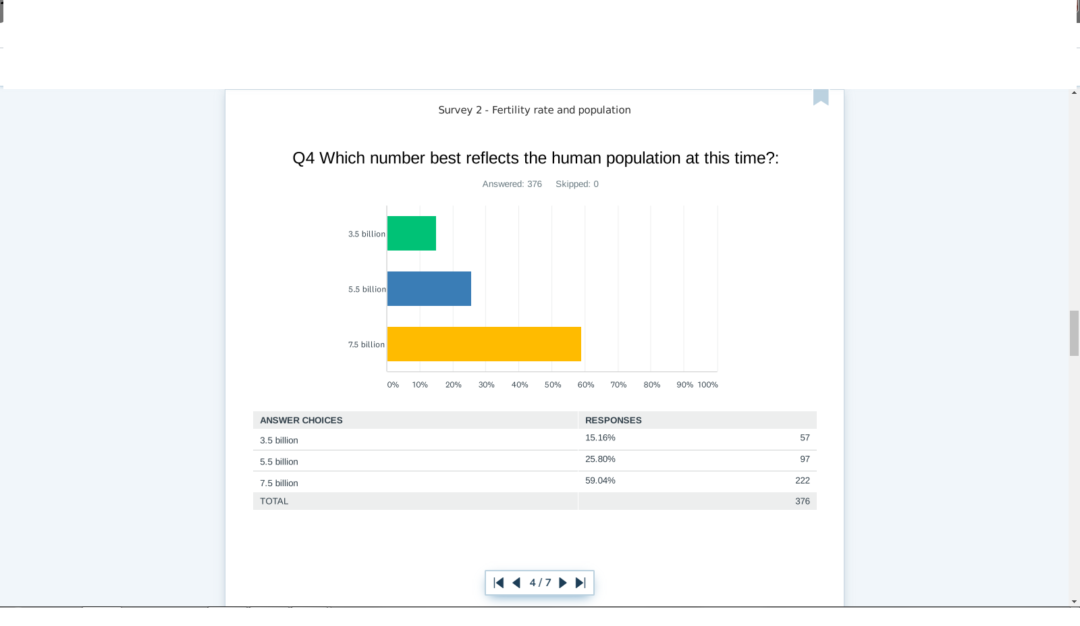
    • Though a majority of respondents have an accurate picture of current population numbers and those 50 years ago, a notable minority do not. Forty-one percent of respondents think the current number of people on the planet is either 3.5 billion (15.25%) or 5.5 billion (25.8%) instead of the correct answer of 7.5 billion and that the population in 1970 was either 7 billion (4.3%) or 5.5 billion (32.6%) instead of the correct answer of 3.5 billion.
    • Support for Having Kids’ mission remains high. Seventy-two percent of respondents indicated they would be supportive (36.3%) or very supportive (35.4%) of an organization pursuing Having Kids’ mission.
    • More education is needed regarding both the current population numbers and the expected growth of these numbers.
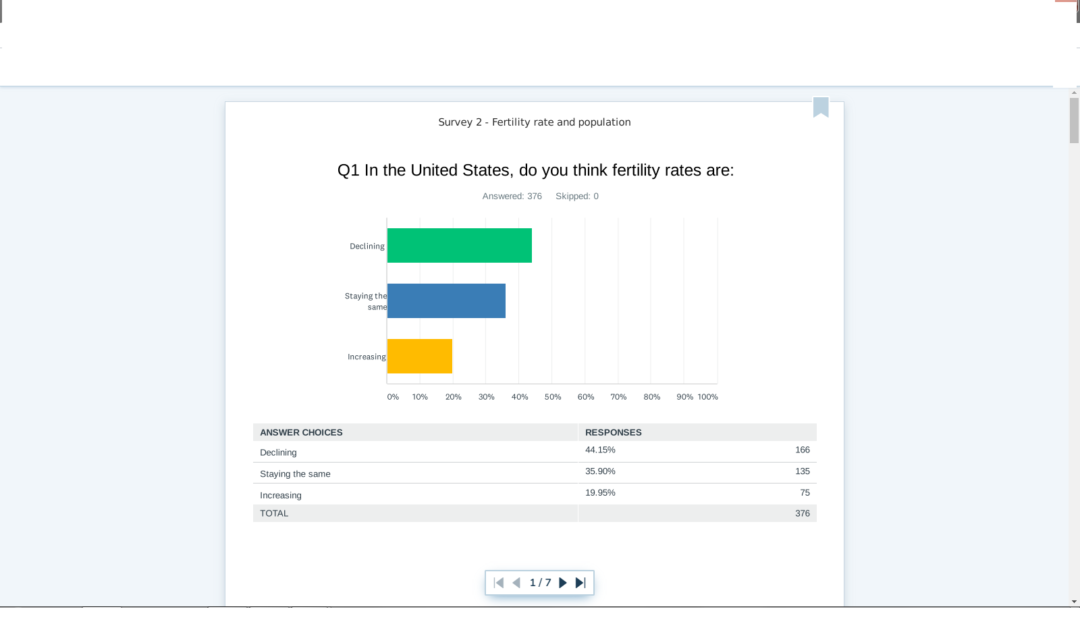
    A survey chart shows U.S. opinions on fertility rates: 45.94% think rates are declining, 35.99% say staying the same, and 18.08% say increasing. Bar graph and response table are displayed.
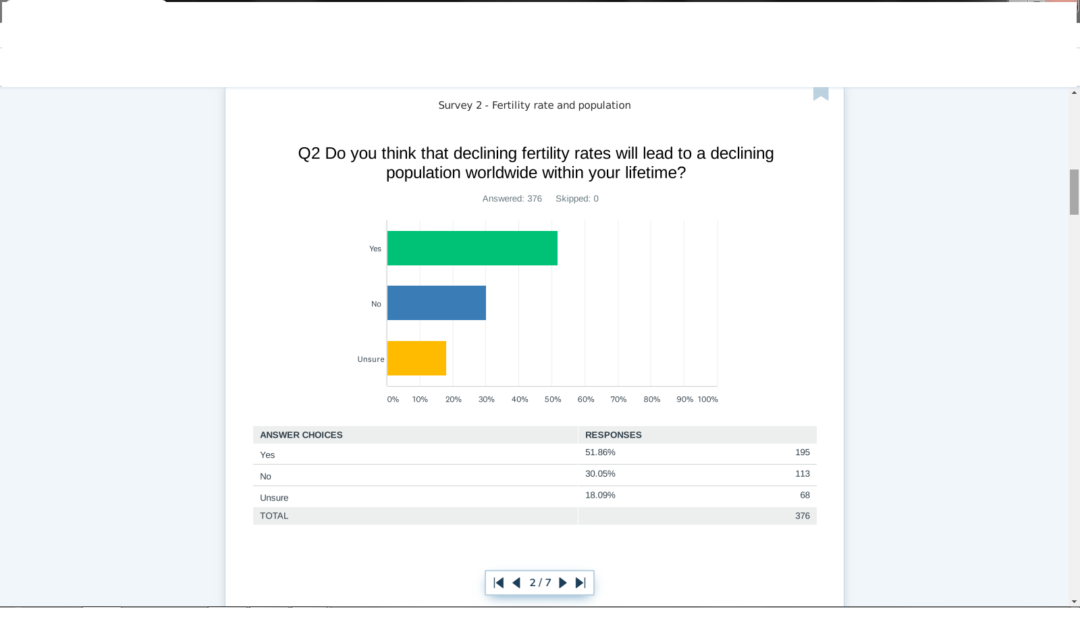
    A survey question asks if declining fertility rates will cause a worldwide population decline within respondents lifetimes. Bar chart: Yes (166), No (53), Unsure (77). Table repeats responses. Total: 296 answered, 0 skipped.
    A survey result screen shows a bar graph and table. The question asks about a relationship between family size and human population. 323 answered Yes, 25 No, and 28 Unsure, out of 376 total responses.
    A survey graph showing responses to Which number best reflects the human population at this time? Most respondents chose 7.5 billion, followed by 6.5 billion and 3.5 billion; results are also shown in a table below the chart.
    A survey question asks about the human population in 1970. A bar graph shows most respondents (62.63%) chose 3.5 billion, 28.29% chose 5.5 billion, and 9.08% chose 7 billion. Total responses: 381.
    A survey results chart shows support levels for an organization promoting cooperation between prospective parents. Most respondents are very supportive or supportive, with fewer neutral or unsupportive responses.
  • World Population Day: Target the People Threatening Our Future

    World Population Day: Target the People Threatening Our Future

    A universal policy promoting smaller and more equitable families is the most effective way to protect our future – ten to twenty times more effective than other policy reforms.

    The Secretary General of the United Nations must take the lead here, and make informal statements that will help change the way we all plan families. He can choose not to put population growth and the economic bubble it creates above human rights and the right to a Fair Start in life, which is the first and most important human right. If he does not change course, he is choosing to exploit and endanger future children, rather than support a system in which we collectively invest more in each child by changing and improving the conditions in which they are born. He gave his own two kids a privileged start in life relative to the poor children of the world, but it does not have to be that way.

    As Secretary General he is obligated to speak the truth of human rights to the powers of the world, his silence on this issue threatens his legitimacy, and it will lead to the people rising over him to ensure the better future we all deserve.

    TAKE ACTION: Engage the Secretary General directly to do what human rights require, and to support a Fair Start in life for all kids: 1) Email Stéphane Dujarric, Spokesman for the Secretary-General, at dujarric@un.org, 2) contact the United Nations at 212-963-4475, or 3) engage the Secretary General in person to demand action.

  • Reframing Population and Family Planning to Focus on Justice

    Reframing Population and Family Planning to Focus on Justice

    Media are abuzz these days about women not having enough kids in order to grow economies. It’s an odd thing to hear, given that others are rightly pointing out that world population will continue to explode by billions of people in the decades to come, exacerbating the population-driven climate crisis and causing untold suffering. It’s also odd given that overcrowding and poor population health set the stage for the COVID-19 pandemic and the dismal reaction to it, and it’s setting the stage for the next pandemic.

    The debate centers on profound differences in values regarding what the differing camps want the world to look like in the future. 

    Are we missing a more important conversation about family planning and population growth?

    Prior family planning approaches have primarily framed having children with a narrow focus on what parents want more than what future children need. This ignores the intergenerational nature of that decision — the ethics of which probably matter more than any other area of human behavior. Thinking in terms of what parents want keeps our focus on the here and now, rather than on the future, and excludes the interests and needs of the future child, the communities we inhabit, and the world our children will impact. This short-term thinking and framing is hurting kids, animals, and the environment, furthering inequity, and preventing us from reaching modest sustainable development goals. 

    Right now, the way we think about population hides the way we are hurting kids. What if we could protect our future by giving children what they need? 

    Can we choose a better model that gives everyone more of what they need? The way we currently deal with population does little to protect our future, drives inequity that threatens everyone, and reduces the quality of our lives by ensuring an overcrowded world filled with people who did not get what they needed as they grew up. 

    Want something better? The key, discussed more below, involves interpreting our Constitution in an intergenerational way and shifting away from family planning systems that focus more on what parents want than what future children need. 

    This new approach involves a child-centric model that both recognizes the implications of our previous flawed family planning approaches as well as our obligations and duties to the children we are bringing into this world. If we don’t fix our fundamental conception of how we plan families, we will continue to create social and ecological crises that could have been averted. We can reframe the discussion away from population.

    Let’s start with the premise that framing is crucial.

    Whether we think about population or start from a different concept, framing could change everything about how we perceive the subject. Framing is the act of first defining, through the choice of initiating language, how people think about the subject matter under discussion. What does the word “population” bring to mind? The debate surrounding “population” tends to focus on quantity, and falls prey to the common human coginitive dissonance of temporal myopia by framing the issue as static – as a noun. This is misleading. Shouldn’t we think of people in the world, and the act of having kids, as more dynamic and qualitative than quantitative and static? Shouldn’t we talk about the behavior that precipitates population growth? Shouldn’t we consider future quality of life and orient our family planning laws and policies around what future children actually need? What good is talking about population change without a normative baseline, or optimum population range, against which to evaluate that change. 

    One way to decide how to frame or define a subject involves asking why we care about the matter. Rather than simply counting people, perhaps what really matters is how we fundamentally relate to them. 

    To create new possibilities and frames, we need to use new language. That language should recognize the central role the creation of new citizens plays in every social policy decision we make. Instead of approaching family planning and population in the narrow way we have, we should talk about it with a broader frame that encompasses four interconnected and inextricable things we cannot avoid in the act of having kids:

    1. The quantity of the people we create.

    2. Their qualities, such as empathy, and other key traits that determine how people socialize. 

    3. Their positioning in life relative to other children.

    4. Their relation to their ecologies.

    The quantity of the people we create

    The current concept of population does capture well the quantitative impacts of having kids, which are enormous, acting as a force multiplier of things like catastrophic greenhouse gas emissions. But when we talk about overpopulation, the question remains: over what? How do we know what an optimal population will be? How could we know without first having decided on the ethics of having the kids that will create the population?

    This is where values other than quantities of persons come in. 

    Right now, we tend to think of population growth as inevitable. What if we had the choice to protect our future instead? 

    The qualities and traits of these children

    The concept of population does not capture the qualitative nature of creating another person, which includes things like the most crucial period of childhood development, such as the development of qualities that determine how well we empathize and socialize with other people. These are inextricable from personal well-being and childhood development, rights guaranteed by international treaties like the United Nations Convention on the Rights of the Child but rarely delivered.

    The current concept of population hides the way our creation determines much about who we are. This includes qualities about us that impact our ecology — such as whether we identify as consumers and workers in our economies or whether feel we should live in democracies where we have meaningful roles in making the rules under which we live (i.e., whether we see ourselves in terms of shopping malls or town halls). The former can tolerate high populations with lower levels of education; that would anathema to the latter. We need a concept and a language that captures this. It should account for how having kids changes the nature of society — and the quality of our lives — by changing the qualities of the people who comprise it. 

    Their position in life relative to other children

    The concept of population does not capture that we cannot create children without determining their positions relative to other children. This includes the opportunities they have in life, with some kids today born billionaires and others born slaves. The way we currently think of population buries the way the act of having children creates inequity. This positioning includes the inevitable estrangement from one another that comes with population growth. We need a concept that accounts for how having kids determines how those kids stand in relation to one another. We also need a concept that connects this positioning, and economic inequality, to the other aspects of family planning, such as the environmental impact, which has been well-established. 

    Right now, the simple idea of population hides the way some parents exacerbate the divide between rich and poor and threaten social stability. What if everyone had equal opportunities in life instead? 

    Their relations to their ecology

    The concept of population does not capture the simple fact that we alter the ecologies children need to thrive by the very act of having them — consider the shortening of pregnancies due to the population-driven climate crisis. What does that mean for the future ecology our kids will experience? Mass extinctions, accelerating climate change, dying oceans, increased risk of pandemics, crowded cities with drastic inequality — these are all crises we now know we and our kids will face. We need language that captures this dynamism and its impact on quality of life. We need language that also accounts for this sobering fact and that the communities where we have children (e.g., the industrialized world versus elsewhere) vary dramatically in terms of their ecological impacts. 

    Can we devise a way of cooperatively planning our families that improves our ecology rather than degrading it? 

    Taking seriously these four aspects could help us shift the frame from the quantitative idea of population to the qualitative nature of creating children, the communities they will compose, and the relation of those communities to the ecology they require to thrive. This will not happen overnight. We need to start by changing the conversation.

    When population is framed with this broader set of criteria, it becomes clear that population is the central consideration for all social policy. Population is not some exogenous policy area we can choose to work in or to ignore. The people on the planet today, and how they limit what’s possible, are largely the product of what was done or not done in past family planning systems. We just have to shift and temporalize our thinking, or overcome the cognitive dissonance of temporal myopia that makes it hard for us as humans to see this. If a policy choice involves people, it involves family planning. Family planning, and the failure to plan, is the foundation of everything social. People are the first building blocks of any policy, and that which creates people, develops their traits, and gives them agency most accounts — and in free societies should most account — for the quality of life on this planet.

    Replacing the simplistic idea of population with the fuller and more accurate concept of constituting gets us more. 

    If we care about the future, and our kids’ futures, shouldn’t we care about future generations, the conditions into which they are born, and the people they will become?

    Given that the population is always changing and is the product of our actions, it’s more accurate to use a verb and to focus on the cause (having kids) before the effect (population growth). The concept of “constituting,” as in the reference to “We the People” in the United States’ and other constitutions, could be ideal. Just the way the climate crisis is not a thing but a process, and more relational than individualized, we are not a static people historically constituted, but a people who are constituting their own nation in a dynamic and ongoing way. 

    Notice how constituting gels with the ideal of “child-centric” family planning — as in, “We the people constitute our future.” The thinking is qualitative, forward-looking, committed to freedom, justice, and equity, and the most effective way to deal with many of the crises we face today. Contrasted with the simplistic concept of population, which hides what’s at stake, the idea of constituting speaks to the dynamic and overriding question of intergenerational justice. 

    Constitutions derive from the idea of people coming together consensually, as free and equal people, to make the rules under which they will live. Constitutions, and the act of constituting, are emancipatory, and meant to capture the complex idea that we can become free by coming together if we do so under very specific conditions. If we apply the idea of constituting intergenerationally, to the act of having kids, it can capture the values and meanings the concept of population cannot. “Constituting” as a concept is ideal for another reason – it’s the perspective, lens, or frame we would  use when justifying the power other people – in the social contract – have over us. 

    In other words, what matters most is not the idea of population as numbers, but the formation of groups of people at the most fundamental level, where other people have power over us. That is what we have to first account for: who the “We the People” are and will be. The social contract, and the legitimacy of government, meant that we should be coming together as free and equal people. But that opportunity actually happens all the time — with every child born. The process is not static; it’s dynamic. The key source of justified governance is not some antiquated document or written constitution to which most people have no relation. It is the constant constituting or re-creation of actual people through family planning. And the key will be moving past a system that treats people as economic inputs to one that creates truly democratic communities where people control the rules under which they live. 

    Remember, framing matters. Technically, we were not constituted as a nation; if we value each person equally, we have to believe that we are constantly reconstituting as future children enter the word. “Constituting” captures, much better than “population,” the antecedent, relational, normative, dynamic, and endogenous nature of the thing, because it proceeds from a perspective of needing to justify the social organization (or the social contract) around us or the power others have over us. That’s the perspective from which free and equal people would orient.

    “Constituting,” as opposed to “population,” captures the fundamental human rights-based lens or perspective that free people would have when thinking about the people with whom they share communities: How is the power others have over us justified? Are we constituting a community of free and equal people, or something else, such as a hierarchical economy? What control do you really have over the rules under which you are forced to live? Aren’t you worth more than being one vote lost in a sea of millions of votes for presidents and other antiquated figureheads with massive control over our lives?  

    If we think in terms of the value-heavy verb of constituting and the four facets above that it captures, we are changing the frame and the way we think about the creation of the people with whom we share the world. This changes the debate. Notice how George Monbiot dismisses the relevance of population growth when critiquing Michael Moore’s new film “Planet of the Humans.” But how can humans be irrelevant to an anthropogenic climate crisis? If we unpack the idea of population, as discussed above, we find a concept that is more qualitative than quantitative, dynamic than static, endogenous than exogenous, normative than descriptive, and multifaceted rather than one-sided and numeric. Monbiot could reframe his thinking on this issue and much more effectively advance the environmental values we all share. 

    Why does this framing change matter? 

    For some, a shift in framing lets them see past myths, such as that population, or the people with whom we share and will share the world, is amorphous and out of our control. Or the myth that some kids are born into fortunate conditions, with what they need to succeed in life, while others are simply not. That’s not the case. Our birth conditions have nothing to do with fortune, God, or some invisible force at work. That is what the wealthiest among us, many of whom inherited and did nothing to earn their benefits, want us to believe. Inequity at birth is simply humans’ failure to ensure fair start family planning

    And for others, moving past the concept of population, and toward constituting, goes past simple myth-breaking and will lead to effective ways to promote human freedom. 

    The U.S. Constitution was born of a revolution to ensure that people could constitute independent, or free and equal, people. That meant both freedom from others, and the freedom to choose valuable options in one’s life, or freedom of opportunity. 

    But for many reasons, the Constitution was never applied intergenerationally. 

    And there is no way to be free from other people, or for each person to have equal opportunities, without accounting for the quantities, qualities, and relative positioning of people entering the world. How we are experiencing the COVID-19 crisis is a perfect example: The chances of us contracting the disease, of the resources each person has to avoid the disease and get help if we contract it, how we are changing our environment to increase the risk of the next pandemic, etc. — all are first and foremost contingent on our quantities, qualities, inequities, etc. Population density, vast inequities in how the disease impacts people, the presence of underlying health conditions and other vulnerabilities, the way anthropogenic environmental impacts are setting the stage for the next pandemic, and more all flow from our family planning systems. 

    And because we have ignored those factors, as well as for other reasons, human rights and democracy are in decline today. Instead of constituting communities of people where everyone has a voice over the rules, we have media pushing women to have kids in failing social systems, and in the face of ecological crisis, to further inflate the economy. Instead of seeing communities as free and equal people in town halls, the politicians, pundits, and companies pushing women to have babies envision a world of crowded shopping malls. But how you would see people and want them to be in a democratic town hall, versus a shopping mall, is very different. 

    People who want to grow economies push women to have more kids, with less investment in each child, and no minimum level of welfare, or equity, for each child born. In these schemes, people are just economic inputs, rather than citizens who must be sufficiently developed to co-rule their democracies. In these constant-growth schemes, it’s OK to push more and more children through failing educational, welfare, healthcare, and other systems. In this worldview, it’s perfectly acceptable — if not desirable — that the average American adult reads at the level of an eighth-grader. 

    The idea of endless growth proceeds from state-based, and top-down, views of people as consumers and labor, rather than a bottom-up view of people as citizens with control over the world around them. Constant-growth systems push in the opposite direction from inclusive family planning systems that would create, or constitute, true democracies of capable and self-determining people. 

    The constant-growth worldview is antithetical to the personal autonomy that would be promoted and protected by a human right to nature, guaranteed minimum levels of well-being for children, and limitations on the right of abusive parents to have unlimited numbers of children who will be seized and spend much of their lives in state custody. 

    Make no mistake: The people pushing poor family planning because they see babies as money are hurting people — and at the most fundamental level. They take no care to avoid children being born into horrible conditions, they further a culture in which women are expected to have children, they exacerbate the climate and other ecological crises, and they ensure the dominance of massive economic systems where the average citizen has no effective role in making the rules under which they live.

    We can reverse the exploitation of future generations, and nature, by using Fair Start family planning to move resources from the entities at the top, both public and private, who have benefited from growth at cost to kids and our communities, and instead investing those resources in ways that give kids a fair start in life. 

    How does that work? Rules like property rights and tax obligations come after, and are subordinate to, the family planning rules that determine our creation. In other words, we are before we do. Because constituting comes first and involves the very first rights and obligations that lead us to become free and equal, the process overrides other rights and obligations — such as property claims and tax obligations — that interfere. The process of constituting — and thereby legitimating through the creation of our societies — overrides everything. The right to a fair start in life, and the process of constituting democracies filled with people who get what they need in their childhoods, is the first human right that puts the human in human rights. It comes first. 

    If the conservative-minded wish to avoid paying taxes, why not see that money be used more effectively, to constitute future generations in ways that ensure responsible parenting, and a safe and secure world for our kids? If the liberal-minded worry about the uber-rich using their wealth to oppress others, why not properly and effectively allocate that wealth based on the dynamic nature of our constantly constituting new societies? 

    We can truly constitute from the roots up. Our governance remains relatively preconstitutional, and illegitimate, until we do. We have a right to protect our future.

    Let’s move past the concept of population, which you by now may recognize as a concept used for centralized state and corporate planning and control, rather than valuing people qualitatively, and toward the action of constituting free and equal societies. We cannot be free until we account for and include the people with whom we do and will share this world, the way we would in a democratic town hall, rather than ignoring them the way we would in a shopping mall. 

    Where do we go from here?

    It’s time for another American revolution. But this time, it should be a bottom-up intergenerational revolution that, simply by demanding more for each child, actually ensures the constitution of capable people that democracies require. The social contract works only if it is made intergenerational and if we constitute as such. Doing so will allow us to build stable communities where we commit to one another and embrace our obligations to our neighbors, our shared political life, and the planet. It will create the opportunity for a more meaningful sense of self and a more active role in our relationships with others. It is also our best chance at avoiding many of the existential risks humanity faces.

    The revolution begins with parents demanding the resources they need, and deserve, from those who are destroying our future so that parens can give all kids a fair start in life. It’s vital to understand constituting here: We have a right to take the resources at the top of our economic pyramid because the ongoing act of justly reconstituting ourselves as free and equal communities always comes first. A child’s right to a fair start is the first and overriding human right that overrides other claims, and ensuring it is the best way to protect our future and our quality of life. Parents have a right to those resources in exchange for responsible and cooperative planning, and it’s time we help parents take them. 

    If we are constantly constituting our legalities, rather than have been historically constituted, then no entitlements proceed the need to redistribute power in ways that assure that “we the people” are coming together — intergenerationally — as free and equal people. That simple and antecedent override would allow us to constitute free and equal communities by any means effective.

    Change the way you see these issues. It’s not about population; it’s about constituting our future. It’s not about numbers; it’s about our and our kids’ quality of life. 

    TAKE ACTION: We can start the process of constituting free and equal communities in a dozen ways, including moving toward child-centric family planning. Choose one today by clicking here and do what’s most effective to protect your future. 

  • Michael Moore and the Return of the Population Question

    Michael Moore and the Return of the Population Question

    [et_pb_section admin_label=”section”] [et_pb_row admin_label=”row”] [et_pb_column type=”4_4″][et_pb_text admin_label=”Text”]

    Jeff Gibbs and Michael Moore are being heavily criticized for their new documentary, “Planet of the Humans,” putting a focus on restraining population growth as the solution for many environmental crises. The criticism centers on a few themes: The focus on population distracts from more immediate solutions, such as radically reforming our energy policies and markets. That given steadily falling fertility rates, population growth has been sufficiently addressed. And most pointedly, that raising population growth as a problem in need of a policy solution invites draconian population control measures that will violate human rights.

    Gibbs and Moore could respond to the criticism directly: Reducing family size by one child is the most effective way individuals can reduce greenhouse gas emissions — twenty 20 times more effective than other changes, to one’s diet or transportation, for example. How could this key factor be a distraction?

    Also, arguing that the world has solved the population problem implies some general agreement on an optimal world population, baselines for environmental protection, levels of biodiversity, etc. In reality, despite a projected world population growth of billions in the next few decades, many are pushing to increase fertility rates and raise the population curve through cash payments, limits on abortions, and pronatal media rather than flatten. Why?

    Population growth often means (albeit unsustainable) economic growth. One’s view of an optimal world population depends on one’s values, and amid the debate, there are wildly different ideals. Even simply focusing on survivability draws huge variances. Whether we have dealt with the population problem by flattening the growth curve in the past century or so is not the question. The question is whether we have flattened it enough or whether we will actually choose to reverse course. 

    Finally, Gibbs and Moore have a ready response to the allegation that they invite violations of human rights: The most searching examinations of the right to have children have found the right is really the right to reproduce one’s self, rather than the right to a large family. The right to have kids, like the right to speak freely but not yell “Fire!” in a theater, is limited by others’ rights, including the right of our children to a safe, healthy, and biodiverse environment.

    A Better Way to Solve the Population Debate

    But is there a better way to resolve the debate? Population growth is preceded by the act of having kids, and perhaps we can find more common ground regarding the optimality of that.

    Four value propositions lay a pathway forward:

    • First, there seems to be common agreement that all children deserve some minimal level of welfare at birth, or the things we aspire to provide all children in the Children’s Rights Convention.

    • Second, while economic equality is controversial, ensuring everyone equal opportunities in life is not, though the process for doing so remains elusive. What if we focused the process on family planning and leveling the playing field by training the redistribution of resources around the start and first stages of every life?

    • Third, if we assume economies are preceded and limited by the rule of law and democracies that enable them, we can assume that family planning policies should be geared around producing citizens rather than consumers and workers. Developing future generations for democratic town halls looks very different from developing them to fill massive shopping malls, with the former calling for smaller families to create a future in which every voice could be heard and more investment in the education of each child to make their voices transcendent. 

    • Finally, given the damaging impact of the anthropocene on everything from pregnancy to the threat of pandemics to wildlife extinction, the safest baseline for environmental protection — consistent with the precautionary principle — is a restorative baseline that values nature as biodiverse nonhuman habitat rather than a human resource. Valuing nature as nonhuman space is more about ensuring our species the nonhuman nature we physically crave and need than an abstract debate about optimal populations and the mathematics of utility far removed from the lived human experience.

    And the pathway toward the highest standard of environmental protection starts with better family planning. 

    All Policy Roads Lead to Family Planning

    Combined, these value propositions promote a universal policy of smaller families achieved through incentives, delayed parenthood, and the equitable redistribution of resources to ensure every child a fair start in life. Regardless, given the volatility of future world population growth and all that risk entails, it’s simply not acceptable for anyone talking about the environment to not have a plan for family planning reform. Contrary to what some think, all polices involve people and hence family planning (or a lack thereof).

    If we want to target consumption, we have to stop producing consumers and start producing free citizens, or what John Rawls called free and equal people, to comprise actual democracies. That may first entail changing the fundamental framework we use to assess these issues, including the concept of population. “Population” refers to people, and if we unpack the concept, we find something more qualitative than quantitative, dynamic than static, endogenous than exogenous, normative than descriptive, and multifaceted rather than one-sided and numeric.

    The Guardian’s George Monbiot could reframe his thinking on this issue and further environmental values we all share much more effectively. Here are five questions that might help Monbiot and the rest of us start this process and move from a traditional family planning system focused on parents to one focused on future children. 

    Regardless of whether Gibbs and Moore confront their accusers directly or choose to open a new dialogue, they have helped to bring back the population question at a time when environmental catastrophes, constant social distancing, a growing pyramid of inequality, and threats to our children’s future seem draped before us.

    Let’s hope we can answer the question correctly.

    [/et_pb_text][/et_pb_column] [/et_pb_row] [/et_pb_section]