Category: News & Fair Start Headlines

  • Comprehensive Animal Rights

    Comprehensive Animal Rights

    If you wanted to work to liberate both humans and nonhumans, how would you do it?

    You might promote diet-focused veganism as a way to eliminate the confinement and suffering that humans inflict on nonhumans in factory farms, and to improve human health and well-being at the same time. Or you might focus on early childhood development programs that build children’s empathy in the hopes that they will end up treating other animals — both human and nonhuman — well.

    While effective, neither of those strategies is comprehensive. To be comprehensive, we have to deal with the interactions of future generations of all animals — or what might be called the long-run future — which dwarf the number of interactions occurring today. One way to do that is to apply an accepted ethical framework such as international human rights. To deal with the long-run future within that system, we could combine a forward-looking and child-focused family planning ethic devised around the Children’s Rights Convention, for example, with a nonhuman-focused ecological ethic, in order to minimize the suffering and death that humans impose on animals (which will continue to increase as human population grows), and maximize self-determination for all entities.

    Let’s unpack that statement a little: To be comprehensive, we have to account — at the most fundamental and irreducible level — for how all humans and nonhumans first come to exist and interact. We would have to account for who we are as a species, in terms of the quantity, qualities, relative positioning, etc., of the people on the planet, relative to the nonhuman world. Who are the people impacting animals, and who will they be in the next generation and in the generations after that? The first step in animal rights is accounting for the existential relationship, and perhaps the balance, between humans and nonhumans. It’s hard to have rights when you are extinct and hard to prevent extinction without a family planning ethic that requires preservation of the nonhuman world.

    Rights Are About Protecting the Most Vulnerable Classes: Future Children and Nonhumans 

    And to be comprehensive and actually account for the interconnections, we have to deal with the crucial phase between the nonhuman and human world: the time-space in which humans are conceived, born, raised, and developed in particular ways, and the nexus of the nonhuman world, or a restorative baseline for environmental protection, in that process (e.g., the shortening of pregnancies due to the climate crisis). In other words, we have to account for the fundamental power humans have over the most two vulnerable categories of entities though the act of procreation: future children and nonhumans.

    We would have to ensure that, relative to the touchstone of the nonhuman world, future generations are free and self-determining and are inherently disposed from the very beginning to treat humans and nonhumans in ways that promote the autonomy and well-being of every individual. 

    How do we know this is true? The climate crisis provides a helpful example: Study after study has shown that the most comprehensive and effective way to mitigate the climate crisis that is the greatest threat to future generations of humans is also the most effective way to protect animals: Creating and implementing better family planning laws that promote more equitable and sustainable families.

    Doing so would not only reduce emissions, but would also create resilient, capable, and cooperative people able to best navigate a degraded ecology.

    In other words, the poor family planning laws designed to promote economic growth to benefit elites also ensured countless children were born into poverty, abusive homes, and misery over the past several decades. This, in turn, ensured the extinction of countless species, the creation of factory farming, the onset of the climate crisis, and other examples of nonhuman suffering and death that has only skyrocketed in our lifetimes. Human population growth (which is actually a misnomer for a more complex process), or the act of having kids, was the genesis of it all.

    Had we applied a standard of protecting the nonhuman world as part of the liberation of nonhumans, we humans would have evaded the climate crisis and would be much better off.

    And it’s not just about population growth: Having kids determined things about our qualities (like empathy) and relative inequity that fueled the colonization and destruction of the nonhuman world. It starts, unsurprisingly, with who we are.

    Being Comprehensive Means Applying a Duality

    How, in practice, do we do reverse this catastrophe? Now we are back to the beginning: We can apply a simple duality. First, we can implement a forward-looking and child-focused family planning ethic, one which recognizes that creating a child is more an act of other-determination than self-determination. That means changing from the current family planning paradigm, focused on what parents want, to a paradigm focused on what children need. We can combine that ethic with a nonhuman-focused ecological ethic — which is not the “world’s environment is a human resource” ethic many mainstream environmentalists use and which precipitated the climate crisis — in order to minimize the suffering humans impose on animals and maximize self-determination for all entities. 

    That’s comprehensive (as opposed to consumption-based) veganism and animal rights — and the only approach truly consistent with the precautionary principle. Comprehensive animal rights is an ongoing process of constituting free societies for all. The good news is that better family planning is on trend, much more so than consumer-based and less comprehensive veganism.

    Having Kids uses the duality described above to help accelerate that trend, through actions like:
    • our campaign to urge the United Nations to use a human rights-based family planning model
    • our campaign to reform child-welfare systems to ensure some minimum level of welfare at birth for all kids, and
    • our support for recent litigation to protect our fundamental human right to the existence of the natural, or nonhuman, world and the restored habitat of countless sentient creatures. 

    You have a right to nature, children have a right to a fair start in life, and no one has a right to have children in abusive or neglectful conditions. Understanding these moral facts is the key to comprehensive animal rights, true fourth-dimensional (or temporalized) freedom, and a better future for all. And we can implement these truths by speaking truth to power, and transferring the resources necessary to incentivize better family planning and fair starts in life for all.

    Nothing Matters More Than Who We Are Becoming

    In other words, maximizing impact means first accounting for the volatility in human population growth created by our current family planning systems — or who we will be in the future — and then ensuring that we build future communities where freedom, and the suffering future humans will cause animals, have actually been accounted for. Maximizing impact means working toward a temporalized and comprehensive vision of a human and nonhuman environment — a vision of who we are to be.

    This goes well beyond traditional welfarist population ethics. We are trying to liberate future generations by making them self-determining, not just accounting for our impact upon their ecology, for example. If we value agency, self-determination and humans controlling the norms under which they live, we have to create self-ruling communities — rather than archaic nation states — where those values are manifest. We have to create people with what John Rawls called a “sense of justice,” or a community of truly legal persons capable of complying with norms that protect animals, rather than relying exclusively on traditional animal protection laws that — especially when it comes to farmed animals — are often not worth the paper on which they are written.

    Comprehensive animal rights would mean intentionally constituting future communities of free and equal people by cooperatively and equitably ensuring the requisite time, love, and energy for each child, so that we are investing in future generations rather than exploiting them. 

    This is where Peter Singer (who focused on suffering, rather than power) and other prominent animal rights theorists failed to account for the majority of animal subjugation (both human and nonhuman), the interrelation of that subjugation, and the way it is causing the social and ecological crises we are experiencing right now. They ignored the point when the interactions begin: our creation. And they ignored the need for an orienting baseline to constitute our communities. They also ignored that justifying social organization at this level prevents that subjugation, and the crises, and serves as the foundation of comprehensive animal rights.  Rights developed as a means of protecting the vulnerable from the powerful. And given that future children and nonhumans are uniquely and inextricably vulnerable, systems of rights must begin with them. Want to protect the vulnerable? Focus on the invariably antecedent, and dominant, factor: the creation of their oppressors. 

    How Do We Achieve Comprehensive Animal (Including Human) Rights?

    There is a way forward that aligns the rights of all animals, using the nonhuman world — or the wild — as a baseline for the unified conception of a dynamic social and ecological, or human and non-human, environment. This is what that conception, which goes beyond descriptions toward a normative account of human power properly oriented from its absence, looks like: Families that invest more in each child and can create sustainable and deliberately inclusive communities; a greater voice for each person in their systems of governance as we reorient social organizations around town halls instead of shopping malls; more time off for parents; smaller impacts on the planet, wildlife, and farmed animals as we restore the wild; better outcomes for each child; and more resources to share among families so that everyone can get a fair start in life. 

    It’s a win-win for all animals. It’s the freedom of opportunities to do things in life balanced with the freedom from the unwanted influence of others. There is simply no coherent conception of freedom, or rights, that does not account for this dynamic alignment. In this sense, while nonhumans were unlucky in the power dynamic relative to humans, they are lucky in that their liberated world is a necessary condition for humans to be the best people they can be.

    Having Kids works to move the world in this direction through what we call the Fair Start family planning model, which orients from a zero-baseline, or the nonhuman world. The work is not purely theoretical but involves very specific real-world policy changes. We can advance family planning to improve lives and our planet’s future through many avenues. Here are just a few:

    • Fighting for the fundamental right to nature, or a nonhuman ethic of environmentalism, which is the anchor point for any coherent conception of freedom and the intersection of human and animal rights. This can include direct action to transfer resources in ways that promote and incentivize Fair Start family planning, and other tactics, given the peremptory status of the right.
    • Using expressive and noncoercive approaches to prioritize child welfare and to accelerate a change in family planning culture, highlighting shocking child welfare crises to illustrate the urgent need for reform. Being free means celebrating our right to nature in tandem with responsible family planning — not allowing kids to be born with no minimum guaranteed level of welfare, e.g., into abusive and neglectful conditions. That warped conception of freedom only feeds into growth economics, the consumption of nature, and the exploitation of future generations. It’s not freedom — it’s the powerful using the powerless.
    • Tax policies that encourage large families can be reformed to encourage delaying parenthood, investing more in each child and transferring resources to ensure that every child gets a fair start in life. This would include guaranteed minimum incomes for all children, pegged to better family planning policies.
    • Fully funding the development and availability of new male long-acting contraceptives. These should have been on the markets decades ago — and would have been, were it not for sexist and pronatal policies. 
    • Urging public figures to speak out, given the massive impact that role modeling better and more sustainable family planning can have. Meghan Markle and Prince Harry’s recent statement about their intent to keep their family small was exemplary.

    If it takes a village to raise a child, it takes a village to plan for a child. Please consider promoting a universal ethic of cooperative Fair Start family planning and sustainable, more equitable families. It’s the most effective and comprehensive way to achieve a socially and ecologically regenerative society for all animals, or making sure we are becoming sufficiently other-regarding and socialized enough to actually constitute free societies. Of course, many alive today will resist doing what’s right. But in the end, it’s not about them: It’s about pushing past them toward the next frontier of social justice to save the most vulnerable and numerous category of entities, future children and nonhumans, from the intergenerational hegemony of a small minority of oppressors.

  • Four Key Questions for Nonprofits or Foundations You May Support

    Four Key Questions for Nonprofits or Foundations You May Support

    Solving the biggest problems we face, from the climate crisis to growing inequality, requires effective action. There is no way to be truly effective without planning ahead and adopting family planning policies that invest more in kids and restore nature. Here are some vital questions to ask groups you might be supporting:

    • If you support a child welfare organization: Does it urge communities and parents to ensure minimum levels of welfare for kids, before they are born, in order to avoid less effective interventions later in life?
    • If you support an environmental or animal protection organization: Does it promote sustainable families, by far the most effective way to ensure a healthy environment, biodiversity, and less animal suffering?
    • If you support social justice organizations working on racial, economic, gender, or other forms of equality: Do they promote family planning policies that a) level the playing field for all kids so that they truly have equal opportunities In life, and b) advance gender equity by eliminating all forms of pronatalism, or pushing people to have kids?
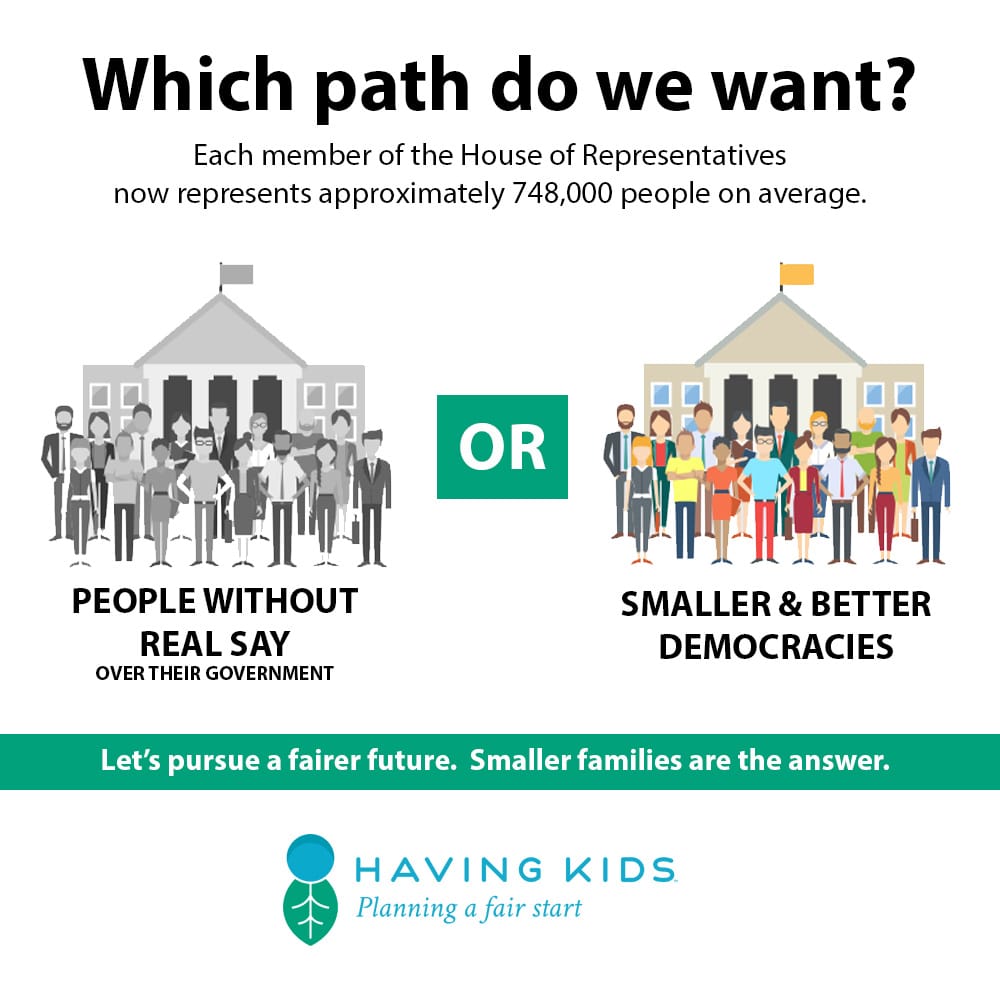
    • If you support organizations promoting human rights and democracy: Do they promote family planning policies that will ensure each person has an effective voice in their political systems and is not lost in the crowd?

    In addition to considering organizations’ current approaches, find out how organizations have historically approached policies for how we should plan our families, and how those positions impacted social and ecological conditions in the world today.

    Changing the way we all plan families is not easy. It requires breaking a taboo and confronting those who benefit from exploiting future generations and nature through unsustainable family planning policies. But there are lots of way to begin.

    Urge any group you support to choose from the actions listed here. Or contact us at info@fairstartmovement.org for more information.

  • The Human Right to Nature: Time for a Second American Revolution?

    The Human Right to Nature: Time for a Second American Revolution?

    Erika Mathews and her daughter Willow are fighting for their right to nature, the fundamental human right for which we should all be fighting in the face of the climate and other ecological crises. They are plaintiffs in a lawsuit currently on appeal to the Ninth Circuit Court of Appeals, challenging the federal government’s actions and inactions that have led to the climate crisis. Having Kids intends to submit an amicus, or friend of the court, brief in the case.

    The case is straightforward: The Declaration of Independence, parts of the Constitution, and the Supreme Court have made clear that there is a fundamental human right to be let alone, or free from others. The Declaration, in particular, talks about freedom as based on Nature. Being in nature, or wilderness more specifically, is the height of that experience, and given that climate change is the greatest threat to nature, climate change is the greatest threat to that right. How can you be free of others without nature? If climate change is a bad thing, what’s the state of affairs we are changing from, and don’t we have a right to that healthy and natural world? Nature is the buffer between us and others – the thing that individuates us.

    And the right to nature is not just part of our legal system. It’s fundamental to the concept of liberty, a necessary condition for any legitimate form of social contract. The right to nature, conceived specifically as a wilderness or regenerative ecological standard, is the highest environmental baseline possible. It’s the gold standard against which any environmental protection efforts must be judged. We are facing the climate crisis and other ecological catastrophes because we’ve failed to protect this right.

    The Trump administration is taking the position that we have no such right, and that they have the authority to exploit and wipe out nature. Is it time for a second American Revolution? How many died to protect freedom in the past? Those opposed to a right to nature are a threat to our freedom, and to our kids’ freedom. Without nature the social contract is over, the deal is off, and we will be subject to the influence of others against our will. Those behind the climate crisis are like foreign invaders threatening us, and the case before the Ninth Circuit will help decide how we deal with them. Having Kids is deeply committed to the case, in part because better family planning is the best way to restore nature, and protect our rights.

    TAKE ACTION: YOU HAVE A FUNDAMENTAL HUMAN RIGHT TO NATURE. The heads of these companies, along with the Trump administration, are violating it. Find and peacefully engage them to change their ways, tell us how you did it, and we will publicize your story. One very effective way for them to change their ways is through funding Fair Start family planning. Having Kids is starting to make the just and morally undeniable demand for those resources. Together we can protect our rights, and ensure freedom for ourselves and our kids.

  • Should Louisiana adopt a “Fair Start” policy like the proposed Colorado Amendment?

    Should Louisiana adopt a “Fair Start” policy like the proposed Colorado Amendment?

    By Timothy David Ray

    Last year, Having Kids proposed an amendment to the Colorado Constitution that would have enshrined into law, policies that reduced inequality of resources and opportunities for all children born in the state, as well as enhanced natural environmental protections to ensure Colorado’s children had access to the rich natural resources of the state’s ecosystem.

    Louisiana policymakers have expressed support for similar policies, or at least the importance of addressing [through the laws] the inequities of children.  Louisiana policymakers have also fought and won major victories to pass laws protecting the state’s vast natural resources; especially along its coasts.

    It is important to note, in Louisiana, political ideologies amongst the two major political parties rarely align when it comes to family planning matters, and the state is deeply religious.  However, support for children’s equity policies have been supported by lawmakers and policymakers across the political and religious spectrums. 

    The Colorado fair start approach would enshrine “ . . . freedom and equality from the moment of birth . . . ” into the Constitution.  The proposed constitutional amendment also places the state’s natural resources in a trust – held by the State – with the goal of protecting them for the “ . . . benefit of present and future generations . . . “

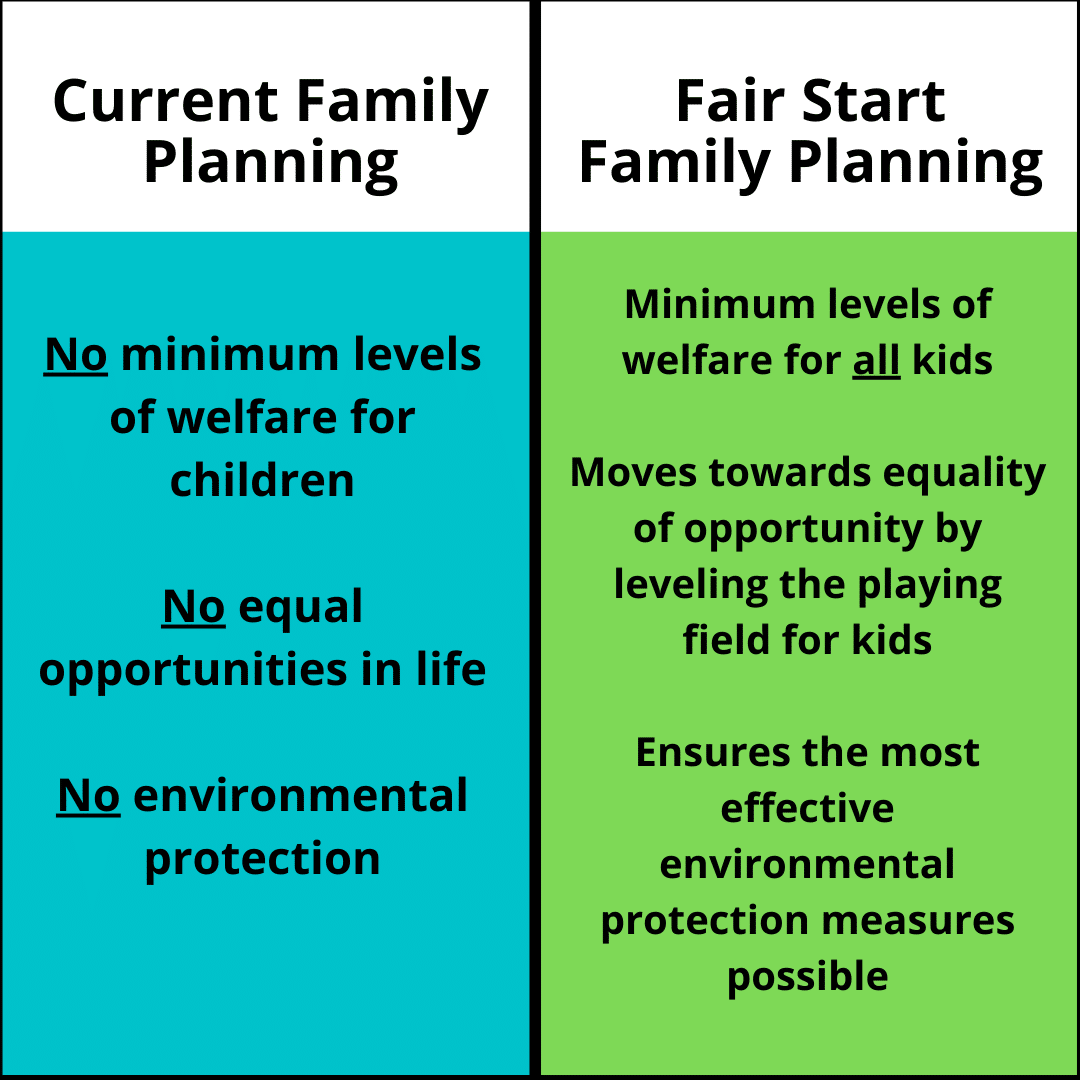
    A comparison chart of Current Family Planning and Fair Start Family Planning. The left side lists negatives: no minimum welfare, no equal opportunity, no environmental protection. The right side lists corresponding positives.

    Perhaps, Louisiana would support a “fair start” plan as a legislative policy if supporters of the policy could unite a coalition of parents, educators, environmentalists, and lawmakers – convincing them of the need to dedicate new laws that would cause a reduction in inequity among children and provide for the protection and use of public lands.

    Louisiana currently ranks last in the U.S. among the best states for children to live, according to a 2020 report from Save the Children.  Among the organization’s recommendations to provide better opportunities for children, they call for governmental investment in the future [lives] of all children:

    “We therefore call on policymakers at all levels of government to  . . . craft strong policies, provide sufficient resources, and create an appropriate regulatory environment for relevant childhood programs and interventions to flourish.”

    As the Colorado Fair Start proposal gains traction, Louisiana must begin rethinking its approach to providing for the fair, holistic, and equitable development of and investment in children. 

  • Want a Fair Start for Kids in Your State Constitution? Colorado Could Be the Beginning.

    Want a Fair Start for Kids in Your State Constitution? Colorado Could Be the Beginning.

    Having Kids is working closely with leaders in Colorado to develop an amendment to the state’s constitution that would guarantee every child a fair start in life, both ecologically and socially. Click below to read the proposal:

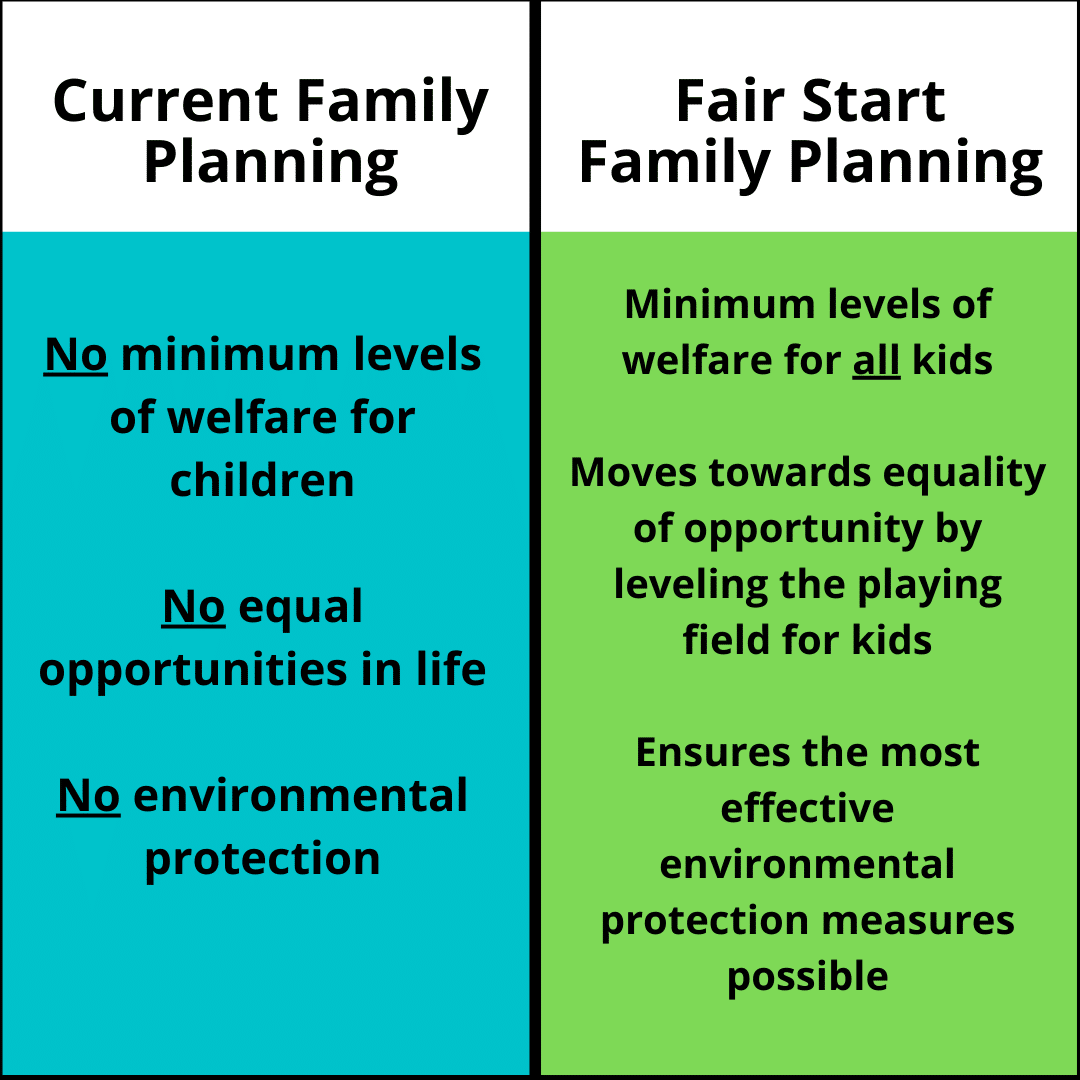
    • Our current family planning systems provide no minimum standard of well-being for future children, allowing children to be born into failing state systems because their parents cannot care for them. That exacerbates inequity and ensures rich kids stay rich and poor kids stay poor. 
    • The United State and much of the world believed that new bodies were needed to produce more labor. This pro-natal, pro-capital belief has created a world in which huge inequities exist. For example, the world’s 2,153 billionaires have more wealth than 4.6 billion people, which is more than 60% of the planet’s population.
    • A recent study from Stanford has found that efforts to mitigate climate change could yield trillions in economic benefits. And the best wayto mitigate climate change is by choosing smaller families. Yes, it’s more effective than changing diet or forms of transportation. 
    • By the year 2100, the world population could vary by billions of people, depending on whether the average woman in the world today has one child more or one child fewer in her lifetime. If the average woman alive today has between 2 and 3 children, the world population will grow to as many as 16 billion by 2100.
    A comparison chart showing Current Family Planning with no minimum welfare, equality, or environmental protection, versus Fair Start Family Planning with welfare for all kids, equal opportunity, and strong environmental protection.
  • Ready for Something Different? Fair Start Concept Changes Everything

    Ready for Something Different? Fair Start Concept Changes Everything

    The impending overturn of Roe. v. Wade has starkly and publicly revealed the new reality facing the United States. The anti-choice, pro-gun, ‘anti-everything-good’ conservatives are playing their hand face up. They have shamelessly stopped pretending to play by the rules and – if you’re listening – they’re telling us exactly what our future looks like. For 99 percent of us, it doesn’t look good.

    The powers that be – mostly old, white, dusty antiques like Mitch McConnell, Eugene B. Meyer, Donald Trump – are climbing the castle walls in their 50-year strategy to cement in place their power and influence. As the world changes around them, as American society embraces all different stripes of people, the old guard conservatives and the wealthy 1 percent are terrified of losing their grip.

    The Fair Start Movement  approaches this fight from a new and different perspective. We believe that: No government, state or federal, has legitimate standing to mandate the birth of every child conceived unless it is prepared to care for those children beyond the birth canal and give them a Fair Start. free from the climate crisis through a return to nature, and free in terms of having an influential role in one’s democracy.

    At this critical crossroads in human history, we must acknowledge that every child born has a right to start out in decent circumstances. We must account for the wellbeing, equity and personal development of future generations if we are to foster a real democracy where each person’s voice matters. We must accept that our current system destroys the environment and does nothing, in fact takes negative action, to mitigate the oncoming crises. 

    We already see progress. Many people agree with our vision and are committed to real, positive change. As we build a truly democratic population, wherein everyone has a voice that is heard, we will move away from the toxic, crumbling society of today. 

    We will honor individual rights and guarantee universal healthcare. We will return to nature by respecting our place in the ecosystem, giving and taking sustainably. We will escape the domination of the selfish, greedy, wealthy few whose plan for the future – assuming they have one – accounts for their survival alone.  

    A comparison chart of Current Family Planning and Fair Start Family Planning. The left side lists negatives: no minimum welfare, no equal opportunity, no environmental protection. The right side lists corresponding positives.

    In the meantime, we must work within the system we have. The State must accept its obligation to invest heavily in common-sense family planning programs and science-based sex ed. Those items alone will automatically lower abortion rates and teach young people the truth about having and growing a healthy family. 

    The State must break its unconstitutional commitment to Christian moral dictates and adopt a reality-based approach to governing. It is absurd and completely unacceptable that 350 million+ people of every faith are governed based on the ethos of bronze-age men. 

    We must shift our paradigm away from the endless-growth-economy fantasy, which demands that mothers continually produce their supply of workers and consumers. Prisoners to boot.

    TAKE ACTION:

    Let’s hold accountable those responsible for the current societal roadmap that pushes the opposite of a Fair Start for our children. Urge any organization you are part of to support and join our Tell the Truth campaign, which would obligate disclosure of this information.

  • Having Kids Urges Federal Government to Prioritize Funding for Male Pill

    Having Kids Urges Federal Government to Prioritize Funding for Male Pill

    The human rights advocacy group Having Kids today urged the National Institutes of Health to prioritize funding and research for male contraceptives like the male pill as a way to improve family planning, and reduce unwanted pregnancies.

    Read our special report, and campaign announcement, here.

    “Having Kids believes that in light of the world’s current population increasing at the rate of 80 million persons a year, and projected to exceed 9 billion by 2050, it is imperative that NIH make research and funding for the development of male contraception an extremely high priority over the next five years,” wrote Katherine A. Meyer, an outside lawyer for the group, in a letter to the National Institute of Child Health and Human Development.

    Meyer noted that while clinical trials of some male contraceptives have shown promise, more research is needed to ensure they are safe and effective.

    “NICHD can play a crucial role in making this a reality,” she wrote.

    The letter noted that groups such as the Population Council and private foundations have funded male contraception research, but can’t afford the large, phase-3 clinical trials required by the Food and Drug Administration. NICHD could give this effort a boost by seeking congressional appropriations for research, and directing current funding toward this clinical research.

    Also today, Having Kids issued an illuminating report and campaign announcement on how federal agencies have failed to take into account population growth when examining the environmental impact of federal actions under the National Environmental Protection Act.

    The report noted that the Council on Environmental Quality, which issues regulations interpreting NEPA, under President Richard Nixon did take population into account. Six months after signing NEPA into law, Nixon said In a letter to Congress that the CEQ “is concerned with all aspects of environmental quality – wildlife preservation, parklands, land use, and population growth, as well as pollution.” Every subsequent CEQ report during the Nixon Administration addressed population in its analysis. But over the last 40 years or so, CEQ stopped identifying population growth as a significant factor affecting the environment.

    Having Kids works to promote sustainable and more equitable families, as a way to help children, restore the environment, and protect animals.

    ###

  • Dear UN: We Can Do Better for Kids

    Dear UN: We Can Do Better for Kids

    Today, Having Kids is calling on the United Nations to back up its commitment to protect children. The international community, including key United Nations agencies, requires minimum standards of care for children. But we don’t apply those same standards in family planning models. Why not? Could we afford to do that, through future child entitlements, if we promoted a universal ethic of sustainable families and shifted the savings? We think so. Help us urge the UNFPA and UNICEF to consider the change. Here’s what we sent to the UN:

    Dr. Natalia Kanem

    Executive Director

    United Nations Population Fund

    605 3rd Ave, New York, NY 10158

    Henrietta Fore

    UNICEF House

    3 United Nations Plaza

    New York, New York 10017

    Dear Directors Kanem and Fore,

    Having Kids is nonprofit organization dedicated to replacing subjective and parent-focused family planning models with the human rights-based and child-focused Fair Start model. We and other organizations have asked the Secretary General of the United Nations to speak out on the need for better family planning models that focus on delay, cooperation, and families that invest more in each child.

    As the impacts of the climate crisis manifest, and studies confirm that simply improving access to family planning services will not accomplish what was previously predicted, there is an urgent need to revisit the ethical models that underlie and drive family planning laws, policies, funding, etc. Can we do better than treating the act of bringing a child into the world as a matter parents decide in isolation from their community? We think so.

    The best reading of the Children’s Rights Convention is that it prohibits children from being born into conditions the Convention is attempting to reform. Preventing violations of the rights of future children, while respecting the rights of intending parents, requires something more internationally cooperative than a model where parents are walled off from others in their decision to have children.

    We believe Fair Start modeling provides one cooperative path forward, and that public statement by the UNFPA and UNICEF regarding changing  the underlying ethical modeling is the necessary first step. We believe it  open the door for things like family planning delay and relocation payments, which under new modeling are more akin to entitlements for future children than incentives for parents.

    More specifically, we are urging you, as heads of the key international organizations responsible for shaping family planning modeling, to speak out about the need for a universal ethic of sustainable families who cooperatively work together to give every child a fair start in life. New modeling, which would require explicitly abandoning old modeling that treats family planning as a matter of parental privacy or autonomy, could be the most effective solution to many of the crises facing the world today.

    A child-first model, based on giving all kids a fair start in life, would advance all 17 of the U.N.’s Sustainable Development Goals. The following is a framework for a possible statement:

    The responsibilities referred to in the ICPD Programme of Action ensure progress toward the Sustainable Development Goals and the goals of the Convention on the Rights of the Child. Helping parents fulfill those responsibilities could be achieved though policies that, without discrimination or coercion, 1) encourage prospective parents to delay parenthood, 2) encourage communities and their governments to ensure all parents the resources they need to give their child equal opportunities in life relative to other children, as well as 3) encourage prospective parents to choose a sustainable family so that they can invest more time and resources in each child.

    We believe new family planning modeling could save countless lives.

    The international community, including key United Nations agencies, requires minimum standards of care for children. But we don’t apply those same standards in family planning models. Why not? Could we afford to do that, through future child entitlements, if we promoted a universal ethic of sustainable families and shifted the savings? We think so.

    Thank you for considering our request.

    Sincerely,

    The Phelps-Mathews Family
    The Phelps-Mathews Family

    Erika and Willow

    Executive Director of Having Kids, and her daughter, age 11

    Having Kids is a 501(c)3 nonprofit nonprofit organization dedicated to reforming family planning by replacing parent-centered family planning models with the human rights-based and child-first Fair Start model.

  • Having Kids Calls on Congressional Leaders to Prevent Child Abuse

    Having Kids Calls on Congressional Leaders to Prevent Child Abuse

    Today the national child-protection organization Having Kids called upon the leaders of the Senate Committee on Health, Education, Labor and Pensions to amend the Child Abuse and Prevention Treatment Act (“CAPTA”) to require states to enact legislation that allows judges to prohibit offenders convicted of certain felonies from having children as a condition of probation.  CAPTA allows states to apply for federal grants for child abuse prevention and treatment programs but also enumerates certain “eligibility requirements” that each state must comply with in order to receive funding.

    Read the full letter here.

    Having Kids’ proposal seeks an amendment to Section 106 of CAPTA to include, as funding eligibility requirements, that a state have Fair Start order legislation enacted.  Such legislation would, in the event of a conviction, temporarily prohibit an offender from having additional children during the pendency of any probation in order to prevent the abuse and neglect of any future children.  While the Congressional Findings from the CAPTA Reauthorization Act of 2010 hold that “substantial reductions in the prevalence and incidence of child abuse and neglect and the alleviation of its consequences are matters of the highest national priority,” national statistics from the past 5 years show that the epidemic of child abuse and neglect in the United States is not improving.  In 2016, there were an estimated 676,000 children across the country who were victims of abuse and neglect, up 3% from 2012.  The number of child fatalities that were the result of abuse and neglect steadily rose each year with 1,750 fatalities in 2016 versus 1,640 in 2012.  That is approximately 5 children dying every day in the United States as the result of abuse and/or neglect.

    “We believe that in order to truly make an impact in the prevention of child abuse, we must ensure that children are not born into potentially life-threatening situations,” said Anne Green, Executive Director of Having Kids. “It is a matter of national importance that we not only take care of abused children after the fact but do all that we can to prevent the abuse from happening in the first place.”

    Take action:
    Email the senate committee members and tell them that you support Having Kids’ proposal for a Fair Start amendment to the  Child Abuse and Prevention Treatment Act.

    Email Ranking Member senator Patty Murray