While many nations’ constitutions are clear in protecting the property rights of the wealthy, they are less clear in protecting the nature we and future generations need to thrive. That’s a mistake.
Given that humans need nature to survive, we have a right to nature’s restoration and protection. A lawsuit in the United States is making that case, and will be heard in 2021.
Solving the baseline problem will allow us to trace these calamities — like the unfolding death of the Great Barrier Reef — and help us back to an ultimate source, and, perhaps, to a solution. We can no longer use a baseline for environmental policy that treats nature or the nonhuman world as a human resource. This is the baseline most environmentalists use, and the one that created the Anthropocene era in which we find the world today. A much higher baseline would view nature as something that ought to be a nonhuman habitat or the homes of sentient species who have a right to survive and thrive. This would be a restorative baseline, and the one more consistent with animal liberation. Such a baseline would be most protective against things like climate change and the pandemics it drives. A policy based on this baseline would revolve around ensuring our children have the only environment proven — over millennia‚ that allows humans and all species to thrive. It would seek to eliminate the way the absence of nature in our lives is degrading our psyches.”
How many other animals in total – farmed, wildlife, animals in research, etc. – die to support the current lifestyle of a human individual?
The answer is that we don’t really know. Fair Start aims to find out and, in partnership with several researchers, is engaging in a new research project that hopes to tell the truth about our existential relationship with other animals. Here is some of the background:
For survival, humans depend completely on Earth’s ecosystems and the services they provide us, they are also called ecosystem services. These include the production of healthy air and water, food, medicines, disease management, removal of toxins, building materials, fuel, climate regulation, buffering of storms, spiritual fulfillment, and aesthetic enjoyment. Ecosystem services are primarily provided by the activities of biotic flora and fauna interacting with nonliving (abiotic) elements in nature that provide the nutrients and minerals to support a planet once teaming with life.
Today, we have entered a period of mass extinction that rivals the extermination of the dinosaurs and 76% of life on Earth. However, unlike past extinction events caused by natural global pulses, our species has already caused the extinction of nearly 60% of assessed vertebrate populations and these trends are accelerating (WWF, 2016). Beyond the massive loss of species and wildlife populations, the abject suffering that humans are causing on the planet is significant. These human-induced adversities should not be assumed inevitable, and are due to human psychological shortcomings that can be remedied through equal access to information, resources, and security.
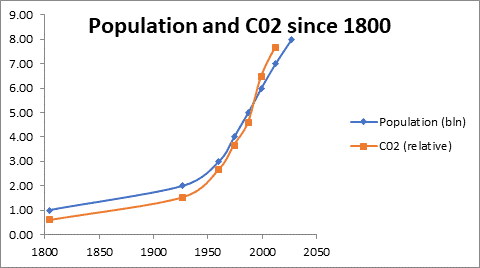
The vast and detrimental changes to Earth’s ecosystems are largely to meet rapidly growing human demands for food, fresh water, timber, fiber, minerals, and fuel at levels that are unsustainable and based on irresponsible human overpopulation, consumption and false-dependency on economic growth (Global Humanitarian Forum, 2009; Millennium Ecosystem Assessment, 2005; WWF, 2014; 2016). Although our demands on Earth’s ecosystems have led to substantial gains in human physical well-being and economic development for a few, the long-term costs are now being observed in the forms of climate change, habitat destruction, pollution, disease, war, displacement, hunger, and mass mortality in humans and nearly all other life forms (e.g., Ceballos, et al., 2015; Cohen, et. al., 2017; Dockery & Evans, 2017; Raworth, 2012; Rockstrom et al., 2009).
We now know that we as a species have so degraded and destroyed parts of our life-support system that our health, well-being and survival as a species is threatened and a sharp unplanned decline in our population has become very probable. It is increasingly clear that environmental problems cannot be resolved through technical solutions alone and that these ecological issues are forcing us to rethink what development and progress means, and to consider the size and activity of our population with new urgency (Hickey, Rieder & Earl, 2016). These threats are not as new as some might think, with one of the most prominent calls to action coming from the Limits to Growth studies, first published in 1972 (Meadows, Meadows, Randers, & Behrens, 1972).
Additionally, destruction and despoliation of the environment has not happened in a vacuum, nor with only the suffering of our species as collateral damage. At no time in human history has the suffering and death of other species been so numerous, prevalent and profound. Much science has come forth to successfully quantify and describe the sentience of nonhuman animals with whom we share Earth (e.g., Bekoff, 2006; Darwin, 1998; Fossey, 2000; Goodall, 2000; Griffin, 2001; Marino & Allen, 2017; Masson & McCarthy, 1996; Moss, 2000; Poole, 1998, Shanor & Kanwal, 2011). Recently, insects have been shown to have emotional states not different from our own (Paul & Mendl, 2016; Perry, Baciadonna & Chittka, 2016). Logic, therefore, would dictate that, like humans, other species suffer needlessly and we have a moral obligation to reduce and alleviate such trauma, much of which is caused by nonessential human behaviors.
The enormity by which humans torture and kill other animals is indefensible. The numbers in a single year are in the billions in the U.S. alone. If human nonessential activities were killing billions of humans each year, it would be considered apocalyptic on an unprecedented scale. Here is a breakdown of some of the data. Cows: 30.6 million adults; 487,700 calves (USDA, 2017) Pigs: 118.2 million (USDA, 2017) Sheep and Lambs: 2.24 million (USDA, 2017) Chickens: 8.9 billion (USDA, 2017) Wildlife: Diffuse numbers, but just one example is 3.2 million killed intentionally in
2015 by the U.S. government, primarily to serve the interests of the livestock industry and agribusiness, that serve the consuming public (USDA, 2016). Other significant numbers are killed every year as “road kill”, by hunters, captured to serve as pets, die due to pollutants, habitat destruction, and more.
While the sharing of the numbers of animals used in animal agriculture may appear out of step with our current mass extinction event and environmental harms, animal agriculture has been found to be the second largest contributor to human generated greenhouse gases and the leading cause of water and air pollution, deforestation and biodiversity loss (Koneswaran & Nierenberg, 2008). Therefore, the suffering and killing of nearly 70 billion animals in agriculture per year, literally leads additionally to the suffering and death of countless wild animals and the deterioration of the natural environment.
About the Animal Mortality Calculator
The objective of this project is to develop the algorithms to calculate the average number of animals that die to support the lifestyle of one human individual. This calculation will serve as a basis for an educational tool of the organizations, Fair Start and the Institute for Human-Animal Connection to garner further support from people everywhere for the responsibility to protect other species. A consideration for animal protection that has largely been avoided is the fact that a decreasing and healthy human population is the best protection for all animals, including humans.
A key behavioral objective of this project is increased support of the Fair Start Model (Fair Start , 2016) by animal advocates and the general public through recognition that continued human population growth means more suffering and loss of life of other species with eventual ecological and industrial collapse, and that we have choices on limiting personal family size. The magnitude of the issues humans have caused and now face today can be psychologically overwhelming, therefore the provision of solutionary pathways for our species is of utmost importance to deflect the development of apathy and avoidant tendencies. This project will also result in multiple scientific publications in peer-reviewed scientific journals.
Informing Family Planning
Thoughtful parents are concerned about the world in which the next generation will inherit and inhabit. Jessica Blome, a mom from California shared her thoughts:
“When I thought about starting a family, I sought advice from family and friends, discovered the world of mommy blogs, considered the latest parenting trends, and consulted with my healthcare provider. My husband and I researched the costs of childcare and education. We questioned whether we would be able to balance work and family. We wondered how to best position our child, so she could get into the best schools, what kinds of opportunities or barriers she would face when she grew up, and what her world will look like when she does. And when we got pregnant, we hoped our daughter would be able to enjoy nature, appreciate non-human animals, and live in a healthy environment.
As my daughter makes her way through primary school, I wonder if I truly understand how my family planning choices impact the environment, animals, and nature. What am I doing to make it more or less likely that my daughter will live in a thriving, healthy environment, free from cruelty to all animals? If that were something I could know, I’d want to know. Should we all want to know? Wouldn’t we add that calculation to our list of considerations before having a family and while raising children?
Seeking protection for non-human animals and our planet is not in opposition to having a family. The Animal Mortality Calculator has the potential to inspire parents like me to plan families that reduce the human impact on farmed animals and ecosystems while creating a sustainable future for all children.”
Interested in assisting with this project? We are seeking researchers and modelers. Email us at Ashley@faairstartmovement.org for more information on funding, volunteer, and other opportunities.
Social movements that try to protect kids, animals, the environment, and democracy tend to see themselves as distinct, and even conflicting. That’s a huge mistake. The most impactful way to further the core missions of all movements lies in making a simple change: Restructure family planning policies, universally, by 1) promoting delayed parenthood, so that people are ready to actually parent, 2) prioritizing giving all kids a Fair Start in life in any political system of resource and stakeholder redistribution, and 3) encouraging smaller families for all, something which helps enable and pay for the first two moves.
So who would be oppose this transition? Big business and big government both thrive on poor family planning, because it creates a wave of consumers, cheap future labor, and taxpayers. Both use growth to increase and concentrate their power, at cost to the development of individuals, real democracy where every voice matters, and nature. The solution? Social justice movements can unify against these concentrations of power, finding reasonable allies on both the political left and the right, who want effective reform that furthers our widely shared values, the decentralization of power, and our actually reaching sustainable development goals. Want more information? Our peer-reviewed white paper on family planning reform can be found here.
Want to help with this unification of social justice movements against the concentrations of power? Please consider donating to HavingKids.org, or signing up to volunteer at info@fairstartmovement.org.
The most effective way to protect children, animals, our environment, and equality is by changing from family planning policies that focus on what parents want to policies that ensure future children what they need, both ecologically and socially.
The sooner you speak out, the better our and our kids’ future will be.
There are massive advantages to planning smaller and more equitable families.
It enables greater empowerment for women, more individual attention and more resources invested in each child, greater achievement in school, and more engaged, less crowded communities. But most importantly, research indicated that smaller families are better for kids. Smaller families also leave time, energy and resources for parents to invest in their community, and to ensure that the world their children will inherit is better and more equitable than the one we experience today. This list is by no means exhaustive. The bigger picture is that families and communities benefit. Read more reasons to have a small and more equitable family.
Have you chosen to have just one or two kids? Send us a video and tell us why. Email info@fairstartmovement.org
The voices of animal-rights advocates have become more prominent in social justice circles, and The New Republic magazine recently pondered whether animal rights is the next frontier of the left. It’s inescapable, the argument goes, because animal rights overlap with other key elements of the progressive agenda, including environmental protection, social justice, the ravages of capitalism, and more. But loud voices are often misleading.
Over the past several decades, the extent to which humans are driving animals into extinction, consuming them through massive factory farms, and experimenting on them in research labs has only skyrocketed.
Why? Because poor family planning has driven an explosion in human population over the past several decades. In that time, billions more of our species has overrun, tortured, and destroyed other species. And while many animal protection organizations raise money through claims of success, we have all failed animals if we haven’t accounted for the overwhelming negative impact of humankind’s poor family planning policies.
What can we do to change course and create real success?
The first step entails reenvisioning animal rights and liberation in terms of the most aspirational versions of those concepts. Animals have a right to live and develop autonomously in the nonhuman world, truly liberated from human oppression. To ensure that requires universal family planning reforms that promote smaller and more equitable families for all of us. These reforms will leave room on our planet for nonhumans and will ensure the high levels of empathy in future generations that nonhumans need us to have in order to live and develop. That constitutes true animal rights and veganism. Veganism is not just another way to be a consumer. It’s the natural evolution of a truly inclusive form of social justice that marries animal, environmental, and human rights by moving from archaic and divisive approaches that involve welfare and aesthetics to a unifying approach that focuses on the simple limitation and decentralization of human power.
One of the best parts? These policies are a win-win for humans as well. They ensure greater investment in each child, finally achieving the human-rights ideal of fair starts in life for all, smaller and truly democratic communities where each voice matters more, and the highest standard of environmental protection possible. Now that’s effective altruism. Had early animal-rights advocates insisted we protect nonhuman autonomy and treat the environment more as a nonhuman habitat than as a human resource, we could have avoided the climate crisis.
Want to help animals? Go beyond being a consumer in a humanized world. Focus on the people with whom nonhumans will interact. Lock arms with other social justice movements that protect future children, equity, and the restoration of nature. And bend the qualitative arc of our species’ growth trajectory to liberate humans and nonhumans at the same time. Envision a better future — and focus on family planning reform to build it.
Take action: If you support an animal protection organization, ensure that it signs this simple letter to United Nations Secretary-General António Guterres urging him to adopt Fair Start family planning reforms as essential to the international bill of human rights. If the organizations you support do not publicly take a position on family planning reform, ask them why not and urge them to. There is no legitimate form of animal protection that would allow our species to overrun all others.
In a recent piece, The Guardian and George Monbiot do right by at least discussing family planning, the fundamental driver of our ecological and social crises. But they miss the mark by using their pulpit to demonize and exclude those focused on family planning reform, as opposed to unifying environmentalists, and offering ways for anyone who cares about our future to work together on the most effective changes.
This is not in dispute: People cause anthropogenic impacts, and people don’t fall from the sky. In the case of the climate crisis, choosing one child fewer has 20 times the impact of altering one’s diet. In the mid- to late 20th century, world leaders and environmentalists made a gamble that family size would fall quickly enough to evade catastrophe. All of us, including George, were wrong. Our children will suffer for that mistake.
What’s the solution now? The right to have children is universal, but properly interpreted, it has to orient from what future children need more than what intending parents want because future children have the most at stake. In other words, social justice and the constituting of just societies has to start at the beginning by prioritizing a resource distribution that incentivizes smaller and more equitable families. We can start by targeting the industries most responsible for the crises to pay what they owe. Making that one change in our family planning systems, and quickly employing policies that give all kids a fair start in life, is the way to be most effective and to unify family planning and equity. And we can do that by starting at home, as Meghan Markle and Prince Harry have done by choosing a smaller family and speaking out.
Yale Climate Connections is a crucial media service for understanding the greatest environmental threat facing our species. But a recent article may have missed a key opportunity to further that understanding. The article involved an interview with fertility coach Elizabeth Bechard, and focused on the connection between family planning and our ecological future. Bechard, whose profession involves people having kids, gave this advice:
I personally have, I guess, a spiritual framework that helps me to trust that there’s more going on than meets the eye, and I believe at a spiritual level that the children who come through are souls that chose to be here. And so, you know, if someone deeply desires a child, I would say listen to that.
Is there better advice we can give prospective parents who want to protect their kids’ future? The key lies in Bechard’s own decision not to have a third child, for ecological and other reasons. Choosing a small family is the most effective thing one can do to mitigate the climate crisis – twenty times more effective than other lifetsyle changes like changing one’s diet. And if we go one step further, and collectively shape our family planning polcies around equity, and the distribution of resources that would give every child a fair start in life, we can effectively reverse many of the other crises facing our kids.
If we really care about our kids’ future, shouldn’t we do what is most effective?
TAKE ACTION: 1) Urge Bechard at elizabeth@elizabethbechard.com to tell the truth about the connection between family planning and our shared future, and 2) tweet the Editor of Yale Climate Connections, @bud_ward, and urge him to ask the questions that really matter for our shared future.
Having Kids researchers recently published an article in Animal People Forum.
The thesis: How could there be a coherent conception of nonhuman rights that does not account for the creation of the humans that torture, consume. and drive nonhumans into extinction? It’s hard to see how that would be possible.
Instead, animal rights would have to start with some assessment of what the existential relationship should be between humans and nonhumans. When we engage in that assessment we find that compassion for nonhumans and humans align, and that compassion counsels us to create smaller human families, invest more in each child using equity as our guidestar, and use all means effective to dentralize bloated nation states and massive monopoly corporations into smaller democratic communities comprised of highly empathetic people capable of actual self-rule. Read the full Animal People Forum article here.
The BBC recently reported on who might be held responsible for the climate crisis and why that matters. Writer Jocelyn Timperley acknowledges that human activity causes climate change and argues that identifying the prime sources is essential to proposing solutions. She examines the blame that might be assigned to fossil fuel companies, rich people, or wealthy countries.
But the article never mentions family planning and population, even though that is a fundamental driver of the climate crisis, with larger families in wealthy countries creating 20 times the impact on the climate by having children than they do with their other choices or behaviors such as energy consumption. Every one of the causes the article cites depends on population and related factors such as consumer demand. And population, or who we are and who we will be, ultimately flows from universal norms we create. In other words, we exist before we consume, and who we are flows from the norms that surround procreation. So who is fundamentally responsible?
TAKE ACTION: Contact the head of the BBC, or find and engage him in person, and urge comprehensive reporting regarding a threat as serious as the climate crisis.