Category: Media Critique & Fact-Checking

  • Fact-checking Harvard: How Do Family Policies Undo Its Claims?

    Fact-checking Harvard: How Do Family Policies Undo Its Claims?

    Harvard President Larry Bacow says that Harvard is committed to confronting the climate crisis. Harvard fundamentally built its wealth and prestige on an unsustainable system of growth – family policies – that externalized their costs on others and did nothing to protect nature from the Anthropocene. Is Harvard reversing its position on those family policies? Is it employing a restorative standard for climate mitigation? It is pointing the world towards optimality, or growth that will multiply unforeseen threats – the very thing that happened with greenhouse gasses?

    If Harvard is not changing course on family policies Bacow’s statements are misleading, with growth remaining the fundamental driver of the crisis. You cannot make any claim of a policy impact that does not start with, and become fundamentally contingent upon, people and the family policies that create them. And in a democracy, those people – comprised as relatively self-determining – are the baseline to assess costs and benefits.

    The same questions can be raised with Harvard’s recent purported commitments to racial justice, child welfare, animal rights, or human rights and democracy. Is it embracing redistributive policies that eliminate the massive birth-wealth gap between black and white children? Does it apply the Children’s Rights Convention as a standard for family planning? What is it doing to prevent our species from overrunning and eliminating others? Growth and inequity have ensured the average person will have little if any impact on their systems of governance. Is Harvard reversing that process?
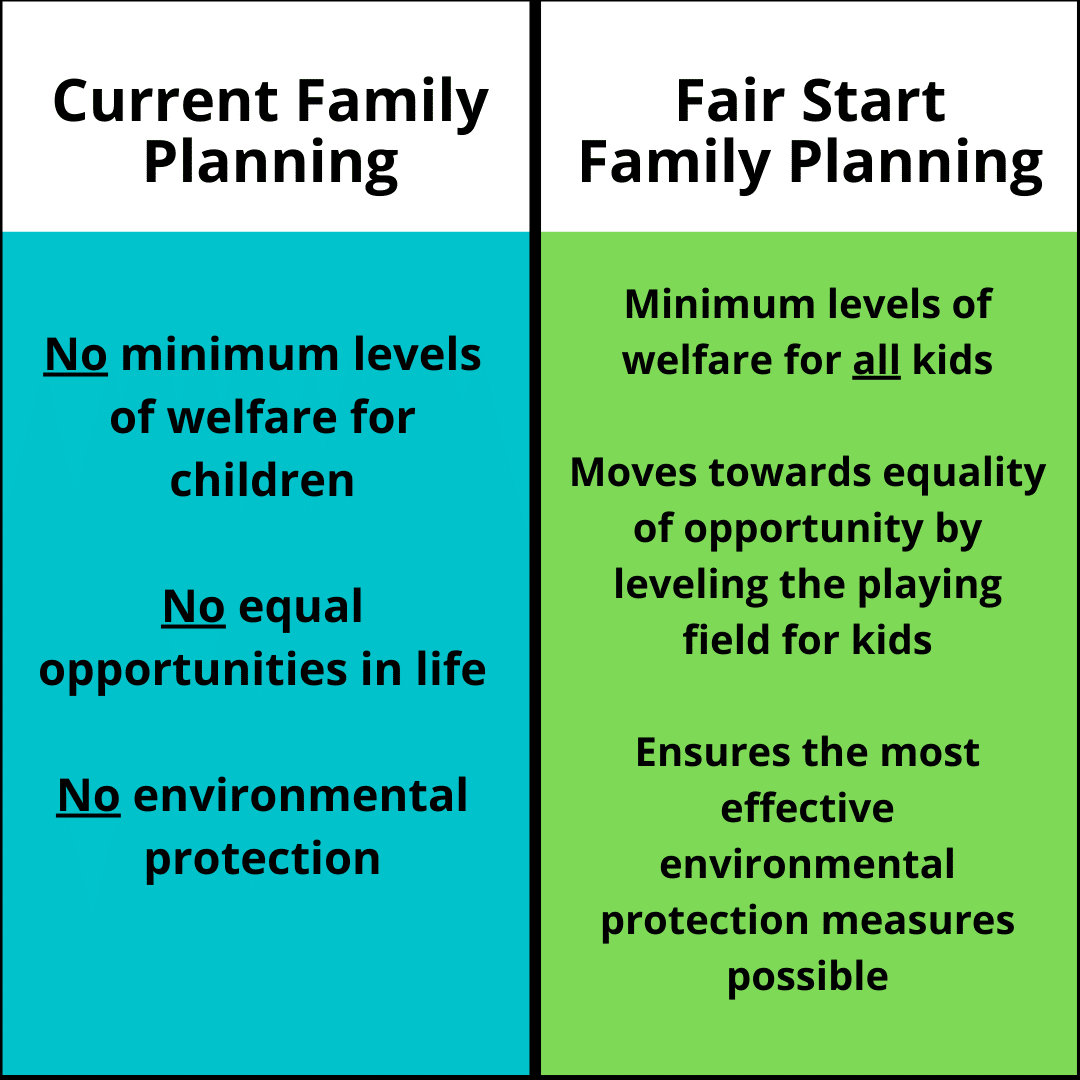
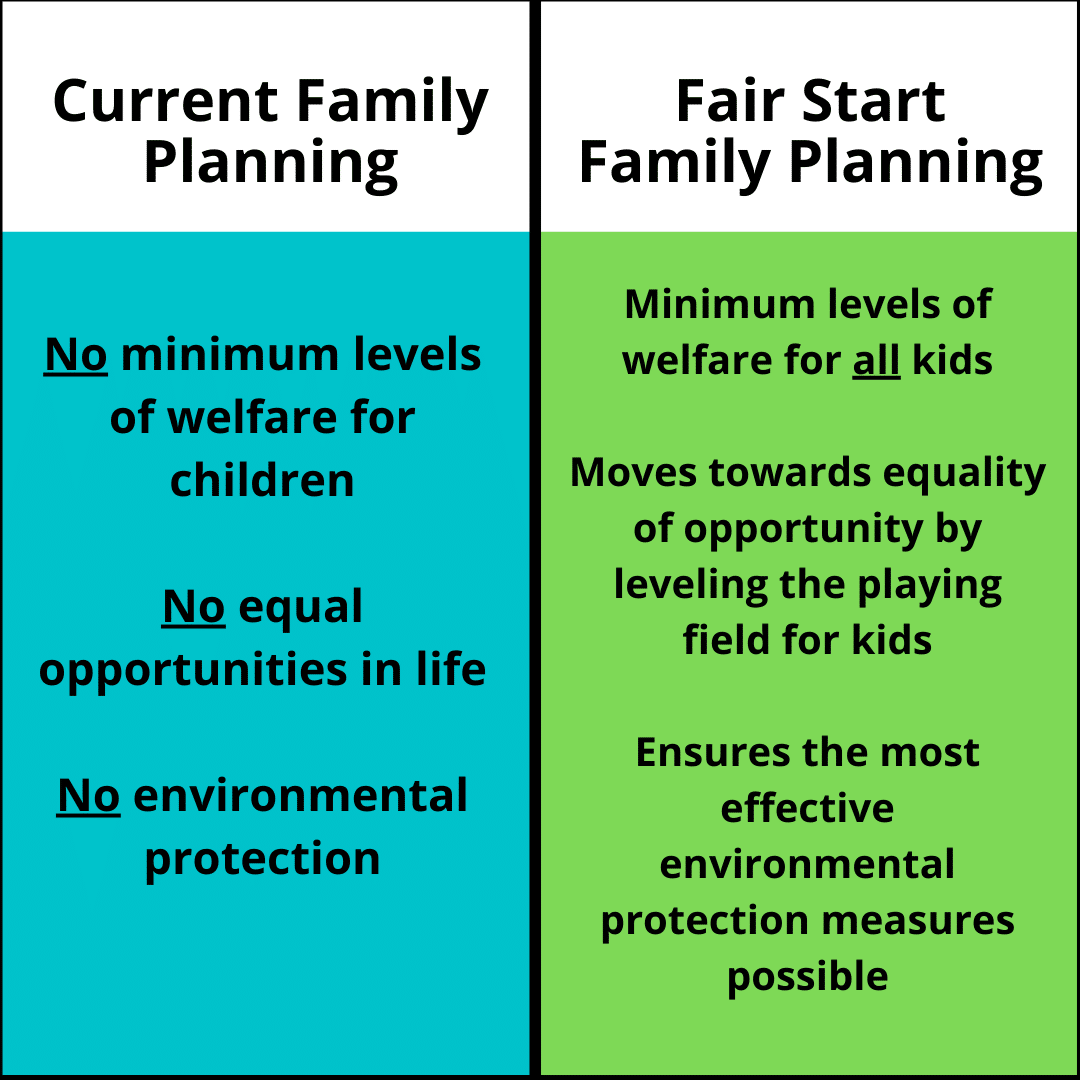
    A comparison chart of Current Family Planning vs. Fair Start Family Planning. The left side lists negatives of current planning; the right side highlights positive outcomes of fair start planning for welfare, equality, and environmental protection.
    Source: A Human Rights Approach to Planning Families – Matthew Hamity, Carter Dillard, Sarah M. Bexell, Catharina Graff-Hughey, 2019 (sagepub.com)

    Quietly undoing downstream fixes with upstream anthropocentric growth and birth inequity is disingenuous, has concentrated power in a few, and foisted social and ecological costs on others. Harvard is one of those concentrations. The family policies it tacitly accepts, which pretend that our social and ecological positions are a matter of some magic fortune, are the fundamental source of injustice. The greatest act of justice, for the vast majority who will live in the future, means recovering those costs and using the wealth to plan just and sustainable families where power is physically limited and decentralized.

    Urge Larry Bacow to tell us all the truth about these matters. Contact him here:

    617 495 1502
    Email: president@harvard.edu

    We cannot afford to lose ground on these issues having missed the fundamental driver and allow concentrations of wealth and power to use people to further exacerbate power differentials.


  • Ezra’s Dilemma: Vox Is Pushing Women to Have Kids, Which Accelerates Species Extinction and Expands Factory Farming

    Ezra’s Dilemma: Vox Is Pushing Women to Have Kids, Which Accelerates Species Extinction and Expands Factory Farming

    [et_pb_section fb_built=”1″ _builder_version=”4.16″ global_colors_info=”{}”][et_pb_row _builder_version=”4.16″ background_size=”initial” background_position=”top_left” background_repeat=”repeat” global_colors_info=”{}”][et_pb_column type=”4_4″ _builder_version=”4.16″ custom_padding=”|||” global_colors_info=”{}” custom_padding__hover=”|||”][et_pb_text _builder_version=”4.16″ background_size=”initial” background_position=”top_left” background_repeat=”repeat” global_colors_info=”{}”]

    Ezra Klein has a dilemma.


    Vox Media reports responsibly on the horrors of factory farming and the climate crisis but openly pushes women to have more kids as a means of creating economic growth. They do so through their tax policy promotions, the work of Matthew Ygelsias, articles denying the science of population and climate, etc. It’s the same approach used by Donald Trump and many right-wing politicians who think of future generations as numbers to inflate the economy, rather than as children who all need a socially and ecologically fair start in life.


    Factory farming and every other animal and environmental crisis is fundamentally driven by human population growth. While Peter Singer is often credited with advancing the philosophy of animal rights, Paul Ehrlich probably did more to actually mitigate animal suffering and extinction through his influential work to slow population growth. Animal liberation, ours and nonhuman, begins with a family planning ethic that promotes sustainable and more equitable families who build empathy and fluid democracy in future generations. It’s not whether we talk about animal rights — it’s how we actually influence nonhumans and their worlds.


    Vox’s “women should have more kids” reporting is slanted, exacerbates the greatest factor driving the climate crisis, and hurts animals. Vox should recognize that any economic growth is first contingent on human rights compliance, which requires more equitable and sustainable families that invest heavily in each child. The human rights regime envisions a future filled with town halls where everyone has a voice, defined by nonhuman habitat. It does not envision a world where the average voice is lost and nature is paved with shopping malls where consumer freedom has replaced political freedom.


    Take Action:


    Learn more about why social justice for all starts with family planning reform and urge Editor Lauren Williams (@laurenwilliams) and Ezra Klein (@ezraklein) to support Fair Start sustainable family planning policies, and to stop pushing women to have kids.


    Also, urge Cory Booker to adopt family planning reform as key aspects of his opposition to factory farming and his support for guaranteed minimum income for children.


    [/et_pb_text][/et_pb_column][/et_pb_row][/et_pb_section]

  • Four Key Questions for Nonprofits or Foundations You May Support

    Four Key Questions for Nonprofits or Foundations You May Support

    Solving the biggest problems we face, from the climate crisis to growing inequality, requires effective action. There is no way to be truly effective without planning ahead and adopting family planning policies that invest more in kids and restore nature. Here are some vital questions to ask groups you might be supporting:

    • If you support a child welfare organization: Does it urge communities and parents to ensure minimum levels of welfare for kids, before they are born, in order to avoid less effective interventions later in life?
    • If you support an environmental or animal protection organization: Does it promote sustainable families, by far the most effective way to ensure a healthy environment, biodiversity, and less animal suffering?
    • If you support social justice organizations working on racial, economic, gender, or other forms of equality: Do they promote family planning policies that a) level the playing field for all kids so that they truly have equal opportunities In life, and b) advance gender equity by eliminating all forms of pronatalism, or pushing people to have kids?
    • If you support organizations promoting human rights and democracy: Do they promote family planning policies that will ensure each person has an effective voice in their political systems and is not lost in the crowd?

    In addition to considering organizations’ current approaches, find out how organizations have historically approached policies for how we should plan our families, and how those positions impacted social and ecological conditions in the world today.

    Changing the way we all plan families is not easy. It requires breaking a taboo and confronting those who benefit from exploiting future generations and nature through unsustainable family planning policies. But there are lots of way to begin.

    Urge any group you support to choose from the actions listed here. Or contact us at info@fairstartmovement.org for more information.

  • Fact Check Your Charities

    Fact Check Your Charities

    Don’t get scammed.

    Fact check your charities to see if growth is undoing their progress. Nonprofits that claim to help children, animals, the environment, as well as human rights and democracy, are obligated to account for the impact of poor family planning and unsustainable population growth on their missions and strategic progress.

    Many organizations are moving in the right direction of family reform. Why? Because the impact of family planning determines all progress. If charitable outcomes depend on people, they depend on family planning policies.

    But not all charities are being truthful. Some ignore growth impacts because their funders rely on population-based economic systems, though that growth fundamentally created the climate crisis and is setting back success in moving towards sustainable development goals. Or funders often want to avoid paying to change family systems to give all kids a fair start in life, and instead choose to give their own children a massive head start in life. By evading the key or fundamental issue of growth, and forestalling policy reforms, many nonprofits helped exacerbate the climate crisis.

    Many charities that make claims regarding helping children, animals, the environment, as well as furthering human rights and democracy, are seeing their progress undone by growth. More children are being born into horrible conditions than are being saved from them. More animals are dying from increased demand than are being liberated. And both our environment and our democracies are degrading because of that same growth.

    Downstream measures do not offset this.

    Infographic showing CO2 savings from various actions. Have one fewer child saves 58.6 tonnes per year, much more than others like living car-free (2.4), avoiding flights (1.6), recycling (0.21), and eating plant-based (0.82).

    Work upstream

    Fair Start family reforms are the most just and effective way to protect children, animals and the environment. Join our Tell the Truth campaign urging corporations and charities to disclose their family policies, past and present, and the impact of those policies on things like inequity and the climate crisis. 

    This is the scam that created the crises: That the act of having children, the base “we” from which all our language proceeds, should be determined by top-down parental autonomy rather than bottom up, and future child-centric, justice. No other form of justice, or freedom, precedes this. That kind of justice – and the emancipatory freedom that comes with it – is existential, requiring minimum levels of welfare approaching birth equality (eliminating the black/white birth wealth gap), an effective voice in democracies where each voice matters, understanding efficiency as starting with maximizing each person’s capacity to flourish, and the restoration of the nonhuman world or nature.

    It’s a lie that we are politically obligated to follow laws and to play fair – without having been created fairly. We can’t be created in that way until we de-appropriate the most vulnerable and numerous groups of entities: future generations and the nonhuman world. And that depends on how we plan families and have kids.

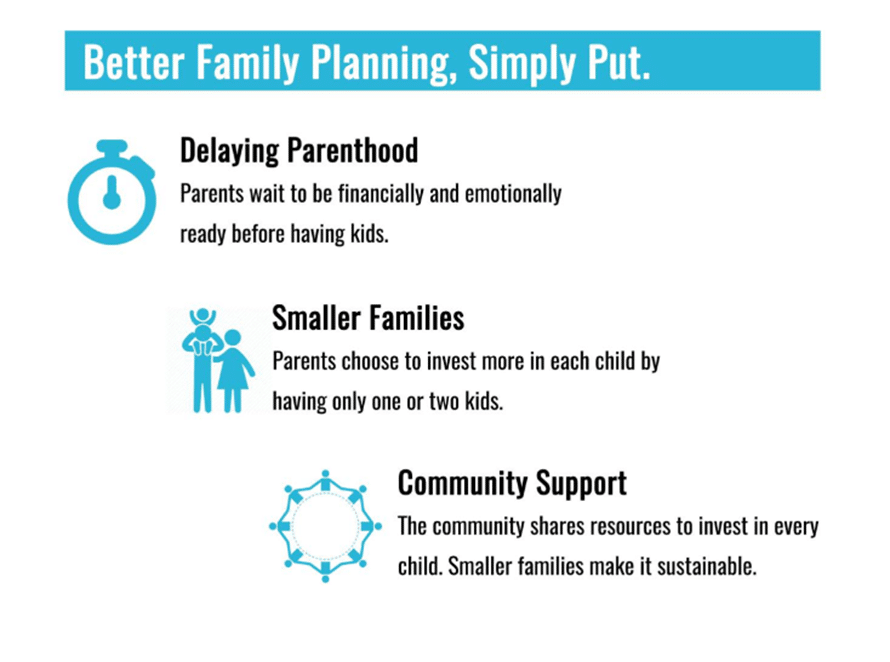
    Infographic titled Better Family Planning, Simply Put with icons and three points: Delaying parenthood, smaller families, and community support, each explained with brief text and blue graphics.

    Act effectively

    It’s time to apologize to younger generations and act effectively. How do we actually ensure an ecosocial fair start in life for every child? The science is clear: Equitable family entitlements that encourage delayed parenthood work. But instead of going forward into future generations – into women and children – wealth has historically gone into the hands of a few at the top, though there was easily enough wealth available to prevent the crises we are experiencing today.

    Instead elites in each nation hid the complexity of power behind shell legal systems, never paying the full price of freedom. To make the change towards justice we will have to create enough demand to take the wealth back for women and children. We can’t solve problems without also empowering future generations to constitute as free and equal people. 

    This is not about population – it’s about initial and fundamental power relations. Help us bend the arc of who we become towards freedom and justice.

    A comparison chart of Current Family Planning and Fair Start Family Planning. The left side lists negatives: no minimum welfare, no equal opportunity, no environmental protection. The right side lists corresponding positives.
  • 10 Guides for Effective Nonprofit Management

    10 Guides for Effective Nonprofit Management

    By Jenna Sherman, of parent-leaders.com

    Have you recently become interested in the philosophy behind the Fair Start Movement? From family planning reform to environmental activism, there are so many ways that people can get involved in order to establish a more equitable society for children and parents. Maybe learning about this concept has even sparked your interest in starting your own nonprofit! If you’re considering this major undertaking, check out these resources first.

    The First Steps

    Starting a nonprofit doesn’t happen overnight. Here are a few tasks that belong on your checklist!

    • Want to build your nonprofit around family planning? Read up on the movement to find out how your nonprofit can become part of it!
    • Work out everything from your fundraising strategy to your overall message in your initial business plan.
    • Next, you need to think about your budget — be realistic about how much you expect to bring in and spend.
    • Finally, you can begin hiring your first team members! Look for candidates with a combination of skills and passion.

    Money Matters

    How can you bring in funds for your organization? And how can you ensure that your money goes far? These financial management tips will help!

    • These strategies can make your fundraising efforts more effective.
    • From tracking important dates to distributing paychecks on time every month, a payroll software and calendar template that automatically does calculations for you is a great tool.
    • Don’t forget about everything you’ll need to take care of come tax season! Check out your reporting requirements ahead of time.
    Several hands of different skin tones are stacked together. Overlaid text reads, The most powerful social justice is a fair start in life. Join the coalition. The Fair Start Movement logo appears at the bottom.

    Great Management Skills

    You want to polish your leadership skills and motivate your team to succeed. These resources are full of essential management recommendations.

    You might feel simultaneously excited and nervous about starting your nonprofit. At first, you will have a lot to learn about nonprofit management! But as time goes on, you’ll realize that you’re making a real impact, and building a brighter future is possible.

    Want to create a better world for all children? Get involved with the Fair Start Movement. Sign up on our website today to find out how you can lend a hand to our campaigns!

    Photo via Pexels

  • Growth Economics Created the Climate Crisis. Why Are Politicians and Media Pushing Women to Have Kids? Ask NYT’s Editor

    Growth Economics Created the Climate Crisis. Why Are Politicians and Media Pushing Women to Have Kids? Ask NYT’s Editor

    Fact: Falling fertility rates and eventual population decline will have the most beneficial long-run impact on the climate and other ecological crises. And yet influential media like the New York Times, and politicians pushed by businesses that rely on unsustainable growth, continue to urge women to have more kids. That is what even progressive Joe Biden is trying to do with his Ivanka Trump-inspired increased child tax credits.

    For demographers and other population experts population decline is the expected and desired outcome of decades of family planning interventions meant to end and reverse unsustainable population growth. Why the media alarmism then? 

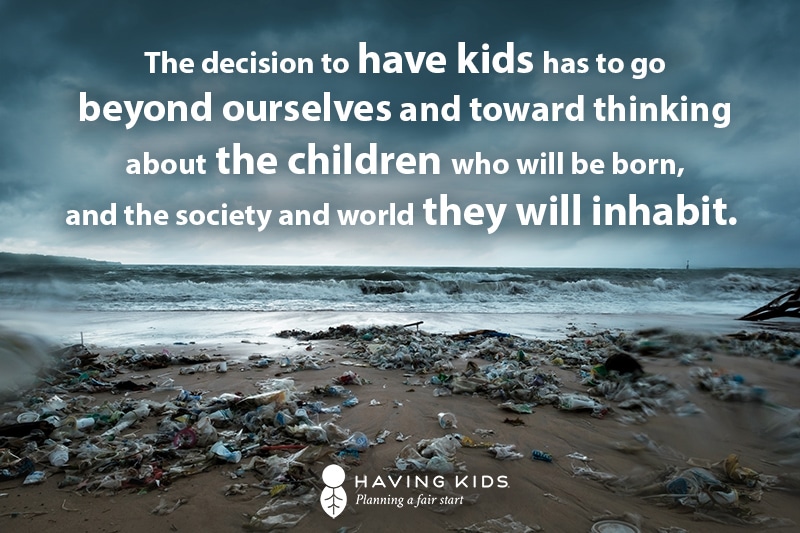
    A beach littered with plastic trash under a cloudy sky. Overlaid text reads: The decision to have kids has to go beyond ourselves and toward thinking about the children who will be born, and the society and world they will inhabit.

    Between the time those interventions were begun and today, neoliberalism and unsustainable growth-based economics that externalizes costs – like the climate crisis and birth inequity, has become the zeitgeist. The Times itself wrote about the same. But fanciful ideologies aside, growth remains unsustainable. The more interesting question is how the arc of population growth became so high to initiate the climate crisis, and who among those who have benefitted from that mistake will pay to compensate the future generations who certainly will be harmed – through no fault of their own.

    Justice begins with an ecosocial #FairStart in life.

    TAKE ACTION: Engage and urge the Times editor and his family to address the #FairStart question, and how we will redistribute power – including influential media platforms – to compensate future generations.

    A circular infographic titled “Fertility Delay Incentives to Planning” shows a leaf in the center with four benefits: Delayed Parenthood, Better Family Planning, Guaranteed Minimum Income, and Equal Opportunity & Education for all kids.
  • Vox Founder Pushing Population Growth Made the Climate Crisis Worse. Hold Him Accountable.

    Vox Founder Pushing Population Growth Made the Climate Crisis Worse. Hold Him Accountable.

    The Financial Times just published an article detailing the massive impact policies that promote smaller families – for all – have on the climate crisis. Nothing comes close.

    And yet people like Matthew Yglesias and the media outlet Vox continue to push women to have kids. Many have said that we should punish climate change deniers for blocking policy reforms that could have mitigated the crisis. But all climate emission flow downstream from the increase in demand population growth creates. It is the fundamental driver. Aren’t the people actually making the crisis worse, usually to grow their investments, just as bad as the deniers? Did Ygelsias pushing women to have kids actually have an impact? The proposals to change federal child tax and care subsidy policy to encourage population growth that followed his advice suggest it did.

    Let’s hold him and others, like Lee Raymond, accountable. We have a right to take the resources of wealthy people like Lee and Matthew who profited from poor and unsustainable family planning but never paid that costs that growth imposed on the environment, animals, women, and children. Why? Because every child’s right to an ecosocial Fair Start is the first human right, and it precedes and overrides any other obligation, including property rights.

    It’s time to pay up. Those that really profited owe future generations – more than most.

    What is Fair Start? It’s about people, not population. It’s about shared values and thinking qualitatively about the future, not using poor and unsustainable family planning to grow economies. Read the Allegory of the River, and why Having Kids talks about constituting democratic communities instead of framing our work around the concept of population, to understand more. Let’s make family planning truly inclusive, and geared around creating democratic communities where everyone has a voice. 

    It’s simple: Fair Start family planning means smaller families sharing resources to invest more in every child. For some, the closest analog for this new model would be responsible family planning incentives. But Fair Start resources are actually entitlements held by future children, and funded through non-traditional means. Those opposed to remodeling favor our current system of unsustainable families, unearned privileges, and undemocratic influence, over giving kids a fair start in life.

    In a previous blog post, Having Kids argued that his approach — like many others who see babies as economic inputs to be exploited — was actually compelling evidence of the fundamentally unjust nature of our system.

    All kids have a fundamental human right, ecologically and socially, to a #fairstart in life. It’s the first human right. Help us secure it against those who threaten our future.

    A comparison chart of Current Family Planning vs. Fair Start Family Planning. The former lacks welfare, equality, and environmental protection, while the latter ensures welfare, equal opportunity, and environmental protection for all kids.

    Groups and individuals from around the world are signing on to an effort to change the old model that focuses on what parents want toward a new model that focuses on what all kids need. The new model, called Fair Start family planning, is the beginning of real social justice. The reform can begin with the United Nations secretary general simply acknowledging the need for change.

    Sign on, and urge any organization you support or can influence — nonprofit or for-profit — to also sign on. Sign here, or contact us at info@fairstartmovement.org for more information.

  • The New York Times Pushes Women to Have Kids. Take Action.

    The New York Times Pushes Women to Have Kids. Take Action.

    Every crisis we face, from the climate to Covid-19, is a function of family planning laws and policies that actually do nothing to ensure planning. They do nothing to give children minimum levels of welfare, or birth equity, and nothing to promote sustainable environments, or functional democracies where each voice matters. All of these problems, social and ecological, root in the people that comprise them.

    The reasonable reaction to this situation would be to reform these systems to address the problems, especially given the massive impact changes in family planning systems make on things like climate emissions. Any discussion of family planning is an opportunity to do so. So why is the New York Times publishing empty pieces that celebrate thoughtlessly having children and simply hoping for the best? The most recent piece does nothing to address whether a more collective model of planning could mitigate the crises, sets up a false dichotomy of anti/pro-natalism, and spends the rest of the piece dressing the former up as nihilistic and the latter as a glorious leap of faith that even Kant would endorse. The author manages to ignore that if we followed Kant, we would in fact find a universal norm for family planning that did not simply exacerbate the problems and injustice we see today but address them as a collective action problem, a norm like Fair Start.

    Infographic titled Better Family Planning, Simply Put with icons and three points: Delaying parenthood, smaller families, and community support, each explained with brief text and blue graphics.

    The New York Times can do better than push people to have kids with babies = hope messaging. It can address the problem one Nobel Laureate laid bare: Those in power like Times editor Dean Baquet sit atop a population pyramid, the growth of which they are incentivized to promote as a means of expanding their wealth and influence. Baquet and the Times benefit from the growth, but don’t pay its costs. The costs of that expansion, including the inequity that floats Baquet and his son Ari above the masses, are leveled on others, especially on future generations who will suffer in the climate crisis. Family planning is the first border of justice – address that issue, Dean and Ari, and let People Magazine publish thoughtless pieces on hopeful baby making as a solution to the crises causes by the same.

    Take Action: Urge @deanbaquet, or his son Ari, to explain how they intend to promote the reform family planning laws and policies to address the crises we see today, and account for the social and ecological benefits they enjoy, but others will not.

  • New York Times: Population Is About People and Shared Values, Not Economic Growth

    New York Times: Population Is About People and Shared Values, Not Economic Growth

    It’s downright jarring to see the New York Times report on the climate crisis and mass extinction with alarm but subtly treat low birthrates as similarly threatening to our future. Smaller families are the most effective way to mitigate the threat of the climate crisis and many other environmental and social dilemmas.

    Lower birthrates might be a threat to unsustainable growth-based economics, where we see babies as free money in the form of new consumers, cheap future labor, and compliant taxpayers. But lower birthrates are a boon to shared values like investing more in each child and creating a safe and healthy environment. And they are a boon at the key moment in human development where those values matter most of all. 

    What matters most is the people with whom we and our kids will share this planet as its ecology degrades. That is the most fundamental question of all.

    Take action: Contact the Times at nytnews@nytimes.com and urge them to deal with the values at stake and not to promote unsustainable growth.