A specific example of this is when civil society groups knowingly undo claimed progress with outdated family policies that disempower most people in order to – per one Nobel Laureate – grow economies that benefit a few at cost to freedom and democracy. And even when shown the undoing, some groups have continued on course, opting for growth policies that will continue to undo claimed progress.
This scam hides something called the “constitutive fallacy,” basing one’s obligation to follow the law on coercive top-down instruments like written constitutions rather than bottom-up family reforms that actually empower and liberate people – in terms of their actual relations – and in a measurable way, enabling them to physically constitute – under the Children’s Convention – legitimate power relations between people from whose authority things like written constitutions must derive.
Put another way, try to think, say, or do anything that does not derive from some set of theoretical or actual power relations, relations that would have had to derive from whatever norm created the people between whom those relations exist. It’s not possible to do, and for those relations to create obligations between people they must be created fairly and in a way that measurably empowers people. Acts of mass violence may be driven in part because we have failed to empower people.
Resolving the fallacy allows each of us – individually – to orient from a just position, rather than knowingly being part of systems in which some benefit by placing costs on others.
Truly free people will limit and decentralize the power others have over them, including via reallocating property rights, by actually using resources at the top of the economic pyramid in the act of constituting systems in which they are empowered. This can be done universally through a simple change in employment benefits that ensures discretionary benefits impacting kids should be scaled inverse to wages, or more acutely, targeting the heads of companies like Exxon, as well as leadership at the United Nations, who use their massive influence to preserve unjust systems that heap costs on others.
A specific example of this is when civil society organizations knowingly undo claimed progress with outdated family policies that disempower most people in order to – per one Nobel Laureate – grow economies that benefitted a few at cost to freedom and democracy. And even when shown the undoing, some groups have continued on course, opting for growth policies that will continue to undo claimed progress.
This scam hides something called the “constitutive fallacy,” basing one’s obligation to follow the law on coercive top-down instruments like written constitutions rather than bottom-up family reforms that actually empower and liberate people – in terms of their actual relations – and in a measurable way, enabling them to physically constitute – under the Children’s Convention – legitimate power relations between people from whose authority things like written constitutions must derive.
Put another way, try to think, say, or do anything that does not derive from some set of theoretical or actual power relations, relations that would have had to derive from whatever norm created the people between whom those relations exist. It’s not possible to do, and for those relations to create obligations between people they must be created fairly and in a way that measurably empowers people. Acts of mass violence may be driven in part because we have failed to empower people.
Resolving the fallacy allows each of us – individually – to orient from a just position, rather than knowingly being part of systems in which some benefit by placing costs on others.
Truly free people will limit and decentralize the power others have over them, including via reallocating property rights, by actually using resources at the top of the economic pyramid in the act of constituting systems in which they are empowered. This can be done universally through a simple change in employment benefits that ensures discretionary benefits impacting kids should be scaled inverse to wages, or more acutely, targeting the heads of companies like Exxon, as well as leadership at the United Nations, who use their massive influence to preserve unjust systems that heap costs on others.
A specific example of this is when civil society organizations knowingly undoing claimed progress with outdated family policies that disempower most people in order to – per one Nobel laureate – grow economies that benefit a few at cost to freedom and democracy. And even when shown the undoing, some groups have continued on course, opting for growth policies that will continue to undo claimed progress.
Many are fighting back against that, and for true freedom. And those who benefitted from unsustainable growth policies that did nothing to level the playing field between rich and poor kids know they are in trouble, now coming up with outlandish claims and a fake “underpopulation” crisis to decoy us away from justice.
This scam hides something called the “constitutive fallacy,” basing one’s obligation to follow the law on coercive top-down instruments like written constitutions rather than bottom-up family reforms that actually empower and liberate people – in terms of their actual relations – and in a measurable way, enabling them to physically constitute – under the Children’s Convention – legitimate power relations between people from whose authority things like written constitutions must derive.
Put another way, try to think, say, or do anything that does not derive from some set of theoretical or actual power relations, relations that would have had to derive from whatever norm created the people between whom those relations exist. It’s not possible to do, and for those relations to create obligations between people they must be created fairly.
Resolving the fallacy allows each of us – individually – to orient from a just position, rather than knowingly being part of systems in which some benefit by placing costs on others.
Truly free people will feel obligated to follow the law, including laws that create property rights, when they are empowered. They will limit and decentralize the power others have over them, including via reallocating property rights, by actually using resources at the top of the economic pyramid in the act of constituting systems in which they are empowered. This can be done universally through a simple change in employment benefits that ensures discretionary benefits impacting kids should be scaled inverse to wages, or more acutely, targeting the heads of companies like Exxon, as well as leadership at the United Nations, who use their massive influence to preserve unjust systems that heap costs on others.
* Special update: After writing this open letter Professor Philip Pettit of Princeton University called the claims in it “home truths” and allowed us to share his good words publicly. Take action below to urge Gerken to admit the fallacy in her work and support Fair Start legislation that moves us towards the first condition of being free.
Dear Dean Gerken,
This is a great headline: “‘You cannot be an academic or a lawyer and not believe in free speech’: Dean of Yale Law.” And the points you make are compelling. Yale Law School (YLS) is clearly taking a position on the value of free speech in the context of elevating controversial speakers, including some who might reinforce unjust hierarchies based on the history of colonization (Elon Musk leaving South Africa during apartheid with the wealth his family made under it would be an example).
YLS and its alums will have intimate knowledge of what concentrations of wealth and power – like working on or with the Supreme Court – look like, even when those concentrations are totally attenuated from the citizens over which they have authority. Would YLS take a position on ensuring liberating power relations through family reforms that should precede free speech forums, especially if the changes needed to ensure that would – by empowering people with meaningful voices in participatory democracies – would long-run mitigate the climate crisis?
And from your work on democracy, I will assume you want those relations to be formed bottom-up, in which case there seems to be only one pathway:
Free people will fundamentally limit and decentralize the power (including subtle influences like climate emissions, the slow dilution of democracy, the concentration of wealth, power and control in a few, and the impact of bad parenting on communities) others have over them. They will not allow themselves to be subject to political systems where they are not actually empowered. How do they do this? Fair Start family reforms, like climate restoration and #birthequity baby bonds to physically constitute democracy and consensual governance using an inversion test, ensure that people are actually empowered long-run – in places like town halls – to make the ultimate rules under which all must live.
This evades the undemocratic concentrations of power that – as Robert Tsai saw – prevent people from constituting true legalities by creating relationships between people that are more empowering than disempowering, relative to a neutral point, like Rawl’s original position. It evades the aborted version of freedom Joseph Raz exposed.
These reforms correct something called the constitutive fallacy: Ignoring the way our creation and development does and (assuming we use baselines like the Children’s Rights Convention) should – fundamentally – constitute actual power relations, between humans, and between humans and the nonhuman world or nature upon which freedom is based. Each person chooses to commit or evade the fallacy in every normative claim they make by accepting or rejecting particular forms of supreme political obligation like written constitutions and choosing to orient from a relatively just or unjust place. If they did not the idea that governmental authority derives from groups of people, the authority of which depends on the individuals in those groups, would make no sense. This is about the creation of power relations and relative self-determination more than “population.”
From your work I will assume you see the U.S. Constitution as supreme, perhaps limited by some form of international law. Could a more supreme norm exist in the form of whatever norm would best account for creating the people from whose authority these other norms derive?
One can imagine this process simply as using good democratic representative ratios to move toward what many see as optimal world population ranges. If government is to derive from the people, there must be a first election in which the people decide who is in their polity. Immigration/emigration might have determined that “first election” at one point, but how can we ignore family policy as a more primary form? We cannot and remain in a preconstitutional modes, choosing things like the creation of large populations in the hopes of geniuses magically emerging rather than seeing the genesis of efficiency as actually developing each child to their full capability, as long as we make that mistake.
Fair Start family reparations override because being just in who we are precedes being just in what we do. And we cannot assign things like property rights that derogate from our being (or constituting the fundamental power relations so that we are) free and equal people. Wealthy people, and the unscrupulous politicians and charities that shill for them, will hide the fallacy, and its overriding nature.
But without these reforms people will continue to try to wrongly empower themselves through acts of violence., and against the wrong targets rather than the people responsible for or who benefitted from the family policies that externalized the costs of their wealth and refuse to change course. They will harm innocents, rather than those extracting personal power from collective freedom by crowding people (including the future majority) out of town halls and into the shopping malls, the move that fundamentally created the climate and other deadly crises we face today.
Freedom requires forums of speech, like democracies, be bounded by objective norms of human rights, the first of which is the right to have children.
Help us make that right ecosocially fair, to decolonize the future and become sufficiently other-regarding to actually constitute just communities.
Lee Raymond may have done more to exacerbate the climate crisis than any other one person on the planet. His active burying of the truth of the emerging crisis and how Exxon was responsible stands out among those who have done the greatest harm to our environment.
Using concentrations of wealth and power to fund family reforms is the most just and effective way to respond to the climate crisis, restoring our environment and building resilience in children at the same time. This would also help guarantee the right to a healthy environment, now recognized by the UN. An ecosocial Fair Start in life for all children is the first human right, and we can ensure it by all means effective. Why? We are before we do, so true justice comes in creation; it is existential.
Treason at an existential level does not rely on positive law conceptions of the crime. It simply could mean acting in a way that substantially degrades the security of free and equal people, especially when done for personal gain.
TAKE ACTION: Musk benefits from the United States, while also threatening it and true democracy, for his personal gain. Urge those close to him, like @Grimezsz, to speak out and ask him to change course, or find and engage him personally and share your story.
Many nonprofits have been touting the success of energy efficiency or other campaigns designed to limit emissions.
The success of these efforts has been largely undone by overconsumption. This happens as demand for things like emissions-producing animal products, and even whole ecosystems, rises with growth. But it also happens at a much larger scale as that growth exacerbates the climate crisis on dozens of other levels, something that is enabled by many organizations’ anthropocentric and extractive environmental policies, and policies that failed to protect nature / the nonhuman world.
The crisis was fundamentally driven by the family policies – both tacit and explicit – that many nonprofits have simply accepted despite the harm they cause to women and children. These policies often quietly placed more children, animals, and ecosystems in harm’s way than the organizations’ campaigns were saving, and in a way that degraded human rights and democracy and empowered a few. I have spoken with leadership at nonprofits who admitted to me that their position on population growth, and their ignoring the massive child inequity that comes with such growth, was undoing their claimed success in fundraising materials, but these leaders were afraid to speak out for of fear of losing funding by being controversial.
Not only were many nonprofits embracing outdated family policies that let their wealthy funders pass massive privileges to their children while other children were being born and raised in horrific conditions, but now those vulnerable children will disproportionately suffer the impacts – long into the future – of the climate crisis.
This is not pure theory. I’ve worked in and with nonprofits in which leadership chose climate and population policies that hid the possibility of things like climate reparations, while also benefitting them personally at cost to the organizations’ stated missions. I have talked with prominent advocates of biodiversity who knew their Anthropocentric family policies were quietly causing extinction that undid their public claims, but who were terrified to change course. I have personally met with funders who for years held themselves out to the public as philanthropists protecting animals, in part by investing in vegan products, though they knew the population growth policies they tacitly or expressly supported and profited from were doing much more to harm animals than their investments were doing to help them. I’ve spoken with public officials who understood that growth policies were akin to a Ponzi pyramid scheme (per one Nobel Laureate) that degraded their own representative capacities while exacerbating inequity and the climate crisis, but who chose to do nothing about it.
Investing more in children, right from the start, in the beginning of justice.
It’s time to break this dynamic of fundamental injustice, and to constitute ourselves – through just family planning – as free and equal people.
TAKE ACTION NOW:
First, understand – based on arguments that now have five positive peer-reviews – that because every child’s right to a Fair Start in life is the first and overriding human right, we have the right and obligation to recover the costs these lies have imposed on future generations, and by all means effective, if we actually use the funds and other resources to protect children. It is impossible to derive fundamental political obligations (like property rights) in ways that derogate from the actual/physical relations of consensual governance, which first depends on how we are created.
If you support a nonprofit that claims to protect children, the environment, animals, or human rights and democracy, urge them to disclose their current family policies. Are they opting for policies that could bring more children into horrific conditions than the number of children the group is actually serving? Are they opting for policies that could place more animals in harm’s way than the group is saving? Are the groups accounting for how growth is driving a climate crisis that is undoing local environmental efforts, or degrading democracy in relationships between people irrespective of formal changes in political systems? Urge them to instead adopt more ethical models like Fair Start or comparable options.
Florida continues to see tens of thousands of children abused each year, with many of them dying in the process. And the state care system, despite changes, continues to fail them.
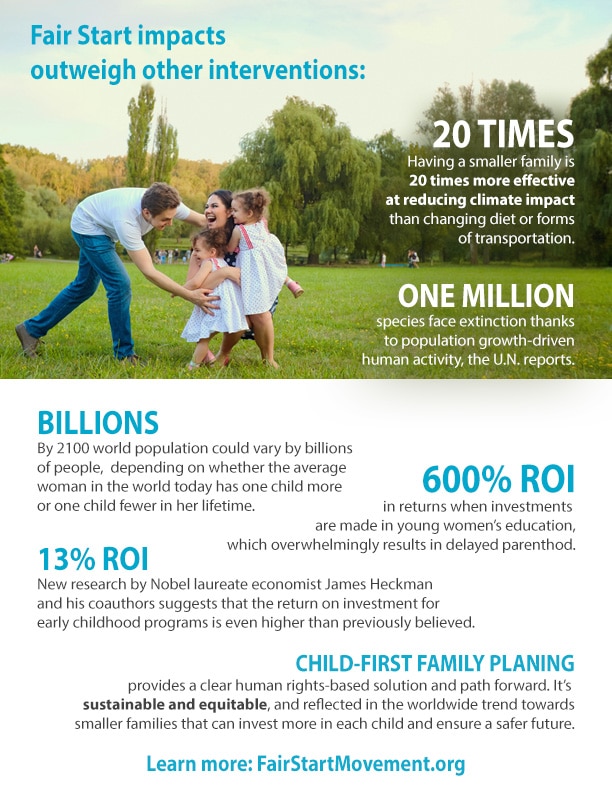
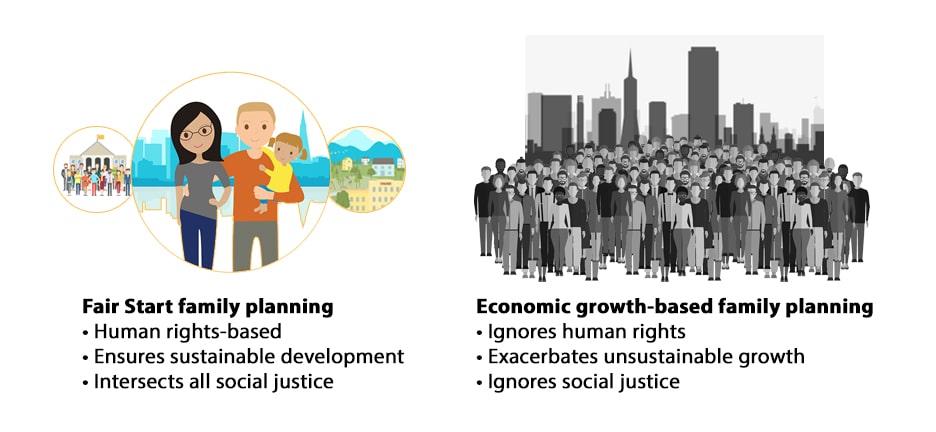
Fair Start Movement’s mission is to replace parent-centric subjective family planning systems with a child-centric model that ensures children are born and raised in conditions consistent – minimally – with the Children’s Rights Convention, a move enabled via effective family planning incentives/entitlements. We partner with organizations around the world, like the wonderful Rejoice Africa Foundation (formerly Kibengo Youth Care Activists), on Fair Start and other initiatives.
Thank you for being a leader in the efforts to assure family planning needs are being met worldwide. Given recent discussions of your foundations possibly funding a world children’s savings bank, if these reports are true, we urge one simple guideline for such a plan. That guideline would correct the baseline error, or the act of trying to assess costs and benefits without orienting from a position of consensual governance, described further below. We urge that the gift recognize that much of the wealth was built on a system of unsustainable growth and illegitimately externalized costs, per one Nobel Laurate, that included billions having and raising children in conditions that did not satisfy the standards children and their parents deserve, the standards that were eventually codified in the Children’s Rights Convention.
Is there evidence that we see children as economic inputs, rather than citizens, and not deserving of minimum levels of welfare, equity, restored ecologies, and an influential voice in their democracies? The ubiquitous bemoaning of falling fertility rates as a “baby bust” economic crisis, with no plans to assure children the things described as various policies are offered to reverse the crisis, is ample proof.
Our work establishing this fundamental baseline for assessing costs and benefits, and the human rights nature of child-centric planning as oriented to protect the vulnerable parties at stake, has been subject to almost half-a-dozen peer reviews. And the claim that a fair start in life logically precedes governmental authority to issue the property rights on which the wealth was built – because we are before we do – seems irrefutable. How could we be self-determining or free in an anthropocentric world dominated by a singularly human-centric viewpoint, rather than a natural or nonhuman one – built into family planning – that allow humans to consent to the power of others? Without that primacy we never constitute fair, or free and equal, societies. We never create the consensual, inclusive, and participatory town halls necessary to actually regulate the wealth-building economies. Free people will condition their political obligations on their capacity, as equals, to change those obligations. Fair Start enables this.
This is our challenge: If your plans are to give as reported, please designate at least part of the funds – by COP 27 – as human rights entitlements designed to move us towards the fundamental baseline discussed above, one which actually complies with the requirements of the international human rights regime. Surely, as things like the threat of climate-driven mass famine in the Horn of Africa unfold, it’s clear that our current, anthropocentric, isolating, and inequitable system of family planning was a terrible mistake. Fair incentives/entitlements, designed to build the town halls that liberate us, could have prevented that. If children deserve the funds, they deserve the efficacy putting the funds into bending the arc of planning and growth would produce through things like allowing delay and preparation, creating changes in family size, ensuring opportunities for co-investment, encouraging relocation etc. If it takes a village to raise a child, it takes a village to plan for one and there is a test for whether we are doing that consistent with human rights and democracy.
The entitlements are not paying for people. They are paying to convert – at the most fundamental or creative level – commercial relations into empowering democratic/normative relations, or the sort of town hall relations needed to regulate the second-order forms of shopping malls. If we value democracy it will be unreasonable for intending parents to refuse the empowering funds, and unreasonable for concentrations of wealth and power to refuse to give them. Whether we are part of groups of free and equal people first depends on whether we correct the baseline error described above (reiterated in the Cairo Consensus which wrongly treats the act of having kids as more self-determining for the parents than other-determining for the children born) and are part of efforts to ensure people are relatively self-determining through collective child-centric planning, or we are not part of such efforts. There is no obligation that can proceed this – becoming a just people.
Legal systems, markets, customs, etc., can only do so much to guide human behavior. The gaps depend on – and in government by the people should depend upon – the circumstances in which we are born and develop and which lead to our emancipation. The value of democracy – the “We the People” – includes the high quality of life sharing the world with people prepared for such systems – with a common core of objective values, prosocial dispositions, high levels of education and equity, etc. – would entail. The antecedent “we,” that proceeds all action, is actually a reference to power relations between people, and between people and their environment, that for self-governing people should arise from birth and development. Collective child-centric planning can get us there, but because group legitimacy derives from individual choice, each person must choose whether they support or reject fundamental fairness and choose to be part of just or unjust systems.
Without this change in entitlements, we risk a future – as the climate crisis deepens – where the system by which we made our wealth does more harm to future generations than our philanthropy can do to help them. We risk choosing not to constitute ourselves as free and equal people. and remaining part of an unjust and exploitative system. Instead, we can follow the lead of others choosing to reorient entitlements, and through that discourse and action, choose to be part of consensual systems of governance.
Thanks for considering, and for your work to date.