Author: Fair Start Movement

  • Will Racism Ever End Without Better Family Planning?

    Will Racism Ever End Without Better Family Planning?

    Denene Millner sketches out the lines of a blueprint for a new and better American Dream, born of the persistence of racism, and need for success to mean more than wealth. It’s a beautiful sketch. But she ends suggesting some form of voluntary economic segregation. “Segregation made the black community self-reliant.” Is there an alternative?Image result for black leaders quotes overpopulation

    Perhaps it lies in her focus on children, and the family. Could racism begin at home? Could home begin with family planning? Martin Luther King recognized the dangers of poor family planning and the growth of our population. What if we couple the solution, smaller families, to a public family planning ethic that treated the decision to bring every child into the world as an act of deliberate inclusivity, with everything that means for economic positioning, racial equality, and equity of opportunities in life.

    Racism persists in part because we tolerate a cavemanish family planning model that treats the act of parents creating and raising children as somehow personal and private, as if it did not create the social world we all share. Doesn’t that treat future children, and the nonhuman world we colonize, as if they were our property, and ours alone to control? Rather than resegregate as Millner might be suggesting, shall we go to the source of our deepest social insufficiencies? Racists don’t fall from the sky – they are born and raised in the shadows and illusion of isolation. We “come together” as future generations enter. Do we want to come together in the way Dr. King envisioned? Better family planning is the key.

  • Today’s Family Planning Is Shaping Your and Your Family’s Future

    Today’s Family Planning Is Shaping Your and Your Family’s Future

    Many caring and thoughtful people who are concerned about the future of the world are being pushed off the idea of having kids. They are concerned about climate change, the mass extinction of other species, and acidifying oceans filled with plastics. All of those things are driven by exploding population growth.

    A line graph shows world population (in billions) from 1800 to 2100, steeply rising after 2000 with three future growth scenarios: high, medium, and low. Data is from the UN, with estimates for 1800-2015.
    By Bdm25 – Own work, CC BY-SA 4.0

    At the same time, many other families are having as many kids as they can, often for religious reasons, or because it distinguishes them from other families, or because they see their family as a replacement for the community around them.

    Is it fair that some people, often the ones that care the most about our future, are put in the moral dilemma of whether to have children because other people are having so many? Do parents that ignore the risk large families pose to the future have the right to infringe on a well-prepared and thoughtful family’s right to have one or two children?

    Today we have a historic opportunity to protect the future, for ourselves and for our families. We can change the course on that graph. We can embrace the worldwide trend of people choosing smaller families. We can demand fairness, and the better world that better family planning can create.

    Child-first family planning means working with your community to get the resources you deserve to give your child a fair start in life, with equal opportunities relative to their peers, and planning a smaller and sustainable family where you and others can invest more in each child.

    Speak up, and speak out. Other peoples’ family planning decisions are deciding your future. Help them get it right.

  • Urge the U.N. Secretary General to Support Child-First Family Planning

    Urge the U.N. Secretary General to Support Child-First Family Planning

    As the United Nations Commission on Population and Development meets in New York this week, Having Kids is urging Secretary General António Guterres to issue a new statement on family planning. Previous Secretary General statements have focused on the rights of parents; Having Kids is urging the Secretary-General to now make a statement that includes the needs of future children and how those needs must shape truly human rights-based family planning models.

    Read the full letter here. 

    Circumstances have changed since former Secretaries General have issued family planning statements; a revised statement is urgently needed.

    • Several studies confirm that smaller families are the best way to confront climate change, as well as other and related environmental crises. If we take climate change seriously, we must laud the benefits of a global family planning ethic that promotes smaller families.
    • The science of early childhood development shows the disproportionate impact the beginning of our lives has on the rest of our lives. This holds true, among other things, for economic inequality.
    • Better family planning is now understood to be an effective way to prevent the conditions that give rise to terrorism and other conflict-based threats to human rights and democracy.

    Take action now. Contact Secretary General Guterres here and politely urge him to consider our request.

    Having Kids is a 501(c)3 nonprofit nonprofit organization dedicated to reforming family planning by replacing parent-centered family planning models with the human rights-based and child-first Fair Start model.

  • Men Pushing Women to Have Kids. Time to Push Back?

    Men Pushing Women to Have Kids. Time to Push Back?

    [et_pb_section bb_built=”1″ admin_label=”section”][et_pb_row admin_label=”row”][et_pb_column type=”4_4″][et_pb_text admin_label=”Text” background_layout=”light” text_orientation=”left” use_border_color=”off” border_color=”#ffffff” border_style=”solid”]

    Lots of men are getting in on the action of pushing women to have more kids, from the Serbian military which recently vowed that it will “participate in raising the birth rate,” to ball-brained bloggers who decry the impact lower fertility is having on youth sports, to politicians urging women to ignore their futures and hurry up and breed the next generation of taxpayers, consumers, and workers.


    Best of all, Donald Trump is doing everything he can to prevent women from not having kids, by pushing back years of progress on access to family planning, and role modeling an unsustainably large and consumptive family.


    Our species has, for most of its history, accepted the cultural push for larger families and higher birthrates because it benefited us, as a species. The caveman and patriarchal systems approach to family planning, “just have more,” had some merit. That all changed in roughly the Twentieth Century, when world leaders realized that population growth itself posed a grave threat to our species, and launched family planning interventions that cut worldwide fertility rates in half. Yes, that happened.


    There was just one problem – these efforts were based on incomplete information. World leaders in the Twentieth Century did not account for climate change, and a dozen other unforeseen impacts on our social and natural environment, from the acidification of oceans to the massive extinction of other species. They did not account for advancements in the science of childhood development, which today show how family planning impacts the prospects a child has in life, for their entire life. They did not account for how, consistent with those impacts, family planning policies could exacerbate the massive gulf between rich and poor.


    In short, the interventions did not go far enough, and certainly did not account for linkages between the issues above, like how better child development policies could have offset humans’ innate cognitive dissonance around slow-moving threats – like climate change.


    What does all of this mean? Today, as an already unsustainable world population skyrockets towards eleven billion, the men who are pushing women to have more kids are a manifest threat to all of us, and the wellbeing of our children. Their caveman approach to family planning is not just wrong. It’s dangerous. Instead, we should embrace the clear trend towards lower fertility rates as a form of human evolution, the move towards a sustainable population, families that can invest more resources in each child, and the creation of smaller –  and hence more democratic – communities where each person has more of a voice and role in creating the rules under which they live.


    Take action: If you belong to civil society organization, one that protects the environment, children and their futures, democracy and human rights, equality for women, etc. please politely encourage them to consider taking a public stance on the need for better family planning, and encouraging a model that promotes smaller and sustainable families where every child is guaranteed a fair start in life.


    [/et_pb_text][/et_pb_column][/et_pb_row][/et_pb_section]

  • Toys R Us Fails To Adapt, Blames Fertility Rates

    Toys R Us Fails To Adapt, Blames Fertility Rates

    In the wake of its bankruptcy announcement, Toys R Us is giving out free family planning advice: Americans, and millennials in particular, are not having enough kids.

    Forget the fact that having large families is the worst way for the average person to exacerbate climate change, otherwise destroy the environment all kids will need to thrive in the future, and lock in the family-based disparity of wealth that is ripping at the fabric of American democracy. What really matters is that Toys R Us exploit more workers to sell more toys, toys that your kids don’t need.

    Toys R Us is worried that smaller families will hurt the U.S. economy. Here’s a thought: The U.S. is meant, primarily, to be a democracy, rather than an economy. What’s the difference? Democracies are by nature smaller, so that each person in them has a voice and plays a role. Their members are not lost in the crowd. Democracies are by nature sustainable, because their future citizens matter. Democracies are made up of free and equal people in whom prior generations have invested much, and right from the start. People in democracies don’t plan families based on how to best sell toys. They plan them based on what children need to thrive as self-determining, free and equal people.

    The move towards smaller families, with parents investing more in each child, represents a move away from the oppressive and unsustainable economies of old towards real democracy, and the end of companies like Toys R Us  – which recently filed for bankruptcy. They should accept the blame for failing to adapt to the 21st century landscape in order to compete with Amazon and other big box and online retailers, rather than pointing the finger at families.

    Toys R Us is wrong on family planning. Tweet @ToysRUs and tell them to stop blaming parents for their business failures.

  • Mass Shootings – Putting Children First Can Help Stop Them

    Mass Shootings – Putting Children First Can Help Stop Them

    Unspeakable acts.

    Thoughts and prayers.

    “Now is not the time” deflections.

    Destroyed families.

    Fading headlines.

    Repeat.

    But what is especially insulting, is the accusation that fed up, heartbroken and frustrated communities are politicizing attacks on children. These events are a uniquely American problem; there have been eighteen school shootings in the United States, this year alone.

    In the 19 years since the Columbine shooting our leaders have made their priority clear: Short-term profits and economic growth, rather than the thinking-head and caring act of investing in kids. We have consistently failed to invest in early child hood development – which is a known and reliable solution to many problems like juvenile criminality.

    Children unquestionably deserve to be safe from other kids when they go to school. If our elected leaders refuse to recognize that, then it is up to us to put someone in their seat who will.

    What kind of nation are we if we aren’t putting children first?  

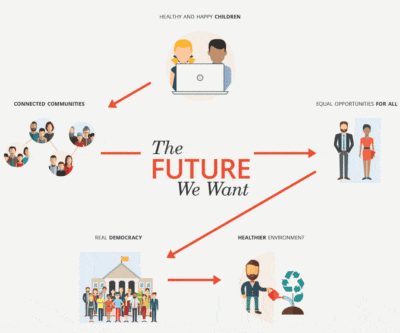
    Infographic titled The Future We Want with arrows pointing to icons representing connected communities, healthy and happy children, equal opportunities for all, real democracy, and a healthier environment.


  • Grey’s Tackles The Question of Maternal Mortality, But We Already Know the Answer

    Grey’s Tackles The Question of Maternal Mortality, But We Already Know the Answer

    If you’re up to date on what’s happening lately on Grey’s Anatomy, you know that the doctors have been preparing for a research competition. On last week’s episode, Pediatric Surgeon Arizona Robbins decided that her project would address the cause of the maternal mortality rate in the United States. As we shared last week, the U.S. now has the highest rate of maternal mortality in the developed world, and it’s on the rise.

    In the United States, 26.4 per 100,000 live births results in maternal death, compared to 4.2 per 100,000 in Italy, 9.2 per 100,000 in the U.K., 5.6 per 100,000 in Spain, 5.5 per 100,000 in and Australia, 9 per 100,000 in Germany and Portugal, 7.8 per 100,000 in France, 7.3 per 100,000 in Canada and 6.7 per 100,000 in the Netherlands.

    Having Kids can save the Grey’s writers some time. We know the cause of these staggering numbers: cuts to Medicaid and Planned Parenthood and the stripping of the Affordable Care Act have hurt expectant mothers, especially women of color.

    According to the WHO, the top contributors to maternal deaths are inconsistent obstetric practice in hospitals, insufficient care for the increasing number of women with chronic conditions such as diabetes and obesity, and the general lack of good data – and related analysis – on maternal health outcomes.

    According to Dr. Priya Agrawal, “Women who lack health insurance are three to four times more likely to die from pregnancy-related complications than women who have health insurance.” And Medicaid at last count covered 51% of all births in the United States. Slashing support for healthcare is killing mothers as in no other developed country. The majority of these deaths are preventable.

    We know that the healthcare crisis is complex. But we can take steps to reverse this unacceptable trend with a renewed commitment to access to affordable family planning and prenatal care, putting mothers and children before politics. And the best way to refocus our priorities is by putting children first in all policy making to give every child a fair start.

    Line graph showing obesity rates by country from 1990 to 2015. The U.S.A. line rises sharply to 26.4, while other countries show lower and mostly stable rates, ranging from 3.8 to 9.2 in 2015.

    Notes

    “Global, regional, and national levels of maternal mortality, 1990–2015: a systematic analysis for the Global Burden of Disease Study 2015,” The Lancet. Only data for 1990, 2000 and 2015 was made available in the journal.

    Source: The Lancet
    Credit: Rob Weychert/ProPublica

  • Is Climate Change Stopping the Most Responsible People From Having Kids?

    Is Climate Change Stopping the Most Responsible People From Having Kids?

    Recently, a New York Times article featured Americans who are choosing not to have kids because they don’t want to expose them to the future dangers of climate change. In addition, some noted that the act of having kids itself has massive environmental consequences. Unfortunately, media sources that deny the existence of climate change and see reduced fertility rates as a threat to American economic growth and dominance quickly ganged up on them. They seem to prefer large families, even celebrating one couple who is expecting their fourteenth child.

    What’s wrong with this picture? Should climate change be a reason for the people most concerned about the future and concerned with others’ welfare, to stop having kids, while people who refuse to accept the science of climate change have huge families? Do we want a future filled with people who care the least about it? Don’t we want all parents to be thoughtful and caring?

    A few things that can’t be denied

    • Better family planning has done more to protect our environment than any other change in human history, both in terms of reducing emissions and creating a smaller, better prepared human population.
    • Despite the success of family planning, current trends suggest that by 2050 there will be 3x as many humans on Earth as there were in 1960.
    • Human activity often has a negative impact on the planet including ocean acidification, mass extinctions, and climate change that even our Department of Defense now admits.
    • Having children today should be a decision that guarantees all children a certain level of wellbeing at birth, includes equity when setting that level, and recognizes the importance of delaying first pregnancies to achieve better outcomes for children.

    What can be done?

    People are ready for better family planning and are ready to push back against irresponsible parenting. Climate change should lead us to better outcomes, not worse. Take action now.

  • Let’s plan for all our futures

    Let’s plan for all our futures

    How can we protect animals without family planning? How can we protect our environment without accounting for the number of people impacting it? How can we maintain systems of human rights and democracy without the creation and development of the moral people that must comprise such systems?

    It is clear that we will never realize the aspirations of human, environmental, and animal rights without reforming our family systems. Family planning is currently driven by policies that ignore the environment and the substantial investment required for the well being of each child, in order to produce as many workers, consumers, and taxpayers as possible.

    The good news is that people are pushing back by choosing smaller families, reducing fertility rates, and investing more resources in each child. Making this trend the new normal could help restore animals’ habitats and our environment, as well as create smaller and more functional democracies where everyone has a voice. We can crystalize and institutionalize this by changing from dysfunctional systems of family planning to the child-first Fair Start model. If you support animal protection, environmental, or human rights organizations, urge them to include family planning as part of their mission.

    Rights-based systems can prevail – but not without reforming family planning. Please take action today.