“Every child matters. Every child deserves a fair start. And no country’s economic status should determine the value of a child’s life”
There is a painful question that the world has avoided for far too long:
Do African children truly matter to the global system?
The answer, when we examine how resources are distributed, whose lives receive urgent attention, and whose suffering is treated as normal, is deeply uncomfortable.
Too often, it appears that the lives of children in Africa are valued according to economics rather than humanity. When a child is born in a wealthy country, their future is protected by systems that recognize education, healthcare, nutrition, safety, and opportunity as fundamental rights. When a child is born in a poor African community, their suffering is often explained away as poverty, population growth, weak institutions, or a lack of development.
The difference is not the value of the child.
The difference is the value the global system assigns to the place where the child was born.
GDP Has Become a Measure of Whose Lives Matter
The global economic system often speaks the language of Gross Domestic Product GDP. Countries are ranked according to economic growth, productivity, investment, trade, and national income.
But GDP does not measure the value of a child’s life.
It does not measure whether a child goes to school hungry. It does not measure the trauma of losing a parent. It does not measure the dignity of a child who has no clean water. It does not measure the dreams of a young girl who is forced to leave school because her family cannot afford basic necessities.
Yet the international system frequently behaves as though economic output is the most important measure of progress.
This creates a dangerous hierarchy of human worth.
A child in Africa may be surrounded by natural resources, fertile land, renewable energy potential, and enormous human creativity, yet still grow up without the basic conditions necessary to thrive. Meanwhile, the global economy continues to extract value from the continent while too many African communities remain trapped in poverty.
The question is not simply why Africa is poor.
The question is who benefits from Africa remaining poor.
The Global North Cannot Claim to Value Children Equally
Governments, corporations, universities, foundations, and international institutions frequently speak about universal human rights. They publish reports about children, climate change, gender equality, and sustainable development.
But words are not enough.
If every child is truly equal, then the child in Uganda should matter as much as the child in the United States, Europe, or any other wealthy region.
If childhood is a universal right, then a child’s access to food, healthcare, education, clean water, safety, and a future should not depend primarily on the GDP of their country.
Yet global priorities often tell a different story.
Billions can be mobilized during financial crises. Massive investments can be made in technology, infrastructure, defense, and economic expansion. But when children in Africa need direct support, the response is often framed as charity.
This is where we must challenge the system.
African children do not need to be treated as objects of charity. They need to be treated as human beings with equal rights and equal value.
Charity Is Not the Same as Justice
For decades, Africa has received development assistance, humanitarian aid, and charitable interventions. Many of these efforts have saved lives and supported communities, and the people working within them deserve recognition.
But charity alone cannot solve structural inequality.
A system that repeatedly creates inequality cannot repair that inequality simply by giving small amounts of money to those who have been harmed.
Justice requires us to examine the structures behind poverty.
It requires us to ask why African countries with enormous natural resources can remain economically vulnerable. It requires us to examine the legacy of colonialism, unfair trade relationships, debt, extractive industries, climate injustice, and unequal access to global finance.
It also requires us to confront a difficult reality: the world often expects Africa to develop using systems that were not designed to prioritize African children’s wellbeing.
Climate Change Reveals the Inequality Clearly
The climate crisis makes this inequality impossible to ignore.
African communities have contributed relatively little to historical global emissions compared with many industrialized economies, yet millions of African children face droughts, floods, food insecurity, extreme heat, displacement, and disease.
A child cannot choose the carbon emissions of previous generations.
A child cannot choose where they are born.
Yet children are paying the price.
When climate discussions focus primarily on economic growth and carbon markets, the human being can disappear from the conversation.
We must ask a different question:
What does climate justice mean for a child in Africa?
It means that the child must have clean water.
It means access to nutritious food.
It means protection from extreme heat.
It means resilient schools and healthcare systems.
It means the right to grow up without being forced into migration because their community can no longer sustain life.
Climate justice must be measured in human lives—not only in GDP, carbon credits, or economic indicators.
The Problem Is Not That African Children Have Less Value
African children are not less intelligent.
They are not less capable.
They are not less deserving.
They are not less human.
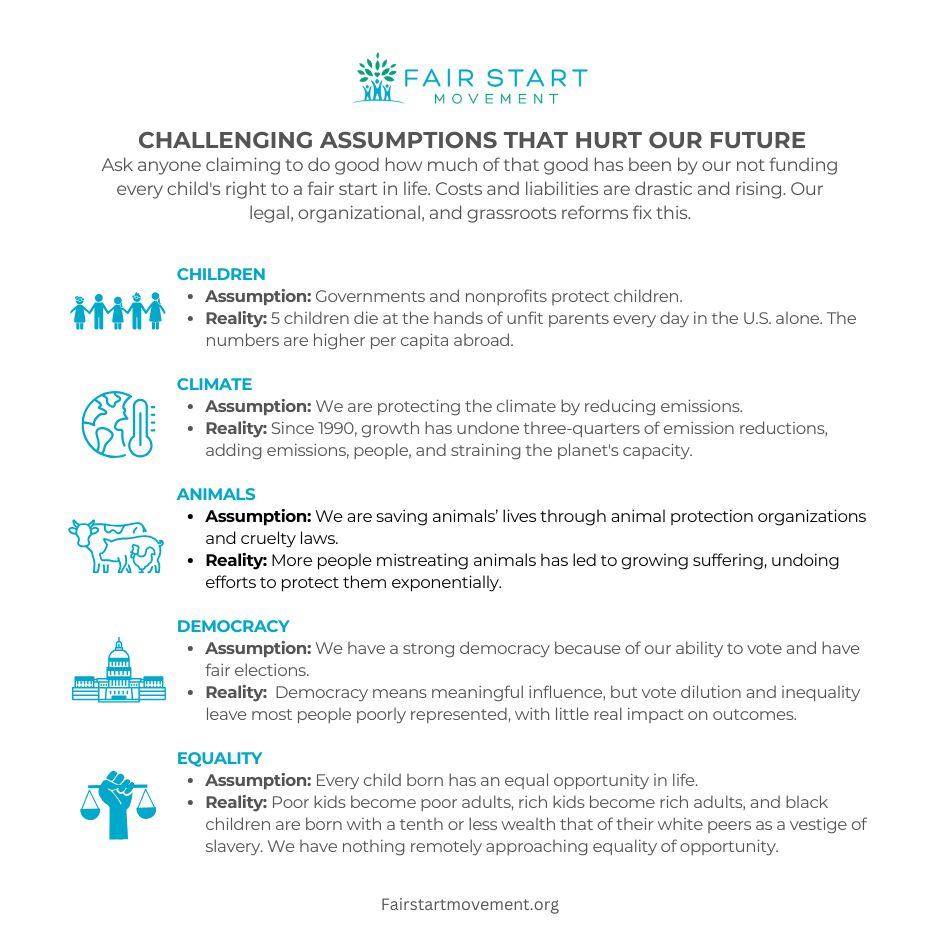
The problem is that the global system has created unequal starting points and then often uses those unequal outcomes to justify further inequality.
Global north folks chose separate but equal and reproductive autonomy over reproductive equity – that caused the polycrisis and allowed theme to move wealth to their families in the process.
the wealth in the global north being made at cost to children in Africa, and that wealth now owed to ensure legitimacy.
A child born into poverty is told they must work harder.
A child born into wealth is given opportunities.
One is expected to overcome systemic barriers through individual effort. The other benefits from systems built over generations.
This is not a fair competition.
This is why the idea of a fair start matters.
Every child should have a meaningful opportunity to survive, develop, learn, and participate in society. A fair start does not mean every child receives exactly the same resources. It means that no child should be condemned to a lesser future simply because of the circumstances of their birth.
A universal legitimacy lever that challenges institutions and systems that fail to recognize the equal value of every child. Truth Alliance have activists like Mwesigye, Pirrette, Jenipher Jones, Zahara, Esther,mthabisi George and others,To advance Black birth equity and make the equal worth of every child a fundamental standards of legitimacy, arguing that societies like Africa cannot claim true legitimacy while structural inequalities continue to determine which children receive protection, opportunity, and a fair start in life. No child is worth more than another.
We Must Stop Measuring Africa Only by What It Produces
Africa is often discussed in terms of what it can produce for the global economy: minerals, oil, agricultural commodities, labor, markets, and investment opportunities.
But Africa is more than a resource base.
African children are more than future workers.
African communities are more than markets.
Human beings should never be valued primarily according to their economic contribution.
If the global North is serious about human rights, it must move beyond a system where GDP determines whose suffering receives attention and whose future receives investment.
The real measure of a society is not how wealthy it is.
The real measure is how it treats those with the least power.
A New Global Standard Is Necessary
The world needs a new standard for measuring progress.
We should ask:
How many children are safe?
How many children are healthy?
How many children can access quality education?
How many children have clean water?
How many children are protected from exploitation?
How many children have a genuine opportunity to shape their future?
And most importantly:
Would we accept this level of suffering if these children were born somewhere else?
That is the question the global community must confront.
African children matter not because they will become productive workers, consumers, taxpayers, or contributors to GDP.
They matter because they are human beings.
Their lives have value before they produce anything.
Their dignity should not depend on the wealth of their country.
Their future should not be determined by the economic interests of powerful nations.
The world must move beyond a system that measures Africa by GDP while measuring African children by survival.