Tag: Wealth Inequality & Reparations

  • How to See and Fix the Fundamental Mistake at the Heart of Our Climate, Inequality and Other Crises

    How to See and Fix the Fundamental Mistake at the Heart of Our Climate, Inequality and Other Crises

    There is a common mistake in all of our language and thinking that drives many of the crises we face today. Our brains have trouble perceiving how time and space interact, and this usually leads to bad long-term decision making. For example, we know promoting a universal norm of sustainable families is one of the best ways to mitigate the climate crisis, but most policies around the world today are pushing in the opposite direction, incentivizing women to have more children.

    The same can be said for the gap between rich and poor, which is inherited from the injustices of the past, and the policies we choose to address the gap.
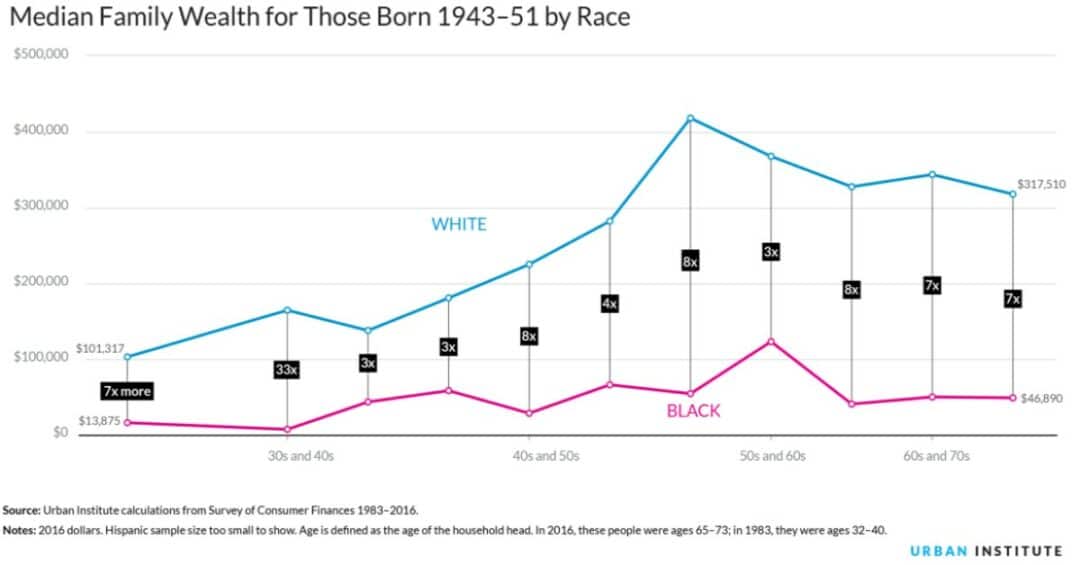
    A line graph compares median family wealth by age for White and Black Americans born 1943–51. White wealth is consistently much higher, peaking at 7,500 in their 60s, while Black wealth peaks at ,800.

    This cognitive dissonance creates a special problem when it comes to systems of justice and freedom, normally things that we first deal with through laws, nations’ constitutions, and international human rights conventions. This is the problem: We tend to think of constitutions, or other fundamental and dominant systems of norms, statically. We think of them as fixed things. That is incorrect. The legitimacy of systems of governance derives from people, and people are not static. They are constantly being born and dying. They are dynamic. And most people, all of whom matter, will live in the future. What lies at the base of things like justice and freedom – the dynamic “we” in “We the People” – is more fluid than our brains usually perceive.

    It is thus more accurate and true to our values of deriving legitimate governance from the people themselves (per a recent peer-reviewed article), to say that we are constantly constituting as we create new persons, not constituted by god-like founders in the past. We have to account for justice and freedom in the fundamental and ongoing formation of power relations, in the act of having children and ensuring their capacity to consent to the power of others. We thus “constitute” by accounting for the key stages in our development, early childhood and the creation of things like empathy, and the collective impact of that on our ability to socially self-determine. This is how we truly come together, or constitute, as free and equal people. We surpass our constant confusion about what it means to be free by seeing that such a state of being first lies in who we are – the fundamental power relations formed between us as we are created – before freedom can emerge, or not, in what we do.

    Making that change, using a verb, frees us from what might be called the constitutive fallacy, an erroneous deference to power structures that oppresses us – like property entitlements that prevent equal opportunities in life for all. Or treating the planning of our families – the creation of children – as “nobody else’s business.” That sense of privacy was not meant to protect would-be parents or children, but was instead designed for concentrations of wealth and power to evade collective obligations to give kids a fair start in life via things like family planning incentives/entitlements pegged to literal birth equity.

    How does the verb form free us? If we are dynamically constituting, then that process – limiting and decentralizing power to ensure future generations are free – becomes the dominant norm or ubernorm. We have to first and constantly make a free “We the People.” It precedes and overrides other norms. If we value justice and freedom (or self-determination over top-down systems of influences outside of ourselves like coercion or even incentives, which we can think of as simple sticks and carrots), we have to start from the premise that governance derives its legitimacy – its compelling oughtness – from the norm which through our creation ensures consensual governance.

    We have to create future generations in ways that assure they are relatively self-determining, part of a system of laws that reflects their will, and as such free from all forms of power to which they cannot consent.
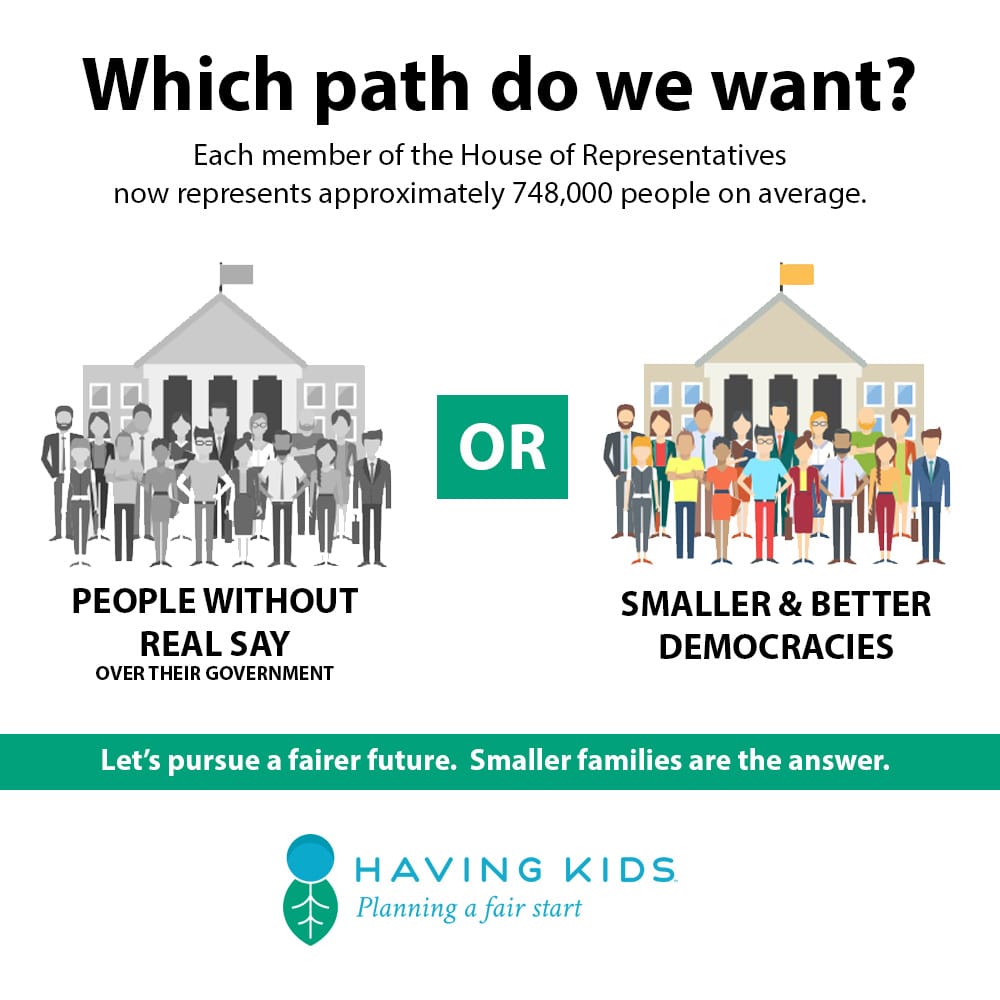
    An infographic compares two options: on the left, gray figures under “People without real say over their government,” and on the right, colorful families with “Smaller & better democracies.” Text promotes smaller families for fairer representation.

    Using the verb constituting may feel nebulous, leaving us lost in time and space without the familiar static concept of a written constitution, sitting under glass in some far-away place, or militarily defended lines on a globe that define some amorphous “we.” There is a simple way to fix this. If we are constituting or in motion, we will necessarily be focused on where we are going, prioritizing a universal and child-centric (as opposed to parent-centric) system for planning our families that ensures justice and freedom for the majority (those that will live in the future) of persons. We will be sufficiently other-regarding – and free enough – to physically constitute just communities.

    In the Fair Start Movement a collective of diverse people are discussing what it means to physically constitute those communities, using the simple and most basic value parameters of 1) minimum levels of welfare approaching birth equity for all, 2) an effective voice for everyone in more participatory democracies, and 3) restoration of nature, or the nonhuman world, which we can also think of as nonpolity, or the original positions/states of nature that undergird all theories of freedom. These values, just relations between people, and freedom, are simply inseparable from who we are and should be. And who we are and should be first depends on our creation. It’s about people, not population, and a physicalizing of justice through an existential norm that would include all other forms of traditional justice, e.g. distributive, environmental, intergenerational, procedural, retributive. We cannot be free if we carry pre-ordained hierarchies into our creation.

    In other words, if we don’t start from a just people policy that gives all kids an ecosocial Fair Start in life, we can never proceed from a just position. We can never really be free. Our language and vision for the future will not orient from any of the values that comprise freedom.

    A four-panel meme showing brain images that progressively light up as the captions advance: from denying global warming, to recognizing overconsumption, to choosing a smaller family, to advocating for future children’s needs.

    As we move to correct the fallacy in our thinking, we will find ourselves divided between free people, and those who are entrenched in preconstituting modes (whom we might call “precons”), often because they benefit at cost to others from those modes. The divide, at this first and uniquely critical border of human power, is binary: We either support sufficiently just beginnings and are sufficiently other-regarding to constitute, or not. We either constitute/maintain polities and their citizenry in the position of being able to effectively participate in a constitutional convention, and have the capacity to consent to others’ power, or we give up the pretense of being free and equal people.

    How can we identify precons? While forthcoming federal policies requiring disclosures regarding the role large companies play in the climate and other crises will help out these people, we can force the conversation with a few questions: How do they account for freedom and justice if not in the ongoing formation of power relations, as we have children? How could they care about children without caring about the conditions in which they are born? Is one’s birth position really a matter of fortune, or the result of things we can control? Is procreation more self, or other, determining? How can we consent to others’ power over us without accounting for the fundamental formation of power relations? If we value welfare, equity, democracy, or nature, wouldn’t we want to reflect those values in the norms that create us? Won’t we want to avoid relegating untold numbers of children to an ecologically degraded future with no guaranteed levels of resource or resilience?
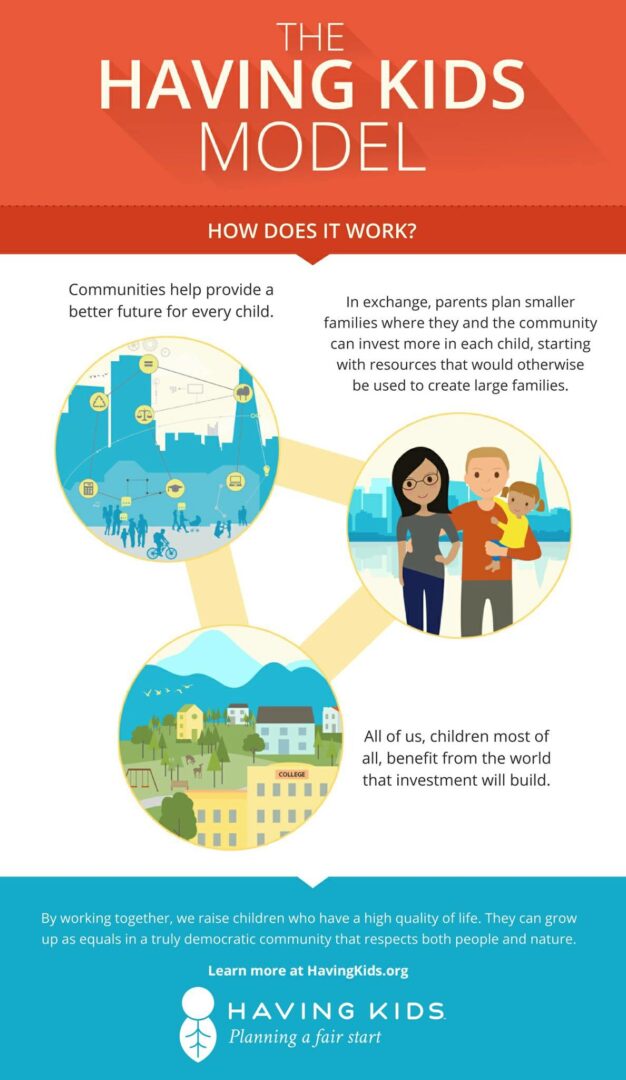
    Infographic explaining the Having Kids Model: communities invest in children’s futures, parents plan smaller families, and all children benefit from increased resources and a supportive environment. Includes illustrations and text.

    TAKE ACTION:

    These facts are indisputable: 1) Many benefitted from the mistakes described above by placing costs – ecological and social – on others. They did so in violation of multiple universal human rights that would have otherwise allowed us to constitute as free and equal people. And they did so in part by hiding the impact of the unjust family planning policies from which they were benefitting, instead using distracting downstream policies to prevent effective upstream reforms. 2) Most justly and effectively compensating future generations, who should be treated as a majority, for those violations requires targeting those precons most responsible, and those precons who benefitted the most, from blocking the process of constituting. They stand between us and legitimate systems of governance. 3) We right the fundamental wrong by taking and using portions of their concentrated power and wealth, measured against the relevant fundamental baseline, to constitute free and equal groups of future people via the effective vehicle of Fair Start incentives/entitlements.

    Free people will demand these resources, and be opposed by precons, who should be treated as the fundamental threat to our freedom.

    In other words these entities, like Exxon, should pay for the costs they externalized on others. And they must do so by complying with the first and overriding human right – Fair Start. We can spread this modeling, and this simple discourse: “Part of your wealth is my and my future child’s family planning entitlement and incentive.” If justice is meant to protect the most vulnerable, and it is, then it starts by protecting future persons, including nonhumans, which are the most vulnerable entities in the moral universe.


  • World Population Day: Young Women, Sustainable Families, and Our Right to Take the Wealth Our Kids Deserve

    World Population Day: Young Women, Sustainable Families, and Our Right to Take the Wealth Our Kids Deserve

    The climate and nature crises that our planet faces are rooted in both population and consumption.  We cannot waste precious time by pointing fingers between consumption and population – we need to talk about both in tandem, as our survival and quality of life, and those of our children, depend on it. 

    On the heels of Independence Day demands from people like Cassie King for the resources all kids deserve to ensure their eco-social Fair Start in life, and others who see their future child’s entitlement to birth equity as a sustainable family planning incentive, dozens of young women have come forward to speak out for more sustainable families. It’s a message for every young person’s future on planet earth.

    On World Population Day, July 11, 2021, GirlPlanet.Earth will launch as an informal forum for global dialogue by women and teenage girls from around the world on population, consumption, planetary boundaries, and personal choices.  Featuring the voices of women from Africa, Europe, North America, Central America, and Asia, GirlPlanet.Earth will enable honest, authentic, lively conversations between women and girls about our future.

    A group of students sit at desks in a classroom, attentively listening and taking notes. The focus is on a girl in a plaid shirt, resting her chin on her hand and looking forward thoughtfully.
    Courtesy of the Urban Institute.

    Join the conversation.

    In addition to young voices pushing back on unsustainable population growth, this Sunday – World Population Day – key experts will make clear the pathway to an optimal world population, at this special event.

    Having one fewer child actually reduces your carbon footprint more than any other single move you can make. We owe it to future generations to ignore advertiser-bound media pushing women to have kids to grow their economies. Instead, those intending to have small and sustainable families should approach concentrations of power for the wealth – and birth equity – their child has a fundamental right to under the Children’s Rights Convention and other human rights instruments.

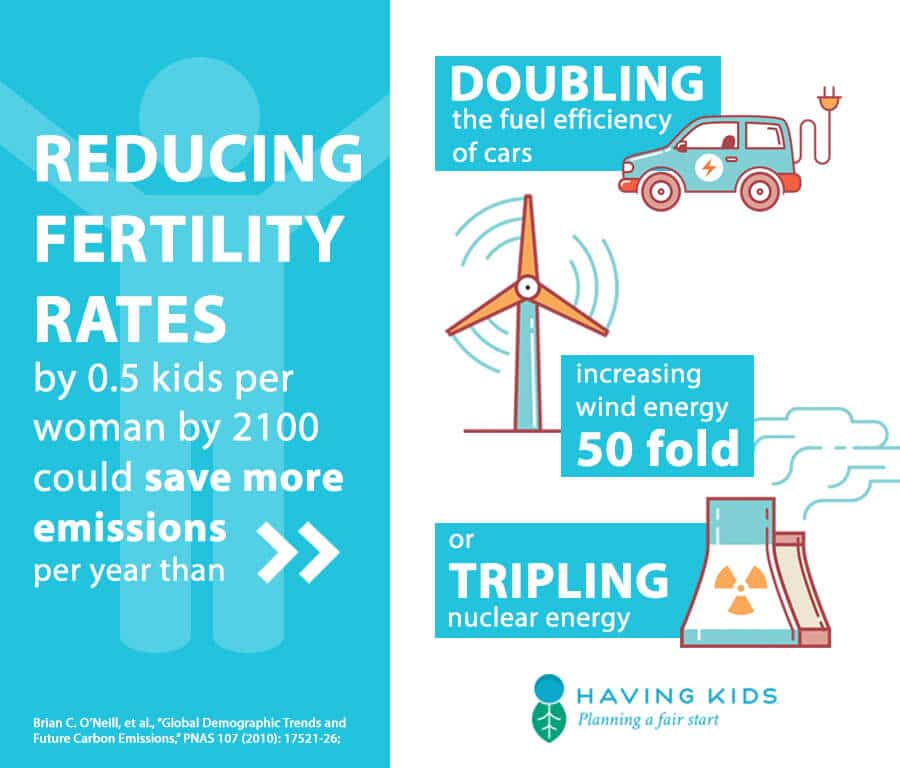
    Infographic showing ways to reduce carbon emissions: reducing fertility rates, doubling car fuel efficiency, increasing wind energy 50-fold, and tripling nuclear energy. Includes icons of a car, windmill, and nuclear symbol.

    This is the time to restart the conversation about family sizes, resources, population, personal choice, climate change and the future of our planet. The science is clear – we get the best outcomes, for everyone, when families plan for and invest more love, time, and attention in each child. 

    Stabilizing our human population, even through the most fundamental educational and economic advancement of women, has been taboo for too long.  Humanity has made terrible mistakes through coercive practices and policies, and stabilizing our population needs to be instead profoundly rooted in improved justice, education, and economic opportunity, especially for women and girls.  


  • Urge Time Magazine to See Falling Fertility As An Opportunity, Not A Crisis

    Urge Time Magazine to See Falling Fertility As An Opportunity, Not A Crisis

    Time recently highlighted the issue of changing fertility rates as a harbinger of a new era for the United States. But the author, Eliana dockterman, errs in thinking changing our old ways, where unsustainable population growth meant free money in the form of new bodies inflating gross domestic product, is a bad thing.

    Falling fertility rates are part of the overall trend towards population stabilization and gender equity, some of the greatest successes of our time. 

    It’s key in this process that we stabilize at a sustainable level – and given the climate crisis (which Docketerman never mentions) – we need smaller families to hit a safe level and we need them now. Delayed fertility and smaller families are one of the greatest ways to mitigate climate emissions. As we change average family sizes  and get over our addiction to growth, we are presented with another opportunity. Can we use new family planning policies to eliminate other crises, like the economic disparity, where the average black family has one tenth the wealth of the average white family in the United States?

    Yes we can, through policies designed to distribute wealth in ways designed to give every child a fair start in life.  Growth had to end sometime – hopefully it’s not too late. 

    Take action: Urge Time’s editor, Edward Felsenthan (@efelsenthal) to talk about better ways of planning our families that can make a brighter future for all.

  • Worried About Democracy? Trump is Merely A Symptom.

    Worried About Democracy? Trump is Merely A Symptom.

    Democracy is eroding. The cause? It’s not what you think.

    Minorities are having their voting rights strangled. Gerrymandering is subverting legitimate representation, as is the interference of foreign adversaries who are manipulating voters. Democracy is crumbling beneath our feet. 

    Believe it or not, the greatest threat to democracy isn’t Trump, or even Vladimir Putin. They are only symptoms of a greater problem.

    The greatest threat to democracy is inequality.

    A major report earlier this year described as such, including the fact that the U.S. (#1) and U.K (#2) have the highest level of inequality in the developed world. Forbes now reports that the “humongous wealth gap” is only getting worse. Furthermore, a 2014 study which concluded that the U.S. is more of an oligarchy than a democracy. It should come as no surprise that moneyed interests control Washington.

    But what does that have to do with democracy? The wealthiest citizens enjoy far greater influence on policy, government and our daily lives than the rest of us. The Koch brothers are the most obvious example. We typically don’t recognize the extent to which it affects our families though.

    And that’s where inequality undercuts democracy – our voice as “the people”, as those with extreme wealth steer policy in their favor. Ask yourself, why is income from hard earned labor is taxed at a higher rate than income from stocks and investments? Who is responsible for that? You can bet that it’s not the majority of Americans.

    “In country after country, the influence of rich elites over policymaking is skewing economies in favour of those at the top, at the expense of economic progress for all,” explains the UN Association – UK. 

    The theory is not new. Former US Supreme Court Justice Louis Brandeis famously weighed in.

    “We can have democracy in this country, or we can have extreme wealth concentrated in the hands of the few, but we can’t have both.”

    The Guardian also argued that the higher the inequality, the more likely we are to move away from democracy.

    The most effective way to address inequality:

    What is the most effective way to address the inequality that is eroding our democracies? Better family planning. 

    Yes, helping parents wait and plan is the proven most effective way to break the cycle of generational inequality and poverty – which is now at a staggering 40%. And it’s not just about being effective, or outcomes. A fair start in life is the first and overriding human right. It takes precedence over anything with which it conflicts, including the wealth that people at the top are using to destroy democracy. Parents and communities have a right to those resources to give kids a fair start. 

    Let’s start the Second American Revolution, the one where we come together as free and equal people with future generations, in our nation’s capital. The idea is simple: The District can reach many of its goals at once by promoting smaller families so that communities and families can invest more in each child. It is centered around every child’s right to a fair start in life, and is designed to address the greatest threats facing the District and nation, including inequality and climate change.

    Take Action:

    Help kids get a fair start. Support our effort for Guaranteed Minimum Income for kids in D.C. by tweeting @MayorBowser. Read more here.

  • Fox News Says Inequality is OK. What Does That Mean for Kids?

    Fox News Says Inequality is OK. What Does That Mean for Kids?

    Fox News personality John Stossel said “there’s nothing wrong with inequality.”

    Are Stossel and Fox News ok with the 41% of U.S. kids living in or near poverty and the life long harm caused by disadvantages early in life?

    HOW INEQUALITY HURTS KIDS

    There’s no question – inequality is harmful to kids. Studies have documented examples of rising inequality decreasing child welfare:

    inequality kids

    Here are the facts on childhood inequality:
    • Inequality affects kids for life. Unequal opportunities translate into unequal lifelong outcomes by the time children reach the age of five. 3

    Children who grow up poor are more likely to be poor as adults. Furthermore, the likelihood increases with each year of poverty that is experienced. – PBS Frontline

    • The impacts of inequality are more damaging the longer it is experienced. The longer a child is poor, the greater the risk of poverty in adulthood, and of experiencing lifelong health problems and involvement in the criminal justice system. 4

    The longer you grow up in poverty, the harder it is to graduate. PBS Frontline

    Disparities have been created through histories of discrimination and opportunity denial, and they dissipate slowly.– Population Studies Center and Survey Research Center

    The child poverty rate for blacks and Hispanics is more than double the rate for whites and Asians. Higher unemployment rates and lower earnings contribute to the gap. – National Geographic

    INEQUALITY IS RISING

    We all believe in fairness, whether liberal or conservative. But some fail to recognize that the playing field is not level. The reality is that socioeconomic status is inherited.

    1. The rich are getting richer, and it gets passed onto their kids.

    child inequality

    A line graph titled Distribution of Family Wealth (2016) shows family wealth across percentiles, with most values low or negative until rising sharply after the 90th percentile, peaking at over  million at the 99th percentile.

    1. Kids born poor stay poor, and social mobility is declining.

    Although overall poverty is declining, poverty is increasing among infants, especially for black and Hispanic children. Social mobility is declining and the condition of those in severe poverty is worsening. That is why a more equitable system to ensure a fair start is as important as ever.

    child inequality
    Source: Stanford Center on Poverty and Inequality

    “The proportion of U.S. children who go on to earn more than their parents has dropped sharply since 1940, when the rate topped 90 percent.” – Equality of Opportunity Project

    The bottom line? Inequality harms kids and it’s getting worse.

    As 2020 candidates propose solutions to inequality, will the response from the right be to deny that inequality is a problem? Inequality must be addressed to give kids a fair start. Fair Start family planning offers a real social contract that brings reasonable people on left and right together.

    This can be accomplished with a cooperative family planning framework. Fair Start family planning brings us together to invest in all kids, to improve equity and create a better society.

    TAKE ACTION
    We can do something about inequality. Help get a guaranteed minimum income (GMI) for kids in Washington D.C., where inequality is higher than any other state in the U.S. GMI that is tied to family planning is even more effective. Ask D.C. Mayor Bowser, @MayorBowser to pursue GMI tied to family planning to give kids a fair start.

  • How to Overcome Inequality and Exclusion? Start With Better Family Planning

    How to Overcome Inequality and Exclusion? Start With Better Family Planning

    Most of the world’s legal systems, and the cultures they shape, treat family planning like this: It is each individual’s personal or private right to decide how many children they want to have, the conditions in which those children will be born, and the opportunities in life those children will have. It’s a model focused exclusively on what would-be parents want in the here and now. That approach to planning our families derives from a cognitive dissonance called temporal myopia that leads us to ignore the long-term consequences of our actions. There is also nothing inclusive about that system. Nothing about it deliberately includes future children in their community, in any meaningful way that would ensure their voice is heard. It is less than ideal, for lots of reasons.  

    It isolates parents from their communities, creating a wall between the two.

    It prevents both communities and parents from working together to ensure that when children are born they get what every child needs. That includes even basic things like basic nutrition, health care, and a loving home. These basic needs are expressly or implicitly guaranteed by the Children’s Rights Convention. But because of the way we plan families, where the community is alleviated of its obligations in the planning process – many children never get them. Downstream solutions, like state protective interventions, are an insufficient band-aid. The Turpin family – and the long-term torture of the thirteen children – provides a jarring example. They abused over a dozen kids under the nose of their community, for years. That is isolation parenting. The Turpins not alone. Roughly 700,000 children are abused in the U.S. annually.  

    The traditional isolation model, the one even the United Nations promotes, helped ensure what happened in the Turpin family, and in similar cases every day around the world. In sum, in the isolation model, future children are treated as the property of the intending parents. This is discussed more below.

    It perpetuates inequality.

    The isolating way we plan our families also ensures (and was designed to ensure) massive inequality. Poor kids become poor adults, and rich kids become rich adults, with the latter inheriting both obvious and subtle benefits they never earned. Racial and ethnic disparities that have persisted are a consequence of that. Elites, in turn, create policies that ensure larger families and population growth, bringing more and more children into the world to fuel a system of workers, consumers, and taxpayers that benefit a small percentage of people at the top in what many have recognized as a Ponzi scheme pyramid. The United States was founded on opposition to birth-based hierarchies, like the British monarchy. How is it then that we are controlled by someone like Donald Trump, who was born in a such dominant positioning to others? Isn’t that odd? It’s not if you begin to examine and question the way we plan families, and how it perpetuates inequality and injustice.

    Line graph comparing median family wealth of White and Black people born 1943–51, showing White families with consistently higher wealth than Black families through their 30s to 60s. Data points highlight the wealth gap.

    It imposes severe environmental costs.

    This should be obvious, but a family planning model that protects people like the Duggars, a disturbing illustration of exponential growth, has not-so-great consequences for nature, the nonhuman world, and the environment upon which humans rely. Large families, and the population growth they created, are the fundamental source of climate change. Does that mean consumption does not matter? No. But the irrefutable truth is that consumption and family planning are inextricably linked, or two sides of one coin, and addressing consumption begins with revising how humans see themselves in relation to the earth, which in turn begins with the examining the meaning of our creation, relative to the ecosystems around us. We are, before we consume. The numbers matter. And here is the simple fact: By 2100, world population could vary by billions of people, depending on whether the average woman in the world today has one child more or one child fewer in her lifetime.

    It treats people and animals as property.

    The isolation model of family planning did something else, something at the most fundamental levels of society. It ensured that our societies, and the legal constitutions upon which they are based, would be positioned to treat both future children and non-humans – the most vulnerable entities in the world – as property. In the almost universally-accepted isolation model, would-be parents would have total control over future children (think the Turpins again here), and over the nonhuman world, which is treated as a human resource to be colonized and used. The nexus, between the human and nonhuman world, is property to be taken and controlled. If we don’t reform family planning systems, we never address that fundamental problem. In contrast, more ethical systems, replace the contradiction of procreative autonomy with more accurate values. With a better family planning model we can liberate both future children, as well as animals and their habitat, at the same time, and stop the former from being used to colonize the latter.  

    It’s time to change the isolating parent-focused model to one that includes the needs of future children and the community, and integrates the two together.

    It’s called Fair Start family planning.

    What’s that? It’s simple: Smaller families sharing resources to give every child a fair start in life. This child-centered model fixes several mistakes in the parent-focused model, and centers family planning around inclusivity and equity. It is nonpartisan at the most fundamental level, derived from fundamental and widely shared values, and it is designed to capitalize on falling fertility rates, steering them into better qualitative outcomes. Fair start family planning is fairness and inclusivity, on caffeine.     

    There is resistance, of course. Those at the top of the pyramid, and the politicians that represent them, are leaning on women to have more and more kids in order to create consumer demand, a class of cheap future labor, and a larger tax base. That is exactly why Trump and his family were behind barely-noticed reforms to the Child Tax Credit in 2018 that were expressly designed to urge women to have more kids. Let’s be clear what this means. Congress will pay you for each kid you have, regardless of whether you neglect and abuse those kids, or simply have them in to totally failing state systems out of which charities are struggling to pull kids every day. Why? Kids equal economic growth, and that equals money for elites. People who oppose family planning reform are godsends for companies like Unilever that will profit from the growth to come.  

    What is one way elites, who benefit from the constant flow of consumers, cheap future labor, and compliant taxpayers produced by poor family planning, keep the system in place? They fear-monger by intentionally conflating better family planning with many of the horrible reproductive rights violations of the past, like eugenics. They elide the complex intersectionality at the heart of family planning. But do you really think Fox News cares about equity? They and many other reactionary entities create endless propaganda to keep discussions of family planning taboo, and this lever for real social change hidden.

    Doing effective social justice work means considering where people come from, the conditions in which they are born and raised, and whether the process that brought them into the world and provided for them is just. That is step one. If you don’t work on reforming family planning systems you are missing what could be the most influential factor in your work, others will be busy controlling that process, and what they do will have nothing to do with justice.

  • Kylie Jenner, Inequality, and the Future of America

    Kylie Jenner, Inequality, and the Future of America

    Twenty-one year old reality tv heiress Kylie Jenner has been called a “self-made” billionaire by Forbes Magazine. Given the wealthy family in which she was born and other massive unearned privileges, many are laughing at that claim. The key to being rich is being born rich, as evidenced by the lavish #StormiWorld amusement park party in which her one year old received her first Chanel purse.

    Displays such as this raise deep questions about what it means to live in a country where the wealthy easily multiply their fortune (see the chart below), while 41% are lacking in the most basic necessities and are becoming downwardly mobile. Our educational systems keep the average person in the United States reading at the level of a 7th or 8th grader.

    Tweet Kylie at @KylieJenner, and urge her to give a child in a need a fair start, relative to her start in life.

    income growth inequality
    Source: David Leonhardt, NY Times

    Climate change is now exacerbating this inequity as it disproportionately affects impoverished communities and drives up the painful costs of being poor. Is the playing field so slanted that it’s finally time to take bottom-up direct action to level it?

    Solutions like the Green New Deal fall short for the same reasons that all other new reforms fall short. They make the same mistake we have made for centuries – by failing to see the responsibility we have to future generations. This is not some abstract duty – it involves ensuring every child born a fair start in life. But we have made, and continue to make, that mistake in part because of built-in cognitive biases against long-term (and especially effective) planning. Those biases blocked thoughtful, sustainable, and cooperative family planning that – had it been instituted decades ago – would have prevented the climate change, massive inequality, and failing child welfare systems that threaten us today.

    All of this stems from the fact that our understanding of the social contract that legitimates our system of government is deeply flawed. How does it account for the fact that United States, through its climate change policies, has become a national security threat to itself?  Our social contract is only valid to the extent it ensures we remain free and equal people. That includes preventing the dystopian future of a degraded environment, massive inequality, a weaker voice in democracy, and the consolidation of power of the few over the many – the path on which we are heading.

    What then are we doing to protect those future generations, today?

    The Fair Start family planning model, corrects that shortsightedness and legitimates the social contract by putting children’s interests first. It does so by making the beginning of the social contract a simple two part agreement:  Communities ensure that parents have the resources to plan families and guarantee that all kids have the resources they need for a fair start in life. And parents delay having kids, and have small, sustainable families that put less demand on our shared resources and our world.

    That agreement creates the first term of the social contract – the first human right, the “we” in “We the People”. It creates an ecologically sustainable (if not regenerative) society of people who receive a fair start in life. It builds human rights-based democracies from the ground up by ensuring all kids get what they need growing up, or a truly level playing field, and is simultaneously the most effective way to mitigate the threat of climate change and other environmental crises. It is, hands down, the most effective way, to protect kids, animals and the environment.

    Unlike the current version of the Green New Deal, the real deal of child-first Fair Start planning appeals to the ideals of the most thoughtful conservatives and libertarians, as well as liberals. The model recognizes that 1) long-term planning and ensuring the actual development of each child is the most effective way to addresses our greatest threats, 2) that both Big Wealth and Big Government have utterly failed their obligations to ensure that development, and 3) that the assets of both should would best be redirected  – by the people – towards Fair Start funds, in an override of any claims people like Kylie might have to unlimited wealth, as well as any obligation to pay tax dollars that may simply be wasted. That’s the real deal – one between us and future generations to build democracy from the ground up – out of the actual people that will comprise it.

    Non-partisanship aside, this is key: Because Fair Start family planning is lexically prior to all other rights in the social contract (the first term), it overrides anything with which it conflicts. We are before we do. All kids have a fundamental human right to a fair start in life – which can be secured by any means effective. What does all of this mean? The right to a fair start in life, as the first human right, overrides both private property rights and tax obligations. The Fair Start model is a non-partisan real deal for conservatives and liberals to both make concessions. Big wealth and big government both need to decentralize influence and use resources to empower future generations and make them resilient. 

    Our world, and future, is defined by the people in it. But they are mostly defined by the conditions in which they were born and raised. Fair Start family planning ensures that all kids have the resources they need for a fair start – not a head start for a few, like Kylie. Fair Start family planning is a real deal – focusing on the creation of future generations, and it should be the foundation of modern attempts to revise the social contract, like the Green New Deal.  

    What would you do to protect future generations and ensure they get what they need? What have prior generations sacrificed to protect us, and ensure our freedom? Could the resources of the elite be put to the best use preventing climate change through the most effective means possible – better family planning? The ground to encourage and ensure Fair Start family planning lies everywhere in this country. Every person is a potential freedom fighter to create a real social contract. Kylie, and especially those bad actors like Exxon that have profited from creating the threat of climate change, should not underestimate what parents will do to protect their kids once they learn to question the legitimacy of unlimited property rights and other unquestionables that the elite take for granted.

    Someone like Kylie, who has colossal influence should openly endorse better family planning to help ensure other kids a fair start in life relative to her own and her daughter’s. Furthermore, the taxes that she and the rest of the ultra-rich are paying could be partially shifted into Fair Start funds. Ensuring all kids a fair start in life should not be a morally controversial thing. Together we can work together to make it happen – a much preferable scenario to the alternative.


  • 2020 Candidates: We Can’t Fight Inequality Without Family Planning Investments

    2020 Candidates: We Can’t Fight Inequality Without Family Planning Investments

    As 2020 contenders like Warren, Booker, Harris, Gillibrand, Schultz, and others make the media rounds, we’ve been hearing a common theme: creating a future where Americans have the opportunity to succeed. They talk about getting a fair shot and the struggle to get ahead.

    Elizabeth Warren frequently declares that it shouldn’t matter where you come from. She wants to fight for “…an America where every kid, no matter what that kid’s zip code is, has that same fighting chance.” It’s a trope used frequently by candidates.  

    But the reality is, it does matter what zip code a child is born into. If we want a country where the zip code in which you are born doesn’t matter, family planning HAS to be part of that picture. There’s no way around it.

    In “Giving Kids a Fair Chance,” Nobel Prize Economist James Heckman argues, “the accident of birth is the greatest source of inequality in America today. Children born into disadvantage are, by the time they start kindergarten, already at risk of dropping out of school, teen pregnancy, crime, and a lifetime of low-wage work.”

    Being born into poverty harms kids for life, and the longer it is experienced, the harder it is to overcome. Unequal opportunities translate into unequal lifelong outcomes by the time children reach the age of five. And right now a whopping 41% of American children live in or near poverty. Inequality in the U.S. is so pervasive that the UN has called us “the most unequal society in the developed world.”

    There’s no level playing field without a fair start in life.
    If we’re not talking about fairness from birth, we are not addressing the disparities in cognitive, emotional and health development that are inflicted. We’re not addressing the gap between young children who receive full attention from their parents and those who are missing critical early learning and social skills because their parents are working multiple jobs to get by.

    We squabble about how to improve school performance while ignoring the fact that 14.8 million kids in the U.S. don’t have enough to eat. It doesn’t take an expert to recognize that hungry kids cannot concentrate and do well in school. 

    As the Huffington Post explained:

    “The root of the problem of school performance is that we do not know how to effectively respond to the impact of poverty on a child’s readiness to learn or how to provide more effective instruction to accelerate progress for low-income students who find themselves behind their peers.

    Children born into poverty must overcome significant obstacles to their educational success before ever stepping a foot into a classroom or school. And once they do enter school, they encounter a system designed to provide instruction to groups of children that are expected to learn in the same environment and at the same pace. For children in poverty who began their formal schooling already behind other children, this uniform pace and structure assure that they will never catch up to their peers.”

    How Family Planning Reduces Inequality
    The decades of evidence is clear. Parents who plan, wait, and focus resources on smaller families are more financially secure and stable, parent better, and invest more in each child. The results pay off for kids in the form of greater academic achievement, emotional health, social mobility, health, community participation, gender equality, lifetime success, and more. Research indicates that better family planning is the most effective way to end the cycle of poverty.

    Fixing Our Broken System
    Some candidates are exploring the idea of a Green New Deal among other fixes. Yes, corporations and the 1% need to pay their fair share in taxes, adults need a living wage, and the cost of higher education needs to be addressed. But history shows that fairer taxes and better jobs are not enough. All of that must go hand-in-hand with investments in children and family planning to enable every child to succeed throughout their development and into adulthood.

    One solution? Guaranteed Minimum Income tied to family planning. Having Kids has proposed such a plan to reduce inequality in D.C. Another approach is having great success in Colorado through the LARC4CO program, a partner of Having Kids. They offer affordable long-acting reversible contraception (LARC) to reduce unintended pregnancy and empower families to achieve greater stability before having kids. Investments like these are powerful tools in reducing economic inequality. 

    Until we invest in better family planning to give all kids a fair start, zip codes will continue to matter in the fight for equality. We implore the candidates to start the conversation.

    TAKE ACTION: Tweet the candidates and tell them that we must invest in family planning to reduce inequality. Use the hashtag #fairstart.

  • What the Occupy Movement Should Have Said

    What the Occupy Movement Should Have Said

    Thanksgiving is not about turkey and football. For thoughtful and caring people, it goes much further, and is tied to the American ideal of democracy.

    In 1896, Abraham Lincoln made the Thanksgiving proclamation to a weary country, divided by civil war, with the fate of the democracy in peril. Many believe that the purpose of the Mayflower Compact was to protect the liberty of dissenters from the tyranny of those in power. These and many other points in history remind us why Thanksgiving is a good opportunity to reflect on democracy. One recent attempt to reset our system to the ideal was the Occupy Movement. It has been described as:

    [A]n international progressive, socio-political movement against social and economic inequality and the lack of real democracy around the world. It aimed primarily to advance social and economic justice and new forms of democracy. The movement had many different scopes; local groups often had different focuses, but among the movement’s prime concerns were how large corporations (and the global financial system) control the world in a way that disproportionately benefited a minority, undermined democracy, and was unstable.

    The movement has been criticized for lack of a centralizing vision, and specific demands for changes in policy. Could it have taken a longer-term view of change, one related to family planning?

    Democracy relies on a fundamental premise: That societies form, and remain legitimate, through the consensual coming together of free and equal people. The reason is simple. How else would you justify the authority of the state, and government?

    Here’s the thing. For many centuries that premise was thought to apply to the people alive at the time, adults who could choose – as free and equals – to enter and leave societies and nations as they pleased. But that static view of freedom and equality is riddled with problems. The idea of “coming together as free and equals” works much better if we think of it in terms of planning for future generations, and what it would mean if we apply it to them. Thanks to modern contraception, reduced infant mortality, the (too slow) recession of religious and other forms of oppressive patriarchal families, and about a dozen other things, we can now do that. We can make democracy inter-generational, and realize it in ways it’s not easy to imagine in today’s world, where democracy is virtually meaningless.

    The child-first Fair Start family planning model does just that.

    It’s simple: Parents plan a fair start in life for their kids. Communities, in exchange, help fund that start – proportional to need. Parents and communities both promote an ethic of smaller families to make the whole thing work, and to free us from crowded societies where the average person’s voice is lost in the crowd and does not matter, where people live in fear of one another, where they are not raised to run their own democracies, and where the freedom and security of nature is disappearing every day, etc.

    Occupy started something. Fair Start family planning can finish it. Learn more, and join us.