Few people born today will ever be vegan. So one cannot effectively protect animals, from all those meat eaters and habitat killers for example, without reforming family policy too.
These companies and their funders are doing so because it ensures cheap labor and lots of consumers for their products. Moves like this also create political space for things like abortion bans.
These companies knowingly undo claimed progress with outdated family policies that disempower most people in order to – per one Nobel laureate – grow economies that benefit a few at cost to freedom and democracy. And even when shown the undoing, many companies and funders have continued on course.
TAKE ACTION: If you want to actually help animals, ask any company appearing to benefit animals to disclose their family policies, including how they are protecting women’s right to terminate their pregnancies and whether they have employment policies that avoid wealthy employees passing massive privilege to their children.
Recently Fair Start added an addendum to this letter. Read it here.
Open Letter to Prime Minister Shri Narendra Modi Regarding India’s Human Rights Obligations in Developing New Family and Population Policies sent January 29th, 2023
This is the key thing to know: India should consider itself bound by international human rights and obligations to future generations when devising a new policy, which it needs desperately. The best human-rights based guidelines for that policy are described in filings now before the United Nations, and which treat Article 16 of the International Bill of Human Rights as the most basic norm – or grundnorm – around which all family and population policy must orient.
We, the undersigned are writing to urge you to bring your legislation in line with international human rights obligations to future generations, an opportunity signaled by Dr. Natalia Kanem of the United Nations Population Fund’s (UNFPA) via her bold statement on World Population Day that equality is not about counting people but making sure people count. India can use international law, the binding sources rather than the flawed Cairo Consensus, to guide its family policy reforms to ensure every child a fair start in life.
Fair Start as the First and Overriding Human Right
All forms of political obligation begin with a list of norms, or human rights, that attempt to objectively limit the subjectivity of democracy. The order of these lists – from the International Bill of Human Rights to India’s constitution, show why the Cairo Consensus, which was driven by elites who did not want to invest in children but rather exploit population growth for profit, ensured an unsustainable population explosion, massive inequality, and the climate crisis, is a failure.
The first norm that must begin any set of human rights is the right to have children, accounting for the people themselves, and that norm – despite what Cairo intended – cannot be subjective to the parents but must be based on the fair and objective needs of children, as outlined in the Children’s Rights Convention. To give parents unlimited power over their future children is a form of property in persons. Many charities, funded by wealthy persons more interested in protecting their wealth than doing good, push distracting campaigns that do little good in the face of things like massive inequity and a climate crisis set to kill millions.
They are hiding something called the “constitutive fallacy,” basing one’s obligation to follow the law on top-down instruments like written constitutions rather than bottom-up family reforms that actually empower and liberate people – in terms of their actual relations – and in a measurable way, enabling them to physically constitute – under the Children’s Convention – legitimate power relations between people from whose authority things like written constitutions must derive.
Truly free people will limit and decentralize the power others have over them, including via reallocating property rights, by actually constituting systems in which they are empowered.
This means changes in the actual practice of India’s family and population changes can happen bottom-up, through class struggle that seeks to invest more in planning for the future of families at the bottom of India’s economic demographic.
An example of the fallacy involves what’s been called the #famscam, in which several civil society organizations were outed by a whistleblower in 2023 for violating ethics rules and knowingly undoing claimed progress with outdated family policies that disempowered most people in order to – per one Nobel Laureate – grow economies that benefitted a few at cost to freedom and democracy.
We urge you to continue your bold actions, and to take a clear public position recommending just and sustainable family planning to address rising global inequality – including gender inequity and the climate crisis. Governments, NGOs, and major foundations are failing women, children and future generations. Without a universal effort to implement equitable and sustainable family planning programs, Sustainable Development Goals (SDGs), FP2030 commitment, and Human Development Index benchmarks cannot be achieved, and human rights will continue to erode.
And they will do so in a world where the climate crisis continues to unfold more quickly than expected, leaving the dead in its wake.
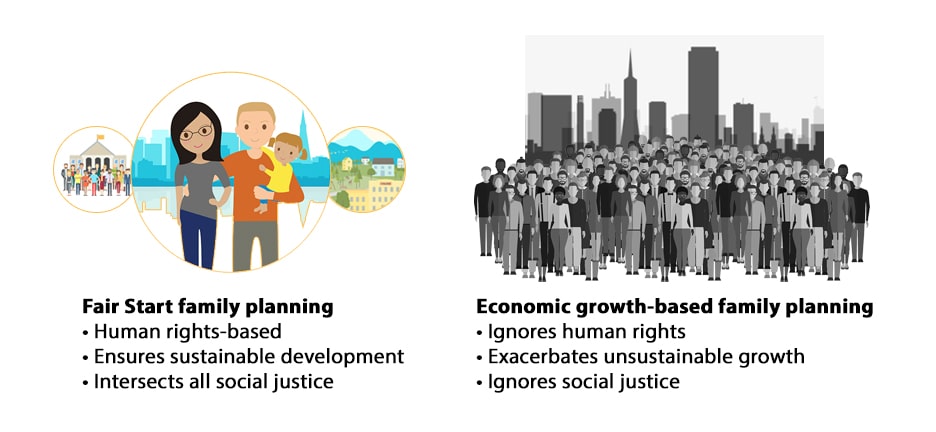
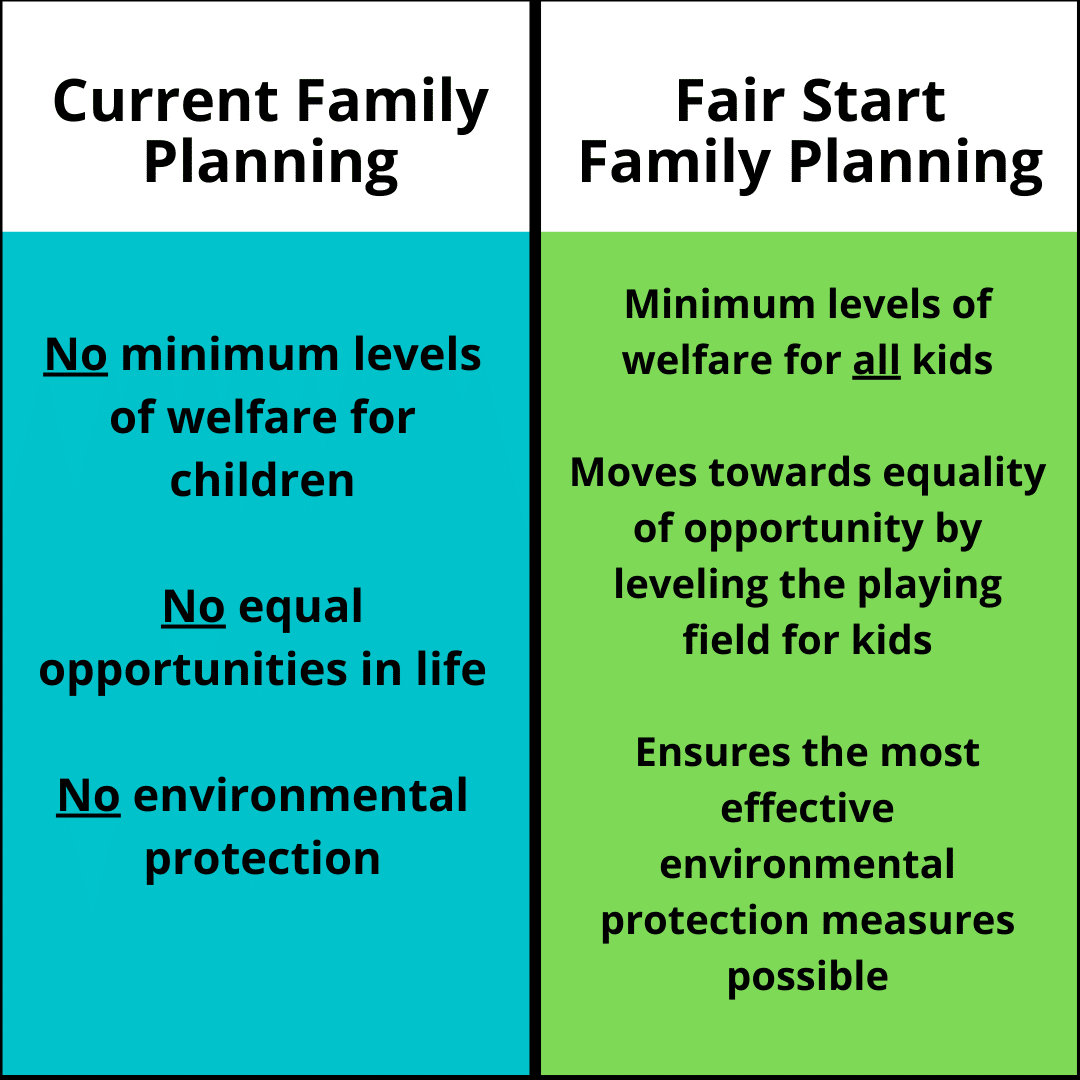
Just and sustainable family planning centers on human rights and accounts for the needs of women, children and future generations – something that current family planning programs across the globe fail to do. Family planning that is just and sustainable:
● Ensures equitable access to family planning and education
● Ensures equitable entitlements at birth and moves towards using fiscal and other policies to ensure that all children are born and raised in conditions that comply with the Children’s Rights Convention
● Ensures every child is born with a fair start with sufficient resource
● Reflects the disparity of ecological impacts between wealthy nations and less wealthy ones, and allocates responsibility proportionally, including calling for the waiving of property claims where appropriate to account for the costs externalized – relative to the Children’s Convention – in the creation of concentrations of wealth
These resources empower individuals and families and enable communities and governments to sustainably and equitably invest more in each child and their future while upholding reproductive rights.
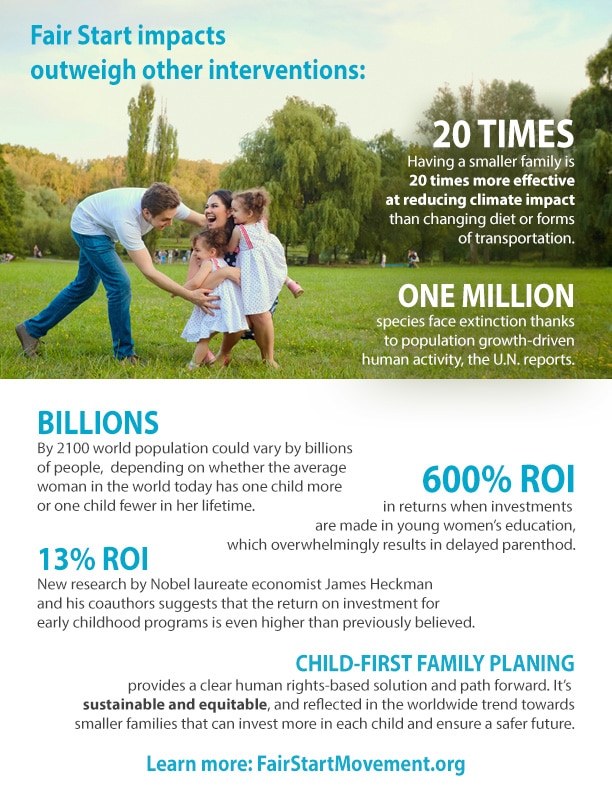
However, current political, religious, economic, and cultural pressures to increase births and obstruct family planning programs are driving our biggest global crises and putting the health, safety, and welfare of current and future generations in peril. The growing human population, with 8 billion alive today, is already too much for earth to sustainably and ecologically support.
Unsustainable population growth, a documented threat multiplier, contributes to catastrophic climate change, unprecedented flooding, pandemics, ecosystem destruction, groundwater depletion, mass extinctions, and environmental degradation. Worsening inequality, in large part driven by our growing population, is also a grave threat to democracy and political stability across the globe.
The Right to Found a Family
Current family planning programs and policies demonstrate clearly the UN’s misinterpretation of the right to found a family under Article 16 of the Universal Declaration of Human Rights. Article 16 should have been exercised in a way that protects all generations – from the middle of the 20th Century to those in 2050 – equally. The United Nations also should have interpreted Article 16 as being consistent with other human rights obligations, such as the Children’s Rights Convention, FP2030, as well as the SDGs.
Because they see the conditions being created today, 40 percent of young people have expressed concerns about exercising their right to plan a family. A robust application of Article 16 could allay those concerns. Instead, the United Nations succumbed to member state pressures to promote and coerce large, unsustainable families and increase population growth rates in the 20th century.
Children’s Rights and Intergenerational Justice
The misreading of Article 16 enabled pro-growth economic and pronatalist pressures to directly undermine the UN’s clear commitment to the rights of children, sustainable development, and intergenerational justice. As things stand, young and future generations face the prospect of significant reversals in human rights.
Mountains of evidence show that because of population-driven environmental threats, children born today and tomorrow will live “an unprecedented life”, facing “conditions older generations have never experienced.” The most recent report from UNICEF indicates that almost half the world’s 2.2 billion children face an “extremely high risk” from the impacts of the climate crisis and pollution. The inequities created by unsustainable growth policies also gravely impact the estimated 356 million children living in extreme poverty worldwide.
Just and Sustainable Family Planning
The global community has failed to promote or support family reproductive decisions that lead to healthy and sustainable ecosystems and equitable prosperity. Quite the opposite, in fact.
The best way to compensate current and future generations for this failure would be to reinterpret Article 16 as stated above and create an equitable balance of resources. Equitable distribution would ensure that children are born into just conditions including entitlements and a global vision that puts them first – with a fair start to a path forward.
Governments and community institutions must make sustainable, equitable investments in current and future families. They must be required to educate would-be parents about the benefits of delayed parenthood, birth spacing, and smaller families – including those with no children. These investments would create greater family financial stability, better social and emotional outcomes, higher standards of living, women’s empowerment, greater investment in each child, and would result in a more sustainable planet.
A declaration by the The Prime Minister would be a powerful step toward dispelling the myths that underpin pronatalism and challenging the reluctance to address unsustainable population growth. Such a statement would elevate discussions around the needs and wellbeing of existing and future generations.
Such a declaration also would highlight the urgency of substantial investment in comprehensive and equitable family planning programs. These programs not only realize individual rights but also advance the legitimate goal of creating equitable and sustainable birth conditions.
The United Nations has been criticized for not intervening to protect human rights in other contexts. This negligence has already resulted in calamitous consequences for the planet and the human species. It is therefore imperative that the Prime Minister call on governments, NGOs, and major foundations to promote equitable and sustainable family planning to ensure intergenerational justice and achieve true liberation for all people, starting with women and children.
But that process was designed before the climate crisis, surely a threat to human freedom as it represents the imposition of others influence upon the natural (or nonhuman) background world that buffered us from one another for millennia.
Can we do more than family planning interventions designed decades ago? Yes – we can use this crisis as a chance to become – existentially – free.
These reforms correct something called the constitutive fallacy: Ignoring the way our creation and development do and (assuming we use baselines like the Children’s Rights Convention) should – fundamentally – constitute actual power relations, between humans, and between humans and the nonhuman world or nature upon which freedom is based.
Family reparations override because being just in who we are precedes being just in what we do. And we cannot assign things like property rights that derogate from our being (or constituting the fundamental power relations so that we are) free and equal people.
Without these things people will try to wrongly empower themselves, and against the wrong targets rather than the people responsible for or who benefitted from the family policies that externalized the costs of wealth by crowding people out of town halls and into shopping malls, through acts of violence.
TAKE ACTION: URGE CALDER, @vanessabcalder, AND CATO TO TAKE FREEDOM TO THE EXISTENTIAL LEVEL, APPLYING THE INVERSION TEST TO MAKE FAMILY POLICY FAIR AND LIBERATING.
Peter Singer is regarded by many as a founder of contemporary animal rights, largely based on his book Animal Liberation. But few realize that he has also taken public and influential stances on family and population policies, in this 2018 public lecture, for example. He avoids making concrete conclusions about population policies in this lecture and elsewhere,
Nowhere has he advocated for effective interventions – like overriding property rights to wealth in order to fund Fair Start family planning incentives/entitlements – and other peremptory norm measures would have bent the arc of unsustainable growth downwards towards what many see as optimal world population ranges. Those ranges, like all population matters, actually involve people – and the fundamental creation of power relations between them. And power and population ethics begin with human rights, the objective frame that after WW2 should cabin utility, Effective Altruism, and all other lesser and more subjective forms of policy Singer normally employs.
How is animal liberation possible in the face of a wave of human population growth causing massive extinction? How is promoting veganism for what is effectively a small percentage of a growing human population that mostly exploits, tortures, and kills nonhumans true animal rights? How does that growth further human rights when the growth enriched relatively few people, at cost to equality and the political stability it brings?
Singer’s work is based on an error called the constitutive fallacy, or ignoring the way our creation and development do and (assuming we use baselines like the Children’s Rights Convention) should – fundamentally – constitute actual power relations, between humans, and between humans and nonhumans. Who we are might be different mixes of nurture, or nature, or influential power relations, but all flow (and among self-determining peoples should flow) from our creation. We cannot separate values like nature and equity from who we are and our power relations with others, which stem from our creation.
For example, our economic birth position mostly determines whether we are rich or poor as adults. Another example would be that it is impossible to ensure the empathy people need to treat nonhumans well without addressing the conditions in which people are born and develop because empathy largely depends on years zero to three in childhood maturation.
Another example would be that if we assume we ought to treat nonumans well, we would have to structure an effective legal system that would obligate that. But because there is such massive attenuation (caused by the growth that is eradicating the nonhuman world) between people and their representatives, we cannot do this. Another example would be world leaders attempting to determine the costs and benefits associated with Anthropocentric environmental baselines like the Paris Agreement, a mistake that only accelerated ecocide, rather than using an organic baseline like beingrelatively self-determining people and the conditioning of wealth on equitable family planning investments that make that possible. (This last example gels with the constitutive fallacy as political adherence to national constitutions, or even international law, as basic and overriding norms, as opposed to adherence the obviously antecedent and more basic family planning norms that create us, the people.)
In other words, in Singer’s prescriptions for animal liberation come from outside of who people ought to actually be, in terms of the creation of the fundamental power relations that define them.
Some have argued that it’s unfair to say that Singer’s population comments (or lack of comments) have “undone” his work for animals, given that virtually no one knows what his views on population are. Per this argument, there are probably zero policy-makers who’ve done anything based on Singer’s population views. Perhaps few or none have decided to procreate or not procreate based on Singer’s silence on the issue.
This response treats population as something, an issue, that we can separate from what we do. But how can we do anything, or suggest that others should do something, without first determining the acceptable power relations that determine who we are, and should be? We cannot separate what we narrowly think of as population – or who we are – from what we do. The former is always a factor and precedes the latter.
Singer’s claim that “we should help animals by not eating them” is wrong on its face because the “we” in his claim – the fundamental creation of power relations that permit growth, relations he accepts – does more harm to animals than changing diets does good. That’s the constitutive fallacy at play. And that mistake – not requiring things like the Children’s Convention standard in family planning policies to improve those relations, which would physically constitute just communities – does more than just harm animals. It fundamentally permits anthropocentric changes that cause irrefutable harm to all, against an absolute standard like infant health.
Don’t confuse chaos with freedom. Truly free people will fundamentally limit and decentralize the power (including subtle power like climate emissions, the impact of bad parenting on communities, massive disparities of wealth, etc.) others have over them, and by all means effective. They will condition their obligation to follow the law on their actually being empowered, assessed via a simple test, in functional democracies.
Singer never seriously addresses this issue, through redistributive birth entitlements that empower us in terms of who we are before turning to what we should do, for example. That mistake of ignoring the primacy of who we should be (and the best answer is fair), given his position of influence and the crucial time for mitigating the climate crisis in which he was working, harmed future generations.
And as a result his work does not effectively protect nonhumans, promote equity, restore democracy, or even protect considered parental desire. An alternative approach which does not make the error would value each person born, and the value of self-determination, above the growth Singer never seriously opposed.
Is this type of fairness a threat to the ongoing processes of decolonization. antiracism, and other forms of anti-oppression? Eliminating the massive birth inequity caused by colonization – the one that disempowers the majority of people, those who will live in the future – and doing so while restoring nonhuman autonomy is the height of anti-oppression. Though admittedly, all of this argument flows from Eurocentric framing and should also be done from more indigenous frames.
It would treat ensuring minimum levels of welfare, and freedom, as more important than total welfare indictors like gross domestic product. It would elevate ethics in the creation of people – and the conditioning of political obligation on family planning policies that ensure people will matter – over the constitutions and governments whose authority to assign property and other rights derive from such people, again something Singer never considered.
TAKE ACTION: Urge Singer to #tellthetruth and admit that his family and population ethics undid his animal liberation ethics. Urge him to support a pivot from parent-centric family planning to child-centric planning. He should admit that before we can engage in Effective Altruism we are politically obligated to constitute just communities – and total liberation – through socially and ecologically regenerative family reforms like Fair Start.
Without this, his work could in the end do more to protect concentrations of wealth and power than nonhumans.
He should not allow his work on animal ethics to mislead people from the truth that we are committing ecocide through poor family planning, and should support paying back the costs to freedom that population growth has imposed on future generations. Also urge him to lead by example and treat property claims – like the extreme wealth he helped create in the plant-based industry – as conditional on our fulfilling every child’s right to a fair start in life.That wealth, and the power disparity it represents, is defended by the threat of state violence, not the true justification possible amid fair power relations.
Parag Khanna’s recent push in Time to make mobility a human right in light of lower fertility rates and ageing in many nations seems well-intentioned. It’s certainly better than the legions of men crying out against a baby bust, as they urge women to have more kids to serve as cheap future labor and taxpayers. But Khana shares the same fundamental value with those men: Economic growth. And he places that over values like nature, equality, and participatory democracy.
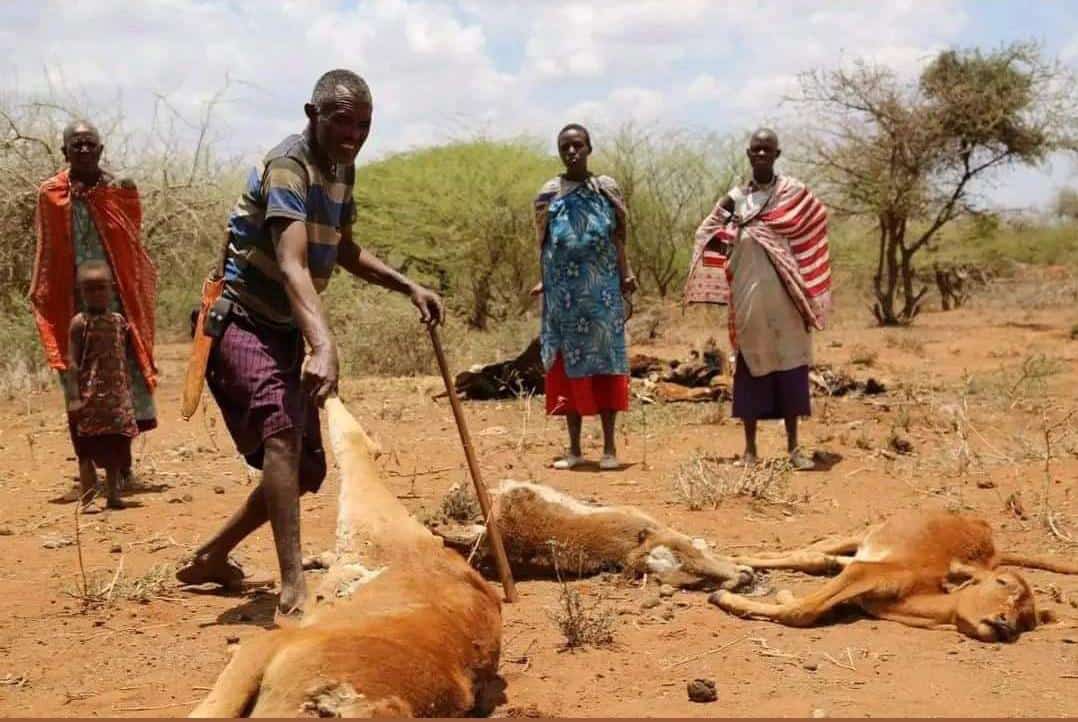
Drought in Kenya has been exacerbated by the climate crisis.
The wealth of the past several decades was made and placed in the hands of a few, according to one Nobel Laureate, by externalizing its costs on future generations. It was made by not requiring environmental regulations that would have prevented the climate crisis, and not ensuring that all children enjoy birth and development conditions consistent with the Children’s Rights Convention. Our priority should be to regulate and provide in this way, in part by compensating future generations through family planning entitlements, before we turn to mobility.
Fair Start Movement’s mission is to replace parent-centric subjective family planning systems with a child-centric model that ensures children are born and raised in conditions consistent – minimally – with the Children’s Rights Convention, a move enabled via effective family planning incentives/entitlements. We partner with organizations around the world, like the wonderful Rejoice Africa Foundation (formerly Kibengo Youth Care Activists), on Fair Start and other initiatives.
Thank you for being a leader in the efforts to assure family planning needs are being met worldwide. Given recent discussions of your foundations possibly funding a world children’s savings bank, if these reports are true, we urge one simple guideline for such a plan. That guideline would correct the baseline error, or the act of trying to assess costs and benefits without orienting from a position of consensual governance, described further below. We urge that the gift recognize that much of the wealth was built on a system of unsustainable growth and illegitimately externalized costs, per one Nobel Laurate, that included billions having and raising children in conditions that did not satisfy the standards children and their parents deserve, the standards that were eventually codified in the Children’s Rights Convention.
Is there evidence that we see children as economic inputs, rather than citizens, and not deserving of minimum levels of welfare, equity, restored ecologies, and an influential voice in their democracies? The ubiquitous bemoaning of falling fertility rates as a “baby bust” economic crisis, with no plans to assure children the things described as various policies are offered to reverse the crisis, is ample proof.
Our work establishing this fundamental baseline for assessing costs and benefits, and the human rights nature of child-centric planning as oriented to protect the vulnerable parties at stake, has been subject to almost half-a-dozen peer reviews. And the claim that a fair start in life logically precedes governmental authority to issue the property rights on which the wealth was built – because we are before we do – seems irrefutable. How could we be self-determining or free in an anthropocentric world dominated by a singularly human-centric viewpoint, rather than a natural or nonhuman one – built into family planning – that allow humans to consent to the power of others? Without that primacy we never constitute fair, or free and equal, societies. We never create the consensual, inclusive, and participatory town halls necessary to actually regulate the wealth-building economies. Free people will condition their political obligations on their capacity, as equals, to change those obligations. Fair Start enables this.
This is our challenge: If your plans are to give as reported, please designate at least part of the funds – by COP 27 – as human rights entitlements designed to move us towards the fundamental baseline discussed above, one which actually complies with the requirements of the international human rights regime. Surely, as things like the threat of climate-driven mass famine in the Horn of Africa unfold, it’s clear that our current, anthropocentric, isolating, and inequitable system of family planning was a terrible mistake. Fair incentives/entitlements, designed to build the town halls that liberate us, could have prevented that. If children deserve the funds, they deserve the efficacy putting the funds into bending the arc of planning and growth would produce through things like allowing delay and preparation, creating changes in family size, ensuring opportunities for co-investment, encouraging relocation etc. If it takes a village to raise a child, it takes a village to plan for one and there is a test for whether we are doing that consistent with human rights and democracy.
The entitlements are not paying for people. They are paying to convert – at the most fundamental or creative level – commercial relations into empowering democratic/normative relations, or the sort of town hall relations needed to regulate the second-order forms of shopping malls. If we value democracy it will be unreasonable for intending parents to refuse the empowering funds, and unreasonable for concentrations of wealth and power to refuse to give them. Whether we are part of groups of free and equal people first depends on whether we correct the baseline error described above (reiterated in the Cairo Consensus which wrongly treats the act of having kids as more self-determining for the parents than other-determining for the children born) and are part of efforts to ensure people are relatively self-determining through collective child-centric planning, or we are not part of such efforts. There is no obligation that can proceed this – becoming a just people.
Legal systems, markets, customs, etc., can only do so much to guide human behavior. The gaps depend on – and in government by the people should depend upon – the circumstances in which we are born and develop and which lead to our emancipation. The value of democracy – the “We the People” – includes the high quality of life sharing the world with people prepared for such systems – with a common core of objective values, prosocial dispositions, high levels of education and equity, etc. – would entail. The antecedent “we,” that proceeds all action, is actually a reference to power relations between people, and between people and their environment, that for self-governing people should arise from birth and development. Collective child-centric planning can get us there, but because group legitimacy derives from individual choice, each person must choose whether they support or reject fundamental fairness and choose to be part of just or unjust systems.
Without this change in entitlements, we risk a future – as the climate crisis deepens – where the system by which we made our wealth does more harm to future generations than our philanthropy can do to help them. We risk choosing not to constitute ourselves as free and equal people. and remaining part of an unjust and exploitative system. Instead, we can follow the lead of others choosing to reorient entitlements, and through that discourse and action, choose to be part of consensual systems of governance.
Thanks for considering, and for your work to date.
Almost every claim of valuing something that we commonly make has been and is being physically undone by a baseline/border error in our universal family planning policies, and the constant violations of the Children’s Convention it causes.
The error makes our political systems fundamentally unjust. The error also makes claims misleading, converting empowering democratic relations that limit and decentralize power into exploitative commercial ones that do the opposite.
Pressing claimants to account for the actual people in their claims – to stop abstracting – demonstrates this. Ask anyone making a policy claim to account for the minimum levels of welfare, equity, restored ecology, and effective democratic voice, they are ensuring for the people – and the future majority that would be impacted by – their claim. If they cannot account for these basic values, they are not making a morally coherent claim.
Many are already moving in that direction with the most effective reforms possible, and choosing not to be part of an unjust, or preconstitutional and anthropocentric, system that exploits rather than invests in kids.
TAKE ACTION: THERE ARE DOZENS OF WAYS TO HELP BEND THE ARC OF WHO WE ARE TOWARDS JUSTICE.
Jessica Campos and Prof. Delcianna Winders are champions for animals, working hard to protect them from abuse, and exploitation, in a variety of ways.
But they know we lose that battle if we do not go upstream, and deal with the way unsustainable and inequitable family systems are driving animal suffering and death, and leaving open the door for continued attacks on women by men that would force them to have children.
Per Jessica:
“The decision of not having kids, for me, was set in my early 20s because of overpopulation. I thought – why bring more kids? There are too many already needing homes. I also agree with the Taking Animal Rights Seriously article. It’s not fair that animals have to be killed mercilessly just for consumption. Low population is good for the environment and also for traffic congestion. There’s a lot of benefits that I see as a whole in not having kids.”
And Delcianna said this:
“It’s time we tackle the taboo topic of procreative ethics. Given the deeply troubling history of eugenics, the subject is fraught and may seem best avoided. But evading it denies millions of women access to basic family planning, exacerbating the climate crisis, global inequality, and more. For the sake of humans, animals, and the environment, we must grapple with procreative ethics and work toward just, rights-centered, and sustainable family planning policies.”
TAKE ACTION:
There are dozens of ways to change family policies and bend the arc of who we are becoming towards justice. Act now.
Who is Rejoice Africa Foundation? Rejoice Africa foundation is nonprofit charitable organization founded by indigenous people from the republic of Uganda with the same vision, mission and objectives in line saving the next generation. [Rejoice Africa Foundation replaces Kibengo Youths Care Activists]
Vision
To strengthen the capacity of grassroots communities in preventing and alleviating climate risks and ensure that no life is jeopardized due to climate change impacts.
Mission
Building resilience against climate change in Uganda.
Objectives
Identifying multifaceted responses to conserve the environment, ecosystem and mitigate climate changes in Uganda.
To promote sanitation and hygiene for grassroots communities through establishing to improve air and water quality and reduce water bone diseases and ensure that there’s shelter and sufficient food.
Collaborate and involve grassroots communities to find and implement solutions to avert climate change induced poverty in youth.
Rejoice Africa foundation founding members based the entity on the following challenges facing today’s generations.
Over population in Africa.
Increased carbon emission and greenhouse gases (harsh climate change)
Poor sanitation and hygiene.
Poverty rates in Africa.
Plastic pollution.
Extinction of wildlife.
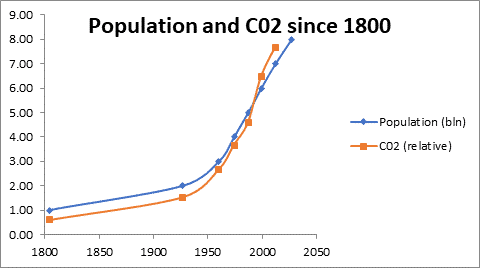
Overpopulation in Africa. In 1990, as the human global population reached 5,327,231,061. then in 2021 human global population reached 7. 9 billion people on global total land area of 13,003 million hectares. Rejoice Africa foundation predicts in 2100 the global human population will be 9,735,033,900 people on the planet earth. These will increase demand for food, water, housing, health, transportation energy, unemployment, instabilities and environmental degradation.
Rejoice Africa foundation is hereby suggesting the following strategies in human overpopulation on the limited global land area of 13,003 million hectares,
Giving reproductive health education through secondary school for all with a particular focus on girls. as an important tool of empowerment, education can potentially provide young people with control over fertility especially among girls. COVID-19 has increased girls’ exposure to unwanted pregnancies due to limited access to birth control facilities in the health centers. In order to meet this strategy, RAF aims at promoting reproductive health education for all girls through peer-to-peer reproductive health education in identified secondary schools, avail learning materials of ways to control unwanted pregnancies.
Assure universal access to a range of safe and effective contraceptive options for both sexes;
90 % of Contraceptives methods have been for only one sex (girls) and the have many side effects affects the girls/women leading to fear of acquiring contraceptives leading to lack of birth control. male sex contributes to population increase because one man can in pregnant 4 women daily if they are in fertile days whereas women can be fertile for only 7 days in the months and a pregnancy takes 9 months. Rejoice Africa Foundation is calling for universal access fewer side effects contraceptives to all sexes (unisex contraceptive methods)
End all policies that reward parents financially based on the number of children. Some countries support poor families with funds basing on size of the family members, these families tend to produce many children for targeting large family members that can attract governments to support them with a lot of funds. There is need for government policy makers to revisit and amend those policies for people to control birth rates.
Convince leaders to commit to ending population growth through the exercise of human rights and human development. Through coalitions with other organizations, foundations, Rejoice Africa foundation is calling stakeholders.
Menstrual hygiene for all girls/women of childbearing age. most girls in developing world have faced poor menstruation care due to inadequate access to safe water and sanitary pads. Rejoice Africa foundation emerged to improve on water accessibility to all identified vulnerable girls in Uganda.
Religious beliefs: some religion in today’s generation they oppose birth control methods they end up promoting population increase.
Rejoice and Fair Start working together
Rejoice leadership and Fair Start have both urged the United Nations, Partners in Population Development and other world leaders to adopt Fair Start or comparable family reforms, and mutually support calls for climate reparations based on correcting the baseline error that underlies current and near universal family planning systems, the error that is fundamentally driving climate change and massive economic inequity.
Poor sanitation and hygiene and end plastic pollution
Figure 1 WATER TANK CONSTRUCTED USING PLASTIC BOTTLESFigure 2 GIRLS RECIEVING SANITARY PADS
Plastic pollution is a fact and it’s widely acknowledged that world is midst of climate crisis.
Human activities such as use of non-biodegradable plastic materials have increased extinction of water animals, water volumes and land degradation.
In Uganda, plastic use such as form of drinking water and sodas have discharged 600 metric tons of plastic waste per day only 6% of plastic wastes are collected.
The remaining 94% of plastic wastes are not collected.
Indigenous people are not well versed with the innovation of reusing 94% of uncollectible plastics. These uncollectible plastics washed away by running water into water sources (lakes, wells, springs, Rivers and pods) and other can be covered by the soil.
Non-biodegradable plastic materials take many years to decay. High amounts of plastic wastes accumulated in water sources have resulted into reduced water volume for human consumption hence reducing rainfall cycle in the region.
Most schoolgirls who are undergoing menstruation period are directly affected because of inadequate access to clean water for hygiene and drinking.
They have suffered unhygienic menstruation management that increased fungal and bacterial infection leading to psychosocial stress in girls hence not learning well in class.
The country ends up having more school dropouts.
Re-using plastic bottles to construct rainwater reservoir tanks in schools has emerged as a major instrument to fight plastic pollutions and inadequate access to clean water supply to schoolgirls in Uganda.
It’s one of the numbers of innovative strategies targeted at reducing 94%of uncollected plastic bottles in the communities.
Improving accessibility of adequate water sources in schools will reduce school dropouts related to Psychosocial stress in schoolgirls.
Increased carbon emission and greenhouse gases
Enhancing Agroforestry/permaculture for Promotion of Climate Change Resilience, Eco social and rural livelihoods in Uganda.
Climate change is a fact, and it is widely acknowledged that the world is in the midst of a global warming Crisis. Human activities such as fossil fuel combustion and land use change have released greenhouse gases into the atmosphere, which is the primary driver of recent climate change. Land use such as Agriculture alone, discharges more than 6 billion metric tons of greenhouse gases (GHG) into the atmosphere each year. Because of increased severity of climate change impacts on some Areas, the consequences have been more severe and disastrous.
In Uganda, climate change is a serious problem, affecting livelihoods. The country experiences prolonged drought, short and erratic rains which are disastrous and affecting Agriculture production, the backbone of the country.
Also due to disparities in traditional roles, societal expectations and livelihoods, men and women are affected differently by climate changes.
Women account for the bulk of Uganda’s Population of 23.19 million population.
They have lower wages, less access to credit, decision – making power and less control over resources all of which make them more vulnerable to climate changes.
It’s therefore important to consider differences when tackling the issue of climate change.
Agroforestry/ permaculture has emerged as a major instrument in the fight against climate change in recent years. It’s a widely accepted answer to the twin problems of climate change and food security.
It’s one of a number of innovative strategies targeted at increasing production while also assisting in the mitigation of climate change by increasing carbon sequestration and boosting the system’s ability to cope with negative consequences of climate change mitigation and development of vulnerable group’s livelihoods such as women, by planting fruit trees alongside food crops.