Category: Responsible Parenting & Smaller Families

  • Open Letter to United Nations Leadership: Condemn Policies Pushing Women to Have Children

    Open Letter to United Nations Leadership: Condemn Policies Pushing Women to Have Children

    Dear Secretary General Gutteres, and Directors Kanem, Andersen, and Russell,

    Several United Nations member states, ignoring the impacts on the climate crisis, the pandemic, human rights, and the sustainable development goals, are intensifying pronatal programs that are designed to push women to have children as a means of expanding economic and other forms of state power.

    These include unsustainable pronatal programs in:

    • Iran (which many human rights organizations have condemned),

    These moves are enabled by the United Nations’ continued misinterpretation and misapplication of the right to have children under Article 16 of the Universal Declaration of Human Rights and the relevant provisions of the International Bill of Human Rights. The United Nations should promote sustainable family planning, not an archaic family planning model that does not reflect the requisite nuances of human rights-based family planning. A growing coalition of prominent organizations is calling for reforms to the modeling.

    Not only do pronatal policies reverse progress in mitigating the climate crisis, but they fundamentally exacerbate the pandemics, which are killing millions. At the same time, faced with the United Nations’ historic failure to adopt a sustainable universal family model, nations like India and Nigeria are struggling on their own to stem disastrous growth.

    Democracy, and respect for the future majority, require that family planning be future child-centric, something that inevitably necessitates collective action rather than isolating families in a misleading choice model, as well as centered on ecosocial fairness.
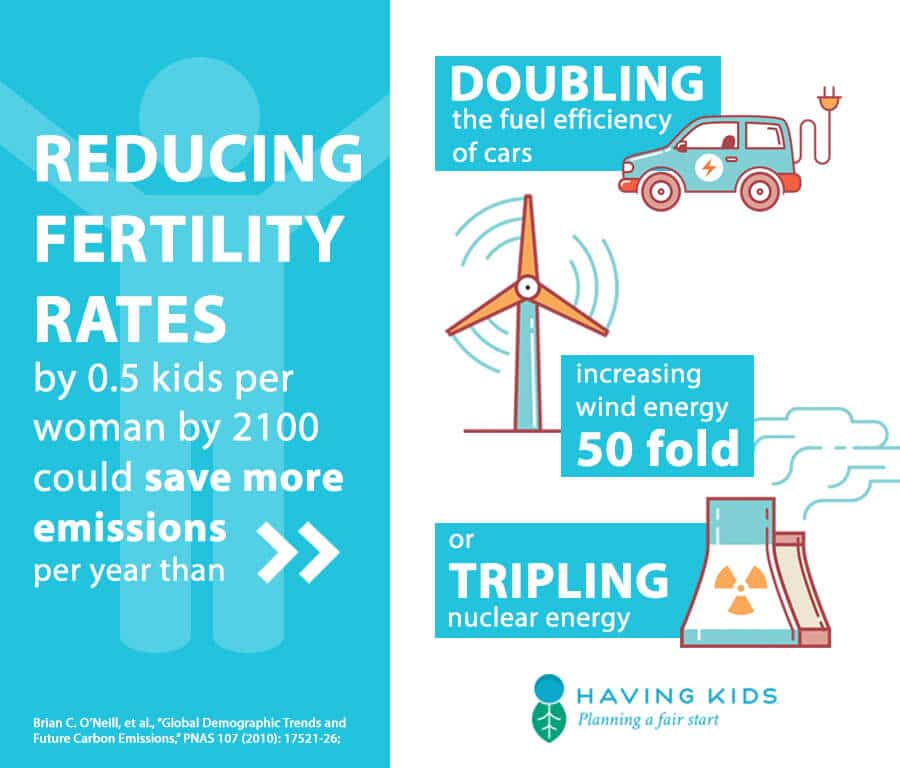
    Infographic showing ways to reduce carbon emissions: reducing fertility rates, doubling car fuel efficiency, increasing wind energy 50-fold, and tripling nuclear energy. Includes icons of a car, windmill, and nuclear symbol.
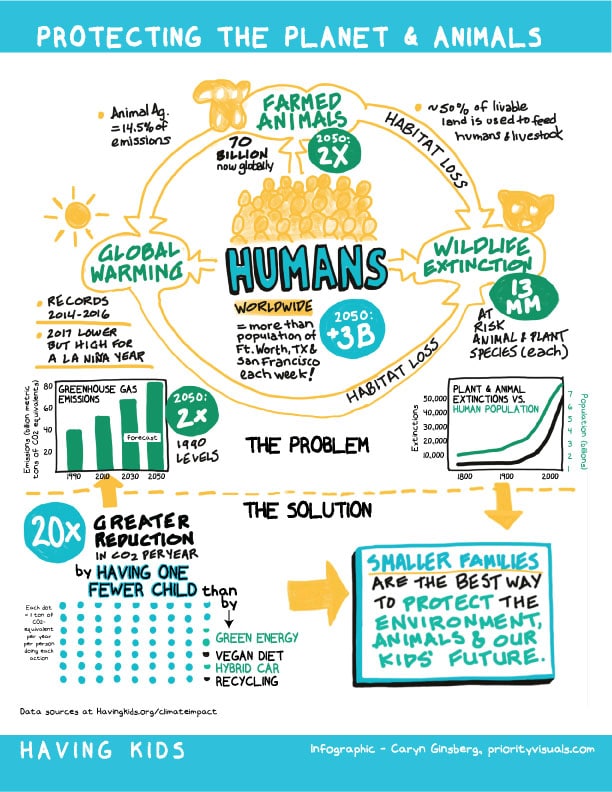
    Infographic showing humans impact on the planet: habitat loss, global warming, wildlife extinction, and farmed animals. Solutions proposed include smaller families, plant-based eating, renewable energy, and recycling.
    • Inaction threatens the UN’s credibility. Pronatal policies being rolled out in response to a perceived economic “baby bust” show that our current systems of governance are fundamentally illegitimate. If we are willing to create lots of people in whom we invest relatively little in order to satisfy markets and economies, instead of fewer people in whom we invest more in order to build the democracies that must precede, justify and regulate those markets and economies, we are admitting fundamental illegitimacy, or as the peer-reviewed work shows, the preconstitutionality, of our political systems. This is especially true when doing so exacerbates the climate crisis. In that case, all effective measures to correct this inversion are just.
    • The costs of ignoring reproductive justice legal reforms are mounting. These include the costs of the climate emissions that could have been avoided since at least 2007, and the role the failure to require equitable family planning has played in driving the massive and growing gap between rich and poor across the globe. The Fair Start Movement is calculating those costs as harms, and believes world leadership must – and one day will – be held fully accountable for them.
    • Because Fair Start and comparable “creation norm” models are peremptory norms that precede other national and international processes and rights (including property rights), the Fair Start Movement is urging young activists to target concentrations of wealth and power to pay for these eco-social harms, derived fundamentally from poor family planning models, by funding Fair Start efforts and incentives.

    Will you join that call? Nothing would have a greater long-run impact on restoring our environment than simultaneously compensating future generations, while helping them become parts of legitimate democracies, via Fair Start investments in their empowerment and resilience.

    Sincerely,

    Ashley Berke, Co-Director at Fair Start
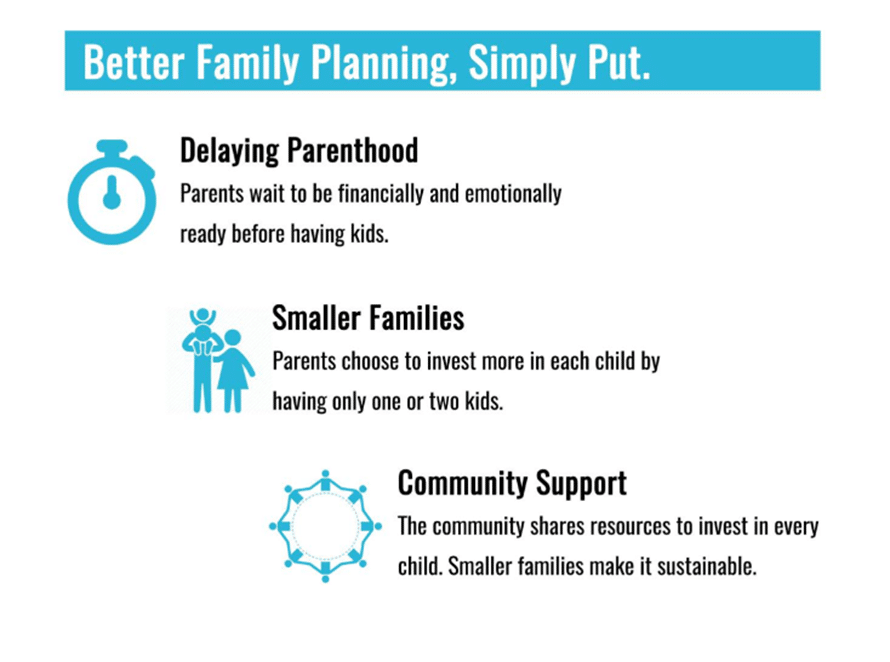
    Infographic titled Better Family Planning, Simply Put with icons and three points: Delaying parenthood, smaller families, and community support, each explained with brief text and blue graphics.
  • If We Live in Economies Rather Than Democracies, Do We Have to Follow the Rules?

    If We Live in Economies Rather Than Democracies, Do We Have to Follow the Rules?

    If you do a term search on Google for recent media regarding issues around human population growth, you will find that the vast majority of messaging tells us women are not having enough kids and that we are in a “baby bust.” In other words, we are not having enough children to satisfy the ever-present push to ensure the economic growth – and greater returns on investments – that comes with more people.

    A counterargument goes something like this: Policies that allowed that growth to happen drove the climate crisis, enslaved women to expectations of motherhood, and ensured no minimum levels of welfare or equity for children. These are all bad things, and it’s not clear that returns on investments – which generally favor the rich – are worth the trade. Everyone loves free money, but the climate crisis is kind of a big deal, right?

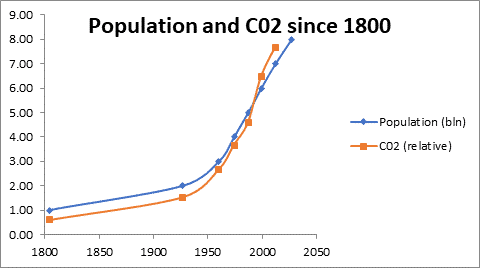
    Line graph showing global population (in billions) and CO2 (relative) from 1800 to 2050. Both lines rise slowly at first, then sharply increase around 1950, with population slightly above CO2 in recent decades.

    But there is a bigger problem with pushing women to have kids for economic reasons. Assuming that how we see future children is how we see our societies, the universal media push (driven often by journalists’ advertisers) to grow our population means that we are essentially economic inputs and comprise economies, measurable in things like gross domestic product. That is who we are.

    This ideology is very different from seeing ourselves as members of a democracy in which, rather than trying to maximize the number of bodies (as consumers, workers, and taxpayers) irrespective of political equity, we try to maximize the civic capacity and effective political voice of each citizen, requiring true equality of opportunity rather than a massive gap between rich and poor. We would be focused on a metric like our empowerment, rather than product.

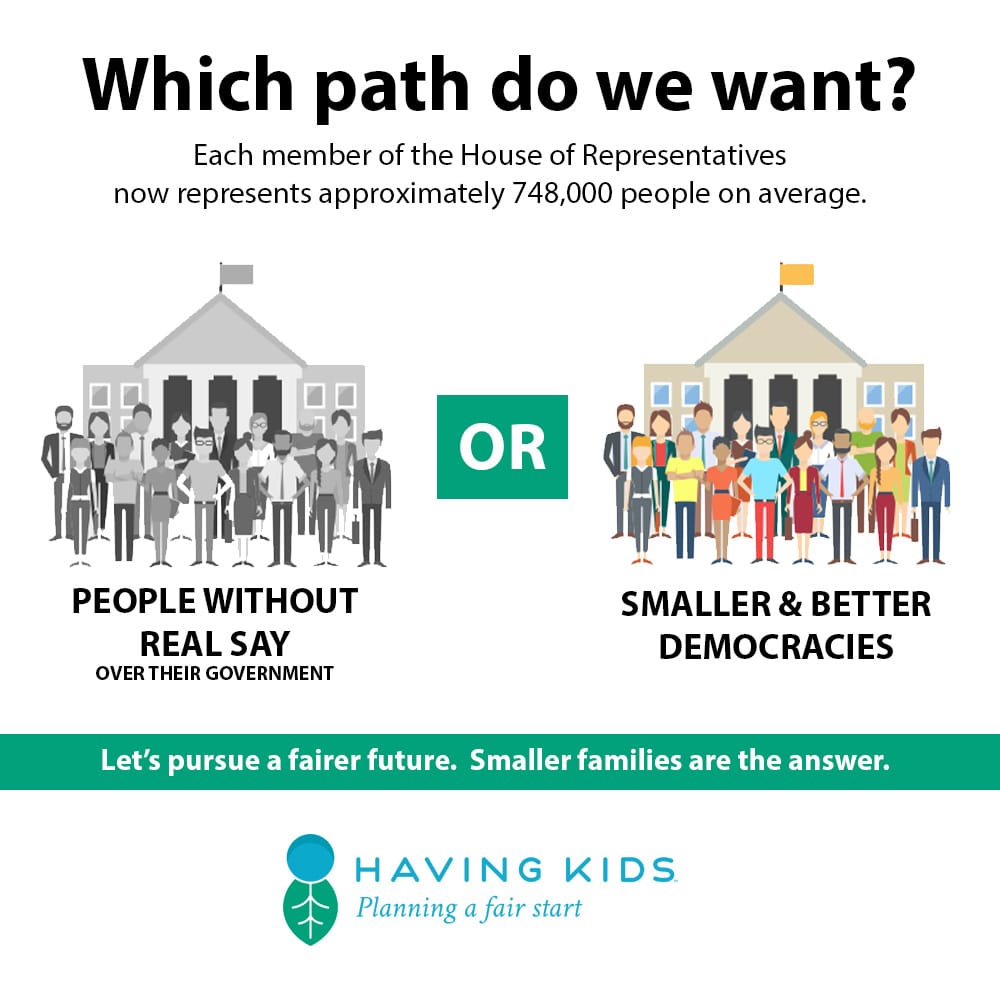
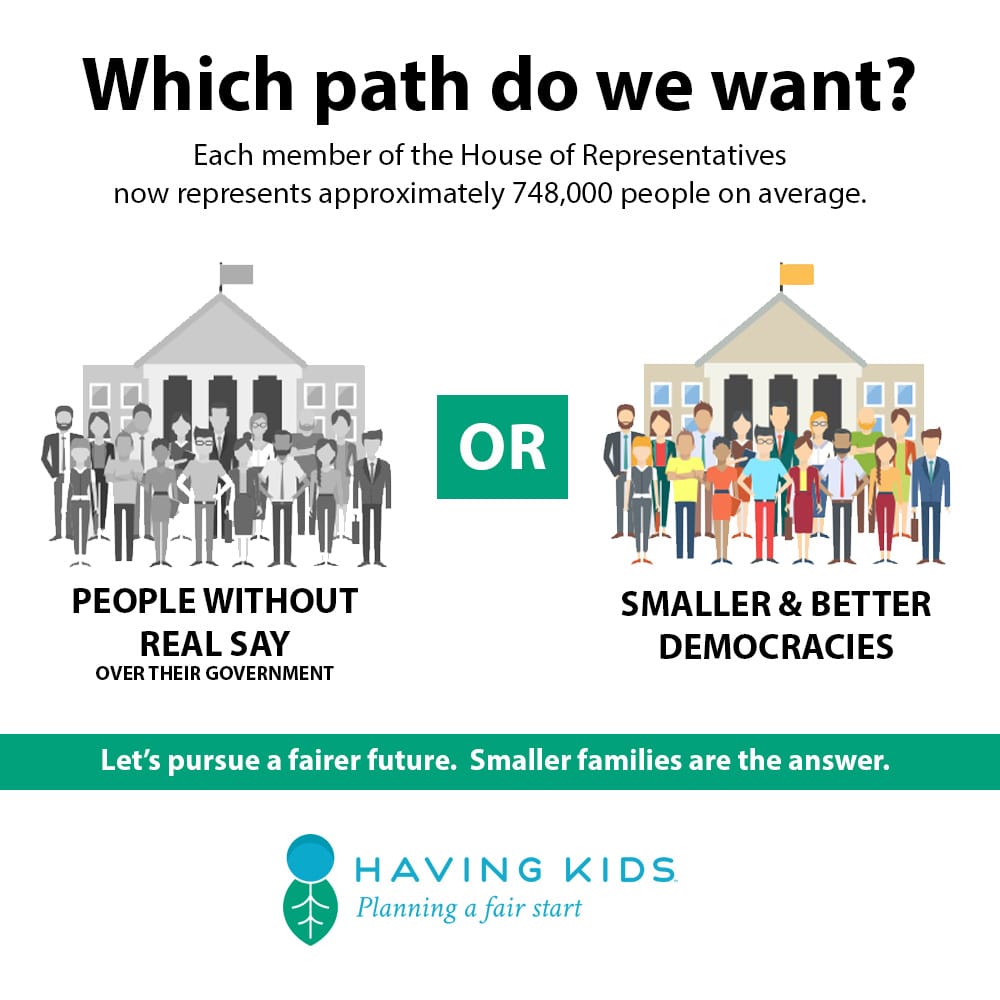
    Infographic compares two groups: one large, gray crowd labeled People Without Real Say by the government, and one small, colorful group labeled Smaller & Better Democracies. Text suggests smaller families improve democracy.

    And if being in a democracy is what obligates us to follow the rules, because in democracy we make those rules, then being in an economy – essentially, because of who we are – would mean we do not have to follow the rules, rules that protect the property of the rich for example. Robbed of our actual role in the process, and left to gape at politicians over which we each have little or no control, why should we? If governments have simply become adept at hiding violence, for the most part, and now mostly partner with private concentrations of wealth to more subtly use economic incentives to control the populace as some think is the case, as opposed to fulfilling their obligation to ensure the self-determination of people directly applying their will in functional town halls, why follow the rules? None of this would matter if getting to those town halls was impossible. It’s not, thanks to Fair Start and other reforms.

    The “baby bust” messaging is scary for many reasons, but it may also be the key to solving many of our political crises today. If we are worried about democracy we should stop seeing kids as economic inputs and use family reforms like Fair Start to make sure children will be comprising – in terms of maximizing our investment in them, and their development via collective family planning – town halls rather than shopping malls. Then we are freed by the rules under which we live because they are our rules.

    Take action: Urge President Biden to put democracy before economy, and free future generations.

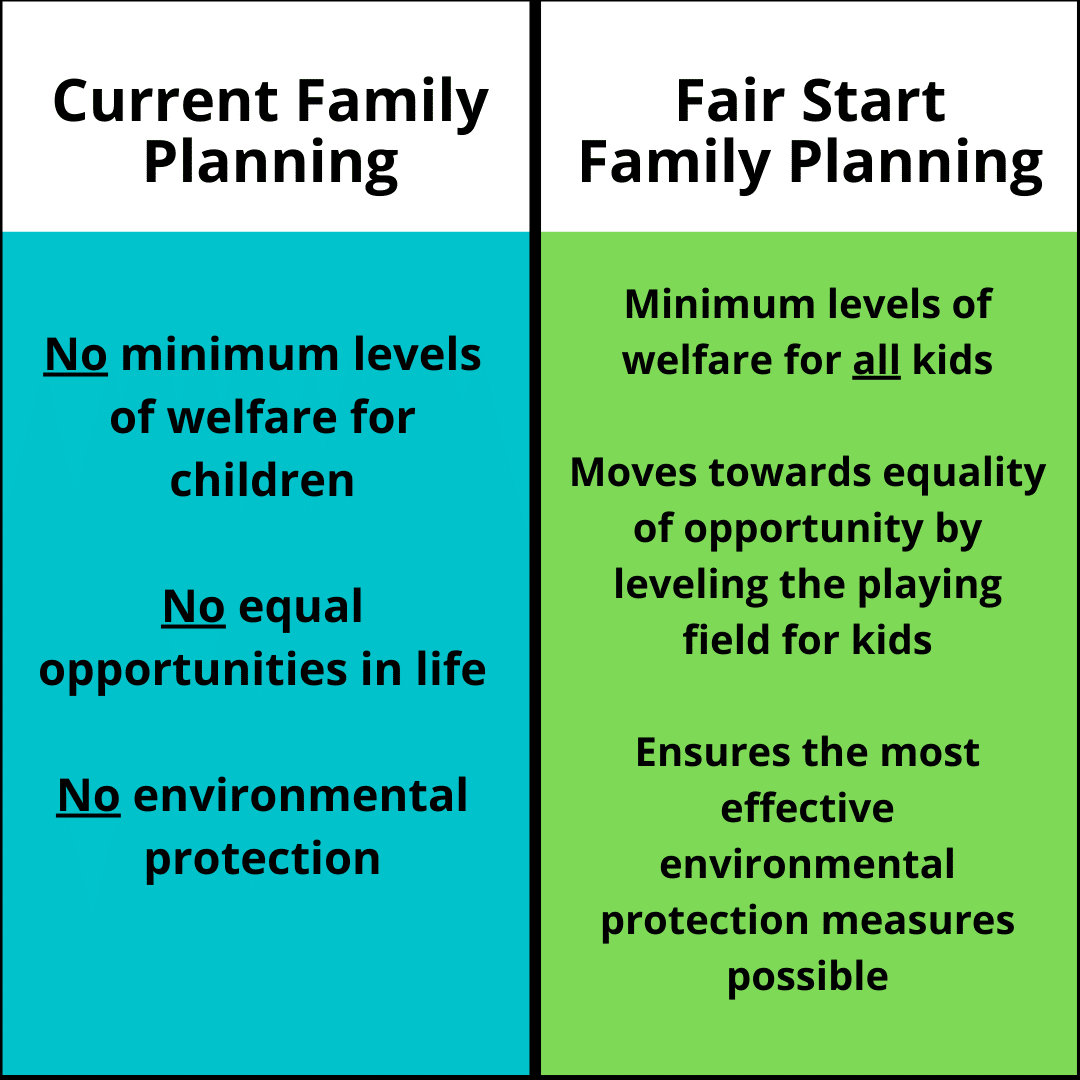
    A comparison chart of Current Family Planning vs. Fair Start Family Planning. The left side lists negatives of current planning; the right side highlights positive outcomes of fair start planning for welfare, equality, and environmental protection.

  • Take Action: More Royal Babies? We Can Do Better

    Take Action: More Royal Babies? We Can Do Better

    Recently Prince William and Kate Middleton joked about having a fourth royal child. Many readers will remember that Fair Start Movement wrote to the Royal family some time ago urging them to publicly adopt just and sustainable family planning modeling instead.

    It’s simple – support a universal ethic of smaller families and shared resources that ensure all kids a level field for development and equal opportunities in life.

    Read the story here!

    Contact the Royal Family here and politely urge them to adopt Fair Start family planning to ensure a future filled with what people need – nature and equity.

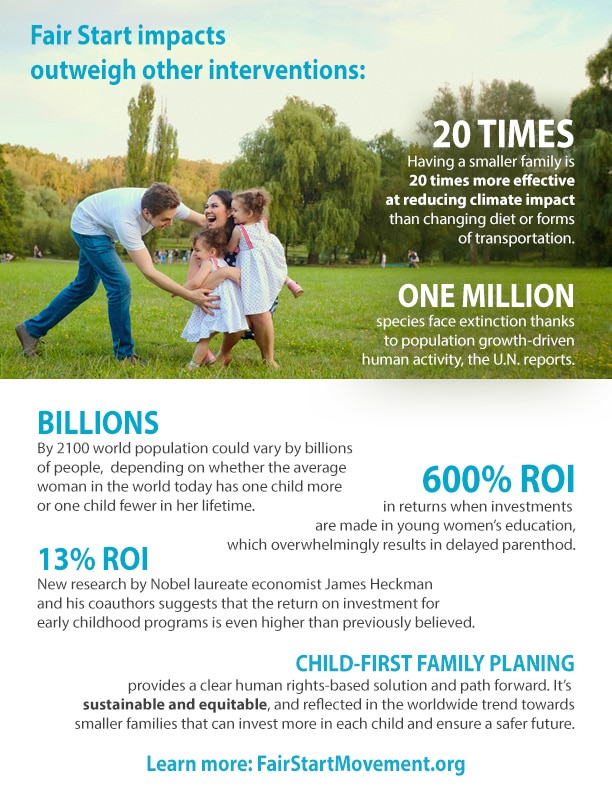
    Infographic about Fair Start family planning, highlighting climate impact, reduced extinction risks, 600% return on investment, findings by Nobel laureate Heckman, and the benefits of smaller families for sustainability.

    FAIR START RESEARCH

    • A clear link exists between rapid population growth and poverty. Better family planning and smaller families increase economic prospects by allowing greater investment in each child.  
    • According to the World Bank, in 2015, almost 2 billion people (26% of the world’s population) were living on less than $3.20 per day, and nearly half of the world (46%) was living on less than $5.50 a day. 
    • The costs and benefits of overpopulation under globalization are now distributed by class more than by nation. Labor bears the cost of reduced wage income; capital enjoys the benefit of reduced wage costs. 
    • The United State and much of the capitalist world believed that new bodies were needed to produce more labor. This pro-natal, pro-capital belief has created a world in which huge inequities exist. For example, the world’s 2,153 billionaires have more wealth than 4.6 billion people, which is more than 60% of the planet’s population. 
    • Family size affects those in developed countries as well as underdeveloped nations: In the U.S., the Kansas City Star reported that of more than 6,000 prisoners in 12 states, 1 in 4 was a product of the foster-care system; there is a foster-care-to-prison pipeline in many states. Foster children are also diagnosed with PTSD at a rate greater than Iraq War veterans, and every year, more than 4,000 former foster care kids end up homeless after leaving the system. Meanwhile, the number of American children in foster care increased 12% between 2012 and 2017. 
    • Our current family planning systems provide no minimum standard of well-being for future children, allowing children to be born into failing state systems because their parents cannot care for them. That exacerbates inequity and ensures rich kids stay rich and poor kids stay poor. 
    • Current pronatalist policies sow the seeds of nation destabilization by further increasing inequality. 
    • A recent study from Stanford has found that efforts to mitigate climate change could yield trillions in economic benefits. And the best way to mitigate climate change is to choose smaller families. Yes, it’s more effective than changing diet or forms of transportation. 
    • By the year 2100, the world population could vary by billions of people, depending on whether the average woman in the world today has one child more or one child fewer in her lifetime. If the average woman alive today has between 2 and 3 children, the world population will grow to as many as 16 billion by 2100.
  • Fair Start: An Open Letter to Pope Francis

    Fair Start: An Open Letter to Pope Francis

    Your Holiness,

    We laud your many commitments to social justice and environmental protection. You are bending the arc of the world towards justice in a way few voices can.  And while you have been criticized for your recent comments regarding the need to parent rather than raise pets, we want to offer the Vatican a constructive challenge. 

    The Vatican has roughly thirty-three billion dollars in net worth. Would you consider donating just one thousand dollars to fairstartmovement.org to support a fundamental policy reform that would make every child’s right to a Fair Start in life the first and overriding human right.

    Nothing would speak out against selfishness more than that and give the majority of people – those who will exist in the future – that which they deserve. It’s not about population. People are not numbers. It’s about the impossibility of separating values like welfare, equity, and nature from their creation.

    This image has an empty alt attribute; its file name is 55b9382d2acae719008bb381
    The curve represents the opportunity to promote values like child welfare, parental readiness, the restoration of nature, and democracies where each person plays a greater role, or to exploit people as consumers, workers, and taxpayers. We should choose the former, and arc down.

    As Nobel Laureate Steven Chu noted, population growth has acted like a Ponzi scheme that has pulled massive wealth to the top of the economic pyramid at cost to women, children and the environment. It’s a fundamentally unjust and exploitative system. And the greatest impact in reversing it, and furthering the Sustainable Development Goals, comes though changing our family policies to promote an ecosocial Fair Start in life as the first and overriding human right. 

    There is nothing else that comes close to having the impact, long term, on the social justice and environmental causes you support. Without an ecosocial Fair Start in life – with guaranteed minimum levels of welfare approaching equity for each child, the restoration of nature, and democracies where voices actually matter – there is no real justice. All forms justice remain downstream – missing the fundamental phase in which we create and most define power relations.

    Fair Start changes that. It’s the biggest win-win of all. 

    His Holiness speaking out for Fair Start and donating would start a trend, changing the ultimate form of selfishness – the concentration of wealth that could be used to save and improve countless lives – into the ultimate form of impact. Many young people stand ready to support such a trend of giving and planning, putting people and nature before profits and property, and treating Fair Start redistributions as a peremptory norm overriding governmental processes.

    Fair Start is not about population. It’s about people, starting from the source, limiting and decentralizing power, and thus becoming the relatively self-determining – or free – people we deserve to be.

    Will you speak out for real social justice that most effectively furthers the values you have espoused, by supporting all children getting a Fair Start in life? 

    Ashley Berke, Nandita Bajaj, Carter Dillard

    FairStartMovement.org 

    FAIR START RESEARCH

    • A clear link exists between rapid unsustainable growth and poverty. Better family planning increases economic prospects by allowing greater investment in each child.  
    • According to the World Bank, in 2015, almost 2 billion people (26% of the world’s population) were living on less than $3.20 per day, and nearly half of the world (46%) was living on less than $5.50 a day. 
    • The costs and benefits of overpopulation under globalization are now distributed by class more than by nation. Labor bears the cost of reduced wage income; capital enjoys the benefit of reduced wage costs. 
    • The United State and much of the capitalist world believed that new bodies were needed to produce more labor. This pro-natal, pro-capital belief has created a world in which huge inequities exist. For example, the world’s 2,153 billionaires have more wealth than 4.6 billion people, which is more than 60% of the planet’s population. 
    • Family size affects those in developed countries as well as underdeveloped nations: In the U.S., the Kansas City Star reported that of more than 6,000 prisoners in 12 states, 1 in 4 was a product of the foster-care system; there is a foster-care-to-prison pipeline in many states. Foster children are also diagnosed with PTSD at a rate greater than Iraq War veterans, and every year, more than 4,000 former foster care kids end up homeless after leaving the system. Meanwhile, the number of American children in foster care increased 12% between 2012 and 2017. 
    • Our current family planning systems provide no minimum standard of well-being for future children, allowing children to be born into failing state systems because their parents cannot care for them. That exacerbates inequity and ensures rich kids stay rich and poor kids stay poor. 
    • Current pronatalist policies sow the seeds of nation destabilization by further increasing inequality. 
    A collage of logos from various international organizations urging COP26 to support sustainable family planning in response to the climate crisis. The message is written in bold text above the logos.
  • Collective Souls Coalition for Lost Girls: Their Story

    Collective Souls Coalition for Lost Girls: Their Story

    Can We Really Prevent Child Abuse? One Family Rides in Search of an Answer

    A father and his son have set out on a bicycle ride across the nation, from South Florida to Los Angeles. After being raised in abusive situations, and being fortunate enough to find a safe place, now they will not run, they will ride to fight for all children to have a fair start.

    On average, according to FBI statistics, 450 children are murdered by their parents each year in the United States. More than one a day.

    Why can’t governments prevent that? 

    The truth is they can.

    A comparison chart of Current Family Planning vs. Fair Start Family Planning. The left side lists negatives of current planning; the right side highlights positive outcomes of fair start planning for welfare, equality, and environmental protection.

    But a few bad policies – family planning systems that push population growth to fill shopping malls rather than parental readiness to ensure functional town halls, underfunded child protection agencies, misplaced systems of rights that treat children as parental property – are standing in the way. 

    This father and son, inspired by the horrific death of Gabriel Fernandez in 2013, and many others,  set out to expose and change those policies. And along the way they’ve seen the other costs of those policies – the ones that push helpless children into the hands of abusive parents – in the form of nature overrun by people mass produced and uncared for,  and systems of government that look nothing like the inclusive democracies in which we are supposed to live. 

    The nature, the family planning policies that will determine it and future children’s fate, and the road ahead. Can you see the connection between these things?

    But they are also seeing support – a gush of online support, an advocate in the capital of their home state, and the animals in what remains of nature, helpless like the children this ride honors. 

    A person relaxes inside a blue tent set up on sandy ground. Next to the tent are bicycles, bags, and a cart with a chalkboard sign, with greenery and a building in the background.
    On the road.

    The father says this of his son: 

    “Now he plays the vigilante of sorts. Taking matters into his own hands, with me as his sidekick and back up. He pounds the streets with his statistics and petitions with a will to change the world for his peers.”

    Help them end  this, the child abuse, the filicide,  that started their ride and keeps them pedaling towards better places and safer spaces. 

    Follow them on YouTube. 

    Sign their Change.org petition.

    Join their group on Facebook. 

    You can also help change the way we plan families by promoting Fair Start reforms universally. 

  • A Simple Discourse: Who Is Fundamentally Just, and Who Is Not

    A Simple Discourse: Who Is Fundamentally Just, and Who Is Not

    The wealth and power of those – both public and private – at the top of the wealth pyramid was created using an unsustainable and unjust system of growth that 1) violated multiple human rights, 2) foisted its costs on the majority – women and future generations – in ways that prevented self-determination, and 3) is most comprehensively and effectively redressed long term using just and sustainable Fair Start family reforms.

    A circular infographic titled “Fertility Delay Incentives to Planning” shows a leaf in the center with four benefits: Delayed Parenthood, Better Family Planning, Guaranteed Minimum Income, and Equal Opportunity & Education for all kids.

    The system of growth rested on obvious myths – like being born rich versus poor was a matter of some magical “fortune” or hand of god, rather than a failure of nations to implement policies that would ensure birth equity. That myth was designed to prevent concentrations of wealth and power for paying what they owed – under human rights obligations – as investments in future generations.

    Those promoting the system treated the act of having children, something inherently interpersonal, as instead personal in order to preserve fundamental – familial – power structures. They used a misperception of privacy and empowerment, within the home or marketplace, to rob people of those same things at the much more fundamental level – in the inclusive and reflective democracies they were entitled to and which are most determined by the first border of human power – creation .

    An infographic compares two options: on the left, gray figures under “People without real say over their government,” and on the right, colorful families with “Smaller & better democracies.” Text promotes smaller families for fairer representation.

    Those preventing us from constituting ourselves as free and equal people via Fair Start reforms cannot – fundamentally – justify power relations. They prevent our becoming free by moving the flow of power from top-down to bottom-up, through a discourse of collective family planning that physically limits and decentralizes the power we have over each other.

    Let’s be more specific, and less abstract:

    These losses of freedom cannot be separated from one another, or from the family planning norms that create them. To make policies just, we have to make their foundation – people – just, and free.

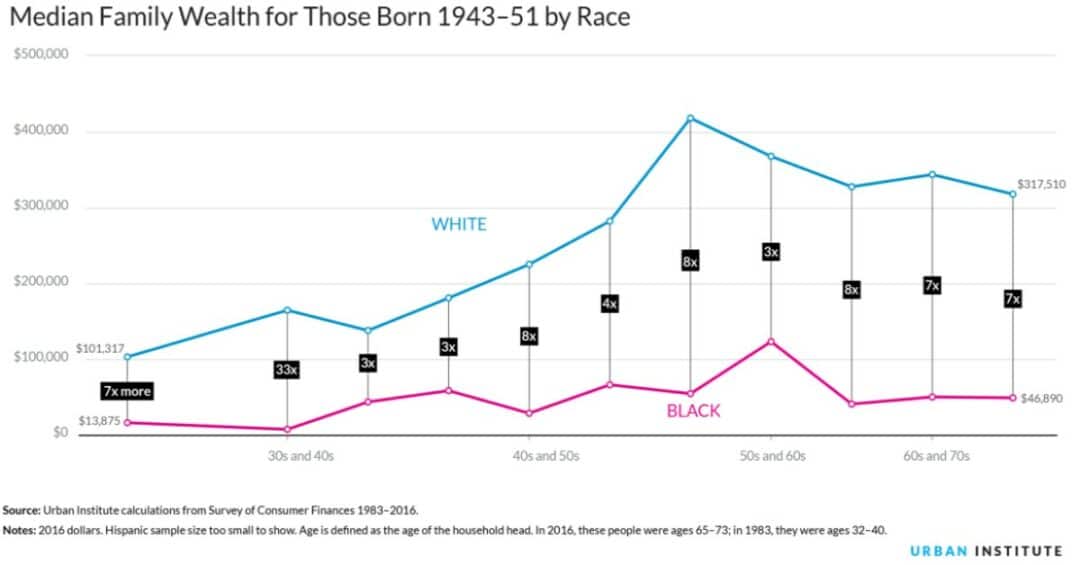
    A line graph compares median family wealth by age for White and Black Americans born 1943–51. White wealth is consistently much higher, peaking at 7,500 in their 60s, while Black wealth peaks at ,800.
    Wealth is largely inherited, and the product of past injustice.

    How can we identify who is a precon, and who is moving towards freedom by helping constitute future generations – the majority of persons – in a just way via child-centric planning? Precons will remain abstract and self-contradictory when pressed on how they will promote the relative self-determination of future persons, even when they are asked to use simple metrics like wellbeing and equity. They will contravene values, like healthy ecologies, they clearly value as demonstrated through their own actions when it comes to ensuring those values for future generations – the majority. They will put existing property rights over investing equitably in the majority of persons – future generations.

    Free people, on the other hand, will begin the development of any policy by 1) treating self-determination as inverse to population growth (which means democracy is functioning, fundamentally, as it should and moving toward relatively self-determining populations) and 2) promoting our constituting new democracies of free and equal persons through a discourse of collective family planning that would create functional constitutional conventions of relatively self-determining persons.*

    *note that the appeal of corporations may stem from their ability to imitate such groups relative to bloated nation states, but their purpose and structure make them anathema to true democracies.

    Those moving towards freedom will first act in ways that support fundamental justice. They will want to come from a just place, and they will act as though people actually matter, politically. They will act as though each person is empowered equally. This is the litmus test for democracy.

    TAKE ACTION:

    Fair Start family planning

    A stylized illustration shows a cityscape with silhouettes of people walking, biking, and talking. Icons connected by lines represent recycling, equality, justice, education, technology, and the environment.

    WHEN COMMUNITIES AND GOVERNMENTS PRIOTIZE A FAIR START IN LIFE AS THE FIRST

    HUMAN RIGHT

    Illustration of a small college campus with several buildings, a playground, trees, deer, flying birds, and mountains in the background under a blue sky.

    WE INVEST MORE IN FAMILIES AND HELP PARENTS BE READY, EMPOWERED, AND POSITIONED

    FOR SUCCESS

    Illustration of a smiling family with a woman in glasses, a man with short hair, and a young girl with pigtails, standing together in front of a city skyline.

    KIDS GET A FAIR START AND OUR FUTURE IS PROTECTED

  • What’s the Most Important Law of All? The One that Makes Us Social

    What’s the Most Important Law of All? The One that Makes Us Social

    Education is compulsory for children, beyond the massive return on investment it ensures, because it is seen as a prerequisite to democracy. Why? Democracy requires people are sufficiently developed, and have enough of a common core, to come to agreement on the rules under which they should live. But most education laws were written before recent developments in child psychology that show the core of the ability to socialize with others and come to agreement — empathy and a disposition for prosocial behavior — develop very early in our lives, including our infancy.

    That’s a problem. How can we have functional town halls without preparing people to care enough for each other to work together? Also, consider the return on investment point above: Education has a huge impact because it determines much about the full measure of our lives, and is designed to impact the majority of our — and all future generations — interactions with others.

    All of this suggests that while family planning laws and educational systems are often decoupled, they should not be. We learn at least as much as home as we do at school. Rather, our family planning systems should be the first aspect of educational systems — moving upstream to help assure the social development and educational goals are achieved, and enough to meet that “town hall” standard.

    What’s blocking this coupling of systems, family planning and education, that would do so much good?

    Big business exerts a lot of influence on our family planning systems, using them to ensure population growth and poor educational outcomes in their quest to create lots of people for shopping malls, rather than fewer people for town halls where their voice matters.

    Republicans pushed for changes in the tax code to do just this, and democrats were quick to join the effort. Yes, that’s the level of influence they have in keeping education from really working. They push as many people, through failing systems, as possible to ensure more consumers, cheap future labor, and large tax bases. That’s not what functional town halls look like. But the taboo against change is deep. I’ve worked with animal protection groups and funders whose purported missions commit them to this change, but they won’t support it for fear of backlash– in the end contravening their missions.

    What’s the solution? Our political systems are not the final answer when it comes to making policy. Human rights override those systems and empower people to demand change at a constitutional level. Given that creating people for democracy is so important, so primary in nature, we can help intending parents to target the concentrations of wealth and power that made so much money debilitating family planning systems to pay for the reforms we need. Why?

    Because people come first, and people come from family planning systems — whether they work well or not. We need to make sure they do work well, for example, through regearing them around equity: every child’s right to an ecosocial Fair Start in life as the first and overriding human right. Without that, how can we come from a just place?

    And that move is not as abstract as it sounds. It could be as simple as replacing our pro-unsustainable growth federal child tax policy with a truly equitable and ecologically restorative one that funds family planning-based humane education as a matter of the fundamental right to full — and effective — development as part of true democracies.

    We might initiate this through a simple discourse of demand and override — in which the wealthy are urged to admit what they owe, we can lay claim to the funding that would link family planning and educational systems, and build the democracies we deserve, one child at a time. We could combine that with eliminating tax credits for wealthy families (150K+ a year as an example, or a multi-faceted eligibility approach to determination) and the savings could be used 1) to increase credits proportionally for lower incomes, 2) fund a federal human education pilot program under the Dept. of Education, 3) accompanied by a federal messaging campaign modeled on NTSB seatbelt campaigns to promote “delayed families for all.”

    Let’s see family planning and education as part of the same system, and start making citizens for town halls, not consumers for shopping malls. That’s what freedom requires.

    Take action in dozens of effective ways.

  • Insist That Public Policy Respects the Rights of Children and Women

    Insist That Public Policy Respects the Rights of Children and Women

    By Dave Gardner, co-host of the GrowthBusters podcast, and director of the film, GrowthBusters: Hooked on Growth

    A woman in a red shirt holds an hourglass and touches her belly, smiling. The Italian text reads, La bellezza non ha età. La fertilità sì. (Beauty has no age. Fertility does.) The hashtag #fertilityday is shown.
    “Beauty has no age limit. Fertility does.”
    Ad issued by Italian government in campaign to boost fertility rate.

    Let’s find a way to reduce child poverty without signaling that society needs to exploit more babies to grow economies. There was a time when a case could be made that bringing more children into the world was a benefit to society. Today, with the overwhelming demands of nearly 8 billion people inflicting serious damage on the planet’s life-supporting ecosystems, there is no case for encouraging births, especially when it will harm the very children we have. More births portend a bleak future for today’s and future children – whom we should be protecting, not exploiting. Public policy needs to catch up with this harsh reality.

    For too long, the decision to bring a child into this world has been all about the “rights” and desires of the prospective parent, with little regard for the rights of children. The rights of children should be paramount, eclipsing other rights and agendas. Nothing could be more important. That’s one reason I admire and support the work of the Fair Start Movement.

    Today, we’re witnessing unenlightened state and business agendas to reverse the trend of dropping birth rates. “People want it. Society needs it. We want the economy to grow,” proclaims Lyman Stone, an adjunct fellow at the pro-growth American Enterprise Institute (AEI).

    On a full planet, it’s time we put an end to pro-natal agendas and rhetoric that pressure, incentivize or otherwise encourage prospective parents to add to our numbers. Let’s consider pro-natal public policies because they are surging today.

    Bear with me while I set the stage:

    A close-up of a sleeping newborn baby wrapped in a blanket, featured on a BBC News webpage discussing the global decline in fertility rates, with headlines and navigation menus visible.

    Birth rates have been dropping around the world for 60 years, and that drop may be accelerating today – for many reasons. There is some lag, but after birth rates drop below replacement rate, a population eventually begins to contract. While that’s not happening yet to our global numbers, many countries have begun to experience this contraction. And there are more to come. Sadly, this is getting negative attention.

    But it’s actually really good news. It’s an indication that we’re collectively planning for and investing more in each child, which naturally brings down family size. It also means more female autonomy, improved access to education and employment opportunities for women, better access to contraception and other family planning services, and a reduction in teen pregnancies.

    Another contributing factor is it’s become SO apparent that we’re doing serious damage to our home planet. Our climate, biodiversity, soil, and water are all degrading before our eyes. Young adults today are reluctant to bring a child into such an uncertain world, and many do not want to contribute to this destruction by adding more people.

    A nearly empty small-town street with a few cars parked along the side, brick buildings on the left, trees in the background, and a cloudy sky overhead. The headline discusses U.S. population growth concerns.

    On an overpopulated planet, we ought to celebrate declining birth rates. It’s exactly what is needed so we can ease our pressure on ecosystems, allowing them to return to health and meet our needs, the needs of other species, and especially the needs of the world’s children. Unfortunately, I’m observing the exact opposite. There’s an unexamined assumption that, “of course we must replenish ourselves” (replenishing is something we should do when we’re at a sustainable population).

    Growth-addicted policymakers in numerous nations have been panicking about what’s being termed a “baby bust.” These fears over a shrinking population are so common, they’ve earned the labels, “depopulation panic” and “baby-bust alarmism.” Some of this panic stems from the fact that governments have been engaged in a population Ponzi scheme, relying on tax revenue from an ever-growing pool of citizens to fund services for those born decades earlier. Plus, a growing population means more workers and more consumers year after year, an easy recipe for GDP growth. New York Times columnist Ross Douthat wrote, “Today’s babies are tomorrow’s taxpayers and workers….”

    Screenshot of a news article titled Its national preservation: Greece offers baby bonus to boost birthrate, with a photo of young children in traditional Greek costumes holding Greek flags.

    Of course, a high rate of GDP growth is the Holy Grail. Economic growth is the most universal public policy goal on the planet. AEI’s Stone, who is also a research fellow at the conservative think tank, Institute for Family Studies, laments, “There is no economy that has managed to knock out gangbuster growth with a declining population.”

    If you’re addicted to growth and running a Ponzi scheme, it can be very alarming to see it begin to unravel. And if you’re running for reelection and you can’t brag about economic growth during your administration, you’re pretty much done.

    So, officials in numerous countries are instituting policies designed to boost the birth rate. According to the U.N., 10% of the world’s nations had explicitly pro-natal policies in 1976, but that number began to rise sharply at the turn of this century, and has almost tripled (28% in 2015, the most recent data). Hungary, Poland, Greece, Japan, and Korea are just a few of the nations very actively attempting to reverse population contraction.

    A close-up of an adult gently holding a baby’s hand, with the headline, “Japan is trying really hard to persuade women to start having babies again,” displayed at the top of the image.

    It’s too seldom discussed, but pressuring women to birth more taxpayers, workers or consumers is an abhorrent violation of their human rights. It commodifies children and dehumanizes women, reducing them to incubators in service to an overheated economy hooked on unsustainable growth. Women and couples should be making family-size decisions free from political and cultural pressure to procreate. As for future children, they have a right to inherit a healthy planet and a shot at living decent lives.

    Even in the U.S., where social support programs have traditionally received limited funding, support for unsustainable and inequitable baby-making has begun ratcheting up. Child tax credits, child allowances, paid family leave, and child care subsidies are getting miraculous bipartisan support. The American Rescue Plan (a response to COVID) has been providing $3,000 to $3,600 per child in tax credits annually – through the end of 2021. Efforts are underway to extend it. Senator Mitt Romney this year proposed The Family Security Act, which would also send a monthly check to families for each child.

    Multiple identical babies in white shirts and diapers crawl in rows on a solid blue background, illustrating concerns about Eastern Europe’s efforts to boost birthrates and address depopulation.

    In defending the proposal, Senator Romney said, “We’re creating an incentive for people to be able to form families and to have children because we’re recognizing that we’re not reproducing ourselves.” In one interview, Romney stated, “Our population is declining pretty substantially. We’re down, I think, 5.8 million people from where we would have been had we maintained the birth rate of the last decade. So, we’ve got some work to do.” Clearly, he is not aware that we’re in overshoot (the scale of the human enterprise – our economy and our population – has outgrown our planet).

    Policies and projects to increase birth rates in several nations have met with mixed results. That’s not deterring policymakers desperate for growth. Advice from New York Times columnist Ross Douthat: “America needs more babies. Public policy alone cannot deliver them, but it can help.”

    Pro-natal public policy emerges in – and helps perpetuate – a pro-natal culture. Emma Green, in The Rebirth of America’s Pro-Natalist Movement (The Atlantic, 2017) wrote, “Ultimately, a shared cultural commitment to the importance of children is the factor that will determine America’s baby-making future.”

    While it is concerning that today we live in a pro-natal culture, I’m optimistic because young adults today are transforming that culture. They are choosing to delay childbearing and choosing to have fewer children. They understand a meaningful life does not require motherhood. They recognize that raising a child is a huge commitment, it’s expensive, and it does require sacrificing career and other priorities. And, of course, many appreciate that a full planet doesn’t benefit from a growing human population.

    Protecting today’s children from poverty is a noble goal. But encouraging higher birth rates isn’t the way to do that. It guarantees those children will inherit a dead planet. It’s challenging to develop policy that alleviates child poverty but does not incentivize prospective parents to bring more children into the world. I don’t know the answer to that dilemma. But policymakers working on this must have a full understanding of the fact that we’re in overshoot. This means we need to embrace and celebrate dropping birth rates and contracting population, not fight it.

    Let your elected representatives know you do not support policies that attempt to bribe women to birth more taxpayers, workers, and consumers. Let them know you support policies that reduce child poverty, but only those that do not also increase the number of children.

  • New Podcast: Scam of the Century, or How the Wealth Bubble Was Taken From Women and Children

    New Podcast: Scam of the Century, or How the Wealth Bubble Was Taken From Women and Children

    How did we end up in a world with massive wealth in the hands of a few and ecosystems crashing as our climates degrade? The answer is surprising. Rather than invest in early childhood development, at the crucial phase in the middle of the Twentieth Century, world leaders chose population growth and the creation of mass consumers, cheap labor and large bases of taxpayers.

    The Fair Fair Start Movement and Christine Dimmick’s Be the Change are pushing back. Listen to the podcast.

    And read the book.

    A podcast webpage displays an episode titled Smaller Families for a Sustainable Future with a photo of a serious man overlaid by large text, #BE THE CHANGE. Episode details and media player are visible on the right.

    WHY FAIR START?

    Governments are failing children’s right to an eco social fair start in life. 

    We know that early childhood experience is pivotal to lifetime outcomes. Why are we waiting for adverse childhood experiences to occur before acting? 

    Children deserve equitable conditions, right from the beginning. A fair start in life is the first human right – it overrides all others. It is what children are entitled to under the Children’s Rights Convention, and what allows them to eventually be free from the power of others, and truly self-determining.

    Because legitimate governance derives from people, who derive from the norms that create them, there are no such things as just societies, political legitimacy and freedom without the sort of Fair Start reforms discussed in this site. Without them we are always coming from an unjust place. 

    How do we change course? Many are joining this simple discourse, in which we recognize that all wealth is subject to future generations’ right to fairness, and that wealth transfers should act as an incentive and entitlement for better – and equitable – family planning. Ensuring an eco-social #fairstart in life for all kids can have ten to twenty times the long run impact on the key social and ecological crises we are facing today relative to other interventions.

    It is the most effective and just thing we can do. We may achieve it by extraordinary means, because there is no justice without it.