Category: Responsible Parenting & Smaller Families

  • When deciding to have children

    When deciding to have children

    BY RUBY FOX

    Ruby Fox is a fourth year student studying Society and Environment with a concentration on Justice and Sustainability at the University of California, Berkeley. She is interested in systemic injustice, environmental issues, childhood development, and food sovereignty, and looks forward to working with educational facilities and community organizations in the future.


    Oftentimes when people are considering whether or not to have children, they think about their own wants and needs. Instead, parents should be considering the needs of the prospective child as they consider their own. Most people understand that humanity is moving into trying times as climate change exacerbates our social issues in profound and unpredictable ways.

    Child holding a duck


    Potential parents must be thoughtful about their own motivations, the social stratification of society, and worsening global environmental conditions when building a family. Intention and motivation is not often questioned when discussing pregnancy. Many people simply decide that they are “ready for a family.” While everyone deserves love and connection, creating a whole new life to increase the quality of your own should not be the immediate response to craving community. Many academics have argued against the compulsory expectation or cultural entitlement to bearing children on ethical grounds. Christine Overall wrote Why Have Children (2012) to ponder the philosophy and ethics of procreation, concluding that the least selfish life plan may not include parenthood, especially for those who would have children only to “please others, to conform to convention, or to benefit themselves based on the delusion that children will fix their problems” (219). Giving breath to another being holds the parent at least partially culpable for any harm against that being. Raising a child requires more than desire and healthy financial support; it requires attention, energy, commitment, patience, and unconditional love for a child to grow into their own unique person.

    A man and a young girl are standing at a kitchen sink washing their hands together. The man is smiling as he washes his hands, and the girl is wearing a pink sleeveless shirt and using soap.
    Photo by CDC on Unsplash

    Parents want to believe the ability to protect and support their child is absolute, but life is unpredictable, and that support inevitably falters from events outside of parental control. Making a family and playing a parental role cannot be the only goal for prospective parents when children exist outside the familial vacuum as independent people and members of greater society. Outside of the individual growth, people must consider the social conditions that each baby is born into. As class demographics shift overtime, researchers have seen the association between marriage and child poverty weaken over time, while the association between work and poverty became stronger, suggesting the limitations of “overemphasizing marriage and the growing importance of work for reducing child poverty in America” (Baker 1166).
    Three children sit at a checkered table. One covers his eyes, the middle rests his face on his hands, and the third covers her mouth. Toy cars are on the table and a window with trees is in the background.

    People must understand that a stable marriage and a paying job alone cannot provide the financial or emotional security necessary to raise children. Research shows significant negative association between parenthood and emotional well-being in high-income countries, especially in the US, due to stress heavily attributable to lack of social policy support with lower-income parents coping with worse emotional well-being and more stress (Glass et al). In 2019, the American foster care removed over 251,359 children from their homes, making a total of 423,997 children living in the foster care system (AFCARS Report). Sixty-three percent of removals were due to neglect, often arising from the inability to cope with the stress and expectations of parenthood.

    Our current systems make it incredibly difficult to raise children with their basic needs met, let alone extra support and opportunity. Prospective parents should not only consider their ability to provide for their children in a tumultuous economic climate, but also whether their children will be able to provide adequately for themselves moving forward. Another issue outside parental control, but still within the scope of parental considerations, is our changing environment. Our societal struggle to reconcile the impending doom of climate change is a relatively new issue in parenting as well. Like most issues facing humanity, climate change is a wicked problem, a complex, ill defined, interconnected problem whose solutions present subsequent issues.
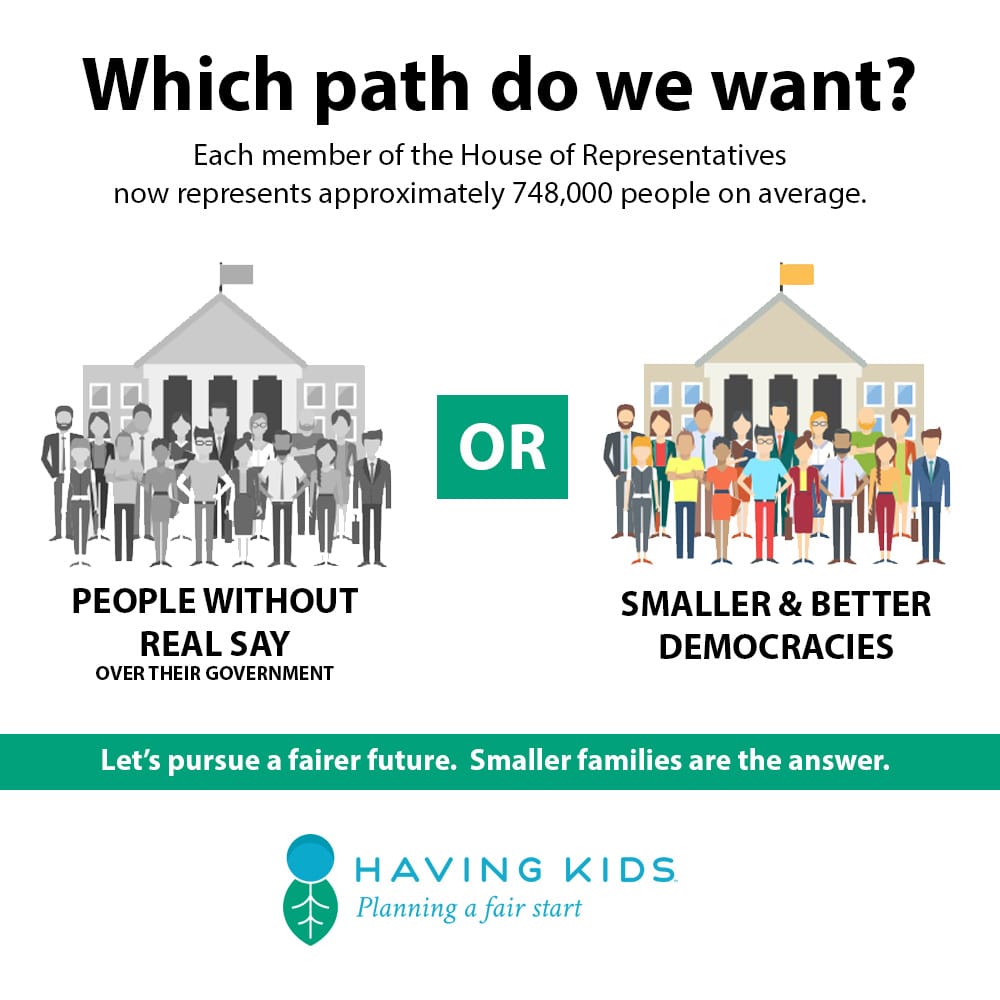
    An infographic compares two options: on the left, gray figures under “People without real say over their government,” and on the right, colorful families with “Smaller & better democracies.” Text promotes smaller families for fairer representation.

    Prospective parents must consider how they will support their families through devastating environmental threats: erratic day-to-day weather conditions, increasing pollution, extreme environmental disasters, population displacement, inconsistency in global supply chains and manufacturing, etc. For example, without extreme policy shifts and decreasing freshwater availability, about 2.3 billion more people than today (over 40% of the global population in total) are expected to be living in river basins under severe water stress; globally, land prices worldwide will skyrocket as agricultural lands become more scarce, and more urgently necessary (OECD Environmental Outlook to 2050).

    A chart with circles of varying sizes showing the impact of different actions on reducing carbon emissions. The largest circle says “Have one fewer child 58.6”. Other actions include living car-free, recycling, and using green energy.

    Issues like these will become more relevant in child development worldwide, including in high-income countries, like the US, that do not currently bear the brunt of climate related issues. One of the largest social shifts at this point in human history is the scope of parental responsibility to expand past
    the parents’ lifetime to include the hardship of generations to come.

    Works Cited


    Baker, Regina S. “The Changing Association Among Marriage, Work, and Child Poverty in the
    United States, 1974–2010.” Journal of Marriage and Family, vol. 77, no. 5, 2015, pp.
    1166–1178., www.jstor.org/stable/2458272


    “Births and Natality.” Centers for Disease Control and Prevention, Centers for Disease Control
    and Prevention, 3 Aug. 2021, https://www.cdc.gov/nchs/fastats/births.htm.


    Glass, Jennifer et al. “Parenthood and Happiness: Effects of Work-Family Reconciliation
    Policies in 22 OECD Countries.” AJS; American journal of sociology vol. 122,3 (2016):
    886-929. doi:10.1086/688892


    “OECD Environmental Outlook to 2050: The Consequences of Inaction – Key Facts and
    Figures.” OECD, Organisation for Economic Co-Operation and Development, 2012,
    https://www.oecd.org/env/indicators-modelling-outlooks/oecdenvironmentaloutlookto205
    0theconsequencesofinaction-keyfactsandfigures.htm.


    Overall, Christine. Why Have Children? The Ethical Debate. MIT Press, 2014.


    Rieder, N. “Procreation, Adoption and the Contours of Obligation.” Journal of Applied
    Philosophy, vol. 32, no. 3, 2015, pp. 293–309. JSTOR, www.jstor.org/stable/26813113.


    Saad, Lydia. “Americans, in Theory, Think Larger Families Are Ideal.” Gallup.com, Gallup, 6
    July 2018, https://news.gallup.com/poll/236696/americans-theory-think-larger-families-ideal.aspx.


    “The AFCARS Report.” The US Department of Health and Human Services, 23 June 2020
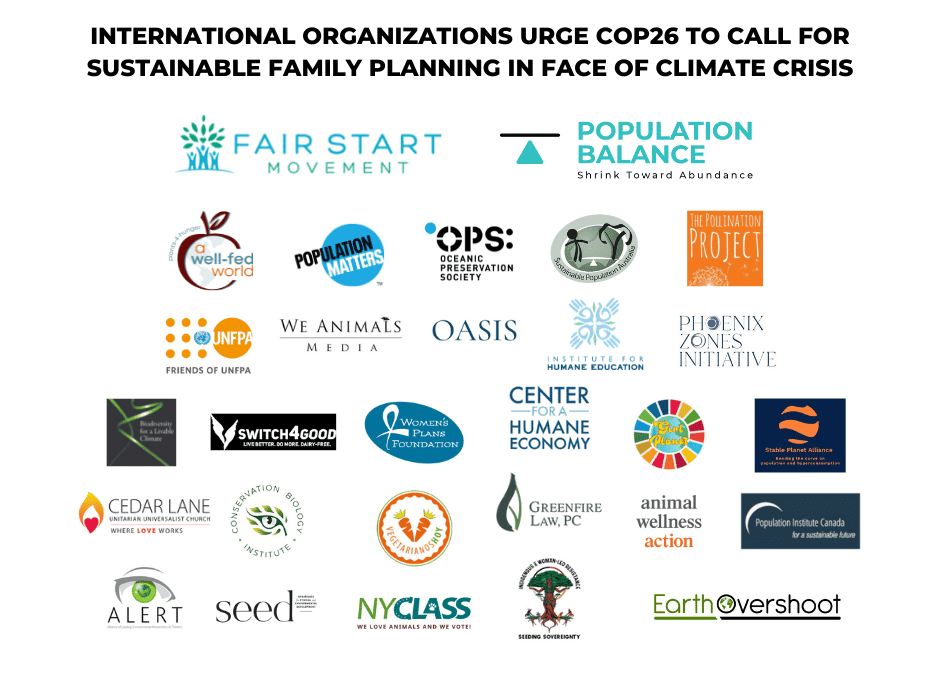

  • NEW COALITION OF ORGANIZATIONS CALLS FOR SUSTAINABLE FAMILY PLANNING IN FACE OF CLIMATE CRISIS

    NEW COALITION OF ORGANIZATIONS CALLS FOR SUSTAINABLE FAMILY PLANNING IN FACE OF CLIMATE CRISIS

    National organizations urge COP26 leaders to protect most vulnerable

    San Francisco, CA – Dozens of leading NGOs are calling on the President and Delegates of the COP26 in this open letter to take an urgent and clear public position recommending just and sustainable family planning as the most effective solution to address the climate crisis, and rising global inequality, including gender inequity.

    The global community has failed to inform and support a universal effort towards just and sustainable family planning, which:

    • Is human-rights centered
    • Ensures sustainable and equitable resources for greater investment in each child
    • Enables communities and governments to protect children and future generations while upholding reproductive rights

    On the contrary, pressures to increase births, or to obstruct family planning programs, are driving our biggest crises and putting the health, safety, and welfare of current and future generations in peril. Unsustainable population growth, a documented threat multiplier, is contributing to catastrophic climate change, unprecedented flooding, pandemics, ecosystem destruction, groundwater depletion, mass extinctions, and environmental degradation. Worsening inequality, in large part driven by our growing population, is also a grave threat to democracy and political stability across the globe.

    Better family planning is the best way to reduce inequality. Other interventions alone are simply too late. 

    Nandita Bajaj, Executive Director of Population Balance says, “Our growth-driven policies are not only a cause of immense suffering for marginalized human and ecological communities, present and future, but they are premised upon oppressive power structures. Not only are reproductive, intergenerational, and ecological justice under attack, our current unsustainable growth-centred family planning policies are threatening all life on earth. We collectively need to acknowledge and address the urgency of this predicament.”

    Fair Start Movement is a 501(c)3 nonprofit organization dedicated to reforming family planning by replacing growth-centered family planning models with the human rights-based and child-first Fair Start model. 

    Population Balance is a 501(c) 3 nonprofit organization that provides education and solutions to address the impacts of human overpopulation and overconsumption on the planet, people, and animals.

    Several hands of different skin tones are stacked together. Overlaid text reads, The most powerful social justice is a fair start in life. Join the coalition. The Fair Start Movement logo appears at the bottom.
  • Fair Start: Let’s Stop Counting People, and Start Making People Count

    Fair Start: Let’s Stop Counting People, and Start Making People Count

    It’s this simple: If we – each one of us – wants to be coming from a place of justice, we have to prioritize giving every child a fair start in life.

    That means reforming our family planning systems – through high incentives and entitlements – to ensure all future children minimum levels of welfare, approaching birth equity, and a meaningful role in their democracies. It means stopping pushing women to have kids.

    That’s the message in a new peer-reviewed book, containing articles originally published by Yale, Duke, Northwestern and other university, by folks at the Fair Start Movement. As the book details, the way we think about having kids is the product of a power grab by elites in the Twentieth Century who wanted to evade their collective obligations to invest more in kids. This fact is indisputable: Those who designed our family planning systems 1) created something unsustainable, that 2) benefitted those in power and 3) hurt the most vulnerable.

    Those systems make most claims about us making the world a better place misleading; our creation norm and paradigm contradicts and is busy undoing the things we claim.

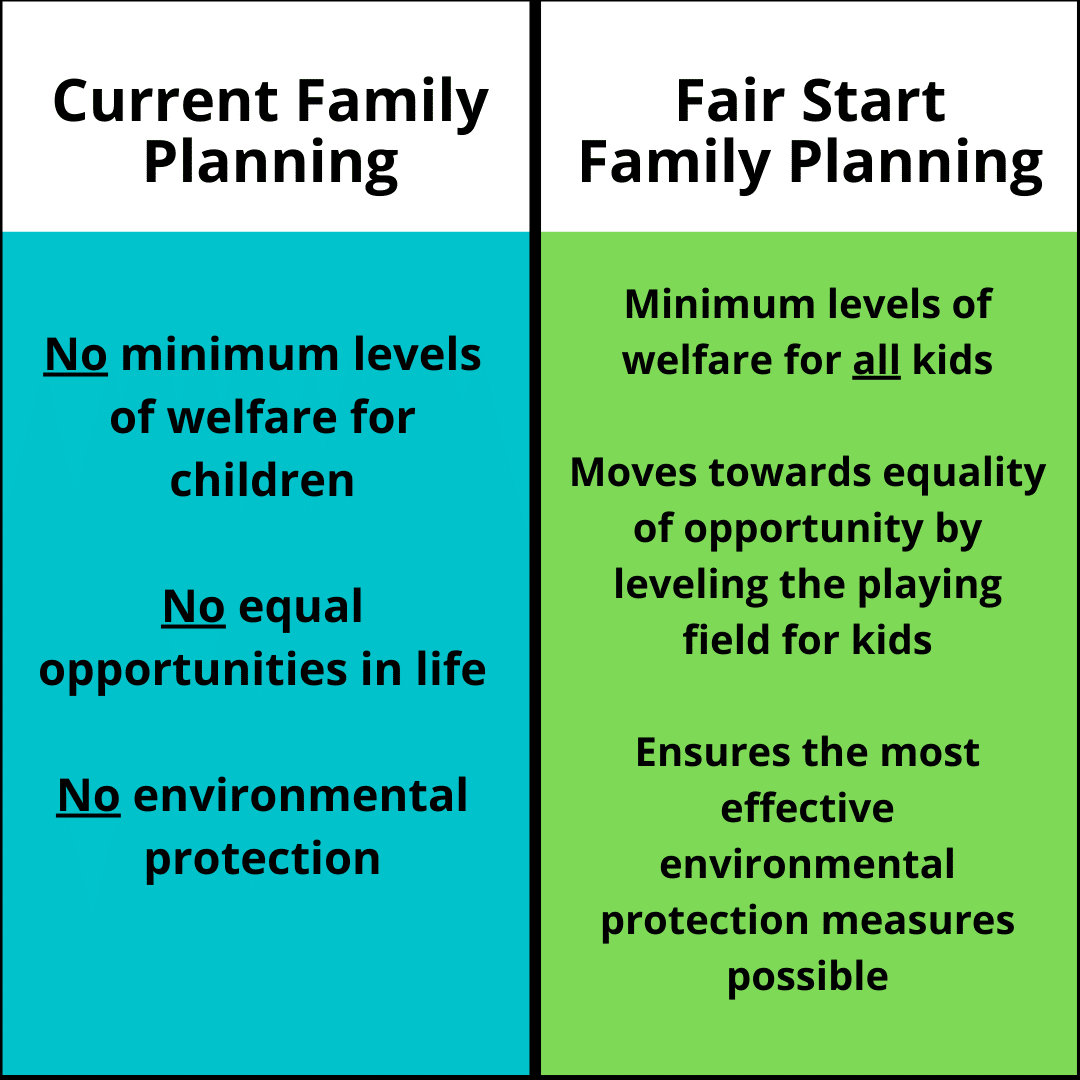
    A comparison chart of Current Family Planning vs. Fair Start Family Planning. The left side lists negatives of current planning; the right side highlights positive outcomes of fair start planning for welfare, equality, and environmental protection.

    Making the fair start change means moving from family planning policies focused on the unsustainable growth big business wants, to a universal child-centric Fair Start model focused on parental readiness, leveling the field between rich and poor kids, and promoting more sustainable families for all. That is the most effective solution to the crises we face today, from the climate to inequity, and starting from a just place frees us.

    How? Every day we do things that show we wish to be self-determining people, to be free and not determined by others. But there is a cognitive dissonance at work here blocking that from happening. The level at which we can be self-determining first depends on who we are – on our creation and our initial relations to others. If we don’t use fairness at that point, we end up with power differentials that subject some person to the power of others. We never constitute, or come together as free nd equal people under an ongoing condition of limited and decentralized power.

    A comparison chart of Current Family Planning vs. Fair Start Family Planning. The left side lists negatives of current planning; the right side highlights positive outcomes of fair start planning for welfare, equality, and environmental protection.

    Take Action: The most just solution to our crises is also the most effective

    Our nations are not constituted by god-like founders in the past. They are constantly being constituted by people, as we create and care for them – and the majority of people and whose rights matter, will live in the future. If we don’t start that process fairly, at Fair Start, we always come from an unjust place. We remain preconstitutional. We can do better. 

    1. Join us in this simple discourse, in which we admit to each other that every child’s right to a Fair Start limits our right to wealth and makes it partially subject to the needs of future generations. No nation, or its legal system, can claim any form of political legitimacy without prioritizing every child’s right to an ecosocial Fair Start in life, which transfers power – or constitutes – from the most powerful to the least.

    Let’s come together from a just place.

    2. Let’s urge the United Nations to make Fair Start – under Article 16 of the Universal Declaration of Human Rights – a universal standard. Nothing exists outside the frame of justifiable we, and it starts with the creation of future generations.

    3. Finally, please urge any groups you support or work with to join our call for mandatory population policy disclosures. We need to know who, among us, promotes putting an unlimited number of children, without any guaranteed levels of preparation, equity, or influential role in their democracy, into an increasingly degraded ecological future.

  • New Book: The Most Effective Solution to the Crises We Face Today

    New Book: The Most Effective Solution to the Crises We Face Today

    Why are we facing climate and other ecological crises, massive inequality, and decaying democracies? How did things not get better than they were in the past? As a new peer-reviewed book by folks at the Fair Start Movement makes clear, these problems derive from a massive power grab by elites in the middle of the Twentieth Century.

    The book was recently recommended reading by a leading constitutional scholar.

    The core claim it makes, that fair family policies which – restore a biodiverse nonhuman world, ensure equal opportunities for children, and build democracies where each person actually has the capacity to influence outcomes – would override all competing interests and rights has been subject to five successful peer-reviews: The Primary Right, A Human Rights Approach to Planning Families, Constituting Over Constitutions, The Right to Matter, and Justice as a Fair Start in Life. But we don’t need peer-review to understand the claim. How could we reject these values and believe in any viable conception of freedom, especially as the loss of nature through the climate crisis seriously harms infants? How can we separate these values from our creation, and how could anything logically precede creation – or existential – justice? How could we actually choose who has power over us without the “first election” of a just family planning norm?

    Rather than ensure equal opportunities for all, and ecological sustainability via properly interpreting Article 16 of the Universal Declaration of Human Rights, world leaders invented a family planning model that evaded their collective responsibility to invest in and protect future generations. They pretended an interpersonal right was personal. They went for “nobody else’s business” over actually protecting kids. And by using that nonsense to maintain the trajectories at the time, they went for growth over equity.

    A promotional banner for the book Justice as a Fair Start in Life by Carter Dillard, featuring the book cover with a tree illustration, a QR code, and a 10% off offer for direct purchases.

    They faked justice, and human rights, to protect existing power structures. Yes, we all got scammed, and our children will suffer as a result.

    But as the book demonstrates, there is no real justice without a Fair Start in life. And right now, taking resources from the top of the wealth pyramid – the one Nobel Laureate Steven Chu recently decried – and using those resources as better family planning incentives/entitlements would have ten to twenty times the beneficial impact on the the climate and other ecological crises, massive inequality, and decaying democracies we are faced with today relative to downstream approaches. Fair Start is justice and freedom, or ensuring the capacity to consent to the influence of others.

    The move to take those resources, and ensure birth equity, exposes a new border war between free people, and preconstitutional people or “precons” who refuse to collectively constitute free and just societies, and thus threaten our kids’ future.

    This is the bottom line: Unless we prioritize an ecosocial Fair Start in life, we are not coming from a just place. Precons won’t prioritize each child getting a fair start in life. Free people will. Full stop.

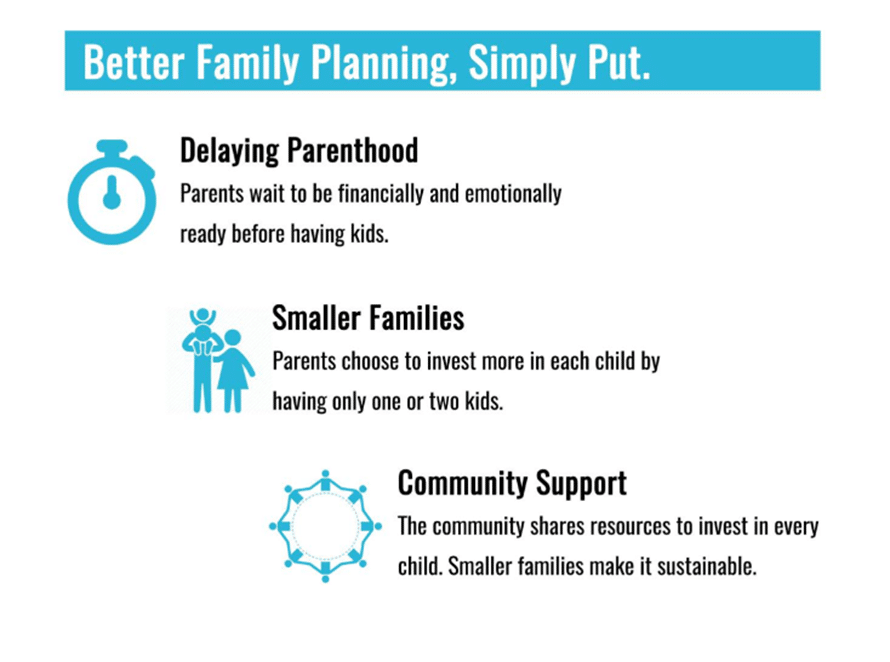
    Infographic titled Better Family Planning, Simply Put with icons and three points: Delaying parenthood, smaller families, and community support, each explained with brief text and blue graphics.

    Order your copy today, and join the fight for true justice.

    1. Concentrations of wealth and power only exist because world leaders chose isolation family planning systems meant to avoid collective obligations to protect future generations. This fundamentally created every crisis, from the climate to massive inequity, we face today.
    2. The right to a Fair Start in life is the first and overriding human right, obligating us to target those concentrations – and people like Ivanka Trump and other wealthy families like the Raymonds – to limit and decentralize their power and pay what they owe. They benefited from, and furthered, a lie at the heart of our systems of human rights and democracy.  They are at the heart of the power grab. Government and all political obligations derive from people, who derive from their creation. The duty to ensure a Fair Start in life – the god norm – overrides all other rules, like the property rights that empower people like Ivanka. Fair Start is promoting a process called the Tell the Truth campaign, under federal law, to require disclosures of who played what role – and what role they plan on playing – in creating the crises we face today.
    3. Making them first apologize and then pay, via Fair Start incentives and entitlements, is the most just and effective way to compensate future generations for things like the climate crisis, with impacts that are ten to twenty times more effective than the downstream measures other nonprofits are promoting. Don’t get scammed. First things first – let’s start by creating optimal and just populations.

    A comparison chart of Current Family Planning and Fair Start Family Planning. The left side lists negatives: no minimum welfare, no equal opportunity, no environmental protection. The right side lists corresponding positives.

  • Justice Without a Fair Start in Life? Don’t Fall for It. Help us Target Companies Greenwashing and Hurting Our Kids.

    Justice Without a Fair Start in Life? Don’t Fall for It. Help us Target Companies Greenwashing and Hurting Our Kids.

    Welcome to the Tell the Truth Campaign

    Which corporations and nonprofits are benefitting from unsustainable and inequitable family planning – the biggest driver of the climate and inequality crises – while pretending to further environmental and social justice? Federal Environmental, Social and Governance (ESG) disclosure requirements provide an opportunity to find out and act. Support Fair Start’s campaign for an executive order to require disclosure of policies and advocacy around the biggest factor of all – families – so that we can hold bad actors accountable.

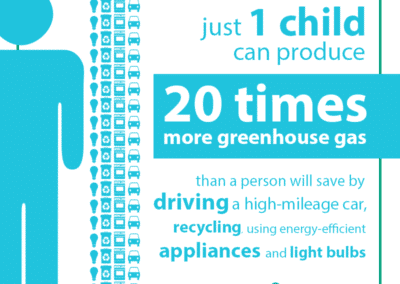
    Infographic showing that one child can produce 20 times more greenhouse gas than can be saved by driving a fuel-efficient car, recycling, or using energy-efficient appliances and light bulbs.
    Why not be effective?

    We are urging the Biden Administration to do what should be painfully obvious by now – actually account for the greatest driver of the climate and other crises that gave need for a new ESG disclosure framework: Our family and population growth policies.

    Nothing has a greater impact. Full stop.

    Why report at all if we do not account for the underlying driver/multiplier, and the volatility inherent in it?

    We need to know who, among us, promotes putting an unlimited number of children, without any guaranteed levels of preparation, equity, or influential role in their democracy, into an increasingly degraded ecological future. And in terms of the past, we need to know which groups said they were making progress, knowing the growth they supported was undoing that progress the whole time and moving wealth away from effective investments in children and into the hands of people at the top of the wealth pyramid.

    ————————————————

    TAKE ACTION:

    Read our letter urging Biden to issue an executive order here, and urge any organizations you work with or support to join our call for the order.

    ————————————————

    Support the Truth. Support Fair Start.

    Governments are failing children’s right to an eco social fair start in life. We know that early childhood experience is pivotal to lifetime outcomes. Why are we waiting for adverse childhood experiences to occur before acting? 

    Children deserve equitable conditions, right from the beginning. A fair start in life is the first human right – it overrides all others. It is what children are entitled to under the Children’s Rights Convention, and what allows them to eventually be free from the power of others, and truly self-determining. Because legitimate governance derives from people, who derive from the norms that create them, there are no such things as just societies, political legitimacy and freedom without the sort of Fair Start reforms discussed in this site. Without them we are always proceeding from, or reconstituting our political societies, from an unjust position. 

    Ensuring an eco-social #fairstart in life for all kids can have ten to twenty times the long run impact on the key social and ecological crises we are facing today relative to other interventions.

    It is the most effective and just thing we can do. And there is no justice without it.

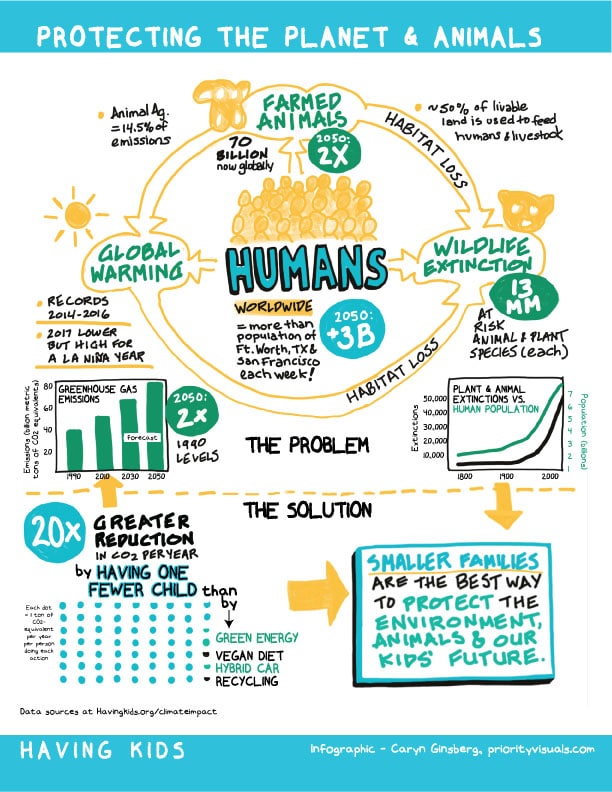
    Infographic illustrating the impact of human activity on the planet and animals, showing links between family size, resource use, global warming, extinction, and proposed solutions like smaller families and sustainable practices.
  • Worried About Having Children in the Climate Crisis? Your Human Rights Were Violated. Fight Back. 

    Worried About Having Children in the Climate Crisis? Your Human Rights Were Violated. Fight Back. 

    The UN has been obligated to interpret the promise of Article 16 of the Universal Declaration of Human Rights, that of a right “to found a family,” in a way that would protect the right for all generations equally. This includes those in the middle of the Twentieth Century, and those in 2050 for example, equally. It should have also interpreted Article 16 consistent with other human rights obligations, like the Children’s Rights Convention, and well as the Sustainable Development Goals.

    Mountains of evidence show young persons are not able to exercise their right equally because of many population-driven threats to the children they would have, including significant birth impacts. In other words, the UN failed to interpret and administer Article 16 correctly.

    In fact it caved to member state pressures to maintain large and unsustainable families and population growth rates in the Twentieth century, and violated future generations’ rights to safely and sustainably found their families under Article 16. Because men – under enabling from the UN – pushed women to have large families in the past, younger generations today have to worry about having even one child, given the ecological future that child faces. Moreover, women who were pushed to have children under the growth paradigm enabled by the UN’s modeling – and have children despite the risks of Covid-19 – are dying in massively disproportionate numbers. We need to hold those who enabled this accountable.

    Read the draft process Fair Start is developing to seek justice before the United Nations Human Rights Council.

    The best way to compensate young people and future generations for this violation of their rights is by properly interpreting Article 16 via Fair Start modeling, which encourages birth equity-level transfers of resources as Fair Start family planning incentives/entitlements. This is forward-facing climate reparations at their best. Given the special foundational nature of Article 16, and when properly interpreted its peremptory status as the grundnorm overriding even state-created property rights, younger persons have the right to take the Fair Start resources they need and we will encourage them to do, including those that will ensure future children’s enjoyment of their rights under the Children’s Rights Convention. 

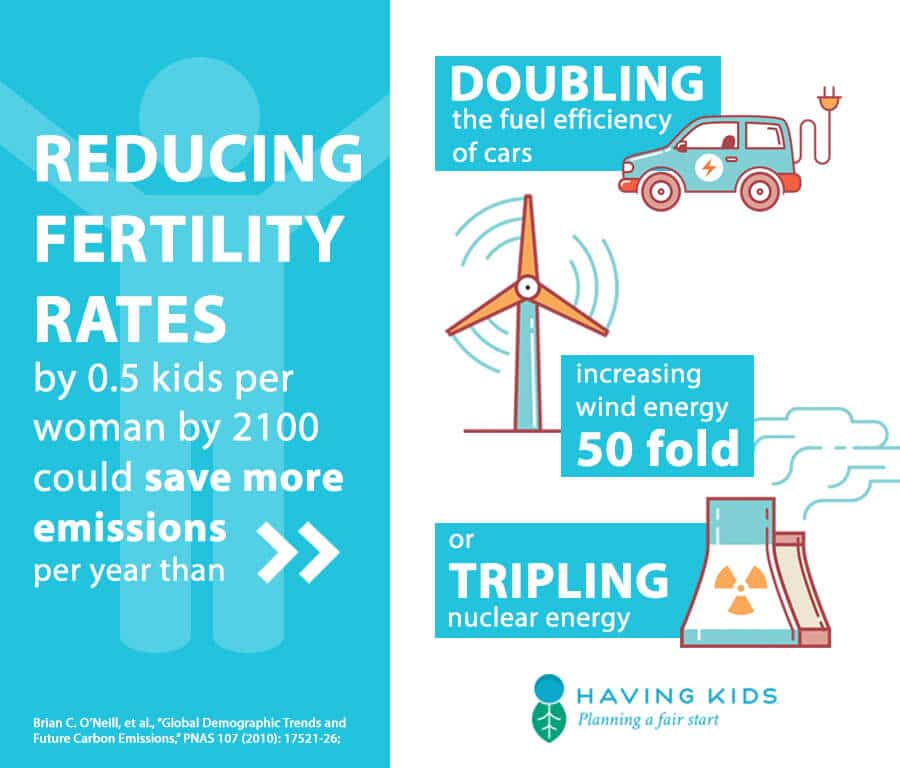
    Infographic showing ways to reduce carbon emissions: reducing fertility rates, doubling car fuel efficiency, increasing wind energy 50-fold, and tripling nuclear energy. Includes icons of a car, windmill, and nuclear symbol.

    Activists should start by engaging the relatively wealthy children of UN officials, in this special  form of lawful and peaceful constitutional dialogue and social change, geared around our just desert to family planning incentives/entitlements. There is nothing more just than targeting an extant minority for the benefit of the countless future majority. This process will build, targeting the concentrations of wealth and power – both public and private – most responsible for the climate and other crises we face today, including those that most benefited from past, inequitable and unsustainable interpretations of Article 16.

    Take action: Urge United Nations Secretary General Antonio Guterres @antonioguterres to speak out and act to protect all generations’ right to found a family.

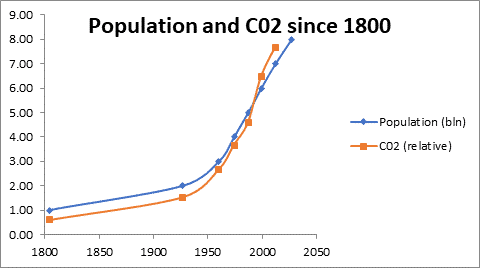
    Line graph showing global population (in billions) and CO2 (relative) from 1800 to 2050. Both lines rise slowly at first, then sharply increase around 1950, with population slightly above CO2 in recent decades.

  • Afghanistan Nightmare: Look to the United Nations and Family Policies of the Past

    Afghanistan Nightmare: Look to the United Nations and Family Policies of the Past

    As Afghanistan descends into a human rights catastrophe, we should look for the mistakes that created the crisis and learn from them. Afghanistan has had one of the highest birthrates in the world, driven by a dominant patriarchy.

    Given this, did the United Nations intervene decades ago to protect women and children through aggressive family planning programming meant to ensure compliance with the Children’s Rights Convention, and to free women from the structure that treated them primarily as mothers? It did not, instead choosing to embrace the isolation modeling that treats the act of having children as as something left to the subjective whims of the parents, and nobody else’s business.

    This was a major missed opportunity, laying the foundation for the birth and development of a ballooning number of children in conditions that would ensure the chaos we see today. In creating its system, the UN bent to pressure from male-dominated members – including the United States – who saw population growth as an easy way to create economic growth.

    Both involve the exploitation of vulnerable entities – women, future children, and the nonhuman world – to empower men. The story of Afghanistan is the story of ignoring the impact of massive family size, abysmal child welfare, vast inequity, and the failure to prepare children as effective members of democracies.

    Eerily, it finds echoes in the patriarchy here in the United States eagerly pushing women to have more and more kids.

    A comparison chart of Current Family Planning vs. Fair Start Family Planning. The left side lists negatives of current planning; the right side highlights positive outcomes of fair start planning for welfare, equality, and environmental protection.

    What’s the solution? Had the United Nations adopted and implemented the correct interpretation of Article 16 of the Universal Declaration of Human Rights, the right to found a family, which treats the provision as the dominant human right and child-centric in nature (focused on the most vulnerable entities, and those with the most at stake), this situation could have been avoided.

    TAKE ACTION: Urge the United Nations to change course and stop creating nightmares like what we are seeing in Afghanistan.


  • Calling for Voices: Think Your Future Child Deserves a Fair Start?

    Calling for Voices: Think Your Future Child Deserves a Fair Start?

    This past Fourth of July, two everyday people Cassie and Matt – exemplified what it would mean to constitute communities that are actually free, in part by compensating future generations for the harm we have caused them through the climate, inequity and other ecosocial crises.

    They are living the truth that justice for future generations overrides all other obligations, including property rights. Older generations lied about the “private” nature of family planning to protect concentrations of wealth and power from distributive obligations to future generations. That lie is fundamentally blocking justice.

    Listen to this brief podcast to understand why.

    Cassie, an activist and nonprofit professional said this about family planning:

    Current corrupt concentrations of power push a growth model that promotes unsustainable family planning policies. They see us ordinary people as economic inputs in their machine, to use for our reproductive and other labor. It’s our job to fight that narrative and elevate the worth of every individual to have their basic needs met, on day one. My partner and I hope to adopt children one day and I feel the urgency to ensure that my future child, and all children, have the resources and opportunities that are their right.

    Matt, a donor to the Fair Start Movement, said this:

    I support the Fair Start Movement because I know that any claims I have to property and wealth are subject to ensuring every child a fair and equitable start in life, the first and overriding human right. I’m willing to step forward, as a donor, and say that. I challenge others to do the same.

    Together, they are exemplifying a real new deal, one that fixes the fundamental source of the biggest problems in the world today, and leads to a comprehensively liberated state of affairs. It’s not about population. It’s about people, the vast majority of people, who will exist in the future. It’s about putting their interests first. And if it takes a village to raise a child, it takes a village to plan for a child. Government derives from the people which derive from their creation. A just creation norm thus precedes and overrides everything else, including the government assigned property rights that have created massive power differentials between rich and poor.

    We can spread this modeling, and this simple discourse: “Part of your wealth is my and my future child’s family planning entitlement and incentive.

    TAKE ACTION:

    1. Do you feel your child or future child deserves a level playing field and equal opportunities in life, relative to wealthy children – the many  millionaire and billionaire kids who will impact your child’s life?
    2. What if your child or future child had a human right to that fair start ? Would you advocate for policies, and direct action, to ensure that right?
    3. If you are someone with wealth, would you be willing to speak out in support of that right and those policies?

    Can you help us find groups of people to enlarge the discourse that future children’s right to an ecosocial Fair Start in life overrides property rights, and necessitates distribution that will incentivize the most comprehensive and effective solution to the crises we face – Fair Start family planning?

    Urge those you know who are willing to step forward and say this to contact Ashley Berke at Ashley@fairstartmovement.org

    Several hands of different skin tones are stacked together. Overlaid text reads, The most powerful social justice is a fair start in life. Join the coalition. The Fair Start Movement logo appears at the bottom.
  • Orgs Are Speaking Out on Smaller Families, and It’s Having an Impact

    Orgs Are Speaking Out on Smaller Families, and It’s Having an Impact

    Kudos to Fair Start Movement coalition member, Population Matters for bringing attention to the topic of sustainable families. The group awarded $695 to Prince Harry and Meghan Markle to be gifted to the charity of their choice, for making the decision to limit their family to two kids. The award, which is garnering headlines and serving to break the taboo, was timed to coincide with the U.N.’s World Population Day.

    Prince Harry revealed the couple’s plans to limit their family size due to environmental concerns back in 2019. Earlier that year we wrote to Megan as well, urging the couple to serve as role models and incorporate sustainability into family planning. It took courage for them to make that statement and it likely would not have happened without the great teamwork and encouragement from Population Matters and Jane Goodall. 

    Despite the endless supply of alarmist stories about declining birthrates, cultural perspectives are beginning to shift and recognize the numerous social and emotional benefits of choosing to have only one or two kids. Choosing a smaller family is also the most effective way to reduce climate impact. 

    The environmental impact of smaller families:

    It’s time for more environmental organizations to inspire eco-conscious parents to choose to have smaller families to reduce human impact on animals and the planet.

    Take Action: Share this headline with your favorite animal and environmental organizations, and urge them to follow suit in promoting more sustainable families. 

    Tweet:

    • Carter Roberts, @Carter_Roberts, president and CEO of the World Wildlife Fund
    • Annie Leonard, @AnnieMLeonard, executive director of Greenpeace USA
    • Michael Brune, @bruneski, executive director of the Sierra Club
    and ask them to take a stand on the most effective way to protect our future: policies that promote sustainable and equitable family planning.