Category: Wildlife & Animal Welfare

  • Societal Pressures on Female Humans and Nonhuman Animals: Calling for Change

    Societal Pressures on Female Humans and Nonhuman Animals: Calling for Change

    by Jess Beaulieu

    One Voice Speaks Out for the Only Form of True Inclusivity

    As a child, I was famously aware of society’s pressure on females to reproduce. I was gifted baby dolls by countless family members in the hopes that I would begin to foster a need to procreate – just as they had. And as I grew up, the pressures of motherhood were relentless. I’ll never forget the required class in my Georgia middle school that taught girls how to be fit stay-at-home mothers while boys learned business and home repair skills. Not to mention the recurrent phrases that haunted me throughout my young adult years: “how can you not want children,” “you’ll change your mind when you’re older,” and “I didn’t want children either until I had my own, and that changed everything.” Rather than taking these questions to heart and seriously considering my need to reproduce for my family, and society at large, I found myself concerned about how this pressure on females generally would impact humans, nonhuman animals, and the environment long-term.

    Consider how our current systems exploit females whether human or nonhuman – and even Mother Earth. For example, in the dairy industry, female cows are artificially inseminated and upon giving birth, their calves are ripped from their side so that their milk may be preserved for the industry itself – all to make a profit. This insidious pattern is repeated throughout a female cow’s life until she is considered no longer useful by the industry and is rewarded for her life-long trauma by being sent to slaughter. Similarly, female human autonomy is under direct attack. State governments are attempting to rip a woman’s abortion right from her to directly benefit the system by producing more bodies for more labor. This pro-natal, pro-capital conviction has generated a world with massive inequities. In both scenarios we see female exploitation for economic gain and supremacy. 

    A comparison chart of Current Family Planning vs. Fair Start Family Planning. The former lacks welfare, equality, and environmental protection, while the latter ensures welfare, equal opportunity, and environmental protection for all kids.
    Care about the majority of sentient beings? Focus on family reforms.

    And concerning Mother Earth, with the largest meat and dairy companies’ impact on the climate now outweighing that of numerous developed nations, no bigger threat to the future of the planet exists than that of factory farming expansion. The U.S. Environmental Protection Agency reports that livestock operations make up 25% of all agricultural greenhouse gas emissions, and that manure management operations are responsible for 12% of overall agricultural emissions. (See David Worford, Letter Asks Congress to Give EPA Power to Regulate Livestock Emissions, Environmental Leader (Feb. 18, 2022), https://www.environmentalleader.com/2022/02/letter-asks-congress-to-give-epa-power-to-regulate-livestock-emissions/.)

    And factory farming, which almost always goes unnoticed as the climate culprit within the agriculture sector, tears down forests to plant crops for animal feed, releasing carbon into the atmosphere; shatters wildlife habitats; displaces local communities; and profits from the immense suffering of billions of farmed animals each year. (See Jacqueline Mills, Factory Farming: The Real Climate Culprit, World Animal Protection (Oct. 29, 2021), https://www.worldanimalprotection.org/blogs/factory-farming-real-climate-culprit.) And yet the government does not require that factory farms obtain permits under the Clean Air Act, and it has failed to determine how to measure emissions from feedlots, barns, and croplands. 

    To this climate change point, Fair Start Movement’s Carter Dillard has stated, “[y]oung people are increasingly choosing not to have children, not because they don’t want them, but because they’re worried about how the climate crisis will impact their children’s future.” (See Elena Shao, More Young People Don’t Want Children Because of Climate Change. Has the UN Failed to Protect Them?, Inside Climate News (Nov. 16, 2021), https://insideclimatenews.org/news/16112021/young-people-children-united-nations-climate-change/.) We may not all have the same reasons behind our choice to not have children, but the fate of the planet is an increasingly rooted concern of many. I join both Fair Start Movement and Population Balances’ desire to see the social pressure and bias shift away from reproduction. Much needs to change for the future of all females.

    A four-panel meme showing brain images that progressively light up as the captions advance: from denying global warming, to recognizing overconsumption, to choosing a smaller family, to advocating for future children’s needs.
    We can go further.

    The most effective way to address many impacts on our environment and other species, such as climate change, is to choose sustainable families. Putting the child first when family planning provides a human rights-based solution, ensuring the availability of resources for all. It is both equitable and sustainable and is also reflected in the worldwide trend towards families that can invest more in each child and ensure a safer future. And all of this considered will empower females in the long-term. 

    Taking matters into our own hands, rather than continually allowing corrupt systems to determine our futures, the future of nonhuman animals, and the future of Mother Earth, is how we will dismantle unjust societal expectations and guarantee a sustainable future for all.

  • Ezra’s Dilemma: Vox Is Pushing Women to Have Kids, Which Accelerates Species Extinction and Expands Factory Farming

    Ezra’s Dilemma: Vox Is Pushing Women to Have Kids, Which Accelerates Species Extinction and Expands Factory Farming

    [et_pb_section fb_built=”1″ _builder_version=”4.16″ global_colors_info=”{}”][et_pb_row _builder_version=”4.16″ background_size=”initial” background_position=”top_left” background_repeat=”repeat” global_colors_info=”{}”][et_pb_column type=”4_4″ _builder_version=”4.16″ custom_padding=”|||” global_colors_info=”{}” custom_padding__hover=”|||”][et_pb_text _builder_version=”4.16″ background_size=”initial” background_position=”top_left” background_repeat=”repeat” global_colors_info=”{}”]

    Ezra Klein has a dilemma.


    Vox Media reports responsibly on the horrors of factory farming and the climate crisis but openly pushes women to have more kids as a means of creating economic growth. They do so through their tax policy promotions, the work of Matthew Ygelsias, articles denying the science of population and climate, etc. It’s the same approach used by Donald Trump and many right-wing politicians who think of future generations as numbers to inflate the economy, rather than as children who all need a socially and ecologically fair start in life.


    Factory farming and every other animal and environmental crisis is fundamentally driven by human population growth. While Peter Singer is often credited with advancing the philosophy of animal rights, Paul Ehrlich probably did more to actually mitigate animal suffering and extinction through his influential work to slow population growth. Animal liberation, ours and nonhuman, begins with a family planning ethic that promotes sustainable and more equitable families who build empathy and fluid democracy in future generations. It’s not whether we talk about animal rights — it’s how we actually influence nonhumans and their worlds.


    Vox’s “women should have more kids” reporting is slanted, exacerbates the greatest factor driving the climate crisis, and hurts animals. Vox should recognize that any economic growth is first contingent on human rights compliance, which requires more equitable and sustainable families that invest heavily in each child. The human rights regime envisions a future filled with town halls where everyone has a voice, defined by nonhuman habitat. It does not envision a world where the average voice is lost and nature is paved with shopping malls where consumer freedom has replaced political freedom.


    Take Action:


    Learn more about why social justice for all starts with family planning reform and urge Editor Lauren Williams (@laurenwilliams) and Ezra Klein (@ezraklein) to support Fair Start sustainable family planning policies, and to stop pushing women to have kids.


    Also, urge Cory Booker to adopt family planning reform as key aspects of his opposition to factory farming and his support for guaranteed minimum income for children.


    [/et_pb_text][/et_pb_column][/et_pb_row][/et_pb_section]

  • Comprehensive Animal Rights

    Comprehensive Animal Rights

    If you wanted to work to liberate both humans and nonhumans, how would you do it?

    You might promote diet-focused veganism as a way to eliminate the confinement and suffering that humans inflict on nonhumans in factory farms, and to improve human health and well-being at the same time. Or you might focus on early childhood development programs that build children’s empathy in the hopes that they will end up treating other animals — both human and nonhuman — well.

    While effective, neither of those strategies is comprehensive. To be comprehensive, we have to deal with the interactions of future generations of all animals — or what might be called the long-run future — which dwarf the number of interactions occurring today. One way to do that is to apply an accepted ethical framework such as international human rights. To deal with the long-run future within that system, we could combine a forward-looking and child-focused family planning ethic devised around the Children’s Rights Convention, for example, with a nonhuman-focused ecological ethic, in order to minimize the suffering and death that humans impose on animals (which will continue to increase as human population grows), and maximize self-determination for all entities.

    Let’s unpack that statement a little: To be comprehensive, we have to account — at the most fundamental and irreducible level — for how all humans and nonhumans first come to exist and interact. We would have to account for who we are as a species, in terms of the quantity, qualities, relative positioning, etc., of the people on the planet, relative to the nonhuman world. Who are the people impacting animals, and who will they be in the next generation and in the generations after that? The first step in animal rights is accounting for the existential relationship, and perhaps the balance, between humans and nonhumans. It’s hard to have rights when you are extinct and hard to prevent extinction without a family planning ethic that requires preservation of the nonhuman world.

    Rights Are About Protecting the Most Vulnerable Classes: Future Children and Nonhumans 

    And to be comprehensive and actually account for the interconnections, we have to deal with the crucial phase between the nonhuman and human world: the time-space in which humans are conceived, born, raised, and developed in particular ways, and the nexus of the nonhuman world, or a restorative baseline for environmental protection, in that process (e.g., the shortening of pregnancies due to the climate crisis). In other words, we have to account for the fundamental power humans have over the most two vulnerable categories of entities though the act of procreation: future children and nonhumans.

    We would have to ensure that, relative to the touchstone of the nonhuman world, future generations are free and self-determining and are inherently disposed from the very beginning to treat humans and nonhumans in ways that promote the autonomy and well-being of every individual. 

    How do we know this is true? The climate crisis provides a helpful example: Study after study has shown that the most comprehensive and effective way to mitigate the climate crisis that is the greatest threat to future generations of humans is also the most effective way to protect animals: Creating and implementing better family planning laws that promote more equitable and sustainable families.

    Doing so would not only reduce emissions, but would also create resilient, capable, and cooperative people able to best navigate a degraded ecology.

    In other words, the poor family planning laws designed to promote economic growth to benefit elites also ensured countless children were born into poverty, abusive homes, and misery over the past several decades. This, in turn, ensured the extinction of countless species, the creation of factory farming, the onset of the climate crisis, and other examples of nonhuman suffering and death that has only skyrocketed in our lifetimes. Human population growth (which is actually a misnomer for a more complex process), or the act of having kids, was the genesis of it all.

    Had we applied a standard of protecting the nonhuman world as part of the liberation of nonhumans, we humans would have evaded the climate crisis and would be much better off.

    And it’s not just about population growth: Having kids determined things about our qualities (like empathy) and relative inequity that fueled the colonization and destruction of the nonhuman world. It starts, unsurprisingly, with who we are.

    Being Comprehensive Means Applying a Duality

    How, in practice, do we do reverse this catastrophe? Now we are back to the beginning: We can apply a simple duality. First, we can implement a forward-looking and child-focused family planning ethic, one which recognizes that creating a child is more an act of other-determination than self-determination. That means changing from the current family planning paradigm, focused on what parents want, to a paradigm focused on what children need. We can combine that ethic with a nonhuman-focused ecological ethic — which is not the “world’s environment is a human resource” ethic many mainstream environmentalists use and which precipitated the climate crisis — in order to minimize the suffering humans impose on animals and maximize self-determination for all entities. 

    That’s comprehensive (as opposed to consumption-based) veganism and animal rights — and the only approach truly consistent with the precautionary principle. Comprehensive animal rights is an ongoing process of constituting free societies for all. The good news is that better family planning is on trend, much more so than consumer-based and less comprehensive veganism.

    Having Kids uses the duality described above to help accelerate that trend, through actions like:
    • our campaign to urge the United Nations to use a human rights-based family planning model
    • our campaign to reform child-welfare systems to ensure some minimum level of welfare at birth for all kids, and
    • our support for recent litigation to protect our fundamental human right to the existence of the natural, or nonhuman, world and the restored habitat of countless sentient creatures. 

    You have a right to nature, children have a right to a fair start in life, and no one has a right to have children in abusive or neglectful conditions. Understanding these moral facts is the key to comprehensive animal rights, true fourth-dimensional (or temporalized) freedom, and a better future for all. And we can implement these truths by speaking truth to power, and transferring the resources necessary to incentivize better family planning and fair starts in life for all.

    Nothing Matters More Than Who We Are Becoming

    In other words, maximizing impact means first accounting for the volatility in human population growth created by our current family planning systems — or who we will be in the future — and then ensuring that we build future communities where freedom, and the suffering future humans will cause animals, have actually been accounted for. Maximizing impact means working toward a temporalized and comprehensive vision of a human and nonhuman environment — a vision of who we are to be.

    This goes well beyond traditional welfarist population ethics. We are trying to liberate future generations by making them self-determining, not just accounting for our impact upon their ecology, for example. If we value agency, self-determination and humans controlling the norms under which they live, we have to create self-ruling communities — rather than archaic nation states — where those values are manifest. We have to create people with what John Rawls called a “sense of justice,” or a community of truly legal persons capable of complying with norms that protect animals, rather than relying exclusively on traditional animal protection laws that — especially when it comes to farmed animals — are often not worth the paper on which they are written.

    Comprehensive animal rights would mean intentionally constituting future communities of free and equal people by cooperatively and equitably ensuring the requisite time, love, and energy for each child, so that we are investing in future generations rather than exploiting them. 

    This is where Peter Singer (who focused on suffering, rather than power) and other prominent animal rights theorists failed to account for the majority of animal subjugation (both human and nonhuman), the interrelation of that subjugation, and the way it is causing the social and ecological crises we are experiencing right now. They ignored the point when the interactions begin: our creation. And they ignored the need for an orienting baseline to constitute our communities. They also ignored that justifying social organization at this level prevents that subjugation, and the crises, and serves as the foundation of comprehensive animal rights.  Rights developed as a means of protecting the vulnerable from the powerful. And given that future children and nonhumans are uniquely and inextricably vulnerable, systems of rights must begin with them. Want to protect the vulnerable? Focus on the invariably antecedent, and dominant, factor: the creation of their oppressors. 

    How Do We Achieve Comprehensive Animal (Including Human) Rights?

    There is a way forward that aligns the rights of all animals, using the nonhuman world — or the wild — as a baseline for the unified conception of a dynamic social and ecological, or human and non-human, environment. This is what that conception, which goes beyond descriptions toward a normative account of human power properly oriented from its absence, looks like: Families that invest more in each child and can create sustainable and deliberately inclusive communities; a greater voice for each person in their systems of governance as we reorient social organizations around town halls instead of shopping malls; more time off for parents; smaller impacts on the planet, wildlife, and farmed animals as we restore the wild; better outcomes for each child; and more resources to share among families so that everyone can get a fair start in life. 

    It’s a win-win for all animals. It’s the freedom of opportunities to do things in life balanced with the freedom from the unwanted influence of others. There is simply no coherent conception of freedom, or rights, that does not account for this dynamic alignment. In this sense, while nonhumans were unlucky in the power dynamic relative to humans, they are lucky in that their liberated world is a necessary condition for humans to be the best people they can be.

    Having Kids works to move the world in this direction through what we call the Fair Start family planning model, which orients from a zero-baseline, or the nonhuman world. The work is not purely theoretical but involves very specific real-world policy changes. We can advance family planning to improve lives and our planet’s future through many avenues. Here are just a few:

    • Fighting for the fundamental right to nature, or a nonhuman ethic of environmentalism, which is the anchor point for any coherent conception of freedom and the intersection of human and animal rights. This can include direct action to transfer resources in ways that promote and incentivize Fair Start family planning, and other tactics, given the peremptory status of the right.
    • Using expressive and noncoercive approaches to prioritize child welfare and to accelerate a change in family planning culture, highlighting shocking child welfare crises to illustrate the urgent need for reform. Being free means celebrating our right to nature in tandem with responsible family planning — not allowing kids to be born with no minimum guaranteed level of welfare, e.g., into abusive and neglectful conditions. That warped conception of freedom only feeds into growth economics, the consumption of nature, and the exploitation of future generations. It’s not freedom — it’s the powerful using the powerless.
    • Tax policies that encourage large families can be reformed to encourage delaying parenthood, investing more in each child and transferring resources to ensure that every child gets a fair start in life. This would include guaranteed minimum incomes for all children, pegged to better family planning policies.
    • Fully funding the development and availability of new male long-acting contraceptives. These should have been on the markets decades ago — and would have been, were it not for sexist and pronatal policies. 
    • Urging public figures to speak out, given the massive impact that role modeling better and more sustainable family planning can have. Meghan Markle and Prince Harry’s recent statement about their intent to keep their family small was exemplary.

    If it takes a village to raise a child, it takes a village to plan for a child. Please consider promoting a universal ethic of cooperative Fair Start family planning and sustainable, more equitable families. It’s the most effective and comprehensive way to achieve a socially and ecologically regenerative society for all animals, or making sure we are becoming sufficiently other-regarding and socialized enough to actually constitute free societies. Of course, many alive today will resist doing what’s right. But in the end, it’s not about them: It’s about pushing past them toward the next frontier of social justice to save the most vulnerable and numerous category of entities, future children and nonhumans, from the intergenerational hegemony of a small minority of oppressors.

  • One Big Move to Make Law Work for Animals, Humans Included

    One Big Move to Make Law Work for Animals, Humans Included

    If animal suffering, death and extinction are any measure, the animal rights movement has largely failed.

    In almost every category, from increased demand for animal products, to the extinction of wildlife, animals are losing. And that’s not even accounting for what the climate crisis will do to animals as it escalates.

    What went wrong and how do we reverse course? In short, as a Yale Climate Connections piece recently showed we allowed the Anthropocene to unfold, unchecked, rather than adhering to ecocentric systems. Here is one effective move to change the law to make it work for animals: Reform family policies to promote delayed parenting, birth equity, and sustainable families for all as a matter of fundamental human rights and obligations.

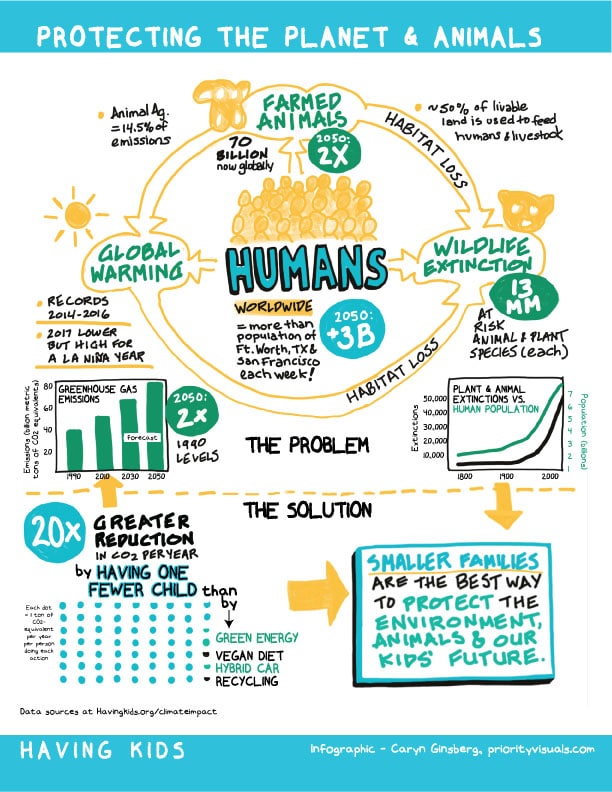
    Infographic illustrating the impact of human activity on the planet and animals, showing links between family size, resource use, global warming, extinction, and proposed solutions like smaller families and sustainable practices.
    Want to be effective? Start at the beginning.

    Let’s be blunt. This move involves redistributing wealth from the top of the wealth pyramid to encourage people to wait to have kids or forgo doing so entirely. Given the beneficial impact on future generations this would have, it’s not just a policy suggestion – it is the practice of the first and overriding human right: The right to a Fair Start in life. It’s a move one influential author called child-centric family planning in his Newsweek piece. It’s a move a Nobel Laureate recently implied would be needed to end the Ponzi scheme of endless growth.

    Groups like the Fair Start Movement have had success shifting the norms in the right direction. This includes assembling a large coalition of groups now pushing for universal change at the United Nations.

    A collage of logos from various international organizations urging COP26 to support sustainable family planning in response to the climate crisis. The message is written in bold text above the logos.

    It also involves several changes to more traditional law, including 1) reforming humane education law to require the demonstrable development of empathy / prosocial behavior in children, 2) the prioritization of corporate prosecutions/injunctions in animal cruelty law via specific legislative and funding reforms, and 3) local personhood ordinances that mesh with comparable rights of nature laws.

    The right to an ecosocial Fair Start represents a unified version of animal personhood – one that aligns human and nonhuman personhood into one functional concept rather than making them oppositional. For example, populations of humans with much higher investments in each child mean more meaningful roles for each person in their democracy, and more room for animals – the height of nonhuman liberation.

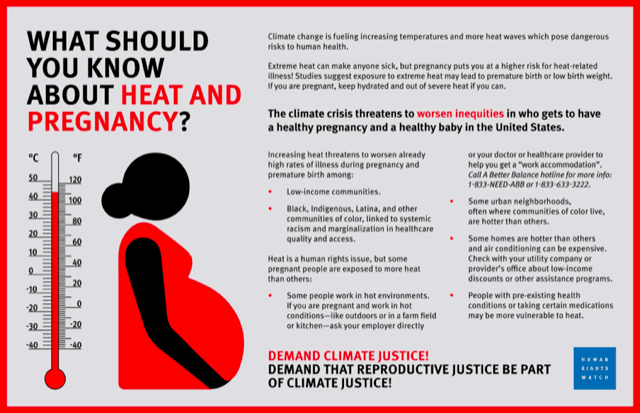
    Fact: An ecocentric and biodiverse standard for environmentalism would have also prevented the horrific impacts of the climate crisis on motherhood, which fall disproportionately because of inherited inequities.

    Infographic titled What Should You Know About Heat and Pregnancy? showing a pregnant person by a thermometer. It explains how climate-driven heat risks pregnancy, especially for marginalized communities, and calls for climate and reproductive justice.

    Without this change refences to animal law are probably misnomers, and misleading . Animal law, minus changing the people we are becoming, would be missing the key ingredient: Us.

    We can’t call something animal law if it does not orient from restoring the nonhuman world – their autonomy, and systems that don’t do that may not even produce law at all – truly obligatory norms – because they do not use a baseline that accounts for how people meaningfully participate in those systems such that the rules the systems produce actually reflect the peoples’ will. How does reconstituting legal systems ensure legitimacy, and help humans and nonhumans? One example: Eliminating the wealth gap at birth between white children and children of color, via Fair Start federal tax reforms, restores the nonhuman world and is antiracist. Traditional “animal law” with its racist outcomes (including evading birth equity, in favor of historical disparities, despite the exponential benefit equity would also bring nonhumans) does none of this. Another: Traditional family law legal scholarship uses case and statutory law – or “positive law” to advance human welfare. But without a system of overriding rights that would mitigate the climate crisis, it’s failed to achieve its purpose and simply condemned future generations to suffer.

    This advanced concept of unified animal personhood is now the subject of litigation, in the Texas abortion fight and in litigation surrounding the right to nature in Oregon (which seeks to restore the nonhuman world (including -300ppm climate policies)) as a matter of constitutional right. It’s a form of full personhood that is also consistent with what renowned author Carl Safina – in a pointed Q&A – recently suggested as the best move for animals.

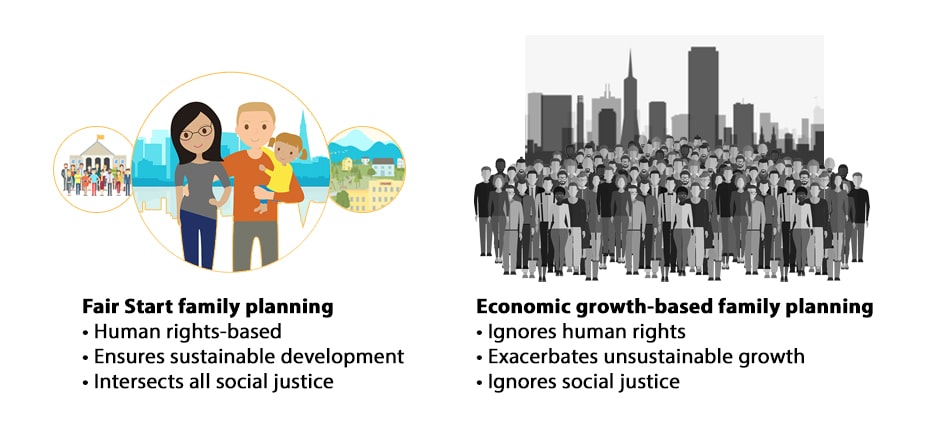
    A comparison chart showing Fair Start family planning with a diverse family and city background on the left, and Economic growth-based family planning with a large monochrome crowd and cityscape on the right. Key points are listed under each type.

    TAKE ACTION: Animal personhood, and animal law, mostly depends on the humans animals share the world with. Let’s start our reforms there.

  • Our Real Impact on Animals: Incalculable. Until now.

    Our Real Impact on Animals: Incalculable. Until now.

    Human population growth is the greatest threat to animals across the globe. For World Population Day, we’re launching a campaign around our interactive Animal Mortality Calculator designed to show individuals and policymakers how human population matters to animals.

    Created alongside experts, our model will use existing interdisciplinary data to measure direct human impact (in animals raised for meat, milk, and other products) and indirect impacts (including habitat  loss, traffic-related mortality, and native carnivores killed to protect livestock) on animal life.

    Though several publicly accessible animal “impact” resources and calculators exist, none helps  individuals easily assess the impact of their family planning decisions on nonhuman life. Our science-based calculator will influence individuals and lawmakers by helping individuals conceptualize the impact of their family planning choices while educating the animal protection movement about the need to include growth policy in our campaigning to reduce animal  suffering and death. The upshot is helping to build a sustainable world for animals and future humans.
    Can you help us reveal the truth about the greatest threat to wild and domestic animals worldwide and fund our Animal Mortality Calculator today?
    Donate
  • Joyce Tischler: Protecting Animals Starts With A Better Population Policy

    Joyce Tischler: Protecting Animals Starts With A Better Population Policy

    Joyce Tischler is widely considered to be one of the founders of modern animal law and a leader in the field of animal protection. She is affectionately known to the many who admire and follow her as the “mother of animal law.” She has inspired generations of animal law attorneys.

    What few know about Joyce is that she is also mother to her wonderful daughter Margeve, and understands the crucial connection between family planning and protecting nonhumans. Nothing has a greater impact.

    Let’s learn more from Joyce, on a topic few are willing to even discuss, and please share the video and graphic beneath the video if you want people to know how to have the biggest impact on animals.

    We can do better. Take other actions here.

    Infographic showing humans impact on global warming, wildlife extinction, and habitat loss. Highlights overpopulation, animal farming, emissions, and advocates for smaller families and green energy as solutions. Hand-drawn charts and illustrations.
  • One Reason Animal Rights Fail: We Willingly Create Animal Abusers

    One Reason Animal Rights Fail: We Willingly Create Animal Abusers

    Focus in on almost all work done by those who hold themselves out as animal protectionists and you will see them focused on the particular behaviors of those who abuse animals. From research labs, to factory farms, to puppy mills, our brains – given to think in the here and now – see what the abusers do, rather than who the abusers are and how they differ from the people we can aspire to be.

    But the genesis of the abuse comes years before it’s committed, in the creation of the abusers, and if we wanted to maximize our impact on nonhumans we would hone in on that. We would see how humans plan their families, and how that impacts the development of things like empathy and the practice of compassion. From the demand for abusive animal products and services, to the qualities and dispositions of the researchers, ranchers, zookeepers, hunters, etc., we miss the fundamental driver of abuse – demand and supply – by ignoring the laws and policies that determine our creation.

    Infographic illustrating the impact of human activity on the planet and animals, showing links between family size, resource use, global warming, extinction, and proposed solutions like smaller families and sustainable practices.

    But what do we do, specifically?

    Our current and largely aspirational humane education laws and systems are a good start. Though rarely enforced, they are ubiquitous and apply the correct standards. But without linking them to family planning and population policies, they fall far too downstream, and do not do what animals need them to do: Capture the key phase of human development (early childhood), and actually determine the behavior of humans and the impact of future generations.

    The beauty of focusing on responsible parenting is that unlike many forms of animal protection, it is highly intersectional, and its baseline is set by a widely celebrated value: Democracy. The minimum level of empathy and helping tendency we should require of every human, and develop in all future ones, is that necessary to ensure a functional social contract. It’s not about altruism – it’s about legitimate and just systems. Given that our current laws and policies ensure no levels of empathy or comparable qualities whatsoever, nonhumans will benefit greatly (especially when we factor in the quantities of humans at stake) from our pursuing even relatively minimal standards – like Fair Start.

    Take action:

    If you support an organization engaged in animal protection urge them to include in their focus the negative qualities of the abusers, and in their programming humane education, law and policy reforms that use those qualities – like sociopathology – as factors in reproductive justice reform. It’s that reform that does the most good for animals by creating a smaller future world population of people in whom we’ve invested more, the sort of people democracy requires.

  • The Logic of Fair Start Policies and Animal Rights (Including Human Ones)

    The Logic of Fair Start Policies and Animal Rights (Including Human Ones)

    These are the facts, and they are not in dispute.

    1) All reasonable people agree reforms are needed to respond to the climate crisis.

    2) All reforms, with a few small exceptions – from the Paris Accords to more conservative carbon markets – assume an environmental baseline where the nonhuman world is a human resource, and protecting human health and safety is primary and exclusive of animal protection.

    3) That baseline, or standard, is offensive to the animal rights movement – the nonhuman world should be nonhuman habitat where others species are free. That is what animal liberation means.

    4) Had world leaders, including environmentalists, embraced that higher, animal rights-oriented baseline in the mid-Twentieth Century the way deep ecologists had advised we not be facing a climate crisis because that standard prohibits many things – including explosive population growth and ecocide – that precipitated the climate crisis. That failure will cause untold suffering – hence seeing the nonhuman world as a resource is also offensive to human rights.

    5) There are things we can do to change our approach to the environment, nonhumans, and future generations to reverse the mistake world leaders, including environmentalists, made. A large coalition of groups has sued to use the higher or nonhuman baseline because the Constitution, and its surrounding literature, imply it is constitutionally required.

    6) Part of the suit involves changing the way we plan families, an urgent requirement of intergenerational justice that is also implied in our constitutional principles. In democracy, what matters most is the people with whom we share and will share our communities and the world, and those people don’ fall from the sky. Let’s protect and invest in them.

    Get real – and fight for your and your kids’ right to nature and all children’s right to a #fairstart in life.

  • The Animal Mortality Calculator: Knowledge for the Foundation of Animal Rights

    The Animal Mortality Calculator: Knowledge for the Foundation of Animal Rights

    How many other animals in total – farmed, wildlife, animals in research, etc. – die to support the current lifestyle of a human individual?

    The answer is that we don’t really know. Fair Start aims to find out and, in partnership with several researchers, is engaging in a new research project that hopes to tell the truth about our existential relationship with other animals. Here is some of the background:

    For survival, humans depend completely on Earth’s ecosystems and the services they provide us, they are also called ecosystem services. These include the production of healthy air and water, food, medicines, disease management, removal of toxins, building materials, fuel, climate regulation, buffering of storms, spiritual fulfillment, and aesthetic enjoyment. Ecosystem services are primarily provided by the activities of biotic flora and fauna interacting with nonliving (abiotic) elements in nature that provide the nutrients and minerals to support a planet once teaming with life.

    Today, we have entered a period of mass extinction that rivals the extermination of the dinosaurs and 76% of life on Earth. However, unlike past extinction events caused by natural global pulses, our species has already caused the extinction of nearly 60% of assessed vertebrate populations and these trends are accelerating (WWF, 2016). Beyond the massive loss of species and wildlife populations, the abject suffering that humans are causing on the planet is significant. These human-induced adversities should not be assumed inevitable, and are due to human psychological shortcomings that can be remedied through equal access to information, resources, and security.

    The vast and detrimental changes to Earth’s ecosystems are largely to meet rapidly growing human demands for food, fresh water, timber, fiber, minerals, and fuel at levels that are unsustainable and based on irresponsible human overpopulation, consumption and false-dependency on economic growth (Global Humanitarian Forum, 2009; Millennium Ecosystem Assessment, 2005; WWF, 2014; 2016). Although our demands on Earth’s ecosystems have led to substantial gains in human physical well-being and economic development for a few, the long-term costs are now being observed in the forms of climate change, habitat destruction, pollution, disease, war, displacement, hunger, and mass mortality in humans and nearly all other life forms (e.g., Ceballos, et al., 2015; Cohen, et. al., 2017; Dockery & Evans, 2017; Raworth, 2012; Rockstrom et al., 2009).

    We now know that we as a species have so degraded and destroyed parts of our life-support system that our health, well-being and survival as a species is threatened and a sharp unplanned decline in our population has become very probable. It is increasingly clear that environmental problems cannot be resolved through technical solutions alone and that these ecological issues are forcing us to rethink what development and progress means, and to consider the size and activity of our population with new urgency (Hickey, Rieder & Earl, 2016). These threats are not as new as some might think, with one of the most prominent calls to action coming from the Limits to Growth studies, first published in 1972 (Meadows, Meadows, Randers, & Behrens, 1972).

    Additionally, destruction and despoliation of the environment has not happened in a vacuum, nor with only the suffering of our species as collateral damage. At no time in human history has the suffering and death of other species been so numerous, prevalent and profound. Much science has come forth to successfully quantify and describe the sentience of nonhuman animals with whom we share Earth (e.g., Bekoff, 2006; Darwin, 1998; Fossey, 2000; Goodall, 2000; Griffin, 2001; Marino & Allen, 2017; Masson & McCarthy, 1996; Moss, 2000; Poole, 1998, Shanor & Kanwal, 2011). Recently, insects have been shown to have emotional states not different from our own (Paul & Mendl, 2016; Perry, Baciadonna & Chittka, 2016). Logic, therefore, would dictate that, like humans, other species suffer needlessly and we have a moral obligation to reduce and alleviate such trauma, much of which is caused by nonessential human behaviors.

    The enormity by which humans torture and kill other animals is indefensible. The numbers in a single year are in the billions in the U.S. alone. If human nonessential activities were killing billions of humans each year, it would be considered apocalyptic on an unprecedented scale. Here is a breakdown of some of the data. Cows: 30.6 million adults; 487,700 calves (USDA, 2017) Pigs: 118.2 million (USDA, 2017) Sheep and Lambs: 2.24 million (USDA, 2017) Chickens: 8.9 billion (USDA, 2017) Wildlife: Diffuse numbers, but just one example is 3.2 million killed intentionally in

    2015 by the U.S. government, primarily to serve the interests of the livestock industry and agribusiness, that serve the consuming public (USDA, 2016). Other significant numbers are killed every year as “road kill”, by hunters, captured to serve as pets, die due to pollutants, habitat destruction, and more.

    While the sharing of the numbers of animals used in animal agriculture may appear out of step with our current mass extinction event and environmental harms, animal agriculture has been found to be the second largest contributor to human generated greenhouse gases and the leading cause of water and air pollution, deforestation and biodiversity loss (Koneswaran & Nierenberg, 2008). Therefore, the suffering and killing of nearly 70 billion animals in agriculture per year, literally leads additionally to the suffering and death of countless wild animals and the deterioration of the natural environment.

    About the Animal Mortality Calculator

    The objective of this project is to develop the algorithms to calculate the average number of animals that die to support the lifestyle of one human individual. This calculation will serve as a basis for an educational tool of the organizations, Fair Start and the Institute for Human-Animal Connection to garner further support from people everywhere for the responsibility to protect other species. A consideration for animal protection that has largely been avoided is the fact that a decreasing and healthy human population is the best protection for all animals, including humans.

    A key behavioral objective of this project is increased support of the Fair Start Model (Fair Start , 2016) by animal advocates and the general public through recognition that continued human population growth means more suffering and loss of life of other species with eventual ecological and industrial collapse, and that we have choices on limiting personal family size. The magnitude of the issues humans have caused and now face today can be psychologically overwhelming, therefore the provision of solutionary pathways for our species is of utmost importance to deflect the development of apathy and avoidant tendencies. This project will also result in multiple scientific publications in peer-reviewed scientific journals.

    Informing Family Planning

    Thoughtful parents are concerned about the world in which the next generation will inherit and inhabit. Jessica Blome, a mom from California shared her thoughts:

    “When I thought about starting a family, I sought advice from family and friends, discovered the world of mommy blogs, considered the latest parenting trends, and consulted with my healthcare provider. My husband and I researched the costs of childcare and education. We questioned whether we would be able to balance work and family. We wondered how to best position our child, so she could get into the best schools, what kinds of opportunities or barriers she would face when she grew up, and what her world will look like when she does. And when we got pregnant, we hoped our daughter would be able to enjoy nature, appreciate non-human animals, and live in a healthy environment. 

    As my daughter makes her way through primary school, I wonder if I truly understand how my family planning choices impact the environment, animals, and nature. What am I doing to make it more or less likely that my daughter will live in a thriving, healthy environment, free from cruelty to all animals? If that were something I could know, I’d want to know. Should we all want to know? Wouldn’t we add that calculation to our list of considerations before having a family and while raising children?

    Seeking protection for non-human animals and our planet is not in opposition to having a family. The Animal Mortality Calculator has the potential to inspire parents like me to plan families that reduce the human impact on farmed animals and ecosystems while creating a sustainable future for all children.” 

    Interested in assisting with this project? We are seeking researchers and modelers. Email us at Ashley@faairstartmovement.org for more information on funding, volunteer, and other opportunities.