

The Supreme Court has sharply limited the Voting Rights Act, deepening an already severe state of racial inequity in the United States.
But this outcome did not come out of nowhere. It reflects decades of entrenched inequality at birth and the accumulation of generational wealth that has concentrated power in the hands of a few. Rather than fully confronting the country’s racist history, past generations built a system that appeared to move gradually toward equality. In reality, it was fragile—a house of cards. Persistent inequity at birth has done more to erode democratic values than to advance them.
Government authority ultimately derives from empowered people. The Court’s authority, like that of any institution, depends on a far more demanding standard of racial equity than what the Voting Rights Act alone provides—a standard the Court itself is now failing to meet. Its legitimacy rests on an interpretation of the Constitution that requires real, birth-based empowerment of those subject to its authority.
Put simply, the Court’s authority depends on every citizen having an equal voice in government—and that begins with equity at birth.
By that measure, the United States falls far short.
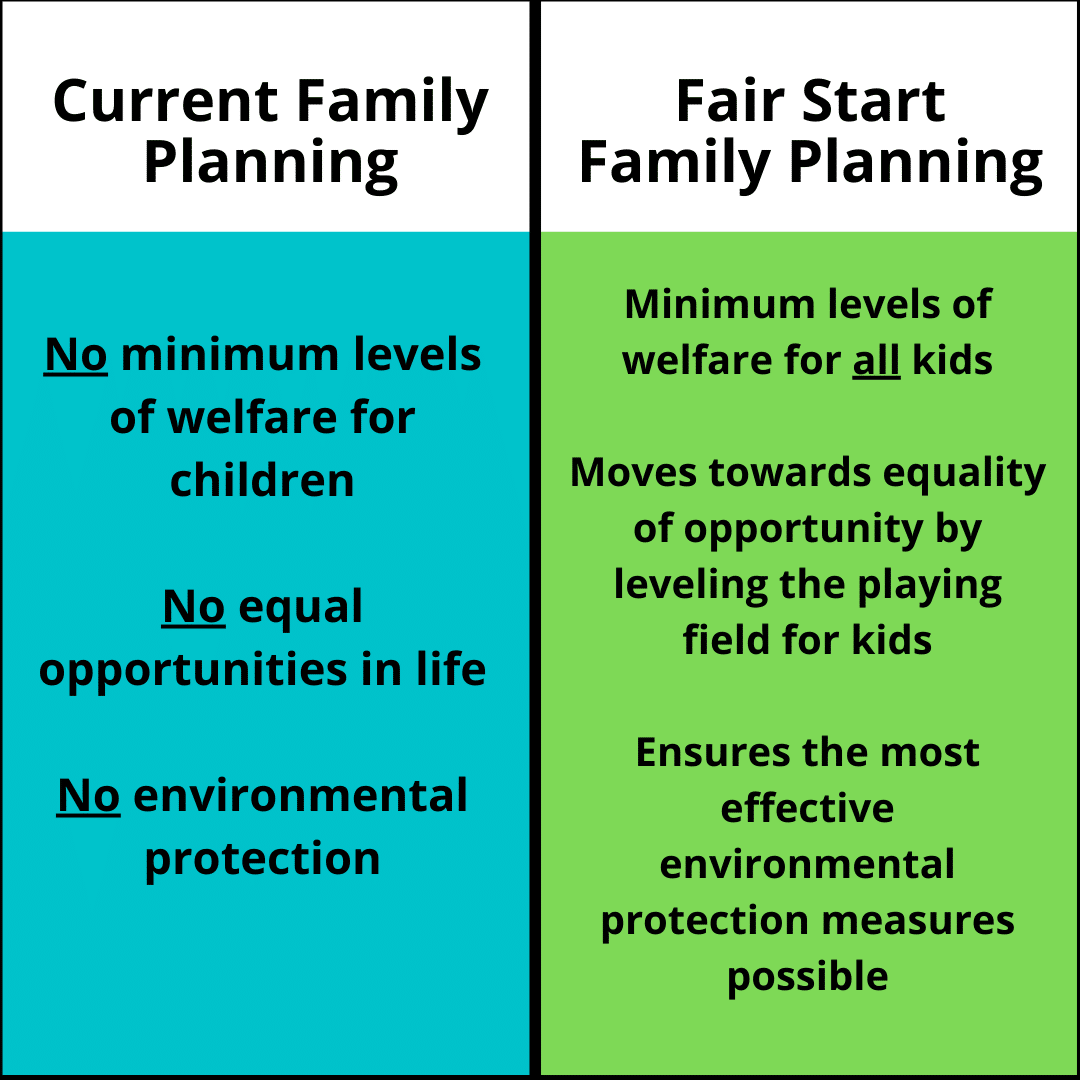
Centering equity in public policy would force government to account for whether people are truly empowered in their daily lives—especially given the conditions into which they are born and that are shaped by public power. This perspective has been emphasized by scholars and advocates who stress the foundational importance of birth equity.
There is nothing inherently special about Supreme Court justices. Their authority is conditional, and like anyone else, they can make flawed claims. If you examine how they justify their authority, you may find assumptions that do not hold up under scrutiny—particularly in a system where many people have little real control over political outcomes.
This raises a fundamental question: authority relative to what standard? Documents alone do not constitute a nation. A nation is constituted by people—by the conditions under which they are born and the extent to which those conditions allow for meaningful empowerment.
The Fair Start Movement aims to advance this principle through litigation, despite resistance from some institutions.
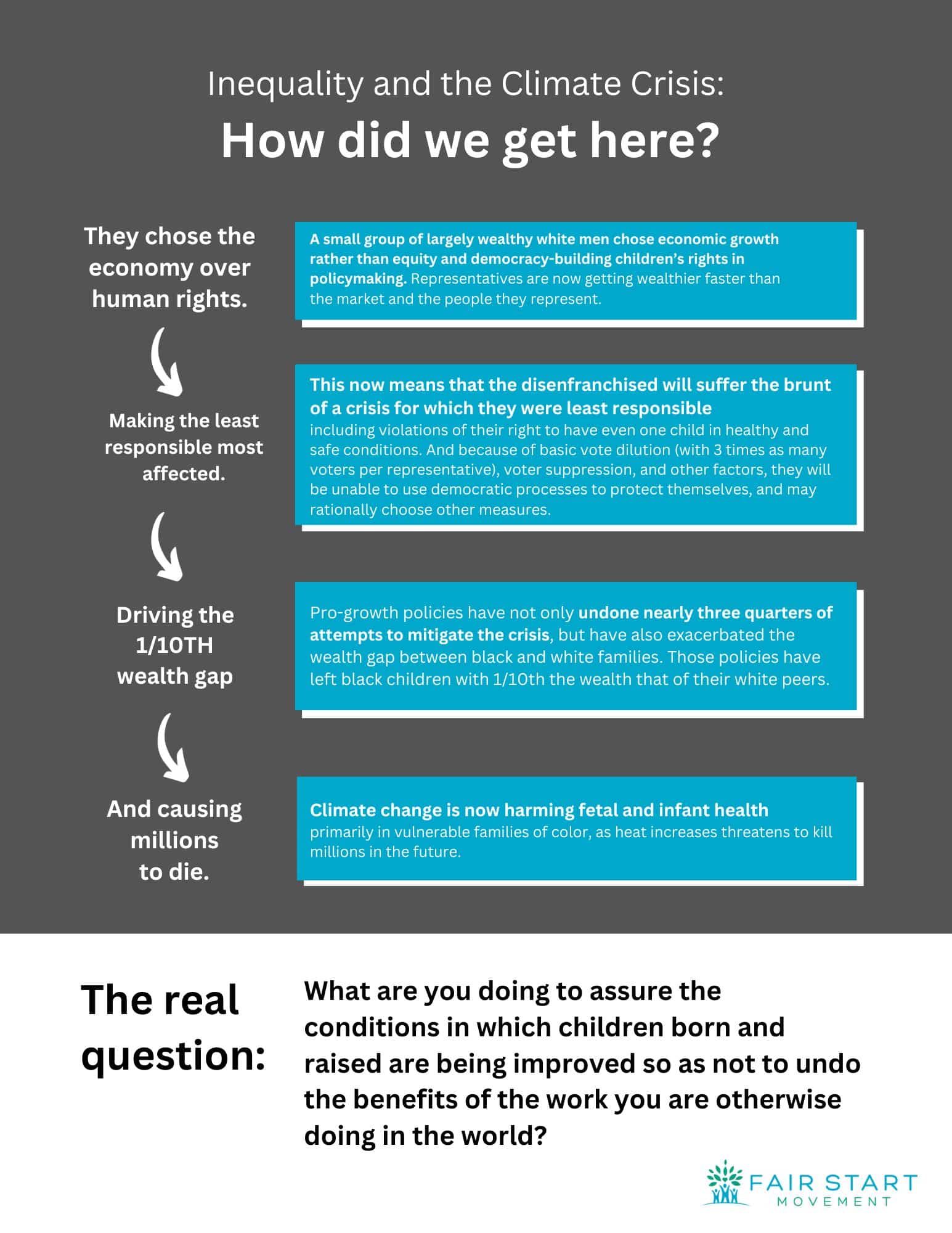
If it is illegal to operate a business that explicitly excludes people of color, it should also be illegal to structure systems that enrich some children while imposing deadly costs on others—disproportionately children of color. Such models obscure accountability, particularly as the climate crisis intensifies, and reflect broader patterns in academic and policy spaces: shifting standards away from meaningful measures of human well-being while still claiming progress.
Any individual or organization claiming to create value should be able to demonstrate that they accounted for the fundamental obligation to ensure that all children are meaningfully empowered from the start—at a level that allows them to withstand systemic threats like climate change, autocracy, and extreme inequality. Without that, such claims risk resting on a flawed baseline that benefits some while imposing severe costs on others.
The Supreme Court is no exception. Its legitimacy depends on whether it operates within a framework of genuine empowerment. If it does not, then its authority should be questioned—not out of disregard for institutions, but in pursuit of a more just and meaningful standard of legitimacy.