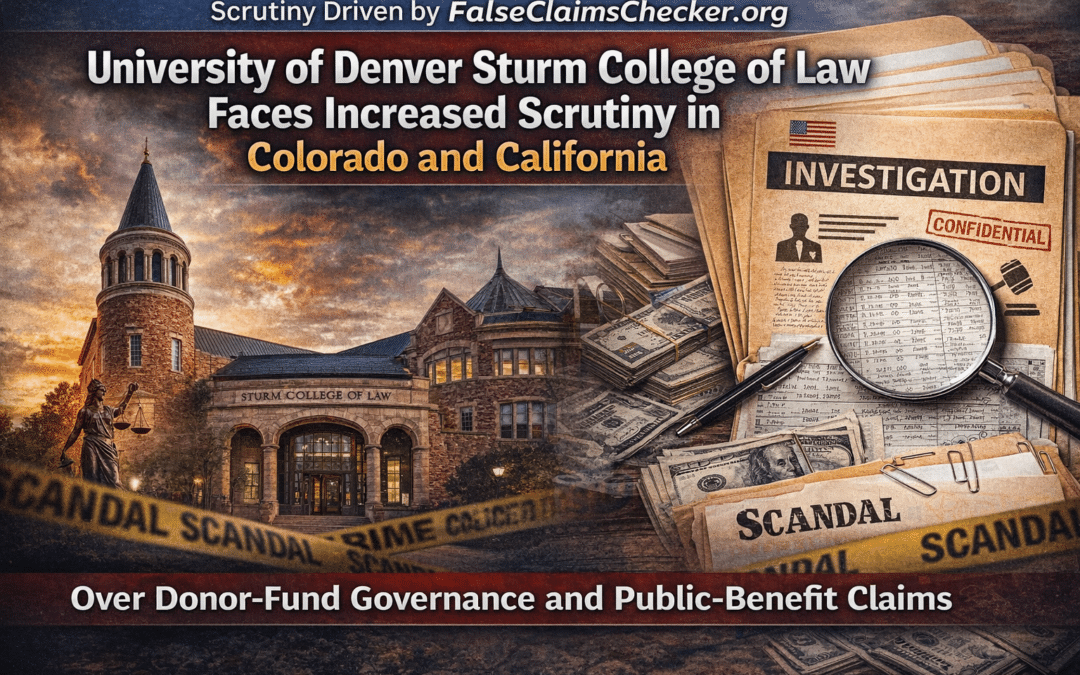
University of Denver Sturm College of Law is facing increased scrutiny in Colorado and California following written inquiries and regulatory referrals concerning donor-fund governance and undisclosed baseline assumptions underlying the law school’s public-facing claims of impact, public benefit, protection, and well-being.
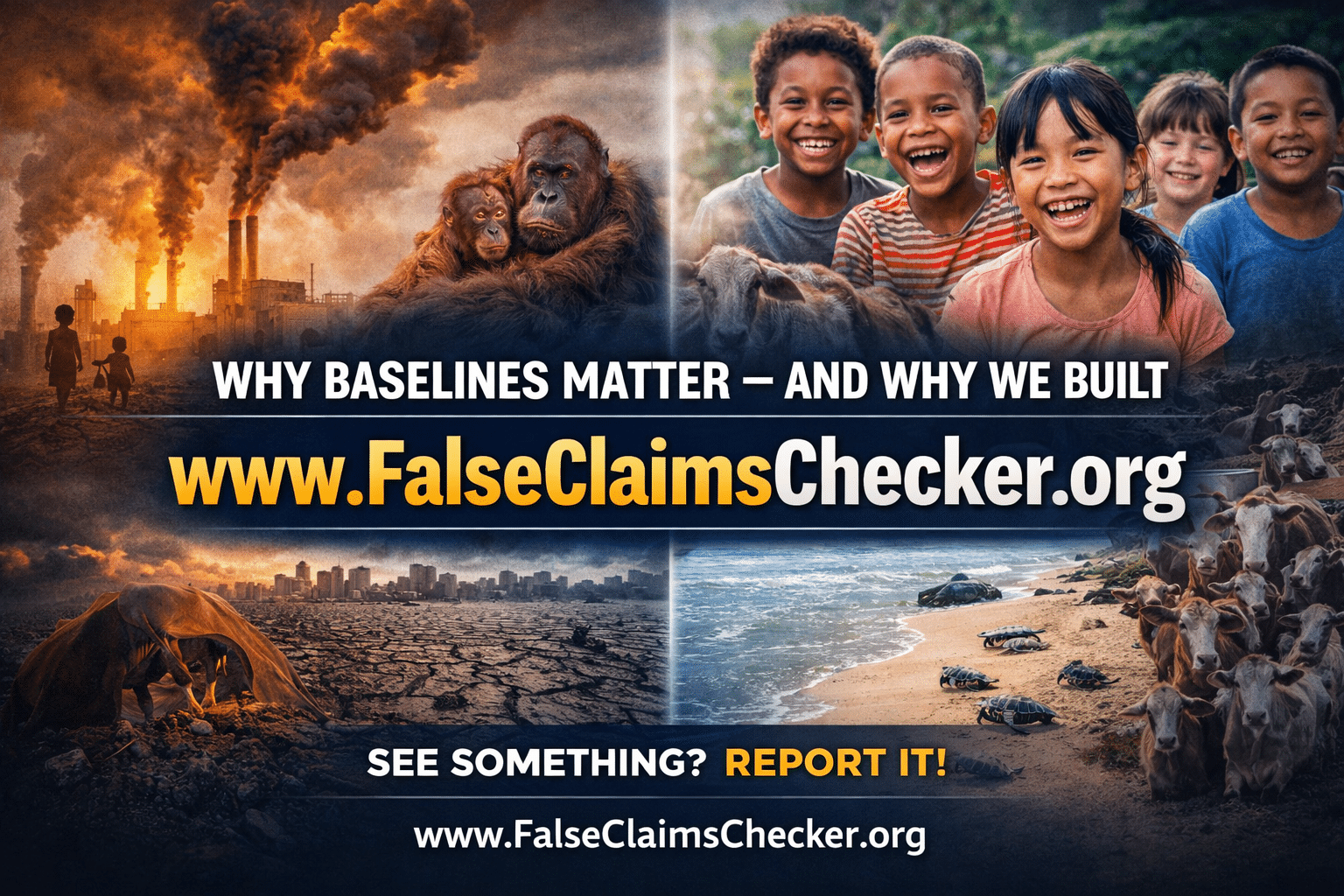
The matter arose after a complaint submitted in early 2026 through www.FalseClaimsChecker.org led to written inquiries concerning donor-fund governance and the omission of baseline assumptions in public-facing “impact,” “public benefit,” “protection,” and “well-being” claims connected to the Animal Law Program and Animal Activist Legal Defense Project.
Read our letter to the University here.

Read our letter to the California Attorney General.
According to The Fair Start Movement, written responses from University of Denver Sturm College of Law did not resolve those concerns and instead expanded questions about donor intent, fund use, and whether public-facing institutional representations were supported by sufficiently disclosed standards. The Fair Start Movement states that it is now formally investigating the matter and has asked the Federal Trade Commission, as well as government bodies in Colorado and California to investigate as well.
The donor-fund issue became concrete when A. F. Rothschild, PhD, Director of the Center for Contemporary Equine Studies, sought accounting from University of Denver Sturm College of Law regarding the use of funds connected to the Center for Contemporary Equine Studies for two years without an on-point response.
Watch this video to learn more.
Then only after University of Denver Sturm College of Law Dean Bruce P. Smith was contacted by The Fair Start Movement, Smith wrote to Rothschild in February 2026 that over $90k in “charges to the Fund were made during 2023-24 to support the salary, benefits, and travel” related to the engagements regarding proposed equine-related initiatives. Smith further wrote: “Ultimately, SCOL and CCES could not reach alignment regarding programmatic priorities. Thus, additional equine-related work conducted pursuant to the commitment has been paused. No charges have been made to the Fund since August 2024, and a balance of $158,403.24 remains.”
 According to donor materials provided by University of Denver Sturm College of Law and other documentation, the total award amount from The Center for Contemporary Equine Studies was $250,000.
The obvious question is why has the “paused” $150k not been returned or otherwise formally resolved for two years?
Those disclosures transformed the matter from a general concern into a concrete donor-intent and fund-governance dispute involving a named donor, a designated equine fund and unresolved questions about whether University of Denver Sturm College of Law’s public-facing institutional representations matched the actual status and direction of the funded work.
Since the matter began, University of Denver Sturm College of Law has received at least two direct written inquiries: one concerning donor-fund use and donor intent in connection with equine-designated funding raised by A. F. Rothschild, PhD, Director of the Center for Contemporary Equine Studies, and another from The Fair Start Movement seeking baseline clarity for public-facing benefit claims connected to the Animal Law Program and Animal Activist Legal Defense Project.
Both inquiries have received written responses from University of Denver Sturm College of Law, but the issues expanded rather than narrowed, and the matter has since reached the Colorado Attorney General, the Colorado Secretary of State, and the California Attorney General.
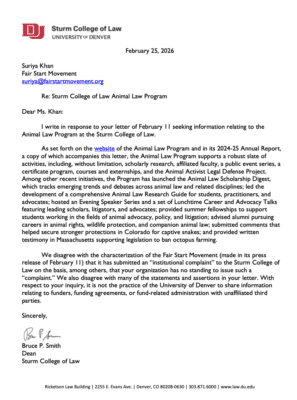
On February 25, 2026, University of Denver Sturm College of Law Dean Bruce P. Smith wrote that “the Animal Law Program supports a robust slate of activities, including, without limitation, scholarly research, affiliated faculty, a public event series, a certificate program, courses and externships, and the Animal Activist Legal Defense Project.”
The Fair Start Movement argues that this response did not address the narrower question it had raised: what evaluative baseline governs University of Denver Sturm College of Law’s public-facing benefit claims.
That question matters because the Program’s own Annual Report uses language such as “enhance animal protection in the United States” and “around the world for generations to come,” describes itself as “well-known in Colorado as a hub for education, advocacy, and compassion,” refers to “elevating the voices of all beyond human animals,” and claims it will “expand our impact throughout Colorado and across the nation.”
The Fair Start Movement says the underlying issue is not whether a program undertakes activity, but whether public-facing claims of impact or benefit disclose the evaluative baseline needed to interpret them. In its view, that includes what counts as benefit, what harms or costs are excluded, what populations are counted, the time horizon used for evaluation, and how uncertainty and tradeoffs are treated.
“This inquiry process has now become a formal case for Fair Start Movement and False Claims Checker,” said Suriya Khan of Fair Start Movement. “We asked a narrow question. The University replied. But the reply did not identify the baseline used for public-benefit language or the disclosure limits attached to those claims. In general, it matters when institutions seek trust, donations, and public reliance.”
Zahara Nabakooza, lead at TruthAlliance.global, decried the charade and misdirection of funding from a macro-level benefit to infants and animals together: “This is not a request for awareness campaigns or symbolic gestures. It is a demand for accountability. Governments, institutions, and global leaders must confront inequality honestly, commit resources where harm has been greatest, and measure progress transparently. Good intentions are not enough. Outcomes matter.” That would entail the school using a zero-baseline to assess value and report impact, something like the inseparable link between future human and nonhuman outcomes.
The Fair Start Movement reports that University of Denver Sturm College of Law is no longer merely in an advocacy dispute and that this matter now presents a policy-level and institutional investigative issue under familiar omission, donor-reliance, and misleading-net-impression theories reflected in Federal Trade Commission deception standards and California unfair-competition law.
The theory is grounded in established federal and California law. The FTC states that a deceptive practice can involve a material representation, omission, or practice that is likely to mislead a reasonable person in the circumstances, and the agency’s deception policy expressly focuses on the net impression created by what is said and what is left out.
California’s Unfair Competition Law defines unfair competition to include unlawful, unfair, or fraudulent business acts or practices as well as deceptive, untrue, or misleading advertising, and Business and Professions Code section 17200/17500 separately prohibits untrue or misleading statements made to induce the public to enter into obligations.
California courts have long recognized that advertising can mislead through implication and omission, including in Committee on Children’s Television, Inc. v. General Foods Corp., 35 Cal.3d 197, and that materially misleading representations tied to reliance and economic loss are actionable under California’s UCL and false-advertising framework, including in Kwikset Corp. v. Superior Court, 51 Cal.4th 310.
The Fair Start Movement says those principles are directly relevant here. In its view, University of Denver Sturm College of Law cannot seek trust, money, credibility, or public reliance through claims of “impact,” “public benefit,” “well-being,” “compassion,” or “protection” while leaving unstated the evaluative assumptions that determine what those terms mean.
“The issue in Denver is just the first of many,” said Suriya Khan, “and The Fair Start Movement is asking regulators across the country to consider baseline-disclosure guidance clarifying that public-facing net-benefit claims should disclose the baseline assumptions that determine what the claim means. The proposed disclosure structure would require statements describing what is counted as benefit, what harms or costs are excluded, the time horizon and uncertainty treatment, how outputs are expected to translate into outcomes, and what verification procedures and correction triggers apply.”
The dispute also has relevance beyond one school or one donor. The Fair Start Movement says the issues raised here may have implications for how universities, nonprofits, and advocacy programs describe public impact, outcomes, and benefit claims.
To help identify similar patterns, Fair Start is directing journalists, donors, advocates, and institutions to www.FalseClaimsChecker.org.
The tool is intended to screen public-impact claims, force baseline clarity before such claims induce reliance, and catalyze identification of similar false or omission-based claims across sectors and across the world.
About Fair Start Movement
Fair Start Movement is a public-interest initiative focused on compliance, disclosure, and governance issues in public-benefit claims. Through research, complaints, and policy advocacy, it examines whether institutions adequately disclose the assumptions and standards underlying claims of impact, benefit, protection, and related outcome-oriented representations. FalseClaimsChecker.org is one of its public-facing projects.
Media Contact
Suriya Khan
Fair Start Movement
suriya@fairstartmovement.org
516-725-3157