Tag: News & Fair Start Headlines

  • The Worst Child Protection System Possible?

    The Worst Child Protection System Possible?

    Imagine a parent torturing their own child. Child Protective Services takes in the child to protect him or her, and begin the long process of trying to find a foster family for the child while courts try to deal with the parent. In the middle of this long, drawn-out process, the parent has another child. Because of the prior abuse, this baby also goes into state custody.

    Although there are ranges of outcomes and different stories of children who lived through situations like this, if we look at the statistics, we can safely say that the children going through the state system are not, on average, getting a fair start in life. Recent reports found state systems that are failing children across the board. The community loses out too, because it will pay for the costs of this failing child protective and care system, in the short-term and in the long-term as it absorbs scores of unprepared children reared in public systems.

    Would it be possible to design a worse system?

    There is a solution. In some egregious cases, judges are ordering abusive parents not to have more children. Many courts have upheld those orders as constitutional, finding that a child’s right to a minimum level of well-being should balance against a parent’s right to have a child.

    But the process of using these orders is haphazard and undertheorized.

    Having Kids strongly believes a child’s right to a fair start overrides other considerations. We are exploring ways to help standardize this process.

    And if you agree that the child’s rights should come first, please click and sign our Fair Start Declaration. Thanks so much!

  • Trump Pushing Teen Pregnancy – Why?

    Trump Pushing Teen Pregnancy – Why?

    Addressing the Trump administration’s assault on efforts to prevent teenage pregnancy, the New York Times commentary demolishes the administration’s stated rationales. But Trump and team’s underlying motivation is also suspect, and goes beyond any religious objections to contraception.

    In the short-term, the economic elite might subvert democracy by subverting the press. How would they do it in the long-term? Various theorists might have noted that higher teen pregnancy rates translate into more consumers with less education. Over time, a less educated populace provides cheaper labor, higher profits, and a more easily manipulated electorate.

    The 1% don’t benefit from a smaller and better-educated populace.

    Babies are big business, with advertisers exploiting the appeal of infancy and motherhood to sell more and more products. If the economic elite can subjugate young women and force them to spend more at the same time, it’s a double windfall.

    Like the European monarchs and oligarchs of old, Trump and his big consumptive family embody an unevolved and unsustainable model of domination and proliferation. Their example is harmful environmentally, socially, and politically.

    How do we get rid of it? We can lead by example with a better model that says “I actually give a damn about children, equality, other species, and the future. I’m not just in this for myself and the narcissism of my bloodline.”

    Want change? Change people. To do that, we need to start before the very beginning of life. Let’s make a Fair Start the very core of our thinking.

  • A Respectful, Productive Discussion, or Cheap Jokes?

    A Respectful, Productive Discussion, or Cheap Jokes?

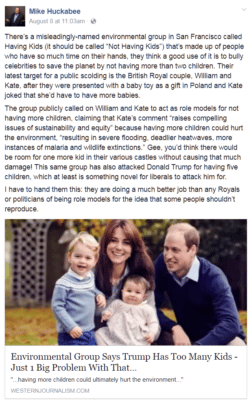
    Having Kids’ Open Letter to Prince William and Kate Middleton has attracted a great deal of attention from around the world, with over 50 media outlets picking it up so far. A Facebook post by Mike Huckabee includes a photo of Prince William and Kate Middleton smiling with their two young children, accompanied by a headline about an environmental group criticizing Trump for having too many kids.

    Instead of discussing the many pressing topics raised in the letter – including the threat the UK faces from climate change, and how family planning is the single most powerful step we can take to address the climate crisis (more) – former Arkansas governor Mike Huckabee took to Facebook to imply that I and Having Kids’ Director of Operations should not have reproduced, thus contending that our child shouldn’t exist.

    Mr. Huckabee’s attack on my family is obviously an irrelevant cheap joke to play to his fan base. What is more disturbing, though, is how Mr. Huckabee’s snide attack is symptomatic of the head-in-the-sand attitude that ignores all the challenges humanity faces, now and in the future. These challenges include not only environmental degradation, but also rising inequality.

    Our single question to our critics is: Do you think every child born today will have an equal and fair start in life?

    Do you think Hillary Clinton’s and Donald Trump’s grandchildren have the same opportunities as those born in Muñiz, TX?

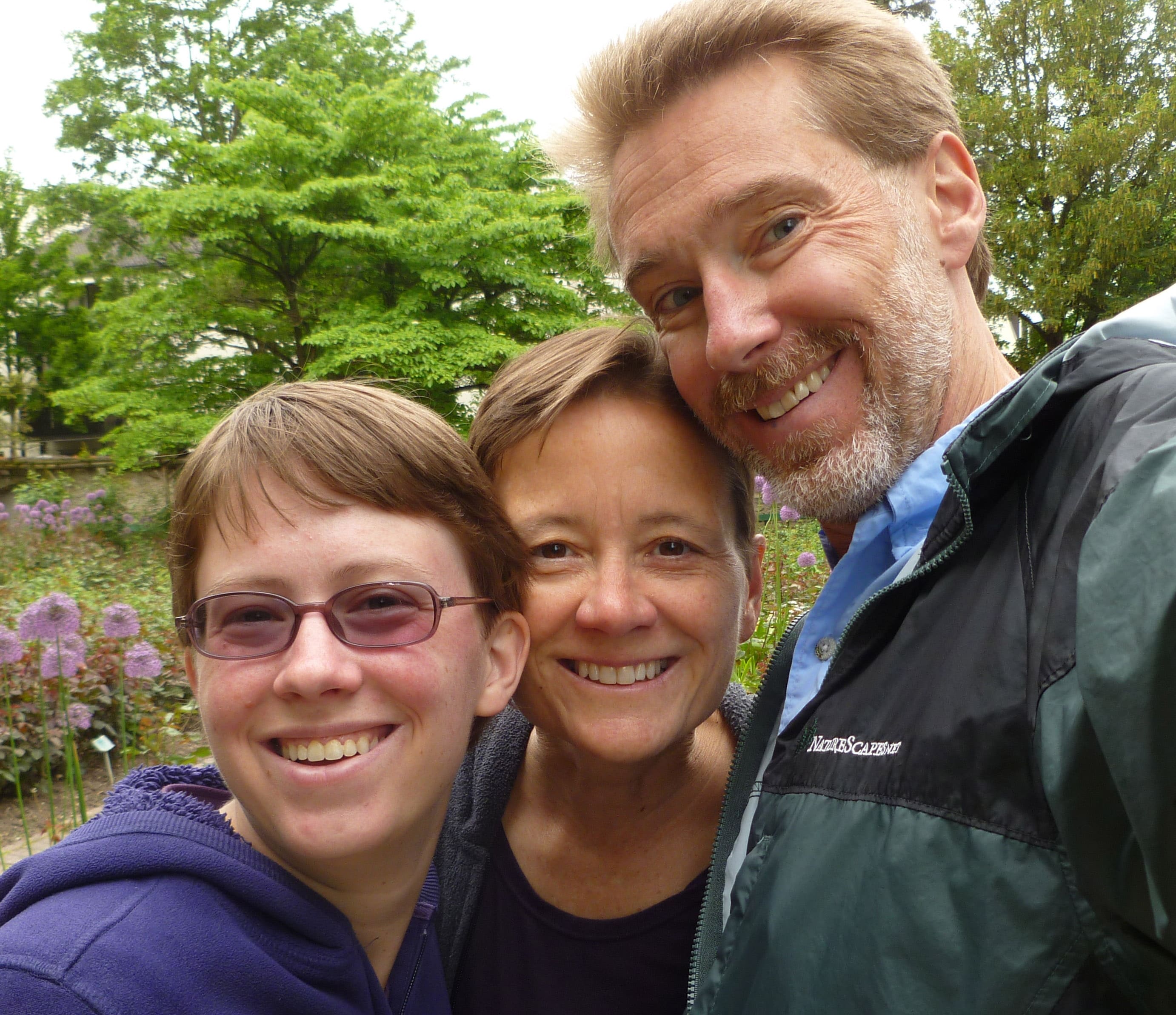
    My husband and I realize, compared to the majority of other children in the US and around the world, our child was born with many advantages. That is why we are dedicating much of our time and resources to helping others, rather than simply pursuing our personal short-term interests.

    Instead of attacking and mocking people dedicated to making the world a better place for all, maybe we should reconsider our tone and tactics. We can each help more children have a Fair Start. We hope Mr. Huckabee agrees. Regardless, we hope you will be a part of this work. Thanks!

    –Anne

  • The Times on Etiquette around Childlessness: A Better Option?

    The Times on Etiquette around Childlessness: A Better Option?

    The title of Anna Goldfarb’s New York Times piece (“What to Say When People Ask Why You Aren’t Having Children,” August 8, 2017) implies that she’s embarking on an examination of the ethics of procreation. But instead, she repeats the trite mantra you’ll hear on trash television and at the grocery check-out: Family planning is only about personal fulfillment, and is a highly personal topic that should be considered off limits for discussion.

    That mantra is simply false. People forgo having children for many altruistic reasons: to protect the environment, restore biodiversity, to retain time and money in order to do public interest work, etc. All of our decisions about having kids profoundly impacts others – that’s the whole point. If we care at all about the future, then we all have a stake in family planning decisions. The topic is inherently interpersonal.

    Why would publicly thinking about our collective future be considered off limits?

    The topic is inherently interpersonal, starting – obviously – with the potential child. Rather than trying to close public forums, why not seek common ground? Specifically, why don’t we have a discussion about what future we want? Why not collectively plan an escape from our current crowded, polluted, divided, unequal, and relatively uneducated world?

    Beyond the Isolationist View

    Goldfarb’s article rides upon the isolation model of family planning. This model focuses only on what parents want in the short term, rather than on what children and society need in the medium and long term. Isolationist views break the link between vital needs and available resources, and ignore the fact that having children is the most public thing most people will ever do.

    Furthermore, the isolation model completely disregards the fact that children are born entirely vulnerable, dependent on the people around them. By focusing only on the parents’ wants, rather than the child’s needs, we have created a society where children are not guaranteed a minimum level of well-being. Arguing that having children is a private matter also eliminated the opportunity for parents to cooperate in their decision making to achieve the best outcomes for every child. Because of the lack of organized, collective action dictated by the isolationist model, the caring and thoughtful people who forgo having children don’t have as great an impact as would otherwise be possible.

    In short, the isolation view harms everyone’s future and denies many children a fair start in life – a deprivation that tends to pass down over the generations. The Fair Star model breaks that cycle.


  • From a Having Kids member. . .

    From a Having Kids member. . .

    Granted, our leadership pulled out of the Paris Agreement, but we can all still make decisions to protect the planet and each other. We can do better than our failing government. We live in a different era than our parents, in that we are now presented data regarding climate change and the carbon footprint of humans, especially those in developed nations. If one accepts the data, the decision to come up with a new plan doesn’t seem so absurd. There is a knee-jerk reaction to the Fair Start model, but if we can get past that, the model helps open us up to think about more factors than previous generations may have.

    Personally, I currently have no kids. I have been part of Plan International USA (not affiliated with HK) for nine years, where I provide monthly donations to a community and hear back from the Plan-sponsored child. The first child was in Cambodia and the current child is in the Philippines. It’s rewarding to hear about community improvements, from latrines to school supplies.

    The success of family planning can be seen in nations like Thailand, where the population has remained at a steady level for decades and its citizens have enjoyed greater access to federally-funded healthcare and education than some of its neighbors. Also, per capita income has nearly doubled since 1971, when the policy officially launched. 

    So long as the methods are noncoercive, I don’t see a downside to the Fair Start model. On the contrary, as the White Paper (draft) articulates so well, there are many upsides at the micro and macro levels.

    About the Fair Start model:

    Today many families are adopting the Fair Start family planning model. First, they try to give their child a fair start in life by having a smaller family where they can invest more in their child. Often they also foster or adopt one of the many children eagerly waiting for parents. Second, they a public role model of these choices. Finally, these families join public advocacy campaigns to shift resources from extractive centers of power like governments, corporations, and wealthy families in order to democratically empower children and future citizens by incentivizing better family planning by all parents. Why? All parents know that the quality of their own child’s life will depend on the decisions of other parents regarding having and raising kids.

    By using the Fair Start model as a guide, families are simply saying this: “If you plan a smaller family with more investment in each child, we’ll do the same. We’ll also help each other, whenever we can, to make sure all our kids get a fair start in life.”

    In the long term, Fair Start family planning is the best way to promote human rights and build resilient populations that can thrive in future environments. Studies also suggest it is the most effective way to improve child welfare, create equity, and protect animals and the environment, all at the same time. It’s the key to the future we want.

  • The Royals test balloon results: Lots of Work to Do

    The Royals test balloon results: Lots of Work to Do

    When Having Kids sent a letter to Prince William and Kate Middleton respectfully offering up the Fair Start model as an alternative to the free-for-all of current family planning models, we mostly received positive reactions. And that was before the most recent terrifying climate change news from the United States government!

    But we also drew threats of violence, racist and eugenicist rants about why white and wealthy couples should have lots of kids, and climate change denying bloggers who seem creepily obsessed with celebrity babies (and who use news of them to sell their advertisers’ products). We also heard from Trump supporters who never questioned the possibility that replacement fertility is not a great a baseline. They think that even though family planning will define our futures and the futures of our children, it is “nobody’s business.”

    It is clear that many people are simply in denial that the “nobody’s business” approach to (not) planning our families is exacerbating climate change and endangering our own children. They are also turning a blind eye to the immorality of some kids being born with everything and some kids nothing.

    And they are also ignoring one simple fact: Caring and thoughtful parents are not going to stand by and ignore the fact that better family planning is quite possibly the single best way to mitigate climate change. These more responsible parents are not going to sit back and enjoy the last of nature while condemning their kids to a denuded, dangerous, crowded, and overheated world simply because people like the Duggar family get famous by having kids. 

    These more responsible families are speaking out and moving us towards better family planning. They are not waiting for the government. As these families set this positive and life-affirming example, Having Kids will help their voices grow in number and strength.

    Asking public figures to lead by example is one way to take action. We are moving beyond the Royals, asking other figures to speak out in favor of smaller families working together to plan a fair start in life for every child. Please be a part of this work!

  • The Royals: Will they be more like Trump, or Thoreau?

    The Royals: Will they be more like Trump, or Thoreau?

    The Royals: Will they be more like Trump, or Thoreau?

    Recently Having Kids wrote an open letter to Prince William and Kate Middleton asking them to consider adopting the Fair Start model. Among other things, we noted a simple fact based on math and exponential growth: Large families of three or more children are not sustainable. Three kids each have three kids, each have three kids, each … you get the picture. It evoked a powerful response from some: “Mind your own business – it’s a matter of personal freedom.” Lessons learned (apart from the fact than many parents are really angry and openly racist): A lot of people think about freedom the way Trump does. For them personal freedom includes the right to harm others – to degrade our environment, to endanger our own children’s future, to exacerbate inequality, etc. Trump’s version of freedom is doing whatever he wants to do – like a petulant and greedy child.

    Instead, Thoreau’s version of freedom was transcendent, like a child being emancipated into adulthood, or the becoming of someone with a deep empathy, who therefore wanted to and was able to control his behavior so as not to harm others.

    Why do these different versions of freedom matter? It’s very important that we use the right version of freedom when we think about family planning.

    Remember the story of the social contract, the historical basis for many modern systems of human rights and democracy? In essence, the story justifies today’s systems of government by treating them as the product of free and equal people voluntarily or consensually coming together to make the rules they will live by. The story tried to maximize human freedom. But – and this is crucial – that story relied upon people who were able to control their behavior so as not to harm others. In other words, people who were more like Thoreau than Trump, or Trump’s followers. How do we make sure future generations actually do grow up, and are more like Thoreau than Trump?

    What if rather than thinking of the social contract as something that happens at a particular point in time, we instead temporalized the process to account for how we “come together” with future generations? Incoming generations might demand some minimum level of well-being at entry that would be consistent with child welfare laws and the Children’s Rights Convention, as well as a fair start relative to other incoming children. Extant members of democracies would also want to consent to incoming generations, their new fellow citizens, which would give a powerful reason for them to invest heavily in the development of those generations as democratic co-rulers. All persons would want, in the process of bringing in future generations, to preserve nature so that humans would be able to consent to coming together. In other words, so that there would be places, states of nature, or neutral political positions from which to consensually come together and to which persons could withdraw. Finally, in this process would-be parents would want to be assured a right to have children, and the help they need to give their kids a fair start, and a better life.

    Our current family planning models do nothing to assure these things, and help us become emancipated or free. The Fair Start model does. Lessons learned? It’s time, more now than ever, to rethink the way we plan families.


    [button link=”https://fairstartmovement.org/faqs/”] More about freedom in family planning [/button]

  • Having Kids urges Prince William and Kate Middleton to consider a smaller family

    Having Kids urges Prince William and Kate Middleton to consider a smaller family

    Today Having Kids sent a letter to Prince William and Kate Middleton, respectfully urging the royal couple to lead by example and consider forgoing having a third child (as they intimated they might). The letter also suggested the couple might use the opportunity to highlight the importance of family planning and to work with other families to plan better starts in life for their children.

    The British royal family sets an extremely influential example in everything they do. Many studies also show that public figures serve as especially effective role models when it comes to family planning. As much-loved public figures, William and Kate have a unique capability to model a sustainable small family, and Having Kids would love to see them do so.

    Recently, scientists like those involved in the highly-publicized study from Lund University in Sweden have confirmed that the best way to reduce climate change is to have fewer children. “William and Kate have a tremendous opportunity to model their choice of a smaller family. In doing so, they would set a powerful example of mitigating climate change and its impacts, including impacts on the United Kingdom like severe flooding, deadlier heatwaves, increase in diseases, and wildlife extinctions,” said Having Kids Executive Director Anne Green.

    “Moreover, given the vast economic inequalities in the world today, the couple also has the opportunity to model a simple principle: Every child deserves a fair start in life,” said Green.

    The letter also calls upon the couple to consider using some of the resources that would have gone into the cost of a third child to help other couples plan a better start in life for their own children. Few children will have the advantages and opportunities in life Prince George and Princess Charlotte have, but we can start to close that gap with better family planning.

    At Having Kids:

    We promote and protect every child’s right to a fair start in life by replacing unsustainable, parent-centered family planning models with the human rights-based and child-centered Fair Start family planning model. The model suggests a shift in family planning from a subjective focus on just the parents, to an objective focus that considers the interests of the potential child, the parents, and the community.

    It’s all about this: Smaller families working together to give every child a fair start in life.

    Today many families are adopting the Fair Start family planning model. First, they try to give their child a fair start in life by having a smaller family where they can invest more in their child. Often they also foster or adopt one of the many children eagerly waiting for parents rather than creating additional need. Second, they publicly role model their choices. Finally, these families join public advocacy campaigns to shift resources from extractive centers of power like governments, corporations, and wealthy families in order to democratically empower children and future citizens by incentivizing better family planning by all parents. Why? All parents know that the quality of their own child’s life will depend on how other parents decide to have and raise their kids.

  • Family Planning: Scare Tactics or Shared Values?

    Family Planning: Scare Tactics or Shared Values?

    Some critics have gone apoplectic over recent calls to reconsider family planning models in light of the overwhelming impact large families have on climate change. The tactic these reactionaries use is old and obvious: Divide the world into Us versus Them, Left versus Right.

    Tenuous and even absurd analogies try to create fear, like comparing family planning to killing extant people. For example: “Or maybe we should get down to business right away and begin by eliminating all of the ‘extra’ people currently milling about the globe, taxing the earth’s precious resources with their costly carbon dioxide emissions.”

    Those opposed to even discussing changing the way we plan families often think about population from a different perspective: the impact family planning has on investments under an economic model where babies serve big business.

    Instead of pushing women to have kids just to keep the investor class rich, we can and should focus on our shared values:

    • You value children’s wellbeing and care about the conditions into which they are born and will grow up.
    • You value democracy and you participate in the democratic process of deciding, as a community, the rules under which you will live.
    • You value nature and you are concerned about your impact on the environment.

    Wellbeing, democracy, and nature are things we all value enough to act on. We won’t be divided into Left and Right. We won’t be scared by boogeyman stories in a ploy to keep us from protecting and furthering those values.

    These families
    are like you and me. They care about kids, community, and nature. Together, we are building a world that can benefit all. Join us and help make the future better than today. Please learn more at HavingKids.org.

    At Having Kids:

    We promote and protect every child’s right to a fair start in life by replacing unsustainable, parent-centered family planning models with the human rights-based and child-centered Fair Start family planning model. The model suggests a shift in family planning from a subjective focus on just the parents, to an objective focus that considers the interests of the potential child, the parents, and the community.

    It’s all about this: Smaller families working together to give every child a fair start in life.

    Today many families are adopting the Fair Start family planning model. First, they try to give their child a fair start in life by having a smaller family where they can invest more in their child. Often they also foster or adopt one of the many children eagerly waiting for parents rather than creating additional need. Second, they publicly role model their choices. Finally, these families join public advocacy campaigns to shift resources from extractive centers of power like governments, corporations, and wealthy families in order to democratically empower children and future citizens by incentivizing better family planning by all parents. Why? All parents know that the quality of their own child’s life will depend on how other parents decide to have and raise their kids.