Category: Freedom & Intergenerational Justice

  • The Constitutive Fallacy: We Cannot Achieve justice and the Freedom It Brings After Power Relations Have Already Formed

    The Constitutive Fallacy: We Cannot Achieve justice and the Freedom It Brings After Power Relations Have Already Formed

    Systems of governance and their laws derive from people, who derive from their creation. Justice (distributive, procedural, retributive, ecological, intergenerational, etc.) and the rule law therefore begin in the dynamic formation of our first relations, or ideally, as we physically and constantly reconstitute democratic communities through forward looking child-centric family planning reforms under Article 16 of the Universal Declaration of Human Rights.

    We scam ourselves and others out of justice by pretending to do it downstream, after the fact of the formation of our power relations, and usually because we personally benefit from doing so. That scamming is rampant in civil society and politics, where those purporting to protect animals, the environment, children and other vulnerable categories of persons utterly fail to do so – and mislead – because they embrace inequity in creation, and the resulting power differentials that make formal and downstream law ineffective. This is especially so for the most vulnerable, like animals, for whom formal law offers little protection.

    Why focus on our creation? It is not fortune, or the will of a god, that some are born poor and others rich or in other inequitable positions of power. The belief in fortune is part of a myth meant to preserve power structures, and to justify our using future generations as unequal economic inputs who will concentrate wealth and power in the hands of a few. The core of that myth is the isolating idea that having children is matter of personal privacy, and that such privacy protects parents. If we really care about people we will be collectively focused on the wellbeing of future children, who have more at stake than their parents, and future generations more generally, who vastly outnumber persons alive today. Our failure to focus forward in this way fundamentally created the ecosocial crises we face today, like the climate crisis, as we avoided ensuring ecological justice in our creation and instead opted for downstream – and now utterly failed – corrective environmental interventions. Environmental groups curried favor with concentrations of power that rely on population growth, despite the risk – now a reality – that their conservation programs would eventually be undone by that growth and the climate crisis it created.
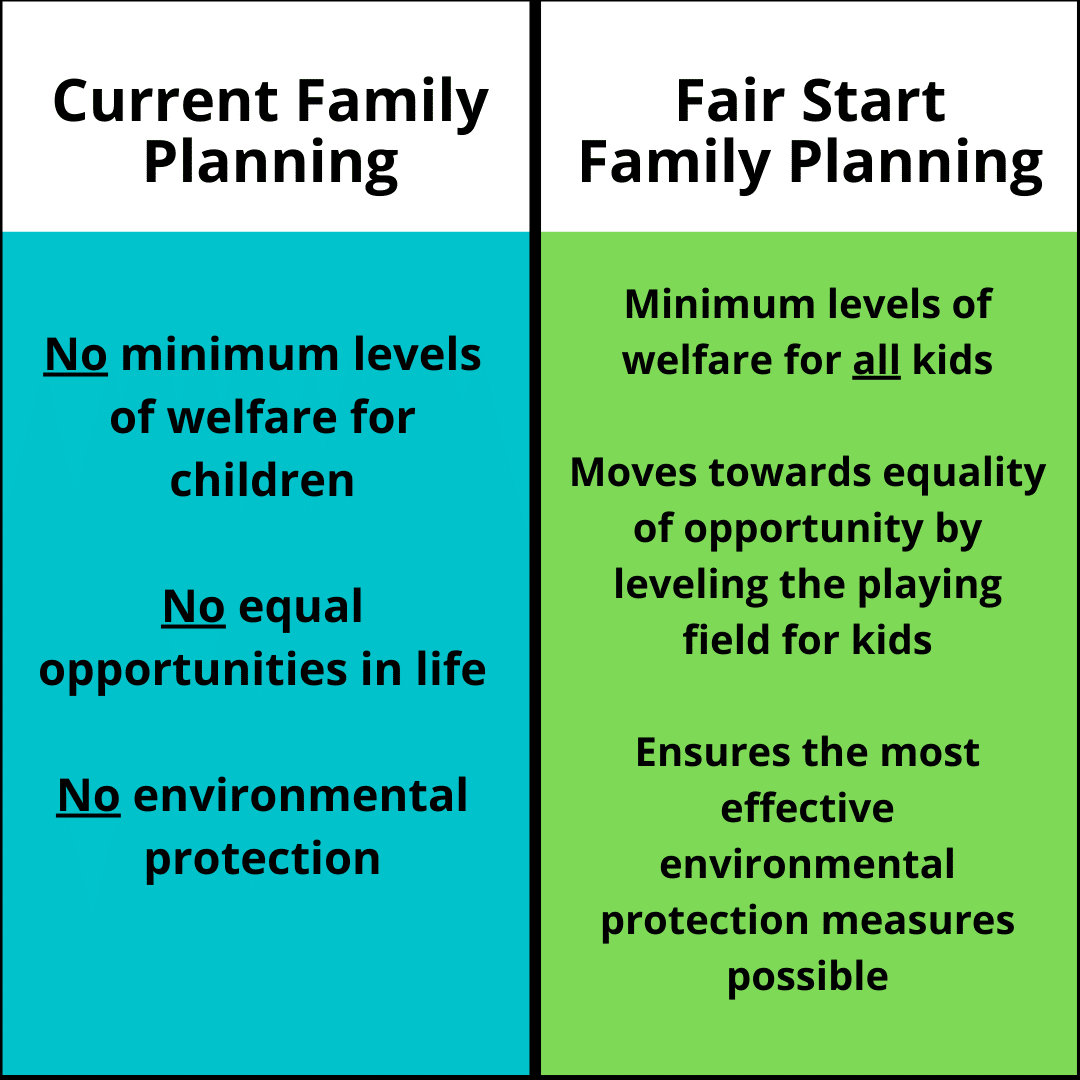
    A comparison chart of Current Family Planning vs. Fair Start Family Planning. The left side lists negatives of current planning; the right side highlights positive outcomes of fair start planning for welfare, equality, and environmental protection.

    Evading the constitutive fallacy allows us to avoid the lie of seeing ourselves as constituted into nation states – where we have little role over public affair and are hardly self-determining – by god-like founders in the past. First deriving justice and rules from that ancient process would require ignoring the formation of the power relations that justice is designed to shape. Committing that mistake or fallacy means denying people the relative self-determination, or fairness, of constituting just communities where their voice actually matters, and ignoring the drivers of our daily experience in favor of the abstraction of celebrities and politicians, divorced from the creation and reality of the lives of the people with whom we share the world. The verb form, constituting, instead empowers people, and focuses us linguistically on relative self-determination rather than being determined by others.

    To constitute means first and always accounting for the future generations impacted by our lives and ensuring that their creation is just, via Fair Start reforms or comparable modeling that uses the entitlements future children deserve as a correlative incentive to ensure – universally – small, sustainable and well-planned families. This includes ensuring minimum levels of welfare, a move towards birth equity, restorative environmentalism or rewilding, and physically constituting participatory democratic communities along the physical borders of human power. If we don’t do this, we are relying on and furthering an illegitimate system that undemocratically exploits the most numerous and vulnerable category of entities – future generations – in a way that retards freedom, or relative self-determination, for all. The freedom that comes from our existential role as sovereigns in a democracy precedes and enables the personal freedom and empowerment we experience, as workers, consumers or otherwise, in that democracy.

    A circular infographic titled “Fertility Delay Incentives to Planning” shows a leaf in the center with four benefits: Delayed Parenthood, Better Family Planning, Guaranteed Minimum Income, and Equal Opportunity & Education for all kids.

    What’s an example of moving past the constitutive fallacy? Consider what rules for containing Covid-19 are most just, balancing public health, personal choice, and the maintenance of one’s livelihood? To answer this question we would have to be constituted into relatively self-determining groups or democratic communities capable of answering the question, and our having first done that would have likely evaded the overcrowding, poor public health, destruction of nature, etc. that drove the pandemic. The same revision in thinking would apply to the climate crisis, and dozens of other problems.

    Practically we can do this – as free and equal people – by limiting and decentralizing existing concentrations of private and public power, taking the resources the people in those concentrations hoarded by externalizing costs, and instead investing them in Fair Start reforms as the entitlements/incentives described above. We may do so because the act of constituting overrides downstream rules, like property entitlements. This will happen over the opposition of preconstitutional people, or precons, who simply block justice. We can test the progress of this process – the ongoing first and fundamental election – by looking for its application in the pronouns in our language, and to see whether we are constituting together the persons those pronouns explicitly and implicitly refer to.

    Several hands of different skin tones are stacked together. Overlaid text reads, The most powerful social justice is a fair start in life. Join the coalition. The Fair Start Movement logo appears at the bottom.
  • Relative Freedom From the Power of Others As a Baseline to Assess Cost

    Relative Freedom From the Power of Others As a Baseline to Assess Cost

    How do we know what counts as a cost or benefit in a particular transaction? Enter the idea of normative baselines, or the theoretical states of affairs by which we can answer the question.

    But is there an antecedent question nesting in the above-linked list of possible states of affairs we might use, from human rights to process-based positive law? From what justifiable social organization, of free and equal people, are we orienting when we assess the states of affairs? Perhaps we first have to be, existentially, a group of self-determining people capable of democratically deciding what’s a cost and what’s a benefit?

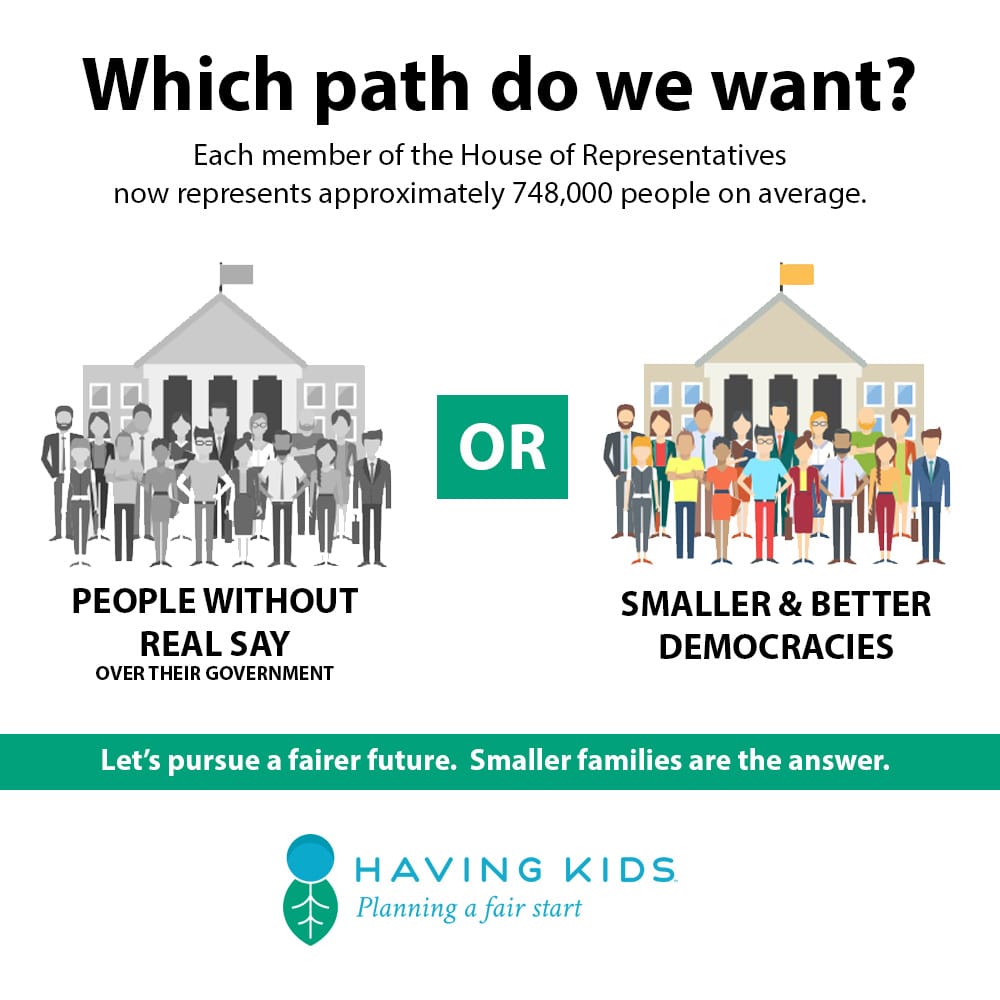
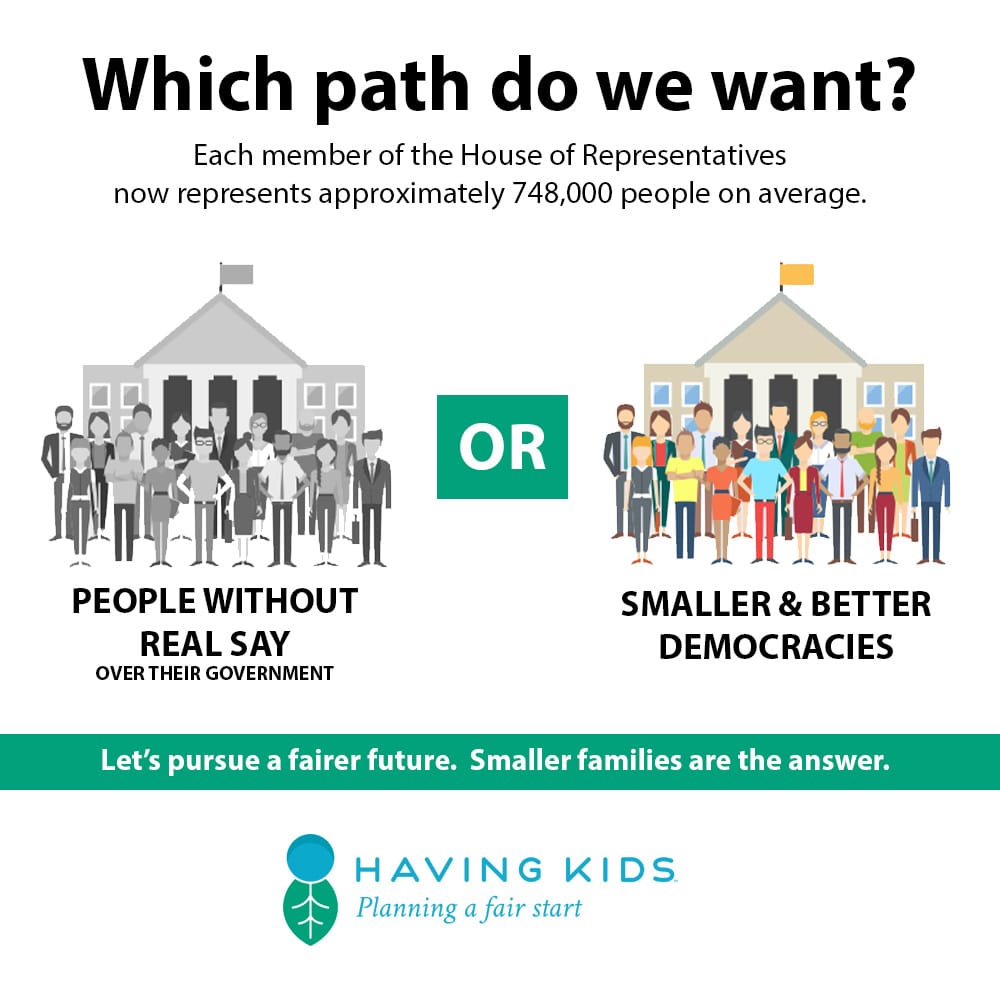
    An infographic compares two options: on the left, gray figures under “People without real say over their government,” and on the right, colorful families with “Smaller & better democracies.” Text promotes smaller families for fairer representation.

    We can think of this in another way. John Rawls is famous for articulating the basic framework of a just and free society. But what rule precedes the existence of the actual people who will eventually comprise Rawlsian systems? Is the rule that determines their creation the first issue that must be decided? How will the quantity of persons, the civic qualities of its members, and their initial relative positioning to their ecology and each other – the conditions of their early development – be determined? What creates the first relations of these people, whom Rawls wished to assure would be free and equal? How, in accounting for those relations, do we account for the dynamic or intergenerational nature of such a group, i.e. that they would die, and others would replace them?

    As a new peer-reviewed article on fair start family planning argues, the most basic criteria for assessing costs and benefits has to be the ideal creation (or procreation) norm, or the norm that first creates the people – and their relations, power differentials, relation to their ecology, etc. – who are making the assessment. Moreover, as the article argues, using such initial criteria to assess what counts as a cost or benefit is actually practicable, given what we know about intergenerational justice, optimal world population ranges, and the need for very specific policies, like education, to ensure relative self-determination or what we commonly call freedom. This differs from the intergenerational justice work of Rawls and others who have asked what we owe, or what we might save for, future generations. Here the question is whether the dynamic “we” – any grouping of people from which we might consider these questions – is a justifiable group of people, in terms of the assuring each member the correct relative degree of self-determination. That difference matters, because the latter approach – or Fair Start reforms – trigger the override of competing norms, very specific criteria for behavior change, and other implications. They would fulfill what might have been the Rawlsian answer to the background question – we must create people in a way that makes them free and equal.

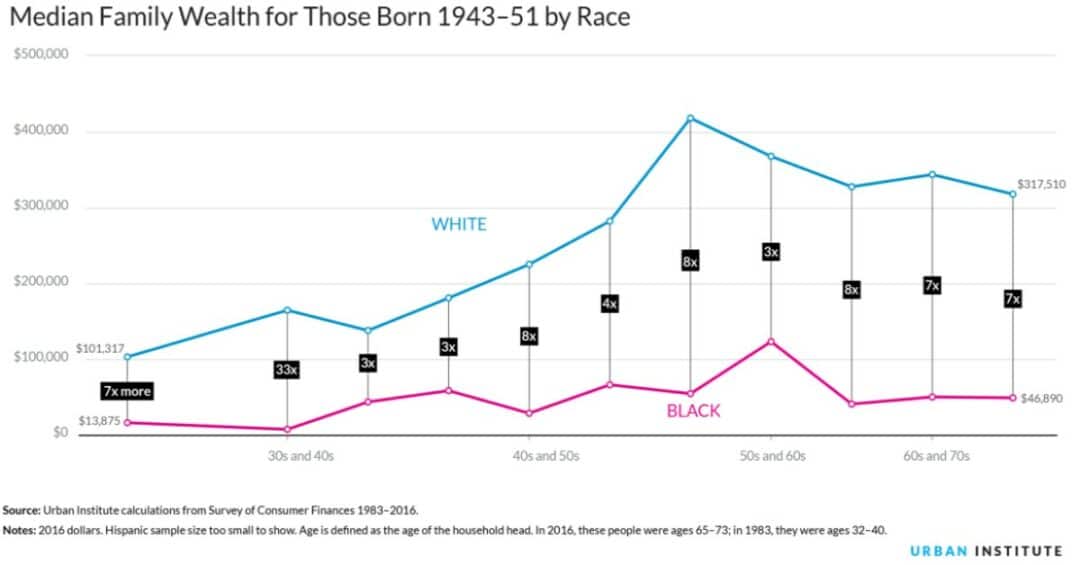
    A line graph compares median family wealth by age for White and Black Americans born 1943–51. White wealth is consistently much higher, peaking at $317,500 in their 60s, while Black wealth peaks at $54,800.

    As part of revisiting the baseline issue for policy reforms, Fair Start is working with IAMECON on the development of further research, specifically around the role of the nonhuman world as an ideal in ecological restoration. Per a lead on the project:

    “In this [forthcoming] paper, we study the relationship between human actions and the wilderness using a static game theoretical framework, and determine the parameter space that manages the gap between the payoff functions required for sustainable action vs payoff functions that leads to unsustainable actions observed in the last two centuries. When agents are not impacted at all from the harm wilderness suffers (as a result of human actions), i.e. zero empathy for the wilderness case, lack of environmental awareness, we find that unsustainable actions are always a dominant strategy for all individuals. When agents are somewhat impacted by the harm the wilderness suffers, i.e. flexible awareness case, we find that the benefit an individual gets from her unsustainable actions should be outweighed by the pressure to conform (to society) plus the negative consequences of the harm wilderness suffers on the individual herself, in order to arrive uniformly sustainable action as nash equilibrium.”

    Fair Start and other more comprehensive baseline approaches can be practiced by targeting concentrations of power, and redistributing their resources to future generations through a “constituting” discourse that limits and decentralizes human power via the simple recognition that every child’s right to a fair start in life, ecologically and socially, overrides the post hoc property rights and entitlements issued by governments whose legitimacy stems from fair and intergenerational social contracting.

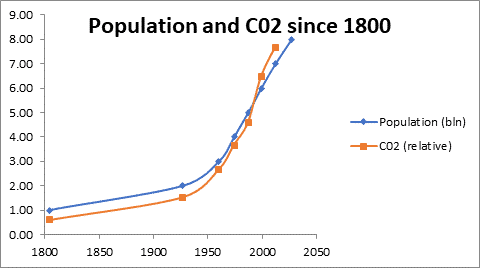
    Line graph showing global population (in billions) and CO2 (relative) from 1800 to 2050. Both lines rise slowly at first, then sharply increase around 1950, with population slightly above CO2 in recent decades.

    Under such an assessment for redistribution of resources and the power that comes with them, we can start by measuring the impact of the climate crisis on maternal, fetal, and neonatal health as a cost relative to a normative state of affairs in which such children would be free from the impacts, or relatively self-determining, rather than having their lives determined by those industries most responsible for the crisis. We can extend the analysis beyond the impact on ecological birth conditions to also assess how those industries benefited from a pronatal and economic growth-based family planning/creation norm that required no minimum levels of wellbeing, economic equality, or an empowering role on one’s democracy, for the children born and thereby impacted, as well as the harms to the parents of the children.

    This is one way to fundamentally assess costs and benefits, by orienting from the most basic notion of a justifiable, or relatively self-determining, social organization constantly recreated through Fair Start family planning.

    What is the upshot of all of this? If Fair Start is the first and overriding human right we have the right to implement it, over all other obligations – like property rights – by all means effective.

    Here is one way to start that process, a discourse, and following that many ways to actualize Fair Start, legally, institutionally, and culturally.

  • What Fundamentally Drives Pandemics and the Climate Crisis? Misunderstanding Freedom

    What Fundamentally Drives Pandemics and the Climate Crisis? Misunderstanding Freedom

    [et_pb_section admin_label=”section”] [et_pb_row admin_label=”row”] [et_pb_column type=”4_4″][et_pb_text admin_label=”Text”]

    Chaos Enabled by Irresponsible Behavior Is the Antithesis of Freedom

    What do pandemics like Covid-19, and ecocidal things like the climate crisis, have to do with the idea of human freedom? For some, these events will be perceived as opportunities for governments to limit human freedom. For others, they will seem like limitations on freedom, along with governments’ failure to prevent them. Whatever the view, these events are largely driven by human behavior, which in turn is driven by values and norms, like freedom. How we further these events, and react to them, fundamentally derives in many ways from our perception of freedom and how it limits or justifies behavior. Dealing with these crises could then fundamentally start with examining the concept. Below are three particular perspectives, centered on isolation, inclusion, and creation, respectively.

    A common view of freedom is the right to do whatever one wishes, absent some obvious and unjustifiable harm to others. The vision here is that one is and should be autonomous from other people, a vision captured in statements we see all the time: A gym owner in Arizona who refuses to require masks or close his business despite Covid-19, landowners who refuse to comply with the endangered species act, companies in trade associations that push back against consumer regulations, or coalitions fighting regulations that would limit climate emissions. The entire concept proceeds from intentional myopia, or the decision to view oneself in isolation from others, in time and space. It is the maintaining of willful ignorance of how people came to occupy different positions in society, the subtlety of harm, and the importance of things beyond harm – like obtaining the considered consent of others we influence. That myopia makes these claims of freedom easy to contest, but they endure to the extent our political systems position people so that they are – in an antisocial way – unwilling or unable to examine them. Collective problems, like the climate crisis and Covid 19, are primarily seen as presenting a risk that the collective will have a new opportunity to interfere with the will of individuals.

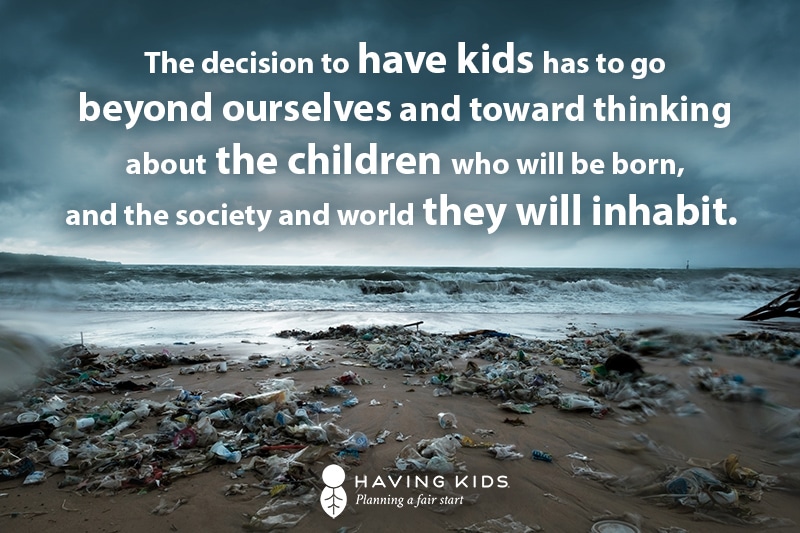
    A beach littered with plastic trash under a cloudy sky. Overlaid text reads: The decision to have kids has to go beyond ourselves and toward thinking about the children who will be born, and the society and world they will inhabit.

    A second and less common view of freedom evades these problems we find in the first view. It takes many forms, but the general idea is to more comprehensively account for one’s position in the collective, and ensure a shared arrangement that allows one to do what one wishes as part of a system that simultaneously allows others to do the same. The goal is to not prevent each other from self-determination in the process. The philosophers: Joseph Raz, in The Morality of Freedom, or Philip Pettit, in a recent Ted Talk, exemplify this more comprehensive view. It cannot easily be picked apart by examining how the autonomy of the individual relates to the collective – they have accounted for these complex and relevant connections. Under this view, both the climate crisis and Covid-19 present direct risks to the autonomy or freedom of all, as well as those in the future. It is consistent with the objective value of people getting to do what they want that we require all to change their behavior in response to these events. This vision is more complex and accurate – but beyond the capacity or willingness of many to grasp.

    But the truly myopic, and even the more comprehensive visions of freedom, aside, there is a third view of freedom that involves something unique.  Is there something odd about the two visions of freedom just discussed? There is no account of how the people in them came to be. It’s as if they dropped from the sky. But if freedom entails freedom from other people and their unwanted influence, as well as the freedom to do things – like choose among the valuable options in life enabled by particular types of social organization – don’t we have to first account for the creation of people? Don’t we have to assure all some minimum levels of welfare or even equity of opportunity at birth, some meaningful role in controlling their governance, and political entities physically defined by nature so that we can be free from others? In other words – we first need a norm that accounts for the creation of free people.

    In this third view, freedom is more dynamic and physical, a norm that through creation, or procreation, determines the quantity, constitutive qualities (persons sufficiently social or empathetic enough to maintain a social contract), and early positioning of each to maximize self-determination. This is not as abstract as it seems. Just reverse the current norm being constantly pushed by many in the media that women should have more children – full stop – as a means of reversing America’s dreaded economic baby bust. In the third view, using those future children to ensure economic growth would be the opposite of freedom, bringing children into the world with no minimum levels of welfare, and degrading equity, nature, and the role each person plays in their democracy. And it does those things in violation of our current standards, or laws, that try – ineffectively and downstream – to pull children out of sub-threshold conditions, redistribute wealth among families, protect nature, and enfranchise each person with a meaningful vote.

    A hazy, polluted city skyline with the quote: Explain to future generations that it was good for the economy when they can’t farm the land, breathe the air, or drink the water. - Unknown. Having Kids logo at bottom.

    This third view of freedom – which we might call a fair start, is centered on the act of creating other people to ensure they live as free and equal persons. It is not exclusive of the first two but rather precedes and enables them, and would be furthered through a very specific process of reforming family planning and population policies – specifically treating the act of procreation as more other-determining for the child than self-determining for the parents. It asks: How can we be inclusive without first accounting for the creation of the people to be included? The impact of these family planning reforms would exponentially surpass many of the downstream reforms underway to alleviate child poverty, ensure equity, restore democracy, and protect our environment. So would the long-term impact on the climate crisis, and the impact and risks of pandemics.

    Lastly, this third view has a unique feature: Because it always proceeds other behaviors, in that we are before we do, it overrides conflicting interests. We may do whatever it takes to ensure all children a fair start in life or to continuously recreate the people who actually – or physically – comprise free societies. 

    The crises we face today arise from and depend on values, like freedom. Starting at the source of the problem entails examining what we mean when we use this word, and what it means for others.

    [/et_pb_text][/et_pb_column] [/et_pb_row] [/et_pb_section]
  • Freedom Though Reproductive Justice: Watch the Values Align

    Freedom Though Reproductive Justice: Watch the Values Align

    Fair Start family planning and reproductive justice reforms are simple and their impact is unrivaled.

    Here is what Fair Start family planning looks like:

    fair start model
    Specific, concrete, and enforceable standards for all three aspects of this Fair Start model are spelled out, in context, here.

    But what makes the modeling unique is the way it frees us, ensuring – through an alignment of values – relative self-determination that is impossible without it. That, and the fact that reproductive justice precedes other forms, means we can purse Fair Start by all means effective, and use it to identify and overcome those that threaten that our and our kids’ freedom.

    For example, the autonomy would-be parents gain through self-development and meeting a standard of readiness to parent aligns with objective, constitutive and naturalistic reasons for having children, parents’ procreative interest in successful relationships with their children, the diminishing interest in having additional children, and the quality–quantity tradeoff of a smaller family or more ecocentric family. These things align with the autonomy a highly loved and developed child experiences in life, and the morally valuable options and equality of opportunities in life they will have, which further aligns with the autonomy created by the gender equity such development allows, cooperativeness within groups, a level of inherent security in groups that avoids the need for top-down limitations on autonomy, as well as fluidity among groups.

    A circular infographic titled “Fertility Delay Incentives to Planning” shows a leaf in the center with four benefits: Delayed Parenthood, Better Family Planning, Guaranteed Minimum Income, and Equal Opportunity & Education for all kids.

    The resulting smaller or more ecocentric populations and high levels of development align with one’s being empowered by having a meaningful voice – not drowned out or diluted by others – in public affairs and the rules under which one must live. This participatory agency aligns with the autonomy created by fulfilling one’s need for meaningful group membership, which in turn aligns with reduced consumption. and personal property that is oriented around nonpolity rather than things like ranking over others.

    And all of these align with a healthy and safe environment and the freedom—or autonomy—from others that is only possible through interaction with the nonhuman world. That is freedom in nature. This in turn aligns with the nonhuman autonomy the animal liberation movement advocates for. Note this alignment spans many types of freedom, from communitarian to libertarian, that might be seen as conflicting, were we not temporalizing our perspective and orienting from creation, a place that could unify values in ways other approaches do not.

    Learn more in our Having Kids White Paper.

    We can assess with a simple test, objectively, whether each of us is choosing to be part of a fundamentally just system in which the values discussed above align and in which we ensure true self-determination, or we are not.

  • The Rights Of and To Nature – What They Mean for Future Generations. Apr 7, 2021 09:00 AM in Pacific Time (US and Canada)

    The Rights Of and To Nature – What They Mean for Future Generations. Apr 7, 2021 09:00 AM in Pacific Time (US and Canada)

    Join the International Animal Law Committee of the American Bar Association’s International Law Section for a great discussion.

    Register here.

    As the rights both of and to nature emerge and solidify in the minds of the public, and in law and policy, they will entail greater investment in and empowerment of future generations. This panel will explain why.

    It begins with the lead attorney, Jessica Blome, in a case currently pending before the Ninth Circuit that argues the Constitution implies a right to nature, including a regenerative standard for environmental policies, under the liberty doctrine. That right aligns with the international rights of nature groups like Earth Law Center promote, and it would help further them, legislatively and otherwise.

    Tony Zelle, will present on those rights, from an international perspective, detailing their history and future. Cat Hughey, will explain what the rights to/of nature entail for reforming our family planning systems, from the United Nations to state ballot initiatives. And finally, Michael Swistara and Max Broad will discuss the local implications of these movements for the District of Columbia, where efforts to promote legislation that would ensure every child a socially and ecologically fair start in life might begin.

    A hazy, polluted city skyline with the quote: Explain to future generations that it was good for the economy when they can’t farm the land, breathe the air, or drink the water. - Unknown. Having Kids logo at bottom.
  • Want Democracy for Your Kids? Do this.

    Want Democracy for Your Kids? Do this.

    When supporters of President Trump stormed the Capitol Building in January, business leaders, and prominent members of both political parties, condemned the act as a direct assault on democracy. The deadly attack was wrong for many reasons, but not because the Capitol represents a functional democracy.

    It’s hard to understand why anyone believes Congress – a handful of people – could democratically represent the diverse and changing interests of the hundreds of millions of people that live in the United States. If democracy is characterized by self-rule or the decentralization of power, what Congress purports to do instead is run a large republic where powerful interests disproportionately control outcomes, rather than engage in the true democracy simply characterized by an extremely decentralized system of local control where each person’s voice matters and is heard.

    We react strongly to the spectacle of what happened at the Capitol in part because it is sensational. Decades of corporate lobbyists invading the Capitol and slowly degrading the way it represents each person equally – and especially those most vulnerable – is less sensational. It’s not better – in many ways it’s worse and more impactful – but our brains don’t process it the same way. (In the linked TED talk Peter Singer focuses on our welfare and our cognitive limits, but the same lesson could be applied to self-determination and democracy).

    While contrasts have been drawn between the police response to the attack versus the response to the George Floyd riots, we can also look to the disproportionate response police had to the Occupy movement, especially in Wall Street’s back yard. We may not be surprised then when the captains of corporate America swiftly condemned the attack on the Capitol. Violence reminds us that there is a form of power other than money.

    If we really wish to ensure justice and to prevent further bloodshed, perhaps we should focus on making each voice heard and matter – whether it is the sort dying to end the constant killings of deeply disenfranchised black men by police, or the sort of voice intent on protesting the federal governance of our massive and deeply unequal population as undemocratic. If we don’t, these voices will raise their level of conflict, and violence.

    Infographic compares two groups: one large, gray crowd labeled People Without Real Say by the government, and one small, colorful group labeled Smaller & Better Democracies. Text suggests smaller families improve democracy.

    How could we possibly increase each person’s role in governance? Traditionally our moderately federalized system pushes population growth as a means of expanding national power, then based on constitutional rules, it counts up everyone and apportions their representatives. Instead of exploiting future generations as a means of growth, what if we changed the way we have and raise kids to equitably invest more in them and in ways designed to give each a voice in hyper-decentralized future governance? Instead of assuming that the written Constitution magically ensures our representation, we could physically decentralize both private and public concentrations of power by taking resources and investing them in a smaller future population developed for self-rule. While that process must prioritize eliminating racial inequity, it is inherently nonpartisan.

    In this way, we could begin to constitute democracies out of people, more than out of words, and build communities around our role in planning them, more than around racial or class identities. We could incentivize early fostering and adoption of children in need using the funds – like child tax credits – that currently incentivize having larger families. We could also do it by redistributing wealth from the top of the economic pyramid through enhanced “baby bond” legislation meant to ensure birth equity and tie future children’s needs to better family planning. Giving a voice  – in this way – can mean giving what both margins, left and right, want respectively, albeit over the span of a few generations: Greater equity for the former, and greater autonomy for the latter.

    The best part? If developing future generations to engage in equal self-rule is something that logically precedes the political processes we are accustomed to, we don’t need the government to begin the decentralization of private and public power. We can instead join as liberals and conservatives to target the power of both big business and big government, which in divided political camps we respectively object to, based on the simple truths that every child deserves to get a fair start – both ecologically and socially – in life, and that every child deserves to eventually matter in the processes that govern their day to day lives.

    They have that first human right, and as their protectors, we may ensure it for them by all means effective.

    Take action: Urge you representatives in Congress to support the United America campaign.

  • Giving To Help Kids, Animals, the Environment, or Democracy? Help Them All At Once Instead

    Giving To Help Kids, Animals, the Environment, or Democracy? Help Them All At Once Instead

    Social movements that try to protect kids, animals, the environment, and democracy tend to see themselves as distinct, and even conflicting. That’s a huge mistake. The most impactful way to further the core missions of all movements lies in making a simple change: Restructure family planning policies, universally, by 1) promoting delayed parenthood, so that people are ready to actually parent, 2) prioritizing giving all kids a Fair Start in life in any political system of resource and stakeholder redistribution, and 3) encouraging smaller families for all, something which helps enable and pay for the first two moves.

    A circular infographic titled “Fertility Delay Incentives to Planning” shows a leaf in the center with four benefits: Delayed Parenthood, Better Family Planning, Guaranteed Minimum Income, and Equal Opportunity & Education for all kids.

    For all four social movements the long-term impacts of changing the way we plan families is incomparable. In other words, long-term thinking, change, and work pays off.

    So who would be oppose this transition? Big business and big government both thrive on poor family planning, because it creates a wave of consumers, cheap future labor, and taxpayers. Both use growth to increase and concentrate their power, at cost to the development of individuals, real democracy where every voice matters, and nature. The solution? Social justice movements can unify against these concentrations of power, finding reasonable allies on both the political left and the right, who want effective reform that furthers our widely shared values, the decentralization of power, and our actually reaching sustainable development goals. Want more information? Our peer-reviewed white paper on family planning reform can be found here. 

    Want to help with this unification of social justice movements against the concentrations of power? Please consider donating to HavingKids.org, or signing up to volunteer at info@fairstartmovement.org.

  • The Fair Start Revolution: Taking Power From the Top to Empower Future Generations

    The Fair Start Revolution: Taking Power From the Top to Empower Future Generations

    Elon’s Musk’s Starlink satellites are creating massive sky pollution and ruining stargazing; his commercial interests are creating “space graffiti” in the night sky and obstructing astronomers’ observations. Can we solve this problem in a way that could apply to other scenarios — such as the climate crisis — in which the uber-wealthy and dysfunctional governments work together to destroy nature and threaten our kids’ futures? These incursions into nature interfere with our being free from others’ power, and their subtlety does not make them any less wrong than more obvious forms of oppression. It’s more proof that Musk, who recently doubled down on his assertion that women must have kids in order to support the economy, is not an environmentalist as much as he is a car and space tourism manufacturer.

    At the most fundamental level, this process of propping up the world economy involves a population pyramid in which a few people exploit population growth, fueled by poor family planning, as an engine to convert nature and the nonhuman world into their own wealth. One fundamental solution involves simply reversing that stream: We should agree that two correlative human rights — everyone’s right to nature and children’s right to a fair start in life — supersede the property rights of wealthy people like Musk. The solution involves seeing the right to be born into the world as a free and equal person as the first human right. And it requires using that foundational right to rebase our constitutions on people, not property.

    As we constantly reconstitute societies through the act of having kids, we have a right and an obligation to recycle the resources at the top, and the raw power over others they represent, to constantly generate nature, equity, and democracy where each voice matters. And there now exist clear policy ideas — like Fair Start baby bonds — to ensure that mankind most effectively uses those resources to empower future generations. The few at the top, who are literally hiding the stars from our view, can’t have power over us if we don’t give it to them.

    Take action: Urge Musk to support Fair Start family planning reforms.

    A split infographic comparing Current Family Planning with no minimum welfare, equality, or environmental protection, and Fair Start Family Planning with minimum welfare, equality of opportunity, and strong environmental protection.
    A vision for comprehensive family planning reforms

  • Is WaPo Promoting Nationalism Over Democracy?

    Is WaPo Promoting Nationalism Over Democracy?

    In a recent news analysis article, not an editorial, a Washington Post writer lamented the recent drop in U.S. fertility rate:

    A news article discusses economists’ predictions of a decline in U.S. births due to COVID-19, referencing a Brookings Institution report. A chart below shows how the Great Recession impacted birth rates.

    “Rather, the pandemic left a permanent mark on American families, with many having fewer children than they would have otherwise, leaving tens of thousands of future American citizens permanently unborn.” The author, Christopher Ingraham, went on:

    Of course, at the individual level, the fertility cost is literally incalculable. How does a parent put a price tag on a child that was never had? What is the loss to an only child who will never have siblings to play with? The discussion is a reminder that even after the pandemic is behind us, it is likely to leave a deep scar on society for years to come.

    — Christopher Ingraham, The Washington Post, June 17, 2020

    Does this rhetoric — the assertion that birthing fewer children exacts a toll on society — sound familiar? It might, because this has been a talking point of nationalist leaders across the globe. Recently, Venezuelan strongman Nicolas Maduro recently called on women in the country to have more kids to “let the homeland grow.” U.S. President Donald Trump chimed in as well, approving a barely noticed tax tweak that pays people even more money to have kids.

    This policy promotes nationalism over democracy because it pushes society away from improving birth conditions for every child; giving kids a fair start in life; ensuring that children grow up in a natural, healthy, and safe environment; and allowing everyone to exercise meaningful voices in their democracies that won’t get lost in the chaotic crowd.

    The problem with this reasoning is that the state and other institutions are artifice: Democracy and legitimate societies derive power from the individual, not the other way around. We should not have children for the state or the economy. Instead, we should cooperatively plan to have kids in ways that empower them to comprise a better future and build real democracies, not bloated nation-states and economies that demand more bodies — even in the middle of ecological and social crises.

    More crowding and poor family planning exacerbates the spread and threat of pandemics, is the worst way to exacerbate the climate crisis, and expands the inequity tearing our communities apart.

    TAKE ACTION: The Washingtion Post holds itself up as a champion of democracy, but it is promoting nationalistic policies. Because family planning is truly constitutional in nature and because the right to a fair start in life is the first and most fundamental human right, we can engage people (and especially wealthy people) pushing women to have kids to instead help pay for sustainable family planning, and for every kid to get a fair start in life. Write the Post editor Marty Baron @PostBaron, or engage him in person, and urge him to reconsider what democracy means and to pay his share to support better family planning.