Category: Family Planning & Child Rights

  • Organizations Joining for World Population Day at the U.N.

    Organizations Joining for World Population Day at the U.N.

    Groups urging Secretary-General Antonio Guterres to recommend smaller families.

    A coalition of child protection, animal rights, and environmental organizations are coming together for World Population Day on July 11th. They hope to urge U.N. Secretary-General Antonio Guterres to issue a statement on the need for smaller families and sustainable family planning as a vital step toward attaining the U.N.’s Sustainable Development Goals. Activists will also gather at the U.N. for a peaceful demonstration to mark the day and to raise awareness on the issue. The event will take place from 11:30 a.m.-1:30 p.m.

    Read the Secretary-General Guterres letter here.

    The groups led by Having Kids and U.K.- based Population Matters also include OneProtest, World Population Balance, Earth Overshoot, Population Institute Canada, Sustainable Population Australia, In Defense of Animals, 34 Million Friends of UNFPA, Wilderness Watch, New Yorkers for Clean, Livable, and Safe Streets, and Seeding Sovereignty,

    The facts are clear: 

    “Our world leaders have failed to recognize the greatest driver of climate and other anthropogenic impacts – unsustainable family planning. We’re working hard to change that by bringing organizations together representing a range of global issues. It’s time for those causes and the media to talk about the most effective way we can protect the future for the next generation,” said Ashley Berke, Director of Communications at Having Kids. 

    Robin Maynard of Population Matters says, “There’s an ever-growing scientific consensus that population growth is a primary driver of climate change and biodiversity loss. The equation is simple: too many of us, taking too much (especially, but not uniquely in rich, developed countries) from a finite planet. This is a global problem, demanding global action. The Sustainable Development Goals are the mechanism through which the international community seeks to achieve a sustainable future – but unless the SDGs incorporate the goal of achieving a sustainable population through people choosing smaller families, they will not succeed in that noble mission.”

    TAKE ACTION:
    Add your name to our letter.
    And if you’re near NYC, join us at the U.N. on Thursday, July 11th for World Population Day. RSVP here

  • Are Small Families Subsidizing Larger and Less Sustainable Ones? Tell Us Your Story.

    Are Small Families Subsidizing Larger and Less Sustainable Ones? Tell Us Your Story.

    * This is authored by a mother of one child. The author preferred to remain anonymous.

    Small families in America routinely pay insurance premiums, taxes, childcare fees, and other costs that incentivize large and unsustainable families. These costs often masquerade as discounts as families grow, translating into cost savings to add more children to otherwise complete families.

    While this may seem benign or even generous to some parents, this archaic “bigger is better” policy is destroying our environment and our quality of life and is unfairly penalizing smaller families. 

    Here are some examples:

    • Insurance schemes often offer family plans that favor large and unsustainable families, rather than charging for each person enrolled. Alternatives exist that don’t ask smaller or nontraditional families to subsidize their larger brethren. In my son’s school (yes, I have only one child) and many others, childcare plans often don’t charge per child, but instead offer reduced fees and more openings for larger families.

    Instead of incentivizing large and unsustainable families, polices should be based on the first human right: ensuring every child their right to an ecologically and socially fair start in life.

    That means incentivizing smaller and more sustainable families who invest more in each child and who can use the resources they save to help improve the conditions into which other families bring their children.

    TAKE ACTION: Tell us your story! If this resonates with you, write to info@fairstartmovement.org and tell us your experience. Also, urge Congress to embrace smaller families who can invest more in each child.

    *After this initial post was written another anonymous mother, who works as an executive in one of the largest companies in the United States, came forward and had this to say: “Even in the arts and other places where there is say a single or couple membership, the options often jump to a family membership of 4 kids and sometimes more, without an in-between option if you only have one kid. I’ve seen that a lot and it pisses me off.”

  • Open Letter to Sundar Pichai, CEO of Google: Please Embrace Fair Start Reforms

    Open Letter to Sundar Pichai, CEO of Google: Please Embrace Fair Start Reforms

    Dear Sundar,

    Congratulations on Google’s recent plans to invest in U.S. job creation, and on your ongoing commitments to social justice in this country. Our organization, Having Kids, is reaching out to you regarding an issue fundamental to social justice – the laws and policies that control the way we plan families and raise our children.

    Google recently announced plans to disrupt liberal arts educational systems with its career certificate program. While the move expands economic opportunities for many, it places Google – an influential actor – at a crossroads between two directions this country may go in terms of family planning and educational policy, culture, and practice. The choice is fairly binary, given the nature of population growth.

    A. We can treat the country as an economy to be driven – as Nobel Laureate Steven Chu recognized – by unsustainable population growth, buoyed up by family planning, rearing and educational policies that ensure no minimum levels of welfare at birth, no equal opportunities in life, political systems where the average person has little impact, and no fundamental right to a biodiverse and natural world. This approach responds to a perceived “baby bust” in population growth by simply creating more and more people as economic inputs. This is the approach championed by Ivanka Trump in her policies on family planning and education, and much of this was recently adopted by Congress in its stimulus legislation.

    B. We can treat the country as a democracy, with family planning, rearing and educational policies which push in the opposite direction, creating fewer people in whose development we invest more, and in ways that are equitable. This requires cooperative family planning systems where parents, and the centers of wealth and power both public and private, work together to ensure all children are born above certain thresholds (like those specified in the Children’s Rights Convention). This move can help us approach equality of opportunities in life, as well as restructured democracies where each voice is heard. These moves, in turn, are consistent with future generations enjoying a biodiverse and natural world. This approach is the subject of recent peer-reviewed research, and can be implemented through things as simple as fertility delay incentives. All of this comports with the Sustainable Development Goals, and eventual stabilization at an optimal world population range of the sort Sir Partha Dasgupta has envisioned. This approach could be termed Fair Start family planning.

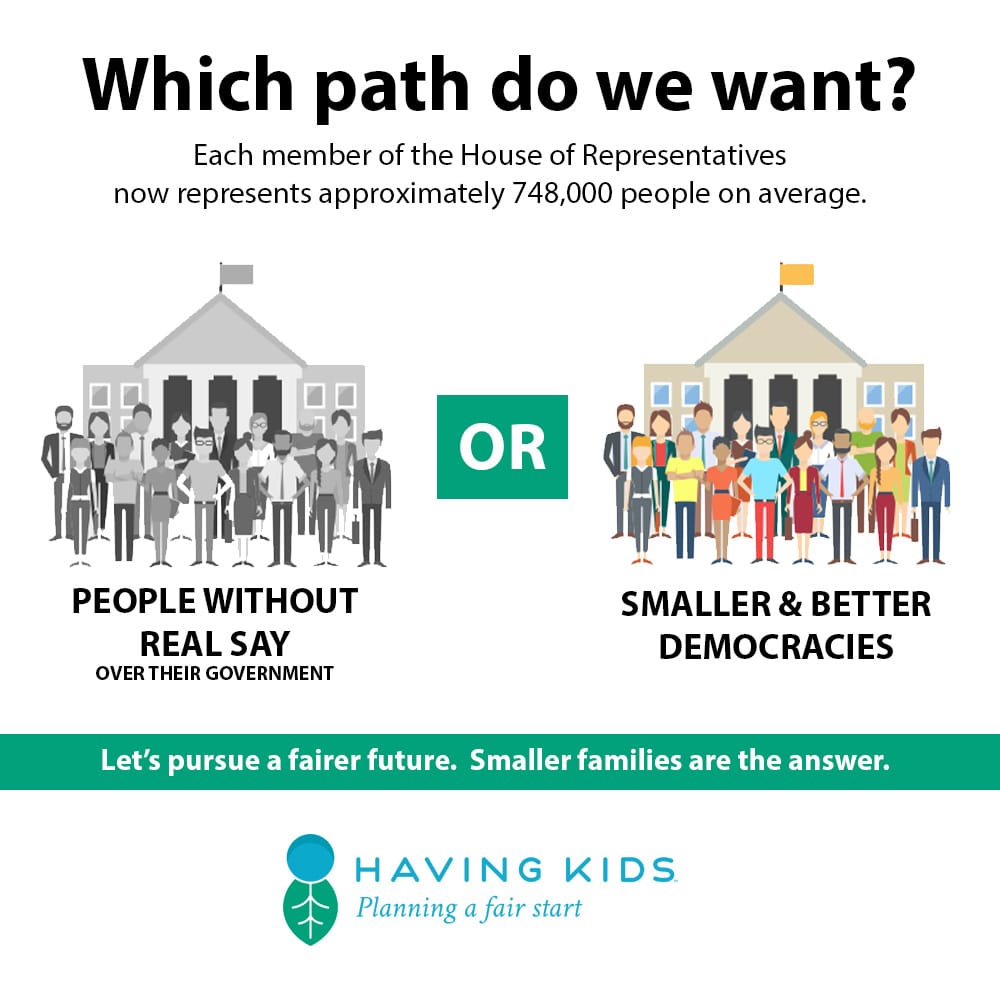
    Infographic compares two groups: one large, gray crowd labeled People Without Real Say by the government, and one small, colorful group labeled Smaller & Better Democracies. Text suggests smaller families improve democracy.

    There are compelling reasons to choose the latter, or more investive than exploitative, approach. It has ten to twenty times the beneficial impact on key crises facing our species, from the climate crisis, to massive inequity, to failing democracies. But more importantly, it is the best interpretation of the Universal Declaration of Human Rights promise of a fundamental human right to have children – one that every generation should enjoy. And because that right is uniquely peremptory, or lexically primary in that we are before we do, we are simply obligated – under international law – to implement it. Put another way, because human rights and democracies must precede and regulate economies, they come first and we must plan to comprise future generations as such.

    We urge Google to take a stand in favor of Fair Start family planning reforms, and we stand ready to assist in any way we can.

    Sincerely,

    Cat Hughey,

    Executive Director, Having Kids

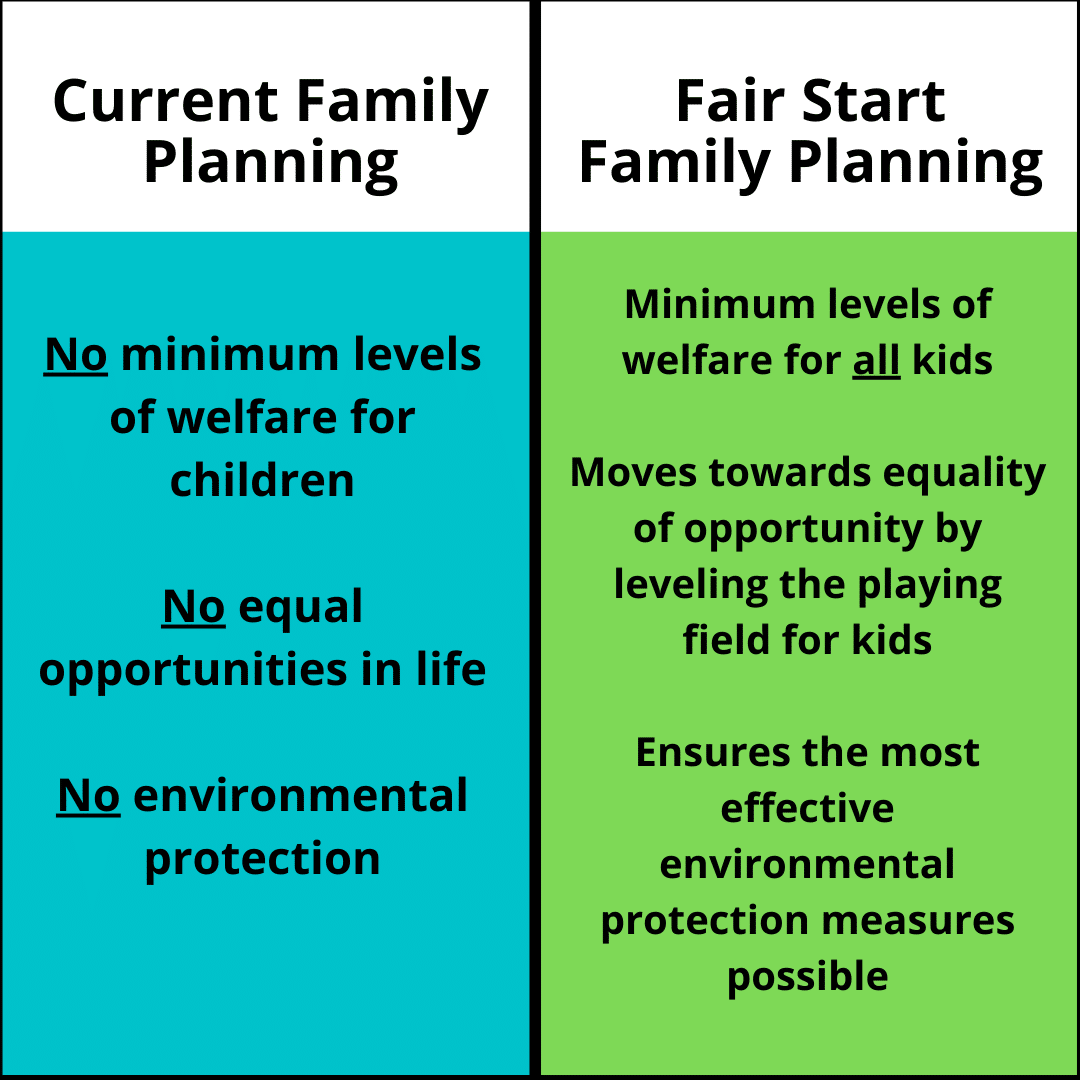
    A comparison chart contrasts “Current Family Planning” with “Fair Start Family Planning,” highlighting differences in welfare, opportunity, and environmental protection for children, using bolded text and underlining for emphasis.
  • Sustainable Families: Surviving and Even Thriving During COVID-19

    Sustainable Families: Surviving and Even Thriving During COVID-19

    The following post is contributed by Huggable, whom the team at Having Kids applauds for engaging on complex social issues. Having Kids receives no compensation from Huggable.

    Here at Huggable, we applaud Having Kids’ mission to create a better and more equitable world by giving all children the best possible start in life. We also believe that research should inform decision-making about important topics such as family planning, child inequality, and climate change.

    Another topic that we are deeply interested in is learning about what makes strong, sustainable families thrive, even when presented with difficult circumstances.

    Huggable’s COVID-19 Research Report

    To find out how the COVID-19 pandemic has affected families with young children, we recently commissioned a survey of hundreds of families. The results of our research provide not only a glimmer of optimism in the midst of the pandemic’s tragic consequences, but also further evidence of the importance of building stable, sustainable families that thrive when given the right resources and opportunities. 

    Our findings are based on the insights of 538 parents with children under the age of three, collected in April and May 2020. The vast majority of the respondents were mothers, although a number of fathers also took part in the survey.

    Key Takeaways From Our Survey


    1. Parents Are Spending More Time With Their Children

    Arguably, the most important finding of our research is that parents are spending more time with their children than they did before COVID-19. Specifically, mothers are spending an average of 49% more time with their babies and toddlers, which is an additional 3.9 hours per weekday. The increase was particularly apparent among mothers who work full-time, as they reported a 60% increase in time spent with their children. 

    Specifically, many parents have found unexpected opportunities to help their children with schoolwork, learn new skills, adopt an exercise routine, and get to know their little ones in a way that just wasn’t possible before the pandemic. 

    2. Mothers Are Feeling Closer to Their Children

    Although COVID-19 has undoubtedly made the multifaceted nature of parenthood even more complex, especially for mothers, many relationships between mothers and children have improved. Notably, 63% of mothers in our survey said they felt either slightly or significantly closer to their children as a result of changes related to COVID-19. 

    Once again, full-time working mothers have experienced the most significant improvement in their relationships, with 67% reporting that they felt either slightly or significantly closer to their children. Several mothers in our survey noted that they were particularly grateful to have been able to breastfeed their babies and toddlers more regularly, as this has helped them develop closer bonds with their littles ones.  

    3. Parents and Children Have Found Unexpected Opportunities to Thrive 

    Despite the anxieties and challenges brought on by COVID-19, we were very pleased to discover that many mothers, fathers, and children are using this time to work together more cohesively as a family unit. 

    The pandemic has resulted in many families taking stock of what really matters and finding ways to cope even in the midst of financial uncertainty. With families valuing time spent together and avoiding unnecessary trips to crowded places, many parents reported that they have found creative ways to make online shopping faster and easier by using money-saving tools such as Wikibuy. 

    Additionally, with parents and children spending more time at home, there have been extra opportunities for shared family meals, creative play, and spending time in nature. In our survey, we repeatedly heard about how children have been helping their parents with chores, exploring their own interests, and developing skills such as independence, resilience, and empathy. 

    We were also pleased to learn that fathers have been sharing in childcare and other household responsibilities more regularly and more equitably. This has been especially valuable for fathers of young children who may have missed out on their children’s earliest developmental milestones.

    You can find out more about our findings, and discover other research on how children and families are dealing with the COVID-19 pandemic by reading our full research report. 

  • Ezra’s Dilemma: Vox Is Pushing Women to Have Kids, Which Accelerates Species Extinction and Expands Factory Farming

    Ezra’s Dilemma: Vox Is Pushing Women to Have Kids, Which Accelerates Species Extinction and Expands Factory Farming

    [et_pb_section fb_built=”1″ _builder_version=”4.16″ global_colors_info=”{}”][et_pb_row _builder_version=”4.16″ background_size=”initial” background_position=”top_left” background_repeat=”repeat” global_colors_info=”{}”][et_pb_column type=”4_4″ _builder_version=”4.16″ custom_padding=”|||” global_colors_info=”{}” custom_padding__hover=”|||”][et_pb_text _builder_version=”4.16″ background_size=”initial” background_position=”top_left” background_repeat=”repeat” global_colors_info=”{}”]

    Ezra Klein has a dilemma.


    Vox Media reports responsibly on the horrors of factory farming and the climate crisis but openly pushes women to have more kids as a means of creating economic growth. They do so through their tax policy promotions, the work of Matthew Ygelsias, articles denying the science of population and climate, etc. It’s the same approach used by Donald Trump and many right-wing politicians who think of future generations as numbers to inflate the economy, rather than as children who all need a socially and ecologically fair start in life.


    Factory farming and every other animal and environmental crisis is fundamentally driven by human population growth. While Peter Singer is often credited with advancing the philosophy of animal rights, Paul Ehrlich probably did more to actually mitigate animal suffering and extinction through his influential work to slow population growth. Animal liberation, ours and nonhuman, begins with a family planning ethic that promotes sustainable and more equitable families who build empathy and fluid democracy in future generations. It’s not whether we talk about animal rights — it’s how we actually influence nonhumans and their worlds.


    Vox’s “women should have more kids” reporting is slanted, exacerbates the greatest factor driving the climate crisis, and hurts animals. Vox should recognize that any economic growth is first contingent on human rights compliance, which requires more equitable and sustainable families that invest heavily in each child. The human rights regime envisions a future filled with town halls where everyone has a voice, defined by nonhuman habitat. It does not envision a world where the average voice is lost and nature is paved with shopping malls where consumer freedom has replaced political freedom.


    Take Action:


    Learn more about why social justice for all starts with family planning reform and urge Editor Lauren Williams (@laurenwilliams) and Ezra Klein (@ezraklein) to support Fair Start sustainable family planning policies, and to stop pushing women to have kids.


    Also, urge Cory Booker to adopt family planning reform as key aspects of his opposition to factory farming and his support for guaranteed minimum income for children.


    [/et_pb_text][/et_pb_column][/et_pb_row][/et_pb_section]

  • Should Louisiana adopt a “Fair Start” policy like the proposed Colorado Amendment?

    Should Louisiana adopt a “Fair Start” policy like the proposed Colorado Amendment?

    By Timothy David Ray

    Last year, Having Kids proposed an amendment to the Colorado Constitution that would have enshrined into law, policies that reduced inequality of resources and opportunities for all children born in the state, as well as enhanced natural environmental protections to ensure Colorado’s children had access to the rich natural resources of the state’s ecosystem.

    Louisiana policymakers have expressed support for similar policies, or at least the importance of addressing [through the laws] the inequities of children.  Louisiana policymakers have also fought and won major victories to pass laws protecting the state’s vast natural resources; especially along its coasts.

    It is important to note, in Louisiana, political ideologies amongst the two major political parties rarely align when it comes to family planning matters, and the state is deeply religious.  However, support for children’s equity policies have been supported by lawmakers and policymakers across the political and religious spectrums. 

    The Colorado fair start approach would enshrine “ . . . freedom and equality from the moment of birth . . . ” into the Constitution.  The proposed constitutional amendment also places the state’s natural resources in a trust – held by the State – with the goal of protecting them for the “ . . . benefit of present and future generations . . . “

    A comparison chart of Current Family Planning and Fair Start Family Planning. The left side lists negatives: no minimum welfare, no equal opportunity, no environmental protection. The right side lists corresponding positives.

    Perhaps, Louisiana would support a “fair start” plan as a legislative policy if supporters of the policy could unite a coalition of parents, educators, environmentalists, and lawmakers – convincing them of the need to dedicate new laws that would cause a reduction in inequity among children and provide for the protection and use of public lands.

    Louisiana currently ranks last in the U.S. among the best states for children to live, according to a 2020 report from Save the Children.  Among the organization’s recommendations to provide better opportunities for children, they call for governmental investment in the future [lives] of all children:

    “We therefore call on policymakers at all levels of government to  . . . craft strong policies, provide sufficient resources, and create an appropriate regulatory environment for relevant childhood programs and interventions to flourish.”

    As the Colorado Fair Start proposal gains traction, Louisiana must begin rethinking its approach to providing for the fair, holistic, and equitable development of and investment in children. 

  • Want a Fair Start for Kids in Your State Constitution? Colorado Could Be the Beginning.

    Want a Fair Start for Kids in Your State Constitution? Colorado Could Be the Beginning.

    Having Kids is working closely with leaders in Colorado to develop an amendment to the state’s constitution that would guarantee every child a fair start in life, both ecologically and socially. Click below to read the proposal:

    • Our current family planning systems provide no minimum standard of well-being for future children, allowing children to be born into failing state systems because their parents cannot care for them. That exacerbates inequity and ensures rich kids stay rich and poor kids stay poor. 
    • The United State and much of the world believed that new bodies were needed to produce more labor. This pro-natal, pro-capital belief has created a world in which huge inequities exist. For example, the world’s 2,153 billionaires have more wealth than 4.6 billion people, which is more than 60% of the planet’s population.
    • A recent study from Stanford has found that efforts to mitigate climate change could yield trillions in economic benefits. And the best wayto mitigate climate change is by choosing smaller families. Yes, it’s more effective than changing diet or forms of transportation. 
    • By the year 2100, the world population could vary by billions of people, depending on whether the average woman in the world today has one child more or one child fewer in her lifetime. If the average woman alive today has between 2 and 3 children, the world population will grow to as many as 16 billion by 2100.
    A comparison chart showing Current Family Planning with no minimum welfare, equality, or environmental protection, versus Fair Start Family Planning with welfare for all kids, equal opportunity, and strong environmental protection.
  • Ready for Something Different? Fair Start Concept Changes Everything

    Ready for Something Different? Fair Start Concept Changes Everything

    The impending overturn of Roe. v. Wade has starkly and publicly revealed the new reality facing the United States. The anti-choice, pro-gun, ‘anti-everything-good’ conservatives are playing their hand face up. They have shamelessly stopped pretending to play by the rules and – if you’re listening – they’re telling us exactly what our future looks like. For 99 percent of us, it doesn’t look good.

    The powers that be – mostly old, white, dusty antiques like Mitch McConnell, Eugene B. Meyer, Donald Trump – are climbing the castle walls in their 50-year strategy to cement in place their power and influence. As the world changes around them, as American society embraces all different stripes of people, the old guard conservatives and the wealthy 1 percent are terrified of losing their grip.

    The Fair Start Movement  approaches this fight from a new and different perspective. We believe that: No government, state or federal, has legitimate standing to mandate the birth of every child conceived unless it is prepared to care for those children beyond the birth canal and give them a Fair Start. free from the climate crisis through a return to nature, and free in terms of having an influential role in one’s democracy.

    At this critical crossroads in human history, we must acknowledge that every child born has a right to start out in decent circumstances. We must account for the wellbeing, equity and personal development of future generations if we are to foster a real democracy where each person’s voice matters. We must accept that our current system destroys the environment and does nothing, in fact takes negative action, to mitigate the oncoming crises. 

    We already see progress. Many people agree with our vision and are committed to real, positive change. As we build a truly democratic population, wherein everyone has a voice that is heard, we will move away from the toxic, crumbling society of today. 

    We will honor individual rights and guarantee universal healthcare. We will return to nature by respecting our place in the ecosystem, giving and taking sustainably. We will escape the domination of the selfish, greedy, wealthy few whose plan for the future – assuming they have one – accounts for their survival alone.  

    A comparison chart of Current Family Planning and Fair Start Family Planning. The left side lists negatives: no minimum welfare, no equal opportunity, no environmental protection. The right side lists corresponding positives.

    In the meantime, we must work within the system we have. The State must accept its obligation to invest heavily in common-sense family planning programs and science-based sex ed. Those items alone will automatically lower abortion rates and teach young people the truth about having and growing a healthy family. 

    The State must break its unconstitutional commitment to Christian moral dictates and adopt a reality-based approach to governing. It is absurd and completely unacceptable that 350 million+ people of every faith are governed based on the ethos of bronze-age men. 

    We must shift our paradigm away from the endless-growth-economy fantasy, which demands that mothers continually produce their supply of workers and consumers. Prisoners to boot.

    TAKE ACTION:

    Let’s hold accountable those responsible for the current societal roadmap that pushes the opposite of a Fair Start for our children. Urge any organization you are part of to support and join our Tell the Truth campaign, which would obligate disclosure of this information.

  • Having Kids Urges Federal Government to Prioritize Funding for Male Pill

    Having Kids Urges Federal Government to Prioritize Funding for Male Pill

    The human rights advocacy group Having Kids today urged the National Institutes of Health to prioritize funding and research for male contraceptives like the male pill as a way to improve family planning, and reduce unwanted pregnancies.

    Read our special report, and campaign announcement, here.

    “Having Kids believes that in light of the world’s current population increasing at the rate of 80 million persons a year, and projected to exceed 9 billion by 2050, it is imperative that NIH make research and funding for the development of male contraception an extremely high priority over the next five years,” wrote Katherine A. Meyer, an outside lawyer for the group, in a letter to the National Institute of Child Health and Human Development.

    Meyer noted that while clinical trials of some male contraceptives have shown promise, more research is needed to ensure they are safe and effective.

    “NICHD can play a crucial role in making this a reality,” she wrote.

    The letter noted that groups such as the Population Council and private foundations have funded male contraception research, but can’t afford the large, phase-3 clinical trials required by the Food and Drug Administration. NICHD could give this effort a boost by seeking congressional appropriations for research, and directing current funding toward this clinical research.

    Also today, Having Kids issued an illuminating report and campaign announcement on how federal agencies have failed to take into account population growth when examining the environmental impact of federal actions under the National Environmental Protection Act.

    The report noted that the Council on Environmental Quality, which issues regulations interpreting NEPA, under President Richard Nixon did take population into account. Six months after signing NEPA into law, Nixon said In a letter to Congress that the CEQ “is concerned with all aspects of environmental quality – wildlife preservation, parklands, land use, and population growth, as well as pollution.” Every subsequent CEQ report during the Nixon Administration addressed population in its analysis. But over the last 40 years or so, CEQ stopped identifying population growth as a significant factor affecting the environment.

    Having Kids works to promote sustainable and more equitable families, as a way to help children, restore the environment, and protect animals.

    ###