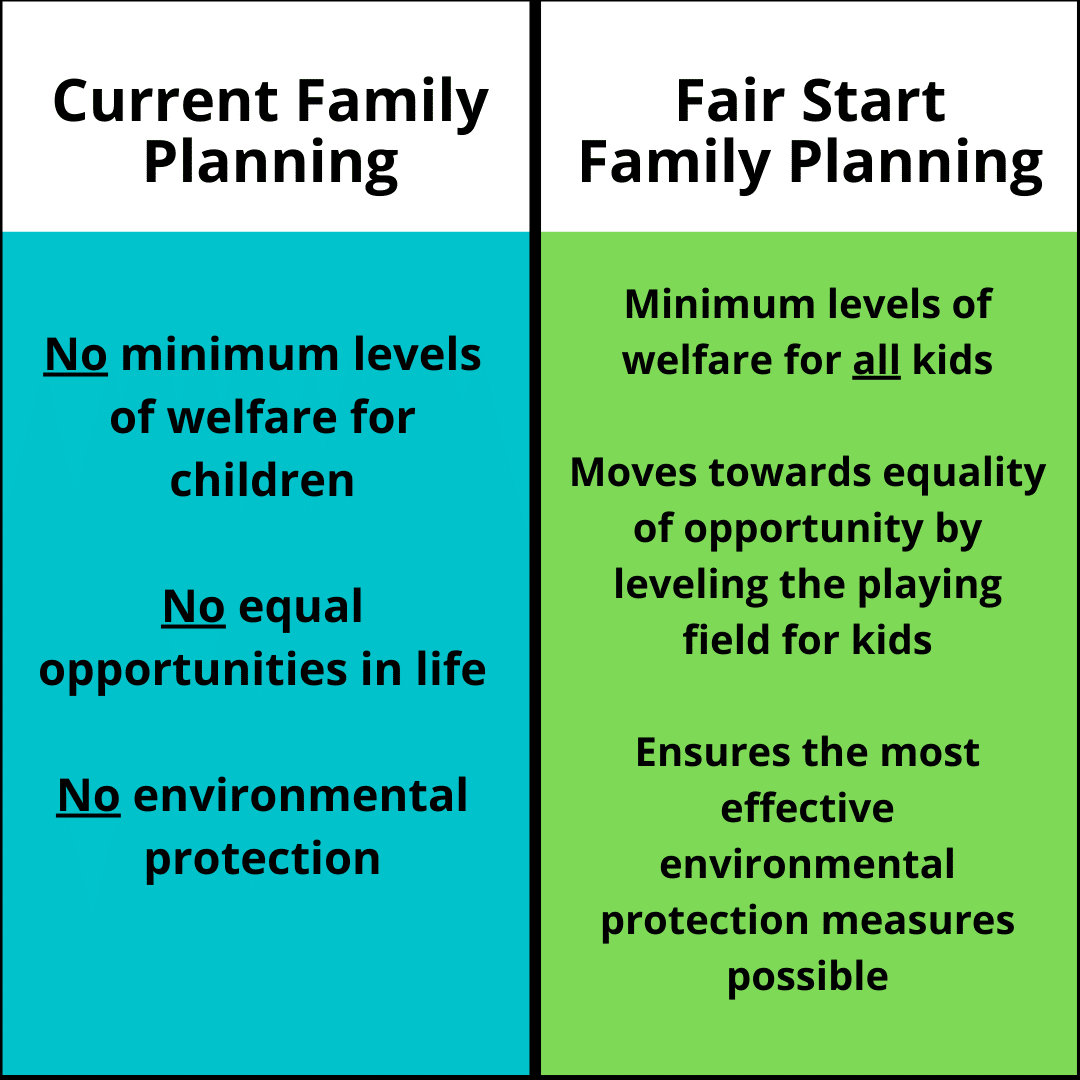
Fair Start Movement’s mission is to replace parent-centric subjective family planning systems with a child-centric model that ensures children are born and raised in conditions consistent – minimally – with the Children’s Rights Convention, a move enabled via effective family planning incentives/entitlements. We partner with organizations around the world, like the wonderful Rejoice Africa Foundation (formerly Kibengo Youth Care Activists), on Fair Start and other initiatives.
Thank you for being a leader in the efforts to assure family planning needs are being met worldwide. Given recent discussions of your foundations possibly funding a world children’s savings bank, if these reports are true, we urge one simple guideline for such a plan. That guideline would correct the baseline error, or the act of trying to assess costs and benefits without orienting from a position of consensual governance, described further below. We urge that the gift recognize that much of the wealth was built on a system of unsustainable growth and illegitimately externalized costs, per one Nobel Laurate, that included billions having and raising children in conditions that did not satisfy the standards children and their parents deserve, the standards that were eventually codified in the Children’s Rights Convention.
Is there evidence that we see children as economic inputs, rather than citizens, and not deserving of minimum levels of welfare, equity, restored ecologies, and an influential voice in their democracies? The ubiquitous bemoaning of falling fertility rates as a “baby bust” economic crisis, with no plans to assure children the things described as various policies are offered to reverse the crisis, is ample proof.
Our work establishing this fundamental baseline for assessing costs and benefits, and the human rights nature of child-centric planning as oriented to protect the vulnerable parties at stake, has been subject to almost half-a-dozen peer reviews. And the claim that a fair start in life logically precedes governmental authority to issue the property rights on which the wealth was built – because we are before we do – seems irrefutable. How could we be self-determining or free in an anthropocentric world dominated by a singularly human-centric viewpoint, rather than a natural or nonhuman one – built into family planning – that allow humans to consent to the power of others? Without that primacy we never constitute fair, or free and equal, societies. We never create the consensual, inclusive, and participatory town halls necessary to actually regulate the wealth-building economies. Free people will condition their political obligations on their capacity, as equals, to change those obligations. Fair Start enables this.
This is our challenge: If your plans are to give as reported, please designate at least part of the funds – by COP 27 – as human rights entitlements designed to move us towards the fundamental baseline discussed above, one which actually complies with the requirements of the international human rights regime. Surely, as things like the threat of climate-driven mass famine in the Horn of Africa unfold, it’s clear that our current, anthropocentric, isolating, and inequitable system of family planning was a terrible mistake. Fair incentives/entitlements, designed to build the town halls that liberate us, could have prevented that. If children deserve the funds, they deserve the efficacy putting the funds into bending the arc of planning and growth would produce through things like allowing delay and preparation, creating changes in family size, ensuring opportunities for co-investment, encouraging relocation etc. If it takes a village to raise a child, it takes a village to plan for one and there is a test for whether we are doing that consistent with human rights and democracy.
The entitlements are not paying for people. They are paying to convert – at the most fundamental or creative level – commercial relations into empowering democratic/normative relations, or the sort of town hall relations needed to regulate the second-order forms of shopping malls. If we value democracy it will be unreasonable for intending parents to refuse the empowering funds, and unreasonable for concentrations of wealth and power to refuse to give them. Whether we are part of groups of free and equal people first depends on whether we correct the baseline error described above (reiterated in the Cairo Consensus which wrongly treats the act of having kids as more self-determining for the parents than other-determining for the children born) and are part of efforts to ensure people are relatively self-determining through collective child-centric planning, or we are not part of such efforts. There is no obligation that can proceed this – becoming a just people.
Legal systems, markets, customs, etc., can only do so much to guide human behavior. The gaps depend on – and in government by the people should depend upon – the circumstances in which we are born and develop and which lead to our emancipation. The value of democracy – the “We the People” – includes the high quality of life sharing the world with people prepared for such systems – with a common core of objective values, prosocial dispositions, high levels of education and equity, etc. – would entail. The antecedent “we,” that proceeds all action, is actually a reference to power relations between people, and between people and their environment, that for self-governing people should arise from birth and development. Collective child-centric planning can get us there, but because group legitimacy derives from individual choice, each person must choose whether they support or reject fundamental fairness and choose to be part of just or unjust systems.
Without this change in entitlements, we risk a future – as the climate crisis deepens – where the system by which we made our wealth does more harm to future generations than our philanthropy can do to help them. We risk choosing not to constitute ourselves as free and equal people. and remaining part of an unjust and exploitative system. Instead, we can follow the lead of others choosing to reorient entitlements, and through that discourse and action, choose to be part of consensual systems of governance.
Thanks for considering, and for your work to date.
A recent court case in Germany begins to recognize that nature, or a restored biodiverse ecology, is inseparable from the concepts of liberal democracy and freedom. Our right to nature is what frees us from the power of others.
So what do we do about that right? There are particular men who have, more than others, violated that right and robbed us and our children of freedom. We can target them to pay what they owe, by all means effective.
To move the wealth he made by helping create the climate crisis into the most effective solution to the crisis would be a coup for freedom. Find and engage him, peacefully and lawfully, to pay what he owes, and we will share your story, and help expand the tactic towards others who are also responsible.
Speaking about an IPCC report, UN Secretary-General Antonio Gutteres revealed “a litany of broken climate promises” by governments and corporations that threaten human lives and will costs governments hundreds of billions to confront. Fossil fuels take the spotlight. But that ignores all other growth driven harms like habitat destruction and water scarcity. We can no longer ignore that the quest endless-growth and profits above all has had catastrophic consequences for all life on our fragile planet. Children have a right to an eco-social fair start. That means restoring nature for the next and future generations. We can do that through Fair Start policies.
In honor of Earth Day 2022, we at the Fair Start Movement encourage ExxonMobil to include every child’s human right to a Fair Start as part of its commitment to meet standards set out in the Paris Agreement.
To the leadership of ExxonMobil,
We members of the Fair Start Movement, on this Earth Day, April 22, 2022, write to inform ExxonMobil of an oversight in your commendable efforts toward sustainability.
You must amend your policy in order to acknowledge the needs and rights of future human generations. Policies that ignore critical factors such as family planning and universal basic human rights will fail. All of us are locked in a global struggle to ensure the existence of our species.
We implore ExxonMobil to take into account the environmental impacts of humankind. Too many children today are born unwanted, into poverty, famine, or war. Our approach to offer a Fair Start to every child born on Earth will ensure that these conditions will be eliminated moving into the future.
We demand that ExxonMobil allocate funds to support restorative ecological policies that acknowledge and actively promote the primary and overriding human right to an ecosocial Fair Start for every child born today and tomorrow.
Fundamental change starts with family policy.
By supporting our and our allies’ initiatives, ExxonMobil will begin to substantively repair damage done by its historical environmental misconduct. You will truly become part of the solution by sustaining and protecting humanity.
Will you commit today, in honor of Earth Day, to right past wrongs? Will you catapult forward the global effort to survive? Will you join our movement’s efforts to ensure every child’s right to a Fair Start?
Earth Day 2022: Exxon Should Pay Reparations for the Climate Crisis That Physically Create Just and Sustainable Communities Through Family Planning Investments
In Exxon’s public commitment to address the climate crisis, the company uses a particular ecological goal or baseline for its risk assessments and climate mitigation strategy that – compliance aside – is at least comparable to the goals of the Paris Climate Accord. While we focus on Exxon in this letter, to be clear, the logic applies to many companies and well beyond the energy sector.
FSM was formed because these goals or baselines are premised on an error. They were developed based on the assumption that nations operate from a place of historical political legitimacy, and can themselves freely define ecological goals, including anthropocentric ones like those of the Paris Accord. That assumption is incorrect. As recent peer-reviewed research shows, nations are constituting, not constituted in the past, and they are either doing so legitimately or not depending on their family policies. Nations cannot simply declare their legitimacy. Legitimacy is a political ideal based relative self-determination that would require, again minimally, that all children enjoy the ecosocial birth and development conditions required by the Children’s Rights Convention.
Resolving this baseline error involves treating legitimacy as contingent on our ongoing fulfillment of our obligations to future generations.
In other words, to properly assess costs and benefits we have to first become groups of people capable of doing so in a way that is actually inclusive and reflective of the group constituents. This is simply the ideal of the “we,” in “We the People.” The ideal political we, meaning fundamental power relations defined by the goals of the Children’s Convention, is the primary baseline. We cannot think of, or describe, an ecological outcome that is not first contingent upon family planning outcomes, on at least five levels.
If we value human self-determination or freedom, we have to begin from an ecocentric – rather than anthropocentric – baseline, because that makes relative self-determination possible, freeing us from the influences of others, including the harmful impacts of even the current rise in global temperature. Humans cannot self-determine when their childhood development is defined by the pollution of others. Moreover, climate goals cannot be limited to ecological outcomes, but should include changes in family policy that maximize the resilience, equity, and democratic cooperability of future generations to thrive despite the crisis. Our creation is the intersection of our values.
In other words, if we correct the error described above, the correct goal or baseline must entail our becoming democratic and legitimate groups of free and equal people, which requires concrete and specific restorative ecological policies much more aggressive than the Paris Accord, redistributive and equalizing family planning reforms that recognize the right to nature and level the playing field for all kids, financially and ecologically. A simple litmus test, given these standards, for our being free and equal persons involves whether we first treat the capacity for each person’s self-determination as directly inverse to population growth, relative to a neutral baseline such as the nonhuman world. This is proof that each person is politically, and equally, empowered. Not treating growth as such calls into question the true role of citizens in their own democracy.
We cannot assign property rights in ways that undercut physically constituting and democratically empowering future generations. Our being, and in this case becoming, positioned to determine costs and benefits in a way that is inclusive of the reasoned views of all, is the first baseline.
Again, we can refer to this helpful summary of the baseline problem. All of the solutions to the problem Professor Solum gives jump to what we should do rather than who we should be, and thus ignore the need to be fair people, in terms of the physical power relations determined by our creation, before we can be positioned/empowered to make fair rules/laws. Ideally we would be created/grouped to look like a functional Rawlsian constitutional convention before fundamentally assessing costs and benefits, hence our being an ideal “We the People,” is the first baseline. And for that, the minimal guidelines that would apply to family planning would be the standards we hold up for extant persons, like parental fitness, the Children’s Convention, equality of opportunity, restoration-based climate sequestration targets, biodiversity restoration targets, historic voter-representative ratios, etc. Those point us towards the UN low-variant population, something aggressive family planning incentives – funded with claims to wealth at the top of the economic pyramid – could practically help achieve.
We are writing in the spirit of Earth Day 2022 to urge Exxon to embrace the specific restorative ecological policies described above as the part of the first and overriding human right to a Fair Start in life, and to commit some share of its wealth and resources as Fair Start planning reparations to offset the harm it has done to future generations, relative to baseline discussed above. Exxon could easily practice this change by supporting the child tax credit reforms linked above, while treating them as a fundamental human right.
This is not about liberal or conservative politics. Family planning redistributions – as primary obligations – can replace wasteful tax obligations that would simply create larger governments which do not reflect the will of the people. This is about a commitment to human freedom and equality of opportunity, enabled by policies that ensure children can develop and physically comprise communities that liberate them from the threats they face today. This is something we all should value. Correcting the baseline error described above enables such a future.
Please let us know if Exxon will commit to these changes.
The following post is contributed by Huggable, whom the team at Having Kids applauds for engaging on complex social issues. Having Kids receives no compensation from Huggable.
Here at Huggable, we applaud Having Kids’ mission to create a better and more equitable world by giving all children the best possible start in life. We also believe that research should inform decision-making about important topics such as family planning, child inequality, and climate change.
Another topic that we are deeply interested in is learning about what makes strong, sustainable families thrive, even when presented with difficult circumstances.
Huggable’s COVID-19 Research Report
To find out how the COVID-19 pandemic has affected families with young children, we recently commissioned a survey of hundreds of families. The results of our research provide not only a glimmer of optimism in the midst of the pandemic’s tragic consequences, but also further evidence of the importance of building stable, sustainable families that thrive when given the right resources and opportunities.
Our findings are based on the insights of 538 parents with children under the age of three, collected in April and May 2020. The vast majority of the respondents were mothers, although a number of fathers also took part in the survey.
Key Takeaways From Our Survey
1. Parents Are Spending More Time With Their Children
Arguably, the most important finding of our research is that parents are spending more time with their children than they did before COVID-19. Specifically, mothers are spending an average of 49% more time with their babies and toddlers, which is an additional 3.9 hours per weekday. The increase was particularly apparent among mothers who work full-time, as they reported a 60% increase in time spent with their children.
Specifically, many parents have found unexpected opportunities to help their children with schoolwork, learn new skills, adopt an exercise routine, and get to know their little ones in a way that just wasn’t possible before the pandemic.
2.Mothers Are Feeling Closer to Their Children
Although COVID-19 has undoubtedly made the multifaceted nature of parenthood even more complex, especially for mothers, many relationships between mothers and children have improved. Notably, 63% of mothers in our survey said they felt either slightly or significantly closer to their children as a result of changes related to COVID-19.
Once again, full-time working mothers have experienced the most significant improvement in their relationships, with 67% reporting that they felt either slightly or significantly closer to their children. Several mothers in our survey noted that they were particularly grateful to have been able to breastfeed their babies and toddlers more regularly, as this has helped them develop closer bonds with their littles ones.
3. Parents and Children Have Found Unexpected Opportunities to Thrive
Despite the anxieties and challenges brought on by COVID-19, we were very pleased to discover that many mothers, fathers, and children are using this time to work together more cohesively as a family unit.
The pandemic has resulted in many families taking stock of what really matters and finding ways to cope even in the midst of financial uncertainty. With families valuing time spent together and avoiding unnecessary trips to crowded places, many parents reported that they have found creative ways to make online shopping faster and easier by using money-saving tools such as Wikibuy.
Additionally, with parents and children spending more time at home, there have been extra opportunities for shared family meals, creative play, and spending time in nature. In our survey, we repeatedly heard about how children have been helping their parents with chores, exploring their own interests, and developing skills such as independence, resilience, and empathy.
We were also pleased to learn that fathers have been sharing in childcare and other household responsibilities more regularly and more equitably. This has been especially valuable for fathers of young children who may have missed out on their children’s earliest developmental milestones.
You can find out more about our findings, and discover other research on how children and families are dealing with the COVID-19 pandemic by reading our full research report.
Despite the continued unsustainable growth, which is the underlying driver of climate change, poverty, and social instability, many media outlets are reporting that women are not having enough kids. This example, from Fortune magazine, is telling. The headline literally misstates a government report’s findings on the subject. Things can be more subtle – like a list of solutions to climate change that omit the most effective one – sustainable families.
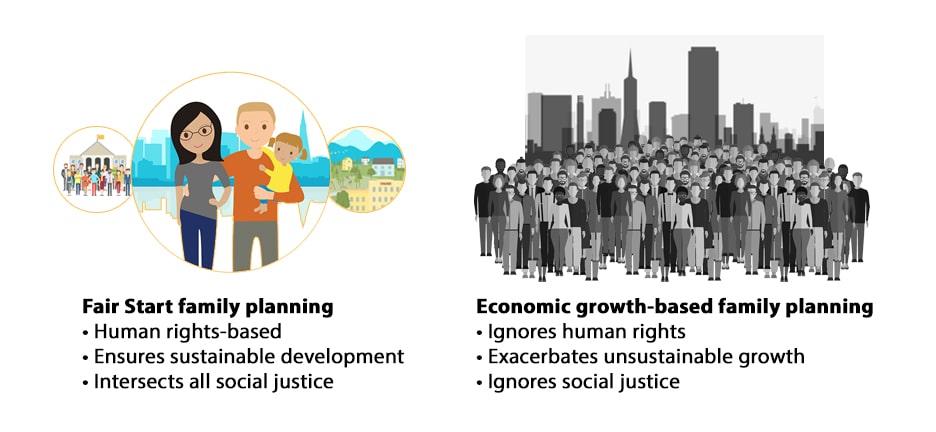
What gives? Modern systems of economic growth were built on population growth – which meant a constant supply of cheap labor, voracious consumers, and compliant taxpayers. Be clear what this means. People pushing arbitrary population growth are pushing for the exacerbation of climate change and other environmental crises, children being born into poverty and unimaginable conditions, and revolution ready-sized gap between rich and poor – because those kids are vital fuel for their growth-backed investments, job security, low tax rates, etc. in an unsustainable pyramid Ponzi scheme. See these people for who they are.
Our Unsustainable Reality
That system of constant growth was never sustainable. That is why we are now faced with the incomparable threat of climate change, crowded cities with unaffordable housing, extreme poverty and inequality. But the people that designed that system left it for future generations to find a better way. Can we?
The Green New Deal
The Green New Deal presents an opportunity. It represents an attempt to address the intersecting issues of environmental crisis and inequality with an ambitious, centralized plan for massive public infrastructure investments and new jobs, all themed around sustainability. Here’s the problem. It does not address family planning.
What’s Missing
How can we address things like climate change and inequality without addressing their underlying driver, and most effective solutions? The Green New Deal also needs to reform our family planning system, and change the focus to ensure sustainable families that work together – yes, transfer significant resources – in order to give every child a fair start in life. The Green New Deal needs to include a transition from parent-focused to child-focused family planning, using something like the Fair Start model. That will mean more effective outcomes, avoiding the inefficiency of centralization and big government, and address a variety of other problems we face today.
We can find a better way, but not without change at the most fundamental level.
Is there a way to make the deal nonpartisan?
Can we use it to eliminate the big businesses that liberals oppose, and big government that conservatives oppose, at the same time? A healthy, safe and natural environment, and an economic system free of big government and big business, one that is comprised of relatively equal players, starts at the same place: With a family planning system that creates a population of highly prepared people, people who got a fair start, and a shot at equal opportunities, in life. Specifically, that means targeting big businesses with an antitrust reform to distribute their market share to future generations, and big government with tax reform to reduce its size, with both reforms designed to fund a cooperative family planning system that maximizes investments in future children, through a variety of mechanisms like delay and relocation incentives, early childhood development programming, and heavy investments in international family planning systems.
Unless the Green New Deal integrates and addresses the source of the problem, it is neither Green nor New. Including family planning reform would integrate the Deal with the overarching and universal human rights regime from which it should derive, a regime that itself derives from the fundamental human right – the right to a fair start in life.
TAKE ACTION: Tweet Rep. Alexandria Ocasio-Cortez and the Sunrise Movement, urging them to include sustainable family planning in the Green New Deal. Copy/paste below into a Tweet.
.@aoc @sunrisemvmt the #GreenNewDeal won’t succeed without a plan to reform #familyplanning to encourage more equitable, sustainable families. It’s the most effective way to reduce inequality AND climate impact. https://fairstartmovement.org/whats-missing-green-new-deal/
Justice begins with the fair creation – or procreation – of power relations, but those at the top of our political systems have historically refused to cede (or “constitute”) their power and influence into future generations.
The Lie
Older generations lied to themselves and others by treating the most interpersonal act – having kids – as a matter personal and private to the parents (often just the father), isolating those parents in the decision-making process from the impact their decision would have on the children born, on our communities and on our world. Families would have no obligation to others’ children, rich or poor. If the state sought to protect children, it would have to wait for them to be harmed.
That isolationism, in family planning, prevented the social contract – which includes the limitation of one person’s power over another, including would-be parents’ power over future children, rich kids’ power into their adulthood over poor kids, humans’ power to overrun the nonhuman world and create a climate crisis where freedom from others’ influence became impossible – from ever forming.
But the act of creating others is more other-determining – for the children born and the societies they will comprise – than self-determining for the parents. The move of older generations, to ignore the impact we have on others, evaded collective obligations to invest in children and preserved and expanded existing power structures via population growth. What appeared to be social justice movements – for equity and the environment – were always being undone upstream by family policies that would eventually bring us to the place of` massive inequality in failing ecosystems in which we live today.
Elites and those they controlled, throughout the Twentieth Century, did not want to pay their fair share to give all kids a fair start in life, a healthy environment, and a meaningful role in their democracies. Instead, they pretended that fortune, or some magical god, simply made it so that some kids were born poor, and others rich. They assumed nature, as a resource, was infinite and growth infinitely sustainable. Elites gave their own children a massive head start in life, contravening basic principles of democracy like the requirement that there be equal opportunities for all.
They made money with policies that prioritized population growth over investing in women in children, turning democracies into massive economies of scale filled with consumers rather than influential citizens, and functional constitutional conventions. Lost in a sea of others elites could exploit, the average person became voiceless, with the choice of what to buy but not to help steer the polity around them. Elites made their wealth by simply evading paying the costs necessary to maintain nations of free people – people free from things like the anthropocentric climate crisis. And they have historically been assisted by media and unethical journalists, as they are today with constant stories of “baby busts” and underpopulation, who shill for their advertisers and the need for more and more consumers.
That is the lie – that the generation of our societies, the base “we” from which all our language proceeds – should be determined by subjective autonomy rather than values and objective justice. That lie preserved fundamentally exploitative power structures and drove the crises causing immense suffering today, and the suffering – of the most vulnerable – that will occur in the future. And those who pushed and are pushing the lie are fundamentally responsible for the outcomes.
They also sought to evade an obvious truth: The obligations we have to future generations come first, and override other obligations, like property rights. Why? Governments derive from people who derive from their creation, so a just creation norm precedes other rules. That norm represents the only opportunity to ensure consensual power relations, from the moment those relations are created. Maintaining an optimal world population range, in terms of the creation and continuation of power relations between people, and between people and their ecologies, is always the first question of ethics because we are before we do. Existential justice precedes and overrides other forms, like property allocation.
We always have to ensure justice, in creation, first.
But instead, under the isolation or privacy paradigm men, and especially rich ones, kept control of their castles. And governments were more than happy to go along with the lie and the subversion of human rights – backed by the excuse of the cold war – as long as they received their cut in taxes, and otherwise benefitted from the growth.
That lie, the idea that what is interpersonal is really personal, fundamentally created the key crises – climate and inequity – we face today by driving the anthropocene over a more ecocentric world, and ensuring the massive inequality we now inherit at birth. It was assisted by religion – if we are made by gods rather than men, then the act is not really interpersonal, or subject to the demands of justice.
The curve represents the opportunity to promote values like child welfare, parental readiness, the restoration of nature, and democracies where each person plays a greater role, or alternatively, to continue to exploit people as consumers, workers, and taxpayers in a world filled with inequity, political voicelessness, and degraded ecologies.
We should choose the former, and arc down.
People are not numbers. They are entities that exert power over one another. We see this when we 1) understand power as any form of human influence (emissions, bad parenting, using language to exclude others, etc.) rather than focusing on the coercive (or official) power of the state, and 2) think about people in terms of their whole life span, including their earliest and most formative years. This is not John Rawls’ intergenerational justice – it’s about creating relatively self-determining people, as discussed below. If there is one condition for rules it is that they be fair, and the rule that creates us is no exception.
If you want to see the lies, join our Tell the Truth campaign and simply urge people and organizations to show you what they were doing to give kids a fair start, ecologically and socially, in the past and how they plan to do it today. Ask them to show the impacts of their family policies – past and present – on things like the climate crisis, inequity, and participatory democracy. Ask them to explain how we can have a just society without fairness, right from the start.
The truth is that no legal system is legitimate and obligatory unless it is comprised of consenting subjects who matter or have an influential role politically, and who thus act as though their capacity for self-determination is inverse to – and balanced against – population growth (which is fundamentally the addition of other sovereign or relatively self-determining people) relative to the absence of human power, or nature. That is the base conception of a social contract – the device that fundamentally makes freedom work. Freedom is the capacity to consent to the influence of others, and as a default, we should not submit to those we do not trust. And with massive power differentials and lack of any common core that proceed from our creation, trust is unreachable.
This is a condition for legitimacy prior to the development of downstream systems – like political representation, markets, or institutions. If power derives from people, is it more accurate to say that we are constituted into a system at some point in the past, through no role of our own, or actively part of a system of constituting physical democracies by taking part in a child-centric system that physically empowers people? Power derives from people who derive from their creation, and if it takes a village to raise a child it takes a village to plan for a child. While things like human rights, representative government, and checks and balances make democracy work, the first and most important device involves the rearing and development of children into people capable of democracy. The way we plan families is blocking this.
It’s hard to make sense of any political or legal system, positive, natural, formal, interpretive or otherwise, without accounting for the creation and development of the people from whom law derives and to whom it should feel obligatory. While we are familiar with forms of social organization like states, corporations, families, and communities, resolving the lie blocking procreative justice opens up the possibility of undiscovered countries of truly consensual obligation – islands of democracy in a sea of nature.
The lie regarding what is personal and interpersonal ensured growth that crippled this process of ensuring consensual governance. The quadrupling of populations in the Twentieth Century fundamentally replaced town halls with shopping malls by converting the possibility of fewer, well-developed citizens whose voices would matter into a mass of disconnected consumers with little influence over their governments, thus disempowering the average person. It ensured the endless greed and self-interest we see today, something Greta Thunberg has noticed, because it robbed people of secure and fulfilling communities that ground people and obviate the need for such things.
The Truth and Resolution
The most just and effective solution to the lie and its horrific impacts is to move the wealth and power that was made through growth – both public and private wealth and power – forward into future generations rather than continue to move it up to the top of the current structure, or what Nobel Laureate Steven Chu called the Ponzi scheme population pyramid.
Just follow where the money that should have gone into investing in future children went by our ignoring their needs and opting for growth.
Dozens of groups are already beginning to move in the direction of just and sustainable families – and it looks like this. The kind of freedom these groups are building is true freedom – e.g., not the fake “I’m alone in the world” freedom to choose to wear or not wear a mask in the middle of a raging pandemic, but the intricate freedom represented by a fundamental state of affairs where any pandemics would have been substantially avoided or mitigated. This move – just and sustainable family planning – has the biggest long run impact by far. It also solves the dilemma at the heart of democracy, aligning 1) just or right outcomes with 2) popularity, by investing more in and developing each person. Through development we come together around truth. There are legitimate economies without democracies preceding them, which means our family policies must create citizens and not consumers. We can ensure that – the first condition of justice – by all means effective.
There is a simple test for whether someone is part of this fix, and really accounting for freedom and justice, that involves looking at their language (much the way we look for binary gender mistakes in pronouns today). How? Ask anyone making claims about policies to define the people – the fundamental social organization – at the base of their claims, e. g. “tell me about the justifiable group that is making and implementing the policy you are discussing, in terms of basic values like the welfare, equity, ecological conditions, and effective roles in their democracy, both now and in the future,” and “tell me how they are consenting to the influence of others.” Ask them to unpack their claims in light of the open multiplier they are using, and the impact of that multiplier on child welfare, equity, nature and participatory democracy. Do they even have an intention for fundamental justice? How do they assess market costs and benefits without the primary baseline of a functional constitutional convention – or democracy – from which to do so?
Do the people in question act as though population growth is inverse to one’s capacity for self-determination, relative to nature or a zero-power baseline? Groups of relatively self-determining people are bordered by the absence of human power (nature, or the absence of being determined by others, which makes consent to power possible), accept loss of pure self-determination as they grow in number, but seek to divide and create new groups to maintain the relative power of each individual. This is the fundamental equation of free and equal people, one test for which will be the presence of fluid – not fixed – political borders defined by people and not arbitrary lines.
This is not mere theory – this is what might be beginning to happen in places Catalan, against the will of autocrats like Donald Trump. This is what optimal world populations – using a base value of freedom – might begin to look like, and where people would matter politically rather than trying to matter by literally imitating figures in the advertising we were raised on as is the case in social media today. Free polities are formed through the rule that meets the basic test for all rules – one that is fair. And in the case of any truly first rule, it can’t be practical or even interpretive, but must be existential in nature. It must be a rule – God notwithstanding – about who we should be.
In other words, do the people making policy claims act as though people matter politically, and do they seek to empower the majority – future generations (which make the idea of population more normative than descriptive) – through family planning reforms that limit and decentralize (or reconstitute) the power each of us have over one another such that we reach qualitative optimal populations? If it takes a village to raise kids, it takes a village to plan for them – for the phase of entry into society, from their creation to their emancipation. If we want relatively autonomous families, where vulnerable entities like the poor, women, and children share in the autonomy, we have to plan for and create them as such and not pretend autonomy will magically appear.
As a practical matter, do the claimants support a discourse where every child’s right to an ecosocial Fair Start in life overrides property rights? To constitute – politically – is to transfer power in a way that ensures the capacity for relative self-determination. It’s about making power flow bottom up, rather than top down and based on coercion, as it does today. Are the claimants willing to make that transfer of power, a sort of “first tax” that pays for existential justice? If they are not, they are putting property and things over people, rejecting the relative self-determination of peoples, and are choosing to remain part of fundamentally unjust systems. In other words, are they part of – or opposed to – constituting just societies comprised of democracies where voices of the people are heard and matter? If not, the people in question are preconstitutional, or “precons.” They cannot account for any form of justice because they cannot account for how people – the majority – will fit into those forms. They cannot account for “constituting” or the physical limitation and decentralization of power, regardless of its form. To the extent they are intending parents they would be unwilling to empower their children and may not be ready to parent. In other words, hey are insufficiently other-regarding to constitute just societies.
Urge them to change course and help us liberate the majority of entities – those who will live in the future (both human and nonhuman) – by supporting our action before the UN Human Rights Council. We begin legitimacy by through the physical conditions that make social obligations genuinely reflective of the people subject to them.
Take action:
We can use the values that free us to physically define our species. Click here for dozens of ways to take action to support true freedom for the majority, starting by engaging in the direct action discourse that puts people over property, and which helps us act against concentrations of wealth and power in ways the liberate and decolonize the future.Putting human rights, like Fair Start, before governmental processes will feel infeasible because we have lived in a world filed with people who did not get a fair start in life. We can change that.
——————
Carter is author of Justice as a Fair Start in Life, works to resolve the constitutive fallacy, or the mistake of attempting to practice any form of freedom and/or justice without first ensuring the same in the dynamic creation – or procreation – of human power relations. Simply put, those that do not promote procreative justice can never orient from a just place or prioritize the needs of the future majoirty, while many have begun to move in the direction of actually doing so and physically constituting – via just power relations – free and equal societies.
Carter began his career as an Honors Program appointee to the U.S. Department of Justice. He later served as a legal adviser to the U.S. Department of Homeland Security, in the national security law division. He wrote his thesis reformulating the right to have children under Jeremy Waldron, his extensive academic work on family planning has been published by Yale, Duke, and Northwestern Universities, as well as in peer-reviewed pieces, and he has served on the Steering Committee of the Population Ethics and Policy Research Project and was a Visiting Scholar at the Uehiro Center, both at the University of Oxford. He has taught at several law schools in the U.S., served as a peer reviewer for the journal Bioethics, and most recently managed an animal protection strategic impact litigation program, with annual resources in excess of five million dollars. As early as 2007 his work provided a sufficient human rights basis for policy changes that could have significantly mitigated the climate, inequity and other crises we now face, and with the Fair Start Movement, Carter now works to hold those blocking the reforms – including those creating noise through self-serving ineffective reforms – responsible for the harm they caused.
Kudos to Inside Climate News for covering a topic many are hiding from: The fact that many benefitted from a clearly unsustainable family planning system that hurt future generations, and how to take wealth from the top to now compensate them.
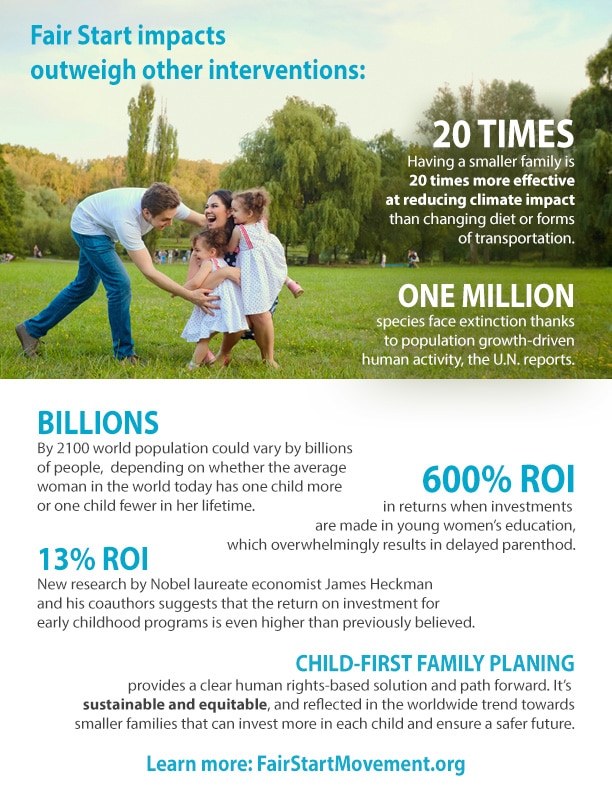
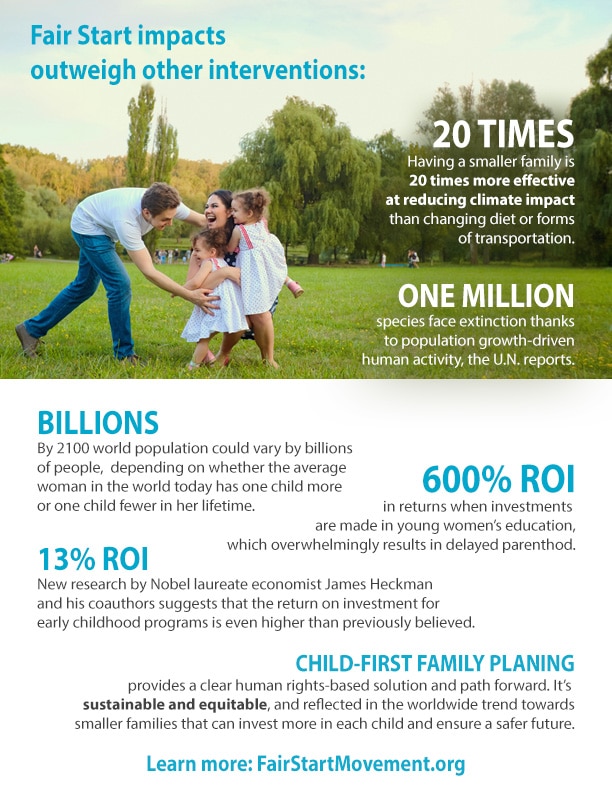
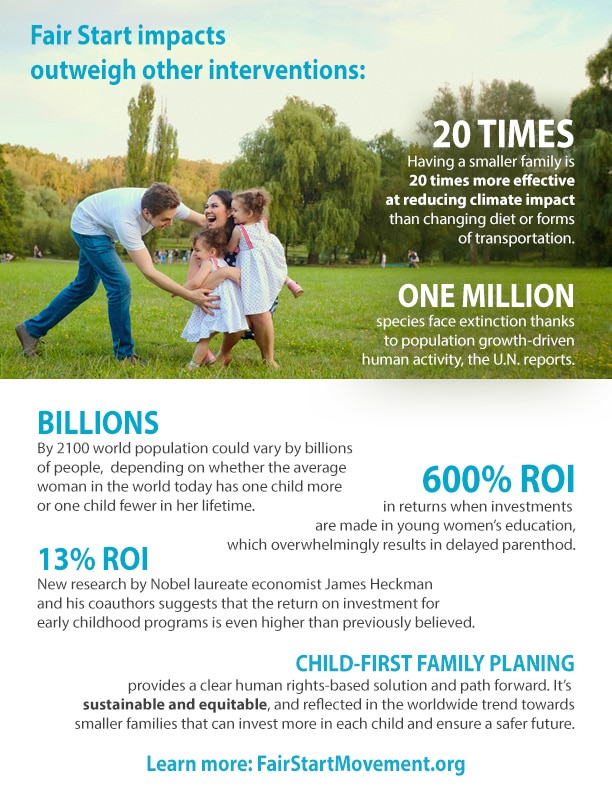
13%: New research by Nobel laureate economist James Heckman and his coauthors suggests that, after accounting more accurately for long-term health and other benefits, the return on investment for early childhood programs is even higher than previously believed, at 13 percent rather than 7-10 percent.
1 MILLION SPECIES face extinction thanks to unsustainable growth-driven human activity, the U.N. reports.