Category: Children’s Rights

  • A Respectful, Productive Discussion, or Cheap Jokes?

    A Respectful, Productive Discussion, or Cheap Jokes?

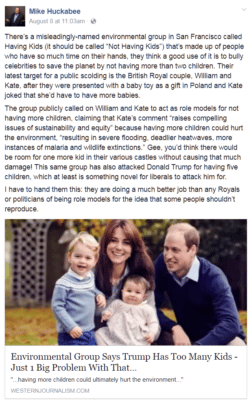
    Having Kids’ Open Letter to Prince William and Kate Middleton has attracted a great deal of attention from around the world, with over 50 media outlets picking it up so far.A Facebook post by Mike Huckabee includes a photo of Prince William and Kate Middleton smiling with their two young children, accompanied by a headline about an environmental group criticizing Trump for having too many kids.

    Instead of discussing the many pressing topics raised in the letter – including the threat the UK faces from climate change, and how family planning is the single most powerful step we can take to address the climate crisis (more) – former Arkansas governor Mike Huckabee took to Facebook to imply that I and Having Kids’ Director of Operations should not have reproduced, thus contending that our child shouldn’t exist.

    Mr. Huckabee’s attack on my family is obviously an irrelevant cheap joke to play to his fan base. What is more disturbing, though, is how Mr. Huckabee’s snide attack is symptomatic of the head-in-the-sand attitude that ignores all the challenges humanity faces, now and in the future. These challenges include not only environmental degradation, but also rising inequality.

    Our single question to our critics is: Do you think every child born today will have an equal and fair start in life?

    Do you think Hillary Clinton’s and Donald Trump’s grandchildren have the same opportunities as those born in Muñiz, TX?

    My husband and I realize, compared to the majority of other children in the US and around the world, our child was born with many advantages. That is why we are dedicating much of our time and resources to helping others, rather than simply pursuing our personal short-term interests.

    Instead of attacking and mocking people dedicated to making the world a better place for all, maybe we should reconsider our tone and tactics. We can each help more children have a Fair Start. We hope Mr. Huckabee agrees. Regardless, we hope you will be a part of this work. Thanks!

    –Anne

  • The Times on Etiquette around Childlessness: A Better Option?

    The Times on Etiquette around Childlessness: A Better Option?

    The title of Anna Goldfarb’s New York Times piece (“What to Say When People Ask Why You Aren’t Having Children,” August 8, 2017) implies that she’s embarking on an examination of the ethics of procreation. But instead, she repeats the trite mantra you’ll hear on trash television and at the grocery check-out: Family planning is only about personal fulfillment, and is a highly personal topic that should be considered off limits for discussion.

    That mantra is simply false. People forgo having children for many altruistic reasons: to protect the environment, restore biodiversity, to retain time and money in order to do public interest work, etc. All of our decisions about having kids profoundly impacts others – that’s the whole point. If we care at all about the future, then we all have a stake in family planning decisions. The topic is inherently interpersonal.

    Why would publicly thinking about our collective future be considered off limits?

    The topic is inherently interpersonal, starting – obviously – with the potential child. Rather than trying to close public forums, why not seek common ground? Specifically, why don’t we have a discussion about what future we want? Why not collectively plan an escape from our current crowded, polluted, divided, unequal, and relatively uneducated world?

    Beyond the Isolationist View

    Goldfarb’s article rides upon the isolation model of family planning. This model focuses only on what parents want in the short term, rather than on what children and society need in the medium and long term. Isolationist views break the link between vital needs and available resources, and ignore the fact that having children is the most public thing most people will ever do.

    Furthermore, the isolation model completely disregards the fact that children are born entirely vulnerable, dependent on the people around them. By focusing only on the parents’ wants, rather than the child’s needs, we have created a society where children are not guaranteed a minimum level of well-being. Arguing that having children is a private matter also eliminated the opportunity for parents to cooperate in their decision making to achieve the best outcomes for every child. Because of the lack of organized, collective action dictated by the isolationist model, the caring and thoughtful people who forgo having children don’t have as great an impact as would otherwise be possible.

    In short, the isolation view harms everyone’s future and denies many children a fair start in life – a deprivation that tends to pass down over the generations. The Fair Star model breaks that cycle.


  • From a Having Kids member. . .

    From a Having Kids member. . .

    Granted, our leadership pulled out of the Paris Agreement, but we can all still make decisions to protect the planet and each other. We can do better than our failing government. We live in a different era than our parents, in that we are now presented data regarding climate change and the carbon footprint of humans, especially those in developed nations. If one accepts the data, the decision to come up with a new plan doesn’t seem so absurd. There is a knee-jerk reaction to the Fair Start model, but if we can get past that, the model helps open us up to think about more factors than previous generations may have.

    Personally, I currently have no kids. I have been part of Plan International USA (not affiliated with HK) for nine years, where I provide monthly donations to a community and hear back from the Plan-sponsored child. The first child was in Cambodia and the current child is in the Philippines. It’s rewarding to hear about community improvements, from latrines to school supplies.

    The success of family planning can be seen in nations like Thailand, where the population has remained at a steady level for decades and its citizens have enjoyed greater access to federally-funded healthcare and education than some of its neighbors. Also, per capita income has nearly doubled since 1971, when the policy officially launched. 

    So long as the methods are noncoercive, I don’t see a downside to the Fair Start model. On the contrary, as the White Paper (draft) articulates so well, there are many upsides at the micro and macro levels.

    About the Fair Start model:

    Today many families are adopting the Fair Start family planning model. First, they try to give their child a fair start in life by having a smaller family where they can invest more in their child. Often they also foster or adopt one of the many children eagerly waiting for parents. Second, they a public role model of these choices. Finally, these families join public advocacy campaigns to shift resources from extractive centers of power like governments, corporations, and wealthy families in order to democratically empower children and future citizens by incentivizing better family planning by all parents. Why? All parents know that the quality of their own child’s life will depend on the decisions of other parents regarding having and raising kids.

    By using the Fair Start model as a guide, families are simply saying this: “If you plan a smaller family with more investment in each child, we’ll do the same. We’ll also help each other, whenever we can, to make sure all our kids get a fair start in life.”

    In the long term, Fair Start family planning is the best way to promote human rights and build resilient populations that can thrive in future environments. Studies also suggest it is the most effective way to improve child welfare, create equity, and protect animals and the environment, all at the same time. It’s the key to the future we want.

  • Why Write the Royals? A Thinking Person’s Guide to Family Planning

    Why Write the Royals? A Thinking Person’s Guide to Family Planning

    Having Kids recently wrote an open letter to Prince William and Kate Middleton to ask them to consider the Fair Start model in deciding whether to have more kids. The reaction of many proves that we need a public discussion of family planning, and we need it now.

    Much of the reaction to our letter fell into these categories:  

    1) Racist and eugenicist rants about why white and wealthy couples should have lots of kids to compete with birth rates in parts of the Southern Hemisphere. It’s hard to think of a more immoral or lose-lose proposition.

    2) Commentators who think royal family size shouldn’t be of interest to those from other countries. This ignores the global nature of climate change, which does not recognize antiquated national borders. Having Kids has been vocal against Mr. Trump, father of five, on these issues. And our points are equally and obviously applicable to any public figure – wherever they may be – pushing unsustainable families. It’s cognitive dissonance to say that choices which so profoundly affect our world are none of our business.

    3) Bloggers who seem creepily obsessed with celebrity babies, and who would subject the rest of us and our kids to a hotter and more crowded world so they can gawk at other people’s newborns. This seems almost too hard to believe, which explains why the blogs are sponsored by companies that sell baby products. These bloggers will have to tell their children, on one of the hotter days in the future, that they were more interested in the royal offsprings’ clothing than the degradation of the world’s atmosphere.

    4) Some asked why we didn’t write to enormous and less admirable families like the Duggars? The simple answer is that we did. But given the massive swings in population that even small changes to a typical worldwide fertility rate of 2.5 would create, the question of role modeling is best raised in the context of couples considering a second or third child rather than marginal families like the Duggars.

    5) Those who feel the right to have children is totally unlimited, and should not be publicly discussed. The fact is that bioethicists and legal scholars have obliterated all arguments for such a right, and instead shown that the right to have children is more akin to the right to speak freely, which is limited in a way that protects others’ rights. Governments have simply not acted because they benefit from growth, and continue to shuffle the problem off on future generations.

    At the core of the responses, however, was this message: Focus instead on would-be parents who won’t be able to give their kids a fair start in life. That is exactly our point.

    Within our current family planning models, there is no medium in which to have this discussion. Prince William and Kate can’t tell massive and irresponsible families to act responsibly while they ratchet up their family size, claiming their right to do so as a matter of personal privacy. We need a child-centered model that focuses on what all children need, as well as what parents want. We need publicly influential people to break the taboo, step forward and say “I gave my kid a great start in life and tried to protect their future and environment. For my own and your kids’ benefit, I want to help you do the same.”

    That is why we wrote to Prince William and Kate. Their leadership could be an effective way to build a better future by breaking the taboo and setting a new and crucial trend of public family planning. They can break that which keeps us paralyzed in the face of threats like climate change. That is what our letter asked them to consider. It’s not about altruism or charity. It’s about working together to help the actual people who will comprise the future, our future. Many in the past have given their lives to protect this world from various threats. The least we can do is plan our families in a responsible and sustainable manner.

    Our environment is degrading, the gap between rich and poor widens, and children are being born into worlds of unfathomable suffering. We can find the cause in large part in a family planning model that privatizes having kids and prevents vital social cooperation.. Having Kids asks you to change this, and join the discussion about child-centered family planning at Havingkids.org

  • Having Kids urges Prince William and Kate Middleton to consider a smaller family

    Having Kids urges Prince William and Kate Middleton to consider a smaller family

    Today Having Kids sent a letter to Prince William and Kate Middleton, respectfully urging the royal couple to lead by example and consider forgoing having a third child (as they intimated they might). The letter also suggested the couple might use the opportunity to highlight the importance of family planning and to work with other families to plan better starts in life for their children.

    The British royal family sets an extremely influential example in everything they do. Many studies also show that public figures serve as especially effective role models when it comes to family planning. As much-loved public figures, William and Kate have a unique capability to model a sustainable small family, and Having Kids would love to see them do so.

    Recently, scientists like those involved in the highly-publicized study from Lund University in Sweden have confirmed that the best way to reduce climate change is to have fewer children. “William and Kate have a tremendous opportunity to model their choice of a smaller family. In doing so, they would set a powerful example of mitigating climate change and its impacts, including impacts on the United Kingdom like severe flooding, deadlier heatwaves, increase in diseases, and wildlife extinctions,” said Having Kids Executive Director Anne Green.

    “Moreover, given the vast economic inequalities in the world today, the couple also has the opportunity to model a simple principle: Every child deserves a fair start in life,” said Green.

    The letter also calls upon the couple to consider using some of the resources that would have gone into the cost of a third child to help other couples plan a better start in life for their own children. Few children will have the advantages and opportunities in life Prince George and Princess Charlotte have, but we can start to close that gap with better family planning.

    At Having Kids:

    We promote and protect every child’s right to a fair start in life by replacing unsustainable, parent-centered family planning models with the human rights-based and child-centered Fair Start family planning model. The model suggests a shift in family planning from a subjective focus on just the parents, to an objective focus that considers the interests of the potential child, the parents, and the community.

    It’s all about this: Smaller families working together to give every child a fair start in life.

    Today many families are adopting the Fair Start family planning model. First, they try to give their child a fair start in life by having a smaller family where they can invest more in their child. Often they also foster or adopt one of the many children eagerly waiting for parents rather than creating additional need. Second, they publicly role model their choices. Finally, these families join public advocacy campaigns to shift resources from extractive centers of power like governments, corporations, and wealthy families in order to democratically empower children and future citizens by incentivizing better family planning by all parents. Why? All parents know that the quality of their own child’s life will depend on how other parents decide to have and raise their kids.
  • Family Planning: Scare Tactics or Shared Values?

    Family Planning: Scare Tactics or Shared Values?

    Some critics have gone apoplectic over recent calls to reconsider family planning models in light of the overwhelming impact large families have on climate change. The tactic these reactionaries use is old and obvious: Divide the world into Us versus Them, Left versus Right.

    Tenuous and even absurd analogies try to create fear, like comparing family planning to killing extant people. For example: “Or maybe we should get down to business right away and begin by eliminating all of the ‘extra’ people currently milling about the globe, taxing the earth’s precious resources with their costly carbon dioxide emissions.”

    Those opposed to even discussing changing the way we plan families often think about population from a different perspective: the impact family planning has on investments under an economic model where babies serve big business.

    Instead of pushing women to have kids just to keep the investor class rich, we can and should focus on our shared values:

    • You value children’s wellbeing and care about the conditions into which they are born and will grow up.
    • You value democracy and you participate in the democratic process of deciding, as a community, the rules under which you will live.
    • You value nature and you are concerned about your impact on the environment.

    Wellbeing, democracy, and nature are things we all value enough to act on. We won’t be divided into Left and Right. We won’t be scared by boogeyman stories in a ploy to keep us from protecting and furthering those values.

    These families
    are like you and me. They care about kids, community, and nature. Together, we are building a world that can benefit all. Join us and help make the future better than today. Please learn more at HavingKids.org.

    At Having Kids:

    We promote and protect every child’s right to a fair start in life by replacing unsustainable, parent-centered family planning models with the human rights-based and child-centered Fair Start family planning model. The model suggests a shift in family planning from a subjective focus on just the parents, to an objective focus that considers the interests of the potential child, the parents, and the community.

    It’s all about this: Smaller families working together to give every child a fair start in life.

    Today many families are adopting the Fair Start family planning model. First, they try to give their child a fair start in life by having a smaller family where they can invest more in their child. Often they also foster or adopt one of the many children eagerly waiting for parents rather than creating additional need. Second, they publicly role model their choices. Finally, these families join public advocacy campaigns to shift resources from extractive centers of power like governments, corporations, and wealthy families in order to democratically empower children and future citizens by incentivizing better family planning by all parents. Why? All parents know that the quality of their own child’s life will depend on how other parents decide to have and raise their kids.
     

  • World Population Day: It’s Time to Admit Our Current Approach Isn’t Working

    World Population Day: It’s Time to Admit Our Current Approach Isn’t Working

    Read news about family planning and population – especially stories coming out around today’s World Population Day – and you might notice something: We all seem to recognize that our future depends on getting family planning right, but there is no agreement on what that means.

    Conservative media continue to push women to have more children, arguing that women in the U.S. should have more babies and sooner, despite the fact that the average person in the U.S. is much more environmentally destructive than the average person in other countries. That’s a shocking position for family-loving conservatives to take, given that those children will suffer the most in the degraded environment of the future. These voices are more subtle than some of the blatant racism that underlies the “bigger white families” approach.

    Mainstream and more liberal media continue to parrot the tired message that population problems are all about the developing world and Africa in particular. They claim we must simply educate young girls and provide more access to contraception and reproductive health services to make it all better. That’s also shocking, given the results of this approach, its failure to establish targets based on sustainability, and the way this approach – like the conservatives’ – has pushed the problem of growth onto future generations. This also ignores the needs of nonhumans and thereby ensures their extinction, putting the nonsensical right of people like the Duggar family to have umpteen kids above the right of entire species to survive.

    While commentators debate from opposite sides of the room, those living with the reality of the population explosion are now moving towards direct forms of population control, something no really wants but may see as necessary given the failure of family planning systems.

    This is chaos.

    And chaos, when it comes to the one behavior that most determines our future, is terrifying. What’s an alternative? It may lie in an opinion piece that came out today. The piece was focused on what David Brooks called pediacracy, how birth positioning determines the economic class in which we will spend our lives. Brooks argues that pediacracy is ruining America.

    What does this have to do with population? The entire system of human rights and democracy begins with a narrative from the 17th century and continues through the adoption of the Universal Declaration of Human Rights some 400 years later, about free and equal people coming together to make their own rules to live by. What if we took that story literally, so that all would-be parents had to work together to ensure all children of that particular generation and community got a fair start in life, with opportunities equalized between rich and poor? What do you think would happen to fertility rates?

    It’s time to change our approach to family planning.

    Having Kids promotes the Fair Start model. Both liberals and conservatives should embrace this approach. It is one way to address the immediate and universal problem of unsustainable growth.

    At Having Kids:

    We promote and protect every child’s right to a fair start in life by replacing unsustainable, parent-centered family planning models with the human rights-based and child-centered Fair Start family planning model. The model suggests a shift in family planning from a subjective focus on just the parents, to an objective focus that considers the interests of the potential child, the parents, and the community.

    It’s all about this: Smaller families working together to give every child a fair start in life.

    Today many families are adopting the Fair Start family planning model. First, they try to give their child a fair start in life by having a smaller family where they can invest more in their child. Often they also foster or adopt one of the many children eagerly waiting for parents rather than creating additional need. Second, they publicly role model their choices. Finally, these families join public advocacy campaigns to shift resources from extractive centers of power like governments, corporations, and wealthy families in order to democratically empower children and future citizens by incentivizing better family planning by all parents. Why? All parents know that the quality of their own child’s life will depend on how other parents decide to have and raise their kids.

  • Building a Better Future Should Never be Taboo

    Building a Better Future Should Never be Taboo

    [et_pb_section bb_built=”1″ admin_label=”section”][et_pb_row admin_label=”row”][et_pb_column type=”4_4″][et_pb_text admin_label=”Post Text” background_layout=”light” text_orientation=”left” use_border_color=”off” border_color=”#ffffff” border_style=”solid”]

    This family wants to join the Featured Families at Having Kids but is afraid of backlash from friends and family. This family will therefore remain anonymous.

    How did talking about our decision to build a better future become taboo?

    We strongly believe in small, nurturing families, but we have been reluctant to speak publicly about this issue out of a fear that we would offend one or more of our family or friends. We have a number of friends, both older and around our age (30s-40s) who have chosen to have larger families. On other issues, these folks are thoughtful and conscientious, but the question of how many kids to have is something that they view as uniquely personal and outside the realm of fair debate or discussion. It is very difficult to talk to someone you love about how you wish they were not having a third or fourth kid.

    As for us, keeping our family small has always been a priority. We are both busy professionals and our time and money can only be spread so far. With a smaller family we have money for travel, cultural events, and other fun outings that simply would not be possible if we had more kids. With a smaller family we can travel and visit grandparents and all comfortably fit in their home for holidays. And with a smaller family, both of us are able to engage in a considerable amount of pro bono public service work. We spend hundreds of hours per year doing volunteer work for our communities and for non-profits, and this would not be possible if we had a larger family.

    If more families make choices like this, the world will become a healthier and happier place. Let’s break the taboo and speak out. Good family planning means smaller families working together to plan a fair start in life for every child.

    At Having Kids:

    We promote and protect every child’s right to a fair start in life by replacing unsustainable, parent-centered family planning models with the human rights-based and child-centered Fair Start family planning model. The model suggests a shift in family planning from a subjective focus on just the parents, to an objective focus that considers the interests of the potential child, the parents, and the community.

    It’s all about this: Smaller families working together to give every child a fair start in life.

    Today many families are adopting the Fair Start family planning model. First, they try to give their child a fair start in life by having a smaller family where they can invest more in their child. Often they also foster or adopt one of the many children eagerly waiting for parents rather than creating additional need. Second, they publicly role model their choices. Finally, these families join public advocacy campaigns to shift resources from extractive centers of power like governments, corporations, and wealthy families in order to democratically empower children and future citizens by incentivizing better family planning by all parents. Why? All parents know that the quality of their own child’s life will depend on how other parents decide to have and raise their kids.

    [/et_pb_text][et_pb_cta admin_label=”Action Button” button_url=”https://fairstartmovement.org/model/” url_new_window=”off” button_text=”Learn More” use_background_color=”off” background_color=”#18aacc” background_layout=”dark” text_orientation=”left” use_border_color=”off” border_color=”#ffffff” border_style=”solid” custom_button=”on” button_letter_spacing=”0″ button_use_icon=”on” button_icon_placement=”right” button_on_hover=”on” button_letter_spacing_hover=”0″ saved_tabs=”all” button_bg_color=”#ea593c” button_border_color=”#ffac9b” button_font=”|||on|” button_icon=”%%20%%” button_bg_color_hover=”rgba(234,89,60,0.8)” /][/et_pb_column][/et_pb_row][/et_pb_section]

  • Featured Families Form Community!

    Featured Families Form Community!

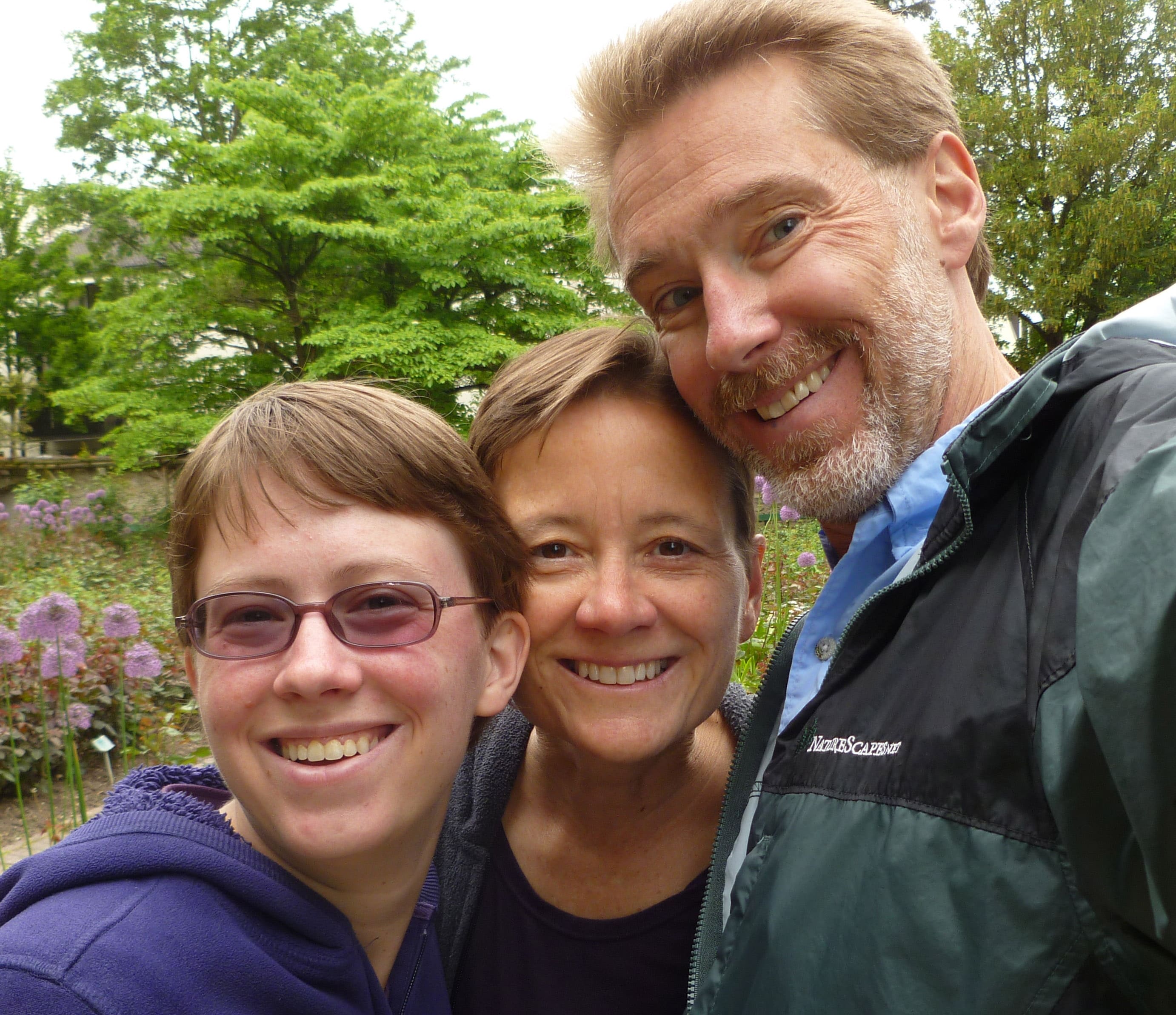
    We are grateful to the Having Kids families that shared their stories of how they are giving their children a fair start. By having a small family, they can invest more in each child, use extra resources to help others, and make a better future for all. These stories are the beginning of a larger community where parents lead by example. If you care about your children’s future, join us at fairstartmovement.org.

    –Anne (center in the picture above)

    At Having Kids:

    We promote and protect every child’s right to a fair start in life by replacing unsustainable, parent-centered family planning models with the human rights-based and child-centered Fair Start family planning model. The model suggests a shift in family planning from a subjective focus on just the parents, to an objective focus that considers the interests of the potential child, the parents, and the community.

    It’s all about this: Smaller families working together to give every child a fair start in life.

    Today many families are adopting the Fair Start family planning model. First, they try to give their child a fair start in life by having a smaller family where they can invest more in their child. Often they also foster or adopt one of the many children eagerly waiting for parents rather than creating additional need. Second, they publicly role model their choices. Finally, these families join public advocacy campaigns to shift resources from extractive centers of power like governments, corporations, and wealthy families in order to democratically empower children and future citizens by incentivizing better family planning by all parents. Why? All parents know that the quality of their own child’s life will depend on how other parents decide to have and raise their kids.