Category: Children’s Rights

  • The Most Fundamental and Effective Social Justice Reform Possible

    The Most Fundamental and Effective Social Justice Reform Possible

    The right to have children comes with responsibilities on parents and their communities that protect us all. The United Nations is using a decades-old pro-growth family planning model that ignores those responsibilities and hurts kids. That model is fundamentally driving ecological crises and the climate crisis, child poverty, and growing inequity across the globe. That model exacerbates the risk and impact of pandemics, and prevents our reaching the U.N.’s Sustainable Development Goals. That non-inclusive model exploits children more than it invests in them, thereby driving political illegitimacy.

    But groups and individuals from around the world are signing on to an effort to change the old model, which is focused on what parents want, toward a new model that focuses on what all kids need.

    The new model is called Fair Start family planning, and it is the beginning of real social justice. The reform can begin with the United Nations secretary general simply acknowledging the need for change.

    Sign on, and urge any organization you support or can influence — nonprofit or for profit — to also sign on. Sign here or contact us at info@fairstartmovement.org for more information.

    Help support this effort and you support new family planning policies that can reduce poverty and inequity, and mitigate the climate and other ecological crises, on a scale of 10 to 20 times non-family planning measures.  

  • Ecological Destruction Starts With Poor Family Planning. Take Action.

    Ecological Destruction Starts With Poor Family Planning. Take Action.

    This video was recently shared by a supporter:

    THE FACTS ARE CLEAR:

    • The most effective way to address many of the impacts on our environment and other species, such as climate change, is to choose smaller families. In fact, it’s 20 times more effective than changing diet or forms of transportation.  
    • By 2100, world population could vary by billions of people, depending on whether the average woman in the world today has one child more or one child fewer in her lifetime.
    • Child-first family planning provides a clear human rights-based solution and path forward. It’s sustainable and equitable, and it’s reflected in the worldwide trend toward smaller families that can invest more in each child and ensure a safer future.

    TAKE ACTION:

    Urge the United Nations to do what it was created to do: protect all of our futures by adopting Fair Start family planning policies: https://secure.everyaction.com/gZiWOydZ_0m7kxrlfD5OjQ2

    Urge any charities you support to commit to better family planning policies. which are the most effective way to protect kids, animals, the environment, and democracy: https://fairstartmovement.org/organizations-joining-for-world-population-day-at-the-u-n/

  • Pandemic Parenting: How Did We Get Here?

    Pandemic Parenting: How Did We Get Here?

    Parents and their kids are suffering under the weight of the Covid-19 pandemic. A recent study shows significant declines in mental well-being for families with children as the quarantines drag on and other crises loom.

    What went wrong?

    Our family planning policies, cultural attitudes, corporate advertising, and other factors have historically pushed women to have kids, often before they’re ready, in order grow the economy. These forces not only created overcrowded and unhealthy conditions that helped the pandemic spread and created ecological impacts such as the climate crisis that are setting the stage for the next pandemic.

    Who created such policies? Elites at the top of the economic pyramid made these policies to ensure big business a constant stream of cheap labor and hungry consumers. Politicians went along because more taxpayers meant bigger government. The people who pushed population growth, instead of human rights-based policies, are responsible for much the suffering we are experiencing today.

    It’s time to turn the tables.

    We have a right to the wealth and resources being hoarded by companies, rich families, and bloated governments — those with disproportionate power who are blocking real democracy. That money belongs to us. The best way to use this wealth would be to reverse the unsustainable growth paradigm and replace it with policies that move us toward 1) parental readiness, 2) ensuring every child a fair start in life, and 3) smaller and more sustainable families.

    Take action: Urge Congress to reverse the exploitation of families and to instead embrace Fair Start family planning.

  • New Survey: Education on Family Size and Population Growth

    New Survey: Education on Family Size and Population Growth

    Having Kids recently surveyed 376 people regarding their understanding of family size and population growth.

    • A significant number of people correctly see a relationship between family size and human population. About 86% of respondents answered affirmatively when asked whether there is a relationship between the number of children a couple decides to have and human population.
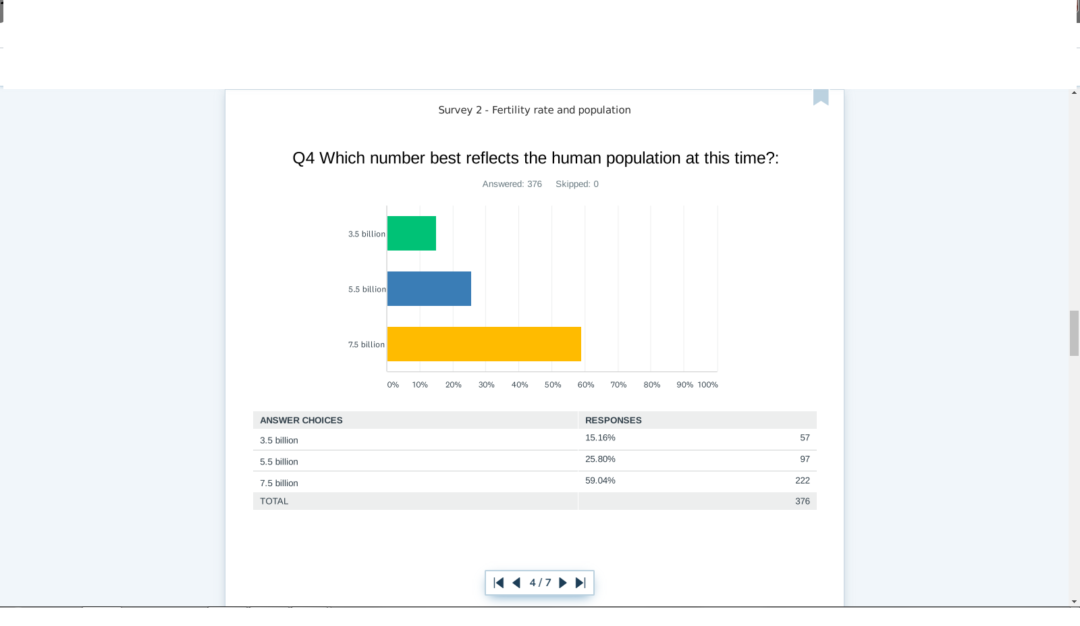
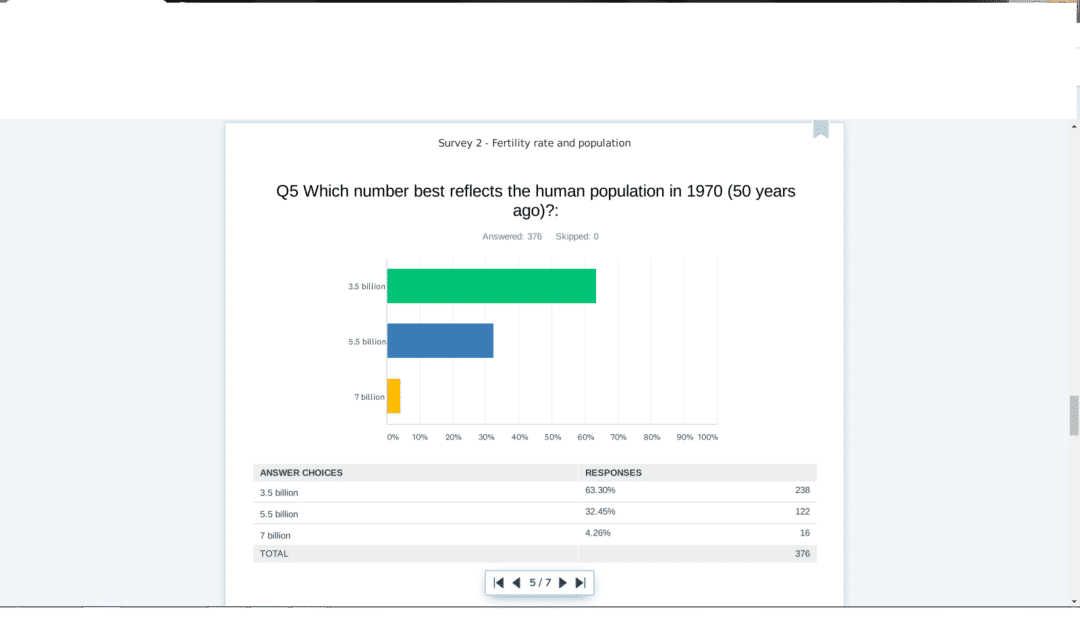
    • Though a majority of respondents have an accurate picture of current population numbers and those 50 years ago, a notable minority do not. Forty-one percent of respondents think the current number of people on the planet is either 3.5 billion (15.25%) or 5.5 billion (25.8%) instead of the correct answer of 7.5 billion and that the population in 1970 was either 7 billion (4.3%) or 5.5 billion (32.6%) instead of the correct answer of 3.5 billion.
    • Support for Having Kids’ mission remains high. Seventy-two percent of respondents indicated they would be supportive (36.3%) or very supportive (35.4%) of an organization pursuing Having Kids’ mission.
    • More education is needed regarding both the current population numbers and the expected growth of these numbers.
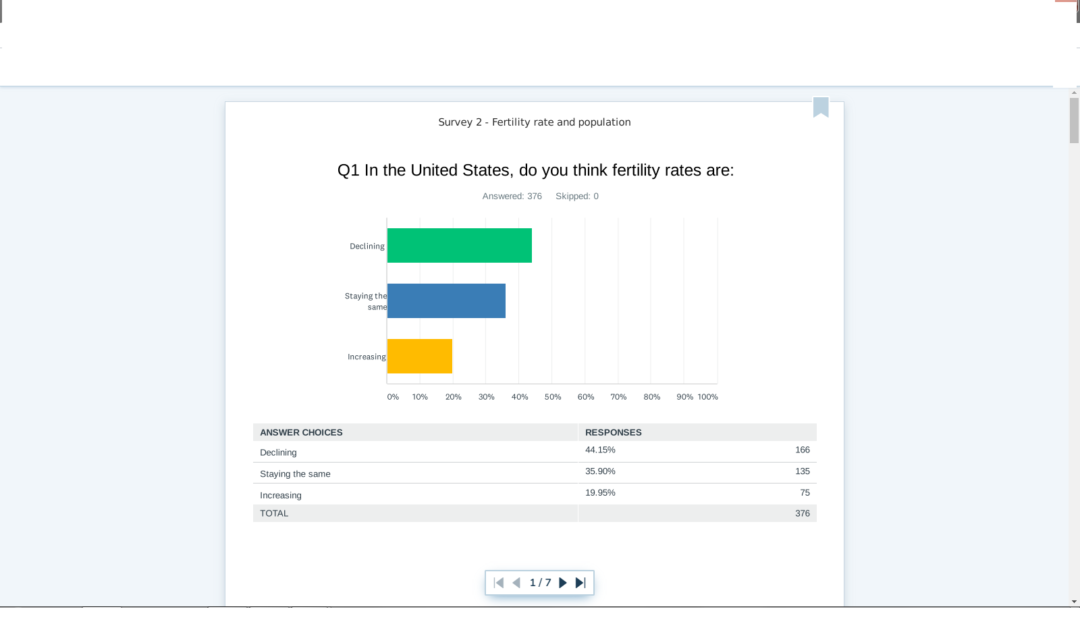
    A survey chart shows U.S. opinions on fertility rates: 45.94% think rates are declining, 35.99% say staying the same, and 18.08% say increasing. Bar graph and response table are displayed.
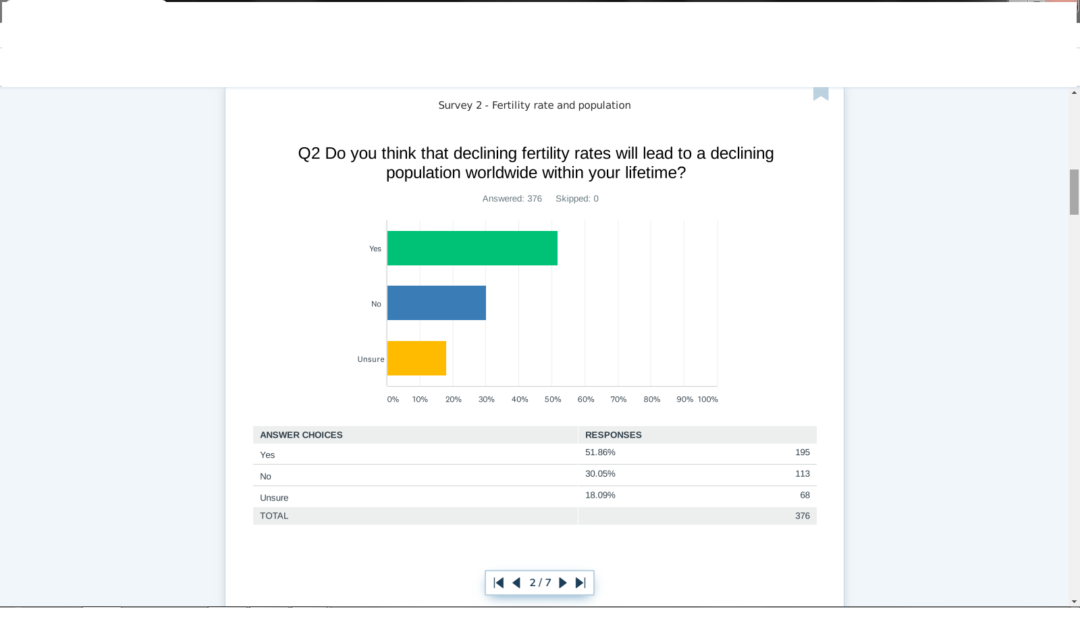
    A survey question asks if declining fertility rates will cause a worldwide population decline within respondents lifetimes. Bar chart: Yes (166), No (53), Unsure (77). Table repeats responses. Total: 296 answered, 0 skipped.
    A survey result screen shows a bar graph and table. The question asks about a relationship between family size and human population. 323 answered Yes, 25 No, and 28 Unsure, out of 376 total responses.
    A survey graph showing responses to Which number best reflects the human population at this time? Most respondents chose 7.5 billion, followed by 6.5 billion and 3.5 billion; results are also shown in a table below the chart.
    A survey question asks about the human population in 1970. A bar graph shows most respondents (62.63%) chose 3.5 billion, 28.29% chose 5.5 billion, and 9.08% chose 7 billion. Total responses: 381.
    A survey results chart shows support levels for an organization promoting cooperation between prospective parents. Most respondents are very supportive or supportive, with fewer neutral or unsupportive responses.
  • Should Parents Be Licensed Before Having Kids? Share Your Thoughts

    Should Parents Be Licensed Before Having Kids? Share Your Thoughts

    In a now-classic essay, one of the world’s preeminent thinkers, the ethicist Hugh LaFollette, argued that parents should be licensed before having kids.

    In short, the government issues licenses for activities that pose significant risk or impact to society, such as driving a car or owning a gun, but not to birth children? Does that make sense?

    Read LaFollette’s classic work here. Then tell us what you think:

    Share your thoughts on the idea of licensing parents at info@fairstartmovement.org.

  • An Open Letter to Ellie Goulding

    An Open Letter to Ellie Goulding

    Dear Ms. Goulding — 

    We at Having Kids Inc. strongly support your decision to delay having kids and your new podcast about your decision not to rush into having children. The many career women of the world have evidenced that having children isn’t the “end all, be alll” in life. We encourage you to follow through on your inspiration to take on a new platform to share your story. Your decision to delay starting a family is very much in alignment with the Having Kids Fair Start model detailed below.

    The Fair Start model is simple:
    1.) Communities help parents to plan their families and wait for readiness before having kids.
    2.) We all ensure prioritized resource distribution to give all kids a fair start in life.
    3.) We all promote smaller and more regenerative families that make all of this possible.

    We believe it is the best interpretation of the fundamental right to have children. The Fair Start Model is 10 to 20 times more effective at protecting children and our environment, and at building human rights and democracy, than other policies that address these issues. For many reasons, it is an overriding human right that can be furthered by all means effective. We would appreciate greatly your helping us promote
    the Fair Start model.

    — Erika Mathews, Executive Director, and Betty Martin-Finneran, Ph.D., MS, Research Associate

  • Our Environmental Impact Starts with Having Kids. Take Action.

    Our Environmental Impact Starts with Having Kids. Take Action.

    In a recent piece, The Guardian and George Monbiot do right by at least discussing family planning, the fundamental driver of our ecological and social crises. But they miss the mark by using their pulpit to demonize and exclude those focused on family planning reform, as opposed to unifying environmentalists, and offering ways for anyone who cares about our future to work together on the most effective changes.

    This is not in dispute: People cause anthropogenic impacts, and people don’t fall from the sky. In the case of the climate crisis, choosing one child fewer has 20 times the impact of altering one’s diet. In the mid- to late 20th century, world leaders and environmentalists made a gamble that family size would fall quickly enough to evade catastrophe. All of us, including George, were wrong. Our children will suffer for that mistake.

    What’s the solution now? The right to have children is universal, but properly interpreted, it has to orient from what future children need more than what intending parents want because future children have the most at stake. In other words, social justice and the constituting of just societies has to start at the beginning by prioritizing a resource distribution that incentivizes smaller and more equitable families. We can start by targeting the industries most responsible for the crises to pay what they owe. Making that one change in our family planning systems, and quickly employing policies that give all kids a fair start in life, is the way to be most effective and to unify family planning and equity. And we can do that by starting at home, as Meghan Markle and Prince Harry have done by choosing a smaller family and speaking out.

    TAKE ACTION: Urge the key U.N. agencies to ditch their isolationist family planning models and adopt the human rights-based Fair Start model instead. And urge the Guardian’s head offices to discuss the real solutions — like better family planning policies — to our biggest problems.

  • Survey Shows Broad Support for Male Pill and Policies to Encourage Its Use

    Survey Shows Broad Support for Male Pill and Policies to Encourage Its Use

    In 2019, Having Kids launched a campaign for policies that would encourage funding for the approval, marketing, and subsidization of the male birth control pill. From a powerful way to deal with Covid-19 and future pandemics to a means of addressing fundamental gender inequity, the male pill could be the magic pill for many of the crises we face today.

    Now, Having Kids is releasing a survey showing just how much people want the male pill and policies that would promote its use.

    The results are below.

    Bar chart showing responses to How supportive are you of a birth control pill for men? Most answered Very supportive (54.99%), followed by Supportive (29.20%), with fewer selecting Neutral, Unsupportive, or Very unsupportive.
    A bar chart shows survey responses about support for the CDC promoting a male birth control pill to male teenagers. Most chose Very Supportive (180), followed by Supportive (140) and fewer chose Unsupportive or Very Unsupportive.
    A bar chart shows survey responses on support for CDC promoting a male birth control pill to combat climate change. Most chose Very supportive, followed by Supportive, Neutral, Unsupportive, and Very unsupportive.
    A word cloud displaying responses to What benefits do you associate with a birth control pill for men? Prominent words include: women, unwanted pregnancies, population, responsibility, control, less, health, benefits, and sperm.
    A word cloud showing responses to concerns about a birth control pill for men. Prominent words include side effects, concerned, none, birth control pill, men, effect, and weight gain.
    Bar chart showing survey responses to organizational support for encouraging cooperation between prospective parents and equitable families. Most respondents are Supportive (166) or Very supportive (140) out of 411 total responses.

    TAKE ACTION: Urge the federal government to prioritize funding for the approval, marketing, and subsidization of the male pill.

  • The CDC Responds and We Reply: Address Overcrowding as a Fundamental Factor in Pandemics

    The CDC Responds and We Reply: Address Overcrowding as a Fundamental Factor in Pandemics

    On Earth Day this year, Having Kids wrote to the Centers for Disease Control and Prevention asking it to consider supporting new family planning policies that would address overcrowding and other factors that impact the spread and impact of Covid-19 and that threaten to help create new pandemics.

    On May 27, the U.S. Department of Health and Human Services and the CDC kindly responded, noting that 1) United States birth rates are at an all-time low, and 2) the CDC is doing much to protect families and children from Covid-19.

    We appreciate the response and applaud these efforts, but we have responded with the following ask:

    Given that the CDC in its letter recognizes the connection between low birth rates, overcrowding, and pandemics, would it support our call for new legislation promoting smaller families? Forthcoming legislation on Covid-19 could be linked to forthcoming legislation on childcare and subsidized “baby bonds” in a way that starts to change the underlying model that drives family planning outcomes and transitions the country to smaller families who can invest more in each child.

    We are also asking the CDC (and World Health Organization) to include in the policy change the other three inevitable factors present in all family planning regimes: 1) the impact on prenatal, birth, and early development conditions on qualitative outcomes like health, education, and the development of empathy, 2) the impact of equity and prospects for equality of opportunities in life, and 3) the impact on the environment and prospects for the restoration of nature as a buffer against future pandemics. The CDC and WHO can support policy transitions to better family planning and can codify the human rights-based child-centered model in a variety of ways.

    The facts are clear:

    • Population growth and the large families that cause it have worsened the impact of Covid-19.
    • The impact of Covid-19 depends on the civic qualities of the populace, including empathy and the willingness to engage in measures that protect others. These qualities, and related factors like the effective dissemination and internalization of simple public health information, depend in part on family planning regimes.  
    • Equity and the massive disparity in health outcomes during Covid-19 largely depend on family planning and birth conditions.
    • The underlying driver of future pandemics is the degradation of nature. We need policies that restore it.
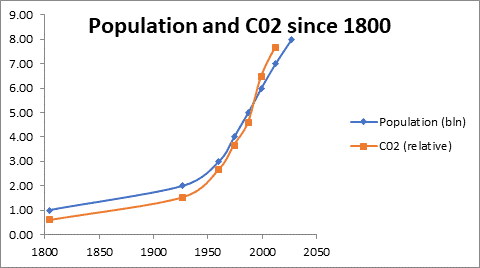
      In other words, the historic spike in population growth over the past century has been a public health problem.

    TAKE ACTION: Urge leadership to move from parent-focused to a human rights-based child-focused family planning model.