Category: Children’s Rights

  • World Children’s Day: Our Open Letter to Barack Obama and Kamala Harris

    World Children’s Day: Our Open Letter to Barack Obama and Kamala Harris

    To the Honorables Kamala Harris and Barack Obama,

    Today is World Children’s Day, the special day designed to promote international togetherness, awareness among children worldwide, and improving children’s welfare. Our organization, Having Kids, is writing to you as leaders who have pushed boundaries in unique ways and have distinctive capacities to change universal norms, including the norms that surround how we choose to have children.

    More specifically, we write because you both recently made key statements — you, Barack, about the need for “an informed citizenry and social cohesion,” and you, Kamala, about “rooting out structural racism” in the United States. In response, we write with this radical proposition and argue that neither of the things you want would be physically possible without ensuring a state of affairs that reflects this new human right:

    Every child deserves a fair start in life, ecologically and socially. That is the first human right, the one that constitutes the communities of free and equal people envisioned by the International Bill of Human Rights. And as such, it overrides all competing norms and interests.

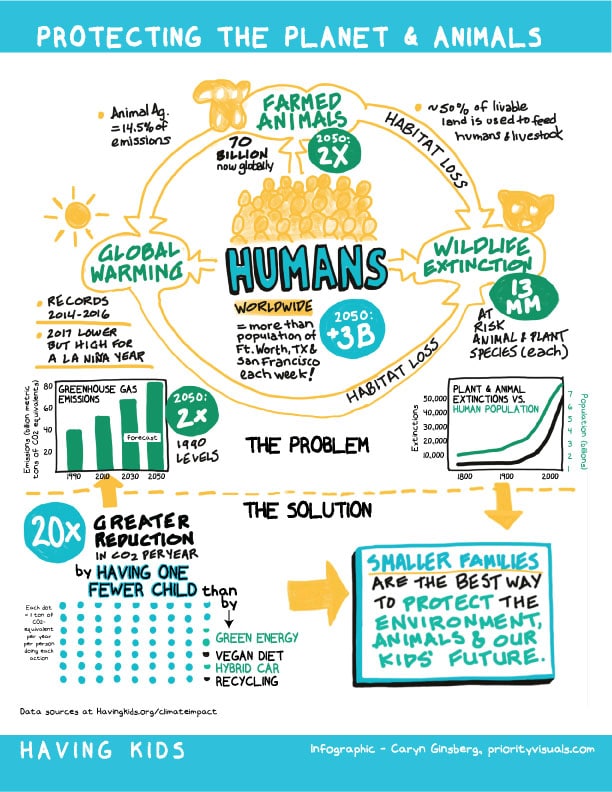
    Establishing and promoting such a right would require reorienting family planning systems from their current focus on what parents want to a focus on what future kids need, and reinterpreting Article 23 of the Universal Declaration of Human Rights to prioritize the redistribution of resources to incentivize a new system of cooperative family planning. It would require using the Children’s Rights Convention as minimum standard for family planning. If we do that, the mitigating impact on the 1) climate crisis, 2) the gap between rich and poor, and 3) child poverty could be 10 to 20 times that of the downstream approaches we traditionally use. It’s time to take seriously an approach to family planning that is both ecologically and socially sustainable.

    We are writing to ask you to consider supporting this change, which we call the Fair Start transition.

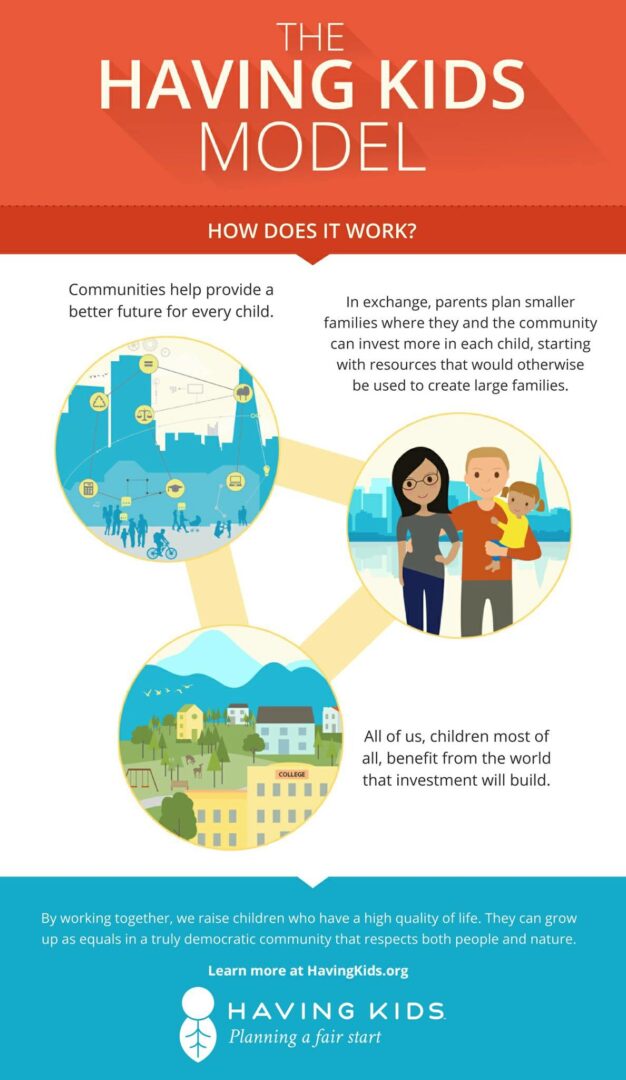
    Infographic explaining the Having Kids Model: communities invest in children’s futures, parents plan smaller families, and all children benefit from increased resources and a supportive environment. Includes illustrations and text.

    Because Fair Start is the first and foundational human right, we believe that political systems that are not implementing it — and that risk social and ecological collapse as a result — are fundamentally illegitimate. This is a claim we flesh out in peer-reviewed work and recent legal scholarship. What’s a concrete next step you all might support?

    Many versions of “baby bond” legislation are being proposed at the state and federal levels. Having Kids would alter this concept to instead move toward leveling the entry field for all kids, through a steep progressive tax and benefit system designed to improve child welfare and equity, and 2) by using these incentives to universally promote smaller and more sustainable families. We believe the latter can help pay for the former, especially in the long run. More specifically, we see the legislation responding to the pandemic as a possible vehicle to begin to implement the transition to Fair Start. Our detailed proposal to Cory Booker is here.

    Thank you for considering our unique approach.

    The Team at Having Kids

  • An Open Letter to Matthew McConaughey: Help Us Do Better

    An Open Letter to Matthew McConaughey: Help Us Do Better

    Dear Mr. McConaughey,

    We appreciate your breaking taboos around discussing families and wealth with your public statements recently regarding raising your three biological children to embrace being born affluent and to not feel guilty about that, but instead to “own it.”

    We want to suggest an alternative way of thinking about the issue. Today we see 1) massive disparities in wealth and well-being in the United States, with black families having roughly one-tenth of the wealth of white families, and 2) clear and increasing evidence that these disparities are largely inherited on the basis of one’s economic positioning at birth. Inequity at birth and early in one’s life has disproporinate impact on one’s life prospects.

    Adding to the injustice, those on the disadvantaged side of the spectrum will feel the impacts of ecological crises like climate change and pandemics like COVID-19, which are both fundamentally driven by the way we plan our families, much more keenly than those on the advantaged side.

    This a result of policy, not some hand of God beyond our control.

    The solution is obvious: Rather than continue laws and policies that promote our current way of planning families, we should cooperate to level the playing field for all kids, with more ecologically and socially regenerative family planning models. Regardless of whether you plan to have additional children, your publicly endorsing such a change in law and policy would go far to eliminating the injustice, while at the same time offsetting your children’s advantage by raising the floor for other kids.

    Changing the way we plan families can free us. Why? Freedom requires a social contract, and that contract does not work if parents can simply pass disproportionate power to their children, rather than at least starting to move toward giving all new members of society a fair start in the social agreement — as free and equal people deserve. One model for such a change is called child-centric Fair Start family planning. As you think through these issues, would you consider this model and perhaps speaking out publicly in support of it or another justice-focused model that promotes ecological and social regeneration?

    Sincerely,

    The team at Having Kids


  • The ‘One Billion Americans’ Idea: Are We Missing the Point?

    The ‘One Billion Americans’ Idea: Are We Missing the Point?

    Matthew Yglesias’ new book, “One Billion Americans: The Case for Thinking Bigger,” is the thought experiment the title implies: exploring policies that might increase the population of the country threefold by using incentives to create larger families and increased immigration. The book has been harshly critiqued by most reviewers for its nationalistic admiration of China, confusing quantitative growth with sustainable human development, ignoring and naively dismissing the environmental consequences of its proposal (the sort of thinking that created the climate crisis), reinforcing a patriarchal vision of women as mothers, and more.

    Its title goes far in revealing the fundamental worldview of the author: People are numbers, and babies are economic inputs. But did his reviewers miss a key point in their critiques? Could he have been focused on something other than a target population?

    Obviously, nothing about current trends suggests that a United States of 1 billion of more people will ever happen, and Yglesias admits the same. Quite the opposite, in fact: Smaller families are considered one of the great successes in development, and the trend toward smaller families, which is the most effective long-term way of mitigating the climate crisis, seems likely to accelerate rather than reverse.

    So why write an apocryphal proposal? It’s possible that Ygelsias is doing something more sleight of hand with this book. Despite urging lager families, his book necessarily focuses on one driver for its audacious proposal: immigration. He does so right before an election in which immigration features prominently. And he does so from an economic perspective that many conservatives and fence-riders will appreciate and could be swayed by.

    Beyond Economies, Toward Becoming a Democracy

    But in raising these issues, Yglesias (and almost all of his reviewers) reveal a deep and common conceptual error, the one at the core of his book. He thinks the United States is defined by physical borders. He thinks we are a group of people competing against other groups of people elsewhere in the world, defined by the invisible lines around them, or the historical borders and the militaries that defend them.

    That conception does not capture the essence of the United States. The United States is defined from the inside out by its Constitution, at the center of which is the idea that political authority and legitimacy derive from the people, or more accurately, from each person rather than any collective. This error presents a serious problem for Yglesias.

    How can we invest sufficient resources in each child, while at the same time creating so many, both here and in places from which persons will immigrate? How can we assure equality — or equal opportunities for each child — and follow Ygelsias’ advice that we simply produce more people irrespective of one’s economic birth position? How can 1 billion people have a meaningful say in their federal governance? The United States isn’t about counting people as much as it is about making each person count, first and foremost in terms of their voice in democratic lawmaking.

    If we take seriously the idea of authority and legitimacy as deriving from “We the People,” we might understand that rather than having been constituted in the past by godlike founders, the United States is instead constantly constituting or deconstituting, with each new member, depending on the values at play. And we might understand that which way we go first depends on how the body of people in the United States does or does not reflect the ideal of self-governance. If people are the fundamental source of power, how could we not see our nation in this way?

    This way of thinking could give us a new political border, one very different from lines on a globe and the mind-numbing simplicity of the political left and right.

    A New and Singular Political Border

    Seeing the new and universal political border as defined by the creation of persons exposes very different ways of thinking about who those people should be. One way, reflected in the “baby bust” and “underpopulation”  discourse popular in both left- and right-leaning media today (the message Yglesias favors) pushes for creating more and more people to increase gross domestic product, through new future laborers, instant consumers, and an ever-growing tax base. There is no assurance that each of those children will have a fair start in life; we have to ignore that black families have one-tenth of the wealth of white families in the United States. Impacts on the environment are also ignored, as are impacts on democracy. We cannot ask whether each of the children born will experience the true inclusivity of having a meaningful voice, not lost in the crowd, in their governance.

    A different way, however, would prioritize these values in deriving more cooperative and child-centric policies for the way we should plan our families. The former is about counting people; the latter is more about making people count. The former exudes the greed, masquerading as amoralism, of markets; the latter reflects the inevitable and specific objective values that human rights and political self-determination that require: equal opportunities in life, small political units where power is decentralized, and the freedom from others inherent in nature.  

    Arguably, the latter is closer to any coherent conception of the United States and must prevail. We have to create people capable of participating in town halls, rather than simply populating shopping malls, because in a democracy, the latter is governed by the former. Political freedom precedes economic freedom. And as recent scholarship has pointed out, we will remain in relative states of preconstitutionality and illegitimacy (and will resist reaching the Sustainable Development Goals) until we have those policies. Note that this approach moves us toward the idea of open borders: If freedom of movement requires the absence of blocking borders, it would also requires family planning that produces people — in quantity and quality — capable of maintaining such a system. Travelers would not be “othered,” because they would be born of a family planning norm to which we all agreed, rather than the “nobody else’s business” model we use today.

    Rather than a rally cry for growth as a means of competing with other countries, Ygelsias’ book may reveal a new border within all nations, and a division between preconstitutional people (or “precons”) and those committed to the inescapable and objective values behind the as-yet-unrealized democratic ideal of the United States and many other nations. Rather than more bodies to fuel an economy, the next part of this conversation might focus on more qualitative questions, such as whether every child deserves a socially and ecologically fair start in life. That focus, rather than treating the way we plan our families as “nobody else’s business,” is the key to the future we and our kids deserve and the realistic policies to get us there.

  • Urge Time Magazine to See Falling Fertility As An Opportunity, Not A Crisis

    Urge Time Magazine to See Falling Fertility As An Opportunity, Not A Crisis

    Time recently highlighted the issue of changing fertility rates as a harbinger of a new era for the United States. But the author, Eliana dockterman, errs in thinking changing our old ways, where unsustainable population growth meant free money in the form of new bodies inflating gross domestic product, is a bad thing.

    Falling fertility rates are part of the overall trend towards population stabilization and gender equity, some of the greatest successes of our time. 

    It’s key in this process that we stabilize at a sustainable level – and given the climate crisis (which Docketerman never mentions) – we need smaller families to hit a safe level and we need them now. Delayed fertility and smaller families are one of the greatest ways to mitigate climate emissions. As we change average family sizes  and get over our addiction to growth, we are presented with another opportunity. Can we use new family planning policies to eliminate other crises, like the economic disparity, where the average black family has one tenth the wealth of the average white family in the United States?

    Yes we can, through policies designed to distribute wealth in ways designed to give every child a fair start in life.  Growth had to end sometime – hopefully it’s not too late. 

    Take action: Urge Time’s editor, Edward Felsenthan (@efelsenthal) to talk about better ways of planning our families that can make a brighter future for all.

  • Who’s Pushing Poor Family Planning?

    Who’s Pushing Poor Family Planning?

    Younger generations are responding to the climate and other ecological crises by doing the most effective thing possible: Choosing smaller families. And while that’s great, there is still a lot of work to be done today, like enshrining the change in our laws and policies, and twisting the quantitative trend to make it more qualitatively equitable, by taking the resources necessary to fund cooperative family planning systems that give every kid a Fair Start.

    So who’s pushing back against this change? The obvious culprits are governments and big businesses that built their power on an unsustainable wave of new consumers, cheap future labor, and complaint taxpayers.

    But another category includes older generations – the ones that failed to prevent the population explosion driving the climate crisis – who can’t see beyond their way of doing things. The Independent featured a great example recently, with an author bemoaning how smaller families threaten the bonds of siblinghood. Should we risk the ecological collapse of our planet because we are unable to raise kids capable of bonding beyond their own blood relations? Perhaps we need to think out of the boxes the created the mess we find ourselves in today, and think of bonding and community in more advanced and sustainable ways.

    TAKE ACTION: The media is failing its journalistic obligations to report on what really matters to people: Effective solutions to the world’s greatest problems. Email us at media@fairstartmovement.org for guidance on how to submit op-eds and contact reporters to help news outlets do their job.

  • Worried About Bringing a Child Into the World? Speak out Here.

    Worried About Bringing a Child Into the World? Speak out Here.

    Many young people around the world are rethinking becoming parents, and are deeply concerned about bringing a child into a world beset by a climate crisis, pandemics, and growing inequity and civil strife. Why are we faced with this?

    Almost every crisis before us – from the collapse of our environment to the gap between rich and poor – starts with family planning policies and cultures that do nothing to promote responsible family planning behavior. And in addition to policies and culture, today thoughtful and caring young people have to worry about having one child, even when they are ready to care for that child, because older generations consistently had unsustainably large and unplanned families. Today, would-be parents are in a dilemma because of the family planning systems older generations created, and the “nobody else’s business” approach to having kids that persists today and that is destroying our environment and communities.

    As one Having Kids supporter, who is keen to have one child one day, wrote:

    I am annoyed and dismayed to learn that one of my colleagues in local government is pregnant for the fifth time! How can you bring another child into the world given the state of the planet? This is selfish and irresponsible. Not only for a kid who will not receive the attention they need, but for everyone else. The current population is unsustainable and the planet is dying. Look out the window. We don’t need another mouth to feed, another Costco account, more plane rides, cars, etc. Why are my taxpayer dollars paying for your selfishness? Policies need to change to protect all children and curb this selfish and ignorant behavior. People need to take responsibility for their children, future generations, and the planet. If you want more kids adopt.

    The best solution to the dilemma is to change the way we all plan our families, and to demand laws and policies – and the cultures they shape – that promote parental readiness, a distribution of resources that give all kids a fair start, and smaller and more sustainable families.

    Take action:

    Speak out – send us your story at info@fairstartmovement.org.

    And: Urge key United Nations agencies to use their positions to help usher in the change we need.

  • Why We Can Ensure A Child’s Right to a Fair Start In Life, Ecologically and Socially, By All Means Effective

    Why We Can Ensure A Child’s Right to a Fair Start In Life, Ecologically and Socially, By All Means Effective

    A lot of people have asked the crew here at Having Kids what we mean when we say that we can all further a child’s right to a #FairStart in life, ecologically and socially, by all means effective. What it simply means is that as a peremptory norm, a child’s right to a fair start, enabled through cooperative resource distribution and responsible family planning, overrides things like the property rights of the wealthy, or the right of intending parents to have limitless numbers of children with no cooperative planning to ensure their welfare and equity. #Fairstart comes first.

    Why are the rights and responsibilities that surround having kids peremptory? If power derives from the people, then the norm that accounts for their creation and subsequent empowerment overrides other norms. It is the first necessary condition of legitimacy. It involves literally constituting the political entities that then develop subsequent norms. In other words, nations were not “constituted” at historical points in the past by god-like founders, but are either constituting legitimate systems of governance with every child we have, or they are not, depending on how they do it and the values (like welbeing, consent and nature) at play.

    We say “all means effective” because we refuse to ignore the moral reality of the order of norms, and because the freedom and wellbeing of future generations and nonhumans – the most vulnerable and numerous classes of entities – depend on our using #fairstart to liberate them. Does that mean we promote things like violence? No – we explicitly reject violence and other forms of coercion because we believe they cannot further #fairstart, but by creating cycles of violence, in fact harm kids and their development.

    Learn more about #fairstart, and why we are focused on concentrations of power in icons like Elon Musk.

  • Factory Farming is Fundamentally the Product of Poor Family Planning Policy. Take Action.

    Factory Farming is Fundamentally the Product of Poor Family Planning Policy. Take Action.

    Cory Booker is spot on in targeting the industrial agriculture complex that is destroying our environment and health.

    But he could go further, and be much more comprehensive and effective.

    That complex was created in response to, and is driven by, ballooning population growth. It also exploits and exacerbates the growing gap between rich and poor, in terms of who consumes and who produces the animal products. Booker should connect the dots, and tie his attack on factory farming to a new version of the guaranteed minimum income for children, or “baby bonds,” proposals he is known for. Specifically, those bonds could be funded by taxes on the biggest factory farming conglomerates, and be modified to incentivize smaller families that cooperatively exchange resources to give all kids a fair start in life. This would cut demand for the products of factory farms, restore our environment, and also restore the middle class – including middle class farmers – that is the antithesis of the toxic corporate structure at the heart of the United States food system. 

    Urge Booker to take a more comprehensive and effective approach. Contact him here.

  • Fair Start Planning Is Essential to the Anti-Oppression Toolkit

    Fair Start Planning Is Essential to the Anti-Oppression Toolkit

    With nearly 40% of all kids in the U.S. living in or near poverty, human rights and democracy under attack, and systemic racism keeping intergenerational inequities alive and well, better policy is long overdue.

    Sadly, it has taken the murders of black citizens in recent years to bring to the forefront the conversation surrounding inequities and oppression. But a deeper look at the intersectional issues is finally making it to the mainstream. Now is the time to develop anti-oppression and anti-racist informed policies to change course effectively. 

    Fortunately, one path forward is clear. Decades of research have shown that family planning is the most effective way to break the cycle of generational poverty and inequality. Early interventions are up to 13 times more effective than reactive approaches. Furthermore, parents who choose to have only one or two kids can invest more time and resources in each child, setting up these children for great success throughout their lifetimes.

    Yet oppression continues because of a lack of equitable resources from birth. The facts are simple:

    • Inequality is inherited. 1
    • Inequality is a welfare issue. Studies have documented examples of rising inequality decreasing child welfare. 2
    • Inequality affects kids for life. Unequal opportunities translate into unequal lifelong outcomes by the time children reach age 5. 3
    • Inequality’s impacts are more damaging the longer it is experienced. The longer a child is poor, the greater his risk of poverty in adulthood and of experiencing lifelong health problems and involvement in the criminal justice system. 4
    • Inequality disproportionately affects children of color in the U.S. 5
    • Affluence plays a role, too. The growing divide between low-income children and their peers reduces opportunities for low-income children throughout their lives. 6

    And that is why anti-oppression policy without Fair Start investments is a nonstarter. If we are truly determined to dismantle systemic racism, we must come together as communities to ensure a fair start for all children. 

    We are already pursuing Fair Start campaigns to improve equity for kids:

    As we plan for 2021, we are working to invite more partners to join our coalition on these intersectional issues. If you would like to join us or share your perspective, please email ashley@fairstartmovement.org.