Category: Children’s Rights

  • Matt Ball, Early Fair Start Organizer, Has a New Book Out!

    Matt Ball, Early Fair Start Organizer, Has a New Book Out!

    Matt Ball, longtime activist, husband, father, and early member of the Fair Start Movement, recently published his third book, Losing My Religions. A mix of memoir, essays, musings, photography, and travel log, Losing tells the story of Matt’s efforts to make the world a better place, while offering a fearless analysis of his many mistakes.

    Matt Ball, Early Fair Start Organizer, Has a New Book Out!

    As one reviewer put it:

    [H]e plays with quotes, stories, and a wily, at times even serious irreverence. He lets us into the world of his own joys, realizations, and daily suffering. Family, religion, consciousness, health, life, reality, and everything are given a series of pulsating reflections and staggering vulnerabilities that are hard to put down.

    From a professional full-time writer:

    A tour de force! The narrative and visuals (everything from Death Valley to chocolate crinkle cookies) are so lively. It’s really unlike anything I’ve read before.

    And from Australia:

    It’s only just after 7 am now and I read the first 70 pages. It’s very unusual writing and I have found it efficient in that I couldn’t put it down – even though I repeatedly thought I’d only just read one more page.

    The ebook version is free; you can get the files and learn more at LosingMyReligions.net

    Young child leaning up against glass
    Matt and Anne’s child Elwen, many years ago.

    Here’s an excerpt from his chapter, “God, the Greatest Murderer of All Time”:

    Abortion is awesome. It isn’t icky. It isn’t a “necessary evil.” It isn’t “I personally oppose abortion, but….” It isn’t something non-politicians should shy away from. Anything that can help women have more control over their reproduction is awesome. Anything that can help make every baby a wanted baby is awesome.

    Just consider what the other side is saying: They, through the powers of the state, want to control when a woman can reproduce. They don’t want every child to be a wanted child. 

    We want every child to be a wanted child.

    Think about it: take two pills and expel a tiny clump of cells with less sentience than a cockroach. The world is spared yet another unwanted child, and on average, poverty is reduced. The woman regains control of her life, and in the future, can bring a wanted and provided-for child into the world.

    And from “Fight the Power Part 1: To breed or not to breed:”

    Of the people you know well, how many were provided a happy, healthy, balanced, lie-free, totally-loved childhood? (Religion counts as a lie.)

    And many parents are far less happy than you would think (or than they will let on). As is probably obvious, parents feel internal and external pressure to sing the praises of their children. But simply Google “Are single people happier?” or “Are childfree couples happier?” and you will find seemingly endless studies showing that having kids is definitely not the key to happiness. Doing this search while I write this, the top results say, “the data suggest single people are happier and more satisfied with their lives than commonly believed,” and “Couples without children have happier marriages, according to one of the biggest studies ever of relationships in Britain. Childless men and women are more satisfied with their relationships and more likely to feel valued by their partner.” And this happiness is in spite of our genetic and familial and social pressures to breed.

    If you think your life would be empty without a child, your life has bigger problems than a child could or should fill. If you think your life won’t be full without a child, are you sure you want to fill it with pain, screams, worry, regret, poop, worry, anguish, apprehension, guilt, and then a topping of worry?

    Matt Ball, Early Fair Start Organizer, Has a New Book Out!
    Matt and Anne.

    …

    I truly think that there would be a lot more happiness if fewer people got married and many fewer people had kids. Even before the pandemic, this seemed to be happening with folks currently in their twenties and thirties. So maybe more kids these days are breaking free of the pressures and doing what’s right for their own life satisfaction. 

    And “Test Your Marriage”:

    Getting “fixed” was yet another example of how society promotes procreating. As happened to all my friends who got vasectomies, I was questioned very seriously if I really wanted this. (YES.) (Although it was uncomfortable, and seeing smoke rising … down there … well, there were moments….) 

    But no one grills you about bringing an entirely new person into the world. No one questions you about that decision at all. That. Is. Fucked. Up. Reverse that – make everyone who wants to breed pass an inquisition and let anyone who wants a vasectomy get one free and without hassle – and the world would be a vastly better place.

    If you’d like to learn more from Matt’s “half-failed life of airplanes, agony, animals, basketball, bliss, cameras, chaos, cops…,” and discover how his life’s lessons led him to realize the importance of the Fair Start Movement, please check out LosingMyReligions.net. But be warned, you might have this reaction:

    I am riveted. For the next 36 hours, I want to curve myself into a comfy chair and read every word, every quote, gaze at every photo…and then read it again.


    Matt Ball, Early Fair Start Organizer, Has a New Book Out!
  • Population Changes Raise Issues of Compensation, Not Competition

    Population Changes Raise Issues of Compensation, Not Competition

    Parag Khanna’s recent push in Time to make mobility a human right in light of lower fertility rates and ageing in many nations seems well-intentioned. It’s certainly better than the legions of men crying out against a baby bust, as they urge women to have more kids to serve as cheap future labor and taxpayers. But Khana shares the same fundamental value with those men: Economic growth. And he places that over values like nature, equality, and participatory democracy.

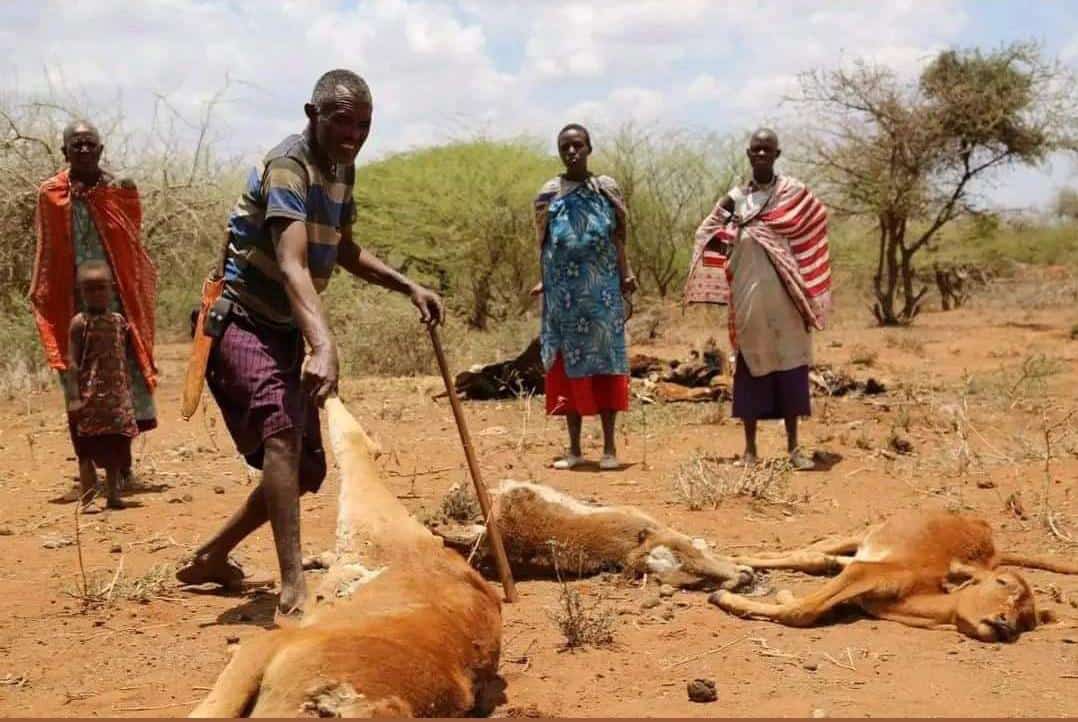
    Climate driven drought in the Amboseli, Kenya - starving cows as people look on
    Drought in Kenya has been exacerbated by the climate crisis.

    The wealth of the past several decades was made and placed in the hands of a few, according to one Nobel Laureate, by externalizing its costs on future generations. It was made by not requiring environmental regulations that would have prevented the climate crisis, and not ensuring that all children enjoy birth and development conditions consistent with the Children’s Rights Convention. Our priority should be to regulate and provide in this way, in part by compensating future generations through family planning entitlements, before we turn to mobility. 

    A group of students sit at desks in a classroom, attentively listening and taking notes. The focus is on a girl in a plaid shirt, resting her chin on her hand and looking forward thoughtfully.
  • Take Action: Urge USA Today to Report Fairly on Family Reforms That Impact Your Future

    Take Action: Urge USA Today to Report Fairly on Family Reforms That Impact Your Future


    Smaller Families Are a Benefit Not a Burden 

    In a recent piece in USA Today Clay Routledge and Will Johnson cover the story of sea changes in American fertility rates. But while they are likely right about the cause of the trend towards being childfree or having smaller families, they proceed from two false assumptions. First, the change is beneficial not detrimental, given the climate crisis and the threat it poses to our nation. While Routledge and Johnson seem eager to return to unsustainable growth that ignores biodiverse nature, changes in fertility are one of the best chances we have to mitigate the crisis and invest more in the children who will need to be prepared for the degraded ecologies of the future.

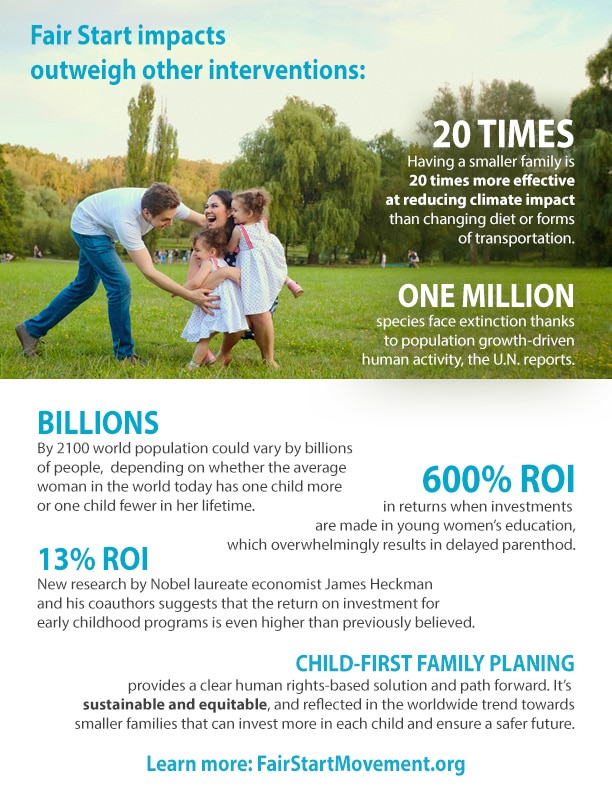
    Infographic about Fair Start family planning, highlighting climate impact, reduced extinction risks, 600% return on investment, findings by Nobel laureate Heckman, and the benefits of smaller families for sustainability.

    Secondly, it’s simply not plausible to say one has to have children to find meaning in life. If we compare the lives of childfree Oprah Winfrey, and Stephanie Jimenez, who starved one of her six children to death, we will see that existential meaning takes more than creating other people. Instead we should opt for just and sustainable family policies that create a future where all have the opportunity to find meaning and success, by having children and otherwise. 

    TAKE ACTION: Urge President and News & Editor in Chief for USA TODAY, Nicole Carroll, to report on the need for Fair Start family planning reforms, the most effective solution to the crises we face today. Email her here: EIC@usatoday.com

  • The Death of Queen Elizabeth II Raises Valid Concerns About Race, Inequity, and Privilege

    The Death of Queen Elizabeth II Raises Valid Concerns About Race, Inequity, and Privilege

    The Death of Queen Elizabeth II has saddened millions, but has also raised conversations about the past, race, inequality and political privilege.

    Fair Start has previously encouraged the Royal Family to embrace more ecologically sustainable and socially equitable family planning, but the impact of a long-running racist and colonial empire / monarchy raise much larger questions:

    Why are so many fascinated by monarchies in a world that purports to be committed to democracy? Does the racist and colonial history of the Royal family obligate reparations? Does the continuing focus on royalty undercut commitments to equality of opportunity, antiracism, and the dismantling of colonization?

    A young girl wearing a yellow long-sleeve shirt is sitting at a table, focused on writing in a notebook with a pen. Sunlight softly illuminates her face and her surroundings.

    One way to show a commitment to justice, at the most fundamental level, would be to embrace family planning reforms that include the needs of future generations and nonhuman animals, using nature and equity as guides to help families cooperate to ensure the best future possible for all children.

    That model is at direct odds with the concept of monarchy, and even politically symbolic monarchies.

    Wherever one falls in the debate about the death of Queen Elizabeth II, the moment provides the opportunity to reflect, and to try to answer questions that many generations ago could not have been publicly addressed.

  • Iran Moves Towards Forcing Women to Have Children. Will the United Nations Step In?

    Iran Moves Towards Forcing Women to Have Children. Will the United Nations Step In?

    Like other top-down concentrations of power that rely on unsustainable population growth to grow their base, Tehran is now moving to force women to have children.

    According to the Los Angeles Times:

    Now, ultraconservative lawmakers have combined with the administration of hard-line President Ebrahim Raisi, who was elected last year, to criminalize the termination of pregnancies except in cases of rape, incest and risks to the mother’s life. Many officials speak of producing offspring as a moral duty, with Supreme Leader Ayatollah Ali Khamenei condemning those who don’t as indulging in a decadent bourgeois affectation. . . . Some of the Youthful Population office’s inducements for childbearing have invited ridicule and criticism, such as making family expansion a factor for university professors to climb up the academic ladder.

    Several hands of different skin tones are stacked together. Overlaid text reads, The most powerful social justice is a fair start in life. Join the coalition. The Fair Start Movement logo appears at the bottom.

    Not only will Iran’s policies exacerbate the climate crisis by multiplying the nation’s environmental impact, but they do nothing to ensure that children will be born into conditions that ensure equal opportunities in life, or that will eventually lead to the development of democratic society Iran.

    And that’s the whole point.

    Iran’s move is enabled by the United Nation’s family planning model, which ignores human rights and environmental sustainability – never ensuring the conditions of democratic development required by things like the Children’s Convention – and instead permits unsustainable growth that favors concentrations of wealth and power in member states.

    TAKE ACTION: Urge @Atayeshe, the head the UN’s Population Fund, to condemn the policy as the first and overriding human right, the right to an ecosocial Fair Start in life, the right that liberates people by limiting and decentralizing power and thereby building true democracy.

  • The Dos and Don’ts of Helping Kids Make Healthy Choices

    The Dos and Don’ts of Helping Kids Make Healthy Choices

    By Guest Contributor Amanda Henderson

    Healthy living is more than eating vegetables and getting in a daily workout. It is a comprehensive lifestyle that nourishes minds, bodies, souls and the environment. Learn how you can encourage healthy living while avoiding common parenting missteps.

    1. Don’t Make Your Kids Clean Their Plates

    While a desire to not waste can be appreciated, requiring kids to eat everything on their plates teaches them to ignore natural hunger cues. Instead, try starting with smaller portions and add more as necessary. Another option is to serve meals family-style and give children agency over what and how much they eat.

    2. Don’t Use Food as a Reward

    One of the oldest parenting tricks in the book is to bribe children with dessert to get them to eat vegetables. This tactic is harmful for multiple reasons.

    The food used as a reward is usually highly processed and loaded with sugar. Since humans already have a biological tendency toward sweets, using sugary foods as a reward can increase cravings, leading to obesity, tooth decay and other health issues.

    A food-based reward system also interferes with a child’s ability to self-regulate. Receiving a treat as a reward teaches children to eat more for pleasure rather than nourishment.
    Once children are offered treats as rewards, they learn to associate these nutritionally-deficient foods as desirable and healthy options as a necessary evil. Promote healthy food choices by offering a variety of nutrient-rich vegan options and empowering kids to follow their bodies’ signals. These recipes include ingredients that are more affordable for families than plant-based alternative meats or dairy products.

    Two young girls stand outdoors in a grassy park blowing bubbles together, surrounded by floating bubbles, with trees and sunlight in the background.

    3. Do Support Dietary Preferences

    There are countless types of diets and reasons why individuals adhere to a specific one. Some do so out of medical necessity while others choose dietary practices that align with their value system. 

    Your child may adopt a diet that differs from your own. Aim to support that choice so long as your child is getting adequate nutrients. For example, a child who is a budding animal rights advocate may commit to veganism. Collaborate to find and prepare vegan recipes. Take the opportunity to learn more about your child and why following a vegan lifestyle is important to him or her.

    4. Do Encourage Outside Time

    Experts recommend that children of all ages spend at least 90 minutes outside each day. In reality, the average American child plays outdoors for only four to seven minutes daily. Adequate time spent in nature is found to develop confidence, boost creativity, reduce stress and anxiety and promote a sense of environmental stewardship. Try the following ideas to increase outside time:

    • Plant an edible garden
    • Create art projects using materials found in nature
    • Build a bird feeder
    • Take a hike to a scenic spot like a waterfall

    5. Do Seek Help From a Medical Professional

    If you find that your child is struggling to develop healthy habits, reach out to a medical professional for help. Instead of waiting to get in-person appointments or dealing with long travel times, seek virtual medical care. Online services are continuously expanding, giving you access to affordable, high-quality care and treatment from primary care providers, dieticians and any other pediatric specialist your child may need.

    6. Do Model Positive Behaviors

    Inspire your children to lead healthy, meaningful lives. Model positive behaviors and traits, such as mindful consumerism. Leading by example, for example, will help your children to not only make healthy choices for themselves but also be forces for positive change in the world. Teaching them leadership skills can help them develop traits such as integrity, which can last them a lifetime.

    7. Help Make the World Wonderful for Them

    Lastly, take steps whenever possible to help make the world a better place for your children to grow. Organizations such as Fair Start Movement, for example, strive to help provide support to policies that help kids from all walks of life have an equal opportunity at success in an ecologically sound world. Learn more about The Fair Start Model and look for ways that you and your family can donate or volunteer to help.

    Teaching your child to make healthy choices is an action that will impact generations to come. Start early, be consistent and grow together.

    Mom and Dad with a child
  • Learn About Great Efforts in Amboseli Maasai Community

    Learn About Great Efforts in Amboseli Maasai Community

    Amboseli Love is working hard to achieve noble ends and is focused on next generations, like Fair Start.

    Per their leadership:

    The Amboseli Love is a non-profit organization based in Amboseli Kenya. Our primary focus is on Orphaned children, children living with disability HIV/AIDs, Rescued children from early marriages and most vulnerable in the community. Amboseli Village is located in Loitokitok, Kajiado South in Oloolarashi/Olgulului group ranch communal Land. Most Maasais in Amboseli are nomads and live in Manyatta Villages with population of around fifty families. With wife inheritance and wife sharing within age sets poses increased danger in spread and new born with HIV/AIDS. That’s where we Amboseli Love get in to educate the community on the risks of shared love and take over the affected children, educated, feed and nature them to their full potential.

    • Quality Education .
    • Clean Water.
    • Providing an orphanage and girls’ safe house.
    A person wearing a blue Adidas face mask and traditional Maasai clothing stands in front of a thatched roof structure under a partly cloudy sky.

    Some of the issues they cover:

    Well Being

    To improve the well- being of vulnerable and underprivileged girls in the maasai communities.

    Education

    To promote primary, secondary and vocational education to vulnerable and underprivileged girls in the slum communities.

    Health

    To provide Health care and support services to these vulnerable and underprivileged girls.

    Income

    To promote income generating opportunities to the vulnerable and underprivileged through Maasai Craft and beading as well as livestock rearing.

  • Seeta, Fair Start Board Member, Urges Democrats to Focus on Family

    Seeta, Fair Start Board Member, Urges Democrats to Focus on Family

    Democrats, we need a message

    Seeta Begui, Fair Start board member, urges Democrats to focus on basics, including policies that promote good family outcomes:

    Her original letter appeared in Florida Today.

    I agree with recent thoughts from journalist and political commentator Fareed Zakaria: Democrats need to get back to bread-and-butter issues, start building things again, focus on gas prices, food prices, etc.

    The culture wars are too divisive. I met 10 people recently, citizens and naturalized citizens from the Caribbean (Haiti, Trinidad, Jamaica), Europe (England), the USA and Africa (Nigeria), all of whom are concerned. Five have switched from the Democratic Party to independent, due to the culture wars, saying there’s too much emphasis on sexual orientation by politicians and people. There is no teacher, anywhere on this earth, who’s waking up and going to teach harmful sexual ideas to their students. 

    A group of young women at a protest hold signs reading “WE WILL NOT GO BACK TO THE 1970s,” “MY BODY. MY CHOICE.,” and “OUR BODIES, OUR CHOICES, HANDS OFF OUR WOMBS!” Others stand smiling beside them.

    We are watching lies, misinformation and such disrespectful behaviors by certain groups who claim to be the moral police. We all care about all students receiving a quality public education and having opportunities to succeed. In my humble opinion, a lot of students are being taught hate, division, bigotry, racism and fear at their homes, places of worship and other places before they enter a school. I firmly believe that the foundation for everything starts in the homes.

    There is a time and place for everything and everyone. The Democrats are the “party of the big tent,” with all welcome. Well, we still don’t have a message and we allow Republicans to control the narrative on every single issue. I’m terrified about democracy vs. autocracy.

    We need a message, Democrats, or we lose.

    Seeta Begui, Melbourne

  • Urge the New York Times and Leonhardt: Cover the Fundamental Driver Behind Poverty

    Urge the New York Times and Leonhardt: Cover the Fundamental Driver Behind Poverty

    The New York Times and David Leonhardt wrote recently about lower-income children and pathways to upper mobility. The reporting never mentions family policies that assign some children to lives of poverty, and others to massive wealth. Instead, it focuses on downstream causes. That’s a crucial omission because as the first and overriding human right, a fair start in life can override the property rights that drive racial and other inequities.

    Fair Start policies are more effective than hoping poor black kids will make friends with rich white ones, which seems to be the upshot policy implication of the Times article. If we truly care about equity, why not promote it in the most effective way? Why not cover the fuller story of people’s lives, including how they begin?

    If the Times can push women to have children to solve an economic “baby bust,” and at massive levels of inequity for the children born, surely it can acknowledge the possibility that systems are not just if they are not constituted fairly.

    TAKE ACTION: Urge @DLeonhardt to cover what matters to ensure a better future.

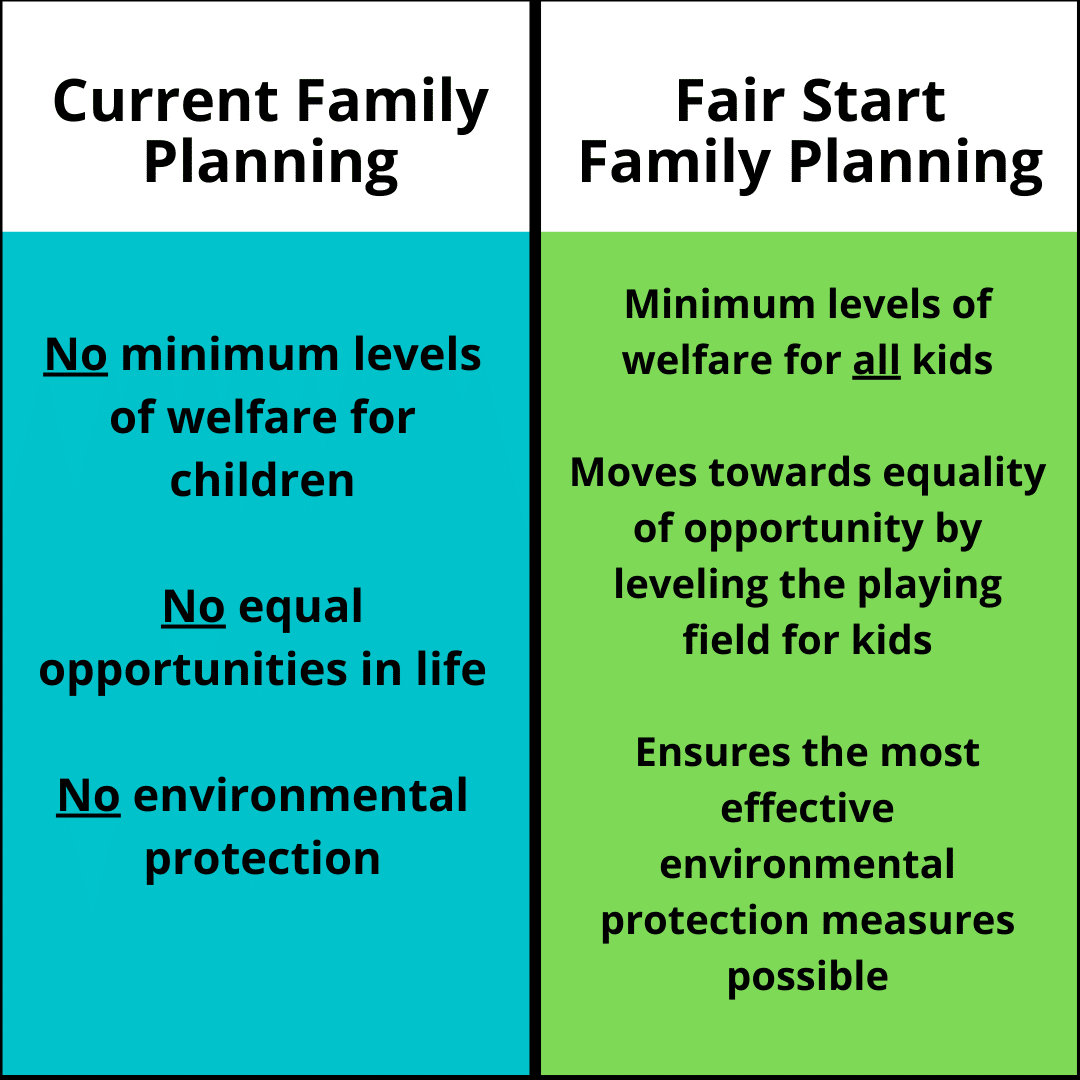
    A comparison chart of Current Family Planning vs. Fair Start Family Planning. The left side lists negatives of current planning; the right side highlights positive outcomes of fair start planning for welfare, equality, and environmental protection.