As evidence mounts that the January 6th riot at the U.S. Capitol was an orchestrated attempt to subvert democracy, one obvious question is how to reverse whatever process made Trump’s attempt possible. At base, what made it possible was an extreme concentration of wealth and power, combined with a large group of supporters who were susceptible to his influence.
No solution is sufficient if it does not address that problem, by fundamentally limiting and decentralizing power into future generations through Fair Start wealth transfers/empowerment. Other fixes just move the problem around. The real fix is to take down pyramidic power schemes, the kind that created Trump.
TAKE ACTION: Real democracy is about empowering people, bottom up. The long run fix for the degrading of our democracies is a universal family planning system that builds town halls, not Trump-owned shopping malls. Urge the United Nations to act, then lawfully engage a wealthy family with Fair Start demands and let us tell your story.
Harvard President Larry Bacow says that Harvard is committed to confronting the climate crisis. Harvard fundamentally built its wealth and prestige on an unsustainable system of growth – family policies – that externalized their costs on others and did nothing to protect nature from the Anthropocene. Is Harvard reversing its position on those family policies? Is it employing a restorative standard for climate mitigation? It is pointing the world towards optimality, or growth that will multiply unforeseen threats – the very thing that happened with greenhouse gasses?
If Harvard is not changing course on family policies Bacow’s statements are misleading, with growth remaining the fundamental driver of the crisis. You cannot make any claim of a policy impact that does not start with, and become fundamentally contingent upon, people and the family policies that create them. And in a democracy, those people – comprised as relatively self-determining – are the baseline to assess costs and benefits.
The same questions can be raised with Harvard’s recent purported commitments to racial justice, child welfare, animal rights, or human rights and democracy. Is it embracing redistributive policies that eliminate the massive birth-wealth gap between black and white children? Does it apply the Children’s Rights Convention as a standard for family planning? What is it doing to prevent our species from overrunning and eliminating others? Growth and inequity have ensured the average person will have little if any impact on their systems of governance. Is Harvard reversing that process?
Quietly undoing downstream fixes with upstream anthropocentric growth and birth inequity is disingenuous, has concentrated power in a few, and foisted social and ecological costs on others. Harvard is one of those concentrations. The family policies it tacitly accepts, which pretend that our social and ecological positions are a matter of some magic fortune, are the fundamental source of injustice. The greatest act of justice, for the vast majority who will live in the future, means recovering those costs and using the wealth to plan just and sustainable families where power is physically limited and decentralized.
Urge Larry Bacow to tell us all the truth about these matters. Contact him here:
617 495 1502 Email: president@harvard.edu
We cannot afford to lose ground on these issues having missed the fundamental driver and allow concentrations of wealth and power to use people to further exacerbate power differentials.
“Behind Elon Musk’s blather about free markets, free speech, and free choice is his goal to be free from accountability,” Robert Reich warns. Like the actions of fellow billionaire Trump, this move to influence the public with false claims and dangerous propaganda threatens democracy. So what does this have to do with a fair start in life? A lot. Unjust birth conditions are the root of inequality. That inequality allows unjust wealth to flow to the hands of a few. When we ensure equity from birth, we build communities where voices are equal and democracy is truly exercised.
In honor of Earth Day 2022, we at the Fair Start Movement encourage ExxonMobil to include every child’s human right to a Fair Start as part of its commitment to meet standards set out in the Paris Agreement.
To the leadership of ExxonMobil,
We members of the Fair Start Movement, on this Earth Day, April 22, 2022, write to inform ExxonMobil of an oversight in your commendable efforts toward sustainability.
You must amend your policy in order to acknowledge the needs and rights of future human generations. Policies that ignore critical factors such as family planning and universal basic human rights will fail. All of us are locked in a global struggle to ensure the existence of our species.
We implore ExxonMobil to take into account the environmental impacts of humankind. Too many children today are born unwanted, into poverty, famine, or war. Our approach to offer a Fair Start to every child born on Earth will ensure that these conditions will be eliminated moving into the future.
We demand that ExxonMobil allocate funds to support restorative ecological policies that acknowledge and actively promote the primary and overriding human right to an ecosocial Fair Start for every child born today and tomorrow.
Fundamental change starts with family policy.
By supporting our and our allies’ initiatives, ExxonMobil will begin to substantively repair damage done by its historical environmental misconduct. You will truly become part of the solution by sustaining and protecting humanity.
Will you commit today, in honor of Earth Day, to right past wrongs? Will you catapult forward the global effort to survive? Will you join our movement’s efforts to ensure every child’s right to a Fair Start?
Earth Day 2022: Exxon Should Pay Reparations for the Climate Crisis That Physically Create Just and Sustainable Communities Through Family Planning Investments
In Exxon’s public commitment to address the climate crisis, the company uses a particular ecological goal or baseline for its risk assessments and climate mitigation strategy that – compliance aside – is at least comparable to the goals of the Paris Climate Accord. While we focus on Exxon in this letter, to be clear, the logic applies to many companies and well beyond the energy sector.
FSM was formed because these goals or baselines are premised on an error. They were developed based on the assumption that nations operate from a place of historical political legitimacy, and can themselves freely define ecological goals, including anthropocentric ones like those of the Paris Accord. That assumption is incorrect. As recent peer-reviewed research shows, nations are constituting, not constituted in the past, and they are either doing so legitimately or not depending on their family policies. Nations cannot simply declare their legitimacy. Legitimacy is a political ideal based relative self-determination that would require, again minimally, that all children enjoy the ecosocial birth and development conditions required by the Children’s Rights Convention.
Resolving this baseline error involves treating legitimacy as contingent on our ongoing fulfillment of our obligations to future generations.
In other words, to properly assess costs and benefits we have to first become groups of people capable of doing so in a way that is actually inclusive and reflective of the group constituents. This is simply the ideal of the “we,” in “We the People.” The ideal political we, meaning fundamental power relations defined by the goals of the Children’s Convention, is the primary baseline. We cannot think of, or describe, an ecological outcome that is not first contingent upon family planning outcomes, on at least five levels.
If we value human self-determination or freedom, we have to begin from an ecocentric – rather than anthropocentric – baseline, because that makes relative self-determination possible, freeing us from the influences of others, including the harmful impacts of even the current rise in global temperature. Humans cannot self-determine when their childhood development is defined by the pollution of others. Moreover, climate goals cannot be limited to ecological outcomes, but should include changes in family policy that maximize the resilience, equity, and democratic cooperability of future generations to thrive despite the crisis. Our creation is the intersection of our values.
In other words, if we correct the error described above, the correct goal or baseline must entail our becoming democratic and legitimate groups of free and equal people, which requires concrete and specific restorative ecological policies much more aggressive than the Paris Accord, redistributive and equalizing family planning reforms that recognize the right to nature and level the playing field for all kids, financially and ecologically. A simple litmus test, given these standards, for our being free and equal persons involves whether we first treat the capacity for each person’s self-determination as directly inverse to population growth, relative to a neutral baseline such as the nonhuman world. This is proof that each person is politically, and equally, empowered. Not treating growth as such calls into question the true role of citizens in their own democracy.
We cannot assign property rights in ways that undercut physically constituting and democratically empowering future generations. Our being, and in this case becoming, positioned to determine costs and benefits in a way that is inclusive of the reasoned views of all, is the first baseline.
Again, we can refer to this helpful summary of the baseline problem. All of the solutions to the problem Professor Solum gives jump to what we should do rather than who we should be, and thus ignore the need to be fair people, in terms of the physical power relations determined by our creation, before we can be positioned/empowered to make fair rules/laws. Ideally we would be created/grouped to look like a functional Rawlsian constitutional convention before fundamentally assessing costs and benefits, hence our being an ideal “We the People,” is the first baseline. And for that, the minimal guidelines that would apply to family planning would be the standards we hold up for extant persons, like parental fitness, the Children’s Convention, equality of opportunity, restoration-based climate sequestration targets, biodiversity restoration targets, historic voter-representative ratios, etc. Those point us towards the UN low-variant population, something aggressive family planning incentives – funded with claims to wealth at the top of the economic pyramid – could practically help achieve.
We are writing in the spirit of Earth Day 2022 to urge Exxon to embrace the specific restorative ecological policies described above as the part of the first and overriding human right to a Fair Start in life, and to commit some share of its wealth and resources as Fair Start planning reparations to offset the harm it has done to future generations, relative to baseline discussed above. Exxon could easily practice this change by supporting the child tax credit reforms linked above, while treating them as a fundamental human right.
This is not about liberal or conservative politics. Family planning redistributions – as primary obligations – can replace wasteful tax obligations that would simply create larger governments which do not reflect the will of the people. This is about a commitment to human freedom and equality of opportunity, enabled by policies that ensure children can develop and physically comprise communities that liberate them from the threats they face today. This is something we all should value. Correcting the baseline error described above enables such a future.
Please let us know if Exxon will commit to these changes.
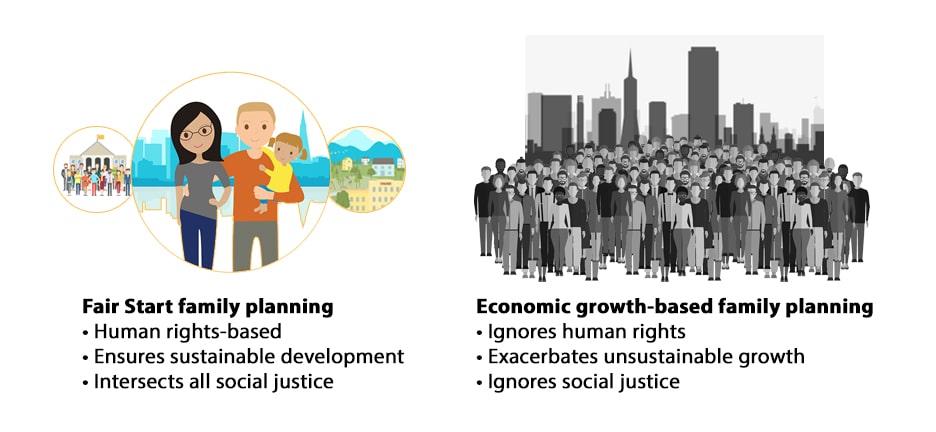
All of the crises we face today stem, fundamentally, from family planning systems that violate human rights regimes by ignoring children’s rights under the Children’s Rights Convention, including the right to a meaningful voice in democracies surrounded by a safe and biodiverse natural world.
To engage in true human rights and bend the arc of population growth towards justice, many are speaking out about the obligation of wealthy and powerful families to take action. Megan Markle recently spoke out.
Estamos escrevendo para pedir que pudessem ser a voz em apoio aos direitos de todas as crianças a um movimento ecossocial Fair Start na vida, justo primeiro e primordial de direitos humanos.
You and 2.5 billion other people likely used one of Unilever’s products today. Unilever is the powerhouse behind more than a thousand household brand names sold globally, including Lipton, Breyer’s, Ben & Jerry’s, Vaseline, and Suave.
In 2013 Unilever launched “Project Sunlight” for “a bright future” – a slick, feel-good campaign to convince couples that the solution to the world’s crises is to bring more children into the world. Watch this video the company produced, and carefully examine the family planning messaging in the mommy blogs the company sponsors.
Unilever claims to support the UN’s global goals and sustainable development. Why then does it encourage would-be parents to ignore environmental and other concerns when planning their families?The company relies on unsustainable growth and higher fertility rates to sell its products, including its worldwide line of baby products under brands like Dove.
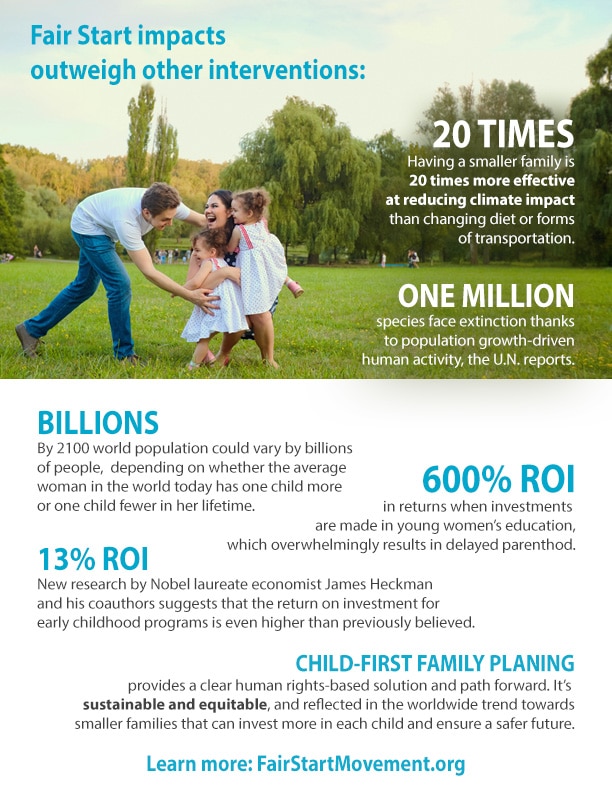
Population growth and the consumerism that comes with it is one of the main drivers of climate change, pollution, inequality, and other societal crises. South Africa is weeks away from running out of drinkable water. Our world’s problems require sustainable solutions and a collective approach to sustainable development. That starts with smarter family planning for more sustainable families; not the reckless pronatalism being promoted by Unilever to create more consumers for their products.
Rather than encouraging parents to ignore their concerns and just have kids, Unilever must exercise its corporate responsibility to encourage sustainable family planning.
Tweet Unilever CEO Paul Polman at @PaulPolman and politely suggest the following: Please promote smaller, more sustainable families as part of your #brightfuture campaign.
Factory farming and every other animal and environmental crisis is fundamentally driven by human population growth. While Peter Singer is often credited with advancing the philosophy of animal rights, Paul Ehrlich probably did more to actually mitigate animal suffering and extinction through his influential work to slow population growth. Animal liberation, ours and nonhuman, begins with a family planning ethic that promotes sustainable and more equitable families who build empathy and fluid democracy in future generations. It’s not whether we talk about animal rights — it’s how we actually influence nonhumans and their worlds.
Learn more about why social justice for all starts with family planning reform and urge Editor Lauren Williams (@laurenwilliams) and Ezra Klein (@ezraklein) to support Fair Start sustainable family planning policies, and to stop pushing women to have kids.
Solving the biggest problems we face, from the climate crisis to growing inequality, requires effective action. There is no way to be truly effective without planning ahead and adopting family planning policies that invest more in kids and restore nature. Here are some vital questions to ask groups you might be supporting:
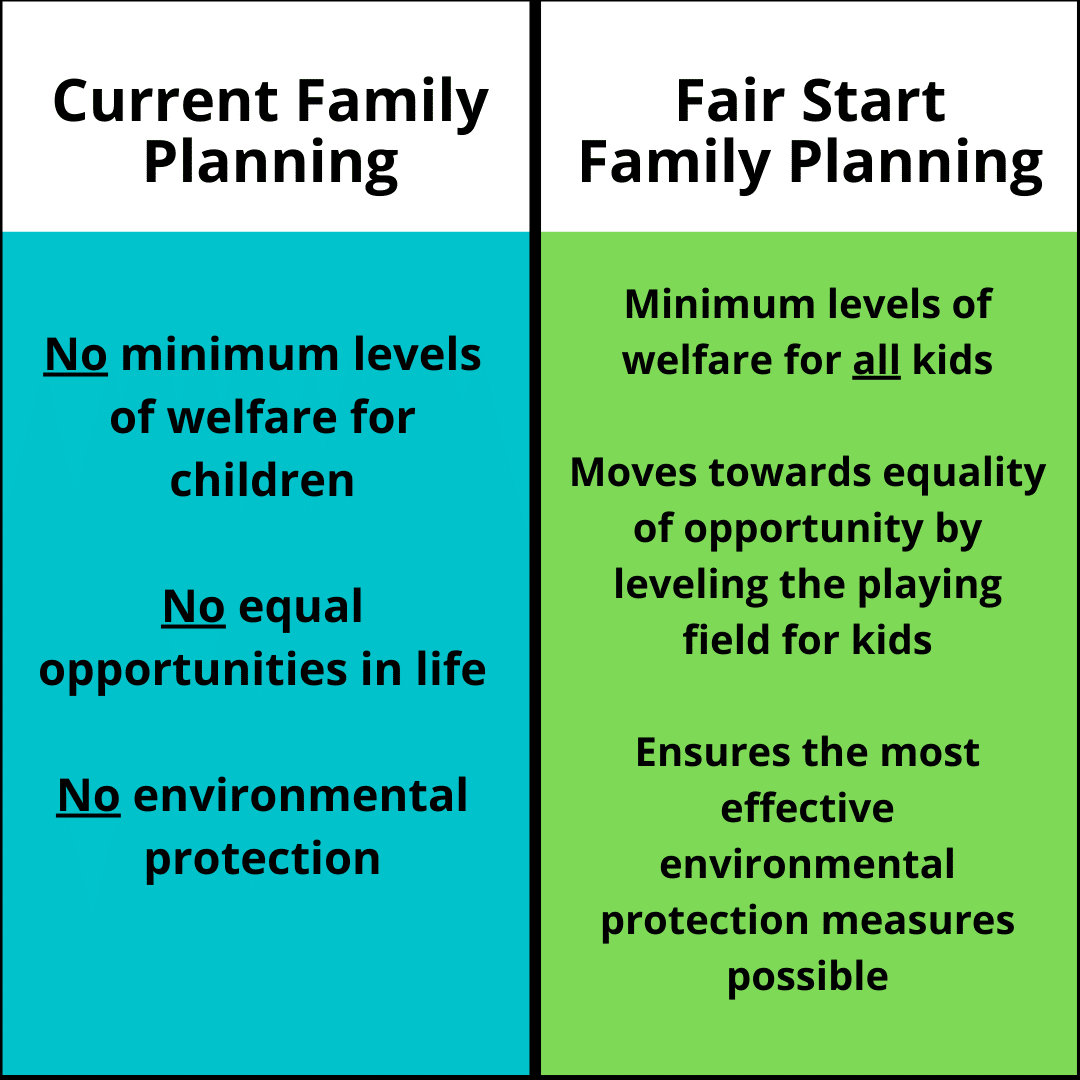
If you support a child welfare organization: Does it urge communities and parents to ensure minimum levels of welfare for kids, before they are born, in order to avoid less effective interventions later in life?
If you support an environmental or animal protection organization: Does it promote sustainable families, by far the most effective way to ensure a healthy environment, biodiversity, and less animal suffering?
If you support social justice organizations working on racial, economic, gender, or other forms of equality: Do they promote family planning policies that a) level the playing field for all kids so that they truly have equal opportunities In life, and b) advance gender equity by eliminating all forms of pronatalism, or pushing people to have kids?
If you support organizations promoting human rights and democracy: Do they promote family planning policies that will ensure each person has an effective voice in their political systems and is not lost in the crowd?
In addition to considering organizations’ current approaches, find out how organizations have historically approached policies for how we should plan our families, and how those positions impacted social and ecological conditions in the world today.