What happened in Atlanta is acute, but not isolated. While many organizations, including Having Kids, condemn these acts it’s crucial to find a grounded solution beyond the fleeting reactions of politicians.
Here is one long-run fix. If racism – and most “isms” – fundamentally arise from humans’ tendency to “other” and degrade people that are not part of their in-group, we need ways to make groups of people more inclusive. Historically government has tried to do that by eliminating formal discrimination, like laws that treated certain races as inferior. This had limited effect. More recently, efforts have focused on structural racism beyond the laws, like changing the way language and other representations can reinforce beliefs about racial inferiority.
Can we go further?
Whether we are part of an in-group, how we perceive others to be related to that group, whether we are really in that group in terms of having an influential voice, etc. – all of these things fundamentally rely on our creation and the family planning norms that determine it. What if instead of ignoring how parents create future generations, we designed systems so that everyone belonged and had a voice? That might work better than simply creating lots of people, jamming them into outdated and massive nation states to maximize economic growth, and simply hoping for good social outcomes that will not happen.
We can fix this. Help Having Kids create truly inclusive communities where we all belong. Take action.
Today is International Women’s Day, but for many women around the world there is little reason to celebrate. Constant discrimination is bad enough, but women are also subject to incredible violence throughout the world and in every aspect of their lives.
If we are serious about elevating women, we won’t just change what we are doing in the short term, but will also focus on changing who we are as people. We will become a people incapable of the atrocities we commit today. Good family planning and parenting play a massive role in that betterment. It’s the change that really matters. But it will take reforms at the highest levels of governance to make the real change happen.
Right now both the United Nations and the Biden administration are failing miserably in this process, and instead of developing future generations around an ethic of care that would protect women, both remain locked in an antiquated and patriarchal system that pushes women to have children in order to grow economies. The systems they use isolate families and subject women to the promise of familial autonomy, which in the reality of our world becomes a license for men to simply subjugate them in private. The parent-focused (read men-focused) family planning policies guarantee future children no levels of wellbeing, no equal opportunities in life, no safe and natural environment, and no real and effective voice in their democracies.
We can help all women, now and all those who will live in the future, by treating every child’s right to an ecologically and socially fair start in life as the overriding human right, and switching to a child-focused form of family planning.
Take action: Urge the United Nations, and the Biden administration, to finally embrace the fact that every child has a right to a Fair Start in life. We will use their own children a benchmarks for what fairness means as we begin to fight for the rights of the most vulnerable.
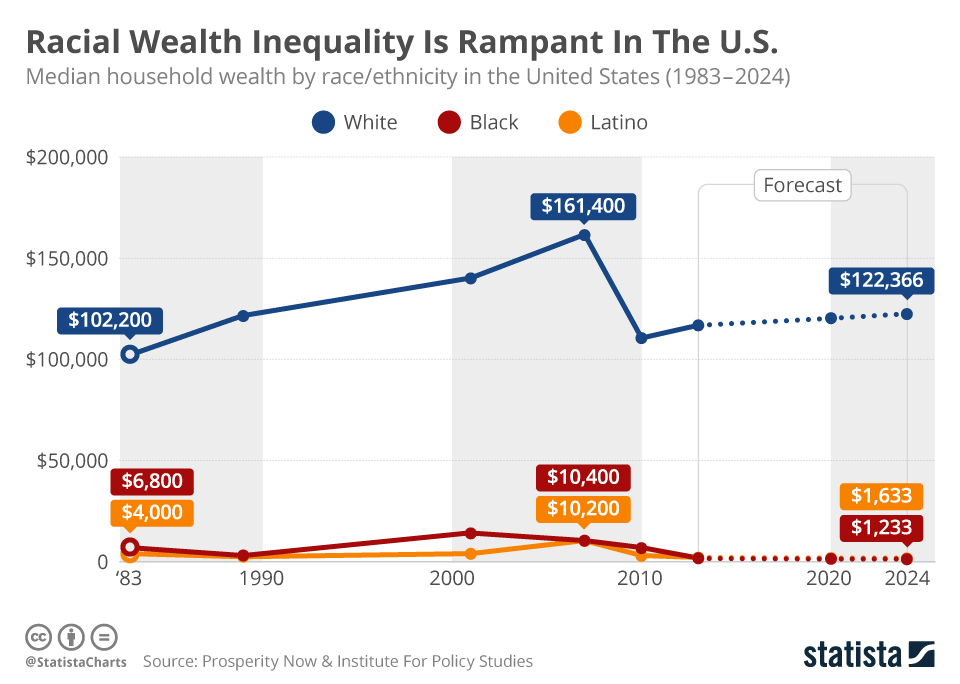
It’s true that many policies that have been promoted under the banner of an attack on systemic racism have – by the accounts from empirical scholars of all political leanings – utterly failed. But is Steele missing the foundational issue that makes any allegation of systemic racism true, regardless of what policies we put forth to eliminate it? Black children, and children of color more generally, are poor – in the extreme – relative to white children.
We cannot coherently talk about racism and policy at all without addressing the core issue – our failure to give all kids a fair start in life – and the specific family planning and redistribution reforms that could actually reverse that failure.
Take action: Every child has a fundamental human right to a #fairstart in life. It is the first human right, the one that makes us free and equal people, and as such it overrides all competing interests. Urge Congress to begin to recognize and legislate around the right.
Earlier this month, The New York Times published an article that made us feminists shake in our boots. “The crisis seems to be cementing traditional gender roles,” the piece read. A poll for the Times found that women with families are bearing the brunt of the increased workload due to coronavirus stay-at-home measures. Even if women earn more than their husbands, the responsibility of housework, childcare, or distance learning for their school-age children tends to fall upon the mother.
Unfortunately, it may not come as a surprise to many that women in opposite-sex partnerships often disproportionately shoulder certain loads within the partnership. As an example, this has been happening with our bodies in the realm of family planning for millennia.
The Coronavirus and Inequality
Given that May is the month back in 1968 that the U.N. declared family planning a human right, it seems fitting to shine light on an opportunity before American society to drill away at outdated gender roles. It’s also an opportunity to tackle the socioeconomic inequality we’ve witnessed the coronavirus expose.
The opportunity I’m referring to lies in male contraceptives. The challenges around gender parity and socioeconomic inequality that are now staring us in the face amid this pandemic are exactly why Having Kids is calling upon Congress and the National Institute of Health to prioritize the research, development, and deployment of the male pill and other long-acting, reversible male contraceptives — or “LARCs,” for short.
Male Birth Control and Greater Equality
How can LARCs address such longstanding problems so deeply embedded within our society?
Research shows that smaller families benefit children and that the economic disadvantage correlated with the alternative tends to perpetuate a greater divide between those with and without. Still, we see the U.S. tax system incentivizing larger families, though incentivizing pregnancy delay may better set up women and future generations for greater equality.
Since family planning was declared a human right five decades ago, women have made great strides in terms of physical and economic well-being. Still, nearly half of pregnancies in the U.S. today are unintended, which costs taxpayers $15 billion annually. In a few short months, the COVID-19 pandemic has made family planning even more difficult due to lack of access to contraceptives and to reproductive healthcare.
While the discussion around family planning often centers on abortion, it should go without saying in today’s politically polarized America that any solution propelling us forward — while side-stepping partisan hot spots — should be a no-brainer. This should be baseline territory. Pre-fertilization forms of birth control, a category into which male contraception falls nicely, show promise to be excellent candidates for building bridges across the political aisle. Unfortunately, apart from the “pullout” method and abstinence, women in the U.S. currently have over a dozen options for pregnancy prevention while men have only two: condoms and vasectomies.
Why Men Should Take Larger Role in Family Planning
Recent studies show that American men want the ability to use their bodies to further participate in their right to family planning. While vestiges of a more sexist yesteryear set speed bumps on the track toward deploying more viable male options, we’re incredibly close to breakthroughs in the field, and this is no time to let up on the gas pedal. If fully tested and approved in the U.S., LARC options like RISUG and Contraline could empower men to share more equally in family planning through leveraging their own bodies, helping reverse the trend of traditional gender roles being “cemented.” Our friends at the Male Contraceptive Initiative have outlined several others.
Again, men want more options to play a larger role in family planning. We women — certainly in our new, less certain reality when fewer couples are opting to get pregnant — could use the support. Ultimately, when communities and parents cooperatively embrace better family planning, we can invest more in every child and create the future we all deserve.
For these reasons, we at Having Kids call upon the National Institute of Health and U.S. Sen. Rand Paul and U.S. Rep. Anna Eshoo — chairpeople of congressional committees on health that oversee family planning matters — to increase funding for the research and development of male contraceptives.
A variety of safe, commonsense, accessible options, along with communities and parents cooperatively embracing better family planning, are key to providing coming generations the future they deserve. Male LARCs would serve as a huge step forward in getting us there.
Erika Mathews is the executive director of Having Kids, a U.S.-based non-profit organization dedicated to raising awareness for The Fair Start Model, a human rights-based, child-focused approach to family planning. Erika holds a bachelor’s degree in English/Journalism and German from Rutgers University.
Twenty-one year old reality tv heiress Kylie Jenner has been called a “self-made” billionaire by Forbes Magazine. Given the wealthy family in which she was born and other massive unearned privileges, many are laughing at that claim. The key to being rich is being born rich, as evidenced by the lavish #StormiWorld amusement park party in which her one year old received her first Chanel purse.
Tweet Kylie at @KylieJenner, and urge her to give a child in a need a fair start, relative to her start in life.
Source: David Leonhardt, NY Times
Climate change is now exacerbating this inequity as it disproportionately affects impoverished communities and drives up the painful costs of being poor. Is the playing field so slanted that it’s finally time to take bottom-up direct action to level it?
Solutions like the Green New Deal fall short for the same reasons that all other new reforms fall short. They make the same mistake we have made for centuries – by failing to see the responsibility we have to future generations. This is not some abstract duty – it involves ensuring every child born a fair start in life. But we have made, and continue to make, that mistake in part because of built-in cognitive biases against long-term (and especially effective) planning. Those biases blocked thoughtful, sustainable, and cooperative family planning that – had it been instituted decades ago – would have prevented the climate change, massive inequality, and failing child welfare systems that threaten us today.
All of this stems from the fact that our understanding of the social contract that legitimates our system of government is deeply flawed. How does it account for the fact that United States, through its climate change policies, has become a national security threat to itself? Our social contract is only valid to the extent it ensures we remain free and equal people. That includes preventing the dystopian future of a degraded environment, massive inequality, a weaker voice in democracy, and the consolidation of power of the few over the many – the path on which we are heading.
What then are we doing to protect those future generations, today?
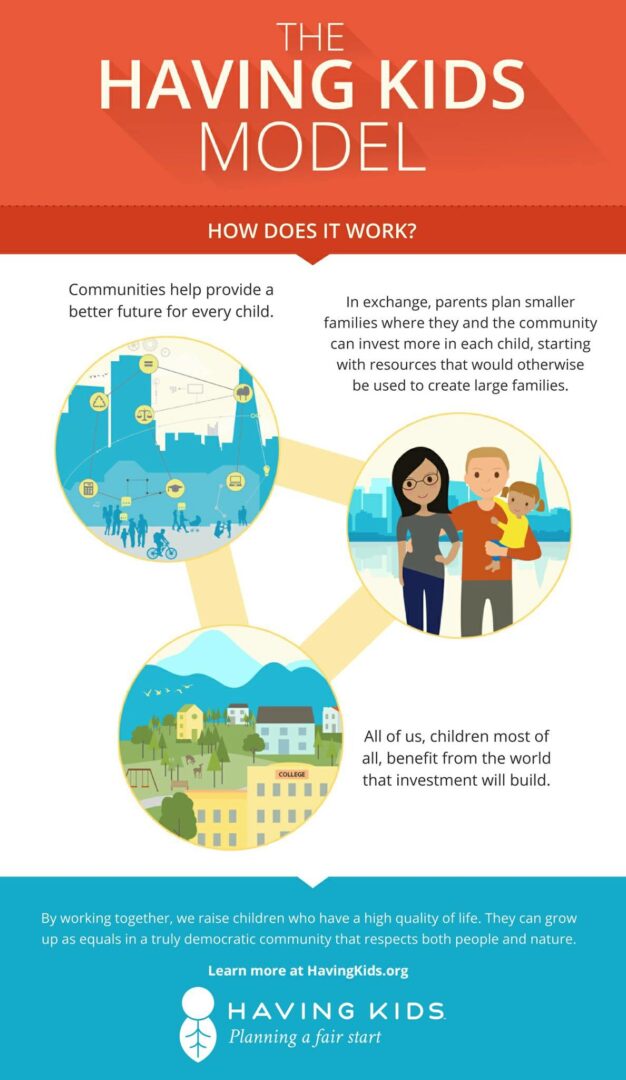
The Fair Start family planning model, corrects that shortsightedness and legitimates the social contract by putting children’s interests first. It does so by making the beginning of the social contract a simple two part agreement: Communities ensure that parents have the resources to plan families and guarantee that all kids have the resources they need for a fair start in life. And parents delay having kids, and have small, sustainable families that put less demand on our shared resources and our world.
That agreement creates the first term of the social contract – the first human right, the “we” in “We the People”. It creates an ecologically sustainable (if not regenerative) society of people who receive a fair start in life. It builds human rights-based democracies from the ground up by ensuring all kids get what they need growing up, or a truly level playing field, and is simultaneously the most effective way to mitigate the threat of climate change and other environmental crises. It is, hands down, the most effective way, to protect kids, animals and the environment.
Unlike the current version of the Green New Deal, the real deal of child-first Fair Start planning appeals to the ideals of the most thoughtful conservatives and libertarians, as well as liberals. The model recognizes that 1) long-term planning and ensuring the actual development of each child is the most effective way to addresses our greatest threats, 2) that both Big Wealth and Big Government have utterly failed their obligations to ensure that development, and 3) that the assets of both should would best be redirected – by the people – towards Fair Start funds, in an override of any claims people like Kylie might have to unlimited wealth, as well as any obligation to pay tax dollars that may simply be wasted. That’s the real deal – one between us and future generations to build democracy from the ground up – out of the actual people that will comprise it.
Non-partisanship aside, this is key: Because Fair Start family planning is lexically prior to all other rights in the social contract (the first term), it overrides anything with which it conflicts. We are before we do. All kids have a fundamental human right to a fair start in life – which can be secured by any means effective. What does all of this mean? The right to a fair start in life, as the first human right, overrides both private property rights and tax obligations. The Fair Start model is a non-partisan real deal for conservatives and liberals to both make concessions. Big wealth and big government both need to decentralize influence and use resources to empower future generations and make them resilient.
Our world, and future, is defined by the people in it. But they are mostly defined by the conditions in which they were born and raised. Fair Start family planning ensures that all kids have the resources they need for a fair start – not a head start for a few, like Kylie. Fair Start family planning is a real deal – focusing on the creation of future generations, and it should be the foundation of modern attempts to revise the social contract, like the Green New Deal.
What would you do to protect future generations and ensure they get what they need? What have prior generations sacrificed to protect us, and ensure our freedom? Could the resources of the elite be put to the best use preventing climate change through the most effective means possible – better family planning? The ground to encourage and ensure Fair Start family planning lies everywhere in this country. Every person is a potential freedom fighter to create a real social contract. Kylie, and especially those bad actors like Exxon that have profited from creating the threat of climate change, should not underestimate what parents will do to protect their kids once they learn to question the legitimacy of unlimited property rights and other unquestionables that the elite take for granted.
Someone like Kylie, who has colossal influence should openly endorse better family planning to help ensure other kids a fair start in life relative to her own and her daughter’s. Furthermore, the taxes that she and the rest of the ultra-rich are paying could be partially shifted into Fair Start funds. Ensuring all kids a fair start in life should not be a morally controversial thing. Together we can work together to make it happen – a much preferable scenario to the alternative.
Thanksgiving is not about turkey and football. For thoughtful and caring people, it goes much further, and is tied to the American ideal of democracy.
In 1896, Abraham Lincoln made the Thanksgiving proclamation to a weary country, divided by civil war, with the fate of the democracy in peril. Many believe that the purpose of the Mayflower Compact was to protect the liberty of dissenters from the tyranny of those in power. These and many other points in history remind us why Thanksgiving is a good opportunity to reflect on democracy. One recent attempt to reset our system to the ideal was the Occupy Movement. It has been described as:
[A]n international progressive, socio-political movement against social and economic inequality and the lack of real democracy around the world. It aimed primarily to advance social and economic justice and new forms of democracy. The movement had many different scopes; local groups often had different focuses, but among the movement’s prime concerns were how large corporations (and the global financial system) control the world in a way that disproportionately benefited a minority, undermined democracy, and was unstable.
The movement has been criticized for lack of a centralizing vision, and specific demands for changes in policy. Could it have taken a longer-term view of change, one related to family planning?
Democracy relies on a fundamental premise: That societies form, and remain legitimate, through the consensual coming together of free and equal people. The reason is simple. How else would you justify the authority of the state, and government?
Here’s the thing. For many centuries that premise was thought to apply to the people alive at the time, adults who could choose – as free and equals – to enter and leave societies and nations as they pleased. But that static view of freedom and equality is riddled with problems. The idea of “coming together as free and equals” works much better if we think of it in terms of planning for future generations, and what it would mean if we apply it to them. Thanks to modern contraception, reduced infant mortality, the (too slow) recession of religious and other forms of oppressive patriarchal families, and about a dozen other things, we can now do that. We can make democracy inter-generational, and realize it in ways it’s not easy to imagine in today’s world, where democracy is virtually meaningless.
The child-first Fair Start family planning model does just that.
It’s simple: Parents plan a fair start in life for their kids. Communities, in exchange, help fund that start – proportional to need. Parents and communities both promote an ethic of smaller families to make the whole thing work, and to free us from crowded societies where the average person’s voice is lost in the crowd and does not matter, where people live in fear of one another, where they are not raised to run their own democracies, and where the freedom and security of nature is disappearing every day, etc.
There is a massive gap between indigenous and non-indigenous communities in Australia when it comes to things like healthcare, education, and employment. (These graphics from The Economist demonstrate the disparity visually.) And despite years of policies designed to close the gap, a recent study shows there has been little progress. Why not?
Gap-closing initiatives often ignore the disproportionate influence thatearly childhood has on quality of health, well-being, learning, and behavior across a child’s life. The Having Kids model increases the focus on early childhood by redirecting the resources being used to create larger families towards improving the birth conditions of each child. By working together, we can close the gap for good.
Almost all modern political systems share at least one guiding principle: that the people within them should be born free and equal. Ensuring that equality — a fair start for all people — is required to legitimize those systems.
So, how are our political systems doing these days, in terms of their legitimacy?
What’s the solution? Oxfam was right to call for more aggressive tax enforcement and investment in public services. But they missed perhaps the most compelling rationale for that enforcement and plan for that investment: Giving every child a fair start in life. The Having Kids model can help.